Six beds · voluntary re-entry greenhouse
Re-Enter Dating With Faith and Choice—Not a Recovery Deadline
A faith-led career guide to dating after heartbreak: use a re-entry greenhouse, protect work, keep community invited, and make safety and consent explicit.
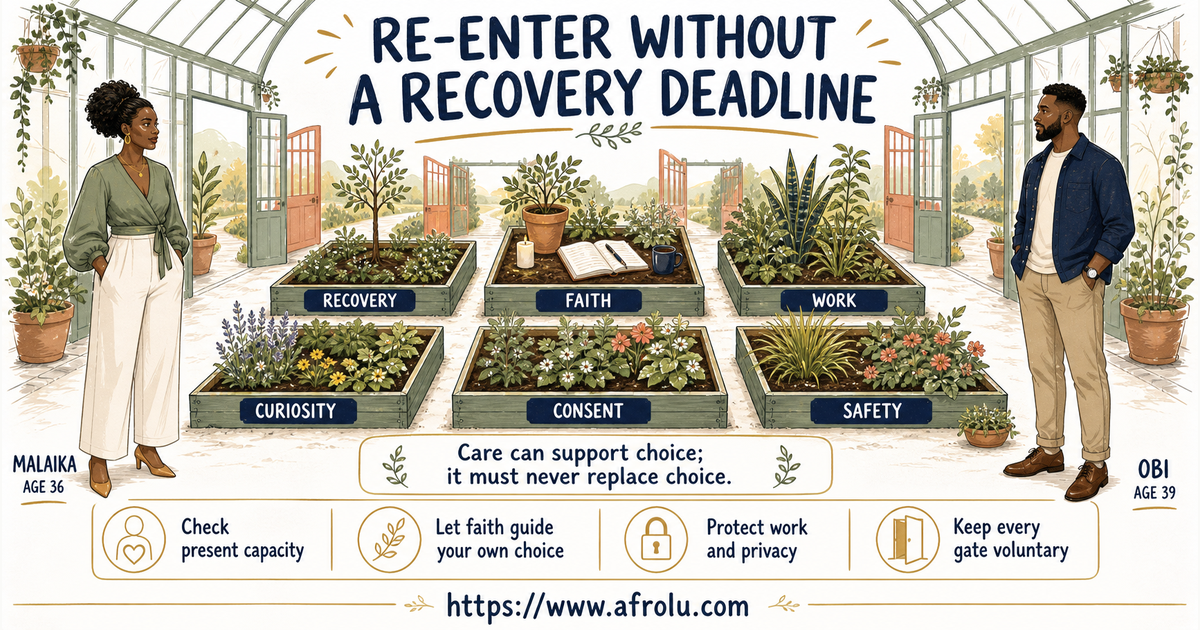
A greenhouse can offer care; it cannot order a person to bloom by a date.
Written and edited by Samira Benali · Faith and North Africa Editor
Use six separate beds: RECOVERY, FAITH, WORK, CURIOSITY, CONSENT and SAFETY. Choose one reversible action rather than proving you are healed. Let faith guide your conduct, invite community counsel only with clear purpose and privacy, and protect career blocks. Shared belief, an enjoyable date or an adviser's opinion creates no status or consent. Continue, grow slowly, redesign, pause or close. Seek qualified local care for lasting impairment and direct help for coercion or danger.
Starting over · Faith-Led Daters
How can a faith-led adult explore dating after heartbreak while rejecting recovery deadlines, protecting career capacity and ensuring that belief or community never overrides consent?
Dating after heartbreak is a voluntary return to romantic discovery after a meaningful ending while grief, relief, comparison, faith questions, career strain and curiosity may coexist. There is no universal recovery deadline. The greenhouse separates current capacity from values, work, interest, consent and safety; it cannot certify healing, diagnose a rebound, issue theology or predict a relationship.
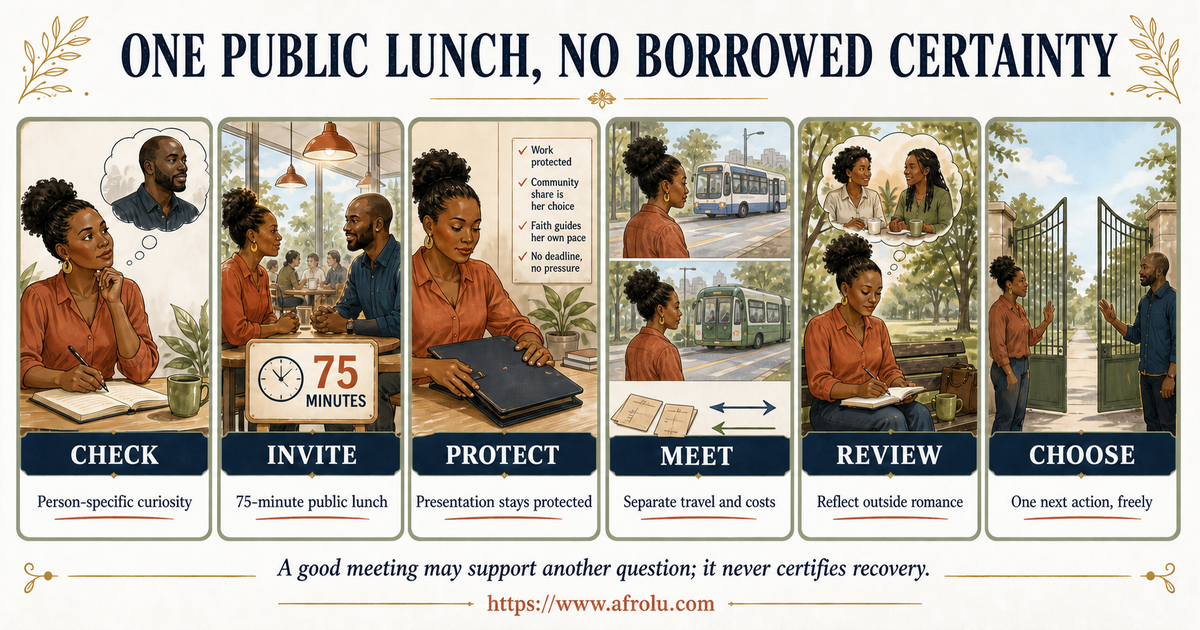
Malaika, 36, chooses one seventy-five-minute public lunch with Obi, 39, while protecting a major presentation. The fictional faith-led adults keep community disclosure, travel, ordinary costs, affection and future plans separate. Malaika later feels both warmth and sadness, then considers another date without treating that mix—or the story's timing—as a healing rule.
The faith-led career re-entry greenhouse
Tend recovery, meaning and work while every consent gate remains voluntary
Samira replaces the recovery finish line with six independent beds and an open walkway for pause, care, closure or another small date.
Review present capacity, keep conviction personal, invite community deliberately, protect work and route pressure to the right gate.
Remove the deadline
A feeling may inform today without sentencing the whole journey.
Keep conviction personal
Faith guides one adult and never supplies another adult's consent.
Invite the circle
Community enters through purpose, privacy and permission.
Protect the gate
Work, health, money, intimacy and exit remain independently controlled.
Recovery is not an appointment you miss
Replace the healing deadline with one present-tense choice
Dating after heartbreak does not begin on a universal day. The end of a relationship can bring sadness, relief, anger, doubt, practical disruption or several of these at once. Feelings may return without following a tidy order. Readiness is therefore not a certificate. Ask whether one current action is wanted, honest, leaveable and small enough for the life you have today.
Faith may give an adult language for grief, hope, values and community. It can shape that adult's own dating boundaries. It cannot announce what another person must feel, require a relationship, disclose private history or transform silence into consent. A sincere belief and another adult's no can exist together. Neither relatives nor faith leaders receive the missing vote.
Career life has its own conditions. A presentation, shift, search for work or season of heavy responsibility may reduce dating capacity. That is useful information, not evidence of spiritual failure or emotional unavailability. You can protect the work block, choose a smaller date, delay a reply or pause. Do not promise future access as repayment for being busy now.
Keep safety outside the healing debate. Pressure to share passwords, money, health details, images, location, home, work or physical access is not a growth exercise. Threats, tracking, forced disclosure and blocked movement need direct protection. When safe, ordinary mismatch can receive a kind close; risk may require blocking, documentation and suitable local professional or emergency help.
Six beds that do not grow at one speed
Keep recovery, faith, work, curiosity, consent and safety independent
RECOVERY asks what feelings, practical ties and support are present now. It does not ask whether every memory has vanished. A difficult evening may need rest while a later coffee still feels welcome. Support should exist beyond a new match, because a date cannot serve as therapist, proof of worth or replacement for the relationship that ended.
FAITH asks what personal practice or value helps you choose freely. It may include private reflection or counsel that you invited. WORK asks what time, focus, reputation and private information must stay protected. Neither bed can order another adult's status. Shared values do not create exclusivity, future promises, physical access or permission to involve a community.
CURIOSITY asks whether interest concerns this person's actual words and conduct, not only the comfort of being wanted. You may notice comparison without making the new adult compete with an ex. A bounded public date can answer a small question. It does not need to prove that you are healed, faithful, desirable or ready for a whole partnership.
CONSENT keeps messages, community disclosure, affection, images, touch, sex and future plans separate. SAFETY protects identity, personal data, money, travel, home, workplace and exit. Both remain active even when a meeting feels meaningful. Revisit the six beds when facts change, not because a community calendar or romantic promise says growth should have happened by now.
Let community be invited support, not conscription
Keep counsel confidential, voluntary and outside the other adult's consent
Some adults want a trusted relative, friend, counsellor or faith leader beside them during re-entry. Others want the dating decision private. Both can be responsible choices. Ask what you want from counsel: comfort, a practical perspective, safeguarding or help stating a value. Choose someone who can keep confidence and respect that the other adult is not present for judgement.
Do not recruit a community to investigate a match, deliver a romantic message, announce courtship or persuade someone after a no. A leader may explain a tradition to the person who requested advice. They cannot create consent for dating, sex, marriage, money, travel or disclosure. Obi does not owe Malaika's adviser a meeting, and Malaika does not owe Obi's circle an account of her past.
Watch for belief language used as leverage: destiny claims, warnings that a boundary shows weak faith, threats of public shame or demands to obey a leader you did not choose. Ordinary disagreement allows both adults to leave. Pressure that narrows movement, work, money, communication or safety belongs with independent informed help, not a larger community meeting that may increase access.
Community can still be a practical source of care. A trusted person might know the public meeting plan, check in afterward or help someone reach qualified care. The person dating chooses what is shared and can change that choice. Safety exceptions depend on real circumstances and local duties; this article cannot replace professional safeguarding, health or legal advice.

Choose the gate supported today; none creates a recovery deadline.
Malaika chooses one lunch, not a healing verdict
A fictional re-entry story keeps work, faith, community and consent in scope
Malaika is 36 and has ended a significant relationship. Obi is 39 and met her through an ordinary social introduction. Both are fictional Black African adults whose personal faith matters to them. Neither represents a religion, country or correct route. Each controls private history, community disclosure, work, money, travel, affection, health choices and the right to stop.
Malaika notices that she is curious about Obi's humour, not only relieved to be noticed. She offers a seventy-five-minute lunch in a staffed public place. A major presentation remains protected before it. Obi agrees and does not ask for her office, breakup details or a promise of regular contact. They plan separate travel and ordinary costs.
Before lunch, a well-meaning friend offers to tell a community elder. Malaika declines because she is not announcing a relationship. Her friend respects the answer. At lunch, Malaika says faith guides her own pace and she is not ready for community introductions or physical intimacy. Obi can accept or leave; he accepts without treating patience as a future claim.
Afterward, Malaika reflects with a trusted person she chose and notices both warmth and sadness. She does not call the sadness failure. She tells Obi that another public date may fit after her presentation, but she is making no future promise. Obi agrees. The story ends with one honest possibility, not a schedule, spiritual sign or guaranteed relationship.
Fourteen signals around the greenhouse gates
Notice what expands choice and what quietly narrows it
The fourteen signals form seven pairs across recovery, curiosity, faith, community, work, consent and safety. Each pair contrasts an action that expands free choice with one that narrows it. They are not a relationship score. Context matters, adults may repair mistakes, and no calm response certifies future safety or compatibility.
Recovery support expands choice when it exists outside romance; pressure narrows it when the new match must cure pain or prove worth. Curiosity expands choice when it concerns this person; urgency narrows it when any attention must become a relationship. Faith expands choice when it guides personal conduct and tolerates disagreement; it narrows choice when certainty is used as authority over someone else.
Community expands choice when involvement is requested, confidential and easy to stop. It narrows choice when relatives or leaders investigate, announce or persuade. Work expands choice when availability is honest and private. It narrows choice when a date demands calendars, client information, office access or career sacrifice as evidence of commitment.
Consent expands choice when each disclosure and physical step receives a current, unpressured answer. Safety expands choice when identity, money, transport, accounts and exit stay controlled. Spiritual shame, forced disclosure, threats, tracking or blocked movement are not poor communication. They call for protection that matches the reader's location and circumstances.

Notice what expands free choice and what narrows it.
Twelve lines for faith, work and a voluntary gate
Speak from conviction without claiming power over another adult
For history, say: ‘A significant relationship ended, and I am sharing only what matters to this choice.’ For pace: ‘I am open to one public date, not a daily-contact promise.’ These lines are honest without providing an intimate archive. Another adult may decide the available pace does not fit, and that ordinary mismatch requires no moral verdict.
For faith, try: ‘My faith guides my choices; it does not decide yours.’ For community: ‘Please do not involve relatives or leaders unless we both choose that step.’ Shared belief may be meaningful, but it creates no silent agreement. Advice requested by one adult does not become an instruction that the other adult must follow.
For work, say: ‘This deadline closes my availability this week; it does not promise access next week.’ For privacy: ‘I do not share my office, health details or breakup story as proof.’ For intent: ‘I am exploring whether we fit; I am not agreeing to exclusivity.’ These lines keep a bounded opening from becoming borrowed certainty.
For consent: ‘Affection now does not decide touch, images, sex or another date.’ For sexual health: ‘Before sex, I need a present conversation and suitable local health information.’ For pause or closure, use one complete line. If belief, reputation or community access is weaponised after a no, secure the gate instead of continuing the debate.

A value can be sincere and still leave another adult free to say no.
Nine conditions can share the same greenhouse
Separate ordinary grief and faith support from urgency, pressure, impairment and danger
ORDINARY GRIEF may bring waves of sadness, relief or memory without deciding whether one date is wanted. FAITH-SUPPORTED CHOICE uses a personal value or practice to widen reflection and autonomy. PERSON-SPECIFIC CURIOSITY concerns the new adult as they are. These conditions can coexist, change and support either a date or a pause.
COMMUNITY PRESSURE recruits reputation, relatives or authority to narrow a choice. REBOUND URGENCY asks a new connection to erase pain, restore status or prove recovery. Neither term should become a casual diagnosis. Describe the function you can see, reduce the pressure and let each adult make a fresh decision without an audience.
CAREER STRAIN affects time, energy or daily function across the week. ORDINARY MISMATCH means values, attraction, pace or relationship aims do not fit. PERSISTENT IMPAIRMENT means severe or lasting changes in sleep, concentration, appetite, enjoyment, work or basic tasks may need qualified local assessment. A date cannot determine cause or provide treatment.
COERCION OR DANGER includes threats, tracking, financial restriction, forced faith practice, public shaming, workplace interference, unwanted images or blocked movement. Use concrete facts and jurisdiction-appropriate support. Legal definitions vary, and the cited UK guidance applies to England and Wales. Safety planning should be informed and local, not delegated to an article or an informal community vote.
Eight greenhouse moments where grief, faith, career and consent need separate answers
Sadness returns before a wanted lunch
A memory can affect the day without issuing a permanent no to dating.
Choose, shorten or postpone freely.Private reflection clarifies a boundary
Personal faith helps one adult speak without assigning the same belief to a date.
State the value as your choice.A friend offers confidential support
Support stays useful when Malaika chooses the purpose and information shared.
Invite only the help wanted.Someone wants to call the meeting courtship
A public label would create status neither adult has agreed.
Decline disclosure and reset scope.A presentation reduces the week's capacity
Honest unavailability protects work without promising later compensation.
Offer a real option or pause.Warmth is mistaken for proof of healing
An enjoyable meeting supplies information about the meeting, not a recovery certificate.
Review one next action.A no is called evidence of weak faith
Belief language is being used to narrow free consent rather than discuss compatibility.
Keep the no and reduce access.A closed contact arrives at reception
Bypassing a clear ending creates a concrete access and safety concern.
Protect work and seek fitting help.Fourteen signs that expand or narrow choice around seven gates
Grief has support outside the person being dated.
No feeling is treated as a recovery deadline or automatic verdict.
Curiosity concerns this adult rather than only relief from being wanted.
Comparison is noticed without making the new person compete with an ex.
Faith guides personal conduct while leaving another adult free to disagree.
Destiny, shame or spiritual rank never substitutes for present consent.
Community involvement is invited, limited, confidential and easy to stop.
Relatives or leaders are not recruited to persuade, investigate or announce.
Career availability is honest without exposing clients, offices or full calendars.
A work conflict receives a realistic option rather than an emotional debt.
Affection, disclosure, images, touch, sex and future plans each keep a separate answer.
Money, identity, transport, health information and accounts remain controlled.
Pause and closure are respected across community, work and digital channels.
Threats, tracking, forced disclosure or blocked movement bypass dating review.
Review one re-entry action through ten independent questions
| Situation | What it may mean | What to do next |
|---|---|---|
| Is this one action wanted today? | Fits: Curiosity and free choice are present. Needs review: Capacity needs a smaller option. Stop: Pressure is deciding the action. | Choose, redesign or wait. |
| Does grief have support beyond romance? | Fits: Several supports remain available. Needs review: One support route needs rebuilding. Stop: The new match must carry recovery. | Widen support before access. |
| Is curiosity person-specific? | Fits: Questions concern current conduct. Needs review: Comparison needs naming. Stop: Any attention must prove healing. | Return to this person's facts. |
| Whose faith choice is being made? | Fits: Each adult owns their conviction. Needs review: One assumption needs wording. Stop: Belief is used to command another. | Restore separate authority. |
| Is community involvement voluntary? | Fits: It is invited and confidential. Needs review: Scope needs narrowing. Stop: Others pressure, investigate or announce. | Withdraw unchosen access. |
| Is career capacity protected? | Fits: Availability and privacy are clear. Needs review: One plan needs redesign. Stop: Work sacrifice becomes proof. | Protect the work boundary. |
| Is current intent explicit? | Fits: The next scope is named. Needs review: One status question remains. Stop: Meaning is promoted into commitment. | Define only what exists now. |
| Is consent granular and reversible? | Fits: Every gate keeps its own answer. Needs review: An assumption needs correction. Stop: Affection or faith is treated as access. | Separate the agreements. |
| Does exit work across every circle? | Fits: No and closure are respected. Needs review: One channel needs securing. Stop: Community or workplace access bypasses no. | Protect access, then disengage. |
| Which support matches the strongest fact? | Fits: An ordinary dating choice remains. Needs review: Persistent impairment may need care. Stop: Coercion or danger needs protection. | Start with the strongest fact. |
Twelve lines for history, faith, community, work, consent and closure
“A significant relationship ended, and I am sharing only what matters to this choice.”
“I am open to one public date, not a daily-contact promise.”
“My faith guides my choices; it does not decide yours.”
“Please do not involve relatives or leaders unless we both choose that step.”
“This deadline closes my availability this week; it does not promise access next week.”
“I do not share my office, health details or breakup story as proof.”
“I am exploring whether we fit; I am not agreeing to exclusivity.”
“I enjoyed the lunch and want time before choosing another date.”
“Affection now does not decide touch, images, sex or another meeting.”
“Before sex, I need a current conversation and suitable local health information.”
“Dating is taking more capacity than I want to give, so I am pausing.”
“This route does not fit me, and I am ending it without a judgement about your faith.”
Know the difference
Faith-supported re-entry and community pressure use authority differently
Personal belief or invited counsel widens reflection while the adult keeps every dating decision.
Reputation, leaders, relatives or spiritual claims are used to narrow consent, privacy or exit.
Support may stand beside the gate; only the adult opens it.

Name the present condition without turning belief or grief into a verdict.
Separate nine grief, faith, pressure, work, care and safety conditions
| Type or dimension | What it describes | Best next question |
|---|---|---|
| Ordinary grief | Memories and feelings vary without setting one dating answer. | Choose the current action only. |
| Faith-supported choice | Personal practice or invited counsel expands reflection. | Keep authority with the adult. |
| Community pressure | Others use belief or reputation to narrow a decision. | Withdraw unchosen involvement. |
| Person-specific curiosity | Interest concerns the new adult's actual character and conduct. | Try one bounded action if wanted. |
| Rebound urgency | Attention is asked to erase pain, restore worth or certify healing. | Slow down and widen support. |
| Career strain | Work conditions reduce energy or functioning across the week. | Protect capacity and seek fitting support. |
| Ordinary mismatch | Values, attraction, pace or aims do not fit. | Close without spiritual judgement. |
| Persistent impairment | Severe or lasting distress affects daily functioning. | Seek qualified local assessment. |
| Coercion or danger | Threats, control, forced disclosure or blocked exit appears. | Protect access and use local help. |
Tend six independent beds without creating a recovery clock
Remove the deadline
Decide one present action instead of grading total recovery.
Tend six separate beds
Keep recovery, faith, work, curiosity, consent and safety independent.
Own your conviction
Let personal faith guide your conduct without assigning another adult's answer.
Invite the circle
Use community support only with clear purpose, privacy and permission.
Protect the career season
State real capacity while keeping work access and private data controlled.
Choose the right gate
Separate ordinary mismatch, care needs and concrete danger.
Questions for recovery, faith, community, work, care and safety
Choose a few prompts that fit the moment. This is a reference library, not a list to complete.
Recovery + curiosity
Choose one action without certifying healing.
- What is present now?
- What support exists?
- Am I curious about this person?
- What action is small enough?
Faith + community
Keep meaning personal and counsel invited.
- Which value guides me?
- Who owns this choice?
- What may be shared?
- Can involvement stop?
Work + consent
Protect capacity and every independent gate.
- Which work block stays closed?
- What privacy remains mine?
- What is agreed now?
- What is not agreed?
Care + safety
Match support to the strongest fact.
- Is this mismatch?
- Is function persistently affected?
- Is pressure narrowing choice?
- Which local help fits?
What current grief, workplace, consent, privacy and control guidance supports
NHS guidance includes relationship endings among significant losses
The official page notes that grief affects people differently and does not necessarily move through stages in one order.
Evidence limit: UK public-health guidance cannot set a personal recovery timeline or decide when to date.
WHO guidance describes mental health and psychosocial risks at work
The official fact sheet supports protecting career function and seeking appropriate workplace or health support when needed.
Evidence limit: General global guidance cannot assess one employer, condition or accommodation.
eSafety guidance explains informed and freely given agreement
The official resource supports clear permission without pressure and respect for each person's boundaries.
Evidence limit: Australian information does not replace local law, clinical care or individual safety planning.
eSafety guidance covers privacy, first meetings and abusive conduct
The official material supports limited personal data, public meetings, independent plans and appropriate reporting controls.
Evidence limit: Australian services and legal routes must be adapted to the reader's location.
Kenya ODPC guidance defines personal and sensitive information
The official context supports protecting location, identity, health, belief, family and relationship details from unnecessary access.
Evidence limit: The FAQ is not personalised legal advice and other jurisdictions may differ.
UK Home Office guidance includes faith abuse, monitoring and workplace interference
The official framework supports taking repeated control, belief-based abuse, tracking and work disruption seriously.
Evidence limit: It applies to England and Wales and cannot decide whether a local offence exists.
Six ways support can become a healing test or borrowed authority
Setting a healing date
A calendar decides readiness. Repair: choose the smallest present action.
Using faith as a verdict
Meaning becomes authority over another adult. Repair: speak only for your choice.
Recruiting the community
Advice becomes persuasion or public status. Repair: request private support with limits.
Making a date treatment
The new person must remove grief. Repair: build support outside romance.
Paying with career access
Work sacrifice proves seriousness. Repair: state capacity and protect private information.
Calling coercion concern
Threats are softened into a relationship talk. Repair: use direct safety support.
Choose one resource that protects faith, work and free choice
There is no moral or professional deadline for dating again. Use a guide only for the question that is present today: a gentle pace, concerning conduct or whether discovery fits your current capacity at all.
Explore the guide library
Show more related guides
Continue with Afrolu
Show more Afrolu guides
Current official grief, work, consent, privacy and coercive-control guidance
Afrolu reviewed these health, research, safety, or public guidance resources while editing this page. They support the behaviour and safety guidance; they do not diagnose any individual described by a reader.
Faith-led questions about heartbreak, careers, consent and community
How long should I wait before dating after heartbreak?
There is no universal waiting period. Ask whether one current action is wanted, honest, leaveable and supported by enough daily capacity. Grief can return in waves and does not move through a fixed order. You may choose one coffee, a pause or no dating without proving your recovery to anyone.
Does faith mean I must be fully healed first?
No single rule represents every faith-led adult, and this guide cannot issue theology. Personal belief may shape your pace or decision. Focus on free choice, truthful capacity, support outside romance and present conduct. A difficult feeling does not automatically forbid dating, and calm does not require it.
Can a new person be a spiritual sign?
You may understand a meeting through your own faith. That meaning does not verify identity, safety, compatibility or future status, and it does not bind the other adult. Keep questions, boundaries and evidence active. A present no, mismatch or safety fact remains valid even when the meeting feels significant.
When should I involve family or a faith leader?
Only when the involvement is genuinely wanted and its purpose, privacy and limits are clear. Advice can support your reflection. It should not investigate a date, announce status, disclose history or pressure someone after a no. Each adult chooses whether and when their own circle learns about the connection.
What if my community says my boundary is selfish?
Listen only if you freely want the counsel, then make your own decision. A boundary may reveal incompatibility, but reputation, destiny or spiritual rank cannot replace consent. If shaming, threats, monitoring or workplace access follows, reduce exposure and seek independent informed support suited to your location.
Can a career deadline justify pausing a promising connection?
Yes. You may protect a real work block, offer a smaller plan or pause entirely. A deadline is a current capacity fact, not a moral or healing failure. State only what is available now and avoid promising future access as payment. The other adult remains free to decide that the pace does not fit.
How much breakup history should I disclose?
Share information that serves the current person's informed choice or a present boundary. You do not owe names, screenshots, intimate details, health records or a full chronology. Protect third-party privacy too. More can be shared later only when it remains relevant, wanted and safe.
Does enjoying a date mean I am ready for intimacy?
No. A pleasant date answers only the choices made for that meeting. Affection, images, touch, sex, exclusivity, community introductions and another date each require separate present agreement. Before sex, use suitable local health information and give both adults enough time for informed, unpressured decisions.
When should heartbreak distress receive professional care?
Consider qualified local assessment when distress is severe, worsening or persistently affects sleep, concentration, appetite, enjoyment, work, relationships or basic tasks. Faith, community care and clinical support can coexist when freely chosen. Immediate self-harm risk or danger needs urgent local help.
What should bypass a faith or relationship conversation?
Threats, tracking, forced faith practice, public shaming, stolen access, financial control, image abuse, workplace intrusion or blocked movement need direct protection. Use appropriate local platform, bank, workplace, legal, health, safeguarding or emergency channels. Do not arrange another private meeting to settle a concrete safety fact.
One thing to do now
Choose the gate that fits today—without appointing a deadline or an authority
Choose only the current action supported by person-specific curiosity, honest capacity, protected work, purposeful disclosure and freely reversible consent. Let faith and invited counsel inform your own decision without commanding another adult. Pause or close whenever the route is unwanted. Use qualified local care for severe or persistent impairment and jurisdiction-appropriate help for threats, control, tracking, forced disclosure or blocked movement.