Look for repeatable care
Dating Green Flags: The Five-R Test
Learn five observable dating green flags: reliability, respect, responsiveness, reciprocity, and repair, with examples, scripts, and a clear evidence test.
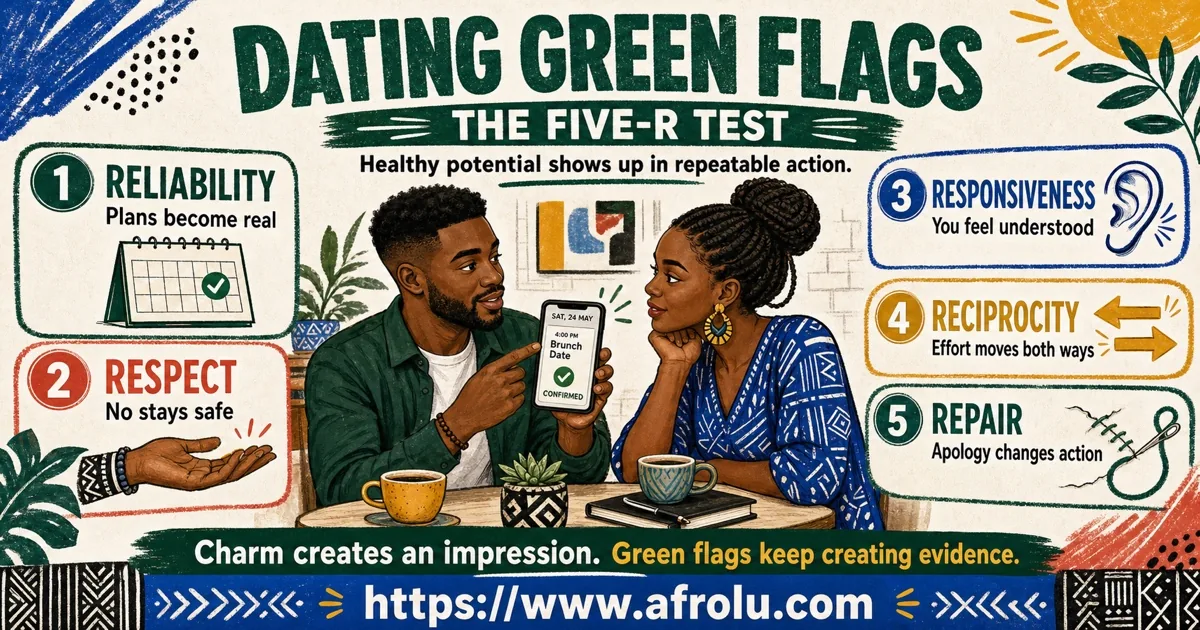
Healthy potential becomes visible through reliability, respect, responsiveness, reciprocity, and repair. Look for a pattern across plans, boundaries, attention, effort, and mistakes. Afrolu visual:
Written and edited by Jean-Claude Mukendi · Relationship Guides Editor
Dating green flags are repeated behaviours that make mutual trust easier: reliability, respect, responsiveness, reciprocity, and repair. Notice them when a plan costs time, a boundary limits access, a misunderstanding requires ownership, or your separate life needs room. One thoughtful gesture is encouraging; a pattern across different moments is evidence.
Healthy dating signs
Which small dating behaviours keep working after attraction meets a boundary, inconvenience, mistake, or difference?
Dating green flags are observable, repeatable behaviours that support safety, dignity, mutual effort, honest communication, and recovery after ordinary mistakes. They suggest healthy capacity; they do not guarantee compatibility or a future relationship.
A polished profile can announce kindness. The useful evidence arrives later: they confirm the plan, accept a no without sulking, remember what matters to you, celebrate a success that does not involve them, and change course after causing hurt. Green flags often look ordinary because trust is built through ordinary moments.
The small-moment evidence audit
A green flag is not a compliment about character; it is a behaviour you can observe again
Words such as kind, mature, secure, and intentional can sound like evidence while still asking you to trust a conclusion. This guide stays closer to the ground. Did the plan become usable? Did a boundary remain safe after it limited access? Did curiosity travel both ways? Did the person own impact without making you manage their shame? Healthy capacity is clearest when ordinary dating creates a small cost or difference.
Use five lenses. Reliability asks whether agreements survive real life or receive prompt repair. Respect asks whether your body, time, privacy, identity, and no remain yours. Responsiveness asks whether the person tries to understand what matters to you. Reciprocity asks whether attention and labour move both ways. Repair asks whether a mistake produces ownership, amends, and changed behaviour. None promises compatibility; together they produce better evidence than charm alone.
Can their care enter your calendar?
Plans are specific enough to use, updates arrive before you are left waiting, and a disruption brings a workable alternative rather than a disappearing act.
Does your no remain emotionally safe?
A boundary can disappoint someone without inviting pressure, bargaining, ridicule, punishment, monitoring, or a demand that you prove affection.
Do you feel understood, not merely admired?
They listen for meaning, remember relevant details, ask before assuming, and adjust support to the person in front of them instead of performing a generic romantic role.
Does the connection have two authors?
Questions, invitations, emotional honesty, planning, affection, and consideration do not have to be perfectly equal each day, but the relationship is not powered by one person.
Can a mistake become safer information?
They can name what happened, care about the impact, make a proportionate amends, and behave differently when a similar moment arrives again.
Make the evidence ordinary
Watch one week of small moments instead of waiting for one grand proof
Create a short record with moments that naturally occur: who confirmed the date, what happened when traffic or work changed it, whether both people asked questions, how a small preference was received, and whether a shared detail appeared again later. This is not a points system or surveillance project. It is a defence against letting the most exciting moment erase all the quiet evidence around it.
A strong week can include imperfection. Someone may be late, misunderstand a joke, need a quiet evening, or choose the wrong restaurant. The useful question is how they carry the effect. Do they update, listen, apologise, offer an alternative, and make the next choice with better information? Trust is not built by avoiding real life; it is built by becoming dependable inside it.

Trust grows through ordinary evidence: a plan confirmed, a no accepted, a detail remembered, effort returned, and a mistake repaired. No single moment has to carry the whole verdict. Afrolu visual:
Ask what the behaviour supports
Reliability, respect, responsiveness, reciprocity, and repair turn a good feeling into readable potential
Run each R as a question, not a label. Can their words enter a usable plan? Can you limit access and remain safe? Do they understand what matters rather than only admire what attracts them? Does effort circulate? When either person misses, can the relationship return with more truth and a changed next move? A yes in one area does not automatically fill the other four.
Then ask what the behaviour cost. It is easy to be patient when the answer is convenient, generous when the schedule is open, or apologetic when nothing must change. Evidence strengthens when care survives disappointment, inconvenience, competing needs, or accountability. Do not create a test; simply notice the costs that ordinary dating already introduces.

Ask what happened, what it cost, and whether it repeated. A green flag is stronger when healthy behaviour survives inconvenience, disappointment, difference, or accountability. Afrolu visual:
Give health something to respond to
A clear request reveals more than a secret compatibility test
Try proportionate language: “I need us to confirm by Thursday evening because I arrange childcare.” “I am enjoying this, and I am not ready to go home together.” “That joke landed badly for me; can we slow down and talk about it?” These sentences describe a need without diagnosing the other person. They create room for curiosity, disagreement, a workable alternative, or an honest no.
Judge the response and the after-effect. A green response does not require perfect wording or instant agreement. It may include a pause, a clarifying question, or a different preference. What matters is that both people retain dignity and choice. Be cautious when every need becomes a courtroom, a loyalty test, a sexual negotiation, or a reason you must restore the other person's mood.

A workable request gives the other person room to respond. Look for a specific alternative, a pressure-free yes or no, and an apology that changes the next interaction. Afrolu visual:
Do not demand conflict-free dating
The first repair shows whether accountability can become collaboration
Separate an apology into parts. Ownership names the specific action without hiding behind intention. Impact shows curiosity about your experience without requiring identical interpretations. Amends address what can be repaired now. Change becomes visible when a similar moment is handled differently. Shame, gifts, romantic speeches, or repeated “I am the worst” may feel intense while still leaving you responsible for the emotional clean-up.
You are allowed to accept an apology and end the relationship. You are also allowed to continue cautiously while change earns trust. Repair is a green flag because it protects reality, not because it erases consequences. Where there is coercion, violence, stalking, or a serious safety threat, a repair framework is not a reason to remain accessible.
Keep health and fit in view
Review encouraging evidence, open questions, dealbreakers, and the life you still have
After several interactions, use four columns. Encouraging moments deserve notice. Repeated evidence can gradually earn trust. Open questions need conversation or more time. Dealbreakers require a decision rather than a prettier interpretation. This structure prevents both extremes: dismissing calm care because it lacks drama and forcing a match because someone appears healthy on paper.
End with the life test. Are you sleeping, working, seeing friends, practising faith, caring for family, and making independent choices without punishment? Can both people grow without treating every opportunity as abandonment? A healthy connection may require coordination and compromise, but it should not make one person progressively smaller so the relationship can feel secure.

Keep four columns: encouraging moment, repeated evidence, open question, and dealbreaker. Let strong patterns earn trust gradually while safety concerns keep their full weight. Afrolu visual:
Three ordinary moments where healthy capacity becomes visible
A cancellation becomes evidence because the repair is usable
You have arranged dinner for Friday. On Thursday afternoon, their work shift changes. They tell you before you travel, apologise for the disruption, offer Sunday lunch and Tuesday evening as alternatives, and ask which option protects your schedule. They do not bury the cancellation under flattery or expect instant reassurance. The new date happens as agreed.
Count the whole loop: early notice, ownership, a specific alternative, consideration for your time, and follow-through. A perfect attendance record is not the green flag. Reliable repair is.A warm evening remains warm after you slow the physical pace
The date has gone well, and you say you do not want to go home together or share your address yet. They answer without debate, help confirm your ride, and keep the goodbye kind. The next message does not become cold, sexual, sarcastic, or guilt-inducing. On the next date, they ask rather than treating earlier affection as permanent permission.
Notice what does not happen: no bargaining, emotional withdrawal, scorekeeping, or attempt to make your boundary responsible for their mood. Respect is visible both in the moment and after it.Interest makes room for faith, family, work, friendship, and distance
One person has family responsibilities and a weekly faith practice; the other is building a business and maintains close friendships. They discuss when calls and dates are realistic, ask before assuming cultural or family expectations, and do not frame independence as rejection. When a diaspora trip changes the calendar, both help plan the next call and decide what the distance can honestly support.
Healthy closeness should add coordination, not erase identity. Look for curiosity about context, equal say over pace, and practical support for the parts of life that existed before the match.Five green flags that become stronger when something costs effort
Plans are specific, confirmed, and repaired when life interrupts
A no is received without pressure, punishment, or bargaining
Curiosity, planning, and emotional labour travel both ways
An apology names the impact and leads to changed behaviour
Read the moment without turning one gesture into a guarantee
| Situation | What it may mean | What to do next |
|---|---|---|
| They confirm a plan and arrive as agreed | Encouraging evidence of reliability and consideration for your time in this context. | Appreciate it, then let ordinary repetition build trust. Do not convert one punctual date into a character guarantee. |
| They cancel, explain early, offer alternatives, and keep the replacement plan | Life interrupted the plan, but the person protected the relationship through useful repair. | Count the full repair loop. This may be stronger evidence than a life that has not yet required flexibility. |
| You say no or slow down, and warmth remains steady | Respect is surviving disappointment; access is not being treated as proof of affection. | Notice the response over time and across boundaries. You do not owe a reward for your no being respected. |
| They misunderstand you, listen, apologise specifically, and change the next interaction | Responsiveness and repair are becoming behaviour rather than image management. | Accept the repair if it feels proportionate, then verify change. Forgiveness and continued dating remain separate choices. |
| They celebrate your opportunity even though it reduces shared time | The connection may have room for your growth and an identity beyond the relationship. | Discuss the practical impact together. Support is strongest when it includes honest coordination, not silent self-sacrifice. |
| Everything is respectful, but desire or life fit remains low | You may be meeting a healthy person who is not your compatible partner. | End kindly rather than inventing a flaw. Green flags support a relationship; they do not obligate one. |
Three conversations that let respect, responsiveness, and repair show up
“I appreciated how you handled that change of plan; the clear update made it easy to trust the new plan.”
“I am not ready for that yet. I would still like to keep getting to know you at this pace.”
“When that happened I felt dismissed. Can we talk about what each of us heard and what we do differently next time?”
Know the difference
Dating green flags vs Strong chemistry
Repeatable behaviour makes trust easier across plans, boundaries, mutual effort, and repair.
Attraction may feel powerful before relationship behaviour is known.
Enjoy the spark, then trust the pattern that remains healthy when excitement meets real life.

Chemistry describes energy and attraction. Green flags describe relationship behaviour. Enjoy the spark, then check whether reliability, respect, mutual effort, and repair remain visible over time. Afrolu visual:
Green flags, chemistry, people-pleasing, conflict avoidance, or compatibility?
| Type or dimension | What it describes | Best next question |
|---|---|---|
| Dating green flag | A repeated behaviour supports reliability, respect, responsiveness, mutual effort, or repair across real situations. | Let trust grow gradually while continuing to communicate and observe the wider pattern. |
| Strong chemistry | Attraction, energy, ease, or fascination feels powerful, but it may appear before relationship behaviour is known. | Enjoy the feeling without using it as proof of consent, character, compatibility, or commitment. |
| People-pleasing | Agreement and generosity may come from fear of conflict, rejection, or disappointing you rather than free choice. | Make disagreement safe. Ask what they genuinely prefer and notice whether both people can say no. |
| Conflict avoidance | The connection looks harmonious because needs, differences, or hurt stay unspoken rather than being handled well. | Invite one low-stakes honest conversation and observe listening, regulation, and repair. |
| Compatibility | Values, attraction, lifestyle, goals, pace, and practical circumstances fit well enough to build the relationship both want. | Use green flags to assess process and compatibility to assess fit. A durable relationship usually needs both. |
The Five-R evidence test in five moves
Record moments, not adjectives
Replace “they are thoughtful” with what happened: they checked your access needs before choosing a venue and remembered the answer later.
Look for a small cost
Healthy behaviour becomes stronger evidence when it costs convenience, requires patience, limits access, shares credit, or asks for accountability.
Wait for a second context
A respected texting boundary is encouraging. Respect across physical pace, privacy, time, and disagreement begins to show a broader pattern.
Keep attraction in its own column
Chemistry matters, but it cannot grade reliability or consent. Let the feeling be real without making it answer every relationship question.
Review your life around the connection
Ask whether dating leaves room for sleep, work, friends, faith, family, health, and self-respect rather than only asking how exciting each interaction feels.
Why healthy dating is easier to see in process than personality
Being understood, valued, and cared for is more useful than being constantly praised
Relationship researchers use perceived partner responsiveness to describe the sense that a partner understands, appreciates, and cares about important parts of the self. A longitudinal study using data from more than 2,000 married adults found responsiveness predicted a small increase in eudaimonic well-being a decade later after several controls. That is meaningful evidence, but it is not proof that one attentive date predicts health or that the result generalises equally across ages, cultures, and early dating.
The first disagreement may reveal more than another perfectly smooth date
An observational study of 73 young-adult heterosexual couples linked a partner's stronger recovery after conflict with a more positive emotional tone in the relationship, and examined later stability. The sample was small and specific, so it cannot supply a universal scoring rule. Its practical value is proportion: healthy relationships are not conflict-free; what happens after tension matters.
Healthy conversation contains listening, turn-taking, questions, and specific feeling language
CDC Dating Matters communication guidance describes healthy communication as both feeling heard, understood, and respected and offering the same attention to the other person. It recommends calming strong emotion, listening actively, taking turns, asking open questions, avoiding premature conclusions, and using specific statements about feelings and needs. These are skills, which means people can practise them imperfectly and improve.
Respect is not only politeness; it preserves choice, privacy, voice, and access to resources
Love is Respect describes healthy relationships through communication, boundaries, mutual respect, support, space, and privacy. A person can be charming in public and still pressure, monitor, isolate, or control in private. Green flags never cancel a coercive pattern. If you feel unsafe, move from relationship optimisation to safety planning and trusted support.
Calm is useful evidence, but it is not a command to date someone you do not want
People sometimes label steadiness boring when unpredictability has been tied to excitement; others pressure themselves to continue because a date looks healthy on paper. Both miss the point. Safety, attraction, and compatibility answer different questions. A respectful person can still be the wrong match, and strong attraction can coexist with a pattern that deserves caution.
Do not only search for a green-flag person; practise becoming a green-flag participant
Confirm the plan you made. Receive a boundary without making the other person comfort you. Ask a follow-up question instead of waiting to be entertained. Name your uncertainty without preserving false hope. Apologise specifically and change the next behaviour. Mutual health is easier to recognise when you are contributing observable evidence too.
Four ways a green-flags checklist can produce another blind spot
Calling instant chemistry a green flag
It turns one difficult moment into a larger emotional decision before you have enough evidence.
Awarding exceptional credit for basic courtesy
It gives uncertainty more attention instead of asking for the clarity or consistency you need.
Reading conflict avoidance as perfect compatibility
It replaces a direct, answerable conversation with guessing, testing, or pressure.
Collecting signs while ignoring how the relationship actually affects your life
It keeps you invested in a pattern that is not protecting your time, safety, or relationship goal.
Use a reviewed resource that matches the decision
This guide focuses on the relationship decision, so it does not rank dating apps. Check current prices, safety tools, and local availability before choosing a service.
Explore the guide library
Show more related guides
Continue with Afrolu
Show more Afrolu guides
Relationship research and healthy-dating resources behind this guide
Afrolu reviewed these health, research, safety, or public guidance resources while editing this page. They support the behaviour and safety guidance; they do not diagnose any individual described by a reader.
Dating green flags answered without perfection tests or guarantees
What are dating green flags?
Dating green flags are observable, repeated behaviours that make trust and mutual dignity easier. Useful examples include keeping or repairing plans, accepting boundaries without pressure, listening for meaning, sharing effort, supporting a separate life, and changing behaviour after an apology. They suggest healthy capacity but do not guarantee compatibility or a lasting relationship.
What are the five most important green flags in early dating?
Afrolu uses five evidence lenses: reliability, respect, responsiveness, reciprocity, and repair. Reliability makes agreements usable. Respect protects consent, time, privacy, and identity. Responsiveness helps each person feel understood. Reciprocity gives the connection two active participants. Repair turns ordinary mistakes into ownership and changed behaviour.
How long does it take to know whether a green flag is real?
There is no universal number of dates. Give more weight to behaviour repeated across different contexts, especially a change of plan, a boundary, a disappointment, a misunderstanding, and a moment when your independent life needs support. Time matters because some qualities cannot be observed before ordinary friction appears; safety concerns, however, do not need a waiting period.
Is strong chemistry a green flag?
Chemistry is information about attraction, energy, or ease. It can be welcome, but it is not evidence of reliability, consent, compatibility, or relationship skill. Keep chemistry in the decision while allowing behaviour to answer the questions it can actually answer.
Is respecting a boundary a green flag or just the bare minimum?
Respecting consent and basic dignity is a minimum requirement, not a favour that earns access. It is still important evidence because the way someone receives a limit can reveal their relationship with power and choice. Appreciate the healthy behaviour without lowering the boundary or treating basic respect as extraordinary heroism.
Can a person have green flags and still be wrong for me?
Yes. A person can communicate well, respect boundaries, and repair mistakes while differing from you on attraction, faith, children, location, money, lifestyle, relationship structure, or future goals. Green flags describe process; compatibility describes fit. A kind ending can honour both truths.
What green flags should I notice on dating apps?
Early app evidence includes a profile with specific and coherent information, respectful questions, no pressure to leave the platform immediately, acceptance of a slower reply or boundary, a clear invitation, and safe planning for a public first meeting. Verification supports identity checks, but no badge proves honesty or relationship readiness.
Do green flags cancel red flags?
No. Kind gestures, apologies, gifts, good dates, or public charm do not offset coercion, threats, stalking, violence, sexual pressure, isolation, financial control, or repeated dishonesty. Evaluate risk on its own terms. If you feel unsafe, prioritise distance, trusted support, local services, and emergency help where appropriate.
One thing to do now
Choose the person whose care remains usable in real life
Give a green flag more weight after it survives a small cost: time, inconvenience, disappointment, accountability, or your independence.

