Build a two-person conversation
First Date Questions That Feel Natural: Build a Two-Person Conversation
Use a first-date conversation ladder with 72 natural questions, follow-ups, privacy reframes, listening cues, closing scripts, and safety guidance.
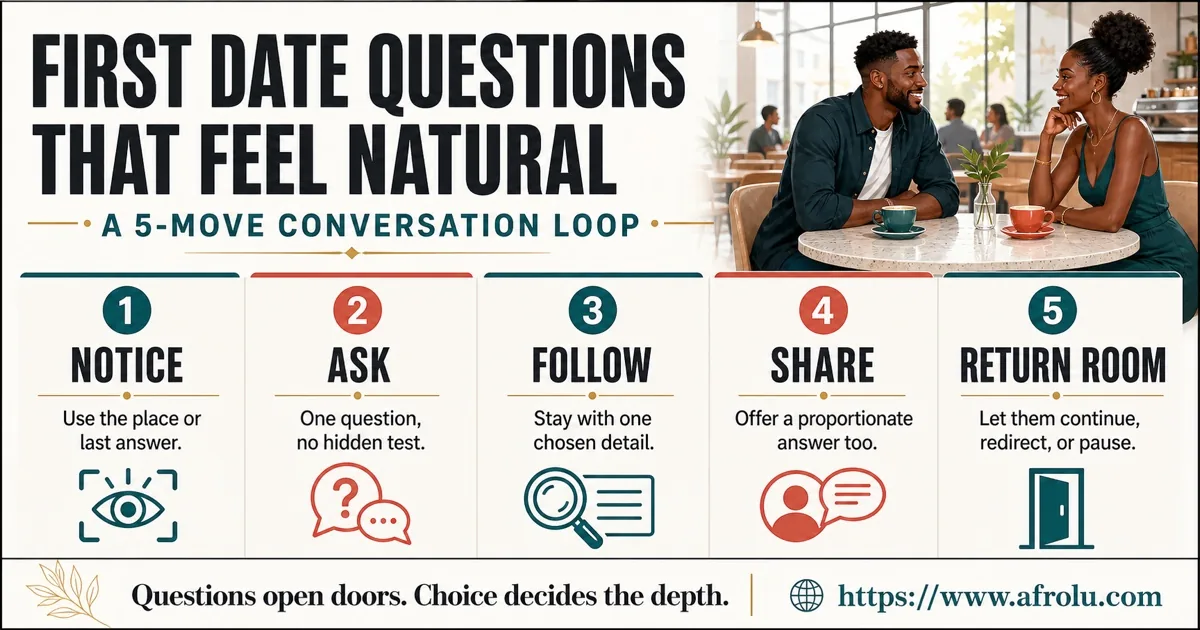
Notice the present context, ask one answerable question, follow the answer, share a proportionate part of yourself, and return room. The loop can stop or redirect at any point. Afrolu visual:
Written and edited by Grace Mutiso · Kenya Guides Editor
Use five moves: notice something real, ask one answerable question, follow the answer instead of switching topics, share a proportionate piece of yourself, and return room. Begin with the present and everyday life, deepen only when reciprocity and permission are visible, protect identifying and intimate information, and close the date explicitly rather than trying to decode every signal.
First dates
How can one answer become a shared conversation that reveals everyday fit, values, pace, and care without turning either adult into a candidate under review?
First-date questions are invitations that help two adults exchange stories, preferences, values, and practical information. Their quality depends less on how clever or deep they sound than on timing, follow-up, reciprocal disclosure, room to pass, and what each person does with the answer.
A prepared list can calm nerves, yet it can also make a date feel like six unrelated interviews. One person asks, the other performs, and neither answer changes what happens next. A natural conversation works differently: the place, profile, or previous sentence supplies a thread; one question opens it; both people add something; and either person can redirect without being punished.
The five-move exchange
The goal is not to ask impressive questions; it is to build a conversation that two adults can safely shape together
Lists of first-date questions solve a real problem: nerves can make every useful thought disappear. The list becomes less useful when it is treated as an itinerary. One adult moves from travel to siblings to ambition to marriage while the other keeps producing compact answers. Nothing is technically rude, yet the exchange feels extractive because each answer is abandoned. A natural conversation is not unprepared. It uses preparation as a reserve, then lets the setting, the previous answer, a shared observation, and each person's boundaries decide what happens next.
Afrolu uses a five-move loop: notice context, ask one answerable question, follow the answer, share proportionately, and return room. The loop sits inside a depth ladder from the present moment to everyday life, joy, relationships, values, and dating intentions. No level must be reached. The reader also checks privacy, consent, accessibility, safety, timing, and the right to pass. This is an editorial conversation aid, not a diagnostic test, attraction technique, or promise that disclosure will produce a second date. Its purpose is to make reciprocity and choice easier to observe.
Begin with something real and shared
Use the place, activity, menu, weather, journey, profile detail, or previous sentence. Context makes a question feel connected rather than imported from a viral list.
Offer one question that can be answered at several depths
Prefer a prompt that permits a short, playful, practical, or meaningful answer. Do not hide a pass-fail test inside a friendly sentence.
Stay with one detail before changing subjects
Reflect what you heard or ask a narrow follow-up. A follow-up shows that the answer changed your attention; it should not demand proof or expose a contradiction.
Contribute a comparable piece of yourself
Do not make the other person carry all vulnerability. Share enough to become knowable without matching trauma, volume, or intimacy mechanically.
Let the other adult continue, ask back, redirect, or pause
A conversation breathes when neither person must answer immediately or follow your preferred depth. Silence, humour, a new topic, and a respectful pass are legitimate moves.
Preparation should support attention
Bring a small reserve of genuine questions, then let the date decide which doorway matters
Prepare by identifying what you sincerely want to understand, not by collecting the most impressive prompts. Choose perhaps six reserves across the present moment, everyday life, joy, people, values, and dating intention. A reserve is available when the conversation needs a bridge; it is not a route that must be completed. If the person mentions restoring old furniture and the subject becomes a lively exchange about patience, family, money, design, and learning, there is no conversational prize for reaching the travel question before dessert.
Use a depth ladder rather than a calendar. Present-moment and everyday-life prompts are usually easier while both people settle. Joy and community can reveal more without requiring private history. Values and dating intentions may be appropriate when both adults are participating and the information matters now. Personal, sexual, traumatic, financial, medical, or identifying material is not the final level of a successful date. It is a different category with greater privacy and consent needs. No date fails because it remains light, and no date succeeds because a stranger disclosed deeply.
Make the structure accessible instead of pretending all good conversation is effortless banter. A direct communicator can say, “I brought a couple of questions because I think better with preparation.” A person who needs processing time can pause. Someone speaking a second language can ask for a rephrase. Eye contact, rapid turn-taking, humour, and voice volume vary by culture, neurotype, disability, safety, and personality. Judge care through the whole exchange rather than one performance norm. Preparation is doing its job when it frees attention for the other person, not when it makes the asker look spontaneous.

Begin with the present and everyday life. Move toward values and dating intentions only when interest is reciprocal. Personal or intimate topics require context, permission, and a free pass. Afrolu visual:
Every question is an invitation
Choose answerable questions and keep redirection, uncertainty, and a respectful pass fully available
An answerable question can be approached at more than one depth. “What has been giving you energy lately?” permits a project, a person, sleep, faith, sport, music, or a short “I am still figuring that out.” “Tell me your deepest fear” prescribes a level of vulnerability and makes refusal conspicuous. Open wording is not automatically safe, though. A broad question about family, identity, health, faith, or childhood can still touch grief, conflict, exclusion, or trauma. Notice hesitation and make the exit real before pursuing another detail.
When a sensitive subject matters for compatibility, name the purpose and volunteer your position. “Faith shapes my week and would matter in a long-term relationship. Is that something you want to talk about tonight?” is clearer than a disguised values test. “I am dating with the hope of commitment; what are you available for now?” asks for present intent rather than a guarantee. The other adult may have a complex, evolving, or uncertain answer. You can decide that uncertainty is incompatible with your needs without accusing them of answering incorrectly.
Repair when a question lands badly. Do not explain for five minutes why a reasonable person should have understood your intention. Say, “That was more personal than I intended. You do not need to answer.” Then change the topic or allow the other person to choose. If you are the one answering, a boundary can be brief: “I keep those details private early on,” “I can answer broadly,” or “I would rather talk about something else.” A caring date does not pout, bargain, diagnose, tease, repeatedly reframe, or make continued warmth conditional on disclosure.

Ask about the shape of a life before exact identifiers, money, trauma details, sexual history, children, or past relationships. Offer a reason, a broad answer, and permission to pass. Afrolu visual:
Listening changes the next move
Follow one chosen detail, reflect meaning when useful, and know when an answer is complete
A follow-up should be traceable to something the person chose to say. If they describe a weekend football league as “the one place my brain goes quiet,” you might ask what creates that feeling or reflect that the routine sounds restorative. You do not need to request the league location, teammates, schedule, injury history, or proof that the story is accurate. Narrow follow-up demonstrates attention when it develops meaning. It becomes extraction when every answer is treated as the beginning of an investigation.
Use four listening moves. Reflect content: “You started learning after moving.” Reflect meaning tentatively: “It sounds as though that gave you a sense of home.” Ask one narrow question: “What kept you going when you were new?” Or let the answer rest: “I am glad you found that.” Validation does not require agreement, praise, or another question. Avoid turning tentative reflection into authority about the person: replace “You are clearly afraid of commitment” with “I heard that you prefer to make plans slowly; what does slowly mean in practice?”
Watch the answer edge. Detail, eye contact, tone, pace, humour, and questions back may invite continuation, but none is permanent consent. Shortening answers, looking for an exit, repeated subject changes, freezing, saying “I do not know,” or declining should reduce pressure. Some cues are ambiguous, so words are better than mind-reading when stakes rise: “Would you like to stay with this topic or switch?” If the person says switch, switch. Good curiosity includes the discipline to leave an interesting question unanswered.

Pick up one detail, reflect its meaning, ask a narrow follow-up, share a comparable detail, and return room. Listening is visible in what happens to the answer. Afrolu visual:
Reciprocity is contribution, not matching
Share enough that the date can learn you without competing, taking over, or demanding equal disclosure
After a question and follow-up, add a relevant piece of yourself. If the topic is what restores energy, a concise answer about walking, prayer, gaming, gardening, friends, or quiet mornings gives the other adult something to understand and respond to. Self-sharing prevents the questioner from becoming an invisible evaluator. It also exposes genuine compatibility: perhaps one person wants highly social weekends while the other protects solitude. Neither answer is defective, and the difference becomes visible without a verdict.
Proportion matters more than symmetry. One person may answer in a sentence and the other in a story. One may discuss family broadly while another chooses a specific memory. Reciprocity does not mean matching trauma, income, sexual history, immigration status, health information, or relationship details because someone else volunteered theirs. Disclosure is not a coupon that purchases another disclosure. Offer your answer as information, not leverage: “My broad answer is this; share only what feels comfortable for you.”
Avoid the conversational takeover disguised as relating. “That happened to me too” can create common ground, but a ten-minute story may erase the speaker's experience. Use a short bridge and return: “I recognise that first-day feeling. Mine happened when I changed courses. What helped you settle?” If you notice you have been speaking for a long stretch, do not apologise theatrically or demand reassurance. Finish the thought, invite the other person in, and see whether attention can move naturally in both directions.

Stacked questions, hidden evaluation, and one-way disclosure create performance. Context, follow-up, mutual sharing, pauses, and permission create a conversation both adults help author. Afrolu visual:
Warmth does not transfer consent
Keep identifying details, money, sexual topics, transport, touch, photographs, and next locations as separate choices
A strong conversation can produce rapid familiarity. Keep familiarity separate from verification and access. Do not reveal an exact home, building, workplace, daily route, children's school, financial account, identification document, password, one-time code, private image, or live location because the person listened well for an hour. Ask about the shape of work rather than the employer; the rhythm of a week rather than a full schedule; broad responsibilities rather than identifying details. Trust can gain specificity over time through consistent, proportionate evidence.
Sexual and physical topics need their own consent. A question about dating intention is not permission to ask for sexual history. Flirting is not permission to touch. A hug is not permission to kiss. One venue is not agreement to a private second location. A photograph is not permission to post, tag, forward, or use facial recognition. Ask plainly when the next action is not already clear, and treat uncertainty as a reason to pause. Alcohol, gifts, payment for the date, status, distance travelled, or personal disclosure do not make an answer owed.
Preserve an independent exit. Meet publicly where possible, tell a trusted person what you need them to know, arrange transport you control, and keep enough battery, money, medication, mobility support, or communication access to leave. Adapt the plan to local conditions and your needs rather than assuming one safety script works for everyone. If behaviour becomes coercive, threatening, tracking, isolating, financially manipulative, or sexually pressuring, stop trying to improve the conversation. Leave when you can, reduce access, preserve useful evidence, and seek appropriate local support.
The ending is part of the conversation
Close in words, then review reciprocity, care, practical fit, boundaries, and follow-through rather than replaying every answer
End before exhaustion erases the useful part. A previously stated time makes this easier: “I have enjoyed meeting you, and I need to leave by nine.” If you know you want another date, you can say so without requiring an immediate answer. If you know you do not want to continue, do not use “we should do this again” as automatic politeness. When direct closure on site would feel unsafe, leave first and communicate from safety or stop contact as appropriate. Nobody owes a post-date debate about chemistry.
Review the interaction in layers. Content: what did you actually learn? Reciprocity: could attention and initiative move both ways? Responsiveness: did answers affect the next move? Boundaries: could either person redirect without punishment? Practical fit: did pace, availability, geography, intention, faith, culture, care responsibilities, or communication preferences reveal a workable direction? Safety: did you remain free to choose and leave? Attraction can matter while remaining only one column.
Keep conclusions proportionate. One awkward pause does not prove incompatibility; one polished answer does not prove character. People often underestimate how positively conversations were received, but a population pattern cannot tell you how this person felt. If interested, send one clear follow-up and offer a specific next step. If uncertain, name a real review point rather than keeping someone on indefinite standby. If there is no fit, close kindly. The strongest evidence arrives when words, choices, boundaries, and follow-through continue to agree.
The same question can land differently depending on context, pace, access, and reciprocity
Mariam has excellent questions, but each answer disappears beneath the next one
Mariam prepared twenty prompts because silence makes her anxious. When Daniel says that he cooks on Sundays, she smiles and immediately asks where he has travelled, whether he has siblings, and what he wants in five years. Daniel answers politely but stops expanding because the questions feel like fields on a form. Mariam interprets the shorter answers as poor chemistry and increases the pace. Neither person is learning how the other develops a thought, responds to humour, asks back, or shares attention.
Mariam puts the list away and follows the cooking thread: “What is the Sunday dish you can make without looking at a recipe?” Daniel describes learning it from an aunt. Mariam shares her own disastrous first attempt at chapati and returns room: “Did you always enjoy cooking, or did that come later?” The subject may remain food for ten minutes, but it now reveals learning, family tradition, play, and care. Fewer topics produce more usable evidence because both adults can contribute to one thread.Chidi values emotional honesty; Ayo experiences a question about childhood as an intimacy demand
The date has been warm, and Chidi asks, “What childhood experience made you who you are?” He means depth, not harm. Ayo has not decided whether personal history belongs in this first meeting and gives a broad answer. Chidi asks for an example, believing that attentive follow-up will help. Ayo feels cornered: declining now seems as though it will be interpreted as emotional unavailability. The problem is not that childhood can never be discussed. It is that the question moved from invitation to obligation without a permission check.
Chidi repairs the moment: “That was broader and more personal than I intended. You do not need to answer it. We can keep this in the present.” A safer alternative is, “Is there a tradition or lesson you enjoy carrying forward?” Ayo can choose a celebration, mentor, place, or no answer at all. If a topic is important for compatibility, it can still be raised directly later. Respecting pace does not mean avoiding substance; it means that vulnerability remains voluntary and proportionate to trust.Njeri and Sam laugh easily but never ask the ordinary questions that would shape another date
Their stories flow, both people ask back, and the evening feels generous. They avoid anything that might sound serious, so neither mentions that Sam travels most weekends, Njeri prefers slow in-person dating, and their communication expectations are very different. Afterwards both say there was chemistry, then experience the planning as a sudden disappointment. A natural conversation does not have to remain light. Practical information can be introduced without turning the date into a contract negotiation.
Near the middle of the date, Njeri says, “I am enjoying this. What kind of pace feels realistic when you are getting to know someone?” She shares her answer too. Sam explains the travel pattern and asks what staying connected means to her. They do not need to solve a future relationship that night. They do gain honest information about availability, distance, and preferred rhythm. Warmth and compatibility are different questions; a strong first date can make room for both without demanding certainty.Six depths of first-date conversation, each optional and revisable
Questions grow from the setting or the previous answer
Follow-ups show understanding rather than extraction
Both adults ask, answer, share, redirect, and pause
The conversation can deepen without making privacy or intimacy the admission price
Choose the next move from what is happening now, not from the next item on a list
| Situation | What it may mean | What to do next |
|---|---|---|
| The date has just begun and both people are settling | Attention is divided across arrival, the venue, transport, ordering, accessibility, and ordinary nerves. A deep opener can feel like a demand before either person is present. | Use the shared moment: ask about the journey, the place, the activity, or something they are looking forward to this week. Offer your own answer and let the pace slow. |
| A profile detail supplies a natural thread | The detail can show that you paid attention, but a profile is a curated doorway rather than permission to investigate every person, place, or claim behind it. | Ask about the experience or preference: “What do you enjoy about hiking?” Avoid exact routes, schedules, companions, home area, or challenges intended to verify identity in public. |
| The answer is short but warm | The person may be settling, concise, unsure which depth you want, processing, speaking in a second language, or less interested in that topic. One short answer does not reveal motive. | Share a small answer of your own, offer one optional follow-up, or change the subject. Do not repeat the question more intensely or label the person guarded. |
| The answer becomes a long, animated story | Interest and comfort may be present, but length alone does not show reciprocity or compatibility. The speaker may not notice that the exchange has become one-way. | Listen for the ending, reflect one detail, and see whether room returns. If needed, use a gentle bridge: “That trip clearly mattered. May I add what it reminded me of?” |
| The other person asks the question back | They may be showing reciprocal curiosity, using an easy bridge, or expecting a comparable disclosure. It does not require the same answer length or private detail. | Answer honestly at a depth you choose. Add one concrete detail, then return to the thread instead of using the opening for a full personal presentation. |
| The topic reaches values, intention, faith, family, or disagreement | The information may matter for compatibility and may also carry cultural, personal, or safety weight. Indirect guessing can be less respectful than a clear optional question. | State why you are asking, use broad language, answer too, and permit a pass: “Faith shapes my week. Is that a topic you want to discuss tonight?” |
| You have asked several questions and none return | Nerves, conversational style, self-focus, low curiosity, low interest, language, or mismatch may be involved. The observable issue is that you are carrying the exchange. | Stop supplying prompts. Share one small detail and leave room. If the pattern remains one-way, you can shorten the date or decide that the exchange does not offer the reciprocity you need. |
| The planned leaving time arrives | Enjoyment does not cancel transport, work, medication, caregiving, rest, access, or a previously stated boundary. Neither person should have to invent an excuse. | Close explicitly: “I have enjoyed meeting you, and I need to leave now.” If interested, add one honest continuation. If not, end safely without bargaining over another drink, venue, ride, or physical contact. |
Eight scripts for following up, sharing back, redirecting, protecting privacy, naming intent, and ending clearly
“You said the community garden became the calm part of your week. What about it changes the pace for you?”
“I reset by walking without headphones. The quiet helps me stop carrying work home. What works for you?”
“That may be more personal than a first-date question needs to be. You do not have to answer, and we can keep this lighter.”
“I keep the details of that private early on, but the broad answer is that family responsibilities shape my weekends. How about your schedule?”
“I am dating with the hope of a committed relationship, and I still want to learn at a steady pace. What are you available for now?”
“I am enjoying this. I need to leave by nine for my journey home. Would you like to order now or take a short walk here first?”
“Would you like a hug, a wave, or something else? Any answer is fine.”
“Thank you for meeting me. I am going home now. I do not want to continue to another place.”
Know the difference
Conversation flow vs Interview mode
Uses context, one question at a time, relevant follow-up, proportionate self-sharing, pauses, permission, and room for either person to redirect or close.
Stacks unrelated questions, hides evaluation criteria, extracts disclosure, withholds the asker's answers, treats hesitation as resistance, and rushes toward certainty.
A natural date is not question-free; it is co-authored.

Do not grade only the answers. Notice whether both people can ask, listen, share, pause, disagree, protect privacy, and close the date without pressure. Afrolu visual:
Compare seven conversation moves that can sound similar but perform different jobs
| Type or dimension | What it describes | Best next question |
|---|---|---|
| Contextual opener | Uses the shared place, activity, profile detail, or immediate experience so the question belongs to this date rather than any stranger. | What can I notice without judging or exposing private information? |
| Open invitation | Allows several truthful answers and does not imply that one preference, ambition, family pattern, or relationship history will pass the test. | Can this be answered lightly, deeply, or with a respectful pass? |
| Narrow follow-up | Builds from a detail the person chose to offer and helps clarify meaning without demanding evidence, a confession, or an increasingly personal story. | Which exact word or contrast am I following, and did the person invite more? |
| Reflective statement | Shows what you understood without immediately converting every answer into another question. It can be warm even when no more detail is needed. | Can I acknowledge the answer before asking the person to produce more? |
| Reciprocal share | Makes the asker knowable by adding a relevant, proportionate detail. It is not a longer story that steals the subject or a demand for matching disclosure. | What comparable part of my experience helps this remain a two-person exchange? |
| Compatibility question | Names a real dating need such as pace, communication, faith, distance, children, or relationship intention without seeking a lifetime guarantee. | Why does this matter now, and how can I answer it before asking? |
| Consent or privacy check | Makes choice explicit before personal, sexual, photographed, posted, transported, or second-location activity. A no or hesitation ends the request. | Does the other adult have a clear, unpressured way to decline, redirect, or leave? |
Build a natural first-date conversation in six deliberate moves
Notice before reaching for a prompt
Name one real detail from the setting, activity, profile, or previous sentence. “You said you nearly missed the exhibition” has a human starting point; “What are your top five goals?” arrives as an assessment.
Ask one answerable question
Choose a question that permits several depths and does not conceal a correct answer. Ask it once. Do not add three versions, examples, and your preferred answer before the other person begins.
Follow the thread, not the list
Select one word, feeling, person, place, or contrast from the answer. Reflect it or ask a narrow follow-up. Stop if the answer shortens, redirects, or reaches a privacy edge.
Share a proportionate answer too
Contribute enough for the other person to learn you. Match the subject and approximate depth, not the exact disclosure. Reciprocity is participation, not a debt to reveal equivalent private information.
Return room and allow a pause
Let the other adult expand, ask back, introduce another subject, laugh, look at the menu, or be quiet. A pause is not automatically failure; it can be the space in which a real answer forms.
Close the date in words
Use the time boundary you planned. Say whether you enjoyed meeting and whether you want to continue when you know. Do not make the final question a test, extend the date by pressure, or read politeness as consent.
72 first-date questions organised by depth and purpose, not by performance
Choose a few prompts that fit the moment. This is a reference library, not a list to complete.
Present moment and place
Use these while settling in. They are low-pressure and easy to connect to the date already happening.
- How was the journey here for you?
- What caught your attention when you arrived?
- Is this kind of place usually your speed?
- What has been the nicest part of your day so far?
- What are you looking forward to this week?
- If we had an extra hour around here, what would you want to explore?
- What makes a cafe, park, or restaurant feel comfortable to you?
- When you say a low-key outing, what does that look like?
- Is there a story behind what you ordered?
- What is one local place you think more people should try?
- Are you naturally early, exactly on time, or creatively on time?
- What helps you settle into meeting someone new?
Everyday life and energy
Learn the shape of ordinary life without requesting exact workplaces, addresses, schedules, or identifying details.
- What does a genuinely good weekday look like for you?
- How do you reset after a full week?
- Are mornings or evenings more naturally yours?
- What part of what you do feels most satisfying?
- How do you usually make time for friends?
- What part of your schedule do you protect most carefully?
- What small routine has improved your life recently?
- What is your favourite form of doing absolutely nothing?
- Do you enjoy cooking, ordering, or finding someone else who cooks?
- Do you prefer a full social calendar or a few planned things?
- What makes a Sunday evening feel good rather than heavy?
- What has been making everyday life easier lately?
Joy, play, and curiosity
These prompts reveal enthusiasm and humour without demanding a personal history or a polished achievement story.
- What subject could you talk about without needing preparation?
- What hobby would you happily be a beginner at again?
- Which song or artist has been following you around lately?
- What food has a memory attached to it for you?
- What made you laugh properly this month?
- What book, film, game, or podcast have you recommended twice?
- How would you spend a free afternoon in your city?
- What skill would you learn if progress were guaranteed to be messy?
- Are you playfully competitive about anything?
- Would you choose a nearby adventure or a carefully planned long trip?
- What can make you lose track of time in a good way?
- What delightfully specific interest do you wish people asked about?
People, care, and community
Ask broadly and let the other person choose family, friends, mentors, faith, neighbours, or community. Do not demand names or private stories.
- What kind of gathering do you most enjoy being part of?
- What quality makes a friendship last for you?
- How do you tend to show care when someone has a hard week?
- Is there a tradition you enjoy keeping or creating?
- What does a good celebration look like to you?
- What advice has stayed useful longer than you expected?
- Where do you feel a real sense of community?
- If comfortable, what did celebrations feel like where you grew up?
- How do you make room for people when life gets busy?
- What makes someone a good teammate in ordinary life?
- What small gesture makes you feel considered?
- What is something you enjoy contributing to other people's lives?
Values, growth, and direction
Use these after reciprocity is visible. Answer too, and keep the question in the present rather than requesting a confession.
- What is something you have changed your mind about?
- What recent decision are you quietly proud of?
- Which value is easiest to see in your ordinary week?
- What makes an apology feel sincere to you?
- What are you enjoying learning at the moment?
- What would success in this season of life mean to you?
- What do you protect time for even when life gets crowded?
- What helps you handle a disagreement with care?
- Where do you like planning, and where do you prefer spontaneity?
- What does useful support look like when you are stressed?
- What would you like a little more of in your life this year?
- What expectation are you learning to hold more lightly?
Dating intentions and practical fit
These are direct compatibility prompts, not promises about a future together. State your answer and allow uncertainty where it is genuine.
- What brought you to dating at this point in your life?
- What kind of connection are you genuinely available for now?
- What pace helps you get to know someone without rushing?
- How do you like to stay in touch between dates?
- What makes planning time together feel easy for you?
- How often could you realistically see someone if things developed?
- Are there responsibilities or commitments that shape how you date?
- What helps a first or early date feel comfortable and respectful?
- How do faith, culture, or community matter in dating for you, if they do?
- How do you prefer to discuss exclusivity if a connection grows?
- What kind of distance or travel is realistic in your life?
- If we both wanted another date, what kind would feel enjoyable next?
What disclosure, question-asking, listening, perception, conversation-ending, safety, and consent evidence can actually support
A meta-analytic review found several disclosure-liking links, while showing that context and study design matter
Collins and Miller reviewed research on self-disclosure and liking and reported three broad associations: people who disclosed more intimately tended to be liked more, people disclosed more to people they already liked, and people sometimes liked others more after disclosing to them. The directions operate together, which is exactly why “ask a deep question to create attraction” is too simple. Disclosure may reflect existing comfort as well as contribute to it. A useful first-date principle is proportionate, voluntary exchange, not maximum vulnerability.
Evidence limit: This was a 1994 meta-analysis across varied paradigms, disclosure types, and participant groups, not a trial of modern app-origin first dates. The authors reported moderation by factors including paradigm, disclosure type, and discloser gender. The review does not prescribe a question, prove causality in every direction, or show that intimate disclosure is safe with a new person. Use it to understand that disclosure is relational and contextual, while preserving privacy and the right to pass.
A structured laboratory study found reciprocal turn-taking produced more liking, closeness, and enjoyment than fixed speaker-listener roles
Sprecher and colleagues paired 156 undergraduates for a structured get-acquainted interaction. In the reciprocal condition, partners took turns answering disclosure prompts; in other conditions, one person disclosed while the other listened before roles changed. Participants in the reciprocal turn-taking condition reported more liking, closeness, perceived similarity, and enjoyment. The practical lesson is not to match every answer sentence for sentence. It is to avoid assigning one adult the permanent role of interviewer, audience, confessor, or candidate.
Evidence limit: The sample was predominantly women and White undergraduates, the interaction was structured, and the outcomes were immediate self-reports in a laboratory rather than actual first-date continuation. The study cannot establish the ideal amount or depth of disclosure for different cultures, ages, neurotypes, relationship structures, or safety contexts. Reciprocity can include listening, humour, a short answer, or declining; it should never require equivalent trauma or forced disclosure.
A reanalysis of speed-dating data challenged the claim that asking more questions straightforwardly earns a second date
Kluger and Malloy reanalysed a speed-dating dataset with 110 adults and 1,953 dyadic scores using a social relations model. They found that question asking was shaped not only by the person asking, but also by the partner and the specific pair. Follow-up and switch-question scores were closely related, and more questions did not simply translate into second-date offers. The guide therefore treats curiosity as interactional: a responsive partner can elicit more questions, and a good exchange cannot be reduced to one person applying a technique.
Evidence limit: The article is a theoretical and empirical reanalysis of one speed-dating study, with its own design, coding, and opposite-sex pairing context. A second-date offer is a narrow measure of liking, and the data do not identify the best conversational move for an individual date. The reanalysis also does not mean questions are useless. It means question volume is not listening, character, or attraction by itself. Read how the pair handles answers, sharing, boundaries, and repair.
Two preregistered studies linked follow-up questions and verbal validation with several markers of connection between strangers
A 2025 paper examined conversations between pairs of strangers across two preregistered studies with 646 participants in total. In a ten-minute semi-structured “deep talk” and a brief small-talk setting, observed verbal listening behaviours such as follow-up questions and verbal validation were associated with faster response timing and self-, partner-, and observer-rated connection. An intervention intended to increase connection also increased follow-up questions in one study. This supports making listening observable through a relevant follow-up or acknowledgement.
Evidence limit: The studies examined brief stranger interactions under research conditions, not dating outcomes, long-term compatibility, safety, or consent to personal topics. Associations between observed behaviours and connection do not make every follow-up helpful; a narrow question can still pressure, challenge, or extract. “That sounds important” may validate without requiring details. Good listening remains responsive to words, tone, hesitation, redirection, access needs, and the other person's chosen depth.
The liking-gap research suggests people often leave conversations thinking they were liked less than partners report
Boothby and colleagues studied conversations between strangers, workshop participants, and people getting to know dorm peers. Across settings, participants tended to underestimate how much their conversation partners liked them and enjoyed the interaction, with the gap persisting in longer-term acquaintance data. The finding can interrupt one common post-date error: treating every pause, imperfect answer, or moment of self-consciousness as evidence that the other person was unimpressed.
Evidence limit: A group tendency cannot tell any reader how a particular date felt, whether attraction was romantic, or whether another meeting will happen. The original studies used specific U.S. social settings and self-report measures. Do not replace negative mind-reading with positive certainty. Close the date clearly, send one proportionate follow-up if interested, and let the other person's answer and action provide individual evidence.
Across 932 conversations, people were poor at estimating when partners wanted the exchange to end
Mastroianni and colleagues studied 932 conversations involving intimates in one study and strangers in another. Conversations rarely ended when both participants wanted them to, and people had limited insight into when their partners wanted to stop. The work explains why a pleasant date can still run too long and why body-language guessing is an unreliable closing system. A simple time check or explicit ending protects the good part of the exchange: “I have enjoyed this, and I need to leave by nine.”
Evidence limit: The research concerned conversations, not specifically first dates, and reported average discrepancies rather than a rule for every pair. It does not mean body language is irrelevant or that every pause needs a formal check-in. Safety, transport, disability, work, caregiving, prayer, medication, and venue closure can shape endings. When the other person states a limit or begins leaving, accept it without negotiating for more time, another venue, transport access, or physical contact.
A U.S. survey documents harassment and continued contact that ordinary conversation advice must not minimise
Pew Research Center surveyed 6,034 U.S. adults in 2022 about online dating. Reported unwanted experiences included unsolicited sexual messages or images, continued contact after someone said they were not interested, offensive names, and physical threats, with exposure differing across demographic groups. This matters for first-date questions because “be open” is not universally safe. Exact location, workplace, schedules, children, finances, identity documents, account access, and intimate material can remain private regardless of conversational warmth.
Evidence limit: The survey is U.S.-specific, self-reported, and describes dating-site or app experiences rather than predicting danger from an individual. It does not replace local law, safeguarding, or specialist advice. Use behaviour-based boundaries: decline a question, withhold identifying details, leave, block, report, preserve evidence, secure accounts, tell trusted people, and seek qualified local support according to the risk. No conversational norm requires continued access after no.
Victoria Police advises public meetings, independent transport, a trusted-person check-in, and leaving when something feels wrong
Victoria Police guidance for online dating recommends setting expectations before meeting, choosing a public place, telling a friend when and where the date is, sharing the date's name and photo, arranging independent transport, and leaving if something feels wrong. It also advises limiting personal information and protecting money and financial details. These practices let conversation remain exploratory: neither person needs an exact address, workplace, pickup point, or financial story in order to have a meaningful first meeting.
Evidence limit: This is police guidance from Victoria, Australia, not evidence that a checklist prevents harm or legal advice for every jurisdiction. Public venues and trusted contacts may not be equally available or safe for everyone. Adapt the plan to disability access, LGBTQ+ safety, transport, culture, privacy, cost, and local resources. If risk becomes immediate, use the emergency and support services available where you are rather than relying on a dating guide.
NHS Scotland guidance frames consent as freely given agreement that can be withdrawn and does not transfer between activities
NHS Greater Glasgow and Clyde guidance explains consent as freely given agreement, emphasising choice, capacity, communication, and the ability to change one's mind. Consent to one activity does not automatically mean consent to another. Applied to a first date, an answer to a personal question does not grant a follow-up, a romantic tone does not grant sexual discussion, and agreement to meet does not grant touch, transport, a second venue, photographs, posting, or another date.
Evidence limit: The page is educational health guidance and includes a Scottish legal context; laws and support routes vary. It does not turn ambiguous social cues into a checklist or replace an explicit conversation. Ask when the next step is not clear, accept hesitation and refusal, and do not use gifts, alcohol, status, persistence, or disclosure as leverage. A person can stop answering or leave without completing the conversation loop.
Four habits that turn curiosity into extraction, performance, forced intimacy, or unsafe access
Running the viral question list in order
The sequence ignores the setting and previous answer, rewards polished responses, and makes the date feel like an assessment neither person helped design.
Using vulnerability as a shortcut
A personal disclosure can feel close without creating trust, compatibility, consent, or future reliability. Depth should follow choice and context, not manufacture them.
Asking while remaining unreadable
One adult supplies stories, values, and private details while the asker stays in control. Relevant self-sharing makes curiosity mutual and reveals whether both people can be known.
Treating warmth as permission
Laughter, eye contact, a long answer, alcohol, a photograph, or agreement to meet does not grant intimate questions, touch, transport, posting, another venue, or another date.
Use a reviewed resource that matches the decision
This guide focuses on the relationship decision, so it does not rank dating apps. Check current prices, safety tools, and local availability before choosing a service.
Explore the guide library
Show more related guides
Continue with Afrolu
Show more Afrolu guides
Disclosure, reciprocity, listening, perception, coordination, consent, and first-meeting safety sources behind this guide
Afrolu reviewed these health, research, safety, or public guidance resources while editing this page. They support the behaviour and safety guidance; they do not diagnose any individual described by a reader.
First-date question and conversation concerns answered without a chemistry formula
What are the best questions to ask on a first date?
The best question is relevant to the moment, answerable at more than one depth, and interesting enough that you can listen to the answer. Start with the present, everyday life, joy, or a profile detail. Follow one chosen detail, share a comparable answer, and return room. Questions about dating intention and practical fit can be direct when you explain why they matter and answer too. No prompt guarantees chemistry, honesty, compatibility, or a second date.
How many questions should I prepare for a first date?
Prepare about six reserves across different depths, not a list you must complete. The 72 questions on this page are a library for many readers and situations. On one date, a single topic may support ten minutes of reciprocal conversation. If you keep reaching for the next prompt, ask whether you followed the last answer, shared anything comparable, or allowed a pause. The quality of the exchange matters more than topic count.
How do I avoid making a first date feel like an interview?
Use notice, ask, follow, share, and return room. Connect the question to the setting or previous sentence. Ask one at a time. Reflect or follow one detail rather than switching categories. Offer your answer without taking over, and let the other person ask, redirect, or pause. Stop supplying questions when the exchange remains one-way. Structure is not the problem; hidden evaluation, stacked prompts, and one-sided disclosure are.
What should I not ask on a first date?
Avoid demands for exact home or work location, schedules, children's identifying details, documents, account access, money, passwords, live location, intimate images, sexual history, trauma detail, diagnoses, or a full relationship post-mortem. Some broader topics may matter, but timing and framing matter: explain why, ask at a proportionate level, answer too, and make passing easy. A person may decline any question, including one that seems ordinary to you.
Is it okay to ask what someone is looking for on a first date?
Yes. Relationship intention is practical information, not a proposal. Use present-tense language: “I am dating with the hope of a committed relationship. What kind of connection are you genuinely available for now?” Allow a thoughtful or uncertain answer, then compare it with behaviour over time. Terms such as serious, casual, exclusive, slow, or open need clarification. One answer does not create an agreement or guarantee that intentions will remain unchanged.
What if my date gives short answers?
One short answer can reflect settling in, a concise style, language, processing, hearing, sensory load, privacy, nerves, low interest in the topic, or low interest generally. Share a small answer, offer one optional follow-up, or change subjects. Do not diagnose or intensify the question. Watch the broader pattern: do they ask anything back, add detail later, respond to you, help plan, and respect boundaries? You can end a consistently one-way date without proving the reason.
What if there is an awkward silence on the first date?
Let a short silence exist. Take water, look at the menu, notice the environment, or say, “I am enjoying this; my brain is taking a moment.” A pause does not prove failure. If you want a bridge, use a present-moment observation or one prepared reserve. If silence feels unsafe, hostile, or combined with pressure, you may leave. If you are simply incompatible conversationally, that is useful information rather than a performance you must rescue.
Should I ask deep questions on a first date?
Depth can be welcome when reciprocity, context, and permission are visible. Begin with a question that allows a broad answer, state why you are asking, and make a pass explicit. Do not treat disclosure as proof of emotional availability or attraction. Research links disclosure and connection in some settings, but it does not create a universal technique or make maximum vulnerability safe. Values and intentions can often be discussed meaningfully without requesting trauma or intimate detail.
How can a shy, anxious, autistic, or neurodivergent person use these questions?
Preparation and directness can be strengths. Choose a quieter, accessible setting; bring a few prompts; say that you sometimes need processing time; and ask whether direct questions work for the other person. You can use a clear turn such as, “Would you like my answer too?” No adult must perform eye contact, rapid banter, or spontaneous disclosure to be caring. This guide is general education, not clinical advice, and individual access needs differ.
How do I know whether the first-date conversation went well?
Review the exchange, not only your own performance. Could both adults ask, answer, share, pause, disagree, redirect, protect privacy, and close? Did either person show understanding through a relevant follow-up or acknowledgement? Did practical information and boundaries receive respect? Warmth can coexist with poor fit, and nerves can coexist with interest. If you want another date, say so clearly and let the reply and follow-through provide better evidence than replaying every sentence.
One thing to do now
Leave with evidence about the exchange, not a score for how impressively either person answered
Ask one question at a time, follow what was actually said, offer a comparable answer of your own, and treat hesitation, redirection, or “I would rather not answer” as complete information rather than a challenge.


