Notice early
Dating Red Flags
Learn how to distinguish a serious dating red flag from a yellow flag, dealbreaker, or repairable mistake, with examples, scripts, and safe next steps.
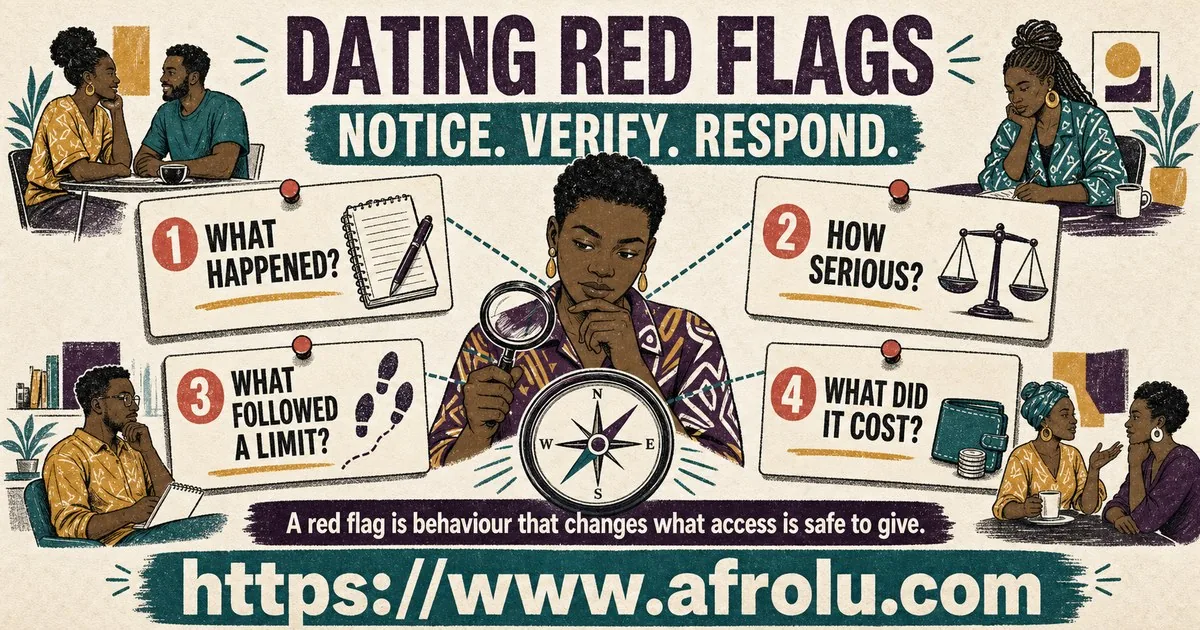
A red flag is observable behaviour that changes what access is safe to give. Separate facts from fear, then match the response to the level of risk. Afrolu visual:
Written and edited by Adwoa Boateng · Dating Safety Editor
Evidence and release review by Miriam Otieno · Senior Kenya Editor · Risk-pattern review by Nadine El-Sayed · Trust & Verification Editor · Reviewed 25 August 2026
A dating red flag is either one serious event or a repeated pattern that threatens safety, honesty, dignity, money, privacy, or freedom to choose. Record the observable behaviour, judge its severity, notice what happens when you slow down or say no, and choose a proportionate response. Threats, coercion, violence, blocked exits, ignored consent, or suspected fraud do not require another test; you also do not need to wait for unwanted following or surveillance to become a stalking pattern before seeking safety.
Dating safety
Is this one imperfect moment, a pattern to verify, or a reason to leave now?
Dating red flags are observable behaviours that suggest a meaningful risk to safety, honesty, respect, autonomy, or financial security. Some become clear through repetition; others are serious enough that one event justifies leaving, blocking, reporting, or seeking support.
The phrase red flag is often stretched until it means anything uncomfortable: a slow reply, an awkward joke, a different dating style, or ordinary nervousness. That makes the label less useful. A stronger approach separates facts from interpretations and asks four questions: what happened, how serious was it, how did the person respond to a limit, and what did the behaviour cost you?
Afrolu editorial triage
Read the event, severity, response, and cost before you read the person
A useful red-flag guide does not diagnose strangers or turn every mismatch into danger. It stays close to observable behaviour. The same late reply could be ordinary life, avoidance, dishonesty, or a poor fit; the label alone cannot decide. What matters is the full evidence and the amount of risk created while you wait for more.
This guide uses four Afrolu editorial lenses, not a validated risk assessment. Event asks what literally happened. Severity asks whether one incident is enough to act. Response asks what happens after a question, pause, or no. Cost asks whether the pattern is taking money, privacy, dignity, support, consent, or freedom. You do not need all four lenses to fail before protecting yourself.
What happened without interpretation?
Write the behaviour as a camera could record it: they asked for a transfer, insulted you, changed a story, checked your phone, ignored no, or cancelled without explanation.
Can one event be enough?
Threats, coercion, violence, non-consensual sharing, blocked exits, and ignored consent may justify action immediately. You also do not need to wait for suspected fraud, unwanted following, or surveillance to worsen before seeking safety.
What follows a limit or question?
Look for ownership and change. Deflection, mockery, retaliation, guilt, a new story, or the same behaviour after an apology adds evidence.
What is becoming less safe or less free?
Notice lost sleep, hidden friendships, pressured sex, money risk, private-data exposure, shrinking confidence, or fear of saying a simple no.
Start with the evidence
A moment, a pattern, and a one-event stop sign need different responses
Most uncertainty does not arrive with a label. Someone cancels twice, tells a joke that lands badly, becomes intense quickly, or gives a detail that does not match. Start with the camera version of the event rather than a diagnosis. Then add severity, repetition, response, and cost.
A lower-risk inconsistency may justify one question and slower access. A repeated crossing after a clear limit is stronger evidence. Threats, coercion, violence, ignored consent, a blocked exit, strong scam indicators, unwanted following, or surveillance may justify immediate distance or support. Proportionate does not always mean gradual.

Ask what happened, how serious it was, how the person responded to a limit, and what the behaviour cost your safety or freedom. Afrolu visual:
Scan four risk zones
Consent, money, control, and honesty leave different evidence
Safety and consent flags include pressure after no, unwanted touch, pressure to drink more, attempted sexual activity when a person cannot freely consent, threats, following, or interference with leaving. Money and identity flags include urgent transfers, codes, documents, tickets, account access, or stories that keep basic consistency checks out of reach.
Control and isolation can appear as device checks, location demands, clothing rules, punishment for friends, or loyalty tests. Honesty and accountability show up in changing stories, hidden relationship status, denial of observable events, and apologies that never change the next behaviour.

Consent and safety, money and identity, control and isolation, and honesty and accountability require different checks but the same respect for evidence. Afrolu visual:
Ask once, watch next
A short boundary can reveal more than a long investigation
For lower-risk moments, name the behaviour and the limit without prosecuting the whole person: "That comment was not okay with me. Do not speak to me that way." The next response adds evidence. Ownership and change are different from ridicule, blame, bargaining, retaliation, or repetition.
For money, private data, sexual contact, and first-meeting safety, you do not need to make the no collaborative. "I do not send money or codes" and "I only meet new dates in public" are complete. If direct communication could increase danger, skip it and prioritise distance and support.

A short sentence reveals more than a long prosecution. Safe people can hear a limit; pressure often becomes clearer after one direct no. Afrolu visual:
Keep the guide fair
Do not turn difference, discomfort, or stereotypes into evidence
A person can be shy, disabled, religious, divorced, older, younger, from another culture, close to family, private online, or slower to text without being unsafe. The useful question is not whether the person fits a familiar image. It is what they do with honesty, consent, respect, repair, and your right to choose.
Compatibility still matters. A communication style, faith practice, family expectation, location plan, or desire for children may be a dealbreaker without being a red flag. Naming incompatibility directly is cleaner than exaggerating it into danger.
Choose the next level of access
Observe uncertainty, verify claims, limit pressure, and leave danger
Use the smallest response that protects you fully. Observe a minor ambiguity without granting more access. Verify a changing story independently. Slow the pace after pressure. End contact when a limit is repeatedly crossed. Block and report suspected exploitation or unsafe contact.
When consent, physical safety, or freedom to leave is threatened, the next task is not perfect wording. Move toward safety, contact trusted people, and use appropriate local emergency or specialist support. You are allowed to leave before you can explain the entire pattern.

Uncertainty may need observation. Repeated pressure needs distance. Threats, coercion, suspected fraud, blocked exits, or unwanted following and surveillance require safety and support rather than another conversation. Afrolu visual:
Three red-flag decisions with different levels of risk
A cutting joke becomes a test of whether you will object
On a second date, they make a humiliating comment about your body and call it teasing. When you look uncomfortable, they say you are too sensitive. One poor joke can be repaired; the useful evidence is what happens after you name its impact.
Say: "That comment was not okay with me. Do not speak to me that way." If they own it and the behaviour stops, observe. If they mock the limit, blame you, or repeat it, end the date or connection.An emergency arrives before basic verification
A match avoids reasonable consistency checks, gives conflicting details about work, and then asks for a transfer, code, account access, or document because only you can help. The emotional story may be elaborate, but the safe decision does not require proving whether every detail is false.
Do not send money, codes, identification, tickets, or private images. Check claims independently rather than through links they provide. Block and report when pressure, impersonation, or suspected fraud appears.A public date is redirected toward privacy and pressure
They repeatedly push to change the venue to a home, order more alcohol after you decline, touch you after you pull away, or stand between you and the exit. This is not a moment to test communication skill or protect the mood.
Leave using the safest available route, contact a trusted person or venue staff, and seek appropriate local emergency or specialist support if you feel threatened. Your safety matters more than a polite ending.Four signs that access should slow down
A clear no is met with bargaining, punishment, ridicule, or another attempt
Stories about identity, availability, money, or relationship status keep changing
Care begins to require passwords, location access, isolation, or proof of loyalty
Urgency pushes you toward private meetings, money transfers, sexual contact, or secrecy before trust exists
Match the response to severity, repetition, and safety
| Situation | What it may mean | What to do next |
|---|---|---|
| One awkward moment, followed by ownership and change | A normal imperfection or skill gap that the person can recognise and repair. | Continue only if you want to, and let later behaviour confirm the repair. |
| An inconsistency with a plausible but unverified explanation | A yellow flag that needs context rather than instant trust or instant accusation. | Slow the pace, verify independently, and avoid increasing money, privacy, or physical access. |
| A limit is mocked, bargained with, punished, or crossed again | The issue is moving from misunderstanding toward a pattern that reduces your freedom. | Stop re-explaining. Reduce access, leave, or end contact according to the risk. |
| Money, codes, documents, or secrecy are requested with urgency | Possible exploitation, fraud, identity misuse, or a relationship built around pressure. | Send nothing, verify through independent channels, preserve evidence where safe, block, and report. |
| Consent, physical safety, or freedom to leave is threatened | A one-event stop sign, not a compatibility question. | Prioritise exit and support. Contact trusted people and appropriate local services. |
Three sentences that protect choice without starting a trial
“That comment was not okay with me. If it happens again, I will leave.”
“I do not send money, codes, documents, or private images to people I am dating.”
“I only meet new dates in public, and I arrange my own way home. If that does not work, I will not meet.”
Know the difference
Red flag vs Normal imperfection
A pattern that threatens safety, honesty, or respect.
A human mistake that can be owned and repaired.
Patterns matter more than one awkward moment.

A mistake can be named, owned, repaired, and changed. A red-flag pattern repeats, minimizes impact, shifts blame, or makes honesty less safe. Afrolu visual:
Red flag, yellow flag, dealbreaker, or ordinary mistake?
| Type or dimension | What it describes | Best next question |
|---|---|---|
| Red flag | Behaviour creates meaningful risk to safety, honesty, dignity, autonomy, privacy, or money. | Match distance to severity; do not wait for repetition when the first event is serious. |
| Yellow flag | Something is unclear or concerning, but context and the next behaviour could change the meaning. | Slow down, ask once if safe, verify, and keep access proportionate. |
| Dealbreaker | A clear incompatibility such as different plans for children, faith practice, location, or relationship structure. | Name the mismatch honestly. No one must be dangerous for the answer to be no. |
| Normal imperfection | A mistake or awkward moment is owned, repaired, and does not become a repeated cost. | Decide whether the repair is enough for you, then observe sustained change. |
The red-flag triage in five moves
Record the observable fact
Replace "they are toxic" with the behaviour you saw, heard, received, or were asked to do. Facts make proportionate decisions easier.
Classify the severity
Decide whether this is uncertainty to observe, a pattern to clarify, or a stop sign that needs immediate distance.
Ask once only when safe
Use one clear question or limit. Do not interview a threatening person in hope of obtaining a confession.
Watch the next behaviour
Ownership, repair, and sustained change matter more than a polished explanation delivered under pressure.
Adjust access
Verification, slower pace, less private information, ending contact, reporting, or seeking support are decisions, not punishments.
Why clear evidence can still be difficult to trust
Strong attraction may make warning signs easier to rationalise
Charm does not cause danger, but it may make uncomfortable evidence easier to explain away. As an Afrolu reflection prompt, ask what level of access you would suggest if a trusted friend described the same observable behaviour.
Difference is not automatically a warning sign
Accent, faith, disability, introversion, family structure, income, culture, age, and communication style are not red flags by themselves. Name the behaviour and its effect instead of using a stereotype as evidence.
Privacy and consistency checks can coexist
A person can reasonably protect personal information while still taking limited steps toward reality: consistent stories, a live call when practical, public meetings, and no pressure for money or secrecy. A live call can reduce one uncertainty but cannot establish identity or safety, and checking never creates entitlement to passwords or surveillance.
Jealousy becomes risk when it limits your freedom
A feeling of jealousy can be discussed. The concern grows when it becomes device checks, location demands, isolation from friends, clothing rules, threats, punishment, or pressure to prove loyalty through access.
An apology becomes more meaningful when behaviour changes
Ownership names the action and impact without making you comfort the person. Repair may include a practical change. Repeated apologies followed by the same crossing add to the pattern rather than erasing it.
You do not owe a risky confrontation
Direct conversation is useful only when it is safe and you want it. If someone is threatening, coercive, violent, repeatedly following or monitoring you, showing scam indicators, or sharing private material, prioritise distance, evidence preservation where safe, trusted support, and appropriate local services.
Four mistakes that make risk harder to read
Calling every incompatibility dangerous instead of naming the actual mismatch
It turns one difficult moment into a larger emotional decision before you have enough evidence.
Letting strong chemistry erase facts you would notice for a friend
It gives uncertainty more attention instead of asking for the clarity or consistency you need.
Confronting a threatening person alone to obtain a confession
It replaces a direct, answerable conversation with guessing, testing, or pressure.
Sending money, codes, documents, or private images to prove trust
It keeps you invested in a pattern that is not protecting your time, safety, or relationship goal.
Use a reviewed resource that matches the decision
This guide focuses on the relationship decision, so it does not rank dating apps. Check current prices, safety tools, and local availability before choosing a service.
Explore the guide library
Show more related guides
Continue with Afrolu
Show more Afrolu guides
Abuse, digital-control, scam, and stalking sources behind this guide
Afrolu reviewed these health, research, safety, or public guidance resources while editing this page. They support the behaviour and safety guidance; they do not diagnose any individual described by a reader.
Dating red flag questions, answered without alarmism
What is a red flag in dating?
Afrolu uses red flag as an editorial triage label for observable behaviour that suggests meaningful risk to safety, honesty, dignity, privacy, money, consent, or freedom to choose. Some concerns become clear through repetition. Threats, coercion, violence, blocked exits, ignored consent, or strong scam indicators can justify action the first time; unwanted following or surveillance can justify seeking safety before it forms a stalking pattern.
What is the difference between a red flag and a yellow flag?
A yellow flag is uncertainty that deserves slower pacing, context, or verification. A red flag carries stronger evidence or greater risk. For example, one unclear detail may need a question; repeated changing stories plus a money request calls for distance and independent verification.
Is a dealbreaker the same as a red flag?
No. A dealbreaker is an incompatibility that makes the relationship wrong for you, such as different plans for children, location, faith practice, exclusivity, or relationship structure. Neither person has to be unsafe or wrong for a dealbreaker to end the match.
Can one incident be a red flag?
Yes. Repetition is useful for lower-risk uncertainty, but you do not need a pattern before responding to ignored consent, threats, violence, blocked exits, non-consensual sharing, strong scam indicators, unwanted following or surveillance, or any event that makes you fear immediate harm. Stalking itself generally describes a pattern; safety-seeking does not have to wait for that label.
Should I confront someone about a red flag?
Only when it is safe and useful. A calm question can clarify lower-risk inconsistency or a hurtful mistake. Do not confront someone alone to obtain an explanation when they are threatening, coercive, violent, repeatedly following or monitoring you, or showing scam indicators. Distance and support are valid responses.
What should I do if I feel unsafe on a date?
Prioritise leaving over explaining. Move toward staff, security, other people, or a trusted contact; use your own transport plan where possible; and contact appropriate local emergency or specialist services if you face immediate danger. Preserve messages or other evidence only when doing so is safe.
One thing to do now
Protect your next decision, not the label
Do not wait for a pattern when the first event removes consent, safety, money, privacy, or freedom to leave. For lower-risk uncertainty, slow access, ask once if it is safe, and judge the response plus the next behaviour.

