Look for room for two
Emotionally Available Dating: The Capacity Map
Learn how to recognise emotional availability through usable time, honest limits, mutual curiosity, boundaries, and repair without mistaking intensity for readiness.
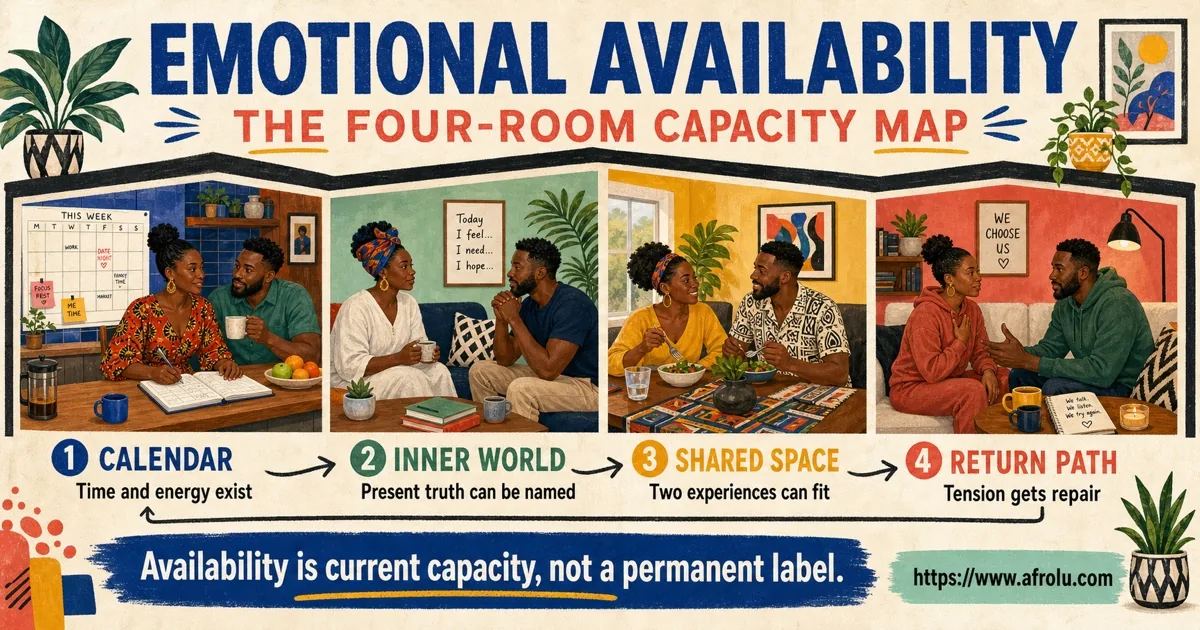
Look for usable time, the ability to name present truth, room for both experiences, and a return path after tension. Availability is current capacity, not a permanent label. Afrolu visual:
Written and edited by Adwoa Boateng · Dating Safety Editor
Emotional availability is current capacity for mutual intimacy. Look for usable time, honest awareness of feelings and limits, curiosity about your inner world, respect for boundaries, and a return path after tension. Strong attraction, frequent disclosure, or constant texting can accompany availability, but none proves it alone.
Emotional readiness
Does this connection have enough time, truth, reciprocity, and repair to make room for two whole people?
Emotionally available dating is the practice of building closeness with enough present capacity to know and be known, give and receive care, negotiate boundaries, and repair ordinary disconnection. It describes an offer available now, not a permanent identity or clinical diagnosis.
A person may tell a moving life story on the second date and still leave no room for yours. Another may speak carefully, text briefly, and keep creating dependable space for your experience. Disclosure is one door. Availability is the whole house.
The capacity-map method
Availability is not a personality type; it is the amount of usable room a relationship has now
The phrase “emotionally unavailable” is often used as a verdict on a person: cold, avoidant, selfish, damaged, or incapable of love. That verdict is usually too large for the evidence. A person can be caring and temporarily have no room for dating. Another can speak beautifully about feelings yet leave no room for a partner's needs. A reserved dater can be deeply receptive. This guide treats availability as a current relationship offer, not a diagnosis or permanent identity.
Walk through four rooms. The calendar asks whether time and energy exist. The inner world asks whether present feelings, wants, and limits can be named with reasonable honesty. Shared space asks whether two experiences can fit without one person becoming audience, rescuer, or manager. The return path asks what happens after disappointment, difference, or hurt. No room needs to be perfect. The question is whether all four are usable enough for the kind of closeness both people are choosing.
Does interest have somewhere to live?
Availability requires realistic time and energy, not constant access. Look for plans that fit work, care, health, faith, rest, friendship, and distance without asking one person to carry every adjustment.
Can present truth be named?
A person does not need perfect emotional vocabulary. They do need some way to say what they feel, want, cannot offer, or need time to understand without making ambiguity do all the speaking.
Can two people be known?
Disclosure is not automatically intimacy. Shared space includes listening, curiosity, privacy, consent, boundaries, and the ability to let your experience matter even when it differs from theirs.
Can the connection come back after strain?
Ordinary closeness contains missed cues and competing needs. Availability becomes visible when people can pause, return, acknowledge impact, clarify intent, and change a workable part of the pattern.
Begin with capacity, not character
Walk through the calendar, inner world, shared space, and return path
Start with the calendar because emotion needs somewhere to live. Count realistic dates, calls, travel, rest, work, parenting, care, health, faith, and friendship. Constant messaging is not required. A smaller rhythm can be fully available when it is honest and workable for both people. The useful question is not “Are they busy?” Everybody has demands. Ask whether the relationship offer has protected space and whether disruptions receive notice and an alternative.
Then inspect the inner world, shared space, and return path. Can the person say “I am excited,” “I am uncertain,” “I need more time,” or “I cannot offer exclusivity” without using affection to blur the answer? Can your experience sit beside theirs without becoming competition? After a missed cue, can either person return and help make sense of it? These rooms turn an abstract label into observable decisions.

Ask whether there is usable time, whether feelings and limits can be named, whether both people can be known, and whether connection can return after tension. Look for capacity, not emotional performance. Afrolu visual:
Do not grade volume as depth
Read one ordinary week of quiet availability instead of waiting for a grand declaration
Monday: the date is confirmed. Tuesday: a demanding workday is named instead of converted into unexplained silence. Wednesday: your worry receives a question before advice. Friday: a boundary about pace is accepted without sulking. Sunday: a small misunderstanding is revisited. None of these moments is cinematic. Together they show time, truth, reciprocity, autonomy, and return moving through real life.
Use the ordinary-week test on yourself too. Did you leave room for their answer, or were you collecting proof that they communicate exactly as you do? Did you make a request, or expect them to infer it? Did you allow a pause, or treat immediate processing as the only honest response? Mutual availability does not require identical styles. It requires a shared rhythm in which neither person must disappear to remain themselves.

Availability can be calm, reserved, and consistent: plans are confirmed, limits are named, your feelings are heard, boundaries are respected, and small tension receives repair. Afrolu visual:
Disclosure is one door
Separate emotional expression from the wider capacity to build intimacy
An expressive person may cry easily, write long messages, speak openly about therapy, share family history, or name attraction quickly. Those behaviours can support closeness. They can also exist beside an empty calendar, one-way conversation, boundary pressure, conflict avoidance, or no willingness to define the present offer. Do not punish openness with suspicion; simply avoid asking one feature to prove the entire relationship.
A less expressive person may need trust, time, a first language, movement, prayer, writing, or a calmer setting before finding words. Ask what care and repair look like for them. If they consistently refuse every conversation, dismiss your feelings, or leave after discomfort, the offer may be unavailable regardless of the reason. If they communicate limits and build a workable bridge, quietness is a style rather than a verdict.
Replace the secret test with a present-tense question
Ask about time, depth, and tension without demanding instant vulnerability
For time, ask: “What space do you realistically have for dating now?” For depth, state your pace: “I want emotional sharing to move slowly enough that we can both be heard.” For tension, invite a return: “Can we come back to what happened yesterday and decide what would help next time?” Each question is narrow enough to answer and leaves room for an honest yes, no, limit, or request for time.
Read three layers. Content is the answer. Process is whether the conversation contains curiosity, respect, pressure, shame, defensiveness, or negotiation. After-effect is whether the schedule changes, the pace is respected, or the repair happens. A polished answer can be encouraging, but capacity is the behaviour that becomes possible afterward. You are gathering shared information, not administering a hidden examination.

Ask what space exists for dating now, state the pace you want for emotional sharing, and invite a return to yesterday's tension. A clear question reveals more than a secret test. Afrolu visual:
Compassion does not require indefinite access
Continue, pace, step back, or take the safety exit from the offer that exists now
Continue when the four rooms are mutually usable, even if they are modest. Pace the connection when capacity is limited but honestly named, boundaries hold, and there is a reliable return or review point. Step back when intimacy keeps asking you to become the sole planner, audience, rescuer, or repairer; when the actual rhythm cannot meet an important need; or when hopeful words repeatedly substitute for usable room. No character verdict is required.
Use the safety exit when emotional access travels with sexual pressure, threats, stalking, monitoring, isolation, financial control, punishment for boundaries, or fear. Do not share more private information to prove love or arrange a private confrontation to obtain closure. Reduce access in the safest available way, involve trusted people, preserve relevant evidence where safe, and seek local specialist or emergency support as appropriate. Emotional availability never requires surrendering safety or autonomy.

Continue when capacity is mutual and usable; pace when limits are honest and return is steady; step back when access leaves no room for you; use a safety exit for pressure, control, or fear. Afrolu visual:
Three people can feel emotionally different and still overturn the obvious first impression
A moving disclosure on date two leaves one person feeling close and strangely absent
The date becomes intimate quickly. One person describes childhood pain, a difficult breakup, family conflict, and the fears they carry into love. The story is sincere, and the listener responds with care. When the listener shares a smaller worry of their own, the conversation returns immediately to the first person. Over the next week, late-night messages continue, but questions about the listener remain rare and a request to slow the emotional pace is treated as rejection.
Do not call the disclosure fake. Call the shared space incomplete. Say: “I value honesty, and I also need our conversations to make room for both of us. I want to slow the depth and see whether mutual curiosity grows.” Expression may be present while reciprocity and boundary capacity are not yet usable.A reserved dater shows availability through attention, planning, and return
Messages are brief and there are few dramatic declarations. The person proposes a date, confirms it, and says that speaking about feelings takes time. In person, they remember what was shared, ask before offering advice, and do not push when physical affection is declined. After a joke lands badly, they send a short message the next day: “I thought about what you said. I can see why that felt dismissive. Can we talk?”
Read the whole pattern rather than using word volume as the test. The person names a limit, makes time, receives another experience, respects a boundary, and opens a return path. Ask for what would help you too, such as one midweek check-in, then see whether the rhythm can fit both people.Caregiving, work, and distance create an honest offer that may still be too small
A diaspora dater is coordinating a parent's medical care, working across time zones, and travelling when money allows. They are affectionate and clear that they cannot offer weekly dates or daily calls for the next three months. They suggest two planned calls each month and a review after the care arrangement changes. They do not ask for exclusivity, emotional on-call access, or indefinite waiting.
This is honest limited capacity, not proof of bad character. Decide whether the available relationship is enough for you now. You may accept the time-limited agreement, keep dating non-exclusively if mutually understood, or decline with care. A credible reason explains capacity; it does not create compatibility by itself.Four capacities that make closeness usable instead of merely intense
Their schedule contains realistic space for dating
They can name present feelings and limits without making you manage them
Curiosity, care, and vulnerability move in both directions
They can return after tension and help repair the connection
Match your next step to the capacity being offered now
| Situation | What it may mean | What to do next |
|---|---|---|
| They share feelings carefully, make consistent plans, and ask about your experience | A quieter expressive style is carrying usable time, truth, and reciprocity. | Continue learning the person. Ask for any communication rhythm you need rather than requiring a more dramatic style as proof. |
| They disclose intensely but rarely listen, plan, or respect a slower pace | Emotional expression is present while shared-space or boundary capacity remains limited. | Slow the depth, name the missing reciprocity, and watch whether the relationship becomes more mutual instead of merely more revealing. |
| They want a relationship but have no realistic time for one | Interest and intention may be sincere while calendar capacity is unavailable now. | Ask for the actual rhythm and decide whether it works. Do not treat potential time as time already offered. |
| They name a temporary limit, avoid demanding exclusivity, and set a review point | Capacity is small but honestly described, preserving informed choice for both people. | Accept, negotiate, or decline the limited offer. If you wait, keep the arrangement time-bound and the rest of your life active. |
| A small disagreement receives a pause, a return, ownership, and changed behaviour | The return path is usable even though neither person handled the first moment perfectly. | Give repair real weight. Notice whether the adjustment lasts and whether both people are allowed to raise concerns. |
| Your boundary produces guilt, threats, monitoring, sexual pressure, or fear | The issue has moved beyond limited emotional skill into unsafe or controlling behaviour. | Do not use more disclosure to prove trust. Prioritise distance, trusted support, specialist services, and emergency help where appropriate. |
Three questions that reveal capacity without demanding instant intimacy
“What space do you realistically have for dating right now?”
“I want to take emotional sharing slowly enough that we can both be heard.”
“Can we return to what happened yesterday and decide what would help next time?”
Know the difference
Emotionally available vs Emotionally expressive
They make usable room for two people through time, honest limits, reciprocity, boundaries, and repair.
They may show or describe feelings vividly while still lacking time, mutual curiosity, boundaries, or a return path after tension.
Expression can open a door. Availability keeps the whole relationship space usable.

An expressive person may show feelings vividly. An available person also makes time, receives your experience, respects boundaries, and returns for repair. Disclosure is one door; availability is the whole house. Afrolu visual:
Emotionally available, expressive, interested, cautious, or honestly at capacity?
| Type or dimension | What it describes | Best next question |
|---|---|---|
| Emotionally available | Time, self-awareness, reciprocity, boundaries, and repair create enough room for mutual closeness at the agreed pace. | Keep observing the ordinary pattern and negotiate the relationship you both have capacity to build. |
| Emotionally expressive | Feelings may be shown vividly or discussed often, but expression alone does not reveal time, listening, boundaries, or repair capacity. | Appreciate the openness, then check whether your experience and limits can enter the same space. |
| Interested but unavailable now | Attraction and sincere intention exist, while work, care, grief, health, distance, another commitment, or low energy leaves too little usable room. | Decide from the actual offer. Respecting the reason does not require waiting or accepting a relationship that cannot meet you. |
| Slow to trust or naturally reserved | Disclosure develops gradually, yet plans, listening, consent, warmth, and return remain visible and the pace can be discussed. | Do not force vulnerability. Ask for the small forms of connection you need and see whether both styles can fit. |
| Emotionally unavailable offer | Access may be wanted, but present time, mutuality, honest limits, boundaries, or repair repeatedly cannot support the requested closeness. | Name the specific missing capacity, ask once where useful, and reduce the relationship to a level that is genuinely mutual or step away. |
The four-room capacity map in five grounded moves
Map the calendar
Identify the time and energy that can actually support calls, dates, rest, travel, care, and ordinary disruption. Interest without usable room may be sincere but unavailable in practice.
Listen for present truth
Notice whether feelings, wants, uncertainty, and limits can be named without turning every answer into a promise about the future.
Check for two-way space
Track who asks, listens, adjusts, remembers, and receives care. Intimacy is not one person performing emotion while the other holds the room.
Test one boundary
A request to slow down, keep information private, change a plan, or decline touch shows whether closeness can coexist with autonomy.
Observe the return
After a small misunderstanding, look for pause, contact, ownership, curiosity, and a workable adjustment. Repair matters more than never getting it wrong.
What emotional availability means, and what the research cannot decide for you
“Emotionally available” is useful only when it describes behaviour instead of diagnosing a person
The term is not a clinical diagnosis. Use it to describe present capacities that another person can observe: making time, naming a limit, receiving a feeling, respecting a no, tolerating difference, and returning after tension. Avoid claiming that one quiet week, one difficult conversation, an attachment label, or a painful history reveals a fixed inability to love. Behaviour can change, and a relationship can still be unsuitable while change remains possible.
Feeling understood can support emotional expression, but expression is not a one-way test of readiness
Two studies indexed by PubMed used a two-week daily diary and an experiment to examine perceived partner responsiveness and emotional expression. Greater perceived responsiveness was associated with more expression in daily life, and experimentally induced responsiveness increased expression of anxiety in the study setting. This supports building a receptive climate rather than demanding disclosure. It does not prove that every private person is unavailable or that disclosure guarantees relationship capacity.
More expression is not automatically healthier for every person, moment, or culture
Laboratory research with couples found that links among emotional expression, partner support, and stress differed according to participants' usual approach to emotions. Other couple research has found that the relationship between suppression and satisfaction depends partly on personal orientation and how a partner's suppression is perceived. These studies have sample and setting limits, but they warn against a universal rule that louder feelings equal greater availability. Culture, safety, privacy, neurotype, language, disability, faith, and family learning can shape how openness looks.
Good communication matters, but one conversation cannot manufacture capacity
Across three longitudinal studies of newlywed couples, negative communication and satisfaction were associated at the same points in time, while communication rarely predicted later changes in satisfaction. The authors caution against a simple cause-and-effect story. In dating terms, a thoughtful script can reveal or negotiate capacity; it cannot force time, readiness, attraction, compatibility, safety, or sustained change. Judge the conversation and the ordinary behaviour that follows it.
Availability includes the freedom not to disclose everything immediately
Healthy closeness needs communication and support, but it also needs privacy, space, boundaries, and equality. A request for slower disclosure can be an available response when it is clear and respectful: “I want to answer, but not tonight,” or “I need more trust before discussing that.” Pressure for trauma details, passwords, sexual history, medical information, or constant location access is not intimacy. Consent applies to emotional information as well as physical contact.
The fairest capacity map faces both directions
Ask whether your own calendar has room, whether you can name the relationship you want, whether another person's feelings can matter without becoming a threat, and whether you return after discomfort. Sometimes the unavailable offer belongs to the person doing the evaluation: seeking closeness while keeping every evening protected, inviting disclosure but avoiding questions, asking for consistency while disappearing during conflict, or dating mainly to escape loneliness. Honest limits are kinder than an aspirational offer you cannot sustain.
Four shortcuts that mislabel people and hide the actual offer
Treating intense disclosure as proof of readiness
It turns one difficult moment into a larger emotional decision before you have enough evidence.
Labelling a reserved or low-text person emotionally unavailable
It gives uncertainty more attention instead of asking for the clarity or consistency you need.
Confusing attraction or pursuit with capacity
It replaces a direct, answerable conversation with guessing, testing, or pressure.
Auditing another person while ignoring your own current limits
It keeps you invested in a pattern that is not protecting your time, safety, or relationship goal.
Use a reviewed resource that matches the decision
This guide focuses on the relationship decision, so it does not rank dating apps. Check current prices, safety tools, and local availability before choosing a service.
Explore the guide library
Show more related guides
Continue with Afrolu
Show more Afrolu guides
Relationship research and healthy-boundary guidance behind this capacity map
Afrolu reviewed these health, research, safety, or public guidance resources while editing this page. They support the behaviour and safety guidance; they do not diagnose any individual described by a reader.
Emotional availability questions answered without personality labels
What does emotionally available mean in dating?
Emotionally available means having enough present capacity for mutual closeness. In practice, there is realistic time and energy for dating, some ability to name feelings and limits, curiosity about the other person, respect for privacy and boundaries, and a way to return after ordinary tension. It is a description of a current offer, not a diagnosis, personality type, or guarantee of compatibility.
What are early signs of emotional availability?
Look for small behaviours that survive real life: a plan fits the person's actual calendar, interest includes reciprocal questions, a no does not trigger pressure, uncertainty can be admitted, and a minor misunderstanding receives a return rather than disappearance. One deep conversation or affectionate week is encouraging but insufficient. Availability becomes clearer across different moments and modest costs.
Is someone emotionally unavailable if they do not talk much about feelings?
Not necessarily. Culture, personality, trust, language, neurotype, privacy, disability, faith, safety, and family learning can shape emotional expression. A reserved person may still make time, listen well, accept boundaries, show care, and repair tension. Ask how they communicate and what helps them open gradually. Judge whether both styles can create a usable relationship, not whether one person performs openness in the expected way.
Is sharing trauma a sign of emotional availability?
Trauma disclosure may be sincere and vulnerable, but it does not prove relationship readiness. Check whether the disclosure is consensual and paced, whether the other person can also be heard, whether boundaries remain respected, and whether the relationship functions outside intense conversations. You can respond with care without becoming a therapist, rescuer, secret keeper under pressure, or sole emotional support.
Can someone like me and still be emotionally unavailable?
Yes. Attraction, affection, intention, and capacity are different. Work, caregiving, grief, health, distance, another commitment, limited energy, or difficulty with mutual intimacy can leave little room even when feelings are genuine. Ask what the person can offer now and decide whether that rhythm meets your needs. You do not have to call their feelings false in order to decline the relationship.
How do I ask whether someone is emotionally available?
Ask about observable parts of capacity rather than requesting a label. Try: “What space do you realistically have for dating now?” “How do you prefer to handle it when something feels uncomfortable?” or “I want emotional sharing to move at a pace where we can both be heard; how does that feel to you?” Then observe whether the answer, process, and later behaviour align.
How can I become more emotionally available for dating?
Start with your own four rooms. Budget realistic time, practise naming a present feeling or limit, ask and listen without immediately solving, choose a privacy boundary, and return after a small disconnection. Offer the relationship you can sustain rather than the one you hope to become ready for later. Therapy or another qualified form of support may help when past experiences or current distress repeatedly make closeness difficult.
When should I step back from an emotionally unavailable relationship?
Step back when the available time, reciprocity, boundaries, or repair repeatedly cannot support an important need; when a clear question receives only promises without change; or when you are becoming the sole planner, listener, or regulator. If boundaries produce coercion, threats, stalking, monitoring, sexual pressure, control, or fear, prioritise safety and trusted specialist support rather than another private availability conversation.
One thing to do now
Choose the amount of closeness that can be built by two people now
Choose usable room for two people, not the loudest emotional performance. A sincere person can have limited capacity, and you may respect the reason while declining the offer.