Know the way back
Signs of a Secure Relationship: The Way-Back Loop
Learn the signs of a secure relationship through truth, autonomy, bounded conflict, reliable return, repair, and the small changes that rebuild trust.
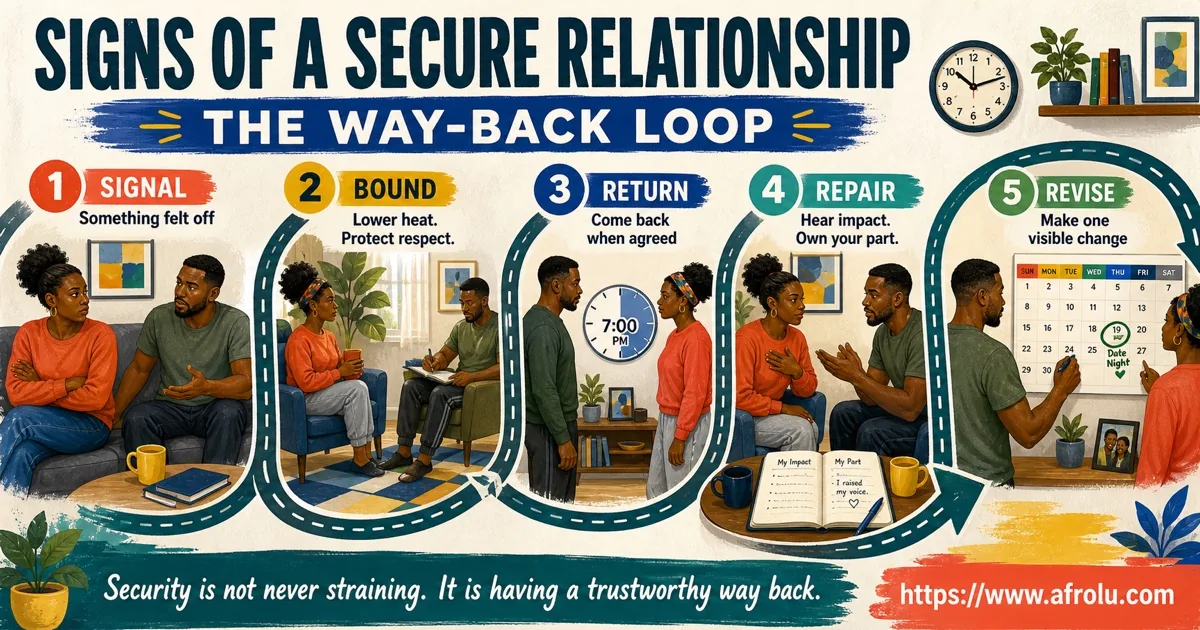
Notice the signal, lower the heat without removing respect, return when agreed, understand impact and responsibility, then make one visible revision. Security is not never straining; it is having a trustworthy way back. Afrolu visual:
Written and edited by Jean-Claude Mukendi · Relationship Guides Editor
A secure relationship makes room for truth, difference, and separate lives without using uncertainty as power. Conflict stays bounded, a pause includes a return, repair names impact and responsibility, and the next version of the agreement becomes visible in behaviour. Security is not never straining; it is having a trustworthy way back.
Healthy relationships
When the connection bends under an ordinary no, misunderstanding, or competing need, do both people still know a respectful way back?
A secure relationship is a mutually shaped connection in which both people can seek closeness, keep autonomy, communicate important truths, and move through ordinary disconnection without punishment, coercion, or loss of self. It is a pattern of interaction, not a promise of permanent calm.
A relationship may look peaceful because one person has stopped asking, disagreeing, or saying no. Another may include awkward moments yet become safer each time both people return, understand the impact, and adjust. Silence can preserve calm; repair builds security.
The way-back method
Security lives in the path through strain, not in permanent calm
A relationship can be quiet because both people feel safe, or because one person has learned that honesty costs too much. It can include conflict because both people are careless, or because two real lives are meeting without pretending to be identical. The number of disagreements does not settle the question. Follow what happens when a plan changes, a no limits access, a feeling lands badly, or two needs cannot both lead at once.
The way-back loop has five observable stations. A signal names that something changed. A bound lowers heat while keeping dignity and safety intact. A return happens at a stated time rather than after one person chases. Repair makes room for intent, impact, responsibility, and both experiences. Revision changes one practical part of the system and checks whether it helps. A secure loop can be imperfect and still become more reliable; an apology-only loop restores contact while leaving the next rupture untouched.
Can the change be named?
A secure relationship allows “That hurt,” “I disagree,” “I need rest,” or “This plan no longer works” without requiring a case, a diagnosis, or a threat to leave.
Can the heat be contained?
Lower voices, separate rooms, a walk, or a pause can protect the conversation. The boundary does not permit insults, intimidation, coercion, surveillance, property damage, or blocked exits.
Does the pause have an endpoint?
“I need thirty minutes; can we continue at seven?” is different from unexplained withdrawal. A trustworthy return means neither person must beg for the relationship to restart.
Can impact and responsibility coexist?
Useful repair can hold two truths: the harm may not have been intended, and it still affected the other person. Listening is followed by ownership rather than a debate over who is allowed to feel hurt.
What becomes different next time?
Trust grows when the calendar, message, boundary, division of effort, or conflict habit changes in a visible way. Repeating the same apology without revision is contact recovery, not full repair.
Begin with a low-risk boundary
Watch what the relationship does after one small no changes access
A small no is one of the cleanest windows into security because it creates disappointment without requiring a major crisis. “Not tonight,” “I do not want that photo posted,” “I need Sunday with my family,” or “I am not ready for sex” changes what another person may receive. The secure response can include a feeling, question, or negotiation. It cannot require guilt, coldness, pressure, ridicule, surveillance, or a loyalty performance before warmth returns.
Test the pattern in both directions. One partner may handle sexual boundaries well but resist financial limits; the other may welcome schedule changes but punish emotional privacy. Security is not awarded from one exemplary moment. Ask whether both people can make requests, hear no, propose alternatives, and keep seeing the person behind the boundary. A no protects choice; a secure bond lets choice remain compatible with care.

One person asks to spend the night, the other chooses rest, an alternative date is offered without pressure, and warmth remains. A boundary changes access; it should not remove care. Afrolu visual:
Security needs more than closeness
Check whether truth, difference, autonomy, and return are all permitted
Truth means a real feeling, need, mistake, or limit can be named. Difference means love does not require identical politics, tastes, faith practice, family habits, or emotional timing. Autonomy means each person can maintain safe privacy, friendships, interests, rest, work, and decision-making. Return means connection can resume after space or strain without one person surrendering the truth that caused it. Remove any permission and apparent security becomes narrower.
Context matters. Public visibility may carry different risks for LGBTQ+ daters, people in restrictive families, public-facing careers, or diaspora relationships where news travels across communities. Separate space can look different for parents, carers, people with disabilities, and those sharing housing or finances. The standard is not one Western picture of independence. Ask whether the arrangement is explained, mutually shaped, revisable, and free from coercion.

Security gives both people permission to tell the truth, hold a different view, keep a separate life, and reconnect after strain. The bond supports two full people rather than demanding one shared performance. Afrolu visual:
Give the pause a bridge
Use five short sentences to move from heat into a reliable return
Pause: “I want to slow this down before I become careless.” Return: “Can we talk again at seven?” Impact: “When the plan changed without a message, I felt left outside the decision.” Responsibility: “I see that I assumed you would adjust and did not tell you.” Revision: “Next time, let us confirm changes by noon.” The sentences are not a magic order; they keep regulation from quietly replacing the relationship conversation.
Both people do not need identical accounts before repair begins. Intent can explain an action while impact describes what entered the relationship. Responsibility asks what each person can own, not how blame must be split evenly. Revision should be small enough to observe and important enough to matter. If every discussion produces eloquent insight but the calendar, boundary, division of effort, or tone remains unchanged, the loop is stopping before trust is rebuilt.

Slow the conversation, name when it will resume, describe impact, own your part, and agree on one change. A pause becomes secure when the return is clear and kept. Afrolu visual:
Distance can regulate or control
Distinguish a bounded pause from open-ended withdrawal and forced pursuit
A bounded pause communicates three things: this conversation matters, I cannot do it well at this intensity, and I will help reopen it at a stated time or after a stated condition. The timing may need to account for work, prayer, sleep, disability, medication, childcare, safety, or a time-zone difference. If more time is needed, a brief update preserves the bridge. Nobody has to process instantly to prove love.
Withdrawal becomes corrosive when it has no return path, removes necessary practical information, is used to make the other person beg, or repeatedly leaves one partner carrying every reopening. Pursuit can also become coercive when messages, calls, door-knocking, or demands ignore a clearly bounded pause. The secure goal is neither endless distance nor forced immediacy. It is a mutually understood rhythm of regulation and return.
Apology is not the final station
Continue, practise, reassess, or use the safety exit by reviewing what changed
Continue when more truth can enter, the pause-and-return path grows more dependable, and repair reduces the same avoidable harm. Practise when care and return exist but ownership or revision is inconsistent; choose one low-risk loop and one review date. Reassess when the same rupture receives the same moving apology while one person carries all the adaptation. A relationship can contain love and still lack a workable repair system.
Use the safety exit when fear, coercion, threats, stalking, monitoring, isolation, sexual pressure, financial control, property destruction, violence, or blocked exits appear. Do not wait for a complete five-step loop or announce a boundary in a way that increases danger. Seek the safest available route, trusted people, specialist services, and emergency help as appropriate. Security requires freedom to participate; fear is not a difficult communication style.

Continue when truth and repair increase; practise when return exists but revision is weak; reassess when the same rupture receives the same apology; use a safety exit for fear, coercion, or punishment. Afrolu visual:
Three ordinary moments reveal more about security than a perfect weekend
Declining a sleepover changes the plan without changing the warmth
After a good date, one person asks, “Do you want to stay over?” The other says, “Not tonight. I am exhausted and want to sleep at home.” There is a brief flash of disappointment, then: “Okay. Would Saturday afternoon work?” They hug goodbye. The next morning does not contain coldness, guilt, a sexual joke, or a test of whether affection was earned.
Notice the whole sequence. The invitation was allowed, the no was complete, disappointment did not become punishment, and connection remained available. Security is not having no preference; it is allowing another person's autonomy to alter access without making them pay for it emotionally.A disagreement about posting the relationship online receives a real return time
One partner posts a photo before asking. The other is upset because family members do not yet know about the relationship. Voices rise. One says, “I am too activated to listen well. I want to pause and come back at seven.” At seven, they return without being chased. The person who posted removes the image, acknowledges the privacy impact, and they agree to ask before future posts while planning how the relationship will be introduced to family.
The pause did not erase the issue or make one person responsible for restarting contact. Repair included impact, a practical action, and a future agreement. Cultural or family context was discussed without letting it become a permanent veto over the other person's need for clarity and dignity.“We never fight” hides a relationship in which only one preference reaches the table
The couple appears easy. Weekend plans, spending, holidays, and contact with former partners rarely produce visible conflict. One person privately dislikes several arrangements but says “anything is fine” because earlier questions were met with sighing, withdrawal, or a lecture about being dramatic. The relationship is calm because one inner life has stopped entering it.
Do not treat low conflict as sufficient evidence. Ask whether both people can influence plans, say no, keep separate relationships and interests, and raise a concern without losing warmth. A secure relationship does not require every preference to win; it requires both people to remain real participants.Four permissions that let two full people stay connected
Important truth can enter without fear of punishment
A pause names when and how the conversation will resume
Repair includes impact, responsibility, and a workable change
Closeness supports two connected people rather than one merged identity
Match the response to what the relationship does after strain
| Situation | What it may mean | What to do next |
|---|---|---|
| A small no is accepted, an alternative is offered, and warmth remains | Autonomy and connection can coexist; access is not being confused with proof of love. | Continue observing. Let both people make requests and decline them so the pattern is tested in more than one direction. |
| A pause is requested with a clear return time and the person comes back without chasing | The relationship can regulate intensity without turning distance into punishment or abandonment. | Use the return to discuss impact and revision. Do not treat merely resuming contact as the entire repair. |
| Apologies are warm, but the same preventable rupture repeats unchanged | Contact recovery is present while revision and trust rebuilding remain weak. | Name the repeated system, agree on one observable change and review point, and decide what you will do if the loop stays the same. |
| The couple rarely argues because one person stops raising needs | Peace may be maintained through self-silencing, unequal influence, fear of withdrawal, or learned hopelessness. | Test whether a small preference can enter safely. If questions repeatedly cost warmth or dignity, reassess the relationship rather than praising its calm. |
| Both people communicate respectfully but cannot reconcile a core goal or structure | The relationship may be secure in process and incompatible in direction, location, faith, children, exclusivity, or another central need. | Do not use good repair to postpone a real incompatibility. A secure ending can honour the relationship without forcing the fit. |
| Conflict includes coercion, threats, blocked exits, monitoring, sexual pressure, or fear | The issue is not an incomplete repair loop; safety and freedom are being compromised. | Use the safety exit. Reduce access where safely possible, involve trusted support, preserve evidence where safe, and seek specialist or emergency help as needed. |
Three return-and-repair scripts for different kinds of strain
“I want to pause before we say something careless. Can we return to this at seven?”
“I understand what I intended, and I also want to hear how it affected you.”
“What is one small change each of us can make before this situation happens again?”
Know the difference
Secure relationship vs Conflict-free facade
Truth, difference, autonomy, and repair can enter without threatening the whole bond.
The relationship stays calm because needs, disagreement, or boundaries are hidden or carried by one person.
Peace is secure when honesty can disturb it and both people still know the way back.

Secure peace can hold honesty, a time-bound pause, reliable return, changed behaviour, and two separate selves. A conflict-free facade protects calm by hiding needs or making one person carry them. Afrolu visual:
Secure relationship, conflict-free facade, intensity, fusion, or ordinary incompatibility?
| Type or dimension | What it describes | Best next question |
|---|---|---|
| Secure relationship process | Truth, difference, boundaries, separate lives, and ordinary conflict can enter while respect, return, repair, and influence remain available to both people. | Keep practising the way-back loop and judge it across different topics, stresses, and directions of need. |
| Conflict-free facade | Calm depends on hidden needs, avoided topics, unequal influence, or one person accepting the cost of every compromise. | Bring one small preference into the open and observe whether honesty can disturb the peace without destroying care. |
| High-intensity bond | Reunions, declarations, chemistry, and relief may feel powerful while rupture and reconciliation repeat without a stable revision. | Grade the ordinary week and the changed behaviour, not the emotional height of the reunion. |
| Fused or dependent connection | Closeness is maintained through constant access, shared identity, or reduced outside life, making boundaries and difference feel like rejection. | Restore safe individual time, friendships, interests, privacy, and decision-making while observing whether the bond can tolerate two selves. |
| Secure but incompatible | Both people communicate, respect boundaries, and repair, yet a central goal or relationship structure still cannot fit both lives. | Make the compatibility decision directly. Security improves how an ending is handled; it does not remove every reason to end. |
The way-back loop in five observable moves
Name the signal
Use the camera version: the plan changed without notice, a joke felt exposing, one voice stopped being heard, or a boundary was crossed. Avoid starting with a character verdict.
Bound the heat
Lower intensity while preserving dignity. Agree on what is off limits during conflict and what each person can do if safety or respect breaks down.
Set and keep the return
Choose a specific time or condition for resuming. The person asking for a pause carries responsibility for returning rather than making the other person pursue.
Repair the impact
Let intent provide context without using it to erase impact. Hear both experiences, take responsibility for your part, and make any immediate restoration needed.
Revise one system
Change the confirmation time, privacy rule, division of effort, message habit, or exit plan. Review whether the change reduced the same rupture when life tested it again.
What relationship research can teach about responsiveness and recovery, with its limits intact
Secure is not a moral ranking or a permanent attachment label
Attachment language can help people notice patterns, but this page does not diagnose either partner as secure or insecure. People can feel more secure in one relationship than another, and the same couple can handle one topic well and another poorly. Describe the interaction: a concern was welcomed, a pause had a return, a boundary was respected, or an apology produced change. A behavioural description supports a decision without pretending to know a person's entire history.
Feeling understood and cared for is associated with security in the specific relationship
A study of 472 people in 236 couples found that people who perceived their partner as more responsive reported less partner-specific attachment anxiety and avoidance, especially when they generally felt more insecure. The design supports an association, not a guarantee that one response transforms attachment or proves a relationship safe. Still, it gives practical weight to a simple question: when you bring a real need, do you experience understanding, validation, and care rather than only an answer?
The minutes after conflict can carry information that the argument itself does not
An observational study followed 73 young adults who had been studied since birth and their romantic partners. After a conflict discussion, researchers coded how well participants shifted into a cool-down task. Better partner recovery was associated with more positive relationship emotion and satisfaction, and interacted with earlier attachment history in predicting stability two years later. The sample was small, young, and studied in a structured setting, so the findings are not a household scorecard. They support reviewing recovery as its own relationship process.
One person can keep the conflict alive while the other withdraws, creating a loop neither explains alone
A longitudinal study of 100 couples examined “recovery sabotage”: negative behaviour and continued conflict during the moments after a disagreement. It was distinct from how much conflict was resolved during the argument and was linked to transactions between partners, including a demand-withdraw pattern. This cautions against assigning one fixed villain from one role. The practical task is to interrupt the loop: stop pursuit that becomes pressure, stop withdrawal that becomes abandonment, and agree on a bounded return both people keep.
Security protects separate interests and influence, not only closeness
CDC Dating Matters materials describe healthy relationships through balanced power, trust, open and honest communication, respectful interaction, appropriate boundaries, and space for individual interests. The training is designed for teen dating-violence prevention, so it is not a clinical measure for adult couples. Its public-health framework is still useful: closeness that requires passwords, constant location, abandoned friendships, financial dependence, or one person's silence is not made secure by affection.
Repair language is not appropriate when conflict contains coercion, control, or fear
A way-back conversation assumes both people can speak, pause, leave the room, decline contact, and return without retaliation. If conflict includes threats, sexual pressure, stalking, monitoring, isolation, financial control, property destruction, blocked exits, violence, or fear, do not use a private repair exercise to test the bond. Prioritise safety planning, trusted support, specialist services, and emergency help where appropriate. An apology after abuse does not by itself make the cycle secure.
Four ways a relationship can look secure while one person disappears inside it
Calling a conflict-free facade secure
It turns one difficult moment into a larger emotional decision before you have enough evidence.
Treating immediate agreement as the only proof of care
It gives uncertainty more attention instead of asking for the clarity or consistency you need.
Accepting apologies that restore calm but never change the pattern
It replaces a direct, answerable conversation with guessing, testing, or pressure.
Confusing constant access or dependence with closeness
It keeps you invested in a pattern that is not protecting your time, safety, or relationship goal.
Use a reviewed resource that matches the decision
This guide focuses on the relationship decision, so it does not rank dating apps. Check current prices, safety tools, and local availability before choosing a service.
Explore the guide library
Show more related guides
Continue with Afrolu
Show more Afrolu guides
Conflict-recovery, responsiveness, and healthy-relationship guidance behind this guide
Afrolu reviewed these health, research, safety, or public guidance resources while editing this page. They support the behaviour and safety guidance; they do not diagnose any individual described by a reader.
Secure relationship signs answered without perfection myths
What are the main signs of a secure relationship?
Look for a relationship in which truth can enter without punishment, both people can influence plans, a no does not remove care, separate lives remain possible, conflict stays bounded, pauses include a reliable return, and repair produces a practical change. Do not require perfect calm. Review whether the relationship repeatedly helps two people reconnect without coercion, fear, chasing, or loss of self.
Can a secure relationship still have arguments?
Yes. Two people with different histories, needs, schedules, cultures, and preferences will sometimes disagree. Security is visible in how the disagreement is handled: no threats or coercion, heat can be lowered, both voices can return, impact is heard, responsibility is taken, and the next version of the agreement becomes clearer. Frequent contempt, intimidation, or fear is not made secure by later reconciliation.
Why can a secure relationship feel boring after chaotic dating?
Predictability can feel unfamiliar when attraction has often been paired with uncertainty, chasing, reunion, or dramatic proof. Calm does not automatically mean compatibility, and intensity does not automatically mean love. Give attention to curiosity, play, attraction, growth, separate interests, and the way small differences are handled. Secure can be alive and exciting without requiring fear to create the excitement.
What does healthy repair after conflict look like?
Healthy repair begins by making the conversation safe enough to continue. Each person describes the event and impact, listens for meaning, and owns their part without demanding equal blame. Immediate restoration may include an apology, corrected information, removed post, repaid money, or honoured boundary. The final step is one observable revision and a later check that it helped. Repair is more than resuming affection.
What is the difference between a healthy timeout and silent treatment?
A healthy timeout is used to regulate, not punish. It communicates that the issue matters, gives an approximate return time or condition, preserves necessary practical contact, and follows through. Silent treatment uses unexplained or open-ended withdrawal to control, avoid, or force pursuit. If someone needs longer than expected, a brief update can protect the return path without forcing a conversation before they are ready.
Can an insecure relationship become more secure?
Patterns can change when both people can recognise the loop, share responsibility, practise different responses, and maintain those changes under stress. Start with one low-risk repeated rupture and one observable revision. Relationship counselling from a qualified professional may help when both people freely choose it and the relationship is safe enough for joint work. Couples work is not a substitute for safety planning in coercive or violent situations.
Does a secure relationship require sharing everything or spending all free time together?
No. Security supports privacy, boundaries, friendships, family ties, work, faith, interests, and time alone alongside chosen closeness. The important distinction is whether separation is communicated and whether both people retain influence and access to support. Constant passwords, location tracking, abandoned friendships, or demands for immediate disclosure can reduce autonomy even when framed as love or transparency.
When is conflict a safety issue rather than a repair issue?
Treat conflict as a safety issue when it includes threats, violence, sexual pressure, stalking, monitoring, isolation, financial control, property destruction, blocked exits, retaliation for boundaries, or fear. Do not arrange a private repair conversation to test whether the person can change. Prioritise distance where safely possible, trusted support, specialist services, and emergency help appropriate to your location and circumstances.
One thing to do now
Use the next small difference to learn whether the way back is real
Do not grade security by the absence of conflict. Follow the entire loop: what can be said, how tension is bounded, whether return is reliable, whether impact is understood, and whether anything changes next time.

