Protect your peace
Dating Boundaries
Set dating boundaries around time, texting, money, privacy, intimacy, and emotional pace with clear scripts, examples, and follow-through.
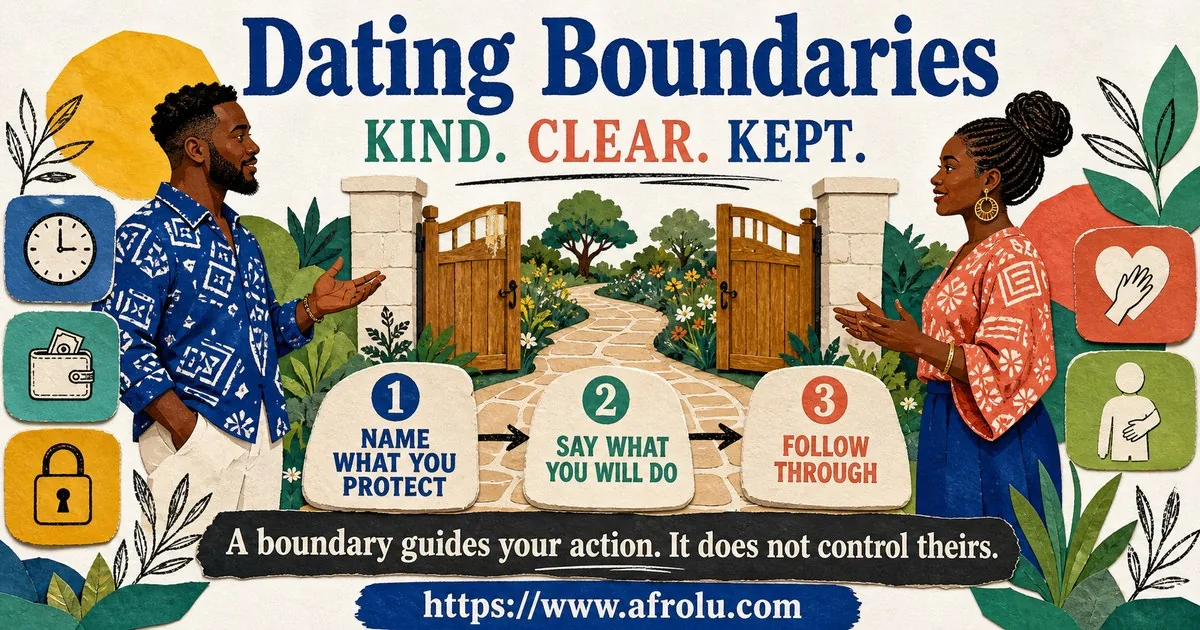
A useful boundary names what protects you and what you will do if the situation continues. It does not try to control another adult. Afrolu visual:
Written and edited by Nia Kato · Profile Advice Editor
A dating boundary names what protects your time, money, privacy, body, safety, or emotional capacity, then states the action you control. It is not a threat and it is not a rule for managing another adult. Say it specifically, read the response, and follow through proportionately.
Healthy communication
How do you protect your standards without building a wall?
Dating boundaries are clear limits around how you will participate in a connection and, when needed, what you will do if a condition is not respected. They protect resources such as time, money, privacy, physical consent, emotional pace, faith, family responsibilities, and safety.
Many people discover a limit only after resentment arrives. They over-explain because they want permission, announce a consequence they cannot keep, or call every preference a boundary. A better boundary is smaller: name the protected resource, state the available behavior, and choose your own next action.
Afrolu editorial framework
A boundary usually directs your behaviour; control tries to direct theirs
Dating advice often turns boundaries into lists of commands: reply within an hour, remove every ex, share your password, or stop seeing certain friends. Those may be wishes, agreements, or attempts at control. A personal boundary is different. It names the conditions under which you can participate safely and respectfully.
This guide uses Afrolu's limit-and-action test as a practical writing aid, not a clinical assessment. First name the resource you are protecting: time, money, privacy, body, safety, or emotional capacity. Then name the action that remains under your control. "If money requests continue, I will end the conversation" describes your participation. "You are forbidden to ask anyone else for money" tries to manage another person.
What are you protecting?
Tie the boundary to something real: sleep, work time, finances, private data, physical consent, emotional pace, faith, family responsibilities, or safety.
What is and is not available?
Use plain behavior. "I do not share passwords" is clearer than "You need to respect me more." Specific language reduces accidental confusion.
What will you do?
Choose an action you can carry out: pause the chat, leave the date, stop lending, meet only in public, reduce access, or end the connection.
How is the limit received?
Respect may include a question or disappointment. Mocking, guilt, threats, repeated testing, and retaliation reveal a different problem.
Start with the level
Preference, request, boundary, and safety rule are not the same
A preference describes what you like: perhaps morning dates or a phone call instead of constant texting. A request invites cooperation: "Could we plan by Thursday?" Neither automatically needs a consequence. Treating every preference as a non-negotiable boundary can make ordinary compatibility feel like enforcement.
A boundary names what you will participate in, while a safety rule protects against risk. "I meet new matches in public" does not need to be negotiated in a private flat. Choosing the correct level keeps small differences flexible and serious limits firm.

Not every preference needs a consequence, and not every safety rule is negotiable. Name the level before choosing your words. Afrolu visual:
Choose the protected area
Time, money, privacy, body, and emotional pace need different language
A time boundary might limit late calls or all-day texting. A financial boundary may prohibit transfers, loans, account access, or shared bills before trust and legal protection exist. A privacy boundary can cover passwords, live location, private photos, workplace details, or when family learns about the connection.
Physical and emotional boundaries need room to change. You can enjoy affection and decline sex, want commitment and decline a rushed timeline, or care about someone and limit crisis calls you cannot safely hold. Name the resource instead of calling every difficult feeling a red flag.

Boundaries become easier to keep when they are tied to a specific resource: your time, money, private information, body, or emotional capacity. Afrolu visual:
The limit-and-action formula
Short language makes the response easier to read
Use two parts when follow-through is needed: the limit and the action. "I do not lend money in new relationships. If the requests continue, I will end the conversation." The sentence does not diagnose motives or demand agreement. It gives the other person accurate information about your participation.
For a preference or request, softer collaboration may be enough: "I enjoy hearing from you, and I focus better without messages during work. Can we catch up this evening?" Strength is not measured by harshness. It is measured by whether the words match the level and you can keep them.

Say what you are available for, then state the action you control. Short language makes the response easier to evaluate. Afrolu visual:
The response is evidence
Respect can include disappointment; pressure removes your freedom
Someone can dislike a boundary and still respect it. They may need to check whether the arrangement works for them, propose a different mutual agreement, or decide that you are incompatible. Those are adult choices. Respect does not require cheerful agreement with every limit.
Watch for a different pattern: jokes that humiliate you, guilt about proving love, repeated bargaining after no, punishment, surveillance, threats, or the same crossing after an apology. Do not keep increasing the detail of your explanation when the real conflict is whether you are allowed to choose.
Follow-through
The boundary becomes real when your action matches your words
Start proportionately. Clarify a misunderstanding. Slow access when pressure appears. Leave a repeated pattern. Seek immediate support when you feel unsafe. The aim is not maximum distance in every conflict; it is enough action to protect the resource the boundary was built around.
If you repeatedly announce a consequence you will not keep, pause and rewrite it. Choose the smallest action you can honestly take. A quiet, consistent limit is more trustworthy than a dramatic warning that disappears when attention returns.

Respect supports connection. Questions may need clarification. Pressure or repeated crossing may warrant more distance; threats, blocked exits, or ignored consent may require immediate safety and support. Afrolu visual:
Workplace boundary desk
Keep willing dating conversation outside employer systems
A colleague can be a dating connection only while both eligible adults retain ordinary professional choice. Move willing personal conversation away from employer systems; never request work logins, calendars, client information, badge access, private shifts or live location.
You can say, “Let’s use our personal numbers, and keep work channels for work.” Avoid “Message me on the work system so I know you are interested,” because employment access is not romantic proof. If work access continues, pause contact.

A usable boundary names the channel you accept, the request to avoid, and the action you control next.
Keep the action yours
Leaving separately is a boundary; tracking a colleague is control
A boundary states the access you accept and the action you control. “I leave work separately” protects choice. “You must show me where you go” attempts to manage another adult.
A date, rejection or prior relationship never creates permission to follow somebody, approach a private workplace area, inspect a device or demand proof of movement.

The ownership test asks whether the sentence governs your access and action or commands another adult.
When private discussion should stop
Repeated unwanted contact may require an appropriate support route
If unwanted contact repeats, preserve only the relevant material and stop trying to settle it through a private romantic negotiation. Use the employer’s applicable harassment, grievance, ethics, union, security or other authorised support route.
Afrolu cannot decide facts, liability or confidentiality for a named workplace. An authorised adviser can explain options; immediate danger requires the relevant urgent service.

Preserve only relevant material, stop private negotiation, and use an authorised workplace or urgent-safety route when appropriate.
Three ordinary moments where a boundary changes the outcome
A new match expects access throughout your workday
The conversation is enjoyable, but they become irritated when you do not reply during meetings and start sending multiple messages to ask where you are. You want regular contact without turning your phone into proof of interest.
Say: "I do not text while I am working. I will reply in the evening; if that rhythm does not suit you, we may not be a fit." Then keep the rhythm instead of apologising for every delay.A person you have not met asks for a transfer
They describe an emergency and make trust the condition: if you cared, you would send money now. The story may be true or false, but early financial pressure creates risk you do not need to investigate through payment.
Say: "I do not send or lend money to people I have not met and verified." Do not negotiate the amount. End contact if pressure, blame, or a new emergency follows.Affection is welcome, but the physical pace is not
A date is going well and you want to continue seeing the person. They move toward more physical intimacy than you want tonight. Saying no does not require you to reject the entire connection or provide a history that proves your reason.
Say: "I like you, and I am not ready for that. I want to slow down." If they stop but feel disappointed, you can decide whether the fit still works. If they keep bargaining, block your exit, or continue touching you, prioritise leaving and contacting support.Four signs your boundary is becoming necessary
You feel resentment because access has become expected rather than chosen
You keep saying yes while hoping the person notices your discomfort
A small no leads to bargaining, guilt, ridicule, or repeated testing
The same limit is crossed after clear communication and an apology
Match your response to how the limit is received
| Situation | What it may mean | What to do next |
|---|---|---|
| They respect the limit | They can tolerate difference and care about your comfort, even if the boundary is not their personal preference. | Continue at the agreed pace and notice whether respect remains consistent. |
| They ask a genuine question | The limit may need context or a practical agreement, not immediate distance. | Clarify once. Keep the core limit visible and avoid turning the conversation into a trial. |
| They bargain, mock, or guilt you | They are treating access as more important than your right to choose. | End the discussion, slow access, and apply the action you stated. |
| They agree, then cross it repeatedly | The problem is no longer unclear wording. The repeated behavior is the answer. | Stop announcing the same consequence. Follow through or end the connection. |
| They threaten, trap, expose, or frighten you | This is a safety issue rather than a compatibility conversation. | Prioritise exit, evidence preservation where safe, trusted support, and appropriate local services. |
Three boundary sentences that do not invite a debate
“I do not text while I am working. I can catch up this evening; if that rhythm does not suit you, we may not be a fit.”
“I do not send or lend money in new online connections. If the requests continue, I will end the conversation.”
“I like you, and I am not ready for that physical step. I want to slow down; if that is not respected, I will leave.”
Know the difference
Boundary vs Wall
A clear limit that keeps connection respectful.
A defensive block that avoids all vulnerability.
Good boundaries protect warmth; they do not remove it.

In ordinary, non-dangerous conflict, a boundary can explain how connection may continue. Total distance can still be a necessary safety choice; this visual is an analogy, not a diagnosis. Afrolu visual:
Boundaries beside nearby communication patterns
| Type or dimension | What it describes | Best next question |
|---|---|---|
| When to Delete Dating Apps: Pause, Uninstall, Cancel or Close the Account | Both sit near healthy communication, but this page is reading the pattern through real-life timing and pressure and the related guide uses a different signal mix. | Use this guide first for clarity, dignity, and emotional safety, then compare with When to Delete Dating Apps: Pause, Uninstall, Cancel or Close the Account if the label still feels uncertain. |
| Ghosting in Dating | Both sit near healthy communication, but this page is reading the pattern through real-life timing and pressure and the related guide uses a different signal mix. | Use this guide first for clarity, dignity, and emotional safety, then compare with Ghosting in Dating if the label still feels uncertain. |
| Situationships: Turn Closeness into a Clear Choice | Both sit near healthy communication, but this page is reading the pattern through real-life timing and pressure and the related guide uses a different signal mix. | Use this guide first for clarity, dignity, and emotional safety, then compare with Situationships: Turn Closeness into a Clear Choice if the label still feels uncertain. |
| Types of Dating: Build Your Five-Part Map | Both sit near healthy communication, but this page is reading the pattern through real-life timing and pressure and the related guide uses a different signal mix. | Use this guide first for clarity, dignity, and emotional safety, then compare with Types of Dating: Build Your Five-Part Map if the label still feels uncertain. |
The boundary process in five usable moves
Name the resource
Is the issue your time, money, privacy, body, safety, emotional capacity, family responsibility, or faith practice? Precision makes the next step easier.
Choose the level
Decide whether this is a preference, request, boundary, or safety rule. Do not attach a breakup consequence to every small preference.
Use one clean sentence
Say what you are available for and, when needed, what you will do. Remove the long case designed to make the other person approve.
Watch the response
A respectful person may ask a question, but they do not mock, bargain endlessly, retaliate, or test the same limit again.
Keep your own word
Follow through with the action you named. If you cannot keep it, revise the boundary honestly instead of issuing a larger threat.
Why a simple limit can feel emotionally difficult
Discomfort does not automatically mean the boundary is wrong
Some people feel guilty when they state a limit, even when the limit is proportionate. Treat guilt as a feeling to notice, not a verdict. Recheck whether the limit is within your control and consistent with how you want to treat others.
Physical boundaries can change at any point
Interest, flirting, a previous yes, travel, gifts, or paying for a date never removes the right to pause or stop physical contact. Consent needs to remain voluntary and current. A caring partner notices hesitation and makes room for a clear answer.
Shared context does not guarantee shared expectations
Family involvement, faith practices, gender roles, public affection, and timelines can carry different meanings even within the same community. Explain the behavior you need rather than assuming a label such as traditional, modern, or religious settles every detail.
Follow-through is not punishment
Leaving a date, ending a call, or reducing contact may disappoint someone. The purpose is not to make them suffer until they comply. It is to remove yourself from a condition you already said you would not continue accepting.
Trust does not require surveillance
Passwords, device checks, private photos, live location, and account access can create ongoing privacy and security exposure. Share only what serves a clear purpose and can be withdrawn where the technology allows. Pressure to prove loyalty through access is a reason to slow down, not surrender more data.
Danger is not a communication exercise
If someone threatens you, prevents you from leaving, follows you, exposes private material, or makes you fear immediate harm, prioritise distance and support over the perfect boundary sentence. Contact trusted people and appropriate local emergency or specialist services.
Four ways a useful boundary loses its shape
Explaining until the other person finally approves your limit
It turns one difficult moment into a larger emotional decision before you have enough evidence.
Attaching a severe consequence to every personal preference
It gives uncertainty more attention instead of asking for the clarity or consistency you need.
Announcing follow-through you are not prepared to keep
It replaces a direct, answerable conversation with guessing, testing, or pressure.
Treating guilt or disappointment as proof that the boundary is unkind
It keeps you invested in a pattern that is not protecting your time, safety, or relationship goal.
Use a reviewed resource that matches the decision
This guide focuses on the relationship decision, so it does not rank dating apps. Check current prices, safety tools, and local availability before choosing a service.
Explore the guide library
Show more related guides
Continue with Afrolu
Show more Afrolu guides
Boundary, consent, money, and digital-safety sources behind this guide
Afrolu reviewed these health, research, safety, or public guidance resources while editing this page. They support the behaviour and safety guidance; they do not diagnose any individual described by a reader.
Dating boundary questions, answered with examples
What is a dating boundary?
A dating boundary is a clear limit around how you will participate in a connection and, when necessary, the action you will take if that condition is not respected. It can protect time, money, privacy, physical consent, emotional pace, faith, family responsibilities, or safety.
What is the difference between a boundary and a rule?
As an editorial writing aid, Afrolu treats a rule as a direction to another person: "You must answer immediately." A personal boundary usually describes your participation: "I need reasonably consistent communication; if this pattern stays unreliable, I will step back." Couples can also make mutual agreements, but those require both people's consent.
How can I set a boundary without sounding rude?
Use one specific sentence, a calm tone, and no character judgment. Try: "I do not take calls during work, but I can talk after six." Clarity may still disappoint someone. Your task is respectful delivery, not guaranteeing that every listener likes the limit.
Do I need to explain why I have a boundary?
A short explanation can help a caring person understand, but you do not owe private history or a persuasive case. For physical consent, money, passwords, private images, and safety, a clear no is enough. Repeated demands for justification can become pressure.
What should I do when someone keeps testing the same boundary?
Stop improving the wording and use the follow-through you named. That may mean ending the call, leaving the date, removing digital access, reducing contact, or ending the connection. Repetition after clear communication is behavior to evaluate, not a vocabulary problem.
Can a boundary be changed later?
Yes. Boundaries can change as trust, circumstances, capacity, and the relationship change. Revise them deliberately and communicate the change. Do not abandon a safety limit only because someone creates urgency, guilt, or fear of losing them.
Is blocking someone a healthy boundary?
Blocking can be proportionate when contact is unwanted, manipulative, threatening, or keeps pulling you into a harmful cycle. It is less useful as a silent test designed to make a safe person chase. Choose it for protection or closure, not as a hidden communication strategy.
What if setting a boundary makes the person leave?
Their decision may hurt, but it also clarifies compatibility. A connection that depends on unlimited access, financial help, ignored consent, or silence about your needs is already charging too high a price. Grieve the loss without treating it as proof that clarity was wrong.
One thing to do now
Make the next connection safer before it becomes intense
If the sentence tells only the other person what they must do, rewrite it. A usable boundary includes a choice or action that remains yours.

