1 · Decision
Define the page's job
Name the reader, question, geography, and decision. A distinct URL must do more than repeat a generic app list with a new place or audience label.
A URL, word count, template, or official-looking link is not enough. Release depends on the exact claims, evidence boundaries, method, limitations, reviewer, dates, and commercial output of the page.
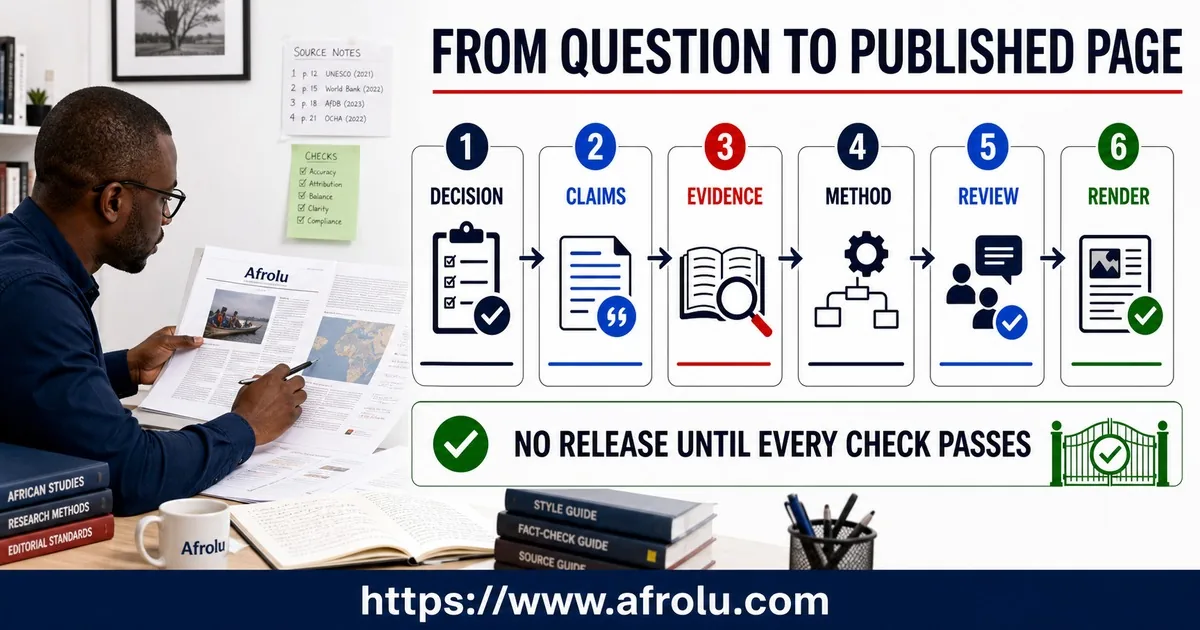
Name the reader, question, geography, and decision. A distinct URL must do more than repeat a generic app list with a new place or audience label.
Record platform features, prices, payment paths, local-market statements, safety guidance, verification statements, comparisons, scores, snippets, and commercial ordering.
Every registered source has an identifier and a stated support boundary. A DCI safety page cannot substantiate app pricing; a Google payment page cannot substantiate a platform ranking or Kenyan user pool.
Explain how options were selected or how a result is calculated. State what the evidence cannot answer and which details still require a current in-app, checkout, or official-source check.
The release record must name an approved reviewer, match the exact route and evidence key, and contain valid publication and review dates. Placeholder names or future-dated records fail closed.
The final HTML is checked for robots conflicts, sitemap eligibility, schema type, visible sources, tool logic, internal links, and commercial leakage. The rendered page is the publication.
| Page type | Required depth | Fail-closed result |
|---|---|---|
| Browser tool | Functional inputs and results, disclosed rules, model version, reviewer, dates, sources, and limitations. | A static checklist is noindex and cannot use WebApplication schema. |
| Research report | Named dataset, sample definition, collection period, method, claim inventory, sources, and limitations. | A research agenda is noindex and cannot use Report schema. |
| App review or comparison | Evidence for features, pricing, payment, safety, local statements, ordering, scores, snippets, FAQs, and every commercial placement used. | Scores, verdicts, rich review schema, and affiliate calls to action are removed. |
| Relationship guide | Standalone editorial review, situation-specific examples, proportionate advice, safety boundaries, sources where factual guidance depends on them, and a reviewed visual/layout pass. | Unapproved variants render only a compact noindex editorial hold. |
A global platform description, one enforcement case, or an editor's search observation does not establish city user counts, market share, match rates, fake-profile rates, or scam prevalence.
A documented verification feature supports a feature statement. It does not prove every profile's identity, background, intent, or safety, and it does not justify a “safest app” conclusion by itself.
Google Play M-PESA Xpress and direct app-level M-PESA billing are different claims. Prices, payment routes, taxes, renewal terms, and eligibility must be checked on the current checkout screen.
Repeated headings, FAQs, cards, and internal links can increase word count without adding evidence. Substantive depth comes from scoped claims, methods, sources, limitations, and useful analysis.
Original Afrolu editorial visuals may be viewed on Afrolu and shared for personal, non-commercial reference when the visual remains unaltered, the embedded Afrolu URL remains visible, and the share links back to the guide that explains it.
Reproduction in publications, advertising, courses, products, datasets, commercial social accounts, or altered derivative works requires written permission. Use the contact page with the image URL, intended use, territory, duration, and format.
Each released dating-guide visual carries a visible Afrolu credit, publication year, descriptive filename, page caption, and machine-readable creator, rights, license, and source-page metadata.
Platform names, trademarks, externally supplied images, screenshots, and quoted source material remain subject to their respective owners' rights. This image-use statement applies only to visuals identified as original Afrolu editorial visuals.
If a source is stale, a claim exceeds its evidence, or a tool rule produces an unclear result, send the page URL, the disputed statement, and supporting evidence. A material correction requires the page and its release record to be reviewed again.
Country evidence stays separate
Afrolu's editions use the same editorial standards while checking country-specific access, payment, privacy and reporting claims separately. Evidence for one country does not establish app availability, prices, local membership or legal requirements in another.
A country hub identifies the scope of its guides. It does not claim a local Afrolu office, a pool of verified singles or a country-wide app ranking. Reader examples are illustrative unless an article explicitly identifies reported research. The country selector opens an equivalent reviewed topic where one exists and otherwise opens the chosen hub.