Quick route: for product categories, open the Kenya dating sites guide. For Nairobi context, use the Nairobi apps guide. For risk planning, begin with online dating safety in Kenya. If you are ready to inspect a live account, use or choose a job-specific lane below.
Choose one useful next read
Find the guide for your question
Each picture belongs to the guide it opens. Start with the decision you face now; the route can change when your question changes.
These guide links and image pairings were checked 24 October 2026. Read the date and source limits in each guide before acting.
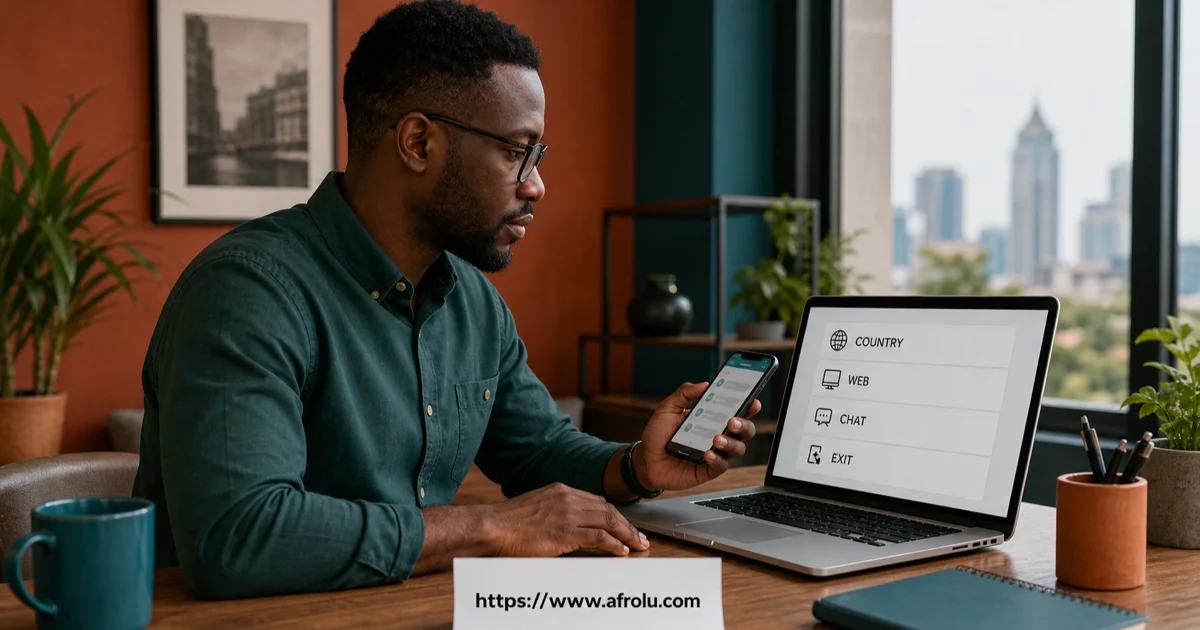 Choose a serviceDating sites in KenyaCheck access, chat and exit before choosing a site.
 Inspect one appTinder in KenyaSee what your own account can do before paying.
 Check the conversationBumble in KenyaReview current chat rules and controls in your account.
 Plan in a cityDating apps in NairobiCompare the work of two apps without guessing who uses them.
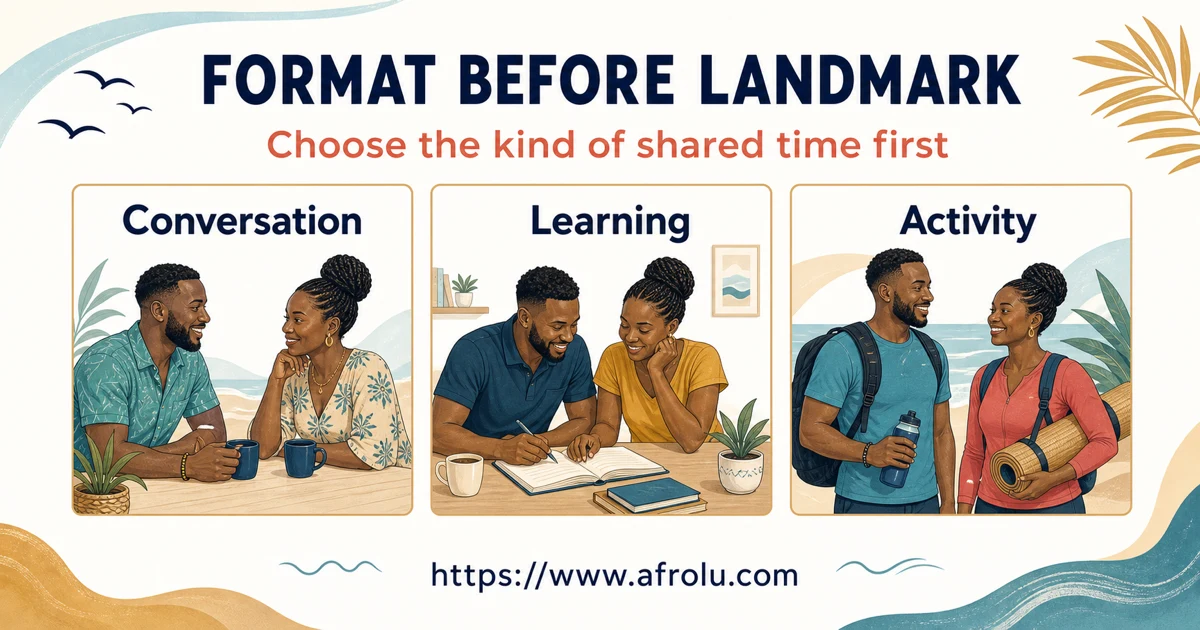 Plan a first meetingDating in MombasaChoose the kind of shared time before a landmark.
 Name your intentionSerious relationship planningTurn a long-term label into a plan two adults can discuss.
 Dating across bordersDating in Kenya as a visitorKeep your profile place, present place and plan honest.
 Protect your choicesOnline dating safety in KenyaChoose a response that fits the signal you can see.
 Stop a money requestKenya dating scamsSeparate fraud, account, evidence and reporting steps.
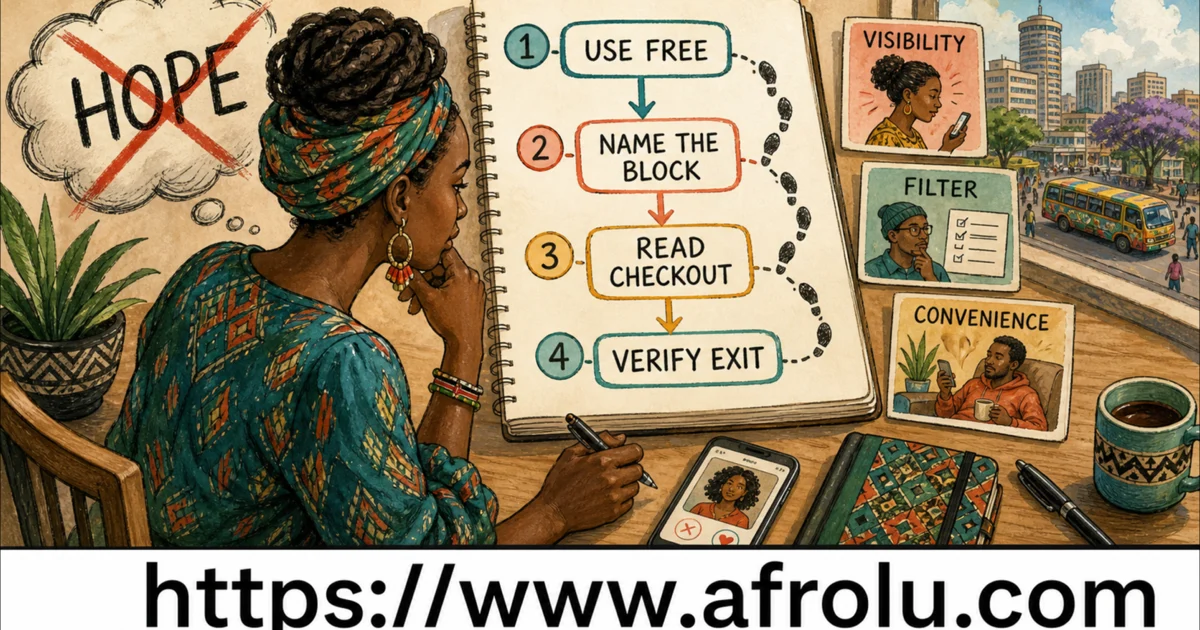 Before a subscriptionFree versus paid appsName the missing function and check the exit first.
A country hub should route, not manufacture a national ranking
Kenya contains different cities, travel patterns, languages, faith contexts, work schedules and relationship goals. A single numbered list would collapse those differences and invite claims the available evidence cannot support. Afrolu does not possess a representative census of Kenyan dating-app users, city-level activity, professional concentration, match quality or relationship outcomes. Current store listings and provider support pages prove much narrower facts.
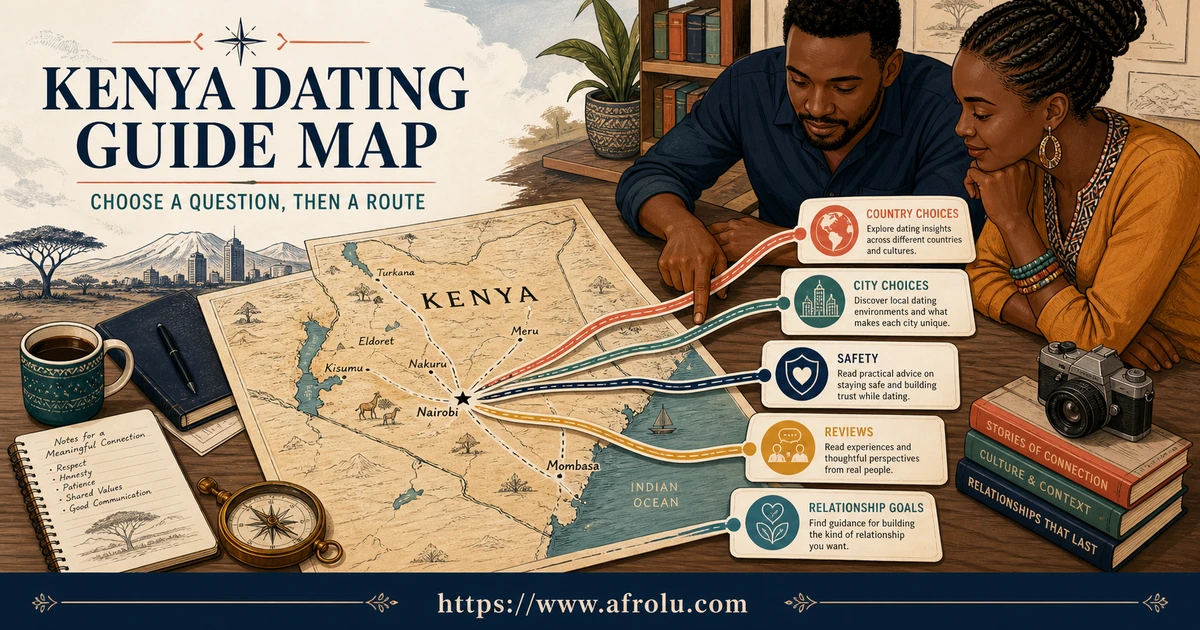
This hub therefore begins with the decision, not a brand or city keyword. Choose a product guide for controls, a place guide for logistics, a relationship guide for purpose, or a safety guide for risk. When no dedicated guide fits, use the broader Kenya guidance and leave unsupported local details unknown rather than borrowing claims from another place or product.
Choose by product question
Use reviews and comparisons when you need mechanics, controls, billing or a feature boundary—not a claim about the “best people.”
Choose by place
Use a city or regional guide for meeting logistics, privacy and travel context. The guide does not claim a local member pool.
Choose by relationship goal
Use serious, marriage, boundary or pace guidance to clarify conduct that no profile label can guarantee.
Choose by risk
Use scam, fake-profile, Telegram-pressure and reporting guides when a signal requires evidence preservation or escalation.
Start with the product or comparison route
The best dating sites in Kenya guide explains how to inspect current categories without turning affiliate availability into a market ranking. The Tinder Kenya review focuses on discovery, matching, messaging, reporting and account controls. The Badoo Kenya review separates Encounters, Discover, conversations and optional paid features. The Bumble Kenya review uses current conversation guidance instead of an outdated universal “women message first” rule.
For a direct mechanics comparison, use Tinder versus Badoo in Kenya. For browser-led international use, choose international dating sites in Kenya. If Hinge is the search intent, begin with the Kenya Hinge availability stop; Kenya is absent from Hinge’s official availability list at this review, so that route does not proceed to setup.
Simple match-and-message inspection
and verify the live account rather than assuming city volume.
Encounter and discovery inspection
and keep core conversation separate from paid extras.
Current conversation-rule inspection
; do not rely on an old slogan.
Question-led profile inspection
when written context is the job.
Muslim marriage-context inspection
only when that specialist framing fits.
Free versus paid decision
Use the Kenya free-versus-paid guide before any checkout. Pay only for a named control bottleneck.
A Kenya Apple listing is a storefront receipt for that iOS listing on the date checked. It does not establish Android access, universal feature parity, member count, local popularity, safety or outcomes. The reader must confirm the device, store, account, privacy controls and live terms they will actually use.
Choose a city or regional guide
Local guides are useful when the question concerns travel, meeting logistics, privacy and ordinary place context. They are not evidence about who is on an app. Nairobi readers can use dating apps in Nairobi for city-level planning, Eastleigh privacy and permission guidance for optional family or community involvement, and Runda serious-singles planning for a deliberate, privacy-conscious routine.
Coast readers can use the guides for Mombasa, Malindi and Diani. Rift Valley readers can choose Nakuru or Eldoret. Western and Central guides include Kisumu, Nyeri, Meru and Murang’a.
Choose the route nearest the real meeting plan, not the city name that seems most prestigious. A local page can help you think about independent transport, venue verification, schedule exposure and public-meeting options. It cannot tell you how many compatible people use a service nearby.

When a town has no dedicated local guide, preserve the evidence gap
A search for a town such as Voi does not automatically justify a Voi dating-app page. The place name identifies the reader’s question; it does not supply current evidence about product access, local activity, compatible adults, travel conditions, venues, fares, safety or outcomes. Afrolu will not replace that missing evidence with generic city copy or send the reader to Mombasa merely because both names may appear in a broader Coast conversation. A nearby city is not a proxy for another adult’s ordinary week.
Use a four-part unserved-town check. First, keep country mechanics national: dated Kenya storefront receipts and provider help can support only the exact access or control claim they document. Second, keep relationship purpose personal: the serious-intent, boundaries, communication and free-versus-paid guides work without inventing a town population. Third, keep safety with the national safety guidance: privacy, app reporting, money-pressure containment and appropriate Kenyan incident channels do not become a local safety rating. Fourth, write the local evidence gap plainly and stop.
The unserved-town stop: “Afrolu has no dedicated local guide or audited local app dataset for this town. Use Kenya-level mechanics and safety guidance, then verify any real meeting plan through current first-party information. Do not infer a local pool, route, fare, venue operation or safety conclusion.”
The reader can still make a useful decision. Write a broad truthful place without a home, workplace or live route. Decide whether a possible conversation could support one independently reachable public plan. Before arranging anything, both adults confirm the exact occupied setting, opening state, entrance, time window, separate arrival and separate return through current authoritative or first-party information. If that evidence is missing, changes, or would require one person to depend on the other, postpone. The absence of a local guide never creates permission to improvise a private meeting.
Product choice remains bounded too. A Kenya iPhone listing can establish one dated storefront receipt, not a Voi user pool. A distance or location setting can change discovery, not prove physical presence or willingness to travel. A profile, badge, match, reply or paid feature cannot certify identity, intent or safety. Use no more than the account you legitimately control, collect no stranger dataset, and judge only whether the product’s current mechanics support your own truthful, proportionate next step.
A dedicated local guide earns its place only when it provides a different evidence-backed tool: for example, a current civic boundary needed to distinguish similarly named places, a documented public-planning mechanism, or a transport dependency that changes the decision. Even then, the sources must remain narrow and the guide must not claim local app popularity or safety. Until that evidence exists, use national mechanics and safety guidance, verify the real plan independently, and leave town-level app claims unknown.

Choose by relationship purpose, not a profile label alone
The serious relationships in Africa guide helps define present capacity, pace, exclusivity and practical progress. The serious dating guide translates “long term” into observable conversations and choices. The dating boundaries guide supplies language for privacy, pace, money and meeting limits, while the red-flags guide distinguishes a concern to clarify from a reason to stop.
A service can expose an intention field, but the field remains self-description. Ask what the label means in current life: available time, communication rhythm, exclusivity expectations, distance, faith, children, family involvement and financial boundaries. Do not accelerate disclosure or commitment merely because two labels match.
when explanations matter. when the adult deliberately wants a Muslim marriage-focused environment. Neither route proves sincerity; conversation and repeated conduct remain the evidence.
Choose by audience or cross-border situation
People navigating Kenya from outside the country should use a route that names their actual circumstance. Dating apps for Kenya expats focuses on honest location, time horizon and practical boundaries. The Kenya foreigners guide addresses the visitor-resident distinction without treating nationality as intent. The Kenya–USA long-distance guide separates identity, time zones, travel and money evidence.
Cross-border interest should never justify an invented local location. Some providers offer documented travel or location controls, but those controls do not convert a visitor into a resident or prove access in every account country. State where you are, where you expect to be, and what meeting horizon is realistic.
if that is the named job. if cross-border discovery is deliberate. Confirm the chosen country and live account before acting.
Safety is a route family, not a badge
Begin with online dating safety in Kenya for privacy, platform controls, public meetings and escalation. Use Kenya dating scams for money pressure, impersonation and urgent-story patterns. Use fake dating profiles in Kenya for a proportionate claim check. If a match pushes the conversation to Telegram and applies pressure, use the Telegram pressure report-and-block guide.
Protect data
Keep exact home, workplace, routine, documents, financial details, PINs and OTPs private. Kenya’s data-protection framework gives rights; it does not remove the need for minimisation.
Keep evidence proportionate
Save only what is needed for a platform or official report. Do not publish another person’s identity or create a private surveillance archive.
Use the right channel
Report platform conduct in the platform, cybersecurity incidents to KE-CIRT where appropriate, and suspected crime to official Kenyan channels.
Stop money pressure
Never send a new match fare, emergency funds, investment money, “verification” charges, PINs or OTPs. Safaricom publishes M-PESA fraud guidance.
before relying on them. in the live account. Verification narrows one uncertainty; it does not certify identity, biography, relationship status, intent or safety.

Inspect billing and exit before purchase
Paid controls belong after the free workflow test. Identify the exact bottleneck, then capture merchant, price, currency, term, renewal and cancellation from the live checkout. Store billing and direct provider billing can have different cancellation routes. Deleting an app icon, hiding discovery and deleting an account are not automatically the same as cancelling a subscription.
. . . The product can change, so preserve the receipt from the account you actually use.
A one-question route method
| Your next question | Best guide family | Stop condition |
|---|---|---|
| Which mechanics fit me? | Product review or named comparison. | No current access or control receipt. |
| How should I plan locally? | Named city or region guide. | The route would require an unsupported pool claim. |
| How do I test serious intent? | Relationship-purpose and boundaries guides. | A label is being treated as proof. |
| What should I do about a warning sign? | Safety, scam, fake-profile or pressure guide. | Immediate danger requires official emergency help, not more editorial reading. |
| Should I pay? | Free-versus-paid and provider billing guidance. | No named bottleneck or clear cancellation receipt. |
Read only far enough to answer the current question. Then act, pause or collect the missing receipt. Opening many guides at once can create the same unbounded attention problem as opening many apps.
Use a three-pass navigation method
Pass one is classification. Write the question without an app name if possible. “How can I avoid exposing my workplace?” is a safety and privacy question. “What does mutual match mean before messaging?” is a mechanic question. “Where could a short first meeting work in Mombasa?” is a local planning question. “Should I buy a filter?” is a billing question. Removing the brand from the sentence prevents a product page from answering a different problem simply because it ranks for a familiar name.
Pass two is evidence fit. Open the guide whose sources can support the decision in front of you. A product review should not invent a local population, a city guide should not choose a product winner, and a relationship label should not be treated as proof of conduct. If no dedicated local guide fits, use national product and safety guidance, verify the real venue and journey through current first-party information, and keep unsupported local details unknown.
Pass three is action. End the reading session with one proportionate outcome: edit a disclosure, inspect a live control, capture a billing term, set a public-meeting boundary, report an incident, choose another relevant guide, or pause. Do not continue opening routes after the current decision is supported. The purpose of a hub is to reduce the search surface, not create an endless editorial feed.
Four example journeys through the guide map
A Nairobi professional worried about colleagues seeing personal information begins with the Nairobi guide, then reads the safety and boundaries routes. They inspect an app only after deciding what employer, location and routine details will remain private. They do not start with a subscription comparison because payment cannot solve workplace exposure.
A Coast reader planning a first meeting begins with the named Mombasa, Malindi or Diani route nearest the real plan. The next destination is the safety guide for venue verification, independent transport and evidence limits. A product review is optional unless an in-app control must be located. The route never claims how many people use the product on the Coast.
A Muslim adult seeking marriage first defines whether the specialist context matches their own faith and family expectations. They use the serious-dating and boundaries guides, inspect the specialist product’s current terms, and keep self-described intentions separate from conduct. The hub does not treat marriage language as proof of readiness or compatibility.
A reader facing an urgent money story skips product comparison entirely. They use the scam or Telegram-pressure guide, stop transfers, preserve only necessary evidence and choose the appropriate platform or official channel. If there is immediate danger, editorial navigation ends and emergency help takes priority. This route shows why a single national “best apps” list cannot serve every reader job.
How to check whether guidance is still current
Dating services, account controls, storefront access, billing routes and official reporting channels can change after a guide is checked. Before relying on a product instruction, confirm the review date, read the source boundary beside the claim, and inspect the current eligible account or official channel. When the available evidence cannot support a local or product-specific conclusion, treat it as unknown and use the broader guide for that decision.
A returning reader should be able to see why each link is useful: the destination answers a distinct question, states what its evidence can and cannot prove, and leaves unsupported gaps visible. That keeps this country map useful without pretending that every city, service or circumstance has the same answer. If a linked guide no longer fits the current question, come back here and choose a different lane.
Final navigation judgment
The Kenya hub is intentionally unranked. It does not promise that every city or product is available; it links distinct decisions to focused guidance and keeps unsupported claims out of the answer. Access, mechanics, location context, relationship purpose, safety, billing and exit each require different evidence.
Choose one route, make one decision, and return when the question changes. If a live product is involved, verify the chosen country, device, account and current terms. No hub can replace that receipt, and no app route can guarantee a person or outcome.
Frequently asked questions
Is this a ranking of dating apps in Kenya?
No. The hub routes readers by question and publishes no Kenya-wide popularity, pool-size, quality, safety or outcome ranking.
Which dating app should I inspect first?
Choose the workflow job first: mutual-match chat, distinct discovery surfaces, current conversation rules, question-led profiles or a specialist Muslim marriage context.
What if my town, such as Voi, has no dedicated local guide?
Use the country hub for Kenya-level product mechanics, relationship-purpose and safety guidance while keeping local app activity, routes, fares, venues and safety explicitly unknown. Do not borrow a nearby city as a proxy. Afrolu should add a local guide only when current first-party evidence supports a materially different planning tool.
How do I know which guide to follow next?
Choose the link that answers the decision in front of you: product mechanics, local planning, relationship purpose, safety, billing or exit. Each guide states its evidence limits; when no dedicated local guide exists, keep local facts unknown and use the broader Kenya guidance.
What should I do about a scam or urgent money request?
Stop transfers, preserve only necessary evidence, use the relevant platform control, and follow the Kenya scam or reporting route. Immediate danger takes priority over editorial reading.
Do Kenya App Store listings prove local activity?
No. A listing is a dated iOS storefront receipt only; it does not prove Android access, feature parity, local members, popularity, safety, prices or outcomes.
Sources and evidence limits
Checked 25 August 2026: current Kenya iOS storefront receipts for Tinder, Bumble, Badoo, OkCupid and Muzz support only the stated storefront-listing receipts. Kenya’s Data Protection Act and the ODPC’s data-subject rights and complaint channel support the data-rights layer; KE-CIRT incident reporting, DCI crime reporting and Safaricom M-PESA fraud guidance support the named escalation and payment-safety routes. None proves app activity, popularity, identity, local routes, venue operation, safety, prices, matches or outcomes.