Ask for a workable rhythm, not constant access
Ghosting When Professionals Are Dating Seriously Across Distance
A practical guide for professionals facing silence in serious long-distance dating: separate a busy spell from withdrawal, protect work and money, and ask for one clear next step.
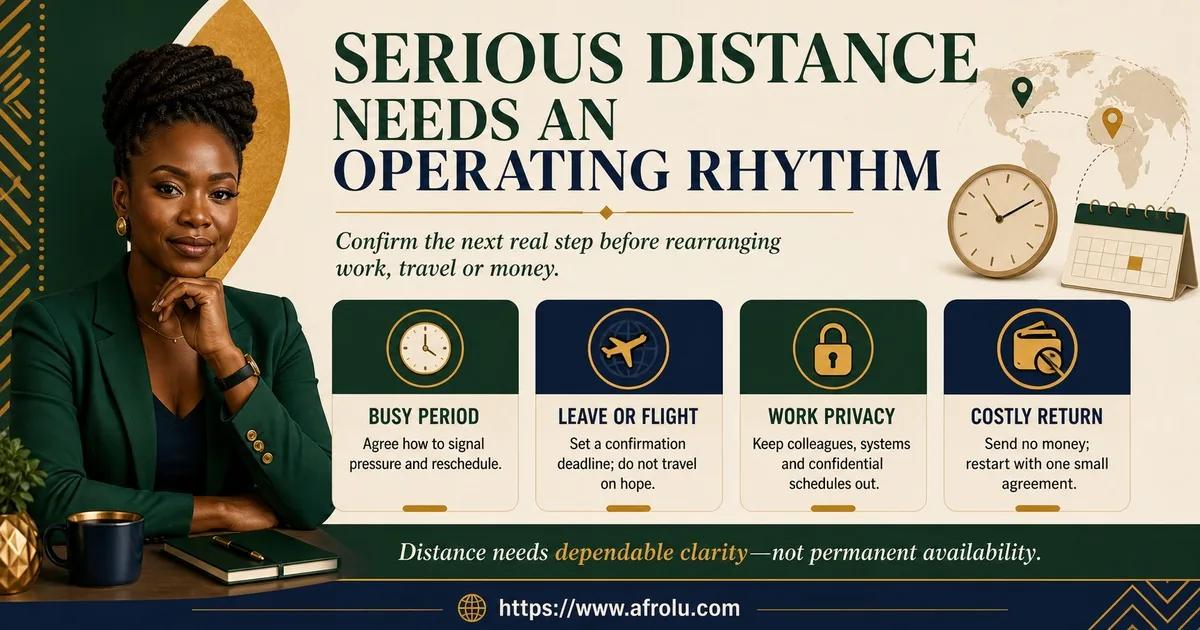
Agree how to signal busy periods, confirm costly travel before acting, protect workplace information, and restart only through one small consistent agreement.
Written and edited by Clarisse Uwimana · Dating Culture Editor
Check the rhythm and commitment you actually agreed, then send one calm message naming the open question and when you need an answer. Do not chase through colleagues, fly without confirmation, share confidential work details, or send money to repair the silence. A genuine return should include a credible explanation and a communication plan both people can sustain.
Dating behaviour · Professionals
Was this an ordinary break in an agreed communication rhythm, or has silence replaced the clarity needed to keep a serious long-distance relationship real?
Ghosting is unexplained withdrawal from an active connection. Professionals can have demanding days, travel, deadlines, or limited phone access, so a delayed reply alone proves little. It becomes more concerning when an established rhythm stops without notice and direct questions about visits, exclusivity, or the future repeatedly receive no answer.
Wanjiku and Daniel lived in different cities and had discussed building a serious relationship. When Daniel disappeared during a week they were meant to confirm a visit, Wanjiku did not contact his office or book a ticket on hope. She sent one message asking whether the visit and relationship plan were still active. When no answer came by her stated deadline, she cancelled her tentative leave and made her own plans. His silence remained painful, but it no longer controlled her calendar.
Field note
Read the pattern before you name the label for professionals
The same dating pattern can require a different response when you are needing a practical framework for busy schedules. Here, distance, calls, and planning and long-term compatibility shape the advice.
Start with observable behaviour, then decide whether the label still fits.
Who this is for
Someone who was enjoying a conversation and suddenly got silence. this version is tuned for needing a practical framework for busy schedules.. Use the parts that match your situation and leave any rule that ignores your actual life.
Distance-Aware Dating
Factor in distance, calls, and planning; timing and practical limits can change what a workable next step looks like.
Intent-first
Judge the next move by whether it protects long-term compatibility, not by whether it keeps a match alive at any cost.
Gentle Pace
The suggested move should still work at a gentle pace: clear enough to act on, calm enough to avoid panic.
Real dating life
How this shows up before anyone names it
Ghosting is when a person disappears from a conversation or dating connection without a direct ending. It can happen after a few messages, after several dates, or even after a warm emotional stretch that seemed to be moving somewhere. For professionals, the useful question is how this pattern changes when distance, calls, and planning and long-term compatibility both matter. For someone who was enjoying a conversation and suddenly got silence. This version is tuned for needing a practical framework for busy schedules., the experience rarely feels neat while it is happening. It usually begins as a small mismatch between what the person says and what the pattern shows. In a distance-aware dating context, that mismatch can feel louder because of distance, calls, and planning. Notice it early, but do not turn one awkward moment into a verdict.
The painful part is not only the missing reply. It is the way the mind starts filling the empty space. You replay the last message, reread the tone, and wonder whether being warmer, slower, funnier, or less available would have changed the result. In this edition, the pressure point is distance, calls, and planning: the same behaviour can feel different when your time, privacy, family rhythm, or future plan is already stretched. The useful response combines words you can say, safety habits you can keep, and a decision you control. The goal is not to become cold; it is to stay open without abandoning your judgment or long-term compatibility.

A prior warm conversation is not current travel confirmation; ask once, then release leave and avoid tickets or workplace pursuit.
Signals
How to read the signal without overreacting
The strongest signal is repetition. One late reply, one nervous date, or one clumsy sentence does not define a person. When the same behaviour keeps returning, it deserves attention. Ask yourself: Did something go wrong, or is silence itself the answer? For professionals, what changes when the goal is long-term compatibility?
For professionals, ghosting in dating works best when you keep long-term compatibility visible, respect distance, calls, and planning, and choose a gentle pace instead of copying someone else's dating rhythm. A calm answer matters because panic makes patterns harder to read. Pause long enough to separate facts from fear: what happened, how often it happened, what you asked for, whether the answer changed anything, and whether the pace still feels like gentle pace.

Allow a communicated busy period, ask once about avoided serious decisions, stop workplace or money bypasses, and judge repair by a dependable new rhythm.
App strategy
Where apps help and where they distort the picture
Apps can make ghosting feel common because people hold several conversations at once. That is why stronger profile intent, slower matching, and safer first-date planning matter. More apps are not the default answer to an emotional problem. Sometimes the smarter move is fewer matches, clearer filters, and more patience before paying for premium.
If you do use apps, choose them around the behaviour you want to encourage. A serious relationship goal needs more profile context. A safety concern needs better verification habits. A confidence reset needs lower volume and better pacing. Choose one useful test instead of opening every app at once.

Check the agreed rhythm, release unconfirmed plans, protect work and money, and test only one small repair before making large commitments.
What to say
Words that keep dignity in the conversation
Most dating confusion gets worse because people wait until they are hurt before they speak. A short, steady sentence often protects more dignity than a dramatic speech. You are not trying to win a debate. You are trying to make the next step visible.
The best wording is specific and easy to answer. Say what you noticed, say what you need, and leave room for the other person to respond honestly. If they cannot handle a reasonable sentence, that is useful information too.

Name the open decision, offer a realistic rhythm, keep contact personal rather than professional, and test a return with one modest agreement.
Takeaway
The final check before you reply, pay, meet, or commit
Use the first two signals as a pattern check: replies changed from specific to vague and plans were avoided twice. If those repeat, ask once, slow the pace, and choose the response that protects long-term compatibility. This rule is simple enough to remember under pressure, which is why it matters. Good dating advice should still work when you are tired, hopeful, nervous, or disappointed.
Silence is information. It is not a request for you to audition harder. For professionals, clarity has to survive distance, calls, and planning. Save that line, send it to a friend, or use it as a quiet check before you reply. Dating becomes healthier when you stop treating every uncertain person as a verdict on your future.
A relationship cannot run on calendar guesses
Turn serious intention into a communication plan that survives busy weeks
Long-distance seriousness needs a modest operating rhythm: how each person signals a busy period, which channel is personal, when an unanswered plan expires, and which decisions require a call. The aim is not constant access or surveillance. It is enough predictability for both adults to manage work, caregiving, sleep, and travel without guessing. A weekly call plus direct rescheduling may be more trustworthy than all-day messaging that vanishes whenever a real decision arrives.
Put expiry times on expensive plans. A leave request, ticket, hotel, visa appointment, airport pickup, or long road journey should have a clear confirmation point while it can still be changed safely. If confirmation does not arrive, release the leave or use it for something worthwhile to you. Do not arrive at a city, airport, office, or home to force clarity. Independent accommodation, transport, funds, and a return route are safeguards even in a relationship described as serious.
Keep professional and financial boundaries intact while emotions are uncertain. Do not share employer systems, client material, confidential itineraries, security protocols, identity documents, account access, passwords, or live location because someone says distance makes trust difficult. Never contact an assistant, manager, colleague, or professional network to bypass personal silence. Dating access does not extend into a workplace, and affection does not require unsafe proof.
A credible fear of immediate danger is different from romantic uncertainty. If the person sent a specific threat, reported an emergency, or disappeared in circumstances that create a reasonable safety concern, use the appropriate local emergency route or a known trusted contact. Share only what is necessary. Do not turn online activity, a missed date, or your need for an explanation into a public search, and do not misrepresent urgency to obtain private information.
Treat a money request after silence as a separate risk decision. A sudden problem involving flights, visas, devices, medical costs, accommodation, customs, or family does not become safer because the relationship felt serious. Send nothing under urgency. Verify identity and facts independently, keep control of bookings, and consider whether the request would make sense without romance. A person can have a genuine hardship while you still decline to fund it.
If the person returns, begin with the smallest viable repair rather than immediately restoring a major trip, exclusivity promise, or future plan. Ask them to name what happened, acknowledge the effect, and propose a communication rhythm they can actually maintain. Then test one modest call or public visit and watch several actions. A clear explanation may deserve empathy, but repeated dependable behaviour is what shows whether the relationship can carry serious plans across distance.
Three ways this can show up
Do not travel on an assumption
Ibrahim had set aside leave to visit Ruth, but she stopped replying before they chose an airport pickup and meeting place. A warm conversation from last week was not current confirmation.
He asks once whether the visit is confirmed, keeps the booking flexible if possible, and does not depart without a clear answer and an independent accommodation plan.Allow pressure without accepting indefinite silence
Zuri knows Kamau has a major project deadline. She can respect concentrated work while still needing to know whether their promised weekend conversation will happen.
She sends a low-pressure check-in offering two times after the deadline, then steps back instead of sending messages throughout his workday.Keep the workplace outside the chase
After several unanswered messages, Eric considers calling Nadia's assistant and messaging her professional contacts to find out whether she is avoiding him.
He does not involve colleagues or expose private dating details. If there is a concrete reason to fear immediate danger, he uses an appropriate emergency or trusted-contact route instead.Do not let an apology become a financial test
After disappearing, Lillian's match returns with affection and an urgent request for money to solve a travel problem before they can finally meet.
She refuses the transfer, verifies identity independently, and requires ordinary consistent contact and a safe plan before considering the relationship again.What to notice before you react
Replies changed from specific to vague while distance, calls, and planning is already shaping the connection
Plans were avoided twice even after the pace is named as gentle pace
The person stayed active online but stopped responding and it starts affecting long-term compatibility
You feel pushed into guessing instead of talking instead of becoming easier to discuss
Read the moment without overbuilding the story
| Situation | What it may mean | What to do next |
|---|---|---|
| The first signal | Replies changed from specific to vague while distance, calls, and planning is already shaping the connection | Notice it, but do not build a full story from one moment in distance-aware dating. |
| The repeated pattern | Plans were avoided twice even after the pace is named as gentle pace | Ask one clear question and watch whether behaviour changes after the answer. |
| The boundary test | The person stayed active online but stopped responding and it starts affecting long-term compatibility | Slow access if your limit is ignored, mocked, or negotiated endlessly. |
| The decision point | You feel pushed into guessing instead of talking instead of becoming easier to discuss | Choose the action that protects long-term compatibility, safety, and honest intent. |
Three calm ways to start the conversation
““We agreed to confirm the visit by Thursday. Please tell me by then whether it is still going ahead; otherwise I will release my leave and make another plan.””
““I do not need replies during every busy day. I do need a short heads-up and a reliable time for our next conversation. What rhythm can you honestly maintain?””
““I keep client, workplace, and travel-security details private. We can plan our call without sharing confidential schedules or documents.””
““I hear your apology. Before we make another big plan, I need to see whether we can keep one small communication agreement consistently.””
Know the difference
Ghosting vs Breadcrumbing
Contact stops without a clear ending.
Tiny attention keeps appearing without real effort.
Do not chase silence or overvalue crumbs. Look for consistent action.

Context matters, but only repeated dependable action can carry a serious long-distance plan after a gap.
Compare the closest dating types before choosing a label
| Type or dimension | What it describes | Best next question |
|---|---|---|
| Dating Multiple People: The Capacity-Ledger Guide | Both sit near dating behaviour, but this page is reading the pattern through distance, calls, and planning and the related guide uses a different signal mix. | Use this guide first for long-term compatibility, then compare with Dating Multiple People: The Capacity-Ledger Guide if the label still feels uncertain. |
| When to Delete Dating Apps: Pause, Uninstall, Cancel or Close the Account | Both sit near dating behaviour, but this page is reading the pattern through distance, calls, and planning and the related guide uses a different signal mix. | Use this guide first for long-term compatibility, then compare with When to Delete Dating Apps: Pause, Uninstall, Cancel or Close the Account if the label still feels uncertain. |
| Situationships: Turn Closeness into a Clear Choice | Both sit near dating behaviour, but this page is reading the pattern through distance, calls, and planning and the related guide uses a different signal mix. | Use this guide first for long-term compatibility, then compare with Situationships: Turn Closeness into a Clear Choice if the label still feels uncertain. |
| Types of Dating: Build Your Five-Part Map | Both sit near dating behaviour, but this page is reading the pattern through distance, calls, and planning and the related guide uses a different signal mix. | Use this guide first for long-term compatibility, then compare with Types of Dating: Build Your Five-Part Map if the label still feels uncertain. |
A simple plan you can use today
What this means
In plain words: Ghosting is when a person disappears from a conversation or dating connection without a direct ending. It can happen after a few messages, after several dates, or even after a warm emotional stretch that seemed to be moving somewhere. For professionals, the useful question is how this pattern changes when distance, calls, and planning and long-term compatibility both matter.
How to spot it
Watch the behavior twice before judging. If "Replies changed from specific to vague while distance, calls, and planning is already shaping the connection" or "Plans were avoided twice even after the pace is named as gentle pace" keep repeating, the pattern is stronger than one awkward moment.
First step for professionals
Use this line once, then watch behaviour: I enjoyed talking with you. If you are no longer interested, no worries, but I prefer clarity.
If this is not helping
If the same pattern continues after one clear conversation, stop arguing with the evidence. Slow the pace, reduce access, or step back using this boundary: Silence is information. It is not a request for you to audition harder. For professionals, clarity has to survive distance, calls, and planning.
What success looks like
The useful outcome is not perfect certainty. It is a decision that protects long-term compatibility and leaves you less dependent on guessing.
Four mistakes that make this harder
Sending a long emotional essay too early when the real issue is distance, calls, and planning
It turns one difficult moment into a larger emotional decision before you have enough evidence.
Checking their profile every hour because professionals often need cleaner pacing
It gives uncertainty more attention instead of asking for the clarity or consistency you need.
Pretending the silence does not hurt instead of asking for one specific next step
It replaces a direct, answerable conversation with guessing, testing, or pressure.
Rewarding inconsistency with more access when long-term compatibility should be the standard
It keeps you invested in a pattern that is not protecting your time, safety, or relationship goal.
Use a reviewed resource that matches the decision
This guide focuses on the relationship decision, so it does not rank dating apps. Check current prices, safety tools, and local availability before choosing a service.
Explore the guide library
Show more related guides
Continue with Afrolu
Show more Afrolu guides
Sources used for this guide
Afrolu reviewed these health, research, safety, or public guidance resources while editing this page. They support the behaviour and safety guidance; they do not diagnose any individual described by a reader.
Ghosting When Professionals Are Dating Seriously Across Distance Questions
Is ghosting in dating for professionals: intent-first in distance-aware dating always a bad sign?
Not always. One awkward moment can be human. It becomes important when the same pattern repeats and starts costing you long-term compatibility, safety, or peace.
How soon should professionals bring it up?
Bring it up when the pattern is clear enough to name calmly, especially if distance, calls, and planning is already shaping the connection. You do not need a courtroom case; you need one honest sentence and a willingness to notice the reply.
Should I keep dating other people while I figure this out?
If there is no clear exclusivity agreement, it is reasonable to keep your options open respectfully. Keep the pace gentle pace, and do not pause your whole dating life for someone who has not chosen clarity with you.
Can dating apps make this easier?
Apps can help when they give you better filters, profile context, and access to people with clearer intent. They do not replace boundaries, verification, or the consistency you observe away from the app.
What is the safest next step?
Use public meetings, protect private information, avoid early money requests, and slow down any connection that pressures you to ignore discomfort. Do not let distance, calls, and planning rush your decision.
Why does this guide include dating app links?
The app links offer an optional next step after the advice. Some may earn Afrolu a commission, but app fit, safety, and honest intent come before the commercial link.
How long should a professional wait during a known busy period?
Use the expectation you both set, not a universal number. If no rhythm exists, send one message that acknowledges the busy period and asks for a specific later check-in. Then protect your calendar.
Should I contact their employer or colleagues after they go silent?
Usually no. It can invade privacy and create workplace harm. A credible fear of immediate danger is different; use appropriate emergency help or a known trusted contact rather than a public search.
Should I still take a trip we had discussed?
Do not treat an old discussion as current confirmation. Travel only if it is safe and worthwhile independently, with your own accommodation, transport, funds, and return plan.
Can a serious long-distance relationship recover after ghosting?
Possibly, if the person takes responsibility, answers reasonable questions, and follows a realistic communication plan over time. You do not owe another chance, and an apology alone is not repair.
One thing to do now
Turn the lesson into a better match pool
If an agreed check-in or serious decision remains open, ask once with a reasonable deadline. If there is still no direct answer, treat the plan as cancelled and protect your time, travel, work, and finances. Reconsider only after consistent actions—not a dramatic message—restore trust.