Attention must become action
Breadcrumbing: The Effort Test
Breadcrumbing keeps hope alive without progress. Use Afrolu's effort test to read texts, likes, vague plans, cancellations, and busy-but-interested dating.
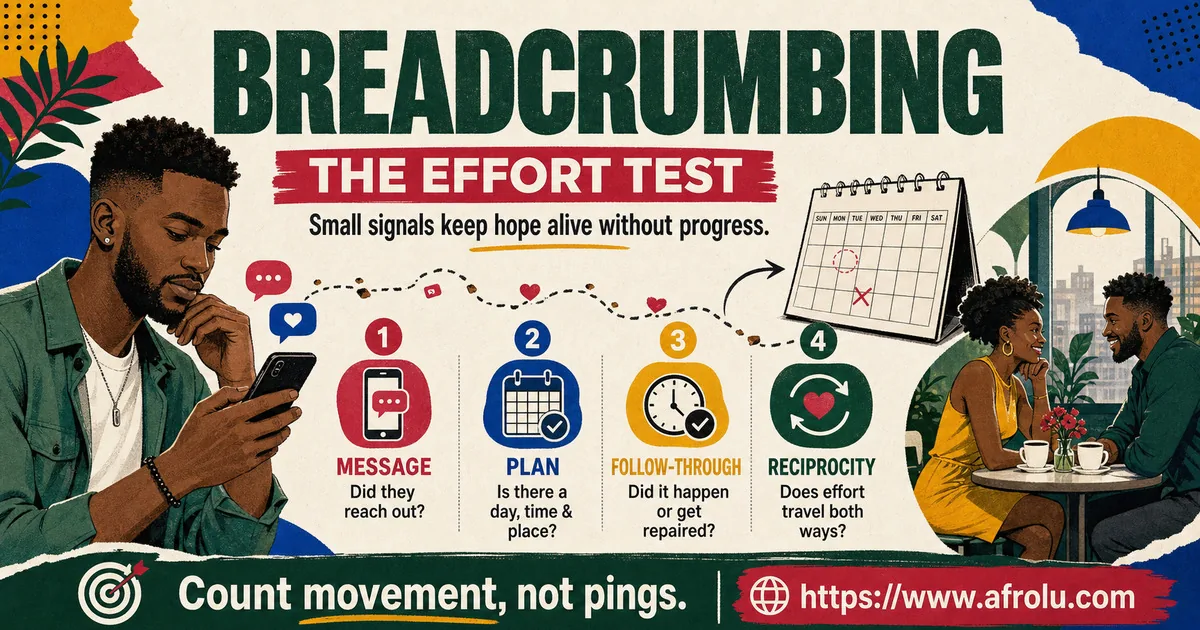
A message can restart hope, but only specificity, follow-through, reciprocity, and shared time can restart a connection. Afrolu visual:
Written and edited by Nia Kato · Profile Advice Editor
Breadcrumbing is a repeated pattern of small, intermittent signals that preserve romantic access or hope without dependable progress. Do not diagnose the person from one slow week. Track whether messages become specific plans, whether cancellations bring alternatives, whether effort is mutual, and whether the connection moves beyond low-cost digital attention. Ask for one concrete next step; if the answer returns to vagueness, stop financing the possibility with your time.
Mixed signals
Does the contact turn into a specific plan, dependable follow-through, mutual effort, and shared reality?
Breadcrumbing is a non-clinical dating term for intermittent, low-commitment contact that keeps another person engaged while plans, clarity, reciprocity, or relationship progress remain persistently out of reach.
The message often arrives when your hope is fading: a heart reaction, "thinking of you," "we should meet soon," or a late-night return after silence. The contact creates a fresh future in your mind, but the next week still contains no date, no repaired cancellation, and no clearer offer. The useful evidence is not the warmth of the crumb. It is what the contact converts into.
The attention-to-action audit
A ping is contact; a relationship needs conversion
Breadcrumbing is easy to overuse as a label. A person can reply slowly, date casually, change their mind, or have a difficult month without deliberately keeping anyone on a hook. The term becomes useful when small signals repeatedly reactivate hope while concrete movement remains unavailable. Read the pattern, not a single delay and not a guessed personality.
Audit four conversions. Specificity asks whether "soon" becomes a day, time, and place. Follow-through asks whether agreements happen or receive prompt repair. Reciprocity asks whether questions, planning, and emotional continuity travel both ways. Shared reality asks whether the connection gains calls, dates, introductions, decisions, or other mutually wanted substance beyond low-cost digital contact.
Does interest become a usable plan?
A real invitation can be accepted, declined, or changed. "We should hang out sometime" creates anticipation without requiring either person to choose.
What happens after the plan exists?
Busy people sometimes cancel. Useful evidence is early notice, a credible reason, a specific alternative, and later behaviour that matches the repair.
Who carries the connection between pings?
Notice who asks questions, remembers details, initiates, chooses times, repairs gaps, and protects shared plans. Warmth without mutual labour is still one-sided.
Is the connection becoming more real?
Progress does not require commitment on a fixed calendar. It does require an honest direction that both people can point to instead of the same possibility reopening forever.
Track contact against progress
A warm return matters less than what changes after it
Build a simple 30-day record. Note direct messages, passive reactions, invitations, confirmed plans, cancellations, alternatives, dates that happened, and who initiated. This is not surveillance. It is a way to stop one emotionally powerful message from rewriting the whole pattern.
Then draw two lines: contact and progress. Breadcrumbing often produces spikes on the contact line while the progress line stays flat. A slower but healthy connection can have fewer messages and still move through reliable calls, dates, repaired plans, or a clearer agreement.

Likes, late-night texts, and vague future hints may keep a chat alive while the calendar stays empty. Count what changes after each return. Afrolu visual:
Run four conversions
Specificity, follow-through, reciprocity, and shared reality turn interest into evidence
Specificity converts "sometime" into an option another person can actually choose. Follow-through converts a plan into trust. Reciprocity converts one person's emotional and logistical labour into a shared connection. Shared reality converts a screen-based possibility into mutually understood experience.
No relationship needs to move at a universal speed. The question is whether both people can see the same movement. If every return produces another hopeful conversation but no specific, repaired, reciprocal next step, the pattern is not waiting for a better interpretation; it is waiting for you to decide how much access vagueness receives.

Ask whether the contact becomes a real plan, whether agreements happen, whether effort travels both ways, and whether the relationship moves beyond the screen. Afrolu visual:
Ask once, concretely
Turn "we should meet" into a date, a counteroffer, or a clean answer
Do not send a long accusation about breadcrumbing. Ask for the behaviour you need: "I am free Thursday after six or Saturday morning. Does either work?" A person who is interested but unavailable can decline and suggest something real. A person who is uncertain can say so. Specific language reduces the room where fantasy and avoidance cooperate.
After the answer, stop negotiating against yourself. "Soon," "let us see," another compliment, or silence is not a hidden yes. You can leave the invitation open for a period that suits you, then close it privately and make other plans.

One concrete invitation is enough. A clear plan creates movement; another vague answer gives you permission to stop waiting. Afrolu visual:
Keep context in the picture
Sparse communication is not breadcrumbing when reality, repair, and progress are visible
Dating rhythms differ across work, parenting, disability, faith, family privacy, data access, migration, travel, and time zones. Constant texting is not the standard of health. Some people communicate briefly and show care through planning, practical support, or dependable presence.
Use a context test rather than a volume rule. Are constraints named? Is the offer honest? Are alternatives made? Do agreed actions happen? Can both people say the pace does not work for them without blame? These questions protect cultural and practical difference while still requiring enough truth for consent.
Return your attention
Set an endpoint, quiet the triggers, and make room for reciprocal dating
Your boundary does not need to make the other person understand. Decide when an unconfirmed plan expires, send one closing line if you want to, and stop giving every digital signal a new hearing. Archive, mute, unfollow, or unmatch when those tools reduce rumination rather than perform punishment.
Use the recovered space deliberately. Confirm plans with friends, reopen conversations with people who show up, return to sleep and work routines, or take a clean app break. The goal is not to become indifferent. It is to stop letting unpredictable access decide where your attention lives.

Record the pattern, request one concrete next step, set your own endpoint, remove low-effort triggers, and return attention to reciprocal connections. Afrolu visual:
Three contact patterns that look similar on a phone but lead somewhere different
An old match keeps reappearing without entering your calendar
Every ten days, an old app match reacts to a photo, sends "hey stranger," compliments your appearance, or says you crossed their mind. The exchange becomes flirty for an evening. When you suggest coffee, they say work is wild, leave the date vague, and later return through another reaction as if the unfinished plan never existed.
Do not restart the emotional story from zero. Say: "I am interested in meeting, so suggest a day and place that works for you." If the reply stays vague, archive or mute the chat and stop treating reactions as active dating.One strong evening keeps funding months of almost-plans
You had a genuinely enjoyable date. Since then, the person sends affectionate messages and occasionally talks about what you could do together. Two proposed dates are cancelled, one is never confirmed, and each disappointment is followed by enough warmth to make the original chemistry feel current again.
Separate the date you had from the pattern you now have. Ask for one plan with a confirmation point. A cancellation repaired with a workable alternative is data; a third wave of affection without a date is also data.Slow contact can still contain visible commitment
A nurse on rotating shifts, a parent with limited childcare, or a diaspora match across time zones may reply irregularly. The rhythm alone can resemble breadcrumbing. The difference is that constraints are explained without drama, calls are scheduled, missed plans are repaired, visits or next steps are discussed realistically, and both people can decide whether the pace works.
Do not punish a person for having a full life. Ask for a rhythm you can both maintain and a concrete next step. If reality supports the words, call it a slow or constrained connection, not breadcrumbing.Four signs that contact is preserving hope without building reality
Contact returns after gaps but the relationship remains in the same place
Flattery, reactions, or future hints replace a date with time and place
Cancelled or vague plans rarely come with a workable alternative
You supply most questions, planning, availability, and emotional continuity
Match your next move to specificity, repair, and follow-through
| Situation | What it may mean | What to do next |
|---|---|---|
| Replies are slow, but a specific plan is made and kept | A busy, low-text, or logistically constrained person who is still investing in shared reality. | Discuss the rhythm you both can sustain. Do not require constant messaging when follow-through is strong. |
| A plan is cancelled with early notice and a workable alternative | Ordinary disruption followed by repair, not breadcrumbing by itself. | Accept the new plan if it works for you, then let later reliability confirm the repair. |
| Warm messages and reactions repeat, but every invitation stays "soon" | Contact is preserving possibility without requiring a decision or investment. | Ask for one concrete plan. Stop carrying the chat if specificity never arrives. |
| They return after each silence but ignore the unfinished cancellation | The return may be seeking access, attention, or relief without accountability for the prior gap. | Do not resume the old tone. Name the missed plan and require repair before reopening. |
| A former partner says they miss you but cannot state what has changed | Nostalgia or loneliness may be real while the offer remains the same. | Ask what they are proposing now. If there is no answer, protect the breakup boundary rather than rebuilding hope from sentiment. |
Three sentences that turn "sometime" into a usable answer
“I am interested in meeting, so suggest a day and place that works for you.”
“I do not keep open-ended chats going; if now is not a good time, I will step back.”
“I enjoyed hearing from you, but I am not reopening this without a clear intention and follow-through.”
Know the difference
Breadcrumbing vs Busy but interested
Intermittent contact renews hope while plans and follow-through remain absent.
Replies may be slow, but constraints are explained, alternatives are offered, and agreed plans happen.
Attention becomes meaningful when it turns into specific, reciprocal action.

Busy interest may move slowly, but it explains constraints, offers alternatives, and follows through. Breadcrumbing repeatedly renews hope without dependable movement. Afrolu visual:
Breadcrumbing, busy interest, slow dating, orbiting, or benching?
| Type or dimension | What it describes | Best next question |
|---|---|---|
| Breadcrumbing | Intermittent contact repeatedly renews hope while specificity, follow-through, reciprocity, and progress remain absent. | Request one concrete next step, set your own endpoint, and stop rewarding vague re-entry. |
| Busy but interested | Communication may be sparse, but constraints are explained, alternatives are offered, and agreed plans usually happen. | Agree on a realistic rhythm and judge the connection by dependable follow-through. |
| Slow dating | Both people intentionally lower volume or pace while remaining clear about interest and making mutually understood progress. | Keep the slower rhythm if it is reciprocal and leaves neither person decoding silence alone. |
| Orbiting | A person remains visible through views, likes, or follows without direct conversation or a relational offer. | Treat visibility as platform activity. Mute it if it keeps emotional attachment active. |
| Benching | A person maintains enough access to keep someone available while prioritising other options; direct contact may be more regular than breadcrumbing. | Ask for the relationship you want and decline reserve status when the offer remains unequal. |
The attention-to-action audit in five moves
Write the 30-day record
List messages, invitations, dates, cancellations, alternatives, and who initiated. Do not score affection; score what became real.
Name the smallest progress you need
Choose one observable next step: a confirmed call, an in-person date, a rescheduled plan, or an honest conversation about intent.
Ask once in concrete language
Offer or request a day, time, and place. A specific question makes a specific yes, no, or counteroffer possible.
Set an endpoint for your attention
Decide how long an unconfirmed plan or vague return remains active for you. Your endpoint is not a threat and does not need negotiation.
Reopen the rest of your life
Stop reserving time, emotional energy, or app focus for a possibility that has not reserved anything for you.
Why tiny signals can occupy so much emotional space
Unpredictable contact can keep attention scanning for the next reward
A long quiet stretch followed by a warm message creates relief as well as hope. Cleveland Clinic describes breadcrumbing through intermittent reinforcement: occasional rewards can keep people engaged longer than a pattern that is consistently empty. The practical answer is not to shame your reaction; it is to reduce the unpredictability by setting an endpoint you control.
Early findings describe association, not a diagnosis or destiny
A 2020 cross-sectional survey of 626 adults aged 18 to 40 found breadcrumbing experience associated with lower life satisfaction and greater loneliness and helplessness. The design cannot prove that breadcrumbing caused those outcomes, and one study cannot represent every culture or age group. Use the research to take distress seriously, not to make clinical claims about an individual.
Digital warmth can be sincere and still require almost no availability
A like, emoji, reel, or short text can express a real passing feeling. It does not automatically offer time, reliability, exclusivity, or intention. Keeping signal and offer separate lets you appreciate a message without enlarging it into a relationship event.
The original chemistry can become a loan you keep extending
When one date or intense chat felt special, each new ping appears to protect that possibility from expiring. Ask what has happened since the good moment. Past chemistry belongs in the record, but it cannot indefinitely substitute for present participation.
Family, faith, data costs, work, and distance can change communication rhythm
Not every healthy connection looks like constant messaging. Shift work, caregiving, travel, shared devices, internet reliability, religious practice, family privacy, and time zones can shape access. Judge whether both people explain constraints, create a workable rhythm, and make progress within reality rather than demanding one universal texting standard.
If you are sending the crumbs, replace access with an honest offer
You may miss someone, enjoy their attention, or feel uncertain without being ready to date them. Before sending the next nostalgic message, ask what you can genuinely offer. State casual intent, propose a real next step, or leave them free from a cycle you do not intend to build.
Four ways intermittent attention gains more power than it deserves
Treating every reappearance as a fresh beginning
It turns one difficult moment into a larger emotional decision before you have enough evidence.
Holding prime time for plans that were never specific
It gives uncertainty more attention instead of asking for the clarity or consistency you need.
Writing long explanations to obtain effort someone can already choose
It replaces a direct, answerable conversation with guessing, testing, or pressure.
Letting one intermittent match block consistent new connections
It keeps you invested in a pattern that is not protecting your time, safety, or relationship goal.
Use a reviewed resource that matches the decision
This guide focuses on the relationship decision, so it does not rank dating apps. Check current prices, safety tools, and local availability before choosing a service.
Explore the guide library
Show more related guides
Continue with Afrolu
Show more Afrolu guides
Clinical and research references behind this guide
Afrolu reviewed these health, research, safety, or public guidance resources while editing this page. They support the behaviour and safety guidance; they do not diagnose any individual described by a reader.
Breadcrumbing questions answered with evidence and proportion
What is breadcrumbing in dating?
Breadcrumbing is a non-clinical term for a repeated pattern of intermittent, low-commitment contact that keeps romantic hope or access alive while concrete plans, clarity, reciprocity, or progress remain persistently unavailable. One slow reply or cancelled date is not enough to establish the pattern.
What are the clearest signs of breadcrumbing?
Look for the combination: contact returns after gaps, messages are warm or suggestive, future plans stay vague, cancellations lack workable alternatives, and you carry most of the planning and continuity. The strongest sign is not inconsistency alone; it is repeated re-engagement without movement.
How is breadcrumbing different from ghosting?
Ghosting is an unexplained break in communication. Breadcrumbing keeps some contact alive through messages, likes, calls, or occasional meetings, but the contact repeatedly fails to progress. A person may also ghost for a period and later return with breadcrumbs, but the two terms describe different communication patterns.
How can I tell breadcrumbing from someone being genuinely busy?
Busy interest still creates usable evidence. The person explains constraints, proposes specific times, offers alternatives after cancellation, follows through often enough to build trust, and welcomes a realistic conversation about rhythm. Breadcrumbing repeatedly substitutes warmth or possibility for those actions.
Why can breadcrumbing feel so hard to leave?
Unpredictable warm contact can create a cycle of hope, disappointment, and relief. It may also reactivate the memory of one strong date or conversation. Early research has linked breadcrumbing experiences with loneliness and helplessness, but those findings are associations and do not prove the same cause or outcome for every person.
What should I text someone who may be breadcrumbing me?
Use one concrete sentence: "I am interested in meeting, so suggest a day and place that works for you." For a repeated vague return, try: "I do not keep open-ended chats going. If now is not a good time, I will step back." Send it once and judge the next behaviour.
Can a breadcrumbing pattern change?
Yes, if the person recognises the impact and the offer changes in practice: clearer intent, specific plans, repaired cancellations, reciprocal effort, and dependable follow-through. A stronger apology followed by the same vague pattern is not change. You are not required to stay while someone learns.
What should I do if I realise I am breadcrumbing someone?
Stop sending contact that implies a future you do not intend to build. Decide what you can honestly offer, then state it clearly: a specific date, a mutually understood casual connection, friendship without flirtation, or a respectful ending. Missing attention is not a sufficient reason to reopen romantic hope.
One thing to do now
Give active space only to active connections
Count movement, not pings. Attention becomes relationship evidence only when it turns into specific, reciprocal action.

