The alarm-evidence method
Dating After Being Ghosted: Separate the Old Alarm From New Evidence
Date again after ghosting with an alarm-evidence method for reply gaps, communication standards, trust, pacing, clean endings, and safe reconnection.
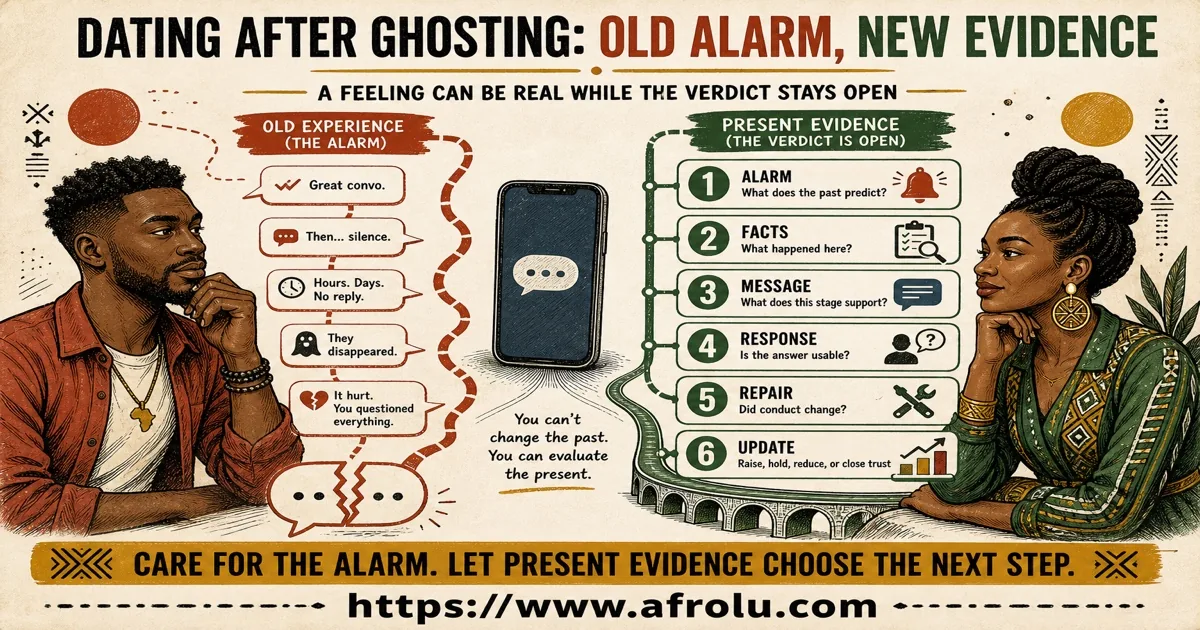
Use six steps when silence activates the old story: notice the alarm, record present facts, choose one proportionate message, read the response, inspect repair, and update trust from the pattern.
Written and edited by Adwoa Boateng · Dating Safety Editor
Do not demand blind trust and do not demand proof that nobody will ever disappear. When silence activates the old story, pause, write the present facts, send one proportionate message if the stage warrants it, observe the response and repair, then update trust from the pattern. A feeling can be real while the verdict remains open.
Dating recovery
How can you protect your dignity after ghosting while still allowing a new person to be judged by their own pattern?
Dating after being ghosted is the process of returning to romantic introductions after someone ended or abandoned a connection through unexplained non-response. The task is not to erase the earlier experience. It is to separate memory-driven alarm from current evidence, set a usable communication standard, and keep each new person responsible only for their own conduct.
A quiet phone can hold two timelines at once. In the old one, warmth was followed by disappearance and no explanation. In the new one, a person may be working, resting, travelling, changing interest, avoiding a conversation, or beginning the same pattern. Guessing cannot separate them. A calm process can.
The alarm-evidence method
After ghosting, the goal is not blind trust; it is a fair process for updating trust
An unexplained disappearance can make ambiguity feel expensive. The next quiet hour may resemble the old ending before it contains the same facts. Ignoring that reaction is not openness, and obeying it immediately is not protection. The practical task is to give the old alarm care while keeping the new person answerable only for the pattern they are creating now.
Move through six steps. Alarm names what memory predicts. Facts records the current stage, agreement, rhythm, context, and open plan. Message chooses one proportionate request. Response asks whether the answer is direct and usable. Repair looks for acknowledgment plus changed conduct. Update raises, lowers, or holds trust without demanding a permanent verdict.
Name the prediction
Write the feared ending in one sentence: “This quiet means I am being abandoned again.” Naming it separates a prediction from a confirmed event.
Build the present timeline
Record the last exchange, normal rhythm, stated constraints, open plan, relationship stage, and what has actually changed without reading intention into a digital trace.
Ask only what the stage supports
A first chat may need no follow-up. A planned date or established rhythm may warrant one concise check-in that leaves room for an honest no.
Look for usable clarity
Notice whether the person answers the real question, proposes an action, respects your standard, or returns only enough warmth to restart uncertainty.
Require more than reappearance
Repair names the disappearance, understands its effect, accepts your freedom to decline, and creates a realistic communication change that later holds.
Let trust become person-specific
Increase access when reliability repeats, reduce it when contradiction repeats, and keep the decision open when one data point is genuinely ambiguous.
Two timelines can share one quiet phone
Acknowledge what the earlier disappearance taught without giving it control of the new verdict
The first task is not to argue with the reaction. Write the old prediction plainly: “When warmth is followed by quiet, I expect the person to disappear and leave me without an answer.” Then write the current facts on a separate line: the relationship stage, last exchange, normal rhythm, stated constraints, open plan, and exact change. Both columns matter, but they answer different questions.
Do not use calm as the price of taking yourself seriously. You can feel activated and still notice present evidence accurately. Likewise, do not use activation as proof that the current person has repeated the old conduct. The pause between feeling and classification protects both dignity and accuracy: your past is not dismissed, and the new person is not convicted by resemblance alone.
Choose the smallest action that can produce useful information. That may be no action in a first chat, a specific invitation when interest has not become a plan, or one direct check-in when a normal rhythm or agreed meeting has changed. The method is not passive. It is proportionate.

Old alarm predicts another disappearance before the facts are complete. New evidence asks what was agreed, what changed, whether a plan is open, how one direct message is handled, and whether repair changes behaviour.
Name the contact state, not the motive
Use a one-message ceiling when the thread goes quiet
First separate a missed reply, an interrupted plan, sustained unexplained silence and a later reappearance. These contact states affect your next step, but none proves why the other person disappeared. Illness, avoidance, changed interest and competing commitments cannot be diagnosed from an empty thread.
When a practical answer is still needed and contact feels safe, send one calm message with a clear endpoint. Do not stack check-ins across channels or recruit friends to obtain a response. The ceiling protects dignity and makes the remaining evidence legible: a reply may repair the thread, while continued silence closes your pursuit even if it never explains the cause.

Created for Afrolu: https://www.afrolu.com. Do not diagnose silence or contact through extra channels. One safe message is a ceiling, not a strategy for forcing an answer.
Stage changes the meaning of silence
Place the quiet inside its actual relationship structure before applying the word ghosting
Start with agreement. Two app users who exchanged messages but made no plan have less shared structure than two people who confirmed a date, established daily contact, discussed exclusivity, shared sexual health information, or integrated friends and family. The loss can hurt at any stage, but the expectation broken is not identical.
Next, classify the pattern. An explained delay leaves a reason and often a return point. An ordinary gap fits the known rhythm. A changed pattern alters frequency, warmth, or planning and may warrant one question. A broken plan affects time and reliability. Established disappearance uses unexplained non-response to abandon a meaningful connection. The ladder is descriptive, not a universal timer.
Keep clean endings separate. “I do not want to continue” may sting more immediately because it removes hope, yet it gives a usable decision. Fading interest can be quieter but still contain replies. Orbiting preserves passive visibility after direct contact stops. A precise label should make the next action clearer, not maximise blame.

Classify the stage before the label: an explained delay needs patience, an ordinary gap needs context, a changed pattern may need one check-in, a broken plan needs a boundary, and established disappearance can be closed without another chase.
Clarity is an agreement, not mind-reading
Ask for communication that protects plans and choice without demanding constant availability
Build a standard you can also meet. You may not need daily texting, but you may require confirmation around plans, an update when availability materially changes, and a direct ending after meaningful investment. Another adult may prefer a different rhythm. Compatibility appears when both standards are spoken and a workable agreement is either created or declined.
Use stage-appropriate scripts. “Does Thursday still work?” is enough for an open plan. “Our usual communication changed; has your interest or availability changed?” fits an established pattern. Do not attach a trial to the message: strategic silence, jealousy posts, read-receipt tests, or a threat designed to force a quick answer. Ask the real question once.
A boundary is what you will do with the answer or absence. You might close a plan, archive a chat, decline to resume after an unexplained return, or end a mismatch in communication needs. A boundary does not require the other person to agree that your label is correct.

State your communication standard before conflict. When a meaningful pattern changes, send one stage-appropriate message. If someone returns, ask for acknowledgment, context, and a different plan before restoring access.
One message, one boundary, one decision
Create a complete response even when the missing person never completes the story
Before messaging, check whether there is a genuine safety concern, known emergency, caregiving responsibility, or practical obligation. If not, send one proportionate message only when the stage warrants it. Keep it factual and easy to answer. Then choose a private decision point based on the plan and pattern rather than repeatedly moving the deadline when hope rises.
Closing your side can mean cancelling the unresolved plan, archiving the chat, muting or unfollowing, removing reminders, protecting sexual health or privacy as relevant, and returning time to ordinary life. It does not require declaring the other person evil, proving their motive, or pretending the connection meant nothing.
If an explanation later arrives, it becomes new information. It does not reverse the decision automatically. You may listen, ask what repair would mean, restore limited access, or maintain the ending. The ability to choose after hearing context is part of closure too.

Check safety and context, send one proportionate message when the connection warrants it, set a private decision point, stop cross-channel pursuit, and close your side if no usable response arrives.
More traces do not always mean more knowledge
Protect attention, identity, privacy, and safety while new trust remains provisional
Limit the number of active chats to a volume at which people remain distinct. Move toward a safe public meeting when identity, interest, and circumstances support it rather than building weeks of imagined closeness from notifications. Keep early transport independent, tell trusted support, protect home and child information, and keep finances separate.
After a disappearance, do not create alternate accounts, contact through every platform, use friends to investigate, or appear at a home or workplace. A block, no-contact request, or credible safety context ends the pursuit. Preserve relevant evidence and use appropriate local support if threats, stalking, coercion, account compromise, image misuse, or financial harm are involved.
Create friction around monitoring. Archive the conversation, mute activity indicators, remove profile shortcuts, set one limited app window, and choose what you will do when the urge to check appears. The purpose is not to erase feeling. It is to prevent an unavailable connection from continually deciding where attention goes.
Return by stages, not by bravado
Re-enter dating through four independently reversible steps
Dating again does not require instant trust. Begin with profile boundaries, move to limited conversation, choose an independent public meeting and review how you felt afterwards. Each stage should be useful on its own and easy to stop; a promising match does not erase the need for privacy, transport autonomy or a check-in with someone you trust.
Set a small experiment before opening an app: perhaps ten minutes of browsing, one conversation or one daytime meeting. Afterwards, record what increased steadiness and what recreated pressure. The aim is not to prove that you are fully healed. It is to gather fresh evidence while keeping pace, access and exit under your control.

Created for Afrolu: https://www.afrolu.com. Choose a small experiment and keep your own exit. Read new conduct without making a new person repay an old disappearance.
Return is an event; repair is a process
Continue, hold, reduce, or close access from what happens after the silence is named
Continue when the response answers the actual question, the person acknowledges the gap, context is plausible without requiring you to deny impact, and a realistic future action is offered. Restore access gradually. A week of reliable conduct tells you more than one intense apology or promise that it will never happen again.
Hold or reduce access when the information is incomplete but not clearly unsafe: the person may need a smaller communication agreement, a slower pace, or a later review. Name the limit so they can choose too. Do not privately downgrade the relationship while keeping their full investment.
Close when disappearance repeats, the person avoids the issue, blames you for asking, returns only for attention or convenience, violates consent, or cannot meet the communication standard you need. Also close when the pattern is simply incompatible. Leaving an inaccurate fit is not making the past choose for you; it is using present evidence.
Four quiet phones, four different decisions
Low investment can still disappoint without requiring a pursuit
You exchanged thoughtful messages for two evenings and imagined meeting, but neither person proposed a date and the conversation stopped. The warmth was real, yet the relationship had no agreed rhythm, plan, or expectation of continued contact. Calling this a full relational betrayal may enlarge the event; sending repeated prompts may enlarge your investment without producing knowledge.
If a simple invitation still feels useful, send one specific message such as “I enjoyed talking. Would you like coffee Saturday?” Treat no answer as a no to that invitation. Archive the chat and return attention to people who can participate.A broken plan creates present evidence, not only an old alarm
After three dates, you usually confirm plans the evening before. This time the confirmation, call, and meeting all pass without an update. The concern is not merely slower texting. A mutual plan created a reasonable expectation of communication, and the unexplained absence has a practical effect on your time and safety.
Check immediate safety information you reasonably have, then send one direct message about the missed plan. Do not contact friends, employers, relatives, or multiple channels unless a genuine emergency or safety responsibility exists. Set a private point after which you will close the connection.Different rhythm is not the same as unreliable conduct
The new date does not maintain all-day contact, but they answer direct questions, confirm plans, arrive when agreed, and tell you when work or care duties will make them unavailable. The slower rhythm activates fear because the earlier connection used constant messaging before vanishing. Frequency feels familiar; reliability tells a different story.
Describe the communication need without prescribing constant access. Ask for updates around plans and significant changes, then watch whether the agreement works across ordinary weeks. Let consistency challenge the old rule that more messages always mean more safety.Reappearance restores contact, not trust
Ten days later, a cheerful “Hey stranger” arrives without acknowledgment. Relief, anger, attraction, and curiosity may appear together. None decides whether to reopen. A return can be a sincere attempt, a convenience check, loneliness, avoidance of accountability, or something else you cannot know until the person speaks and behaves.
Do not resume the old intimacy before discussing the gap. Ask what happened, what they can offer now, and what would be different. Judge acknowledgment, responsibility, respect for your no, and later conduct. You may decline even if the explanation is understandable.Six signs that protection and openness are returning to balance
A normal reply gap immediately becomes a complete disappearance story
You need repeated reassurance before present behaviour has changed
You ignore actual inconsistency because you fear looking anxious
You can name a communication standard without demanding constant access
You are willing to update trust upward or downward from repeated evidence
You can close your side without obtaining the missing person's explanation
Match the response to the stage, facts, open plan, and present pattern
| Situation | What it may mean | What to do next |
|---|---|---|
| A first app conversation stops with no meeting proposed | The conversation ended, attention shifted, the person is unavailable, or interest was not strong enough. There was little shared structure to break. | Send a specific invitation only if you genuinely want one. Treat no reply as a no to the invitation and archive without repeated prompts. |
| A reply is slower but fits a stated work, care, travel, or rest constraint | The rhythm may differ from your preference without showing disappearance or dishonesty. | Wait for the stated window. Discuss communication fit if the relationship continues; do not use online status as a substitute for the conversation. |
| An established rhythm changes while a plan remains open | Interest, capacity, context, or communication may have changed. The open plan makes one direct check-in proportionate. | Name the change and ask whether the plan still stands. Use the answer and action, not speed alone, to update trust. |
| A date or important promise passes without communication | This is a present reliability problem regardless of whether the person later uses the word ghosting. | Check genuine safety context, send one factual message, protect your time, and set a private boundary for closure. |
| Silence follows several dates, sex, disclosure, or a commitment conversation | The unexplained exit carries more relational context and may activate grief, shame, worry, or safety questions. | Do not chase across channels. Use trusted support, protect privacy and sexual health as relevant, and close your side if no usable reply arrives. |
| The person returns with warmth but no acknowledgment | Contact has resumed, but the earlier rupture and communication standard remain unresolved. | Pause the old intimacy. Ask about the disappearance and what would change. Reappearance alone does not restore trust. |
| The person returns with context, responsibility, and a realistic repair | There may be information worth considering, but an explanation does not obligate reconciliation. | Decide freely, restore access gradually if you choose, and judge whether the agreed change holds under ordinary pressure. |
| There is a block, clear no, threat, stalking concern, or request for no contact | Further pursuit may violate consent or increase danger. Etiquette is no longer the decision frame. | Stop contact, preserve relevant evidence if safety requires it, secure accounts, and use appropriate local support rather than personal confrontation. |
Words for communication standards, reply gaps, changed rhythm, return, repair, and closure
“I do not need constant texting. I do value a direct update when a plan or level of interest changes.”
“No rush on a reply. I wanted to check whether Thursday still works for you.”
“Our usual communication changed this week. Has your interest or availability changed too?”
“I have not heard back, so I am closing this plan and moving on. I wish you well.”
“Before we restart, I need to discuss the unexplained gap and what communication would be different.”
“I hear the context. What would you realistically do next time your capacity changes?”
“Your pace is valid, and I need more clarity around plans than this rhythm provides. Are we able to agree on that?”
“I understand that you want to reconnect. I am not reopening this connection, and I ask that you respect that decision.”
Know the difference
Old alarm or new evidence?
Memory predicts the complete ending before the current facts are known. The feeling may be intense and valid, but it mainly describes what happened before and what you fear will happen again.
Present conduct changes the case: a plan is missed, a normal rhythm shifts, a direct question is avoided, a return lacks repair, or repeated reliability supports more trust.
Care for the alarm without asking it to judge alone. The next step should fit the current stage, agreement, facts, message, response, and repair.

A reply gap leaves the connection intact. Fading interest reduces effort without clarity. A clean ending states the decision. Ghosting uses unexplained non-response as the ending. Name the pattern from conduct, not fear.
Which kind of silence is actually happening?
| Type or dimension | What it describes | Best next question |
|---|---|---|
| Reply gap | A temporary period without response inside a connection whose agreement and direction have not otherwise changed. | What context and response expectation were actually stated? |
| Slow texting | A lower-frequency communication style that can still include direct answers, reliable plans, and explained limits. | Does the rhythm work for both people when important matters arise? |
| Fading interest | Effort, curiosity, and planning decline, sometimes without a direct ending, while some communication may continue. | Can one clarity question produce a current offer or a kind ending? |
| Clean ending | A person directly states that they do not want to continue, even if the answer is brief or disappointing. | Can the no be accepted without debate or pressure? |
| Ghosting | Unexplained non-response becomes the way a dating connection is ended or abandoned. | What one response is proportionate, and when will you close your side? |
| Orbiting | Direct contact stops while passive social visibility continues through views, likes, or follows. | Does passive visibility offer any direct intention or repair? |
| Safety no-contact | Communication ends or is blocked because direct engagement could create credible risk, coercion, retaliation, or harm. | What boundary, documentation, account security, or qualified support protects safety? |
The alarm, facts, message, response, repair, and update loop
Name the alarm
Write what the silence makes you predict and what earlier experience taught that prediction.
Write the facts
Record stage, last contact, normal rhythm, open plan, stated constraint, and actual change.
Choose the message
Send no message, a simple invitation, or one direct check-in according to the relationship stage.
Read the response
Look for clarity, action, consistency, and respect rather than temporary warmth.
Inspect repair
Acknowledge the gap, understand impact, agree on a realistic change, then see whether it holds.
Update trust
Increase, hold, reduce, or close access from the present pattern.
What ghosting can change, what research cannot predict, and how trust becomes specific again
Ghosting is unexplained disengagement, not a universal number of silent hours
Research definitions differ in relationship type, suddenness, medium, duration, and level of investment. A stranger not continuing a first chat, a date missing an agreed plan, and a partner ending months of closeness through silence do not carry the same agreement or impact. Use the label to describe conduct, not to manufacture a countdown.
Findings on harm are mixed and highly dependent on context
A 2020 adult survey found no significant association between ghosting alone and the measured life-satisfaction, loneliness, or helplessness outcomes, while breadcrumbing and combined experiences showed associations. A 2026 low-investment experiment found no sleep effect. These results do not erase distress; they show why stage, investment, measures, sample, and study design must remain visible.
A possible kind motive does not create the missing explanation
A 2024 experimental programme found that recipients may underestimate other-oriented motives among people who ghost, such as wanting to avoid hurting someone. That average finding cannot identify why a particular person disappeared, excuse unsafe conduct, or require renewed access. Use it to resist mind-reading in either direction.
Past rejection can make ambiguous present behaviour look intentional sooner
Classic rejection-sensitivity research describes anxious expectations, rapid perception, and strong response to rejection in ambiguous situations. It is a research construct, not a diagnosis for someone hurt by ghosting. Its practical value is the pause: ask which fact belongs to today before assigning today an old intention.
An unanswered why cannot be the entrance ticket to your next decision
An explanation might provide information, but it may also be partial, self-protective, or never arrive. Behaviour already answers a narrower question: this person did not sustain the communication required by the connection. Closure can mean accepting that limit, protecting your attention, and choosing what you will do next without claiming certainty about motive.
New trust should become specific rather than globally high or low
Do not give every new date total trust to prove you are healed, and do not make them overcome a debt they did not create. Start with access proportionate to the stage. Update from directness, plan-keeping, boundaries, reciprocity, privacy, money conduct, conflict, and repair. Different domains can earn trust at different speeds.
Reliable care is more informative than permanent availability
Relationship research describes perceived partner responsiveness as feeling understood, validated, and cared for. That does not mean immediate replies or constant agreement. In dating, look for whether important information receives attention, whether constraints are named, and whether a missed moment can be repaired without punishment or disappearance.
Read receipts and online status can increase data without answering intention
A green dot may show app activity, not why someone has not replied, whether they want a relationship, or what they will do about an open plan. Repeated checking can keep the unanswered connection at the centre of the day. Prefer direct communication and observable follow-through over a private investigation of platform traces.
No-contact can be appropriate when communication is unsafe
Direct endings are not owed when someone fears violence, coercion, stalking, retaliation, outing, image misuse, workplace harm, or another credible danger. Do not use anti-ghosting advice to demand access, bypass a block, appear in person, or recruit other people to make contact. Safety planning outranks etiquette.
Culture and community can change the stakes without changing consent
Faith communities, diaspora networks, family introductions, workplaces, campuses, and small social circles may keep two people visible after contact ends. Protect confidentiality and reputation, but do not turn community access into pressure for an explanation. A clean boundary can be brief and private; gossip is not closure.
Four protection strategies that quietly make dating less accurate
The universal reply clock
Declaring every person a ghost after a fixed number of hours ignores stage, stated constraints, normal rhythm, open plans, emergencies, and communication agreements.
The hidden reassurance test
Withholding, posting strategically, or creating jealousy to see whether someone pursues you reproduces uncertainty instead of testing honest responsiveness.
The digital investigation
Repeatedly checking read receipts, followers, location clues, and online status can increase monitoring without revealing motive or relationship intent.
The instant reset
A warm return can relieve uncertainty so quickly that the disappearance, impact, and needed repair never enter the conversation.
Use a reviewed resource that matches the decision
This guide focuses on the relationship decision, so it does not rank dating apps. Check current prices, safety tools, and local availability before choosing a service.
Explore the guide library
Show more related guides
Continue with Afrolu
Show more Afrolu guides
Ghosting experiments, survey limits, rejection, responsiveness, trust, and stress evidence
Afrolu reviewed these health, research, safety, or public guidance resources while editing this page. They support the behaviour and safety guidance; they do not diagnose any individual described by a reader.
Dating after being ghosted questions without reply clocks or false certainty
How long without a reply counts as ghosting?
There is no evidence-based universal number of hours or days. Consider the stage, normal rhythm, stated constraints, open plans, level of investment, and whether unexplained non-response is functioning as the ending. A missed agreed date carries more relational information than a first app chat that stops.
Should I tell a new date that I was ghosted?
You may share it when it helps explain a current communication need or pace. Keep the disclosure proportionate: name what you learned and what standard you now use. The new person does not need to defend themselves against someone else behaviour or provide a guarantee they can never change their mind.
How many follow-up messages should I send?
Often zero or one is enough, depending on the stage. A simple invitation can clarify a first chat; one direct check-in can address an open plan or established rhythm. Repeated messages across channels rarely create usable consent or trust. Stop immediately after a clear no, block, no-contact request, or safety concern.
Is slow texting a red flag after I have been ghosted?
Not by itself. Compare the whole pattern: direct answers, plan-keeping, stated constraints, reciprocity, important updates, and repair. A slower communicator may be reliable; a frequent texter may still avoid plans and clarity. Discuss fit without calling a preference a diagnosis.
What if the person who ghosted me comes back?
Treat the return as new information, not automatic repair. Ask what happened, why they are contacting you now, what they can offer, and what would change. Look for acknowledgment, responsibility, respect for your freedom to decline, and later follow-through. You never owe reconnection.
Can I trust someone new after ghosting?
Yes, but trust can be gradual and domain-specific. Begin with access appropriate to the stage, then update from directness, reliability, boundaries, privacy, money conduct, sexual consent, conflict, and repair. The goal is not total trust on day one; it is an accurate process for learning.
How do I stop checking their online status or profile?
Remove easy triggers where useful: archive the chat, mute or unfollow, move the app off the home screen, set a limited check window, and return to an activity or person you chose in advance. Do not use alternate accounts or other people to monitor someone who has ended or blocked contact.
Did being ghosted mean the whole connection was fake?
Not necessarily. Earlier interest, attraction, or care may have been real while the person still ended the connection through inadequate communication. You do not need to declare every moment fake to decide that the available conduct no longer supports access or trust.
What communication standard is reasonable in early dating?
A reasonable standard is mutual, specific, and sustainable. It might require confirmation around plans, an update when availability materially changes, direct communication about loss of interest after meaningful investment, and respect for a no. It should not require constant location, passwords, read receipts, or immediate replies.
When should distress after ghosting get professional support?
Consider a licensed mental-health professional or appropriate local health service when distress is intense, worsening, persistent, overwhelming, or disrupting sleep, eating, work, caregiving, substance use, physical health, or safety. Seek urgent local help for immediate danger or inability to stay safe. This page does not diagnose or treat a condition.
One thing to do now
Let present conduct earn present trust
Regulate the alarm, record the facts, make one stage-appropriate request, and judge the answer plus the repair. Trust the repeated pattern, not the loudest prediction.