The doorway message
First Message Anxiety: Send a Doorway, Not an Audition
Build a first dating-app message from one profile detail, one small self-share, and one easy question, then handle replies or silence calmly.
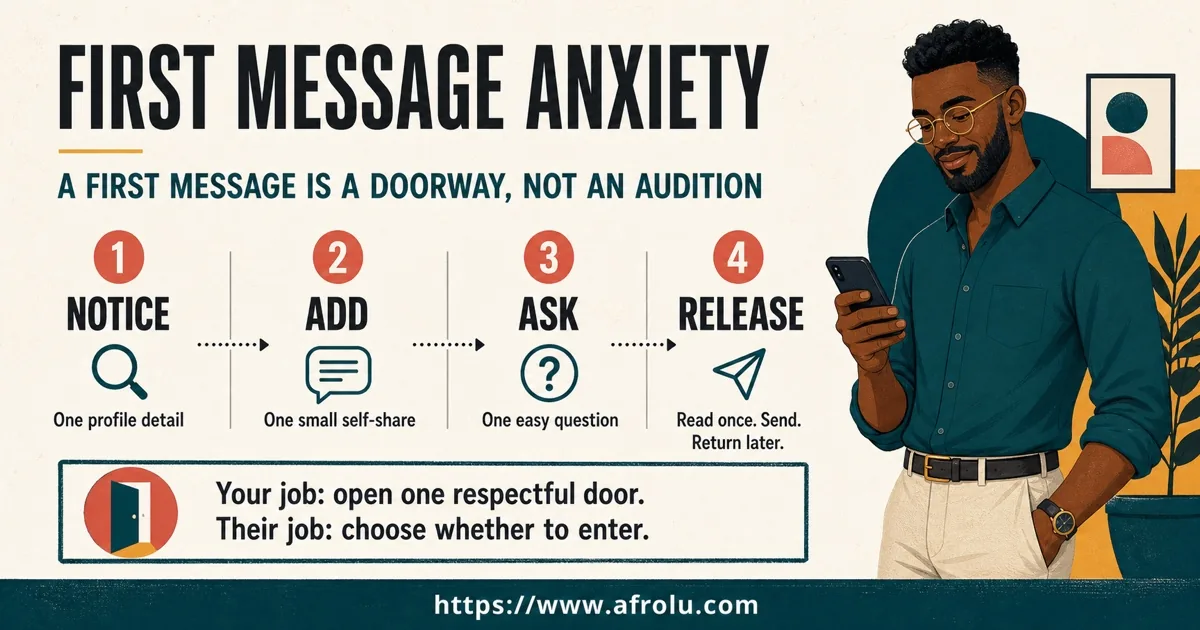
Notice one real profile detail, add one small piece of yourself, ask one easy question, then read once and release. The opener only begins the exchange; it does not have to prove your whole value. Afrolu visual:
Written and edited by Nia Kato · Profile Advice Editor
Evidence review by Miriam Otieno · Senior Kenya Editor · Safety and visual review by Adwoa Boateng · Dating Safety Editor · Reviewed 25 August 2026
Treat the opener as a doorway, not an audition. Notice one real profile detail, add one small piece of yourself, ask one easy question, read once for clarity and respect, then release the outcome. The message begins a two-person exchange; it does not have to manufacture chemistry alone.
Messaging
How can I write a specific, answerable first message without performing, oversharing, or tying my worth to the reply?
First message anxiety is the fear, over-editing, avoidance, or physical tension that can appear before initiating an online dating conversation. It may be a narrow reaction to uncertainty, part of a perfectionism habit, or one expression of broader social anxiety. The phrase describes an experience, not a diagnosis.
A match has already happened, yet the empty box can feel like an examination. “Hi” seems forgettable, humour seems risky, a question seems intrusive, and every rewrite raises the imagined cost of silence. The actual task is much smaller: offer one respectful opening that another adult can easily accept, redirect, or leave unanswered.
The doorway message
The first message is one small invitation, not a one-line proof that you deserve a relationship
Advice about opening messages often makes the blank box heavier. Be original, confident, funny, flirty, short, deep, different, and impossible to ignore, all at once. That turns a low-information interaction between two adults into an audition in which one person performs and the other awards a reply. It also hides the central fact: a conversation cannot be created by one excellent line. The recipient must notice, choose, answer, and eventually contribute. Your part is to offer a respectful doorway that makes those choices easy, not to remove every reason another person might remain silent.
Afrolu uses a four-part doorway message: notice one concrete profile detail; add one small, relevant piece of yourself when it gives the message a human voice; ask one question that can be answered without research, private disclosure, or emotional labour; then read once and release the outcome. This is an editorial writing aid, not a scientifically validated formula and not a response guarantee. Its purpose is narrower: reduce invention, keep investment proportional, and create enough shared context for reciprocity to become visible.
Use one detail that the person chose to show
A prompt, caption, hobby, place, book, dish, value, or activity gives the message a truthful anchor. Do not invent a personality from a photograph or claim a bond that does not exist.
Offer one small piece of your own context
A brief preference or experience keeps the opener from becoming an interview: “I keep choosing forest trails” or “I still prefer small venues.” One sentence is enough.
Make the answer easy to enter
Ask for a preference, recommendation, small story, or choice. Avoid several questions, tests of knowledge, private history, and requests that require the person to entertain you.
Review clarity, respect, pressure, and safety once
Confirm the detail is accurate, the tone is natural, the question is proportionate, and the message contains no sexual pressure, insult, money request, link, or demand to move platforms.
Choose action without waiting to feel perfectly certain
If you genuinely want the conversation and the message passes the check, send it. Confidence can mean acting with manageable uncertainty, not eliminating every nervous sensation.
Return ownership of the next move to the recipient
Close the app and continue your day. A delayed reply, no reply, or polite decline is information about this interaction, not a complete measurement of your attractiveness or worth.
Specific without surveillance
Build from what the person chose to share, not what you can infer from the background
Specificity works best when it demonstrates attention without pretending knowledge. A written prompt, photo caption, listed interest, book, dish, event, pet, craft, or clearly named place is usable because the person placed it in the conversation space. Describe it accurately before interpreting it. “You mentioned learning pottery” is an observation. “You must be patient and artistic” is a personality claim. The first creates a doorway; the second asks a stranger to accept your projection or correct it.
Photographs require more restraint. A mountain may support a question about the hike when the caption names it. An office badge, street sign, school uniform, home entrance, child, licence plate, religious symbol, or background reflection may reveal more than the person intended to discuss. Do not turn visual investigation into proof that you paid attention. Avoid asking where someone lives, works, worships, earns money, or spends a predictable evening unless they explicitly opened that subject. Specific should feel seen, not tracked.
The same principle improves cultural and diaspora conversations. A flag, name, food, clothing, language, or location does not make one person the representative of a nation, ethnic group, faith, or migration story. Ask about the displayed item rather than testing authenticity: “You listed highlife among your favourites; which artist stays in your rotation?” is different from “Are you really Ghanaian?” Curiosity can be direct without demanding that a stranger defend belonging.

Replace a generic hello, appearance-only compliment, or long performance with one profile cue and an easy question. Keep the emotional demand proportional to a conversation that has not started yet. Afrolu visual:
The message workshop
Use one detail, one small self-share, and one easy question instead of a generic greeting or a complete autobiography
Start with the smallest truthful unit. “Your hiking photo caught my eye” identifies the doorway. Add context only if it helps explain your interest: “I keep choosing forest trails.” Then ask something the person can answer from preference or memory: “Which route would you repeat?” The self-share matters because questions alone can feel like screening. The question matters because a statement alone can leave the recipient doing all the work of finding a next thread. Neither element needs to be impressive.
A weak message is not simply a short one. “Hey beautiful” may be warm but generic and appearance-led. “I have never met anyone who seems as adventurous as you” invents importance. “Where was every travel photo taken, what is your favourite country, and where are you going next?” creates an assignment. A stronger opener lowers the claim and the labour: “The night-market photo made me hungry. I always choose something grilled first; what did you go back for?” It gives one reason, one glimpse of the sender, and one answerable path.
Natural language outranks copied cleverness. If you would not know how to respond when the person plays along with a pickup line, do not use it as a costume. Translation tools, spelling support, or a trusted accessibility aid can help make your meaning clear, but the final message should still sound like a voice you can continue. Direct wording is especially useful across dialects, second languages, neurodivergent communication, screen readers, or cultural humour differences. Clarity is not lack of personality; it is how personality survives the channel.

Boring becomes specific, intense becomes proportionate, fake becomes natural language, and fear of rejection becomes a release plan. Anxiety predicts possibilities; a calm review checks what is actually on the screen. Afrolu visual:
When there is no obvious hook
Choose a simple opener or choose not to send; do not manufacture intimacy from a thin profile
A thin profile changes the writing problem. You may have only photographs, an age, a broad location, and one generic interest. In that case, the most specific safe message may still be ordinary: “You have kept the profile brief, so I will start simple: relaxed brunch or an evening walk?” Another option is to state your own context and invite a preference: “I am looking for a thoughtful long-term connection. What kind of conversation makes you want to meet someone?” The question should remain easy to decline and should not demand sensitive history.
You can also decide not to begin. A match indicates some platform-level interest at a moment; it does not obligate you to create substance the profile does not contain. If detailed profiles help you feel safe, assess compatibility, or communicate access needs, choose them deliberately. That is different from punishing a concise writer. It is a channel-fit decision: you need enough voluntary context to make an informed and comfortable opening.
Act once, monitor less
Use a send-and-release routine so uncertainty does not become the main relationship
Before sending, perform one observable check. Is the named detail actually present? Is the question clear? Does the message avoid sexualization, insults disguised as teasing, pressure, money, links, or requests for private information? Would you be comfortable receiving the same level of familiarity from a stranger? Correct what changes meaning. Then decide based on desire and safety, not on whether anxiety has reached zero. Waiting for complete certainty can quietly become a rule never to initiate.
After sending, transfer responsibility for the next action. Close the app, mute nonessential alerts, and choose when you will return. The return point may be later that day or during a scheduled app window; it is a boundary for your attention, not a tactic to appear unavailable. Avoid inspecting online status, changing the opener in your head, or sending a second line to prove that you are funnier than the first. If a platform has an expiry feature, understand its current rules directly, but do not let a countdown erase respectful judgment.
A non-reply can disappoint without carrying a hidden explanation. The recipient may not be active, may have too many conversations, may prefer another person, may feel unsafe, may be unavailable, or may simply decline. You cannot know which from silence. Bruch and Newman's market-level study is one reminder that response patterns involve far more than wording. Take the only reliable fact available: this exchange is not reciprocal now. Let that fact redirect effort rather than invite self-prosecution.

Write the doorway, check clarity respect and safety, send once, close the app, return at a chosen time, and do not use silence as a score of your worth. Afrolu visual:
The second message matters differently
When they reply, follow the answer and watch whether the conversation starts moving both ways
A reply is not the finish line and does not prove compatibility. Read for what the person actually offered. If they name a favourite trail, ask one follow-up tied to the answer and share something adjacent. If they answer briefly, respond once without escalating energy. If they redirect the topic, decide whether the new subject works for you. The most useful follow-up question is not the cleverest one prepared in advance; it is the one that shows the answer changed what you say next.
Then inspect reciprocity over several turns. Does the other person ask anything, develop a shared thread, remember a detail, volunteer relevant context, or make the exchange easier? Some warm communicators ask few explicit questions, and disability, language, culture, work, or texting style can shape pace. Do not score every bubble. Look for movement across the interaction. If you are repeatedly supplying every topic, joke, reassurance, and transition, pause. A strong first message does not contract you to carry a one-person interview.
Progress should eventually leave the message workshop. When identity and safety are sufficient and both adults want to continue, suggest a proportionate next step: another exchange, a voice or video call, or a public meeting with independent transport and check-ins. Do not use a successful opener to rush private images, home access, sexual talk, money, or immediate off-platform contact. Good conversation can increase comfort; it does not remove the need for consent, verification, or practical safety.

Open once, respond to the answer, add a related piece of yourself, and watch whether the other person asks, remembers, or develops the thread. Stop carrying a one-person interview. Afrolu visual:
Know when writing is no longer the issue
Stop optimizing the message when the real problem is pressure, fraud, harassment, or anxiety that reaches beyond the app
Safety can become relevant in the first exchange. Do not click a “verification” link sent by a match, send money or gift cards, share one-time codes, reveal passwords, install software, provide identity documents, or accept investment guidance. Be cautious when a stranger urgently wants to leave the platform or frames compliance as proof that you are genuine. Navigate to official app settings independently. Block and report through available channels, preserve evidence when useful, and contact financial providers or appropriate authorities promptly if money or accounts may be exposed.
Harassment does not require a perfect reply. Sexual comments, insults, repeated contact after a no, threats, outing, coercion, or demands for precise location can justify ending contact immediately. You do not owe an educational paragraph, an in-person rejection, or access to another channel. Platform reporting may help create a record, but personal safety takes priority. Use trusted people, local support services, law enforcement, or emergency help according to the situation and location.
Finally, notice the breadth of the anxiety. A short ritual may help when the fear is limited to sending. If similar worry appears before, during, and after many social situations; produces strong physical symptoms; causes persistent avoidance; or disrupts work, study, sleep, relationships, or daily functioning, the task is larger than messaging. WHO guidance notes that effective treatments for anxiety disorders exist. Seek a qualified local professional for assessment and options rather than treating more matches as exposure you must manage alone. This guide can support one action; it cannot diagnose, prescribe, or replace care.
Three adults at the same empty message box, with three different problems to solve
Imani has three useful profile details, but keeps combining all of them into one impressive paragraph
Imani matches with an adult whose profile mentions a sunrise hike, a favourite jazz venue, and learning to cook jollof rice. She writes about her own travel history, recommends two albums, makes a joke about cooking, asks which mountain appears in the photo, and edits the punctuation until the message sounds like an application. Nothing in it is hostile or dishonest. The problem is load: the recipient must choose among several threads while Imani has already invested enough effort to make silence feel expensive.
She chooses the detail that genuinely interests her and removes the rest: “That sunrise hike looks worth the early alarm. I keep choosing forest trails; which route would you repeat?” The opener has a cue, a small self-share, and one answerable question. The jazz and food details remain available if the conversation develops. Reducing the message is not hiding personality. It gives personality somewhere to unfold after the other person has opted into the exchange.Chinedu wants to avoid a generic hello, but the profile offers only photographs and a one-word bio
The usual “comment on the profile” advice assumes the profile contains enough voluntary context. This one does not. Chinedu is tempted to infer a job from clothing, ask where the person lives from a street background, or lead with a body compliment. Each option creates specificity by crossing a boundary. A thin profile is not a puzzle he must solve and a match does not require him to produce intimacy from information the other person did not provide.
He can use a low-pressure choice that reveals a preference without pretending familiarity: “Your profile is brief, so I will keep this simple: quiet coffee or a lively market for a first meet?” He can also send a plain greeting with one honest question, or skip the match because the profile does not provide enough basis for interest. The goal is not to avoid every ordinary opener. It is to avoid making up evidence, sexualizing the person, or requesting private details to compensate for missing context.Lindiwe sends a thoughtful message, then checks repeatedly and rewrites her opinion of herself when no reply appears
Lindiwe can write the opener. The harder part begins afterward. Every notification that is not the match becomes evidence that she sounded foolish, and she opens the chat to inspect whether the message was too long. She considers sending a joke to repair a problem she cannot observe. The app provides little context: the recipient may be busy, inactive, overwhelmed, uninterested, talking to someone else, or never intend to reply. None of those possibilities can be resolved by monitoring the box.
She uses a send-and-release boundary: one review, one message, notifications off, and one chosen return window. She does not send a second opener to reduce her own uncertainty. If this pattern occurs across social situations, causes strong distress, or repeatedly prevents connection, she treats it as broader support-worthy anxiety rather than a copywriting failure. A clinician or qualified mental-health service can help assess the whole pattern; a more clever line cannot do that work.Four signs the opener is ready even though uncertainty remains
You can point to the exact profile detail that prompted the message
The question can be answered without research, disclosure, or emotional labour
The message sounds like you rather than a copied persona
You can send it without treating the reply as a measurement of your worth
Match the message to the profile, the risk, and the amount of reciprocity available
| Situation | What it may mean | What to do next |
|---|---|---|
| The profile has several detailed prompts | You have too many possible doorways, not a need to use all of them. | Choose the detail that produces genuine curiosity. Build one thread and leave the others for later. |
| The profile is mostly photographs | There may be little voluntary context beyond appearance. | Use a broad preference question, mention a clearly captioned activity, or skip. Do not investigate the background or sexualize the person to sound specific. |
| You want to send only “hi” | You may prefer a very low-effort opening or have no real hook. | A greeting is not a moral failure. Add one honest, easy question if you want a better doorway; otherwise reconsider whether the profile gives you enough interest. |
| Your draft is becoming a paragraph | You may be trying to pre-prove humour, compatibility, status, or seriousness. | Keep one cue, one small self-share, and one question. Save depth for an exchange that has mutual participation. |
| You fear sounding boring | An imagined audience is judging style while the actual recipient has not responded. | Replace generic wording with one concrete detail. Do not add performance merely to create novelty. |
| You fear sounding too intense | The draft may ask for reassurance, private history, a date, or emotional importance too early. | Lower the demand. Ask for a small preference or story and let interest accumulate through replies. |
| The message has been sent and remains unanswered | The exchange is not reciprocal now; the reason remains unknown. | Do not repair an unobserved mistake. Follow any platform expiry you knowingly accepted, then redirect attention to active life and reciprocal conversations. |
| The reply contains pressure, sexual content, money, or a suspicious link | The next decision is safety, not conversational skill. | Do not click, pay, explain, or move channels under pressure. Block, report, preserve evidence when useful, and seek trusted or official help as appropriate. |
Three opening scripts that leave room for the other adult to contribute
“That sunrise hike looks worth the early alarm. I keep choosing forest trails; which route would you repeat?”
“You mentioned live music. I still prefer small venues; what show would you gladly see twice?”
“Your profile is brief, so I will keep this simple: quiet coffee or a lively market for a first meet?”
Know the difference
Doorway message vs audition message
One observed cue, one small self-share, one easy question, and room for the other adult to choose and contribute.
Several jokes, achievements, questions, compliments, or future hints designed to prove value and prevent any possible rejection.
A doorway can be ordinary and still useful. The measure is not whether it guarantees attention; it is whether it starts a respectful, answerable, two-person exchange.

Anxiety says you want to send but fear judgment. A thin profile gives you little truthful material. Low interest means you do not actually want the exchange. Simplify the first, choose or skip the second, and be honest about the third. Afrolu visual:
Compare seven reasons the first message box may stay empty
| Type or dimension | What it describes | Best next question |
|---|---|---|
| First-message anxiety | You want to begin, but imagined judgment drives avoidance, repeated editing, or monitoring. | Use the doorway method and a send-and-release boundary. |
| No usable profile detail | The person has supplied too little voluntary context for a specific opener. | Use a simple preference question or skip without inventing familiarity. |
| Low interest | You like being matched more than you want to know this person. | Do not force a conversation to prove confidence. Leave the match unused or close it respectfully. |
| Perfectionism | The opener feels valuable only if it is unusually clever, flawless, or impossible to reject. | Set a functional standard: accurate, respectful, proportionate, answerable. |
| Safety caution | A detail, request, inconsistency, or platform behaviour gives you a concrete reason to slow down. | Verify independently, keep platform protections, share less, or do not engage. Safety is not a confidence exercise. |
| Language uncertainty | You know what you mean but worry about grammar, translation, tone, disability access, or cultural interpretation. | Use direct literal wording, shorter sentences, and one clear question. Clarify rather than impersonating another voice. |
| Broader social anxiety | Fear and avoidance recur across conversations or settings and cause significant distress or impairment. | Use this writing aid only as one small support and seek qualified assessment when the wider pattern warrants it. |
Build one doorway message in six deliberate moves
Specific does not mean forensic
Use a detail the person intentionally shared. Do not identify a workplace, neighbourhood, school, family member, or hidden location from background clues.
A self-share prevents an interview
One short preference or experience shows why you asked. Keep it small enough that the recipient does not need to reassure, counsel, or validate you.
One question creates one entrance
A cluster of questions creates homework. Choose the question you would genuinely enjoy hearing answered and save the rest for a reciprocal exchange.
Ordinary language is allowed
Clear and warm can be more trustworthy than a borrowed joke or polished line that you could not naturally continue in the next message.
No reply is incomplete evidence
Silence tells you that an exchange is not happening now. It does not tell you the recipient's reason or produce a reliable judgment of your whole profile or value.
A reply creates a new decision
After an answer, check whether curiosity begins moving both ways. You are not required to keep performing just because the first line worked.
What conversation, online-dating, social-anxiety, safety, and survey evidence can actually support
No credible study can promise that one opener will reliably create attraction or a reply
A first message enters a system shaped by profile visibility, app use, timing, attraction, intentions, competing conversations, safety concerns, culture, language, and whether the recipient is active at all. Research can illuminate pieces of that system, but it does not turn “mention a profile detail and ask a question” into a universal conversion formula. Afrolu uses the doorway method because it reduces guesswork and pressure while preserving choice. Judge it first by whether it is truthful, respectful, proportionate, and answerable; a reply is an outcome involving another autonomous adult.
A study of 105 first emails shows variety, context building, and information exchange, not one winning sentence
Sharabi and Dykstra-DeVette analysed 105 naturally occurring emails sent to prospective romantic partners and recontacted participants after an offline meeting. Their qualitative analysis identified multiple strategy categories, including attracting and selecting, authentic self-presentation, shared context, revealing and seeking information, and adapting to online dating. The sample was small, email-based, and drawn from people who progressed to a meeting; the reported associations do not prove that a particular short app opener caused a second date. The useful lesson is structural: initiation can combine self-expression, curiosity, and shared context rather than relying on a copied pickup line.
Question asking can support connection, but the strongest evidence concerns live conversations rather than cold app messages
Huang and colleagues studied question asking across three live dyadic-conversation studies and reported that more questions, especially follow-up questions, were associated with greater liking through perceived responsiveness. A 2025 correction reported minor errors in some result reporting after an independent audit; it stated that the paper's conclusions and substantive hypothesis-test results remained unchanged and linked corrected materials. This does not prove that every first message should end in a question or that multiple questions are better. It supports the more modest practice of making curiosity responsive to what the other person has actually shared.
Large messaging data show why silence cannot be used as a clean grade of writing quality
Bruch and Newman examined one month of 2014 messaging activity on a free online dating service in four large US cities. Their analysis focused on heterosexual users and modelled a market-level hierarchy of desirability; response probability changed with the gap between sender and recipient, while messaging-strategy effects were modest and varied. The dataset is old, US-based, platform-specific, and unsuitable for ranking an individual or explaining one unanswered message. Its relevant caution is that response is not controlled by prose alone. More editing cannot neutralize every preference, market condition, timing issue, or inactive account.
A simulated dating-app study suggests low match feedback may land harder when social-anxiety symptoms are higher
A 2024 experiment assessed social-anxiety symptoms in 128 participants and randomly assigned high or low match-rate feedback during a simulated dating-app task. Higher symptom levels were associated with more negative affect after low-match feedback and a lower self-reported likelihood of initiating contact. This was a simulation, not a diagnosis, a real commercial app, or evidence that dating apps cause social anxiety. It does help explain why “just send it” may be incomplete advice. A bounded sending routine can reduce app exposure, while persistent or impairing anxiety deserves assessment beyond message technique.
Online dating includes insecurity, unwanted contact, and mixed outcomes alongside successful connection
Pew Research Center surveyed 6,034 US adults in July 2022 and reported mixed evaluations of online dating, including insecurity related to message volume and unwanted behaviours such as continued contact after rejection or unsolicited sexual messages. The survey describes US experiences at one time; it does not establish what all African, diaspora, queer, disabled, religious, or older adults encounter. It is still a useful guardrail: advice should not treat more replies as the only good outcome. An opener must leave room for no, protect safety, and avoid adding pressure to a channel where some users already receive too much unwanted attention.
A first message should never make money, links, credentials, or immediate off-platform contact the price of continuing
The US Federal Trade Commission describes romance scammers creating fake profiles, building trust, moving conversations away from the original service, inventing urgent stories, and requesting money through difficult-to-recover methods. The FBI has separately warned about fake dating-verification schemes that lead to malicious links, recurring charges, and identity collection. A real person can still make an unsafe request, and a verified-looking profile can still behave badly. Keep early contact inside available platform protections, do not send money or credentials, and independently navigate to official services instead of following a match's verification or payment link.
First-message nerves are not automatically an anxiety disorder, and a webpage cannot diagnose one
The World Health Organization distinguishes occasional anxiety from anxiety disorders involving intense, excessive, difficult-to-control fear or worry that persists and causes significant distress or impairment. Avoidance, physical symptoms, concentration problems, and disruption across social, work, school, or family life can matter to a qualified assessment. This guide offers a small communication routine, not treatment. If anxiety repeatedly blocks wanted relationships, extends beyond dating apps, or significantly affects daily life, seek an appropriate local healthcare or mental-health professional; urgent risk requires urgent local help.
Four ways an opener becomes a performance, interview, intrusion, or self-worth test
Performing the whole personality
A long, polished opener increases emotional investment before reciprocity exists and gives the recipient several unrelated demands to process.
Using appearance as the only doorway
Generic beauty comments are easy to repeat and may feel objectifying, especially when they become sexual or imply access. Use chosen context where possible.
Sending a questionnaire
Several questions ask the other adult to work while revealing little about why you are interested. One answerable thread gives both people room.
Making the reply a worth score
Response depends on more than prose. Rechecking, double-messaging, or changing yourself around one silence makes unknowable context look like a personal verdict.
Use a reviewed resource that matches the decision
This guide focuses on the relationship decision, so it does not rank dating apps. Check current prices, safety tools, and local availability before choosing a service.
Explore the guide library
Show more related guides
Continue with Afrolu
Show more Afrolu guides
Conversation, initiation, response, anxiety, safety, and online-dating evidence behind this guide
Afrolu reviewed these health, research, safety, or public guidance resources while editing this page. They support the behaviour and safety guidance; they do not diagnose any individual described by a reader.
First message anxiety questions answered without a guaranteed reply formula
What should I say in a first message on a dating app?
Notice one detail the person chose to share, add one small relevant piece of yourself, and ask one easy question. For example: “That sunrise hike looks worth the early alarm. I keep choosing forest trails; which route would you repeat?” Keep the demand proportional to a conversation that has not started. The goal is an honest doorway, not a line guaranteed to produce attraction.
Is “hi” or “hey” a bad first message?
It is not harmful, but it gives the recipient little context for a reply and may resemble many other greetings. If the profile offers a usable detail, add it and one easy question. If the profile is nearly empty, a simple preference question can be enough. Do not create false intimacy or investigate private clues merely to avoid sounding ordinary.
How long should a first dating-app message be?
There is no evidence-based universal word count. Use enough language to identify the profile cue, make your interest understandable, and offer one answerable thread. Often that fits in two or three short sentences, but language, accessibility, culture, and context vary. Remove only what performs, pressures, repeats, or creates homework; do not shorten until the message becomes vague.
Should every first message include a question?
No. A thoughtful observation can open a conversation, and a recipient may respond without a question mark. One easy question is useful because it supplies a clear entrance, not because research guarantees a reply. Question-asking research concerns live conversations and follow-up responsiveness, so do not turn it into a rule that more questions are always better. One relevant question is usually enough.
What do I say when the profile has almost no bio?
Use a clearly captioned activity, offer a simple choice such as “quiet coffee or lively market,” send a plain greeting with one broad preference question, or skip the match. A thin profile may simply provide too little basis for genuine interest. Do not infer a workplace, exact location, income, religion, sexuality, or personality from visual clues, and avoid making appearance or the body your only doorway.
Should I compliment someone's appearance in the first message?
A respectful compliment is not automatically wrong, but appearance-only messages are easy to repeat and can feel objectifying, especially when sexual. Prefer something the person chose, made, wrote, visited, or cares about. If you mention appearance, keep it nonsexual and do not treat the compliment as a debt that requires a reply. One compliment cannot establish compatibility or consent.
How many times should I edit the first message?
Use one functional review: is the detail accurate, the question easy, the tone natural, and the message free of pressure or unsafe requests? Correct anything that changes meaning, then send if you want the conversation. Repeated editing often tries to control the recipient's response, which no wording can do. If you cannot stop reviewing, save a short personal template for structure, not copied content.
What should I do if they do not reply?
Treat the absence of an exchange as limited information. Do not assume a reason, repair an unobserved mistake, or send escalating messages to reduce your own uncertainty. Some platforms have expiring matches or explicit timing rules; follow the current rules you knowingly accepted. Otherwise, redirect attention to your life and reciprocal conversations. Silence can close an attempt without defining your worth.
When is first message anxiety a mental-health concern?
Occasional nerves are common and are not automatically a disorder. Consider qualified support when fear is intense, persistent, difficult to control, repeatedly causes avoidance, produces significant distress, or affects relationships, work, study, sleep, or daily functioning beyond one app. This page cannot diagnose or treat anxiety. Use an appropriate local healthcare or mental-health service, and seek urgent local help for urgent risk.
What first-message requests should make me stop?
Pause or leave when a stranger pressures you to click a verification or payment link, send money or credentials, share intimate images, reveal precise location, move off-platform immediately, accept sexual content, or prove trust. Do not follow a link merely because it looks official. Navigate to the app or service independently, use platform reporting and blocking tools, preserve evidence when useful, and involve trusted or official support where appropriate.
One thing to do now
Send a clear doorway, then let reciprocity do its half of the work
Use one observed detail, one small self-share when it helps, and one easy question. Remove pressure, sexualization, invented familiarity, and private-data requests. Read once, send only if you genuinely want the conversation, and let the reply reveal whether reciprocity exists.


