Change the operating system
Online Dating Burnout: Audit, Pause, Recover, Return or Leave
A careful online dating burnout guide with a load audit, deliberate break plan, safety safeguards, conversation scripts, evidence limits, and return rules.
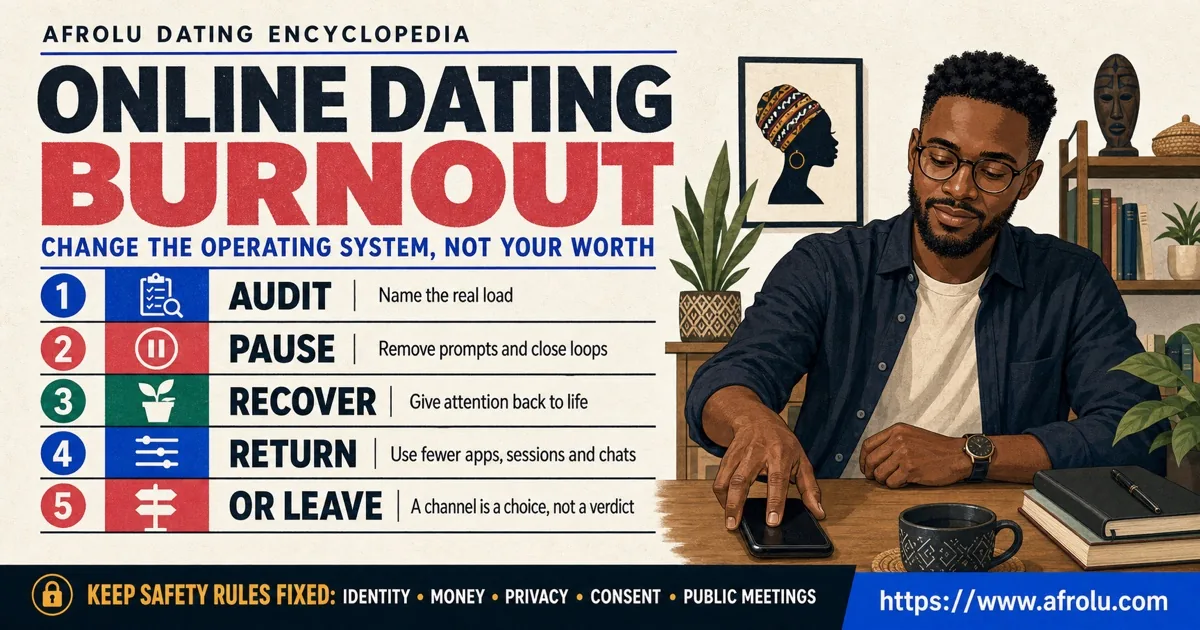
Audit the load, take a deliberate pause, recover outside the marketplace, and return with fewer demands or leave the apps without treating either choice as defeat. Afrolu visual:
Written and edited by Nia Kato · Profile Advice Editor
Treat "dating app burnout" as a useful description of fatigue, not a diagnosis. Audit discovery, comparison, messaging, scheduling, safety, rejection, and recovery. Take a deliberate pause that removes prompts and returns attention to ordinary life. Close developed conversations proportionately, but block or report unsafe contact. Keep identity, money, privacy, public-meeting, transport, and consent rules fixed. Return only with fewer channels, sessions, and active chats—or leave the apps when another route fits better.
Dating wellbeing
Which part of online dating is consuming capacity, what should stop now, and would a smaller return or a clean exit better serve your life?
Online dating burnout is colloquial shorthand for fatigue, dread, numbness, irritability, reduced attention, or loss of useful choice around dating apps. The World Health Organization uses burnout specifically for an occupational phenomenon, so this page does not apply a medical diagnosis to dating behaviour, disappointment, or screen time.
The visible action is a swipe, but the hidden workload includes comparison, self-presentation, matches, silence, open conversations, scheduling, verification, privacy, unwanted contact, money decisions, transport, rejection, and recovery. When that system exceeds capacity, profiles blur and humans begin to feel like tasks. The answer is not necessarily more discipline or a better subscription. It is to identify the expensive part, remove load, restore ordinary life, and decide whether this introduction channel still earns a place.
The central distinction
Dating-app fatigue is real, but the page in your hand cannot diagnose clinical burnout
Online dating can combine browsing, self-presentation, rejection, comparison, safety screening, scheduling, ambiguous loss, and the hope of partnership inside one repeated phone habit. Adults often call the resulting depletion "dating app burnout." This guide uses that familiar phrase as editorial shorthand for fatigue, dread, numbness, irritability, reduced attention, or a loss of useful choice around online dating. It is not a medical diagnosis.
The reset has five possible moves. Audit identifies which part of the system is costly. Pause interrupts automatic checking and closes avoidable loops. Recover rebuilds sleep, attention, friendship, movement, pleasure, and perspective outside the matching environment. Return means choosing fewer apps, sessions, conversations, and metrics. Leave remains a valid outcome when the channel no longer serves your goal. Safety rules about identity, money, privacy, consent, and public meetings do not relax because you are tired.
Name the actual workload
Separate browsing, comparison, messages, planning, safety checks, rejection, and recovery. "The apps are exhausting" becomes more actionable when the expensive task is visible.
Remove prompts and close loops
Choose a defined interruption, silence optional notifications, tell active conversations what is changing when appropriate, and stop opening the platform reflexively.
Restore a life that is not an audition
Sleep, friendships, exercise, faith, creativity, rest, family, and ordinary pleasure are not rewards for finding a match. They are the context from which better judgment becomes possible.
Make the channel earn its place
Return with a small operating agreement and a review date, or leave because another route fits better. Neither outcome measures desirability, maturity, or future relationship success.
The swipe is only the visible task
Separate discovery, comparison, conversation, planning, safety, rejection, and recovery
Begin with a workload map rather than deleting everything in anger. For three or four ordinary sessions, record why you opened the app, what you actually did, how long it lasted, and what happened afterwards. Break the activity into discovery, profile comparison, self-presentation, messages, scheduling, verification, unwanted-contact management, disappointment, and recovery. An adult may enjoy browsing but dread the inbox, or value conversation while finding safety screening exhausting. Those require different changes.
Include the work that happens away from the screen. You may be choosing clothes, travelling, asking a friend to check in, paying for transport, arranging childcare, adjusting prayer or work schedules, explaining repeated disappointments, or recovering from a date that went nowhere. A five-minute session can reopen an hour of rumination. Screen-time totals therefore matter less than the full cost across attention, sleep, money, safety, and ordinary life.
Do not use the audit as a new scorecard against yourself. The purpose is to identify the smallest effective change. If late-night discovery disrupts sleep, move sessions earlier. If ten active chats create resentment, cap them. If the platform exposes you to harassment or unsuitable matches, use safety tools or leave. If every part feels depleted, choose a full pause. Precise language creates options that "I am terrible at dating" cannot offer.

Discovery is only one task. Comparison, messaging, scheduling, verification, disappointment, privacy decisions, and recovery all consume attention. Afrolu visual:
Time alone is not a diagnosis
Track energy, attention, mood, standards, safety, and the life displaced by app use
Use six columns. Energy asks whether a session leaves you steady, activated, or depleted. Attention asks whether profiles remain distinct and messages remain thoughtful. Mood records effects without forcing one cause: curiosity, hope, connection, irritation, shame, envy, anxiety, numbness, or relief. Standards asks whether you become clearer or start accepting incompatibility to end the search. Safety records pressure, inconsistency, unwanted contact, money requests, and privacy risk. Ordinary life records what the session replaced.
Look for repetition and context. A disappointing evening after rejection is not the same as a month of automatic checking and worsening sleep. A positive exchange does not erase a platform’s harassment problem. A low match rate may interact with social anxiety, profile fit, location, filters, timing, or platform design; it cannot calculate a person’s worth. Research on dating-app wellbeing is heterogeneous and often cross-sectional, so the audit should guide a personal experiment rather than announce a clinical conclusion.
Set a threshold in advance. You might stop a session when profiles blur, when you cannot write a specific reply, when irritation changes your tone, when bedtime arrives, or when a safety inconsistency appears. Thresholds protect other users as well as you. Continuing while numb can lead to careless swipes, generic messages, avoidable ghosting, and dates accepted without genuine curiosity. Stopping at reduced capacity is not weakness; it is responsible use of limited attention.

Notice what happens to energy, attention, mood, standards, safety, and offline life before, during, and after a session. Time alone cannot diagnose problematic use. Afrolu visual:
A pause is a boundary, not a secret test
Remove cues, resolve active conversations, preserve evidence, and give the recovered time a destination
Choose a pause long enough to interrupt the pattern you observed. There is no universal seven-day, thirty-day, or ninety-day prescription. A weekend may reveal automatic checking; a longer interval may be needed to restore sleep or decide whether online dating fits at all. Write the purpose and review date. "I am pausing discovery for two weeks to restore evening attention and review my active conversations" is more useful than "I am never dating again" during a depleted night.
Resolve open loops proportionately. Invite a promising, verified match to a short public date if enough alignment exists. Tell a developed, respectful conversation that you are taking a break and will not reply regularly. Decline where fit is absent. Do not send closure to someone who is threatening, coercive, fraudulent, or repeatedly ignoring a request for no contact; preserve relevant evidence, block, report, and seek support as appropriate. A reset should not require unsafe access.
Remove prompts and plan the reclaimed space. Silence optional notifications, sign out, move the icon, or uninstall if that helps, while remembering that uninstalling may not delete a profile, subscription, or stored account data. Then schedule ordinary restoration: sleep, a friend, movement, family, faith, therapy, cooking, creativity, or quiet. Recovery is not a beauty treatment before re-entering the market. It is returning attention to a full life in which dating is one part.

A reset can include respectful closure, a specific public invitation, a clean decline, and honest expectations when you return. You do not need to maintain every weak conversation. Afrolu visual:
Fatigue is not consent to more risk
Do not trade identity, money, privacy, transport, or public meetings for speed and relief
Burnout can create dangerous urgency: perhaps this is the final match you can tolerate, so you overlook a changed story, move to private messaging immediately, accept a secluded meeting, depend on the person for transport, or send a small amount of money to settle an emergency. The emotional logic is understandable and the risk remains. Never send money, gift cards, cryptocurrency, investments, fares, codes, identity documents, or account access to prove trust to an online romantic interest.
Keep first meetings public, independently reachable, and easy to end. Verify inconsistencies before increasing access. Tell a trusted person the plan when appropriate, keep enough battery and transport funds, and retain control over drinks, devices, images, sexual choices, and the route home. A tired person is still entitled to consent that is specific, informed, and changeable. A match who punishes a slower pace provides information; you do not need to persuade them to respect it.
Use platform block and report tools when relevant, while recognising that interfaces and policies change. Save evidence you lawfully need before deleting an account or conversation. Secure the email and phone accounts connected to the profile and change compromised passwords. If contact becomes threatening, stalking, coercive, or financially exploitative, involve trusted support and relevant local services. The solution is not better swiping technique.
Make the channel earn its place
Limit apps, sessions, active chats, and metrics while creating a route toward real meetings
Return only if online introductions still serve a current goal and enough capacity has returned to recognise people. Choose one or two channels based on audience, location, safety controls, communication style, and cost rather than popularity alone. Define when and where you will use them. A twenty-minute session twice a week may suit one adult; another may prefer a short daily check. The useful limit is the one that preserves sleep, work, relationships, judgment, and recovery.
Cap active conversations below the point where names and stories blur. Move a promising exchange toward a short public meeting once identity cues, intention, location, timing, and basic compatibility are clear enough; endless texting can become another queue. Do not rush because of a rigid message count. If someone avoids every practical bridge, asks for money, changes identity details, or keeps you in indefinite attention without reciprocal movement, step back and assess the behaviour.
Review process rather than demanding an outcome. Did you stay present? Were messages specific and reciprocal? Did standards and safety remain intact? Did sessions end when planned? Could you recover and return to ordinary life? Matches, dates, and relationships matter, but they are not fully controllable weekly targets. If the smaller system still produces depletion, pause again, change the channel, meet people through other settings, or leave online dating. A tool does not deserve permanent access simply because other adults use it.

Remove prompts, close urgent loops, restore sleep and ordinary connection, review your standards, preserve scam safeguards, and decide whether returning serves your goal. Afrolu visual:
Deleting the channel is not deleting possibility
Build offline routes and seek wider support when the problem has spread beyond dating
Leaving dating apps can be a clear, healthy decision. You may prefer introductions through friends, faith communities, professional networks, volunteering, classes, sport, cultural events, family networks, or everyday life. Each route has its own access, inclusion, privacy, safety, and social-pressure tradeoffs. Choose two realistic environments you would value even if no date appears. That protects the activity from becoming another disguised matching quota.
Do not confuse a platform break with a loyalty test for someone you are seeing. Exclusivity, app visibility, uninstalling, profile deletion, and relationship commitment are different agreements. If a developing connection matters, discuss what each action means rather than deleting silently to force a reaction. Likewise, do not keep an account as insurance after agreeing to exclusivity. Clear words and observable follow-through are more useful than hidden tests on either side.
Notice when fatigue has expanded into a broader loss of hope, sleep, pleasure, connection, or functioning. Trusted friends, community, and a qualified local health professional can help assess what an app article cannot. Persistent distress is not a reason to optimise harder or isolate further. The final aim is not to return to swiping. It is to preserve a life with attention, dignity, safety, relationship possibilities, and enough support to make free choices about how you meet people.
Online dating fatigue does not look the same for every adult
You open the app without deciding and leave feeling more scattered
The session begins in a queue, bed, bathroom, meeting break, or lonely moment. Ten minutes becomes forty. Profiles receive less attention, the same people blur together, and the final feeling is not curiosity but agitation, envy, numbness, or self-criticism. You may not even remember why you opened the app.
Interrupt access for a defined period and record the trigger, task, duration, and after-effect without moralising. Move the icon, sign out, or silence prompts if useful. Replace the exact moment with a small offline action rather than expecting willpower to defeat every cue.Several decent conversations have become unpaid administration
Nothing is dramatically wrong. The burden comes from remembering names, jobs, stories, reply timing, screening questions, location constraints, and possible plans across multiple threads. You reply because silence feels rude, then resent the work and give each person less presence than you intended.
Narrow active conversations to a number you can engage with attentively. Invite one promising match to a short public meeting when enough basics align, close low-fit conversations respectfully, and pause new discovery until the existing queue is resolved.Hopelessness, sleep disruption, or loss of interest has spread into ordinary life
Deleting an app does not restore energy. Work, friendships, food, movement, prayer, hobbies, and rest also feel flat or difficult. You may be withdrawing broadly, experiencing persistent distress, or carrying a health concern that a dating strategy cannot explain.
Treat the wider pattern as a wellbeing question, not a profile-optimisation problem. Reach out to trusted support and consider a qualified local health professional, especially when distress is persistent, severe, affects daily functioning, or includes thoughts of self-harm. Use urgent local support when immediate safety is at risk.Six areas to audit before deciding what the apps mean about you
You open the app automatically and cannot name the goal
Profiles blur, replies become generic, or active conversations feel like debt
Matches and silence are becoming measurements of personal worth
Fatigue is tempting you to lower identity, money, privacy, consent, or meeting safeguards
Match the response to the kind of load you are carrying
| Situation | What it may mean | What to do next |
|---|---|---|
| You open the app automatically and cannot name the goal | A cue-response habit has replaced a deliberate dating session. | Create access friction, note the trigger, and choose defined sessions rather than continuous availability. |
| Profiles blur and your choices become less careful | Comparison and decision load have exceeded useful attention. | End discovery for the day, narrow the pool, and revisit only when you can recognise individuals again. |
| Several respectful chats feel like administrative debt | The number of open loops exceeds your conversational capacity. | Cap active threads, propose a short public meeting where fit exists, and close low-fit exchanges clearly. |
| One rejection becomes proof that nobody will choose you | A noisy platform outcome is being converted into a global identity judgment. | Pause the feedback stream, name the specific disappointment, and seek perspective outside the matching environment. |
| You want to lower safety rules because starting over is exhausting | Fatigue is impairing risk tolerance and creating urgency. | Stop the interaction or session. Keep identity, money, privacy, public-meeting, transport, and consent boundaries intact. |
| A break restores curiosity and ordinary life | The introduction channel may remain usable under lower volume and clearer boundaries. | Return as a time-limited experiment with fewer apps, sessions, and active conversations. |
| A break feels good and you prefer other ways of meeting | The platform may no longer earn a place in your dating strategy. | Leave or keep it paused. Build realistic community, friendship, activity, faith, professional, or referral routes without promising instant results. |
| Distress remains broad, persistent, severe, or functionally impairing | The difficulty may extend beyond online dating fatigue. | Reach out to trusted support and consider qualified local health care; use urgent local help when immediate safety is at risk. |
Words for pausing, narrowing, meeting, declining, and returning
“I have enjoyed our conversation. I am taking a break from the app this week and will not be replying regularly. I did not want to disappear without saying so.”
“I would rather learn in person than keep a long chat going. Would you like a short coffee in a public place on Saturday afternoon?”
“I check the app a few times a week rather than throughout the day. A slower reply is not a signal that I expect instant availability from you either.”
“Thank you for talking with me. I do not feel the fit I am looking for, so I am going to close the conversation. I wish you well.”
“I do not send money, codes, documents, investments, fares, or gifts to people I know through a dating app.”
“I only meet a new match in public and arrange my own transport. If that plan does not work, I will not meet.”
“I am back on the app with a smaller routine. I am open to a real conversation, but I am not available for continuous messaging.”
“Online dating is not serving me now, so I am stepping away rather than forcing it. I am not asking anyone to wait for me.”
Know the difference
Deliberate app pause or hopeless withdrawal?
The pause names a load, changes access, restores specific parts of life, preserves safety and support, and includes a review. Returning and leaving both remain available choices.
Current fatigue becomes a permanent prediction: nobody is trustworthy, you are unlovable, dating is pointless, or all connection will fail. Isolation expands beyond the app and support narrows.
Reduce the channel without reducing your whole life. A reset should create attention, support, and choice rather than demand optimism on command.

A deliberate pause reduces app load while preserving relationships, support, safety, and future choice. Hopeless withdrawal turns current fatigue into a permanent judgment about self or others. Afrolu visual:
Volume fatigue, discouragement, safety vigilance, or broader distress?
| Type or dimension | What it describes | Best next question |
|---|---|---|
| Discovery fatigue | Browsing continues after profiles stop feeling distinct, and more options produce more comparison than understanding. | What is the smallest pool I can evaluate with real attention? |
| Conversation overload | Names, stories, replies, screening, and scheduling exceed the number of people you can engage with respectfully. | Which conversations deserve a date, a pause, or a clean ending? |
| Rejection accumulation | Silence, unmatching, ghosting, or decline begins to feel like one continuous verdict rather than separate outcomes. | Can I stop exposure before the current disappointment becomes my identity? |
| Safety vigilance | Verification, privacy, unwanted contact, scam screening, and meeting plans consume a large share of capacity. | Which safeguards stay fixed, and which introduction route creates less risk work? |
| Loneliness-driven checking | The app is opened for immediate relief from loneliness even when the usual result is greater agitation or emptiness. | What live human contact or grounded activity can meet part of this need now? |
| Performance exhaustion | Photos, prompts, jokes, response timing, and perceived marketability turn every session into an audition. | Does my profile represent me clearly enough without requiring constant reinvention? |
| Broader distress | Low mood, anxiety, sleep problems, withdrawal, or loss of interest continues across work, relationships, and daily life. | What support is needed beyond a dating-app reset? |
The audit, pause, recover, return-or-leave method
Energy
Rate energy before and after a session. A repeated drop is more useful than one bad evening, and it identifies when access needs to change.
Attention
Can you recall distinct details about the profiles and conversations you chose, or are people becoming interchangeable inputs?
Mood
Notice irritation, shame, anxiety, numbness, envy, hope, curiosity, or connection without claiming that the app is the only cause.
Standards
Check whether fatigue makes you abandon compatibility needs, chase unavailable matches, or accept conduct you would question for a friend.
Safety
Record pressure to send money, move privately, share codes or documents, leave the platform immediately, or surrender transport and consent choices.
Ordinary life
Ask what app use displaced: sleep, work, exercise, friends, family, faith, creativity, rest, or face-to-face community.
Why a phone-sized activity can become a large emotional workload
WHO uses burnout for an occupational phenomenon
The World Health Organization describes burnout in ICD-11 as an occupational phenomenon resulting from chronic workplace stress that has not been successfully managed, and not as a medical condition. "Online dating burnout" is therefore a popular analogy, not the WHO category. This distinction matters because a dating article should not turn tiredness, disappointment, or high screen time into a diagnosis.
Research finds associations, not one universal app effect
A 2026 systematic review and meta-analysis reported small-to-moderate associations between swipe-based dating-app use and several mental-health correlates across 27 studies, while also identifying substantial heterogeneity and limits on causal inference. A separate systematic review found inconsistent definitions of problematic online dating and relatively few longitudinal studies. The responsible conclusion is neither "apps are harmless" nor "apps cause distress for everyone."
Discovery, evaluation, messaging, planning, and safety are separate jobs
A swipe is quick, but the surrounding work is not. The user interprets photos and prompts, compares options, presents a self, handles matches and silence, remembers conversation details, negotiates dates, verifies inconsistencies, protects privacy, manages unwanted contact, and recovers from rejection. Burnout plans fail when they limit swipe minutes while leaving every other task open.
More options can increase search without improving the choice
An experimental online-partner study found that larger option sets led participants to search more and make worse choices in that specific context. It involved 128 Taiwanese participants and an earlier online-dating environment, so it does not establish a universal ideal pool size. It supports a practical experiment: if comparison is replacing recognition, narrow discovery and give a smaller set enough attention to become distinct people.
Matches and replies are noisy outcomes, not measurements of worth
Visibility, geography, timing, filters, platform design, profile fit, user activity, preferences, paid placement, and chance all affect who sees and answers whom. A match count cannot isolate attractiveness, character, compatibility, or relationship capacity. Use outcome data to adjust a process, not to produce a verdict about your value.
Fatigue can lower the quality of the very choices you want to improve
When profiles blur, adults may swipe automatically, miss incompatibilities, forget details, send generic messages, overinvest in minimal attention, or accept plans they would normally question. That is a reason to stop the session, not to push through for productivity. Dating is not improved by processing more humans with less recognition.
Tiredness must not lower identity, money, privacy, or meeting standards
A fatigued user may want to skip verification, move off-platform immediately, send money to end an urgent story, meet privately for convenience, or ignore an inconsistency because starting over feels worse. FTC guidance is direct: never send money or gifts to a romantic interest you have not met in person. Keep public first meetings, independent transport, account security, consent, and reporting options outside the efficiency experiment.
A pause works best when it restores something specific
Deleting an icon can remove a cue, but recovery needs a destination. Decide what the reclaimed attention will support: regular sleep, a friend, exercise, creative work, faith, therapy, family, cooking, time outdoors, or dating through community. The purpose is not to become perfectly healed before meeting anyone. It is to regain enough energy and perspective for deliberate choice.
A smaller system should be observable and revisable
Choose one or two introduction channels, defined sessions, a cap on active conversations, a rule for moving promising chats toward a safe public date, and a date for reviewing the experiment. Track process signals such as presence, clarity, safety, and recovery rather than promising yourself a match by Friday. If the system remains costly, pause again or leave without converting the result into hopelessness.
Four common reset plans that quietly preserve the same pressure
The new-app solution
Adding platforms increases discovery, profiles, prompts, subscriptions, messages, and safety work when the real problem is capacity.
The productivity sprint
Setting swipe quotas treats people as inventory and encourages continued use after attention, standards, and recognition have declined.
The secret disappearance
A reset does not require maintaining every chat, but vanishing from a developed, respectful exchange can create avoidable ambiguity when one sentence would close the loop.
The safety discount
Exhaustion can make convenience feel more valuable than verification, public meetings, independent transport, consent, privacy, and money boundaries.
Use a reviewed resource that matches the decision
This guide focuses on the relationship decision, so it does not rank dating apps. Check current prices, safety tools, and local availability before choosing a service.
Explore the guide library
Show more related guides
Continue with Afrolu
Show more Afrolu guides
Burnout terminology, dating-app wellbeing, fatigue, choice, and safety sources
Afrolu reviewed these health, research, safety, or public guidance resources while editing this page. They support the behaviour and safety guidance; they do not diagnose any individual described by a reader.
Online dating burnout questions, answered without false certainty
Is online dating burnout a medical diagnosis?
No. The phrase is common shorthand for fatigue, dread, numbness, irritability, reduced attention, or loss of useful choice around dating apps. WHO uses burnout specifically for an occupational phenomenon. Persistent or severe distress affecting daily life deserves qualified support rather than self-diagnosis from an article.
How do I know whether I need a break from dating apps?
Look for repeated effects: automatic opening, poorer sleep, profiles blurring, obligation-based replies, abandoned standards, unsafe shortcuts, persistent agitation after use, or dating displacing ordinary life. One difficult session is information, not a diagnosis. A short deliberate pause can test whether access is part of the load.
How long should an online dating break last?
There is no evidence-based universal number. Choose enough time to interrupt automatic checking and restore the capacity you identified. Set a review date rather than a punishment: assess energy, attention, mood, standards, safety, and ordinary life, then continue, extend, return, or leave.
Should I tell matches that I am taking a break?
Tell people with whom you have a developed, respectful exchange when a short message would prevent avoidable ambiguity. You can say that you will not be replying regularly and do not expect them to wait. You do not owe further contact to harassment, coercion, fraud, threats, or repeated unwanted messages; block and report where appropriate.
Does uninstalling a dating app delete my profile?
Not necessarily. Removing software from a device, hiding or pausing discovery, cancelling a subscription, and deleting an account are different actions. Check the platform’s current official help pages and confirmation screens. Save any safety evidence you lawfully need before deleting access, and protect the email or phone account connected to the profile.
Should I add another dating app when matches are slow?
Only if the new channel solves a clear fit problem and you have capacity for its messages, settings, safety work, and cost. If people already blur together or open conversations feel like debt, another platform increases the workload. Reduce volume first and evaluate one deliberate change at a time.
How many matches or conversations should I handle at once?
There is no universal ideal. Use attention as the limit: can you remember each person, respond with care, screen for safety, identify fit, and keep ordinary life intact? Cap active conversations below the point where people become interchangeable. A smaller number is not a failure of ambition.
Can a dating app break improve my chances of finding a relationship?
A break cannot guarantee matches or a relationship. It may improve sleep, attention, standards, safety, and the quality of your choices if continuous use was impairing them. The useful outcome is restored agency, whether you return to one app, meet people another way, or stop online dating.
How do I return to dating apps without repeating the cycle?
Use a small operating agreement: one or two channels, defined sessions, a cap on active chats, a route from promising conversation to a short public date, fixed safety rules, and a review date. Track presence and recovery rather than match quotas. Pause again if automatic use and depletion return.
When is dating app fatigue a reason to seek professional support?
Consider qualified local support when low mood, anxiety, sleep disruption, isolation, loss of interest, compulsive behaviour, or distress is persistent, severe, difficult to manage, or affects work and daily life. Immediate danger or thoughts of self-harm require urgent local help. An app guide cannot assess an individual condition.
One thing to do now
Return to dating only when you can notice a person again
Audit effects, pause deliberately, recover outside the matching environment, and return only with a smaller operating agreement. If safety shortcuts, broad distress, or hopeless withdrawal appear, stop optimising and increase support.