The six-answer DTR
Define the Relationship: The Six-Agreement Guide
Use a six-agreement DTR conversation to define status, scope, time, sexual health, visibility, and direction without pressure or guesswork.
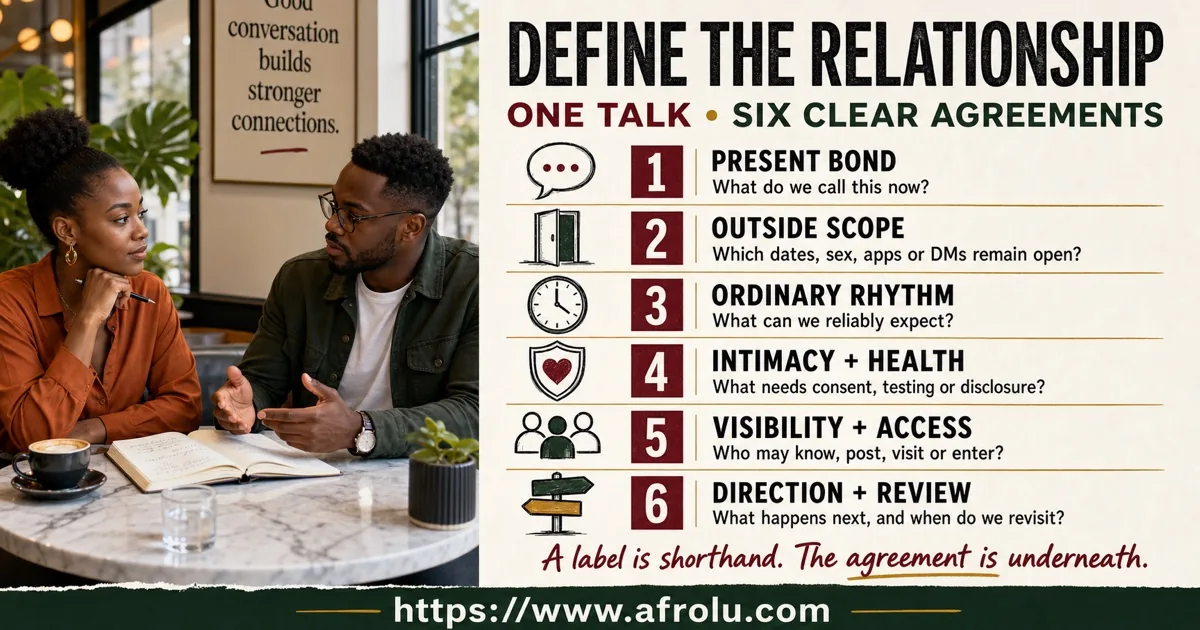
Name the current bond, outside-dating scope, ordinary rhythm, sexual agreements and health, social visibility, and future direction or review. Both adults should be able to repeat the same answer. Afrolu visual:
Written and edited by Clarisse Uwimana · Dating Culture Editor
A DTR conversation is not a request for the preferred label at any cost. It is a mutual description exercise. Define six answers separately: the present bond, outside-dating scope, ordinary time and contact, sexual agreements and health, social visibility, and future direction or review. Each person remains free to say yes, no, not yet, or offer a different structure. The useful result is an answer you can act on, not temporary reassurance.
Relationship agreements
After one honest conversation, can both adults give the same usable description of what exists now?
To define the relationship, or have a DTR conversation, is to discuss the current status, rules, and future of a romantic connection and decide what each adult freely agrees to now. Afrolu treats the label as shorthand rather than the whole agreement: two people may use the same word while attaching different expectations to exclusivity, sex, contact, publicity, family involvement, or direction.
A connection can become consequential before it becomes describable. Two people may sleep together, stop accepting other dates, appear at family events, talk every night, or plan travel while one thinks they are partners and the other thinks they are still exploring. More closeness does not automatically produce the same meaning. A DTR talk brings those private assumptions into one room where both people can compare them.
The six-agreement definition stack
The goal is not to win a label; it is to build one description both adults can actually use
A relationship label can be emotionally important and still be informationally thin. "Partner," "exclusive," "dating," "open," "serious," and "seeing each other" do not carry one universal package. One person may hear daily contact, public acknowledgement, sexual monogamy, and long-term direction. Another may hear affection in the present with private visibility and no future promise. The word sounds shared while the lives underneath it remain different. A DTR conversation makes those meanings comparable before either person relies on an assumption.
Afrolu uses a six-agreement stack. First define the present bond or label. Then define outside-dating scope, ordinary time and contact, sexual agreements and health, social visibility and practical access, and future direction or review. The six answers can be modest. "We are dating, not exclusive, meeting weekly, discussing sexual health before sex, private online but known to two friends, and reviewing after my work trip" is more useful than an enthusiastic label with six blank spaces. A relationship can be monogamous, consensually non-monogamous, queer, faith-led, long-distance, private, friends-first, disabled, child-free, parenting, or culturally visible. The test is not conformity. The test is mutual meaning, free choice, and behaviour that keeps the answer true.
What do we call what exists now?
Choose language both adults understand: exploring, dating, partners, casual, committed, open, monogamous, or another description. A label is allowed to matter without pretending it explains everything.
Which connections remain possible?
Define outside dates, sexual contact, app discovery, active matches, flirting, former partners, and disclosure. Do not assume that a partner label automatically creates monogamy or that no label means no responsibility.
What can each person reliably expect?
Discuss realistic contact, date planning, cancellations, care during busy periods, privacy, accessibility, caregiving, and how much integration fits. Consistency is an agreed pattern, not constant availability.
Which choices require informed consent?
Sexual consent remains activity-specific and reversible. Discuss relevant partners, testing, prevention, contraception or pregnancy intentions where applicable, and disclosure before a changed risk affects another choice.
Who may know, see, or enter this relationship?
Define social posts, friends, family, faith community, children, home access, travel, events, and emergency contact. Privacy may protect safety or dignity; secrecy that removes informed choice is different.
What are we choosing next, and when do we revisit it?
Name whether the relationship is staying present-focused, moving toward partnership, testing compatibility, maintaining a chosen structure, pausing, or ending. A review point prevents "not yet" from becoming endless borrowed certainty.
Translate the hidden need
Ask the precise question underneath "What are we?" before a label becomes the only possible answer
The broad question "What are we?" often carries a quieter practical question. Do I keep accepting dates? Can I rely on a weekly plan? Are we sexually exclusive? May I introduce you as my partner? Are we building toward cohabitation, marriage, a long-term open relationship, or nothing beyond the present? Is this private for safety or hidden for convenience? If you do not identify the question underneath, a warm label can soothe the emotion while leaving the decision untouched.
Write one sentence that begins, "I need this conversation because..." Complete it without diagnosing the other person. "I need to decide whether to close other dates." "I need informed sexual-health choices." "I am considering travel and cannot spend that money on an undefined assumption." "Being introduced as a friend after six months affects my dignity." The sentence reveals which of the six agreement areas needs attention and keeps the talk proportionate. You are not required to negotiate a lifetime because one present choice needs clarity.
Then ask a present-tense question. "How do you understand our relationship today?" is different from "Where is this definitely going?" The first requests available truth. The second may demand prediction. Future direction can still be discussed, but distinguish hope, intention, plan, and promise. Someone may hope for marriage generally, intend to explore seriously, plan another three months of dating, and make no marriage promise with you. Precision protects both adults from accidental certainty.

Translate the hidden need into a present-tense question: status, scope, time, health, visibility, or direction. A precise question gives the other person something real to answer. Afrolu visual:
No magic week
Choose the moment by consequence: talk before an undefined assumption begins making decisions for either person
Dating advice often turns timing into a countdown because a number is easy to share. Research does not provide one universal date count for defining every relationship. Context changes what can be known and what is already at stake. Friends-first adults may have years of behavioural knowledge but no romantic-scope agreement. App matches may need identity and meeting evidence before commitment. Long-distance adults may need a definition before expensive travel. Parents, carers, disabled adults, shift workers, religious daters, and people protecting queer privacy may need different routes and pacing.
Use consequence triggers instead. The question becomes timely when the undefined connection changes whether you see others, when sexual-health decisions depend on scope, when one person is reorganising time or caregiving, when travel or money enters, when family or community visibility carries meaning, when a child may meet someone, when housing or relocation appears, or when emotional access has grown beyond the agreement. The trigger does not mean the answer must be commitment. It means informed choice now requires information.
You may also choose a personal earlier threshold. One adult can enjoy months of non-exclusive exploration; another knows after several dates that ongoing ambiguity is not a structure they want. Neither preference creates an obligation in the other person. State the fit: "I do not need a forever answer, but I do need exclusive dating to keep investing." If the answer is no, the boundary is to change your participation, not to prosecute the other person for moving at a different pace.

Have the conversation before an undefined assumption changes other dating, sex, health choices, time, money, travel, family access, public visibility, or a major future decision. Afrolu visual:
Notice, own, ask, compare, decide, confirm
Use six moves that keep the talk direct while preserving both adults' freedom to answer
Notice the shared facts first: "We have been dating weekly, staying over, and making plans a month ahead." Own the meaning for you: "This now affects how I use my time and whether I date other people." Ask one direct present question: "How do you describe our relationship and what are you choosing now?" This sequence avoids the two common disguises: pretending not to care while fishing for reassurance, or presenting a case designed to make only one answer morally acceptable.
Compare meanings after the first response. If the answer is "We are partners," ask what partner changes across outside dates, apps and DMs, normal contact, sexual agreements and health, friends and family, public posts, practical access, and direction. This is not hostile fine print. Dyadic agreement research shows why asking both people about exact terms matters. Keep the list relevant; a new relationship may need four answers today and leave cohabitation, finance, marriage, or parenting for a later conversation.
Decide freely, then confirm briefly. "We are partners and romantically exclusive from today. We will close existing chats, discuss sexual health before changing anything, remain private online while telling two trusted friends, and review after the visit in September." Each person should be able to correct the summary. Afterward, do not keep interrogating. Let ordinary behaviour reveal whether the agreement works. A definition becomes trustworthy through consistent implementation, honest disclosure, and repair when something changes.

State the facts, own your need, ask one direct present-tense question, compare what each word means, decide freely, and confirm the practical scope and review point. Afrolu visual:
The agreement beneath the label
Keep status, scope, rhythm, intimacy, visibility, and direction separate enough to prevent silent substitutions
Status answers what bond exists. Scope answers which outside connections are permitted. Rhythm answers what ordinary reliability looks like. Intimacy and health answer which sexual or physical choices are informed and consensual. Visibility and access answer who may know and which parts of life become shared. Direction answers what the pair is trying next and when revision becomes relevant. One area can change without automatically changing the other five. A pair may become exclusive without becoming partners, become public without becoming sexual, or become committed without choosing cohabitation.
This separation protects non-standard and traditional relationships alike. Monogamy still needs a definition of emotional and digital boundaries. Consensual non-monogamy needs permissions, disclosure, health, time, resources, and revision. Faith-led courtship needs clarity about community involvement and adult consent. A private queer relationship needs visibility rules that protect safety without normalising erasure. A relationship involving children needs a separate, child-centred decision about introductions. A label never gives blanket access to a body, home, device, money, family, or future.
Record only what helps. Some couples write a short message after the talk; others repeat the summary aloud. The purpose is not surveillance or a legal imitation. It is memory and mutual correction. If a later event exposes a missing meaning, add it. If a need changes, disclose before another person makes a choice based on the old agreement. Relationships stay defined through revision, not through pretending the first talk froze both people in place.
Context changes meaning
Design the definition for culture, distance, disability, family, faith, privacy, and relationship structure without surrendering consent
Family introduction may mean casual hospitality in one home, formal courtship in another, or a safety risk in a third. Public posting may feel joyful, performative, professionally risky, or impossible. Daily messaging may be easy for one schedule and inaccessible for another. Cross-border couples may need travel milestones and strict money separation. Disabled adults may need accessible venues, support-person planning, or alternative communication. Parents may need slower home access and child-centred boundaries. Ask the person what each practice means instead of importing a cultural script and calling it respect.
Power also changes how free an agreement can be. Age, employment, housing, immigration, disability support, money, family authority, social stigma, and outing risk can give one person leverage. The existence of a power difference does not automatically make every relationship coercive, but it requires extra care: independent advice, control over documents and accounts, a real ability to decline, and no exchange of relationship status for essential resources. A DTR should not become the price of safety, shelter, work, healthcare, or belonging.
Include every person whose consent or resources the agreement changes. In consensual non-monogamy, a pair cannot define permissions as though other partners are props. In caregiving or parenting contexts, a romantic decision cannot erase responsibilities already held. In community-visible courtship, families may offer knowledge and support without owning the adult answer. A relationship definition becomes ethical when it is truthful at every relevant edge, not merely comfortable at its centre.
Five honest outcomes
Use the shape of the answer and the behaviour afterward instead of grading only the emotional relief
An aligned yes means the six relevant answers overlap and both choose them. The same label with different meanings is not yet agreement; compare and resolve the differences. "Not yet" can be usable when the current offer, missing evidence, reason, and review point are specific enough for both people to choose. A different offer may be sincere and incompatible: friendship, casual dating, non-exclusivity, a different structure, less contact, or no future direction. A no ends the requested path. None of these outcomes becomes clearer by arguing it into another category.
Watch the implementation. Does outside-dating behaviour match the scope? Does the promised rhythm survive an ordinary busy week, with honest updates and repair? Are sexual-health disclosures made before choices depend on them? Is agreed privacy respected without using secrecy to deny dignity? Does the review happen? One breach may call for fact-finding and repair; repeated contradiction makes the spoken definition less usable. You are allowed to revise trust without proving a hidden motive.
If the answer does not fit, end proportionately: "Thank you for being honest. I want a relationship with a different scope, so I am stepping back." You do not need to make the other offer shameful. If the reaction becomes threatening or controlling, stop explaining and move toward safety. The success of a DTR conversation is not that every connection becomes a relationship. It is that private assumptions stop making decisions in secret and each adult regains the ability to choose from the same reality.

The answer may be an aligned yes, the same label with different meanings to resolve, not yet with a reason and review, a different relationship offer, or no. Each answer creates a different next choice. Afrolu visual:
Three connections that need different DTR questions, not the same label
Mumbi and Darius both say "partner," but only one believes it includes exclusivity and family visibility
They have dated for three months, spend most weekends together, and use partner language in private. Mumbi has stopped accepting other dates and has told her sister. Darius uses the word to describe affection and regular dating, but still has an active profile and has not decided whether he wants monogamy. Neither person deliberately lied. Each imported a different social script into the same word, and their next sexual and emotional decisions now depend on knowing the difference.
They need more than "Are we official?" Mumbi can ask how Darius defines partner across outside dates, sex, apps, disclosure, family, and direction. Darius can answer the present offer without promising a future he has not chosen. If their structures differ, the result is not a failed conversation; it is a compatibility answer they can use before more access rests on the wrong assumption.Zuri wants close friends to know; Amara cannot be publicly posted without risking family or work consequences
Their affection and commitment are mutual, but visibility has different stakes. Zuri has previously been hidden by a partner who wanted relationship benefits without acknowledgement. Amara is queer in a setting where a public post could create material harm. A simple demand to "hard launch" would flatten both realities: Zuri needs evidence that privacy is not erasure, while Amara needs control over information that affects safety.
Their DTR can separate public posting from trusted recognition. They might name one another as partners, agree which friends may know, attend selected spaces together, prohibit identifying posts, decide how introductions work, and revisit visibility if circumstances change. The agreement should protect Amara without requiring Zuri to live inside an unnamed relationship. If no design meets both needs, either person can decline without declaring the other need illegitimate.Jean-Claude and Naledi talk every evening, but an expensive visit would turn ambiguity into financial risk
They met through a regional professional network and have built genuine affection across countries. A holiday window appears, and Jean-Claude considers paying for flights and accommodation. Naledi speaks hopefully about the visit but believes they are non-exclusive and still exploring. Jean-Claude assumes that daily calls and travel planning mean they are moving toward a committed monogamous relationship. The immediate question is not whether distance makes the connection real; it is what agreement should exist before money and travel raise the cost of misunderstanding.
Before any booking, they can define the current bond, other dating, who pays which cost, independent accommodation and transport, meeting safety, sexual-health expectations, what the visit does and does not promise, and the decision they will review afterward. Neither should transfer money into the other person's account as proof of trust. If the visit only makes sense under a commitment Naledi does not choose, Jean-Claude should know before purchasing hope.Four signs that the relationship now needs shared language
Private assumptions now affect dates, sex, health, time, money, travel, family, or other partners
One label is being used while its practical meaning remains different or unspoken
Either person needs a present answer to make an informed next decision
The conversation can include a genuine no, a narrower offer, or an ending without retaliation
Match the question to the decision that depends on it
| Situation | What it may mean | What to do next |
|---|---|---|
| After several good dates, one person needs to know whether to keep accepting other invitations. | They are not necessarily demanding commitment. Their next dating choice depends on whether romantic focus is mutual, optional, or not available. | Ask the scope question directly: "Are we both still open to dating other people, or do we want to focus here?" Then define apps, existing dates, sex, and the start point instead of treating one yes as a complete relationship agreement. |
| Both people say they are partners, but one expects daily contact and shared weekends while the other expects spacious independence. | Status may be aligned while ordinary rhythm is not. Neither communication preference is automatically uncaring, but an unstated gap can create repeated injury. | Compare a normal week: planning, reply expectations, alone time, work or caregiving constraints, cancellations, and repair. Choose a realistic baseline rather than promising constant access to prove the label. |
| The answer is "not yet," accompanied by warmth but no explanation, needed evidence, or review point. | The person may be genuinely uncertain, avoiding loss, preserving options, or unable to offer more. Motive is not available from the phrase alone, and indefinite waiting is not neutral. | Ask what remains unknown and when reality could change. Decide whether that answer and timeframe fit your needs. "Not yet" can be honest; you are still free to treat the current offer as insufficient. |
| One person wants monogamy; the other wants an open or polyamorous relationship. | This is a structure mismatch, not proof that one person loves more, is less mature, or must be persuaded. Consent to one structure cannot be assumed from affection. | Define the proposed structure, permissions, disclosure, health, time, resources, hierarchy, and revision rights. If either person cannot freely choose it, do not create reluctant consent to preserve access; choose another arrangement or end. |
| Family or faith expectations make "official" sound like courtship, marriage intent, or immediate community involvement. | The label may carry social obligations beyond what one or both adults intended. Public recognition can offer support while also creating pressure, stigma, or loss of privacy. | Ask which people may know, what language may be used, what role family or faith leaders will have, and which decisions remain with the adults. Respect tradition without outsourcing consent or inventing a marriage promise. |
| A partner label is proposed just before changing condoms, contraception, or sexual practices. | The label may be serving as a shortcut for trust, exclusivity, or health information that has not actually been discussed or verified. | Separate the conversations. Discuss partners, testing, timing, prevention, contraception or pregnancy intentions, and consent with appropriate clinical guidance. Relationship progression does not obligate sexual progression. |
| A long-distance pair is considering a costly visit, relocation, visa support, or shared accommodation. | Ambiguity now has practical cost. Hope can make a major commitment feel like the way to prove a relationship instead of a decision that needs evidence and safeguards. | Define the relationship before the transaction, then independently review money, documents, accommodation, transport, legal implications, and exit options. Keep accounts and identity credentials separate and make the trip safe even if romance changes. |
| The other person responds with threats, insults, sexual pressure, outing, surveillance, financial leverage, or punishment. | The problem is no longer an awkward communication style. The reaction is attempting to control the answer or the person giving it. | Stop negotiating the label. Move toward safety using distance, trusted support, evidence preservation, account protection, platform reporting, local services, or authorities as appropriate. Closure is secondary to reducing exposure. |
Three DTR scripts for opening, defining, and acting on a mismatch
“I value what is happening, and it now affects choices I make. I want us to compare how each of us describes the relationship today. What do you believe we are choosing?”
“When we use that description, what does it mean for other dates and apps, our normal contact, sexual agreements and health, who may know, and the direction or next review?”
“I understand that your present offer is different from what I can continue. I am not asking you to promise more, and I am going to step back rather than keep building on two definitions.”
Know the difference
DTR conversation vs ultimatum
Invites a truthful present answer, compares meanings, preserves the right to say no, and lets each person choose what they will do with the result. A boundary may end the connection without controlling the other person.
Uses fear, punishment, public exposure, sex, money, housing, immigration, family, surveillance, or withdrawal of basic respect to force the preferred label or behaviour. The consequence is designed to remove free choice.
Directness is not coercion. "I need exclusivity to continue" can be a boundary when the other adult may safely decline and leave. "Agree or I will harm, shame, expose, trap, or punish you" is control. Judge the freedom inside the answer, not whether the sentence sounds calm.

A DTR conversation asks for a truthful present answer and allows either person to leave. A boundary explains what you will do. An ultimatum uses punishment, control, or manufactured fear to force the preferred outcome. Afrolu visual:
Compare seven nearby conversations before asking one label to do every job
| Type or dimension | What it describes | Best next question |
|---|---|---|
| DTR conversation | Both adults compare the current status, rules, and direction and decide what they freely agree to now. It may produce a relationship, a narrower scope, more information, or an ending. | Can we repeat the same six answers, and what changes in behaviour after today? |
| Talking-stage check-in | The main task is deciding whether early contact is producing enough identity, safety, reciprocity, real-world progression, and intention evidence to continue. A full relationship agreement may still be premature. | What one next step would make this connection more knowable? |
| Exclusive-dating agreement | The pair defines which outside romantic, sexual, app, or messaging doors close. They may still be evaluating whether to become partners, and exclusivity does not settle every DTR area. | Which doors close, when does it begin, what must be disclosed, and when do we review? |
| Committed relationship | Both adults name and maintain an ongoing partnership. The commitment can include monogamy or another structure and still needs explicit choices about health, money, family, privacy, cohabitation, and future transitions. | What partnership are we maintaining, and which obligations have we actually chosen? |
| Situationship | Recurring relationship-like access exists while status, responsibility, or direction remains unresolved or differently understood. Some people mutually choose low definition; others remain because the avoided answer would reveal incompatibility. | Does the current ambiguity work for both people, and which access now requires a shared agreement? |
| Relationship check-in | People revisit an existing agreement after circumstances, needs, trust, health, distance, family, or future plans change. Defining a relationship is not a one-time ceremony that makes later revision unnecessary. | Which part of our old definition still fits, which part changed, and what begins now? |
| Ultimatum or coercive demand | The speaker tries to force a preferred result through punishment, humiliation, threats, control, or leverage. A genuine boundary can end a relationship without taking away the other person's freedom to decline. | Is the answer still free, and can either person leave without retaliation or unsafe exposure? |
Build a definition that can survive beyond the conversation
Define the decision behind the talk
Write what you need the answer for: accepting other dates, changing sexual-health choices, investing more time, travelling, meeting family, using a partner label, planning a future step, or deciding whether to leave. Ask only for the clarity that decision requires.
Separate present facts from the hoped-for future
List what currently happens, what has been explicitly agreed, and what you have privately inferred. Daily calls, sex, holidays, app deletion, or family introductions may be meaningful without carrying the same interpretation for both people.
Choose all six agreement areas that matter
Review bond, outside scope, ordinary rhythm, intimacy and health, visibility and access, and direction or review. You do not need a long contract; you do need to uncover any difference that changes informed choice.
Ask in the present tense
Use "How do you describe us now?" and "What are you choosing now?" before asking for a lifetime forecast. Present-tense truth is easier to evaluate and more respectful than extracting certainty nobody possesses.
Compare meanings out loud
When both say partner, exclusive, casual, serious, open, or private, ask what the word changes in ordinary life. Agreement is the overlap between definitions, not the pleasant sound of the label.
Confirm the next action and review
End with a brief restatement: what begins now, what remains open, what must be disclosed, what each person will do next, and when a review becomes relevant. Then let repeated behaviour test the answer.
What DTR research can illuminate, where its samples stop, and what still requires mutual choice
The foundational evidence describes status, rules, and future talks among adolescents and emerging adults
Kayla Knopp's 2019 University of Denver dissertation reported three manuscripts on DTR talks. Its descriptive work used a college undergraduate sample of 341 young adults and a nationwide online sample of 248 US adolescents aged 15 to 17. In those samples, DTR talks were common and associated with commitment and sexual behaviours; among a subset of 163 adolescents, having the talk before sex was linked with delaying sex and more frequent contraception use. These are associations, not proof that one conversation caused the outcomes. The age groups, US context, measures, and study designs do not establish a universal adult script, ideal timing, or result.
Status, rules, and future are connected questions, but they are not interchangeable answers
The DTR research definition grouped discussion of relationship status, rules, or future. In daily life, adults often answer only one. "You are my partner" may settle status while outside dating, safer-sex choices, social visibility, money, and future direction remain open. "I am not seeing anyone else" may settle one scope without creating a partner label. "I want marriage someday" names a personal direction without promising it with this person. Treat each statement as the answer it actually is. Then ask the next question only when another decision needs it.
The fear of asking can reflect real stakes without proving that silence is safer
A 2025 qualitative study interviewed 26 emerging-adult women in ambiguous dating relationships. Participants described internal barriers such as fear of rejection, losing intimacy, or harming self-esteem, and external barriers such as a partner changing the subject, trivialising the issue, withdrawing, or offering superficial reassurance. The small, gender-specific qualitative sample cannot represent all daters or cultures. It does make one useful distinction visible: anxiety can arise from anticipated loss, from an avoidant interaction pattern, or from both. Prepare for the answer and examine the response instead of treating fear as evidence that the question is wrong.
Uncertainty can shape the body and the conversation, but a label is not a medical treatment
Laboratory research on relational uncertainty and cortisol examined how dating partners responded to hurtful and supportive messages. Greater uncertainty about a partner's feelings was associated with a larger cortisol response in one hurtful-message context, and the authors situated this within research showing that uncertainty can inhibit direct problem communication. The studies do not prove that a DTR talk will remove anxiety or improve every relationship. They support a narrower point: uncertainty is not merely silly overthinking, and a calm request for usable information may be more honest than endless private interpretation.
Two people can remain together while carrying substantially different levels of dedication
A study of 315 unmarried opposite-sex US couples in serious exclusive relationships classified substantial differences in measured commitment and examined characteristics associated with those asymmetries. The sample had a median relationship duration of a little over two years and was not a study of new dates, queer couples, non-monogamous structures, or global prevalence. It cannot diagnose a pair from one conversation. It does warn against assuming that continued access means equal intention. Ask what each person is choosing; then compare the answer with the resources, alternatives, future, and responsibility each person actually carries.
Even couples who report having an agreement may disagree about its exact terms
A dyadic study of 160 male couples in three US cities examined sexual agreements. Even among 110 couples where both partners reported an agreement, concordance about general rules and specific permitted behaviours was only weak to moderate. The HIV-related male-couple context does not define every romantic relationship, but the measurement lesson travels carefully: an agreement cannot be evaluated only by asking one person whether it exists. Compare exact meanings, restrictions, permissions, and disclosure rules with every person whose consent depends on them.
A DTR label never supplies consent, test results, or a complete safer-sex agreement
CDC guidance encourages conversations about partners, STI status, testing, and safer-sex choices before sex. Local services and individual clinical recommendations vary. Keep the health conversation separate enough to be accurate: relationship status does not reveal current results or testing windows, and an exclusive agreement does not retroactively change prior exposure. Consent remains specific, informed, freely given, and reversible. No one owes sex because the relationship became official, and no one must accept a label to obtain basic respect or healthcare information.
A direct question leaves the answer free; coercion punishes the person for having one
The CDC includes psychological aggression used to harm or exert control within intimate partner violence and includes forced or attempted forced sexual activity when a partner does not or cannot consent. A DTR talk becomes unsafe when it includes threats, humiliation, stalking, sexual pressure, financial leverage, outing, isolation, device surveillance, or punishment for saying no. A personal boundary may still have a consequence: "I cannot continue without exclusivity" states what the speaker will choose. The difference is that the other person remains free to decline without being controlled, harmed, or made responsible for managing retaliation.
Four ways a clarity conversation becomes incomplete, coercive, or unusable
Collecting the label and skipping its practical meaning
Two adults can celebrate becoming partners while still holding opposite assumptions about other dates, sex, apps, contact, family, publicity, money, or direction. Compare the six answers before relying on the word.
Using a viral timeline as evidence that someone owes certainty
No study establishes a universal number of dates or months for every adult, structure, culture, disability, caregiving load, or distance. Ask before an assumption becomes consequential, and remain free to leave when the pace does not fit.
Treating "not yet" as either a promise or an automatic rejection
The phrase becomes usable only when the current offer, reason, missing evidence, and review point are specific enough for the listener to choose freely. Warm ambiguity should not reserve another person indefinitely.
Believing words that behaviour repeatedly cancels
A good conversation is evidence, not immunity from future evidence. If the agreed scope, rhythm, disclosure, visibility, or respect disappears in practice, name the breach, revise, repair, or leave rather than preserving the label alone.
Use a reviewed resource that matches the decision
This guide focuses on the relationship decision, so it does not rank dating apps. Check current prices, safety tools, and local availability before choosing a service.
Explore the guide library
Show more related guides
Continue with Afrolu
Show more Afrolu guides
DTR, uncertainty, agreement, commitment, sexual-health, and coercion sources behind this guide
Afrolu reviewed these health, research, safety, or public guidance resources while editing this page. They support the behaviour and safety guidance; they do not diagnose any individual described by a reader.
DTR questions answered without a magic week, perfect script, or compulsory label
What does define the relationship or DTR mean?
DTR means discussing the current status, rules, or future of a romantic connection so the people involved can decide what they freely agree to now. A useful talk covers more than a label. Compare the present bond, outside-dating scope, ordinary time and contact, sexual agreements and health, visibility and access, and future direction or review. You may need only some of those answers at an early stage.
When is the right time to define the relationship?
There is no evidence-based universal week or date count. Ask before an unspoken assumption changes a consequential choice: accepting other dates, sex or sexual-health decisions, major time investment, travel, money, family involvement, public visibility, cohabitation, or future planning. You can also ask earlier when present scope affects your willingness to continue. The other person remains free to say the evidence is too thin for their preferred commitment.
Is it too soon to ask after only a few dates?
It may be too soon for a confident long-term promise and still be the right time for a smaller present answer. Ask the question you actually need: "Are we both still dating other people?", "Are we exploring romance?", or "What pace are you available for?" Do not make a new match promise a future, and do not pretend early choices such as sex or exclusivity carry no need for communication.
Should a DTR conversation happen in person or by text?
Use a medium that supports enough context, time, accessibility, and safety. In person or live video often makes comparison and follow-up easier. Text can help a person organise language, accommodate disability, cross time zones, preserve safety, or begin a difficult topic. Avoid running the whole talk through fragmented late-night messages if tone and scope keep getting lost. Someone who fears retaliation should prioritise distance and support over an in-person meeting.
Does defining the relationship mean becoming exclusive?
No. DTR asks what relationship and rules people choose; exclusivity is one possible scope. The result may be non-exclusive dating, exclusive dating without a partner label, a committed monogamous relationship, consensual non-monogamy, a present-focused connection, friendship, more discovery with a review, or an ending. Define outside dates, sex, apps, messaging, and disclosure rather than inferring them from the status word.
What if they say they are not ready for a relationship?
Treat that as the current offer, not a puzzle you must solve. You may ask what they are available for now, what specifically remains unknown, and whether any realistic review point exists. They do not owe a commitment, and you do not owe indefinite access. Continue only if the present arrangement itself works for you, not because warmth has been converted into an unmade promise.
What if we want the same label but define it differently?
Do not declare agreement yet. Compare what the label changes across outside dating, sex, apps, contact, planning, privacy, family, money, future, and disclosure. Keep only the overlap both adults knowingly choose. If a difference is important and cannot be reconciled, the shared word should not hide the incompatibility.
Can queer or consensually non-monogamous partners use this DTR framework?
Yes. The six-agreement framework does not assume heterosexuality, a two-person household, monogamy, marriage, public visibility, or a relationship escalator. Name everyone whose consent and resources are affected, define permissions and disclosure, discuss sexual health, time, hierarchy or non-hierarchy, family and community visibility, and how agreements may change. No structure is ethical merely because it has a progressive or traditional label; consent must remain informed and voluntary.
Can we have a healthy relationship without using a label?
Yes, when everyone affected understands and freely chooses the same practical arrangement. A custom description may be clearer than a conventional label. Problems begin when "no labels" is used to avoid consent, disclosure, responsibility, or an answer that another person needs for sex, health, time, other dating, or future choices. Low label is not the same as low agreement.
What should I do if the DTR conversation becomes angry, threatening, or controlling?
Stop trying to secure the preferred relationship answer and protect safety. Threats, humiliation, sexual pressure, stalking, outing, surveillance, financial leverage, isolation, or punishment for saying no are not normal costs of clarity. Use distance, independent transport, trusted support, evidence preservation, account protection, platform reporting, local services, or authorities as appropriate. You do not owe an in-person ending when contact creates danger.
One thing to do now
Leave with one shared description or one honest decision
Do not judge the talk by whether you receive your preferred label. Judge it by whether both adults can state the same present agreement, choose it without punishment, and behave in a way that keeps the answer usable.


