The restart compass
Dating After Heartbreak: Start Again Without Leaving Yourself
Use grief, capacity, curiosity, and comparison checks to date after heartbreak without countdown myths, rebound pressure, or rushed promises.
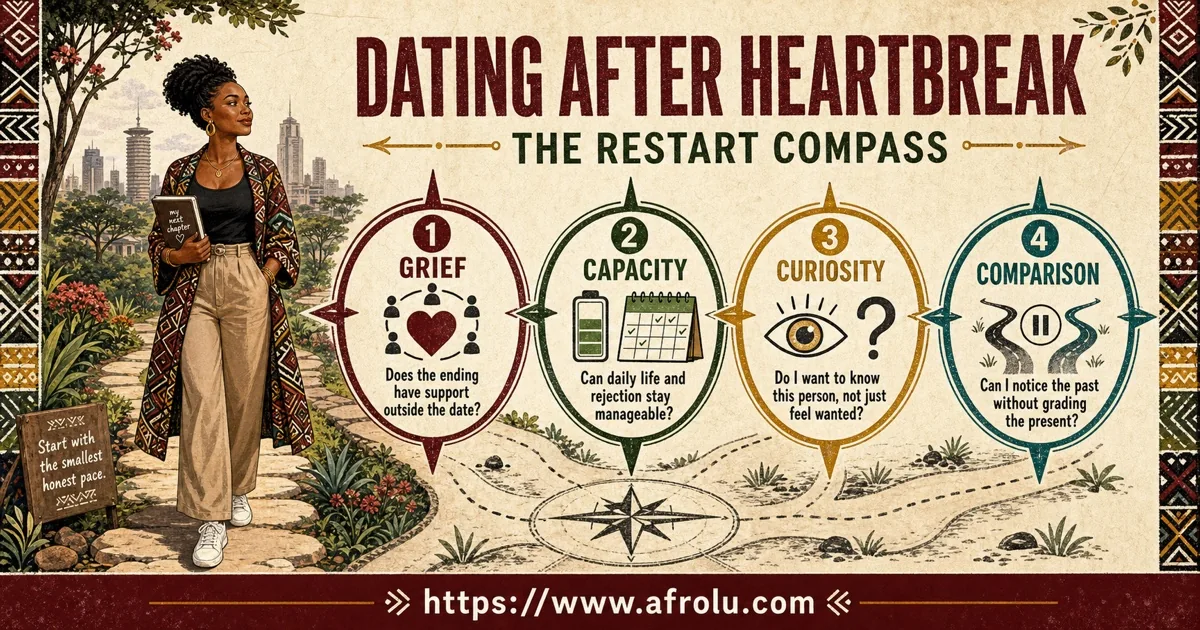
Check four things before dating: Can grief have a place outside the date? Do you have capacity for another person? Are you curious about who they are? Can you notice comparison without obeying it?
Written and edited by Clarisse Uwimana · Dating Culture Editor
You do not need to erase every feeling before dating. Check whether grief has support outside romance, daily life is steady enough for uncertainty, curiosity is about this particular person, relevant history can be disclosed honestly, and comparison can be noticed without controlling the pace. Start with one small date and review the effect; there is no universal waiting period.
Starting over
What can you offer another person now without asking their attention to become your recovery plan?
Dating after heartbreak is the deliberate return to romantic discovery after a breakup or significant relational ending while grief, identity change, comparison, relief, fear, or unfinished practical realities may still be present. It describes a transition, not a diagnosis or fixed timeline.
The first warm match can feel larger than the conversation. It may offer attraction, company, relief, proof, and a possible future in the same hour. Another part of you may scan every delay for the old ending. Both reactions make sense. Neither has to make the next decision.
The restart compass
You do not have to finish every feeling before dating, but a new person should not become your recovery plan
Heartbreak can disturb sleep, attention, appetite, identity, confidence, routines, and the story you expected to live. Recovery does not move in one clean line, and research does not supply a universal number of weeks that makes every person ready. The useful question is narrower: what can you offer another adult now without hiding your limits, abandoning yourself, or making their attention carry a job it cannot perform?
Use four checks. Grief asks whether the loss has places to be felt outside dating. Capacity asks whether ordinary life and rejection remain manageable. Curiosity asks whether the new person is visible as themselves rather than as relief, proof, or replacement. Comparison asks whether memories can inform your standards without turning every difference into a verdict. Choose the smallest dating pace that keeps all four honest.
Give the ending somewhere else to go
Use friends, reflection, routine, cultural or faith support, and qualified care when needed so a date is not the only room where pain can speak.
Measure what you can carry now
Look at sleep, work, care, attention, rejection tolerance, app habits, and recovery after contact rather than demanding emotional perfection.
See the person beyond the function
Ask whether you want to know this particular adult, including their limits, or mainly want the feeling of being wanted again.
Turn contrast into a question
Notice when an ex becomes the invisible third person. Ask what the new behaviour means here before calling familiarity chemistry or difference danger.
Keep permission to slow or stop
A match, date, kiss, disclosure, or good week does not create a debt. Revise your pace before your capacity becomes a promise you cannot keep.
One person cannot carry the whole ending
Give heartbreak real support before asking romance to change how you feel
Start by naming what was lost. It may include the person, home, daily rituals, sexual bond, family connections, social identity, imagined children, financial plan, community status, faith expectations, or confidence in your own judgment. A match can create novelty and company. It cannot restore every one of those losses, and it should not be required to prove that they never mattered.
Build a support map that does not depend on romantic success. Choose people who can listen without turning every conversation into pressure to reunite or move on. Restore food, sleep, work, care, movement, and ordinary pleasures in forms your circumstances allow. Reflection, cultural or faith support, peer groups, and qualified professional care can each have a place. Use the options that fit you rather than treating one method as a test of strength.
Then write the smallest honest purpose for dating. Perhaps you want one coffee and a conversation with no promise. Perhaps you are open to companionship but not exclusivity. Perhaps you are not ready to date and only miss being held. That last truth deserves care rather than shame. A clear no for now protects both you and a person who might otherwise be recruited into a role they never agreed to perform.

A date can offer company and discovery. It cannot prove your worth, punish an ex, erase grief, or promise that abandonment will never happen again. Choose the smallest honest purpose.
Readiness lives in behaviour
Audit function, recovery, and attention instead of waiting to feel perfectly healed
Use a normal week, not your best afternoon. Notice sleep, appetite, concentration, essential responsibilities, alcohol or other substance use, contact with supportive people, time spent checking an ex, and the amount of emotional recovery required after a match or date. Grief can still be present. The question is whether dating can fit without consuming the systems that keep you well and safe.
Test rejection tolerance in small ways. Can an unanswered message remain one unanswered message? Can a date decline without you bargaining, attacking yourself, contacting an ex, or swiping until morning? You do not need indifference. You need enough space between pain and action to choose a response. If ordinary uncertainty repeatedly produces severe disruption, reduce the experiment and seek appropriate individual support.
Capacity also includes what you can offer. Do you have time to ask questions, remember answers, make a plan, honour a boundary, and communicate a change? Someone can be kind and sincerely interested while having little relationship capacity. Saying so early is more respectful than using good intentions to justify an offer that daily life cannot sustain.

Green means daily life is steady enough for curiosity. Amber means reduce pace and support the tender area. Red means dating is worsening function, risk, or acute distress and deserves a pause.
Turn comparison into present evidence
Let the past inform standards without becoming the third person on every date
Comparison often arrives automatically. A laugh feels familiar. A texting rhythm feels wrong. A quiet person seems safer or more threatening because an ex was loud. Do not shame the mind for using recent information. Slow the conclusion. Ask what exact behaviour occurred, what value or fear it activated, and what explanation the current person gives through words and conduct.
Watch for reverse selection. Choosing someone only because they are unlike an ex can be as past-directed as searching for a replica. Difference does not prove compatibility, and familiarity does not prove danger. Assess present fit across kindness, attraction, pace, values, emotional capacity, lifestyle, repair, money, faith or culture where relevant, family goals, and the freedom each person has to remain themselves.
Use the first four dates as an observation period. After each one, note whether you were present, whether curiosity and effort moved both ways, whether a limit was respected, how much comparison occurred, and how you recovered. Ask only for the next decision the evidence can support. This protects a promising connection from being forced into either the old future or the old ending.

After each date, check: Was I present? Did I recover normally? Did curiosity move both ways? Were boundaries easy to keep? Continue only when the pattern supports another small step.
Honesty without emotional dumping
Give a new date enough truth to choose while keeping intimacy proportionate to trust
A recent breakup is relevant when it affects your availability, ongoing contact, living arrangement, legal or parenting reality, emotional pace, sexual health, or ability to consider commitment. State those facts directly. Avoid claiming to be completely healed to secure a date, and avoid making the other person certify that your pain is understandable before they know you.
Separate decisions that chemistry often bundles together. More texting, another date, sexual intimacy, app deletion, exclusivity, family introduction, public visibility, travel, money, and future planning are different agreements. A yes to one is not a yes to all. Make each choice at a pace that lets you remain honest the next morning as well as hopeful that evening.
Leave room for the other adult to decline. They may want someone further from a breakup, more available, or ready for a defined commitment. Their boundary does not prove you are damaged. Your honest offer and their honest no can both be healthy. The aim is not to convince every promising person to wait; it is to make the reality clear enough that both people can choose.

Name the present offer without making a new date process the whole breakup: state your pace, answer relevant history honestly, ask for what is workable, and revise before overpromising.
Tender does not mean careless
Keep ordinary dating safeguards and treat worsening distress as health information
Heartbreak can increase urgency for closeness, but the ordinary safety baseline remains. Keep early meetings public, control transport, tell trusted support where you are, protect home and child information, keep finances separate, and do not treat gifts, travel, alcohol, intense disclosure, or emotional rescue as consent. Verify identity and important claims in proportion to the risk before increasing access.
If the previous relationship involved coercion, threats, stalking, financial abuse, image misuse, or violence, new dating may change risk. Review account security, devices, shared plans, location exposure, mutual contacts, and what is posted publicly. Use qualified local legal, health, advocacy, or safety resources for your circumstances. Do not rely on a new date to confront, negotiate with, or protect you from an unsafe former partner.
Pay attention when distress becomes persistent, worsening, overwhelming, or disruptive to sleep, eating, work, caregiving, physical health, substance use, or safety. A licensed mental-health professional or appropriate health service can assess your individual situation. This guide can help organise questions; it cannot diagnose depression, anxiety, trauma, or any other condition.
A restart is a series of reviews
Continue, reduce pace, pause, or end without turning the choice into a verdict on recovery
Continue when curiosity is specific, capacity remains mostly steady, the offer is accurate, effort is reciprocal, and ordinary boundaries survive attraction. The next step can still be small: another date, a clearer conversation, or one new kind of closeness. Progress is not measured by how quickly the connection resembles the relationship that ended.
Reduce pace when the person is promising but the current rhythm creates comparison, fatigue, overdisclosure, compulsive checking, or a mismatch between hope and capacity. Name the change and make it operational: fewer dates, less all-day texting, preserved routines, or a later conversation about exclusivity. A slower offer is only fair if the other person knows what it is and remains free to decline.
Pause or end when dating is being used for revenge, proof, numbness, replacement, or avoidance; when the new person is hidden from the real timeline; when daily function keeps deteriorating; or when the fit is simply wrong. Ending a date respectfully does not erase recovery. Sometimes it shows that you can feel hope, gather evidence, and still choose yourself without making another adult the villain.
The same first date can carry very different emotional work
Relief and grief can exist together without cancelling each other
You may have known the relationship needed to end and still miss the routines, family ties, shared future, or version of yourself inside it. Because you initiated, other people may assume you are ready immediately. Relief can make dating feel possible before the identity and practical changes have settled.
Do not perform certainty to justify the breakup. Date only at a pace that leaves room for mixed feelings, and tell a new person the relevant present truth without inviting them to argue the old case.A new delay can feel like the old ending before there is enough evidence
Unexpected loss can make ordinary uncertainty feel unusually loaded. A changed plan or slow reply may activate a story that the new person is secretly leaving. The feeling is real; the conclusion still needs present evidence.
Pause before protest, surveillance, or repeated messaging. Name the observable event, ask one direct question, and judge the response pattern. A clear inconsistency deserves attention; an old alarm does not need to become a new accusation.Readiness and safety may require more than positive thinking
Infidelity, coercion, stalking, financial abuse, image misuse, threats, or violence can change practical safety as well as trust. Contact with an ex may continue because of children, property, work, legal processes, or risk. A generic instruction to get back out there can be unsafe.
Prioritise safety, documentation where appropriate, account and device security, trusted support, and qualified local help. Do not disclose your address, routines, children, finances, or new dating life in ways that increase risk. Dating can wait; safety planning is not failure.A good connection does not require an immediate lifetime forecast
Warmth can bring hope and fear at the same time. You may want to accelerate because the contrast feels extraordinary, or retreat because enjoying the date seems disloyal to the past. Neither impulse has to decide the relationship.
Keep the next decision small. Plan another date, preserve ordinary routines, notice how each person handles a limit, and disclose pace before exclusivity or emotional dependence grows beyond the offer you can sustain.Six checks before you match, meet, disclose, or escalate
Grief has support outside the new connection
Daily life can hold ordinary uncertainty and rejection
Interest is specific to this person rather than their attention
Your pace and recent history can be stated without hiding or overpromising
Choose from the pattern you have now, not a universal breakup clock
| Situation | What it may mean | What to do next |
|---|---|---|
| You want to download every app on the night the breakup becomes final | You may want relief, proof of desirability, revenge, or company more than actual discovery. | Wait through the most activated window. Contact support, protect sleep, and write what you hope a match will change. Date later only if the answer can be offered honestly. |
| You enjoy a date and then feel grief, guilt, or exhaustion | Pleasure and loss may be arriving together; one difficult after-effect does not automatically mean the date was wrong. | Reduce pace, restore routine, and observe recovery over the next day or two. Continue only if dating is adding information without repeatedly destabilising daily life. |
| Every quality is measured against your ex | The previous relationship is still functioning as the only available map for safety, attraction, or identity. | Translate each comparison into a present value or question. If the new person remains invisible, pause dating and rebuild a wider picture of what you want. |
| The new person asks when your last relationship ended | They may be assessing pace, emotional availability, ongoing contact, or their own risk, not accusing you of being unready. | Answer factually and briefly, name the current offer, and welcome a decision that protects both people. Do not hide the timeline or overshare to prove honesty. |
| Chemistry creates pressure for exclusivity or constant contact | Relief and hope may be escalating faster than knowledge, capacity, or agreements. | Separate contact, sex, apps, exclusivity, visibility, and future promises. Agree only to the parts both understand and can sustain now. |
| A slow reply feels like the previous abandonment | An old alarm may be active, or a current inconsistency may genuinely need clarification. | Regulate first, identify the observable event, ask once, and judge the response pattern. Do not use surveillance or repeated messages to manufacture certainty. |
| You are dating mainly so your ex will notice | The new person is being placed inside an unfinished conflict and cannot give informed consent to the real role. | Stop escalation and remove the audience. Process anger elsewhere; resume only when the new connection can exist without being used as a message. |
| Breakup distress is worsening or daily function is failing | The situation may need individual health assessment rather than more matches, dates, or reassurance. | Pause dating pressure and contact a licensed mental-health professional or appropriate local health service. Seek urgent local help for immediate danger or inability to stay safe. |
Words for pace, history, boundaries, triggers, interest, and a kind pause
“I am open to getting to know someone, and I am moving slowly after a significant ending. I can offer a real date and honest communication, not a rushed promise.”
“The relationship ended recently. I have support and I am not trying to recreate it, but I am keeping the pace deliberate while I learn what I can offer.”
“There is more history, but I do not want our date to become a full account of my former relationship. I can answer what is relevant to your choice now.”
“I noticed an old experience is making me read this moment quickly. Could you tell me what the change of plan means for you?”
“I enjoyed tonight, and I am keeping tomorrow for my normal plans. I would like to see you again next week rather than speeding up contact.”
“I like what is developing, but I am not ready to close other doors or use a relationship label yet. I understand if that does not fit what you need.”
“Dating is taking more capacity than I currently have. I am going to pause instead of asking you to wait inside an unclear offer.”
“I have appreciated meeting you, and I do not feel the fit I need to continue. This is my decision about us, not a test you failed against my previous relationship.”
Know the difference
Gentle re-entry or rebound escape?
Grief has support outside the connection. Interest is about this person, the offer is accurate, pace remains adjustable, boundaries survive chemistry, and a mismatch can be disappointing without becoming a verdict on worth.
Attention is expected to numb pain, prove desirability, replace an ex, create jealousy, or restore a lost role. Escalation outruns knowledge, limits are hidden, and the new person is compared with a private past they cannot see.
Timing alone does not decide whether a connection is a rebound. Motive, honesty, capacity, comparison, pace, and the treatment of the new person provide more useful evidence.

Timing alone does not decide the label. Gentle re-entry stays honest, curious, paced, and able to pause. Escape makes a new person responsible for numbing, proving, replacing, or repairing the past.
Which version of starting again are you living?
| Type or dimension | What it describes | Best next question |
|---|---|---|
| Quiet companionship | A date offers company and modest discovery while both people understand the limited pace. | Can you stay honest if companionship remains the only present offer? |
| Curiosity-led dating | Interest in this particular person remains visible beside grief, and each decision stays small. | Does knowledge of each other grow without daily life or recovery shrinking? |
| Validation dating | Matches and compliments are being used to disprove rejection or restore status. | What happens to mood and self-worth when attention pauses? |
| Revenge dating | The date, image, or new relationship is partly designed to reach or punish the former partner. | Can the new person exist without an audience from the old relationship? |
| Replacement dating | A new adult is moved quickly into routines, intimacy, family, or future plans left vacant by the breakup. | Are you learning who they are, or hiring them for a position? |
| Comparison dating | Every trait is graded against an ex, so unfamiliarity becomes danger or contrast becomes instant compatibility. | What present evidence exists when the comparison is removed? |
| Recovery pause | Dating is paused to restore function, identity, support, or safety, not because love is declared impossible. | What capacity or support would make a future review useful? |
The grief, capacity, curiosity, and comparison method
Grief has another room
Do you have support, reflection, routine, community, or qualified care where the breakup can be processed without requiring a match to regulate it?
Daily life is mostly intact
Can you meet essential responsibilities and recover from ordinary disappointment without dating taking over sleep, work, care, or safety?
Curiosity is person-specific
Can you name what interests you about this adult beyond their attention, availability, resemblance to an ex, or usefulness as a distraction?
The offer is accurate
Can you state your current pace and availability without minimising the recent ending or promising seriousness you do not yet have capacity to give?
Boundaries survive chemistry
Can you keep your app limit, private information, routines, consent, spending, and support network when a date feels unusually hopeful?
A no remains one no
Can a slow reply, mismatch, or ending be painful without becoming proof that you are unlovable or that every future relationship will fail?
What readiness looks like when healing is still unfinished
Time since the breakup is context, not a readiness score
Length, dependence, surprise, betrayal, ongoing contact, living arrangements, culture, children, health, and support can all change recovery. Research documents varied distress trajectories rather than one deadline. Ask what is functioning now and what a new connection would be asked to carry.
The first readiness evidence appears outside romance
Can you sleep and eat reasonably, meet core responsibilities, enjoy some non-romantic life, tolerate a quiet evening, and recover after disappointment? A difficult day does not disqualify you. A persistent collapse in function is a reason to reduce dating pressure and seek appropriate support.
Rebuild a self that is larger than relationship status
Breakups can unsettle shared routines, friendships, home, future plans, language, and self-definition. Research links self-concept recovery with later wellbeing. Restore choices that belong to you: people, places, skills, care, values, clothes, music, movement, rest, and goals that are not auditions for a partner.
Most dates carry mixed motives; name the strongest one
Companionship, attraction, curiosity, loneliness, validation, revenge, distraction, and hope can coexist. The problem is not having an imperfect motive. Risk grows when a hidden motive determines the pace or when another person is promised a relationship while being used mainly as proof, anaesthetic, or leverage.
Use the ex as history, not the measuring instrument
A new date will differ in voice, humour, affection, appearance, money, communication, faith, family, and pace. Some contrast clarifies a value. Some is simply unfamiliarity. Replace "better or worse than my ex" with "what happens between us, and does it fit the life and relationship I can choose now?"
Tell the present truth without handing over the entire archive
A new person may need to know that a significant relationship ended recently, that contact continues for practical reasons, or that you are moving slowly. They do not need every private detail on the first date. Share enough for informed choice, answer direct relevant questions, and let deeper history follow earned trust.
Set an app budget for attention as well as money
Late-night swiping can briefly change mood while multiplying comparison, rejection, and unfinished chats. Choose limited windows, a small number of active conversations, clear filters, and an off-screen recovery ritual. Delete or pause when the app repeatedly leaves you more dysregulated than informed.
Do not let chemistry make logistical promises
Strong relief and attraction can accelerate disclosure, sex, exclusivity, spending, travel, family introductions, or constant contact. Enjoy what is real while keeping each decision separate. Consent to one kind of closeness does not settle the rest, and a good date remains good without immediate escalation.
A new no can hurt without reopening the entire old verdict
Dating includes mismatches and endings. Prepare a response plan before the first date: one person to contact, one grounding activity, no bargaining messages, no profile surveillance, and a review of the actual fit. If ordinary dating setbacks repeatedly trigger severe or persistent distress, pause and seek qualified care.
Know when this is bigger than a dating-strategy problem
Stress after loss can affect body and mind. If distress is intense, worsening, persistent, or disrupting safety and daily function, a licensed mental-health professional or appropriate local health service can provide individual assessment. Dating advice is not diagnosis or treatment, and a new partner should not be made the sole source of stability.
Four ways a restart quietly becomes another loss of self
The healing deadline
A calendar rule ignores the ending, ongoing contact, safety, identity, function, support, and the actual offer available now.
The match-as-medicine loop
Swiping changes mood for minutes, then makes attention, rejection, and comparison the main recovery system.
The invisible comparison
A new adult is graded against an ex without being allowed to become known in their own context.
The accelerated replacement
Exclusivity, constant contact, family access, money, or future plans fill an empty role before compatibility and capacity are known.
Use a reviewed resource that matches the decision
This guide focuses on the relationship decision, so it does not rank dating apps. Check current prices, safety tools, and local availability before choosing a service.
Explore the guide library
Show more related guides
Continue with Afrolu
Show more Afrolu guides
Breakup adjustment, identity, coping, rumination, and stress evidence
Afrolu reviewed these health, research, safety, or public guidance resources while editing this page. They support the behaviour and safety guidance; they do not diagnose any individual described by a reader.
Dating after heartbreak questions, answered without countdown myths
How long should I wait to date after a breakup?
There is no research-backed universal waiting period. Review daily function, support, motive, curiosity, honesty, boundaries, rejection tolerance, and the capacity to see a new person as themselves. Start with a small date if those are mostly workable; pause if dating repeatedly worsens function or becomes the main way you avoid the loss.
Do I need to be completely over my ex before dating?
No. Memories and grief can remain while you make an ethical present offer. The important questions are whether the breakup has support outside dating, whether you can be curious about this person, whether relevant history is disclosed, and whether you can avoid promising more than you have capacity to give.
Is dating soon after a breakup always a rebound?
No. Timing is only one fact. Early research found that relationships begun sooner were not uniformly harmful and sometimes accompanied positive outcomes, though the evidence base is limited. Examine motive, honesty, comparison, capacity, pace, and how the new person is treated instead of applying a calendar label.
What should I tell a date about my recent breakup?
Share the facts relevant to informed choice: that a significant relationship ended recently, whether practical contact continues, and what pace or commitment you can offer now. Keep private detail proportionate. You can answer a direct question without turning the date into a complete trial of your former partner.
Why do I feel worse after a good date?
Enjoyment can coexist with grief, guilt, fatigue, comparison, or fear. Restore your routine and observe whether the reaction settles. Reduce the pace if needed. If distress is severe, persistent, worsening, or disrupting daily function, pause dating pressure and seek individual assessment from a qualified professional.
How do I stop comparing every date with my ex?
Do not demand that comparison disappear. Translate it. Ask which value, fear, habit, or preference the contrast reveals, then return to present evidence: what does this person actually do, what happens between you, and does that fit the relationship and life you can choose now?
Can casual dating help after heartbreak?
It can be a valid choice when the arrangement, emotional and sexual scope, safer-sex expectations, and capacity are clearly understood by everyone. It becomes unfair when casual language hides a wish for reassurance, revenge, exclusivity, or a level of care the other person did not agree to provide.
Should I delete dating apps if they make me think about my ex?
Use the effect as information. Limit time, active chats, notifications, and late-night swiping first. Pause or delete when the app repeatedly drives compulsive comparison, surveillance, validation seeking, spending, or poorer sleep rather than genuine discovery. You can review the decision later.
How can I handle rejection while I am still tender?
Prepare before dating: identify one support person, one grounding activity, and a no-bargaining rule. Review the actual fit rather than turning one no into a verdict on worth. Slow the pace if each mismatch reopens the entire breakup, and use qualified care when distress becomes intense or persistent.
When should I get professional help after heartbreak?
Consider a licensed mental-health professional or appropriate local health service when distress is worsening, persistent, overwhelming, or disrupting sleep, eating, work, caregiving, substance use, physical health, or safety. Seek urgent local help when there is immediate danger or you cannot stay safe. This guide cannot diagnose or treat a condition.
One thing to do now
Let a new person meet the self you are rebuilding
Let grief have support, let capacity set the pace, let curiosity see the new person, and let present evidence outrank the comparison.