The function test
Rebound Dating: Follow the Function, Not the Stopwatch
Understand rebound dating through motive, honesty, capacity, comparison, pace, and treatment instead of a universal post-breakup countdown.
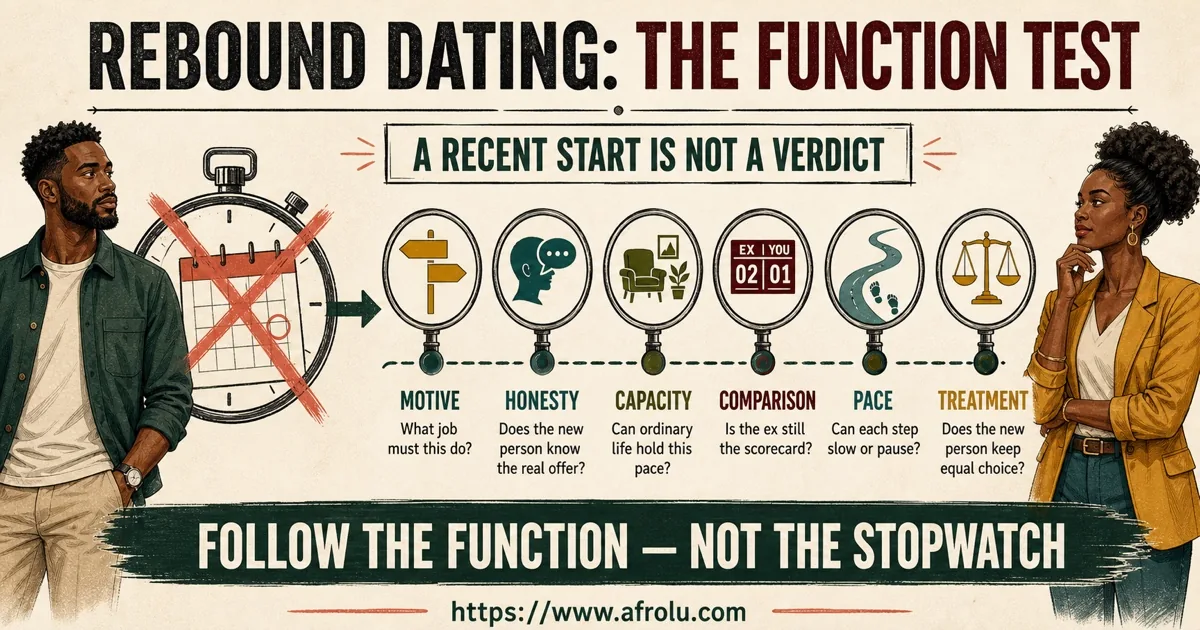
Do not decide from days alone. Check motive, honesty, capacity, comparison, pace, and treatment. A recent start can be ethical; a hidden job can be unfair at any speed.
Written and edited by Clarisse Uwimana · Dating Culture Editor
A relationship that begins soon after a breakup is not automatically unhealthy, and research does not provide a universal waiting period. Treat timing as context, then inspect function: motive, current capacity, truthful disclosure, ex comparison, pace, and treatment of the new person. Continue when curiosity and informed choice grow; slow or pause when attention must numb pain, prove worth, provoke an ex, or fill a vacant role.
Breakup recovery
Is this new connection being allowed to become a relationship between two people, or assigned a hidden job in the previous breakup?
Rebound dating is a loose social label for dating after a breakup, often implying that a new connection began quickly or is helping manage unresolved feelings about the previous relationship. The label has no agreed clinical threshold. Timing describes when a connection began; motive, honesty, capacity, comparison, pace, and conduct show what the connection is being asked to do.
A new message can bring relief before either person knows what the connection is. That relief is not proof of harm, and it is not proof of readiness. The ethical question appears when the new adult becomes invisible behind a role: painkiller, proof, replacement, messenger, shield, or instant future.
The function test
The word rebound often judges the calendar while missing the treatment of the new person
Popular advice treats a short gap between relationships as automatic evidence of denial, instability, or certain failure. The research base is much smaller and more mixed than that confidence suggests. Some studies have found better adjustment or fewer intrusive thoughts among recently partnered participants, but designs, samples, definitions, and causal limits matter. None provides a timer that can approve an individual relationship.
Use six lenses instead. Motive asks what the connection is expected to change. Honesty asks whether the new person knows the relevant timeline and offer. Capacity asks what can be sustained outside a hopeful evening. Comparison asks whether the ex remains the hidden scorecard. Pace asks whether escalation can be separated and revised. Treatment asks whether the new person remains a full decision-maker rather than a tool in the old story.
Name the strongest job
Curiosity and company can coexist with grief. Risk rises when proof, revenge, numbing, replacement, rescue, or public performance secretly controls the pace.
Make the offer visible
Disclose the recent ending, ongoing practical entanglement, current availability, and important limits before another adult invests on a false premise.
Test an ordinary week
Notice sleep, work, caregiving, attention, support, spending, rejection recovery, and whether dating can exist without taking over the systems that keep life steady.
Remove the hidden judge
Ask what present evidence remains when resemblance to, difference from, or imagined reaction by an ex is taken out of the decision.
Separate each escalation
Review another date, contact, sex, apps, exclusivity, public visibility, money, family, and future plans separately. Slowing one step should not threaten the whole connection.
Keep the new person free
They may accept, renegotiate, slow, or decline the offer. Their boundary is not betrayal, and their affection does not create an obligation to heal you.
Timing is context, not character
Start with what the research can and cannot tell you about quick new relationships
The everyday word rebound combines several claims: the new relationship began quickly, the person has unresolved feelings, the motive is distraction, and the outcome will be poor. Research does not use one universal definition or cutoff. Some studies compare people who are single with people who have repartnered; others examine months spent single, dating activity, or a self-reported tendency to rebound. That makes a precise countdown look more scientific than it is.
Exploratory research has challenged the belief that every quick new relationship is harmful. Recently partnered participants in some samples reported favourable adjustment measures or fewer intrusive thoughts about an ex. These findings matter because they remove automatic shame. They do not prove that quick partnering causes recovery, that every sample represents every age or culture, or that one promising connection is safe and compatible.
Treat time as one line in the case, not the verdict. Record when the previous agreement ended, when the new connection began, and what practical ties remain. Then move to the evidence a calendar cannot provide: why this person matters, what they know, what you can sustain, how an ex influences choices, whether pace can change, and whether both people retain equal dignity and agency.
A person is not a vacant position
Find the hidden role before relief quietly becomes a relationship promise
Write every job the connection is performing. It may offer discovery, company, attraction, touch, fun, hope, relief, validation, social status, revenge, numbness, replacement, rescue, or an instant future. Mixed motives are common. The important distinction is whether the strongest motive can coexist with seeing and respecting this adult, especially when they are unavailable, different from an ex, or unwilling to escalate.
Look for role transfer. Perhaps you miss a nightly call and create all-day contact. Perhaps a family event is approaching and the empty partner role feels exposed. Perhaps shared travel, rent, parenting, faith, or community status disappeared with the breakup. Those losses need names. A new person may later share some roles, but they should not be promoted into a predecessor position before mutual knowledge and agreement exist.
Use the no-audience question for revenge and status. Would you choose this date, photo, gift, declaration, or public launch if the former partner and mutual network could never see it? If the answer changes, delay the public act. The new person deserves a relationship that is not secretly transmitting a message to someone else.

A new partner can offer company, affection, discovery, and support by choice. They cannot be silently assigned to numb pain, prove worth, replace an ex, provoke jealousy, hide grief, or guarantee a future.
Truth must remain usable
Disclose the present reality without making a new date hold the whole breakup
The new person usually needs a concise version of the timeline, the current offer, and any ongoing contact or practical entanglement that affects them. They may need to know that you co-parent, share housing temporarily, work together, manage property, complete a legal process, or remain visible in the same community. They do not need every private detail or an invitation to judge the former partner on date one.
State the offer in operational language. Slow can mean one date a week, protected routines, limited all-day texting, no exclusivity promise yet, or a review after more ordinary interactions. Casual needs its own agreement about emotional and sexual scope. Serious intention still does not justify immediate exclusivity or future planning. A vague label is not enough if two people use it differently.
Leave the answer free. Someone may like you and decide that the timeline, ongoing contact, or limited offer does not fit. Do not call that fear, immaturity, or punishment. Informed choice means the information can change their decision. Accepting their no is part of proving that the new relationship is not being used to reverse the old rejection.

Say when the breakup happened, what practical contact remains, what you can offer now, and which decisions are still open. Honesty does not require a first-date archive; it requires accurate choice.
One yes cannot settle nine decisions
Let chemistry be real without allowing it to govern the entire relationship system
A strong first week can make several decisions feel like one: more contact, another date, sex, app deletion, exclusivity, public visibility, spending, family access, travel, or future plans. Separate them. Each carries different information, consent, risk, and reversibility. A good date can earn another date without earning a key, password, post, loan, label, or lifetime forecast.
Protect the ordinary week while the relationship is new. Keep sleep, work, care, movement, friends, faith or community, money boundaries, and private time. This is not emotional distance. It gives both people a stable place from which to notice whether the connection improves knowledge, reciprocity, freedom, and repair rather than only intensity.
Set review points based on events rather than a universal number of days. Review after the first cancellation, first boundary, first disagreement, first quiet week, first conversation about sex or exclusivity, and first moment an ex influences a decision. These ordinary moments reveal whether the connection can hold truth and difference without escalating to preserve relief.

Review each step separately: another date, contact rhythm, sex, apps, exclusivity, social visibility, money, family access, and future plans. A yes to one is not a yes to all.
The old relationship may still affect risk
Keep practical ties bounded and do not use a new partner as shield, mediator, or evidence
Ongoing ex contact can be appropriate for children, housing, business, health, immigration, family, legal matters, or community obligations. Define its purpose, frequency, and boundaries. Avoid unnecessary intimacy disguised as logistics, and avoid demanding total no-contact when responsibilities make that impossible. The new person needs accurate implications, not control of your devices or communications.
If the previous relationship involved coercion, stalking, threats, financial abuse, image misuse, or violence, publicising a new connection may increase risk. Review account access, devices, location sharing, mutual contacts, children, transport, housing, and what appears online. Use qualified local advocacy, legal, health, or safety support for your circumstances. A new date should not be asked to confront or protect you from an unsafe former partner.
Keep the standard dating baseline regardless of emotional urgency: verify important identity claims in proportion to risk, meet publicly early on, control transport, tell trusted support, protect home and child information, keep finances separate, and treat every sexual decision as specific consent. Relief, rescue, gifts, travel, alcohol, or intense disclosure never purchase access.

Notice what remains when attention pauses. Capacity keeps daily life, curiosity, truth, boundaries, and rejection manageable. Relief alone needs the new person to keep changing how you feel.
The next decision can remain small
Continue, reduce the role, pause, or end without turning the label into a life sentence
Continue when interest is specific, the timeline and offer are accurate, daily capacity remains mostly steady, comparison is losing control, pace can be revised, and the new person is treated as an equal participant. The relationship can still be recent and imperfect. Ask only for the next agreement the evidence supports.
Reduce pace when the person is becoming meaningful but relief is driving contact, routines are shrinking, public performance is increasing, or a vacant role is filling too quickly. Name the exact change: fewer dates, limited late-night texting, delayed visibility, restored independent plans, or a later exclusivity review. A smaller offer is fair only when it is visible and the other person can decline.
Pause or end when the connection mainly needs to numb, prove, replace, provoke, rescue, or hide; when relevant facts are concealed; when a former relationship still controls choices; when consent or safety is compromised; or when the offers simply do not fit. Ending respectfully does not prove the connection was fake. It can show that both people became visible enough to stop using a label as permission.
The same short timeline can contain four very different relationships
A short visible gap may follow a long private ending
Two people may have lived separately, attempted repair, discussed ending, or grieved inside the relationship before the final announcement. A new connection that begins soon afterward can look abrupt from outside while the person has already completed substantial practical and emotional work. That does not guarantee readiness, but the public date is incomplete evidence.
Describe the actual sequence without rewriting history to appear blameless. Check whether the prior agreement was truly over, whether the new person knows relevant facts, and whether present capacity and curiosity support a relationship beyond relief.Feeling better can be genuine without making the match responsible for keeping you better
Novelty, attention, attraction, and hope can reduce intrusive focus on an ex for a time. That effect is not automatically fake or harmful. The pressure appears when silence, a boundary, or a changed plan makes the whole recovery system collapse because the match has become the main regulator of worth and distress.
Keep the date small, preserve support and routine, and observe the period between contacts. If the person remains interesting when attention is not actively soothing you, curiosity may be growing. If panic controls the pace, reduce the assignment before increasing closeness.Ongoing contact is not the same as ongoing romance, but it must be described accurately
A former partner may remain present because of parenting, housing, business, immigration, health, family, community, or legal processes. A new partner does not need every private detail, yet they need enough truth to judge availability, boundaries, scheduling, safety, and the likelihood that old conflict will enter the new connection.
Name the purpose, frequency, and boundaries of contact. Do not ask the new person to police or mediate the former relationship. Where there is coercion, stalking, threats, or violence, prioritise qualified safety planning over romantic transparency rituals that increase exposure.Defensiveness cannot answer the question; a usable offer can
The question may carry fear of being compared, discarded, hidden, rushed, or asked to repair damage they did not cause. Calling the concern insecure avoids the substance. Promising that the relationship is definitely forever offers certainty you cannot yet know.
Acknowledge the timeline, explain what you can offer now, describe how you are handling the old ending outside the relationship, and invite their boundary. Then let pace and conduct make the answer more credible over time.Six questions that matter more than the number of days
Interest remains specific to the new person rather than their attention
The breakup timeline and current offer can be stated accurately
Pace can slow without panic, secrecy, or punishment
The new person can decline without being blamed for the old ending
Read the function of the connection at each pressure point
| Situation | What it may mean | What to do next |
|---|---|---|
| Friends say any date within a certain number of months is doomed | They may be trying to protect you, applying their own history, or repeating a popular rule that research does not establish universally. | Thank them for concern, then audit motive, honesty, capacity, comparison, pace, and treatment. Use conduct and fit rather than winning an argument about the label. |
| You feel dramatically better while the new person is attentive | Relief, hope, validation, and genuine interest may all be present; the connection may also be carrying too much regulation. | Observe sleep, routine, mood, checking, and self-worth between contacts. Keep other support active and slow escalation if silence makes the entire recovery system collapse. |
| The new person asks when the previous relationship ended | They are gathering information about availability, overlap, comparison, ex contact, and the risk of being rushed or hidden. | Answer factually, name the current offer, and allow their boundary. Do not minimise the timeline or promise a future to make the question disappear. |
| You want to post the relationship where an ex will see it | The new person may be becoming a messenger, status display, or instrument of revenge. | Delay public visibility and ask whether the post serves this relationship without the old audience. Discuss consent before posting another person. |
| The new person resembles or sharply contrasts with the ex | Familiarity or difference may be controlling attraction before present compatibility is known. | Translate the comparison into a value or concern, then gather evidence about this person. Do not reward or punish them for a resemblance they did not choose. |
| Chemistry creates an urge to merge routines immediately | A vacant relationship role may be pulling the connection faster than mutual knowledge and capacity. | Preserve separate routines and review each agreement individually. Let new rituals be negotiated rather than copied into an old space. |
| The new person wants more commitment than you can offer | The connection may be real while the present offers are incompatible. | State the limit without asking them to wait indefinitely. Their decision to leave is a fit judgment, not proof that you should have hidden the truth. |
| Dating is worsening function, substance use, risk, or acute distress | More romantic attention may not address the problem and could increase volatility or dependence. | Pause dating pressure and contact a licensed mental-health professional or appropriate local service. Use urgent local help where safety is immediate. |
Words for timeline, motive, pace, ex contact, visibility, exclusivity, slowing, and ending
“My previous relationship ended recently. I am interested in meeting you, and I want that fact visible rather than making you discover it later.”
“I can offer slow, honest exploration and regular communication. I am not ready to promise exclusivity or a long-term outcome yet.”
“We still communicate about our child and shared property. The contact has a practical purpose, and I can explain the boundaries that affect us.”
“The timing is recent, so your concern makes sense. I do not need you to ignore it; I want my pace, honesty, and treatment of you to remain open to review.”
“I like what is developing, and I do not want to post us while public attention or my former relationship can still influence the choice.”
“Another date is a yes. Exclusivity is a separate conversation, and I do not want chemistry to answer it for either of us.”
“I noticed I am leaning on our contact to regulate more than this connection can fairly carry. I need to slow down and strengthen support outside us.”
“My current offer does not match what you need. I will not ask you to wait inside uncertainty while I hope my capacity changes.”
Know the difference
Recent start or rebound function?
This is a timing description: the new connection began after a recent breakup. It does not reveal motive, honesty, capacity, compatibility, respect, or likely duration. Those questions require present evidence.
This describes the job assigned to the new person: numbing pain, proving desirability, replacing a role, provoking an ex, rescuing identity, or guaranteeing safety. The function can appear in a fast or slow connection.
Use timing as context, not a verdict. A relationship becomes more ethical when its current offer is accurate, the old ending has support elsewhere, and the new person is treated as a person with equal choice.

Recent start describes timing. Honest transition describes a limited disclosed offer. Rebound function describes an emotional job. Overlap means the new connection began before the prior agreement ended.
Are you describing timing, or describing a hidden job?
| Type or dimension | What it describes | Best next question |
|---|---|---|
| Recent start | The new connection began soon after the previous agreement ended; motive and outcome are not assumed. | What do honesty, capacity, pace, and treatment show now? |
| Honest transition | Both people understand the recent ending and agree to a modest scope while learning what is sustainable. | Does the limited offer stay accurate as attachment and investment grow? |
| Rebound function | The new person is expected to numb, prove, replace, rescue, provoke, or stabilise without informed agreement. | Can the hidden job be moved to broader support before more promises are made? |
| Overlapping relationship | The new romantic or sexual connection began before the prior relationship agreement actually ended. | Address consent, truth, accountability, sexual health, and safety; timing after discovery does not erase overlap. |
| Casual post-breakup dating | The connection is limited by mutual agreement rather than secretly treated as a route to reassurance or commitment. | Are emotional scope, sex, safer-sex practices, disclosure, and endings genuinely understood? |
| Curiosity-led relationship | Interest and knowledge increasingly concern this person while the old relationship loses control of the decisions. | Can ordinary disagreement and a slower week exist without reopening the old role? |
| Recovery pause | The person pauses introductions to restore function, safety, identity, or support without declaring permanent unworthiness. | What observable change would make a later review useful? |
The motive, honesty, capacity, comparison, pace, and treatment method
The interest has a name
Can you identify what you want to know about this person beyond their availability, attention, resemblance, difference, or usefulness in the breakup story?
The timeline is accurate
Can you state when the prior agreement ended and what contact, housing, parenting, legal, financial, or social entanglement still affects the present?
The offer fits this week
Can you sustain the contact, dates, care, boundaries, and uncertainty you are offering without borrowing energy from a fantasy future?
The pace can be revised
Can either person slow texting, postpone exclusivity, decline sex, preserve routines, or ask for space without punishment or panic deciding the relationship?
The ex is not the audience
Would you choose the date, post, gift, or declaration if the former partner and mutual network never saw it?
A no leaves dignity intact
Can the new person decide that the timing or offer does not fit without being blamed, chased, or recruited to disprove the previous rejection?
What the word rebound hides when it is used as a verdict
There is no agreed number of days that turns dating into a rebound
Research operationalises rebounding in different ways: new relationship status, time spent single, dating activity, casual sex, or self-reported tendency. Everyday speech often adds unresolved feelings and presumed bad motives. Because the label mixes timing, psychology, and outcome, use it as a question starter rather than a diagnosis.
Early findings challenge doom, but they do not guarantee success
A small 2015 study and newer cross-sectional young-adult research reported some favourable associations for people in new relationships after breakups. These results challenge the claim that quick relationships are always harmful. Selection effects, self-report, sample age, limited diversity, and non-causal designs prevent a universal prescription to couple quickly.
Mixed motives are ordinary; concealed controlling motives change the ethics
You can want company, attraction, discovery, hope, relief, validation, and fun at once. Ask which motive would still support respectful conduct when attention pauses. Revenge, proof, replacement, numbing, rescue, or avoidance become dangerous when they drive promises or hide the real role from the other person.
A mood change is a benefit, not a contract
A date may interrupt rumination and remind someone that attraction or connection remains possible. Receive that benefit without requiring the person to reproduce it on demand. Their slower reply, no, or independent life should not become an emergency they must repair.
Relevant disclosure is about informed choice, not compulsory confession
Share that a significant relationship ended recently, any practical contact or living reality that affects the present, and the commitment pace actually available. Avoid false claims of total healing. Also avoid making a first date process private allegations, intimate details, or a complete defence of the breakup.
Watch for the vacant-position interview
The old relationship may leave empty routines, family roles, financial habits, sexual familiarity, travel plans, social status, or a shared future. Moving a new adult directly into those spaces can feel efficient while bypassing who they are. Rebuild some roles independently and negotiate new ones from scratch.
Opposite is not automatically compatible
Choosing someone because they look, communicate, earn, worship, parent, or socialise differently from an ex can still keep the old relationship in control. Translate the contrast into a present need, then evaluate this person across their own values, limits, behaviour, and fit.
Separate emotional speed from agreement speed
Strong attraction can be real on day one. It does not settle contact rhythm, sex, safer-sex practices, apps, exclusivity, public posting, travel, money, family access, cohabitation, or future plans. Keep each agreement separate so either person can revise one without threatening the whole connection.
Remove the old audience from the new relationship
Posting, soft launching, public dates, gifts, or declarations can be designed partly for an ex, mutual friends, family, or community. Ask whether you would make the same choice if the former partner could never see it. Protect the new person from being used as a message or a competition.
Know when dating advice is too small for the distress
Breakups can affect mood, sleep, attention, body, work, caregiving, and safety. When distress is intense, worsening, persistent, or disrupting daily function, pause romantic pressure and seek assessment from a licensed mental-health professional or appropriate health service. Seek urgent local help for immediate danger or inability to stay safe.
Four ways a new relationship becomes an unfair assignment
The stopwatch verdict
A universal waiting rule substitutes one public number for motive, function, capacity, agreement, and individual context.
The vacant-role promotion
A new adult receives constant contact, family access, money, routines, or a future position before being known in their own right.
The old-audience launch
Posts, gifts, public affection, or declarations are designed partly to reach an ex or repair social status.
The hidden limited offer
Someone accepts growing care and investment while concealing that they cannot consider the commitment the other person reasonably expects.
Use a reviewed resource that matches the decision
This guide focuses on the relationship decision, so it does not rank dating apps. Check current prices, safety tools, and local availability before choosing a service.
Explore the guide library
Show more related guides
Continue with Afrolu
Show more Afrolu guides
Rebound, breakup adjustment, new-partner, identity, rumination, and stress evidence
Afrolu reviewed these health, research, safety, or public guidance resources while editing this page. They support the behaviour and safety guidance; they do not diagnose any individual described by a reader.
Rebound dating questions without myths, guarantees, or moral labels
How soon after a breakup is a relationship considered a rebound?
There is no agreed research-backed cutoff. Some studies use new relationship status or time spent single; everyday definitions also assume unresolved feelings or distraction. Record the timing, then examine motive, honest disclosure, present capacity, comparison, pace, and treatment rather than treating a number of days as a diagnosis.
Are rebound relationships always unhealthy or likely to fail?
No. Early and newer studies have reported some favourable associations among people in new relationships after breakups, but the evidence is limited and cannot predict an individual couple. A recent start can be respectful or harmful. So can a later start. Follow the actual offer, reciprocity, compatibility, boundaries, and conduct.
What is the clearest sign that I am using someone as a rebound?
No single feeling proves it. A strong warning is that the person is valued mainly for a hidden function: numbing pain, restoring worth, replacing an ex, creating jealousy, filling a role, or guaranteeing safety. Ask what remains interesting and workable when their attention is not actively changing your mood.
Should I tell someone that my breakup was recent?
Yes when the timeline affects informed choice, availability, ongoing contact, housing, parenting, legal matters, emotional pace, sexual health, or commitment. Be factual and proportionate. You do not owe every private detail on a first date, but concealing a relevant present reality prevents the other adult from choosing accurately.
Can a rebound relationship become a serious long-term relationship?
It can, but the label cannot forecast the outcome. Let seriousness emerge from knowledge, reciprocity, agreement, compatibility, repair, and sustained capacity. Do not use survival so far as proof that unresolved roles, secrecy, or pressure no longer need discussion.
What if dating someone new genuinely helps me feel better?
That benefit can be real. Enjoy company, attraction, and hope while keeping other supports and ordinary routines active. The ethical line is not feeling better; it is making the new person responsible for continually regulating worth or distress, especially without their knowledge or freedom to decline.
How do I answer when a new partner asks whether they are a rebound?
Acknowledge the timeline and the concern behind it. Describe what you can offer, how you process the former relationship outside the new one, what ex contact remains, and how pace will be reviewed. Avoid defensiveness and forever promises. Their boundary may still be that the timing does not fit.
Is casual dating after a breakup automatically a rebound?
No. Casual dating can be a clear adult choice when non-exclusivity, emotional scope, sex, safer-sex practices, disclosure, and endings are mutually understood. It becomes unfair when casual language hides a demand for reassurance, secret exclusivity, revenge, or care the other person never agreed to provide.
What should I do if I realise I am moving too fast?
Stop the next escalation, name the mismatch, and propose a concrete smaller pace: fewer dates, less all-day contact, delayed visibility, preserved routines, or a later exclusivity review. The other person is free to decline the revised offer. Do not keep their investment while privately withdrawing.
When should post-breakup distress get professional support?
Consider a licensed mental-health professional or appropriate local health service when distress is intense, worsening, persistent, overwhelming, or disrupting sleep, eating, work, caregiving, substance use, physical health, or safety. Seek urgent local help for immediate danger or inability to stay safe. This page does not diagnose or treat a condition.
One thing to do now
Let the new connection belong to the people who are actually in it
Do not classify the connection by days alone. Follow its function, disclose the present offer, separate each escalation decision, and keep the new person free to choose with accurate information.

