Six windows · values without access control
Protect Faith, Safety and Rest in Long-Distance Online Dating
Reduce long-distance dating-app overload without turning faith into pressure. Audit access, identity, money, rest and safety before returning or leaving.
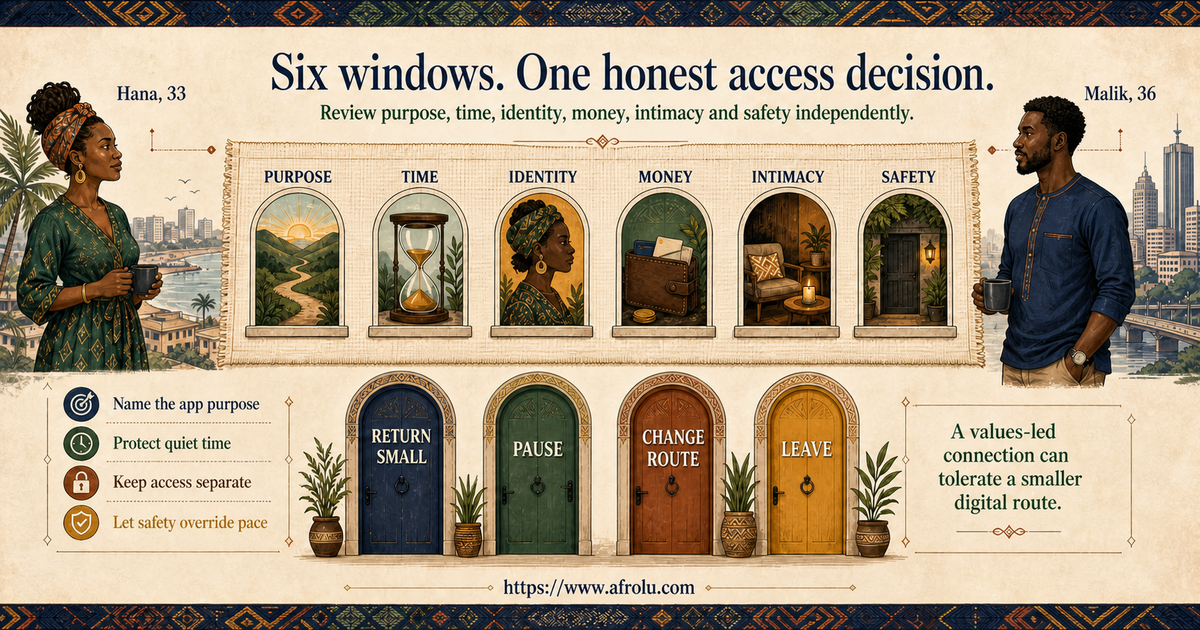
Faith can guide the questions while each adult keeps authority over access, money, travel and consent.
Written and edited by Samira Benali · Faith and North Africa Editor
Use six independent windows: PURPOSE, TIME, IDENTITY, MONEY, INTIMACY and SAFETY. Protect a quiet period, close unwanted threads, then test at most one bounded call or question. Shared faith language never verifies identity or grants access to accounts, funds, travel, images or sex. Review the delivered impact and choose RETURN SMALL, PAUSE, CHANGE ROUTE, LEAVE, SEEK CARE or SEEK SAFETY HELP. No universal faith-led contact rhythm or reset length exists. Persistent impairment deserves qualified local assessment; threats, coercion, stalking, fraud, image abuse or blocked exit use suitable safety channels immediately.
Dating wellbeing · Faith-Led Daters
How can a faith-led adult reduce long-distance dating-app load while keeping values, verification, money, travel, consent and safety under independent control?
Dating-app burnout is a non-diagnostic description of unwanted work from profiles, messages, uncertainty, verification and remote planning. In faith-led long-distance dating, app load can overlap with private practice, values incompatibility, time-zone strain, ordinary disappointment or wider distress. A six-window audit changes access to observe impact; it does not test devotion, diagnose a condition or certify a match.
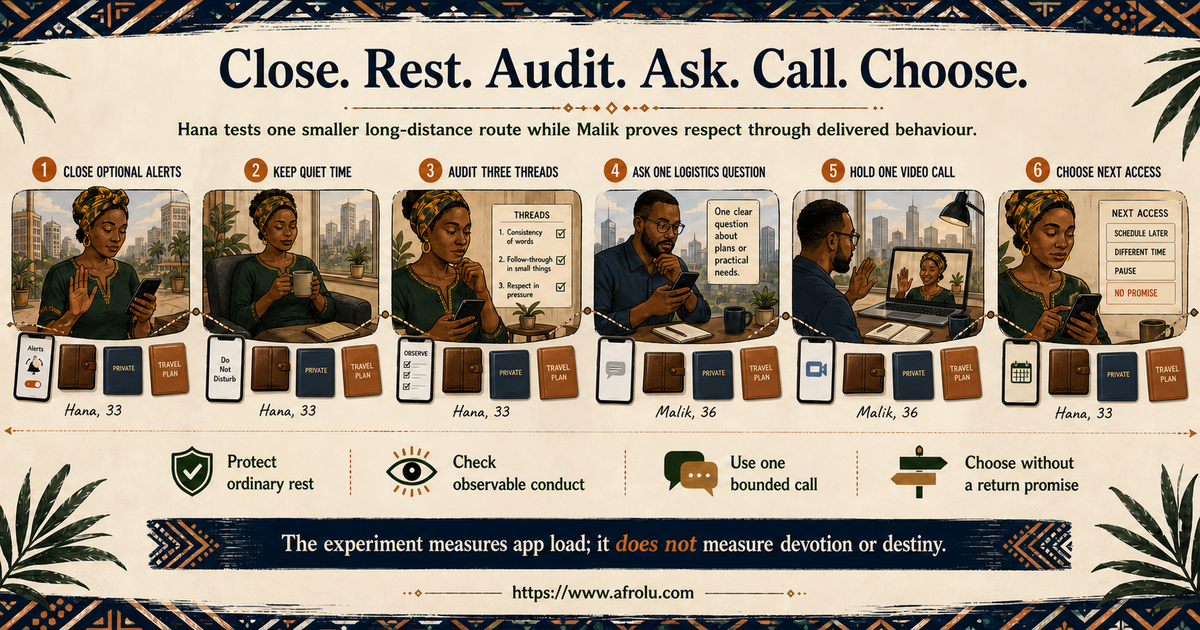
Hana, a fictional 33-year-old adult, closes optional alerts for thirty-six hours, ends two unsuitable threads and holds one bounded video call with Malik, 36, in another city. He respects her quiet time, documents, money and call ending. She keeps one scheduled check-in while pausing new matching, without treating the result as a spiritual verdict.
The six-window faith-and-distance ledger
Protect private practice, verify proportionately and keep every door available
Samira separates personally chosen values from another person's access and keeps app load, compatibility, care and safety on different routes.
Audit six windows, run one quiet interval, test one bounded exchange and choose from delivered evidence.
Name the job
Open for one chosen task and protect quiet, work and sleep.
Keep accounts separate
Verify proportionately and never fund an online match.
Unbundle every yes
Disclosure, images, touch and sex remain separate choices.
Let danger bypass the review
Protect access and use the authority suited to the harm.
Keep belief and authority separate
Faith may shape purpose without giving a match control over your time
Faith-led dating can mean prayerful reflection, community accountability, sexual boundaries, marriage intention, service, honesty or another personally chosen value. Hana names what it means in her life instead of allowing a match to define it for her. A shared label is an opening for specific questions; it is not evidence that identity, character or future plans have already been verified.
Digital intensity can borrow sacred language. A person may call constant contact devotion, demand immediate replies as respect, frame money as generosity or treat a private photo as proof of trust. The content of a value does not make the method safe. Mutual care leaves each adult free to think, sleep, work, worship, decline, seek counsel and control personal accounts.
Hana distinguishes private practice from relationship administration. She protects quiet time because it matters to her, not because a dating experiment promises spiritual improvement. Malik can ask when she is available; he cannot audit her practice, rank her sincerity or use community shame to obtain access. Their beliefs may be compatible, incompatible or still unknown after a pleasant conversation.
When faith communities influence dating decisions, privacy deserves care. A trusted adviser can support reflection, but a new match should not recruit leaders, relatives or friends to pressure an answer. Threats, stalking, financial exploitation, sexual coercion or blocked exit are safety problems. They do not become ordinary disagreements because religious language appears around them.
Audit six windows
Purpose, time, identity, money, intimacy and safety need separate answers
PURPOSE asks what Hana wants from this app now: one conversation, serious exploration, community-specific discovery or no digital dating at all. TIME records actual checking, reply and recovery costs across time zones. A clear relationship intention does not make unlimited availability reasonable, and low capacity does not automatically make either adult unserious.
IDENTITY separates reasonable verification from data extraction. A bounded video call and consistent public information may reduce some uncertainty, yet no method proves safety or character. Hana does not send identity documents, workplace credentials, account recovery codes or private community records. Malik keeps the same protections, even when both describe their intentions as marriage-minded.
MONEY and TRAVEL remain individual logistics until substantial evidence and explicit agreements exist. No emergency, ticket problem, investment idea, charity appeal or verification fee receives funds because the story sounds faithful. A future visit requires dates, budget, accommodation, public meeting points, independent return and a cancellation plan; affection alone cannot do that administrative work.
INTIMACY keeps video, emotional disclosure, images, touch and sex as separate, reversible choices. SAFETY overrides the ordinary audit when there are threats, impersonation, coercion, image abuse, stalking or controlled movement. Hana can preserve relevant records and seek appropriate platform, financial, legal, health or emergency support without first winning an argument about the person's motives.
Follow a thirty-six-hour quiet window
Hana reduces app load before testing one bounded call with Malik
On Thursday evening Hana notices that three long-distance conversations are crossing her workday, family time and private reflection. She disables optional alerts for thirty-six hours, writes each thread on paper and does not announce a test. The quiet window is not punishment. It simply lets her compare chosen contact with the pull of unanswered notifications.
On Saturday morning she closes one exchange that has become a daily sermon about her availability and blocks another account that requested airfare money. Malik's thread contains one unanswered logistics question and no demand. Hana replies that she can hold a twenty-minute video call that evening and will decide afterward whether the app remains open during the coming week.
Malik joins at the agreed time, answers ordinary identity questions, accepts that Hana will not show her home or documents and explains his actual travel constraints. They discuss what faith-led dating means to each of them without claiming agreement where none exists. The call ends on time. Neither person interprets warmth as permission for money, sexual content or a visit.
Hana reviews the six windows the next morning. Her rest improved when alerts stopped, and Malik's conduct fitted the smaller route. She keeps one scheduled check-in and pauses new matching. If he had punished the boundary, the result would have been closure rather than a failed spiritual opportunity. The experiment produced access evidence, not a destiny verdict.
Read twelve independent signals
Observable conduct matters more than reassuring spiritual vocabulary
PURPOSE fits when both adults can state what they are exploring and revise that answer without punishment. Redesign a conversation that relies on destiny claims but avoids present questions. Stop spiritual threats, community shaming or claims that declining contact violates belief. A serious intention should make honest uncertainty easier to discuss, not forbidden.
TIME fits when reply windows, work, sleep and private practice coexist. Redesign constant checking, cross-time-zone calls that repeatedly impair rest or guilt about ordinary delay. Persistent distress across life may deserve qualified care. Dating-app load is one possible contributor, not a diagnosis or proof that a person lacks discipline.
IDENTITY and MONEY fit when verification is proportionate and accounts remain separate. Redesign oversharing that grows faster than observable trust. Stop requests for funds, codes, documents, intimate proof or investment. A verified photo, community affiliation or mutual contact may add context but cannot transfer responsibility for independent checks.
INTIMACY and SAFETY fit when consent stays specific and leaving stays possible. Redesign pressure disguised as future commitment. Stop stalking, threats, image abuse, sexual coercion, impersonation or controlled travel. Use suitable support channels according to the problem, and do not send a boundary message when direct engagement could increase danger.

The strongest concrete fact chooses the response; the cards are not a spiritual or mental-health score.
Use ten plain boundary lines
Short statements protect quiet time, identity, money, travel and consent
For app time Hana can say, 'I check this app on Tuesday and Saturday evenings.' For values, she can ask, 'What does faith-led dating require from you in practice, and what does it never permit you to demand from me?' These lines create answerable information without asking either adult to perform certainty or disclose private devotion.
For identity, 'I can do a short video call, but I do not share documents or account codes' is sufficient. For plans, 'I am not arranging travel yet; we can review dates and independent logistics after more evidence' separates interest from movement. Malik remains free to decide that the pace does not fit him.
For money, Hana does not soften the answer: 'I do not send funds, buy tickets or join investments for an online match.' For intimacy, she can say that emotional disclosure, sexual conversation, images and future physical contact are separate choices. Sexual-health discussions belong before sex and should leave time for informed, unpressured decisions.
For pause or closure, 'This digital rhythm is not fitting my life, so I am stepping back without a return date' and 'Our values or pace do not align, so I am closing contact' are complete. A concise ending does not require agreement from the recipient. Persistent unwanted contact changes the task from explanation to access protection.

A boundary states available access and leaves the other adult free to accept, counter or close.
Choose the smallest honest door
Return small, pause, change route, leave or seek suitable support
RETURN SMALL means one named task, one or two reply windows and no automatic expansion. PAUSE removes optional app work without promising when it will resume. CHANGE ROUTE may mean community introductions, offline activities, a different service or continuing one existing connection without remaining visible to new matches. Each choice can be reviewed again.
LEAVE is complete when the app is unwanted, even if no dramatic harm occurred. Hana separates cancelling renewal, hiding a profile, downloading records, deleting an account and ending a specific conversation because those actions have different consequences. Money already paid and time already invested do not create a duty to continue.
SEEK CARE applies when severe or distressing symptoms persist, spread across contexts or interfere with ordinary functioning. Qualified local professionals can assess causes and options that an editorial cannot. SEEK SAFETY HELP applies to immediate danger, coercion, stalking, fraud, threats or image abuse and may involve distinct platform, financial, legal, health, community or emergency channels.
A trusted faith adviser may help Hana interpret values if that person respects consent, privacy and professional boundaries. Spiritual counsel is not a substitute for clinical assessment, financial fraud response or emergency help. The clearest route preserves the kind of authority needed for the actual problem rather than asking one helper to do every job.

A pause may remain a pause; no spiritual deadline requires reopening.
Compare nearby states carefully
App overload, faith rhythm, distance friction, mismatch, impairment and control are different
APP OVERLOAD is concentrated in profile review, notifications, message triage and planning. Reducing those tasks may change Hana's experience. PRIVATE FAITH RHYTHM is a chosen pattern of reflection, worship, community or rest that deserves protection regardless of app intensity. Neither state proves lack of relationship readiness.
DISTANCE FRICTION concerns time zones, connectivity, travel cost and limited in-person evidence. It can be addressed with specific logistics if both adults want that work. VALUES MISMATCH concerns substantive differences about exclusivity, marriage, family, money, gender expectations, sexuality or community involvement. Compatibility cannot be manufactured by increasing message volume.
PERSISTENT IMPAIRMENT reaches beyond one platform into sleep, concentration, appetite, enjoyment or ordinary tasks and deserves qualified assessment when severe or enduring. The cross-sectional research cited here can raise useful questions but cannot establish that app use caused an individual's symptoms or that a reset will resolve them.
UNSAFE CONTROL includes financial exploitation, threats, surveillance, coercion, impersonation, image abuse and blocked exit. It requires access-focused action rather than a couple's communication exercise. Shared faith language, distance or prior affection does not reduce the seriousness of unsafe conduct, and the target is never responsible for another person's abuse.
Eight faith-led distance moments where access needs a clearer boundary
Quiet time fills with app checks
Hana opens three threads during every reflective or rest period even though no reply is urgent.
Disable optional alerts and place one chosen app task after the protected period.A match calls constant access devotion
Delayed replies are framed as proof that Hana is not serious or faithful enough.
State one real reply rhythm once and treat punishment or shaming as access evidence.Affection becomes an airfare request
A distant match describes a ticket emergency and asks Hana to send funds immediately.
Do not pay; stop contact and use independently found platform or financial channels.Malik accepts a bounded call
He joins for twenty minutes, answers ordinary questions and does not request private rooms or documents.
Record the delivered behaviour and keep the next contact equally bounded.Values language stays abstract
Both adults say faith matters but avoid questions about exclusivity, family, money or decision-making.
Ask one concrete values question and allow incompatibility to become a complete answer.Distance logistics consume every evening
Time-zone negotiation and travel fantasy take more energy than the connection currently returns.
Reduce contact and require one feasible logistics step before expanding access.The app is quiet but distress persists
Sleep, concentration and ordinary enjoyment remain seriously affected after optional dating work stops.
Treat the wider pattern as a health question and seek qualified local assessment.One smaller route fits
A scheduled check-in protects work, private practice, money and independent choice for both adults.
Continue at the tested size and review actual impact before adding frequency or travel.Twelve signals across purpose, time, identity, money, intimacy and safety
{'name': 'Chosen purpose', 'detail': 'Hana can say why she is opening the app and what result would complete that task.'}
{'name': 'Protected quiet', 'detail': 'Work, sleep, family and personally chosen faith practice remain outside reply demands.'}
{'name': 'Accepted delay', 'detail': 'Malik receives a cross-time-zone gap without guilt, suspicion, monitoring or retaliation.'}
{'name': 'Specific values', 'detail': 'Each adult can explain a value in behaviour rather than relying on a shared label.'}
{'name': 'Proportionate verification', 'detail': 'Identity questions stay bounded and no document, password or recovery code is requested.'}
{'name': 'Separate money', 'detail': 'Travel, emergencies, investments, gifts and verification never become a match-funded obligation.'}
{'name': 'Feasible logistics', 'detail': 'A future visit includes real dates, budget, public meeting, independent lodging and exit.'}
{'name': 'Specific consent', 'detail': 'Calls, disclosure, images, touch and sex remain separate freely changeable choices.'}
{'name': 'Private counsel', 'detail': "Trusted support does not recruit community pressure or disclose Hana's information without permission."}
{'name': 'Complete pause', 'detail': 'She can step back without setting a spiritual deadline or promising to reopen.'}
{'name': 'Independent exit', 'detail': 'Each adult controls phone, accounts, transport, accommodation and the ability to close contact.'}
{'name': 'Problem-matched support', 'detail': 'Care, fraud response, platform reporting and urgent safety remain distinct routes.'}
Review long-distance app access through ten independent questions
| Situation | What it may mean | What to do next |
|---|---|---|
| Can I name today's app purpose? | Fits: One task and stopping point are clear. Needs review: I am checking for reassurance or destiny signs. Stop: Someone demands immediate proof of devotion. | Choose one task, delay the check or close coercive access. |
| Does contact protect quiet time? | Fits: Chosen practice, work and sleep remain intact. Needs review: Calls repeatedly cross protected periods. Stop: Boundaries trigger spiritual threats or monitoring. | Reset the rhythm once; protect access if punishment follows. |
| Are values translated into conduct? | Fits: Both adults answer specific questions honestly. Needs review: Shared labels replace practical discussion. Stop: Doctrine is invoked to cancel consent or equality. | Ask for behaviour-level meaning and leave unsafe control. |
| Is identity checking proportionate? | Fits: A bounded call and consistent context are available. Needs review: Oversharing is mistaken for trust. Stop: Documents, codes or private records are requested. | Keep sensitive data closed and use independent checks. |
| Does money stay separate? | Fits: Each adult funds ordinary life and dating choices. Needs review: Gift expectations grow before evidence. Stop: Airfare, emergency or investment money is requested. | Do not transfer funds; use relevant fraud or financial help. |
| Is distance becoming a real plan? | Fits: Dates, cost, public meeting and exit are feasible. Needs review: Travel fantasy repeats without logistics. Stop: Only controlled lodging or movement is offered. | Require independent logistics or do not travel. |
| Does intimacy remain specific? | Fits: Every step has a fresh, unpressured choice. Needs review: Future commitment is used to bundle access. Stop: Sexual pressure, threats or image abuse appears. | Separate choices and use suitable safety support. |
| What happened when access became smaller? | Fits: Respect and reciprocity remained stable. Needs review: Interest vanished when constant contact stopped. Stop: Harassment crossed platforms or accounts. | Keep the tested size, close, block or preserve evidence as appropriate. |
| Is the difficulty app-specific? | Fits: Reducing app work changes the burden. Needs review: Distance or values mismatch remains. Stop: Severe impairment affects ordinary functioning. | Match the response to app load, compatibility, logistics or care. |
| What is the smallest honest door? | Fits: One route fits current evidence. Needs review: A longer pause would create clarity. Stop: Immediate danger bypasses review. | Return small, pause, change route, leave or seek suitable help. |
Ten lines for values, quiet time, identity, travel, consent and closure
“I check this app on Tuesday and Saturday evenings, not throughout the day.”
“This period is private and phone-free; I will respond afterward if I choose.”
“What does faith-led dating require from you in practice, and what may it never require from me?”
“I can do a short video call, but I do not share identity documents or account codes.”
“I do not send funds, buy tickets or join investments for an online match.”
“I am not arranging a visit until dates, budget, public plans and independent lodging are clear.”
“Emotional disclosure, images, touch and sex are separate choices, not one promise.”
“Before sex, I need an unhurried conversation about partners, testing and protection.”
“This app rhythm is not fitting my life, so I am pausing without a return date.”
“Our values or pace do not align, so I am ending this connection here.”
Know the difference
Long-distance app load and nearby faith, logistics, health or safety states
Profile review, message triage, uncertainty and remote planning consume more attention than the adult wants to give.
Private practice, distance friction, values incompatibility, wider impairment or unsafe control requires a different route.
Shared values do not erase the need to identify the actual problem.

Name the smallest supported problem before choosing its response.
Separate eight nearby app, faith, distance, health and safety states
| Type or dimension | What it describes | Best next question |
|---|---|---|
| Dating-app overload | The removable burden is checking, sorting, replying and planning through the platform. | Pause, reduce or leave the app and observe wider functioning. |
| Private faith rhythm | Chosen reflection, worship, community or rest needs protection even when the app is manageable. | State availability without asking a match to validate the practice. |
| Distance friction | Time zones, connectivity, cost and scarce in-person evidence create administrative strain. | Build one feasible plan or reduce the route rather than messaging harder. |
| Values mismatch | Specific expectations about commitment, family, money, sexuality or community do not align. | Name the difference and allow a respectful ending. |
| Ordinary disappointment | A weak match or cancelled call hurts without a persistent cross-context pattern. | Close the event, recover and avoid a global self-verdict. |
| Persistent impairment | Sleep, concentration, appetite, enjoyment or ordinary tasks remain seriously affected across settings. | Seek qualified local assessment; a reset cannot establish cause or care. |
| Unsafe control | Threats, surveillance, coercion, fraud, image abuse or blocked exit changes the problem. | Protect access and use suitable platform, financial, legal, health or emergency help. |
| Healthy low-frequency contact | A small scheduled rhythm still carries specific questions, follow-through and freely chosen affection. | Keep the working size and review before expanding. |
Use the six-window distance ledger in six moves
Define faith-led
Translate a personal value into mutual behaviour-level questions.
Audit six windows
Purpose, time, identity, money, intimacy and safety stay independent.
Run one quiet window
Reduce optional app load without turning silence into punishment.
Test one bounded call
Observe timing, verification, questions and respect for an ending.
Keep logistics real
Affection never substitutes for dates, cost, lodging, transport and exit.
Choose the right authority
Spiritual counsel, clinical care, fraud response and urgent safety do different jobs.
Questions for purpose, access, distance and the next door
Choose a few prompts that fit the moment. This is a reference library, not a list to complete.
Purpose
Define faith-led in conduct.
- Why this app now?
- Which values are mine?
- What needs a direct question?
- What remains private?
- What answer could close this route?
Access
Separate the digital windows.
- When do I reply?
- What identity data stays closed?
- What money stays separate?
- What intimacy is not agreed?
- Can I leave safely?
Distance
Turn warmth into logistics.
- Which time zones?
- What call is bounded?
- Who pays what?
- Where would we meet?
- How does each person return?
Decision
Choose the smallest honest door.
- Return small?
- Continue the pause?
- Change route?
- Leave?
- Which support has the right authority?
What app, distance, disclosure and current safety evidence can support
A cross-sectional adult study reports associations between swipe-based dating use and mental-health outcomes
The study supports asking about distress, frequency and context while retaining the distinction between association and individual causation.
Evidence limit: Its Australian convenience sample and cross-sectional design cannot diagnose Hana or prove that an app produced her experience.
A large adult survey examined predictors of problematic Tinder use
The work supports examining whether a person opens an app for enhancement, coping or social connection rather than assuming one motive.
Evidence limit: A predictor model for one branded service cannot define faith-led use or set a healthy personal threshold.
Research links texting with relationship satisfaction in a long-distance sample
The findings show that remote communication can have constructive roles, which guards against treating every high-message relationship as unhealthy.
Evidence limit: Correlational results do not prescribe frequency, establish compatibility or guarantee that a specific remote contact is safe.
Five studies examined online disclosure, intimacy and partner satisfaction
The research supports treating medium and content as relevant when deciding what personal material belongs online.
Evidence limit: The findings concern established relationships and cannot dictate disclosure pace for new matches across cultures.
Current FTC and eSafety guidance separates romance, privacy, money and abuse risks
Official resources support limiting personal information, recognising money routes and using reporting or evidence-preservation options suited to the harm.
Evidence limit: Jurisdiction and available remedies vary; readers should use independently found services relevant to their location.
CDC conversation guidance supports talking before sex
The resource supports partner discussions about testing, partners and prevention early enough for an informed choice.
Evidence limit: It is U.S.-based general guidance, not personal clinical advice or a substitute for relevant local care.
Six ways faith language can hide app load or unsafe access
Using faith as a compatibility shortcut
A shared label replaces practical questions. Repair: ask what the value changes in conduct.
Calling constant contact devotion
App access becomes a sincerity test. Repair: protect chosen reply windows and private time.
Treating oversharing as trust
Documents or home details move before evidence. Repair: use proportionate independent checks.
Funding a distant emergency
Affection opens a money route. Repair: do not transfer funds to an online match.
Planning travel from chemistry
Warm calls substitute for logistics. Repair: require independent, leaveable arrangements.
Setting a spiritual return deadline
A pause becomes proof of failure. Repair: review app impact without a required reopening.
Use a reviewed resource that matches the decision
This guide focuses on the relationship decision, so it does not rank dating apps. Check current prices, safety tools, and local availability before choosing a service.
Explore the guide library
Show more related guides
Continue with Afrolu
Show more Afrolu guides
Adult app research, long-distance communication and current safety guidance
Afrolu reviewed these health, research, safety, or public guidance resources while editing this page. They support the behaviour and safety guidance; they do not diagnose any individual described by a reader.
Faith-led long-distance dating-app reset questions
Is faith-led dating supposed to involve daily contact?
No universal faith-led message rhythm exists. Communities and individuals differ, and a shared label does not create constant access. Name the actual reply windows each adult can offer. Respectful interest can survive work, sleep, family and private practice. Pressure, monitoring or spiritual shaming is evidence about conduct, not proof that you should reply faster.
Can a dating-app pause be part of faith practice?
It can be a personally chosen boundary, but this guide does not prescribe worship or spiritual discipline. A pause may protect rest and clarify app load without being a cure, punishment or test. Keep its purpose explicit and avoid asking a match or adviser to grade its sincerity. Reopen only if the route remains wanted.
How long should the quiet window last?
There is no universal length. Hana's thirty-six hours is fictional and illustrates a bounded change in optional app access. Choose a period that fits work, caregiving, safety and ordinary communication obligations. Review what changed, then return small, continue pausing, change route or leave without promising a deadline.
Does shared faith make identity verification unnecessary?
No. Shared language, mutual contacts, verified photos and community affiliation can add context but do not prove identity, character or safety. Use proportionate independent checks, protect documents and account codes, and keep early meetings public and leaveable. No verification method turns consent, money or travel into an obligation.
What if a long-distance match asks for airfare?
Do not send money, buy a ticket through their link or share financial credentials. Romance scams commonly use urgent travel and emergency stories. Stop contact when appropriate, preserve useful records and navigate independently to the platform, financial provider or relevant official reporting service. Affection and faith language do not verify a request.
Can an adviser help decide whether I should continue?
A trusted adviser can help you reflect on values if they respect privacy, consent and your independent decision. They should not contact the match, disclose your information or pressure a relationship outcome without permission. Clinical, legal, financial and urgent safety questions belong with appropriately qualified or authorised support.
How do we discuss sexual boundaries in faith-led dating?
State what each choice means now rather than relying on assumptions about a label. Emotional disclosure, sexual conversation, images, touch and sex are separate and reversible. Before sex, discuss consent, partners, testing and prevention with time for informed decisions. A serious intention or future-marriage discussion is not present consent.
What if reducing app time does not improve how I feel?
That is useful information, not a failed reset. If severe or distressing symptoms persist across sleep, concentration, appetite, enjoyment or ordinary functioning, seek qualified local assessment. An editorial cannot determine cause or treatment. Immediate self-harm risk or danger requires urgent local support rather than another app experiment.
Is leaving apps a rejection of faith-led partnership?
No. An app is one meeting method, not a measure of commitment to partnership or belief. You may use community introductions, friends, activities, another service or no dating route. Leaving can be temporary or permanent. The relevant question is whether the format fits your values, capacity, privacy and safety now.
When should I stop explaining and protect access?
Stop ordinary negotiation when there are threats, stalking, impersonation, coercion, image abuse, financial exploitation, controlled movement or persistent unwanted contact. A further message may increase risk. Preserve relevant evidence where safe and use appropriate platform, financial, legal, health, community or emergency support for your location.
One thing to do now
Let values guide the route without surrendering the controls
Continue only while a deliberately small digital route fits purpose, time, identity protection, money, travel, intimacy and safety. Leave whenever the format or connection is unwanted. Use qualified local care for severe or persistent impairment and appropriate platform, financial, legal, health or emergency help for unsafe conduct without waiting for a reset review.