Four lanterns · six-week review
Begin Faith-Led Long-Distance Dating Without Making Pain a Sign
A faith-aware guide to serious long-distance dating after heartbreak, recovery, values, family, sexual health, money, safer travel and voluntary support.

Faith may illuminate a choice; it does not remove another adult's freedom to choose differently.
Written and edited by Samira Benali · Faith and North Africa Editor
Carry four independent lanterns. RECOVERY asks whether dating leaves room for mixed grief, ordinary functioning and freely chosen support without a healing clock. FAITH translates labels into person-specific values while counsel, family and consent remain voluntary. EVIDENCE evaluates the new adult's accurate scope, calls, repair and boundary response rather than comparing everything with the ex. DISTANCE protects money, identity, health, documents, visits and exit. Review after a personally suitable interval; six weeks is fictional, not universal. Continue, slow, pause or close from present evidence. Persistent impairment needs qualified local care, while fraud, coercion, spiritual pressure, stalking, threats, image abuse or blocked exit uses appropriate safety support.
Starting over · Faith-Led Daters
How can faith-led adults date seriously across distance after heartbreak without turning a new person into spiritual rescue, a shared label into compatibility or serious intent into unsafe access?
Faith-led dating after heartbreak uses chosen beliefs, practices and values as one source of meaning while recovery, consent, relationship status, person-specific evidence and distance logistics remain independently answerable. It does not require complete emotional silence, a universal waiting period, spiritual certainty or a partner appointed to heal the loss.
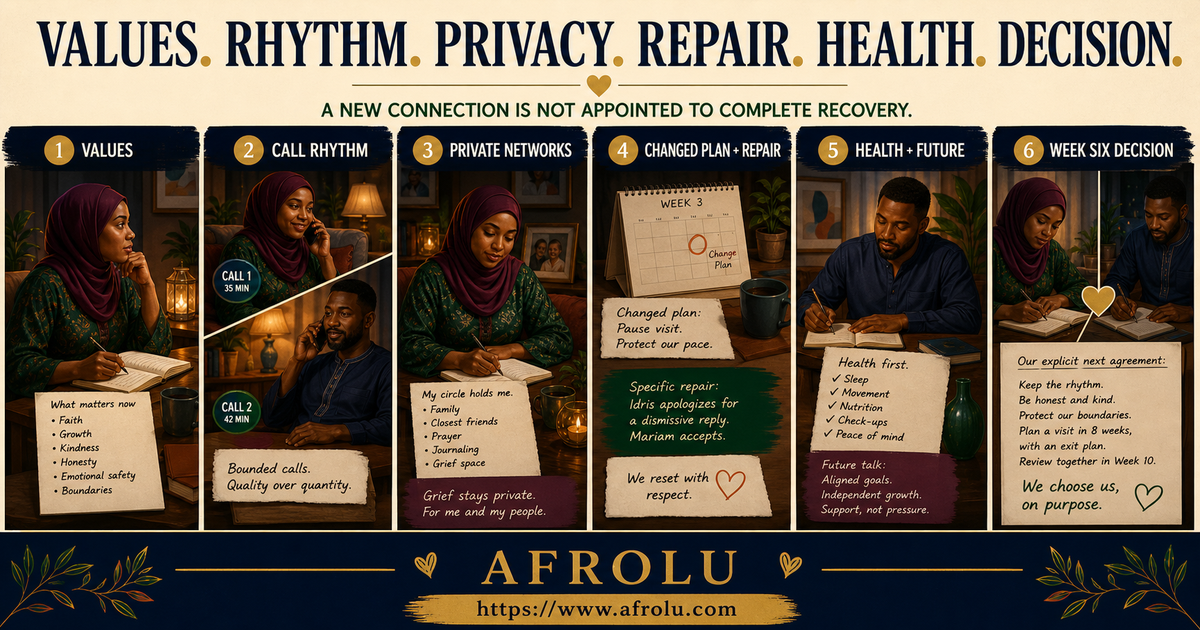
Mariam, a fictional 35-year-old Muslim adult, and Idris, 38, share six weeks of serious-intent long-distance discovery. They define values, use a bounded call rhythm, protect family and grief privacy, observe one repaired change and discuss sexual health and future location. They continue without declaring full healing, exclusivity or dependent travel.
The four-lantern faith-led distance path
Let recovery, belief, evidence and logistics illuminate separate decisions
Samira keeps spiritual meaning voluntary, makes serious intent present-tense and limits research claims to the faiths, ages and settings actually studied.
Review recovery impact, translate values into ordinary choices, observe this person and keep every distance step independently leaveable.
Recovery
Allow mixed grief while watching agency, support and ordinary functioning.
Faith
Make beliefs and counsel voluntary, concrete and person-specific.
Evidence
Assess Idris through his own scope, delivery, repair and boundaries.
Distance
Protect health, money, documents, travel and exit.
Protect meaning from judgment
Heartbreak can carry spiritual meaning without proving failure, punishment or a required next partner
Mariam's previous relationship ended after several years and disrupted plans she had connected with prayer, family and a serious future. The ending can feel like relational loss and sacred loss at once. That experience does not prove weak faith, divine punishment, permanent damage or that a new relationship has been assigned to restore what ended.
Research on religious and spiritual coping after romantic breakup suggests that faith appraisals can relate to distress, growth and adjustment in different ways. The evidence does not rank traditions or guarantee benefit. Positive support may offer meaning, community and compassionate practice; spiritual struggle, shame or coercive counsel may intensify pain and deserve a different response.
Mariam decides which prayers, practices, mentors or communities she wants involved. A leader may provide valued counsel without owning her consent, health information, travel, finances or relationship status. Idris cannot invoke faith, age, marriage intention or family reputation to accelerate access. Belief becomes support only while her action remains free.
Persistent difficulty with sleep, appetite, concentration, ordinary tasks or enjoyment may merit qualified local mental-health care, whether or not faith support is also present. Immediate self-harm risk or danger requires urgent local help. A relationship page cannot diagnose grief, depression, anxiety, trauma or determine which care is appropriate.
Carry four separate lanterns
Recovery, faith, evidence and distance keep a serious route from becoming destiny
RECOVERY asks what dating currently changes in Mariam's body, routines, thoughts and ordinary responsibilities. She can experience sadness and still enjoy Idris, or feel hopeful and still need a pause. Readiness is not the absence of every memory. It is enough present capacity to choose, notice impact and leave without assigning the new person responsibility for repair.
FAITH asks which values and practices Mariam freely carries into serious dating: honesty, compassion, sexual ethics, family involvement, worship, service or other commitments. Idris answers for himself. A shared label cannot reveal interpretation, observance, gender expectations, conflict practice or future household decisions. They ask person-specific questions instead of assuming spiritual compatibility.
EVIDENCE concerns Idris rather than the ex or an imagined promise. Does he state serious direction accurately, keep calls, repair changes, accept limits and discuss difficult topics without spiritual leverage? Mariam avoids comparison as the only measuring tool. The question is not whether he is better than her former partner but whether this delivered route fits now.
DISTANCE makes calls, visits, money, identity, family disclosure and sexual-health planning explicit. Serious intent does not verify a distant person or justify travel dependence. Every visit needs independent funds, suitable public plans, separate accommodation where appropriate, protected documents and an exit. No destiny claim can make unsafe logistics safe.
Follow one serious route without a healing clock
Mariam and Idris use six weeks to gather relevant evidence, not to prove recovery
In week one, both say they date toward a committed partnership. Mariam explains that heartbreak still surfaces and that she does not want a new connection treated as spiritual rescue. Idris does not ask for the former partner's private details or promise to heal her. They compare broad faith practice and agree that a shared label requires specific questions.
During weeks two and three they use two planned calls weekly and keep homes, employers, money and family contacts private. Mariam tells one trusted friend about the route but does not invite a leader to negotiate for her. Idris respects a quiet evening she reserves for recovery and does not frame delayed replies as spiritual neglect.
In week four, Idris moves a call because of family care. He gives notice, names the affected plan and offers a realistic replacement that he keeps. In week five they discuss serious direction, future location, family expectations, consent, current partners, testing and protection without scheduling sex or travel. Values make the conversation possible; they do not predetermine answers.
At week six, Mariam chooses another six-week discovery interval and a separately planned public visit later, if independent logistics remain workable. She does not declare herself fully healed or exclusive. If the route had increased impairment, spiritual shame or pressure, pausing or closing would have been equally complete and faith-consistent.
Read four lanes across three states
Recovery, faith, evidence and distance should not be averaged into compatibility
RECOVERY continues when dating leaves room for ordinary routines, mixed feelings and a freely chosen pause. Clarify comparison, rumination or validation-seeking that begins to organise the route. Seek qualified care when distress is severe or persistent and impairs functioning. Stop any partner who weaponises disclosed pain, threatens abandonment or demands access as treatment.
FAITH continues when beliefs can be discussed with humility and each adult owns practice and consent. Clarify differences in worship, family, gender roles, sexuality, money or marriage process before assigning compatibility. Stop spiritual threats, claims of divine authority over the other adult, forced disclosure, leader recruitment or faith language used to demand sex, silence, payment or travel.
EVIDENCE continues when serious direction is matched by accurate scope, consistent calls, proportional knowledge and repair. Clarify future language that outruns present agreement. Stop identity contradictions, isolation, surveillance or pressure to prove purity, loyalty or healing. Mariam evaluates Idris's conduct directly rather than using the ex as a permanent benchmark.
DISTANCE continues when communication, visits, money, documents, sexual health and exit remain answerable and independent. Clarify a real logistical barrier with a specific next point. Stop transfers, investments, immigration-document requests, secret travel, controlled accommodation, threats, stalking or image abuse. Danger bypasses an ordinary values conversation.

Do not average spiritual pressure or financial danger against otherwise respectful words.
Speak values without spiritual leverage
Ten direct lines protect grief, belief, serious intent, family, health, money and travel
For recovery, Mariam can say, 'I can enjoy this connection and still have grief that is not yours to fix.' This removes a rescue role without hiding her capacity. Idris may decide he cannot offer the desired pace. A clear mismatch is preferable to promises that make him the cure and her recovery the relationship's performance target.
For faith, she can ask how belief shapes ordinary decisions rather than testing labels. 'Who decides family involvement?' and 'How do you handle disagreement when both people believe they are acting with integrity?' reveal more than assumed sameness. No answer gives a leader, relative or partner authority to override consent.
For serious direction and health, they can distinguish dating toward commitment from present exclusivity. Before sex, adults should discuss consent, current partners, testing and protection early enough for informed choices. Faith commitments may influence each person's choice, but silence, shame or a marriage promise cannot replace factual health communication.
For distance, Mariam can state that she does not send money, share documents or enter dependent travel. A future visit will be public, independently funded and leaveable. 'Our values or available route do not match, so I am closing' is complete. She need not argue that ending preserves or violates faith.

A values conversation invites an answer; it does not turn belief into leverage.
Review at six weeks without grading grief
Continue, slow, pause, close or seek the right support from four separate evidence folders
CONTINUE when Mariam retains ordinary functioning, chosen spiritual support and enough positive person-specific evidence for another bounded interval. Serious direction remains explicit, while exclusivity, family involvement, sex and travel receive separate agreements. The next interval should answer new questions rather than merely extend emotional investment.
SLOW when the connection is welcome but contact, future talk or family discussion outruns capacity. PAUSE when Mariam needs distance to observe grief, health, faith struggle or practical load without the new route. Neither choice is punishment. Idris remains free to decide that a slower or paused route does not fit him.
CLOSE when values, serious direction, logistics or delivered conduct do not fit. Closure does not prove the connection was a rebound or that faith failed. SEEK CARE when persistent distress or impairment needs qualified assessment; pastoral or community support may accompany care when Mariam chooses, but should not replace competent treatment by default.
SEEK SAFETY HELP when fraud, coercion, spiritual abuse, stalking, threats, image abuse, identity misuse or blocked exit appears. Secure accounts and documents, preserve useful records and contact appropriate services independently. Immediate danger should not wait for the six-week review, family permission or another attempt to reason from shared belief.

The interval reviews a route; it never grades grief, devotion or spiritual worth.
Separate six nearby states
Faith-supported recovery, ordinary grief, serious direction, mismatch, pressure and danger are different routes
FAITH-SUPPORTED RECOVERY uses chosen belief, practice or community to expand compassion, meaning and agency. ORDINARY GRIEF includes waves of sadness, memory and uncertainty after loss without establishing pathology or unreadiness. They can coexist with dating. The key question is whether Mariam can notice impact and choose rather than whether every painful feeling has ended.
SERIOUS DIRECTION means adults may be dating toward committed partnership. It does not create destiny, exclusivity, sexual consent, family authority or a guaranteed future. SPIRITUAL MISMATCH occurs when interpretations, practice or household plans differ and both adults remain free to close. Shared faith labels can contain substantial person-specific difference.
SPIRITUAL PRESSURE uses divine certainty, shame, leadership, family reputation or purity claims to narrow another adult's action. It may exist without physical violence. Mariam does not have to settle theology with Idris before reducing access. Qualified faith counsel can be useful only when independent, competent, safe and freely chosen by her.
UNSAFE CONDUCT includes fraud, coercion, stalking, threats, image abuse, violence, document control or blocked exit. Use appropriate local specialist, legal, platform, financial, health or emergency help in every case. Genuine belief and affectionate moments can coexist with danger; neither cancels the strongest access and safety evidence.
Eight faith-led moments where meaning, evidence and distance diverge
A new match is framed as an answer to prayer
Hope becomes certainty that Mariam must continue despite unanswered evidence.
Keep spiritual meaning personal and ask what present conduct supports.A faith leader is offered as the final decision-maker
Counsel shifts into authority over Mariam's pace, travel or consent.
Choose advisers freely and retain the adult decision.The ex becomes the only comparison
Idris is judged mainly by ways he differs from the former partner.
Ask whether his own delivered route fits current values and safety.A changed call receives specific repair
Family care creates a conflict, followed by notice, ownership, a realistic alternative and delivery.
Count the repair as current evidence without guaranteeing the future.Marriage intention is treated as exclusivity
Shared serious direction silently closes other dating and opens family access.
Define present status and exclusivity separately.A pilgrimage or family trip needs money
Faith and distance are used to request tickets, documents or an urgent transfer.
Do not fund or supply records; use independent reporting help where needed.Grief affects ordinary functioning
Sleep, concentration and daily tasks remain seriously impaired across the new route and other contexts.
Seek qualified local mental-health assessment without framing care as weak faith.Values differ without coercion
Mariam and Idris want incompatible roles for worship, family or future residence.
Close respectfully without declaring either adult spiritually defective.Twelve signals across recovery, faith, evidence and distance
{'name': 'Grief can be named', 'detail': 'Mixed feelings do not trigger rescue, shame or a readiness test.'}
{'name': 'Recovery keeps ordinary supports', 'detail': 'Sleep, work, friends, faith and care are not replaced by the new connection.'}
{'name': 'Faith remains voluntary', 'detail': 'Each adult owns belief, practice, counsel and consent.'}
{'name': 'Labels open questions', 'detail': 'Shared religion does not assign gender, family, sexual or financial roles.'}
{'name': 'Serious direction is present tense', 'detail': 'A long-term aim remains distinct from current dating and exclusivity.'}
{'name': 'The new person is observed directly', 'detail': 'Idris is not idealised or condemned through the former partner.'}
{'name': 'Calls fit ordinary life', 'detail': 'Contact protects work, sleep, worship, care and community responsibilities.'}
{'name': 'Change receives repair', 'detail': 'Notice, ownership, alternative and delivery arrive together.'}
{'name': 'Family involvement is chosen', 'detail': "Relatives or leaders are not recruited to negotiate another adult's no."}
{'name': 'Money and documents stay separate', 'detail': 'No ticket, emergency, investment, identity or immigration route opens.'}
{'name': 'Sexual health is answerable', 'detail': 'Consent, current partners, testing and protection can be discussed without shame.'}
{'name': 'Travel is independently leaveable', 'detail': 'Funds, public plan, accommodation, transport and exit remain controlled separately.'}
Review the serious route through ten independent questions
| Situation | What it may mean | What to do next |
|---|---|---|
| What is the recovery impact? | Fits: Mixed feelings coexist with ordinary choice. Needs review: Comparison or validation drives the route. Stop: Severe persistent impairment affects daily functioning. | Slow or pause; seek qualified local care for wider impairment. |
| Who owns spiritual meaning? | Fits: Mariam chooses her beliefs and practices. Needs review: A mentor's view is carrying too much weight. Stop: Divine authority is claimed over her actions. | Restore voluntary counsel and reduce coercive access. |
| Are values person-specific? | Fits: Both explain ordinary decisions. Needs review: Shared labels hide assumptions. Stop: Faith is used to demand sex, money or silence. | Ask concrete questions or seek safety support for pressure. |
| What does serious intent mean now? | Fits: Direction and present status are separate. Needs review: Future language outruns evidence. Stop: Destiny claims bypass consent or verification. | Define the current agreement and protect each access door. |
| Is Idris assessed on his own conduct? | Fits: Calls, repair and boundaries supply evidence. Needs review: The ex remains the main benchmark. Stop: Pain disclosures are weaponised. | Return to current evidence and close manipulative access. |
| Can the call rhythm fit two lives? | Fits: Work, sleep, faith and care remain intact. Needs review: One person carries every sacrifice. Stop: Constant proof or monitoring is demanded. | Redesign the rhythm or stop controlling contact. |
| Does repair change the plan? | Fits: Notice and alternative lead to delivery. Needs review: Context lacks follow-through. Stop: Blame, shame or threats follow change. | Count delivery; reduce access for coercive reactions. |
| Are sexual-health choices explicit? | Fits: Consent, partners, testing and protection are discussable. Needs review: Faith or marriage intent substitutes for facts. Stop: Sexual coercion or image abuse appears. | Separate choices and use suitable health or safety support. |
| Are money, documents and travel independent? | Fits: Each adult controls their resources and exit. Needs review: A future visit lacks detail. Stop: Transfers, secret travel or controlled accommodation is required. | Delay or decline and use independent reporting help if needed. |
| What does week six support? | Fits: One next route is freely chosen. Needs review: Slow, pause or close needs space. Stop: Danger bypasses ordinary review. | Continue, slow, pause, close, seek care or seek safety help. |
Ten lines for grief, belief, intent, health, money, travel and closure
“I can enjoy this connection and still have grief that is not yours to fix.”
“How does your faith shape ordinary choices when two sincere adults disagree?”
“I choose which relatives or faith advisers are involved in my decision.”
“I date toward commitment; we are not yet exclusive or promised.”
“Two planned calls fit me; constant messaging does not.”
“I will share family and heartbreak details at my own pace.”
“I do not send travel, emergency, investment or verification money.”
“Before sex, we will discuss consent, partners, testing and protection.”
“Any visit will be public, independently funded and separately leaveable.”
“Our values or available route do not match, so I am closing without a spiritual judgment.”
Know the difference
Faith-led recovery and nearby spiritual, relationship and safety states need different responses
Belief, practice, mentors and community may offer meaning while consent, health, status and logistics stay independently answerable.
The next move changes when distress impairs functioning, values diverge or spiritual language narrows action and safety.
Faith support expands choice; spiritual pressure narrows it.

Faith support expands choice; spiritual pressure narrows it.
Separate eight nearby recovery, spiritual and safety states
| Type or dimension | What it describes | Best next question |
|---|---|---|
| Faith-supported recovery | Chosen beliefs, practices or community add compassion, meaning and agency. | Continue support while keeping dating and care decisions voluntary. |
| Ordinary grief | Sadness, memory and uncertainty recur without establishing pathology or unreadiness. | Allow non-linear feelings and observe functioning rather than a healing clock. |
| Serious direction | Adults may seek commitment while current dating and exclusivity remain separate agreements. | Ask person-specific values and define each present scope. |
| Spiritual mismatch | Beliefs or practices differ and both adults can hear a no without punishment. | Clarify a consequential issue or close respectfully. |
| Spiritual struggle | Loss activates doubt, anger, shame or conflict within Mariam's chosen faith life. | Use qualified, safe support she chooses; do not assign the new partner as cure. |
| Spiritual pressure | Divine certainty, shame, leaders or family reputation is used to narrow consent or action. | Reduce access and seek informed independent support. |
| Romance fraud | Serious or faith language opens money, document, account or travel access. | Stop transfers and use suitable platform, financial and official reporting channels. |
| Unsafe conduct | Threats, stalking, image abuse, violence or blocked exit changes the problem. | Protect access and use appropriate local specialist or emergency help. |
Use the four-lantern serious distance path in six moves
Remove the healing clock
Mixed feelings do not establish unreadiness or a deadline for dating.
Carry four lanterns
Recovery, faith, evidence and distance answer different questions.
Make faith person-specific
Shared labels open concrete values conversations rather than fixed roles.
Observe the new person
Judge Idris through his own scope, delivery, repair and boundary response.
Keep distance independent
Money, documents, health, travel and exit do not follow from serious intent.
Separate support lanes
Faith counsel, qualified care and safety help solve different problems.
Questions for recovery, faith, evidence, logistics and decision
Choose a few prompts that fit the moment. This is a reference library, not a list to complete.
Recovery
Remove the healing clock.
- What is the present impact?
- Can I choose and leave?
- Which support remains?
- What does the ex still organise?
- Does functioning need care?
Faith
Make values voluntary and concrete.
- Which practices matter?
- Who owns counsel?
- How is disagreement handled?
- What role does family have?
- Can a no remain faithful?
Evidence and distance
Assess this person and route.
- What is serious now?
- Are calls delivered?
- How is change repaired?
- Are money and documents separate?
- Is travel leaveable?
Decision
Choose from four folders.
- Continue?
- Slow?
- Pause?
- Close?
- Care or safety support?
What breakup, spiritual-coping and long-distance research can support
A longitudinal study examines attachment, coping and anxiety or depressive symptoms after breakup
The design supports separating pre-breakup factors, coping strategies and different distress trajectories over time.
Evidence limit: The emerging-adult sample, pandemic context and modest breakup sample cannot predict Mariam's recovery.
A longitudinal dissertation studies religious and spiritual coping after non-marital breakup
The research supports considering both psychosocial and spiritual appraisals in longer-term adjustment rather than assuming faith is uniformly helpful.
Evidence limit: A U.S. college sample and dissertation findings cannot represent all faiths, ages or African contexts.
Research with Christian university students examines breakup as sacred loss and desecration
The study supports recognising that romantic endings can activate spiritual meaning, anger, distress or growth for some participants.
Evidence limit: Its Christian student sample cannot define Mariam's Muslim experience or prescribe theological interpretation.
A survey examines meaningful communication formats in long-distance romantic relationships
Findings support asking what voice, video, text and other formats mean to a particular pair rather than ranking them universally.
Evidence limit: The U.S. retrospective sample cannot establish relationship quality or a correct call rhythm.
NIMH distinguishes everyday self-care from persistent symptoms that merit professional help
Current official guidance supports attention to sleep, priorities, social support and impairment in ordinary functioning.
Evidence limit: U.S. guidance is not diagnosis and should be adapted to relevant local care and crisis resources.
FTC guidance explains how distance, devotion and urgent stories can open money routes
Official guidance supports refusing transfers or gifts to an online love interest not met in person and using independent checks.
Evidence limit: General scam guidance cannot verify Idris, determine motive or guarantee recovery after payment.
CDC recommends informed partner conversations before sex
Current official guidance supports discussing current partners, testing and prevention before sexual activity rather than relying on assumptions.
Evidence limit: The U.S. resource should be paired with suitable local clinical advice and individual circumstances.
Six ways meaning becomes destiny, judgment or unsafe access
Turning a match into a sign
Hope becomes certainty that contrary evidence must be ignored. Repair: return to present conduct.
Grading recovery by feelings
Sadness becomes proof of unreadiness. Repair: examine agency, impact and functioning.
Letting shared faith answer everything
Labels replace values, health and role conversations. Repair: ask person-specific questions.
Assigning a leader the decision
Counsel becomes control over consent or travel. Repair: keep advice voluntary and bounded.
Promoting serious intent into destiny
Direction silently creates exclusivity and access. Repair: define present agreements separately.
Funding faith-shaped urgency
Pilgrimage, family or charity language opens a transfer. Repair: keep money and documents closed.
Use a reviewed resource that matches the decision
This guide focuses on the relationship decision, so it does not rank dating apps. Check current prices, safety tools, and local availability before choosing a service.
Explore the guide library
Show more related guides
Continue with Afrolu
Show more Afrolu guides
Breakup research, spiritual-coping evidence and current health and fraud guidance
Afrolu reviewed these health, research, safety, or public guidance resources while editing this page. They support the behaviour and safety guidance; they do not diagnose any individual described by a reader.
Faith-led serious long-distance dating after heartbreak questions
How do I know if I am ready to date after heartbreak?
There is no universal readiness feeling or timeline. Ask whether you can make reversible choices, notice impact, maintain ordinary supports and leave without assigning the new person responsibility for recovery. Mixed grief can coexist with dating. Severe or persistent impairment deserves qualified local assessment.
Does faith mean I should wait until I am fully healed?
No single rule fits every faith-led adult, and this page cannot issue theology. You may choose counsel and practices that support you. Recovery is often non-linear. Focus on agency, values, functioning and present evidence rather than proving that every memory or difficult feeling has disappeared.
Can a new match be an answer to prayer?
You may understand the meeting through your faith while still testing identity, scope, behaviour and safety. Personal meaning does not obligate the other adult or turn the relationship into destiny. Contrary evidence, mismatch and a present no remain valid even when the connection feels spiritually significant.
How should faith leaders or family be involved?
Only through involvement each adult freely chooses and understands. Advisers may offer context without owning consent, health information, money, travel or status. Do not recruit leaders or relatives to pressure someone after a no. Seek independent qualified support if faith or family authority is being used coercively.
Does serious intent make us exclusive?
No. It states a direction toward commitment. Dating status, exclusivity, family involvement, sex and travel require separate present agreements. Ask what serious means in ordinary behaviour and when another definition will occur. Marriage or destiny language cannot substitute for identity, financial or safety evidence.
How can we discuss sexual health in faith-led dating?
Before sex, discuss consent, current partners, testing, protection and information each adult needs for an informed decision. Faith values may influence whether or when someone chooses sex, but assumptions, shame or future marriage plans do not provide health facts. Use suitable local clinical guidance.
What if my grief returns after a good call?
A wave of sadness does not automatically mean the new route is wrong or that you are unready. Notice what triggered it, protect ordinary supports and decide whether to continue, slow or pause. Seek qualified help when distress is severe, persistent or impairs daily functioning across contexts.
How do we plan a first long-distance visit safely?
Delay until identity and scope have proportionate evidence. Use independent funds, a suitable public plan, separately controlled accommodation and transport, protected documents, trusted plan sharing and an exit. Do not send ticket, visa, emergency or verification money to a new online contact.
What is spiritual pressure in dating?
It is the use of divine certainty, shame, purity claims, leaders, family reputation or faith-based threats to narrow another adult's consent or action. Ordinary theological disagreement permits a no. Reduce access and seek informed independent help when belief language becomes control, isolation, financial pressure or danger.
Can closing a faith-led route still be a serious decision?
Yes. Values, timing, grief capacity or distance logistics may not fit. Close without declaring either adult spiritually defective. 'Our values or available route do not match' is complete. If direct closure could increase danger, prioritise access controls and appropriate support rather than a final explanation.
One thing to do now
Let faith support choice while evidence and consent remain decisive
Continue only while recovery impact, faith autonomy, person-specific evidence and distance safety support another reversible step. Slow, pause or close without spiritual judgment when capacity, values or logistics do not fit. Use qualified local care for persistent impairment and suitable independent support for fraud, coercion, spiritual abuse, threats, stalking, image abuse, identity misuse or blocked exit.