Later starter · low pressure · long distance
Types of Dating for Later Starters in a Long-Distance Connection
Choose a low-pressure long-distance dating structure as a later starter. Set contact, verification, visit, money and consent boundaries before commitment.

Keep adult authority, finite contact, and staged evidence together.
Written and edited by Nia Kato · Profile Advice Editor
Keep authority over every step, agree on finite contact, and separate observed facts from the future you imagine. Build evidence in small stages before travel. Keep funds, accounts, booking, lodging, and return plans independent. After a call or public meeting, review contact, commitment, and another visit separately; you never owe a leap because you began dating later.
Dating basics · Late Entrants
How can I explore a low-pressure long-distance connection without letting novelty, message intensity, travel cost, or another person's experience decide my pace?
Low-pressure long-distance dating for a later starter is a reversible adult structure that uses finite communication, proportionate verification, independent travel, and explicit consent before greater commitment.
Sifa is new to app dating and enjoys weekly calls with Malik in another city. His affectionate messages make the future feel close, but travel has not been priced. When he offers to book everything, she keeps control of her ticket and lodging, asks for a public plan, and waits until the trip is affordable. Her pace is evidence-led, not fearful.
Adult authority · distance facts · evidence ladder
Let experience grow without handing away the pace
Newness can invite learning while money, privacy, travel, and consent remain fully adult choices.
Set finite contact, separate facts from projection, stage checks, and keep two return plans.
Which step is yours?
Experience does not grant another person control.
What contact is sustainable?
Protect sleep, work, and reflection.
What has been observed?
Build several modest checks before travel.
Can both return alone?
Control bookings, lodging, money, and exits.
experience · autonomy · pace
Treat later starter as experience, not age or ability
A later starter may be dating for the first time, returning after a long pause, or learning app-based dating after relationships formed in other ways. Ask what feels unfamiliar and what already feels clear. Do not infer age, sexual history, confidence, social ability, or the reason for the timing.
Low pressure means each step can be considered and declined without punishment. It does not mean low information, endless ambiguity, or accepting whatever pace the more experienced person chooses. Both adults can ask direct questions, set contact limits, and leave before a meeting if the arrangement no longer fits.
Sifa tells a distant match that video calls are new to her and that she wants one scheduled call each week. She does not hand him her accounts or ask him to decide what is normal. Her stated preference becomes the operating term; her amount of dating history does not reduce its weight.
Choose one learning edge at a time. You might practise ending a call, declining a money request, or asking about exclusivity before considering travel. Small reversible choices create usable experience. A dramatic leap cannot be required as proof that you are finally ready to date.
location · availability · projection
Separate distance facts from imagined closeness
Record current city or region as voluntarily shared, time-zone overlap, communication rhythm, whether video has been mutually attempted, and whether either person has a real travel window. Put hopes, impressions, and future language in another column. Warmth can be sincere without proving every practical claim.
Frequent text can allow selective presentation because each person controls timing, topics, and surroundings. That does not mean distance dating is deceptive. It means curiosity should stay open. Ask how the other adult handles disappointment, changes a plan, or answers a reasonable boundary instead of relying only on polished stories.
Sifa and Malik have messaged for six weeks. They know the rhythm suits them, but they have not met and neither has priced travel. Calling the bond a committed partnership would add a conclusion their shared evidence does not yet support. They can value the connection while keeping the status accurate.
Do not demand passports, immigration records, workplace credentials, or live-location proof. Those materials create privacy and fraud risks and still may not answer the relationship question. Use a mutually comfortable video call, consistent facts, public meeting planning, and independent checks proportionate to the decision being considered.

Use several modest checks before travel or commitment.
low pressure · consistency · rest
Choose a low-pressure contact rhythm
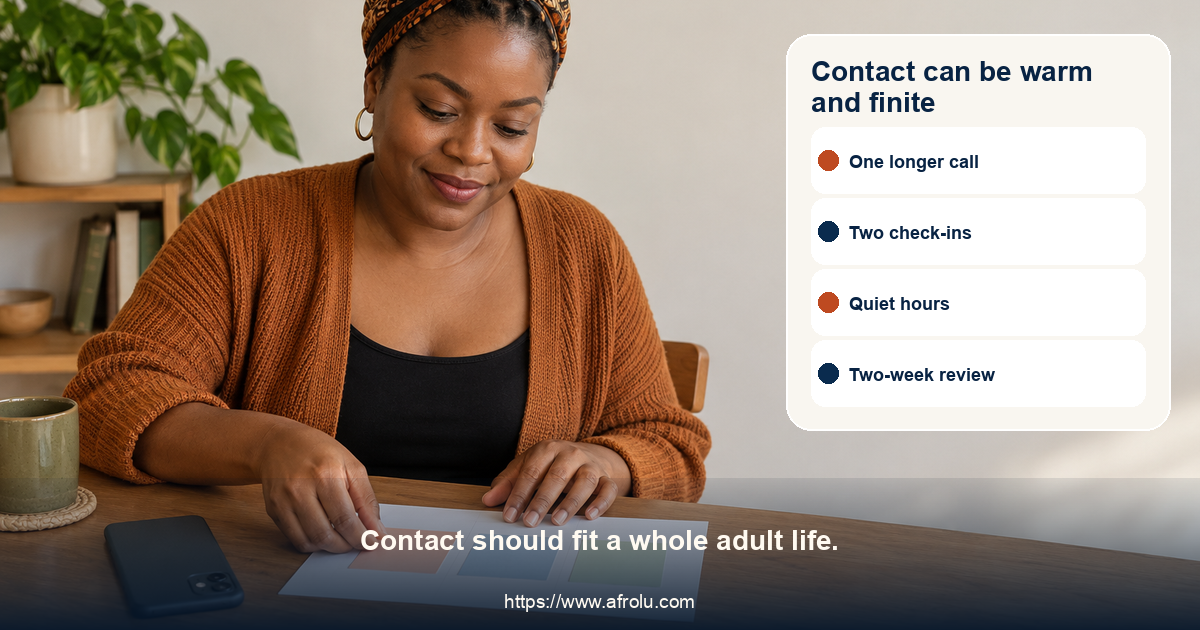
Agree on a baseline such as one longer weekend call and two short check-ins. Decide what happens when a call is missed and which hours remain quiet. The plan can change, but having one stops instant replies from becoming a hidden loyalty test across different schedules or time zones.
A lower message frequency is not automatically low effort. Look for preparation, attention, follow-through, and repair. Conversely, hundreds of affectionate messages can coexist with avoidance of basic questions. Measure whether contact helps both adults learn and choose, rather than how completely it fills each day.
Protect account access and private material. Do not share passwords, one-time codes, intimate images, financial documents, or a complete daily routine to maintain closeness. If someone threatens exposure or punishment after a boundary, save relevant evidence if safe, restrict access, and use current reporting and local support.
Review the rhythm after two weeks. Keep it if both adults feel informed without feeling managed. Reduce it if it crowds out ordinary life. Increase it only when both people freely want more and the extra contact has a purpose. A routine should serve the relationship decision, not simulate possession.
verification · consistency · staged trust
Build an evidence ladder before travel
Begin with consistent basic facts and a communication pattern both adults can sustain. Add a live call if mutually comfortable, then discuss a specific public meeting with dates, costs, and independent returns. Each rung should answer the next practical question without exposing unrelated private information.
Romance-fraud warnings often include repeated excuses for never meeting, movement away from platform protections, and requests for money or account access. Treat those patterns as reasons to pause and verify. Do not use them to accuse every distant match, and never send funds to test whether a story is genuine.
If a video call does not happen, ask once about a realistic alternative. Connectivity, privacy, disability, or schedule can affect calls, so one difficulty is not proof of deceit. A repeated pattern of refusal, contradictory details, and rising financial urgency gives a different decision context.
Keep the ladder reversible. Ending after a concerning answer is not failure or overreaction simply because you started dating later. It is an ordinary use of information. The purpose of verification is to support a choice, not to complete an investigation or win a confession.
travel · money · two returns
Price the first visit without combining money
Include fare, local transport, public accommodation if needed, meals, data, and an emergency return reserve. Each adult should personally control their own booking and identification. Do not transfer funds to release a ticket, resolve a visa problem, pay customs, unlock an account, or prove commitment.
Meet first in a staffed public place during active hours. Tell a trusted contact the plan if you choose, and arrange a check-in that does not require sharing continuous live location. Keep a charged device and a route back that does not depend on the new match's vehicle or home.
A visitor can still say no to changing venue, extending the trip, physical intimacy, or meeting family. Money already spent does not create consent. The local adult also owes no home access or hosting. Travel increases logistical stakes; it does not reduce either person's right to revise or leave.
If the budget only works when one adult sends essential funds to the other, postpone the visit. Waiting for an independently affordable plan may be disappointing, but it preserves more choice. A relationship that cannot tolerate that boundary is not made safer by purchasing the trip sooner.

Control booking, lodging, money, and the return route.
conversation · verification · exit
Use scripts for contact, verification, travel, and exit
For rhythm: “One Sunday call and two short check-ins work for me.” For verification: “Before travel, I want a live call and a specific public plan.” For money: “I do not send funds or share accounts in a dating connection.” Each line states the condition without pretending it guarantees safety.
For consent: “I can change my mind even after booking.” For privacy: “I will not send identification or intimate images.” For uncertainty: “I need more observable consistency before I call this committed.” The other adult's response supplies important evidence about whether low pressure is actually mutual.
Do not debate every explanation after a clear financial or access boundary. If pressure continues, close the conversation, secure accounts, preserve evidence where safe, and report through the relevant platform or specialist channel. Cross-border support and law differ, so verify current services for the locations involved.
An ending can acknowledge the real connection without keeping a door half open: “This arrangement no longer works for me, so I am ending contact.” You do not owe a final trip, a repayment for ordinary conversation, or a lesson in how experienced daters behave.

State the conditions before money or reservations move.
observation · fit · next structure
Review the structure after real interaction
Did the person respect time, venue, transport, money, privacy, and physical boundaries? Did ordinary conversation feel mutual rather than performed? Did a small change receive calm repair? These questions help both adults decide what they learned without treating chemistry as the only result that matters.
Continue low pressure when more observation is welcome and the current rhythm remains enough. Discuss exclusivity when both want it and can define what changes. Plan another visit only when it is independently affordable. Do not combine those three decisions merely because the first meeting felt important.
Revise the contact rhythm if reality differs from the imagined connection. Some bonds become more comfortable after meeting; others become less compelling. Neither result invalidates the time spent. A later starter is allowed to learn, change a preference, and choose differently without proving a mistake occurred.
End when distance, cost, conduct, or desired structure no longer fits. Close account or image access that was voluntarily shared, stop any financial entanglement, and seek support if contact becomes threatening. The aim is an informed adult choice, not a perfect performance of first-time dating.
Eight distance choices for a later starter
A match offers to teach all the rules
Being newer is framed as permission for the other person to control pace.
Choose one learning edge and retain every decision.Daily messages feel like established partnership
The bond is meaningful, but identity, travel, and conduct remain lightly tested.
Separate known facts from hoped-for conclusions.Late-night calls consume sleep
Time-zone overlap is being paid for by one adult alone.
Set finite call windows and protect quiet hours.A call keeps failing while urgency rises
One difficulty may be ordinary; a repeated pattern changes context.
Ask for a realistic alternative and pause financial decisions.A ticket needs a small emergency transfer
Travel planning is being linked to sending funds.
Do not send money; postpone until each adult can book independently.The host expects a home stay
Lower cost is being used to widen private access.
Keep accommodation and return travel under your control.Booking is treated as agreement to intimacy
Sunk cost is replacing a current choice.
State the boundary and leave if it is not respected.A warm meeting is treated as relocation consent
Several future decisions are being bundled into one good visit.
Review contact, exclusivity, travel, and relocation separately.Fourteen signs that low pressure still has substance
Less dating experience is discussed without loss of adult authority.
Known location and availability facts are separated from hope.
Contact has quiet hours and does not consume sleep or work.
A missed call receives proportionate repair instead of accusation.
Video or another check is mutually chosen rather than demanded.
Basic facts remain consistent across ordinary conversations.
Neither adult sends money, codes, accounts, or identification.
The first visit has a written independent budget.
Both adults control their transport, lodging, and return plan.
A public meeting occurs before private venue decisions.
Travel spending creates no physical or romantic obligation.
Exclusivity is discussed after evidence rather than assumed from intensity.
The arrangement changes only through a mutual conversation.
Either adult can end without completing a visit or proving deceit.
An evidence ladder for contact, money, and travel
| Situation | What it may mean | What to do next |
|---|---|---|
| They call you inexperienced | A fact about history may be becoming leverage. | Restate that pace and access remain your decisions. |
| Messages become constant | Intensity may exceed a low-pressure structure. | Set a finite rhythm and protect sleep. |
| Future plans arrive early | Hope is moving ahead of tested logistics. | List known facts and unresolved choices separately. |
| A video call fails | Technology or privacy may be the cause. | Offer one realistic alternative and observe the pattern. |
| Money is requested | Financial urgency materially changes the risk. | Do not transfer funds or share an account. |
| They offer to book for you | Convenience would reduce control over travel. | Use your own booking and keep a return reserve. |
| They insist on hosting | Free lodging is being linked to private access. | Use independent accommodation or postpone. |
| Chemistry is strong in person | The meeting adds evidence but not every agreement. | Review exclusivity and future travel separately. |
| You feel uncertain after meeting | Real interaction may have changed the fit. | Allow the preference to change without self-blame. |
| Contact becomes unwanted | The ending boundary is not being accepted. | Restrict access, preserve evidence, and seek current support. |
Twelve scripts for rhythm, verification, and visits
“I am newer to this format, and I will still choose my own pace.”
“One Sunday call and two short check-ins work for me.”
“I do not answer calls overnight; we can plan within this overlap.”
“What is your current location and what travel window is actually available?”
“Before travel, I want one live call that we both schedule.”
“I do not send funds, codes, or account access in a dating connection.”
“I will purchase and control my own ticket and return plan.”
“For a first visit I will use accommodation I control.”
“Let us meet first in a staffed public place during active hours.”
“Travel does not decide what I want physically, and I may change my mind.”
“I value this connection and need more real-world evidence before exclusivity.”
“This distance arrangement no longer works for me, so I am ending contact.”
Know the difference
Low pressure versus low effort
Finite contact, direct questions, staged evidence, and freedom to pause support adult choice.
One adult avoids facts, repair, planning, or contribution while asking the other to keep waiting.
A gentle pace still contains information, reciprocity, and a next decision.

Look for finite contact, direct answers, and shared planning.
Low pressure versus low effort
| Type or dimension | What it describes | Best next question |
|---|---|---|
| Low-pressure dating | Steps remain reversible while questions and boundaries stay direct. | Choose one evidence rung at a time. |
| Long-distance dating | Location, travel, cost, and time zones shape the arrangement. | Keep two independent returns and money separate. |
| Slow dating | Observation extends over time without requiring constant contact. | Define what the slower pace is meant to reveal. |
| Talking stage | Connection may grow before commitment is decided. | Keep the present status accurate despite message intensity. |
| Serious dating | Long-term fit is explored more deliberately. | Do not treat a first visit as a guarantee. |
| Exclusive dating | Both adults stop other romantic dates by agreement. | Discuss what distance-specific conduct the agreement covers. |
| Casual dating | Commitment may remain limited even when contact feels warm. | State nonexclusivity and health-relevant terms clearly. |
| Travel-based dating | In-person contact depends on occasional visits. | Budget, book, meet, and return independently. |
| Dating pause | More information or capacity may be needed before continuing. | Pause without sending money or promising to wait forever. |
A simple plan you can use today
Newer does not mean powerless
Dating history never transfers authority over your pace or boundaries.
Intensity is not evidence
Frequent messages can feel close while practical facts remain untested.
Low pressure needs structure
Quiet hours and planned calls prevent an always-open channel.
Verification is a ladder
Several proportionate checks are more useful than one risky proof demand.
Travel needs two exits
Each adult controls money, booking, lodging, and return.
A visit is one data point
Good chemistry does not combine exclusivity, relocation, and finance decisions.
Questions organised by purpose and depth
Choose a few prompts that fit the moment. This is a reference library, not a list to complete.
Experience edge
Choose one skill rather than solving dating at once.
- What feels new?
- What already feels clear?
- Which boundary can I practise?
Fact ledger
Separate observation from projection.
- What location is confirmed?
- What rhythm was kept?
- Which plan remains hypothetical?
Visit control
Price a reversible first meeting.
- Can I book independently?
- Where will I stay?
- How will I return alone?
After meeting
Keep future choices unbundled.
- What conduct did I observe?
- What status do I want?
- Which decision can wait?
What deserves a closer look
Expect some idealisation
Research on geographically close and long-distance relationships found that idealisation and reunion conditions can shape perceived quality.
Evidence limit: An older study cannot predict an individual connection or later starter.
Notice selective presentation
Communication research discusses how distance can support selective positive presentation and topic avoidance while partners build an image of each other.
Evidence limit: These patterns cannot diagnose deceit.
Choose behaviors that sustain connection
Relationship-maintenance research can inform discussion of assurance, openness, shared tasks, and networks across distance.
Evidence limit: A research model does not prescribe a call schedule.
Pause at money and repeated non-meeting
Official warnings describe romance scams that build trust, remain remote, and request funds or financial access.
Evidence limit: Distance alone does not mean fraud, and reporting routes are location specific.
Keep financial boundaries simple
International law-enforcement warnings describe fake profiles and trust-building before money requests in cross-border fraud.
Evidence limit: A warning pattern is not an identity test.
Keep agreement free and withdrawable
Consent should be knowing, voluntary, and open to change before and during a visit.
Evidence limit: The cited law and services are Australian; verify local support.
Shortcuts that convert distance into dependence
Letting the experienced person set every rule
Experience does not grant control over another adult.
Counting messages as verification
Intensity cannot establish identity, conduct, or travel readiness.
Sacrificing sleep for time zones
One-sided availability makes low pressure unsustainable.
Sending a small test payment
Money does not verify a story and can deepen financial pressure.
Depending on the match for the return
Travel dependence narrows the ability to leave.
Bundling decisions after a good visit
Chemistry does not automatically settle exclusivity or relocation.
Make the next distance decision small and reversible
This guide is editorial information, not identity verification, legal, immigration, financial, medical, or emergency advice. Verify current local support where needed.
Explore the guide library
Show more related guides
Continue with Afrolu
Show more Afrolu guides
Sources used for this guide
Afrolu reviewed these health, research, safety, or public guidance resources while editing this page. They support the behaviour and safety guidance; they do not diagnose any individual described by a reader.
Questions about beginning long-distance dating later
Am I too late to start dating?
No age or experience level decides your right to date. Choose a pace, structure, and learning edge that preserve your adult authority.
What does low-pressure dating mean?
Steps stay reversible, contact stays sustainable, and neither adult is punished for asking, pausing, or declining.
How often should long-distance couples talk?
There is no universal number. Agree on a baseline that supports learning without damaging sleep, work, or other relationships.
Does frequent messaging mean commitment?
No. Contact intensity can feel close, but commitment begins through an explicit agreement.
Should I request identification?
Avoid collecting passports or sensitive documents. Use proportionate checks, consistent facts, and public meeting planning without claiming certainty.
What if a video call keeps failing?
Offer a realistic alternative and observe the wider pattern. One difficulty is not proof; repeated contradiction plus urgency may justify stopping.
Should I help pay for travel?
Keep first-visit costs, bookings, accounts, and emergency money independent. Postpone if an independently affordable plan is unavailable.
Where should we meet?
Choose a staffed public place during active hours and keep separate transport, accommodation, and returns.
Does travel create an obligation to be intimate?
No. Money and distance never create consent, and either adult can change their mind.
What happens after the first visit?
Review conduct and fit, then decide contact rhythm, exclusivity, and another visit as separate choices.
One thing to do now
Review the connection after real interaction
Choose the next smallest step that answers a real question without exposing unrelated private information or creating dependence. Keep money and travel control separate. Let in-person conduct update the relationship rather than confirm a story in advance; continue, revise, pause, or end from the evidence you actually have.