Diaspora dating · weekend visits · independent plans
Plan a Safer Weekend Visit When Dating Across the Diaspora
Planning a weekend visit with an online match? Set expectations, verify modestly, control lodging and money, meet publicly, and keep an independent exit.
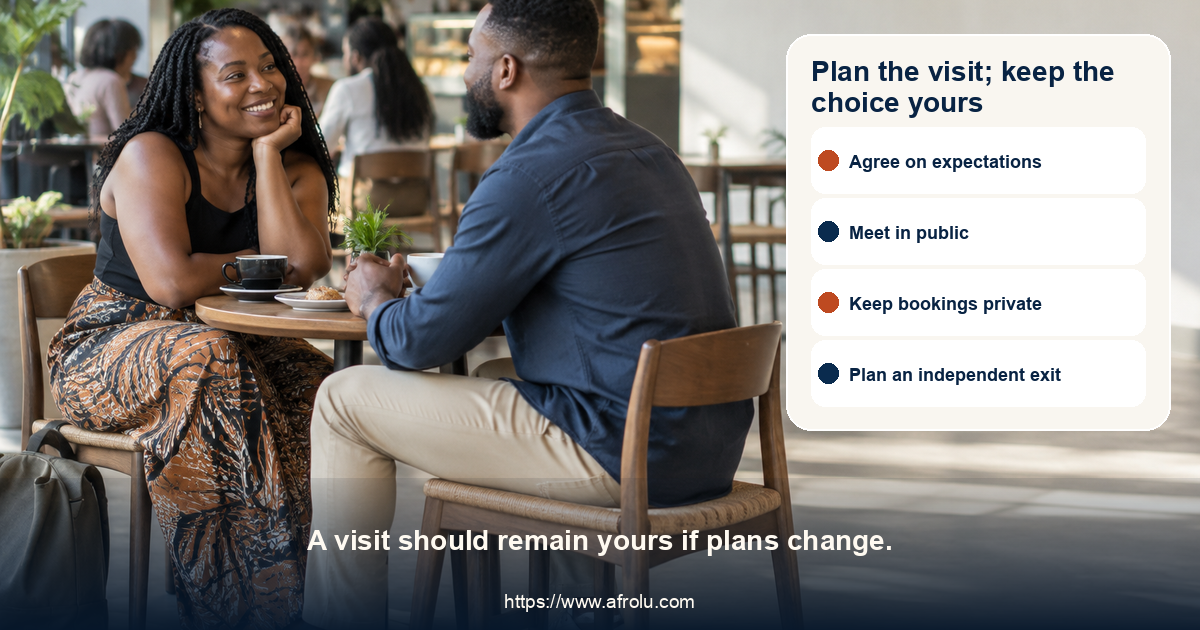
Agree on the purpose while keeping travel and exit choices independent.
Written and edited by Miriam Otieno · Senior Kenya Editor
Agree what the visit means before booking, use modest independent checks, book your own lodging and return route, keep documents and money private, and meet first in public. Treat intimacy, a shared room, and exclusivity as separate choices. If an urgent fee, changed story, or pressured plan makes the trip feel wrong, postpone or leave; travel spending never creates an obligation.
Dating basics · Diaspora Daters
How can I plan a weekend visit with an online match without making travel, lodging, or money depend on that person?
A safety-led diaspora dating visit is a voluntary in-person meeting planned so each adult retains control of travel, lodging, money, communication, and the decision to continue or leave.
After months of video calls, Amara considers a weekend trip to meet Kojo in person. He is warm, but he assumes she will stay at his apartment and asks her to send a passport image for a pickup. Amara books a modest room through a provider she chooses, declines to share the document, and suggests a daytime cafe. Kojo accepts. They meet for two hours; Amara returns to her room and decides after the trip whether another visit fits.
diaspora · travel · dating safety
Meet across distance without giving up your exit
A weekend trip should preserve independent choices before, during, and after the first meeting.
Agree on expectations, control logistics, meet publicly, and review observed behavior afterward.
What does the visit mean?
Say what is expected before anyone books.
Who owns the logistics?
Keep lodging, funds, and documents independent.
What is not implied?
Travel does not decide intimacy or exclusivity.
Can you leave freely?
Budget and plan for a changed decision.
diaspora · visit · expectations
A weekend visit is a meeting, not a shortcut to certainty
Before choosing dates, say what the visit means to each of you. One person may picture a few public dates; the other may assume an overnight stay, exclusivity, or a relationship decision. Ask plainly about those expectations before spending money, and treat a disagreement as useful information rather than something to solve after arrival.
A weekend is a short calendar window, not a relationship milestone. You may enjoy meeting and still want to return home without deciding whether to continue. Neither an invitation nor the cost of a ticket creates consent to share a room, change plans, or provide physical intimacy.
Name the practical limits that would affect your choice: the hours you are available, whether you are willing to meet more than once, the amount you can spend, and whether you intend to arrange your own lodging. Share only the travel detail needed to coordinate, not copies of documents or a live itinerary with a new match.
If the other adult frames independent arrangements as an insult, ask what they expect you to give up. A considerate person can be disappointed and still respect your plan. If the meeting only works when you depend on them for a bed, cash, transport, or permission to leave, postpone until the terms can be made workable.
identity · consistency · limits
Use several modest checks and remember what they cannot establish
Have a live video conversation before committing to travel if that is comfortable for you. Ask ordinary questions about the proposed plan and notice whether answers stay consistent over time. Do not send identity documents, verification codes, account credentials, or intimate images as a condition of proving that you are genuine.
Check important details through sources you find independently, especially when a claim affects money, employment, family ties, or the reason a visit must happen urgently. A reverse image search or social profile may reveal inconsistencies, but a clean result does not establish that every account belongs to the same person.
Keep the conversation on the dating service until you are ready to move; leaving the platform can remove some reporting or blocking tools and may expose a phone number or connected accounts. If you do share another channel, review its privacy settings and avoid publishing your real-time location or travel routine.
A person who asks for secrecy, rushes a ticket purchase, changes their explanation, or requests money for a sudden travel problem is asking you to make a consequential decision under pressure. Pause and consult someone you trust outside the match. Do not send funds to unlock a meeting or recover a supposed lost ticket.
travel · accommodation · financial control
Keep your documents, accommodation, funds, and return plan under your control
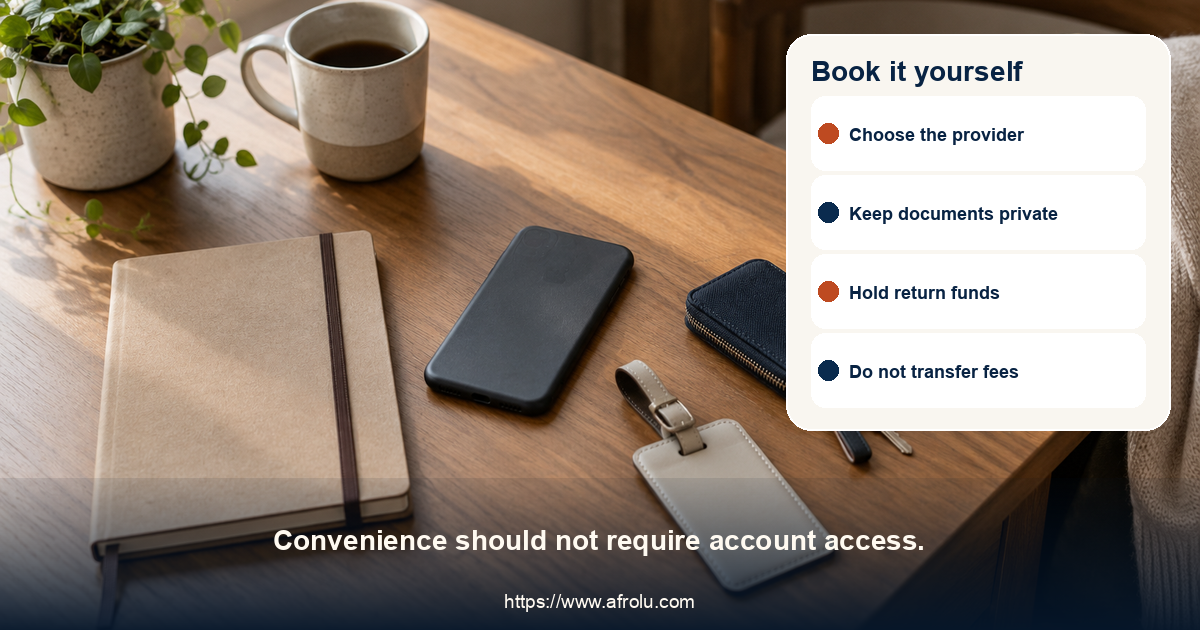
Book transport and lodging directly through providers you select, using contact details you found independently. Keep your travel documents, payment method, phone, and return funds accessible to you. Do not hand over a passport, bank card, phone, or login for safekeeping, even if the person describes it as a local custom or convenience.
Avoid sending a new match money for a visa, customs fee, hospital bill, ticket change, or family emergency. A believable story and affectionate messages do not make a transfer reversible. If you are uncertain, pause the relationship conversation and ask a trusted person or your financial provider what protections apply before acting.
Choose lodging that you can enter and leave without the date's assistance. You do not need to disclose the exact room, booking code, or address before you decide that sharing it is appropriate. If the person insists that you stay with them or cancels your independent booking, keep your original plan or reconsider travelling.
Budget for the full cost of going home earlier than planned, including local transport and a place to wait. If that reserve is not available, choose a shorter local meeting, a later date, or a video conversation instead. Postponing is a complete decision; it is not proof that you are not serious.
public plans · check-ins · transport
Make the first in-person plan public, specific, and easy to leave
Set a first meeting during ordinary public hours, with a clear start and end and a cost you can cover yourself. You can share the meeting point without sending a door-to-door itinerary. Arrange your own route there and back, and keep your phone charged and available rather than relying on the date for directions or a ride.
If useful, agree a simple check-in with someone you trust: when you expect to message and what they should do if they cannot reach you. Share only the information needed for that purpose. Do not post live updates publicly, and remember that a check-in plan supplements your judgment rather than replacing it.
You can decline a second venue, private accommodation, alcohol, or a late-night extension even after travelling a long distance. If the plan changes, stop and reassess whether the new arrangement still gives you a way to leave. A ticket, gift, or long wait does not make the change obligatory.
Consider how you will respond if the person does not arrive, appears materially different from what you expected, or pressures you to change a boundary. Keep provider contact details and enough money for a different route. If immediate danger arises, move toward staffed public help and use the emergency service appropriate to your location.

Choose a specific place and independent arrival route.
consent · sleeping arrangements · safer sex
Travel does not create an agreement about intimacy or where you sleep
If one person assumes the visitor will share a room, correct that assumption before the journey. State your accommodation plan and ask what the other adult had pictured. You are not obliged to make a private arrangement more convenient because the person has spent time planning or believes a visit signals commitment.
Talk about physical boundaries at the pace you choose. A yes to one activity is not consent to another, and consent can change after arrival or during an encounter. If sex may be part of the visit, discuss contraception, barrier methods, testing, and any relevant health concerns with reliable health information or a qualified clinician.
A weekend can include several dates, one brief meeting, or no meeting if the situation changes. You can keep your own schedule and decide day by day. Alcohol, gifts, airfare, or a host's generosity do not change the need for freely given agreement or your ability to stop.
If a person reacts to a boundary with ridicule, threats, repeated bargaining, or a claim that you owe them, take that response seriously. End the meeting if you want, contact your trusted person, and use local specialist support if you feel unsafe. Reporting systems and legal options differ by country, so seek location-appropriate guidance.

Discuss lodging before departure and respect the answer.
reciprocity · pressure · repair
Notice whether the other person makes independent choices easier or harder
Observe whether practical effort is mutual. Who chooses the public venue, confirms details, accommodates time zones, and handles changes? Differences in budget or travel distance do not have to be equal, but one person should not be pressured to absorb every cost or risk because they are the visitor.
A changed plan is a useful moment to learn. Does the person tell you promptly, offer an option that preserves your independence, and accept that you may cancel? Or do they use urgency, guilt, or the money already spent to push you into a private alternative? The response is more informative than a claim that they are simply spontaneous.
Notice requests that move from romance into control: continuous location sharing, access to your phone, a bank transfer, a copy of your document, or a demand that you keep the visit secret. You may ask what the request is for and decline without debating whether the person is trustworthy.
If a concern appears, you do not need to prove malicious intent before changing the plan. A mismatch, discomfort, or loss of trust is enough reason to shorten, postpone, or end the visit. Keep relevant messages if there is a financial or safety issue, report through suitable channels, and ask a trusted local support service what practical options apply.
review · distance · decision
Decide what the visit taught you before promising another one
After the visit, reflect on what happened rather than what the trip was supposed to prove. Did each person respect the agreed meeting plan? Could you say no without managing the other person's reaction? Did the online account and in-person story align enough for you to continue learning? Write down specifics while they are fresh.
If you want another visit, first discuss what would change: who travels, how costs are handled, how often you can meet, what exclusivity means, and whether both adults want the same relationship direction. Do not infer commitment from a second ticket or assume that a long-distance label settles communication and financial expectations.
You can decide that the connection is promising but travel is too expensive or disruptive right now. Explore calls or a shorter public visit instead. If one person uses money already spent to demand a faster relationship label, repayment, intimacy, or a second trip, keep those decisions separate and seek independent advice before responding.
A clear ending may be brief: you can say that you do not want to continue and will not arrange another visit. Protect travel accounts and contact details, block or report if unwanted contact continues, and ask for local help if there are threats. The choice to return, remain in touch, or stop belongs to each adult independently.

Let observed behavior matter more than money already spent.
Eight cross-border visit moments involving money, lodging, identity, consent, and exits
A fare must be bought tonight
A match says prices are rising and asks you to transfer money for a ticket they will book.
Pause, verify through an independent provider, and do not send a stranger travel funds.The host says a separate room is insulting
Your date insists that staying with them is the only way to show trust.
Keep independently chosen accommodation or postpone the visit.A passport photo is requested
The match says a document image is needed to arrange a surprise pickup.
Do not send sensitive documents; coordinate only the detail you choose.A last-minute fee blocks the meeting
An online partner asks you to pay a customs, medical, or ticket-release charge.
Do not transfer money; consult someone outside the relationship.The public date moves to a private home
After you arrive, the person says the venue is closed and offers their apartment.
Accept only if the alternative still works for you; keep your own exit.Travel is treated as consent
The date says the long journey means you should share a room or be physical.
Restate that travel and intimacy are separate decisions.Continuous tracking is demanded
A match asks you to share live location for the whole weekend to prove safety.
Choose a limited check-in with a trusted person, not continuous access.A changed plan becomes a loyalty test
Your date cancels the agreed meeting and says you must accept a late private plan.
Reassess independently and leave the visit unchanged or end it.Fourteen signs that a weekend plan preserves adult choice
Both adults explain what the weekend visit means to them before travel is booked.
A video call or other check is treated as limited information, not identity proof.
Each person can keep documents, accounts, and verification codes private.
Travel and lodging are booked through providers the visitor selects independently.
The visitor retains return funds and a workable route home if plans change.
No online partner needs a transfer to unlock a meeting, ticket, or emergency.
The first meeting is public, time-bounded, and easy for either adult to leave.
A changed venue or schedule is discussed without guilt or urgency.
Accommodation and intimacy are discussed separately from the invitation.
A yes to travel does not get presented as agreement to sex or exclusivity.
A trusted-person check-in is voluntary and shares only necessary details.
The visitor can decline location sharing, document requests, or private contact.
Travel costs and planning effort are discussed without turning them into debt.
Either adult can postpone or end the visit without being threatened or shamed.
A practical map for travel pressure, changed plans, and your own return
| Situation | What it may mean | What to do next |
|---|---|---|
| They want me to book now | Urgency can narrow the time available to check a plan. | Pause and verify the details independently before paying. |
| They offer their home | The visitor may depend on a new match for lodging or exit. | Choose accommodation you control or delay the trip. |
| They request my passport | Sensitive identity information is not needed to establish affection. | Keep the document private and ask what minimum detail is required. |
| They need an emergency transfer | A money request may be difficult to reverse. | Do not send funds; seek independent financial advice. |
| The venue changes | The new place may alter privacy, cost, and transport. | Decide whether the revised plan still works and keep an exit. |
| They assume a shared room | Each adult may attach different meaning to the visit. | Clarify accommodation before travelling. |
| They ask for live tracking | A check-in may be shifting into ongoing access. | Set a limited check-in only if you choose one. |
| I feel obliged after paying | A sunk cost may be mistaken for a duty to continue. | Separate travel spending from consent and relationship choices. |
| The story changes | Important details may need more time to verify. | Postpone consequential decisions and check outside the match. |
| I want to leave early | Your comfort or circumstances may have changed. | Use your own transport and local help if needed; you can leave. |
Twelve scripts for setting expectations before a trip
“What does a weekend visit mean to you, and what are you not assuming?”
“I want to video call and discuss the plan before choosing travel dates.”
“I will book my own accommodation and decide later whether to share details.”
“I do not send travel or emergency money to someone I have not met.”
“I will not send a passport image or login code for this plan.”
“Let's choose a public place and a time we can both leave independently.”
“That new venue does not work for me; I will keep our original plan or cancel.”
“I can check in with a friend, but I do not share live location continuously.”
“Travel is not consent to share a room or be physical; I want us to ask separately.”
“I enjoyed meeting, but I need time at home before discussing another visit.”
“The details changed and I am postponing until I can verify them.”
“I do not want another meeting. Please do not contact me again.”
Know the difference
Independent planning versus a visit built on dependency
The adults set expectations early; the visitor books their own room, controls funds and documents, meets publicly, and can return without permission.
A ticket, bed, fee, location feed, or changed plan becomes a reason the visitor must comply, stay, pay, or prove trust.
A visit is workable when either adult can change their mind.

Notice who controls the room, money, route, and next decision.
Independent travel planning versus a visit built on dependency
| Type or dimension | What it describes | Best next question |
|---|---|---|
| First visit | The adults have not met in person and know only selected information. | Keep the meeting short, public, and independently reachable. |
| Hosted stay | One person controls the room, transport, and return options. | Compare the dependency with booking separate lodging. |
| Separate lodging | Each adult retains a private place to rest and decide. | Discuss any change without treating it as owed. |
| Shared itinerary | Travel dates are known but each person still owns their plans. | Share only coordination details you choose. |
| Live tracking | A continuous location feed provides ongoing access to movement. | Consider a limited check-in with someone you trust. |
| Money request | The match asks for funds tied to travel or an emergency. | Do not transfer; verify and seek independent advice. |
| Public first date | The first conversation happens in a staffed shared setting. | Agree on duration, arrival, and an exit option. |
| Second meeting | A first date has happened but compatibility remains uncertain. | Review what you observed before spending more. |
| Long-distance plan | Both adults want continued contact across distance. | Discuss cost, frequency, exclusivity, and realistic next steps. |
A simple plan you can use today
A visit is not a verdict
Meeting in person gives information; it cannot certify safety or future compatibility.
Verification has limits
Video calls and profile checks can help identify inconsistencies but cannot prove every claim.
Keep the basics independent
Control your documents, funds, lodging, device, and return route.
Money stays separate
Airfare, gifts, and sunk costs do not create a duty to pay, stay, or be intimate.
Consent is specific
Travel, accommodation, exclusivity, and physical contact are separate decisions.
Local support varies
Emergency, reporting, and legal options depend on where you are; seek location-specific guidance.
Questions organised by purpose and depth
Choose a few prompts that fit the moment. This is a reference library, not a list to complete.
Before booking
Separate the invitation from expectations.
- What does this visit mean to each of us?
- Which details need independent checking?
- What would make either of us postpone?
Trip control
Keep the traveler's choices available.
- Who controls lodging and return funds?
- Can I leave without asking my date?
- What information should remain private?
First meeting
Make the plan specific and reversible.
- Where is the public meeting?
- How long do I want to stay?
- Who knows my broad check-in plan?
After the visit
Review behavior and capacity rather than sunk cost.
- Did a no remain acceptable?
- What did I learn in person?
- Would another visit fit both adults' real budgets?
What deserves a closer look
What should we agree before travel?
Discuss whether the plan is one public date or several, what each person expects afterward, and what would lead either of you to postpone. Keep the conversation about present choices rather than demanding a relationship guarantee.
Evidence limit: An agreement cannot predict how the in-person meeting will feel.
Can a video call prove who someone is?
It can let you compare a live conversation with prior interactions, but it does not verify every identity, job, family, or money claim. Check consequential details independently and do not treat a clean search as certainty.
Evidence limit: Afrolu cannot verify a match or investigate an account.
Why arrange separate lodging?
Separate lodging preserves a place to rest and leave without asking a new date for permission. Choose a provider and booking channel you control, and keep your access details private until you decide otherwise.
Evidence limit: A hotel or separate room is not a guarantee of safety.
What if the person needs help with a travel fee?
Do not let affection or a deadline make a transfer feel routine. Pause, verify through an independently found provider, and speak with someone you trust before any consequential financial decision.
Evidence limit: Scam reporting and payment protections differ by country.
How can the first date stay reversible?
Choose a public staffed setting, manageable time, independent route, and clear way to leave. A trusted-person check-in may help, but use the emergency resources local to your location if immediate danger arises.
Evidence limit: No checklist or venue can guarantee a safe outcome.
How should we decide about another visit?
Review conduct and practical fit after returning to ordinary routines. If both adults want to continue, discuss cost, frequency, exclusivity, communication, and who travels next instead of letting another ticket imply a commitment.
Evidence limit: This guide is not immigration, legal, financial, or emergency advice.
Shortcuts that confuse travel spending, trust, consent, and commitment
Buying under a deadline
Urgency removes time to check the provider, itinerary, and expectations.
Using the host as your only exit
A new match may then control transport, lodging, or access to funds.
Sending an emergency fee
Transfers may be difficult to recover and can lead to repeat requests.
Treating a badge as proof
Platform signals do not certify all identity, employment, or financial claims.
Assuming travel means intimacy
A ticket or invitation is not consent to a room, sex, or exclusivity.
Ignoring a changed plan
The reason and method of a change can reveal whether boundaries are respected.
Review distance, first meetings, and the boundaries around travel
Use current local travel, financial, emergency, and specialist-support information for your location. This guide cannot verify a person or provide immigration, legal, medical, or emergency advice.
Explore the guide library
Show more related guides
Continue with Afrolu
Show more Afrolu guides
Sources used for this guide
Afrolu reviewed these health, research, safety, or public guidance resources while editing this page. They support the behaviour and safety guidance; they do not diagnose any individual described by a reader.
Questions about weekend visits with online dating matches
Should I travel to meet someone I met online?
Only if the plan and level of uncertainty work for you. Consider a video call, public first meeting, independent lodging and transport, return funds, and postponing if money or identity concerns remain.
Should I stay with my online date?
You can decide, but separate accommodation preserves an independent place to rest and leave during an early visit. Do not let a host's preference or the cost of the trip make the decision for you.
Is a video call enough verification?
No single check proves every claim. Use it as one limited data point, compare details over time, and independently verify consequential information without sharing sensitive documents or codes.
What if they ask me to pay for a ticket?
Pause and do not send money to unlock a meeting. Verify the claim through a provider you find independently and consult someone outside the relationship before making a financial decision.
Does travelling imply I will share a room?
No. Travel and sleeping arrangements are separate choices. State your plan before departure and keep the right to revise it if circumstances change.
How do I plan a first date during a visit?
Choose a public place, specific time window, manageable cost, and independent return route. Confirm the plan on the day and change it if it stops working for you.
Should I share my live location?
That is optional. You might choose a limited check-in with a trusted person instead of giving a new match ongoing access to your movements.
What if the venue changes after I arrive?
Reassess whether the new location, transport, and privacy still suit you. You can keep the original plan, meet another time, or leave; travel does not obligate you to accept a private alternative.
What if I feel unsafe abroad?
Move toward staffed public assistance and contact the emergency or specialist service relevant to where you are. Local reporting and legal options differ, so use current location-specific guidance.
How soon should we plan a second visit?
There is no universal timeline. Review the first visit after returning to your routine and discuss practical capacity, costs, expectations, and whether both adults want to continue.
One thing to do now
Meet only on terms that leave your next choice yours
Before you book, name the visit's purpose and check the details that matter to you. Keep the room, return funds, documents, and route under your control; make the first meeting public; and discuss intimacy separately. Continue only if the plan remains voluntary and workable. Postpone or leave when pressure, money requests, or changed details outweigh your comfort.