The whole guide in one small card
This guide is for eligible adults. It uses plain words because the choice should not hide inside a puzzle. The tool is called the One-Choice Card. A tool is simply a way to remember what to do. The card is not a legal test. It is not a medical screen. It cannot prove what happened. It helps two adults make one present choice easier to state and respect.
Write one activity on the card. Do not write a whole evening. Do not write “be intimate” or “go further.” Those phrases can mean different things. Write “kiss,” “hold hands,” “take this photo,” or another exact action. If the action changes, the question changes too.
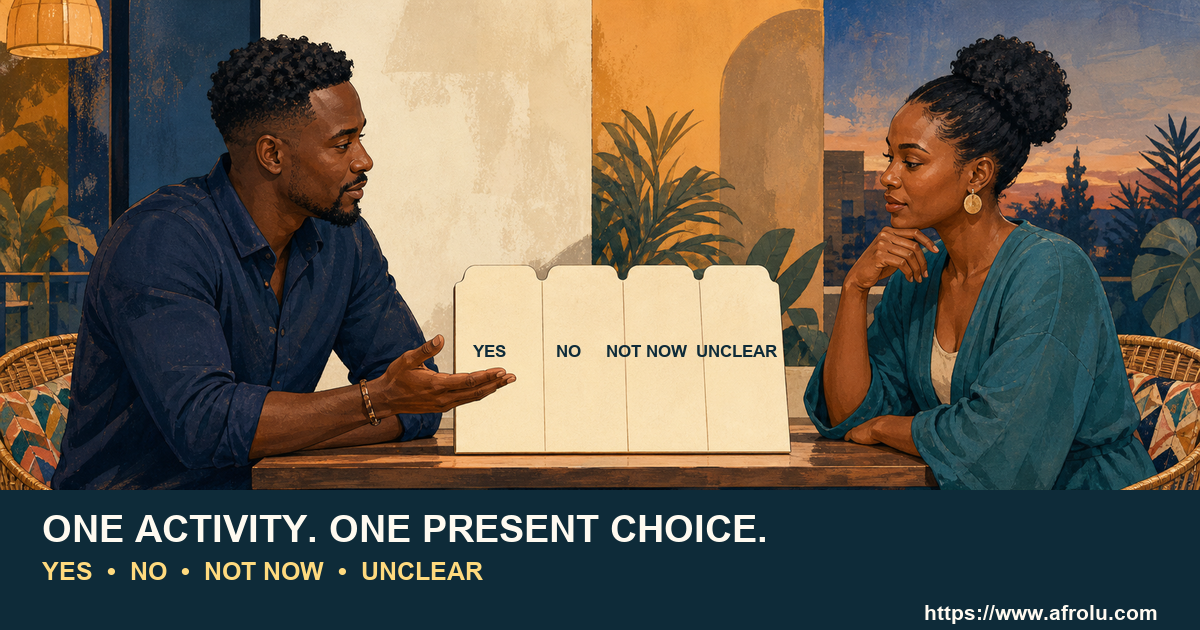
The card keeps four answers open: yes, no, not now, and unclear. Each answer must work in real life. A “no” must not start an argument. “Not now” must not create a debt. “Unclear” must not become a guess. A “yes” opens only the named action, in the present setting, while that yes remains clear.
This is why the card is called One-Choice. It does not ask one person to approve a relationship, a night, or a list of acts. It asks about one action. It also protects the next choice. One yes does not make another yes automatic.
Voluntary means freely chosen. The person should not need to avoid anger, shame, loss, threats, or punishment. They should not have to prove love. They should not have to repay a meal, trip, gift, or past kindness. If “no” would bring a cost from the asker, the answer is not being kept free.
Present means now. Yesterday is not now. A message sent earlier is not always the answer after the setting changes. A past sexual experience is not a standing pass. A marriage or relationship can explain closeness. It cannot answer a new activity for either adult.
Clear means the answer can guide the next action without wishful thinking. Speech can be clear. A sign, communication device, or agreed gesture can also be clear. Not every person speaks. The key is shared meaning, not one required way of communicating.
Do not treat body language as a secret code. A relaxed person may still not want the activity. A nervous person may still want time to answer. Freezing, pulling away, going silent, or becoming still is not a green light. Stop. Make space. Ask what would feel okay, including no contact.
Use the card before touch, sexual activity, images, recording, or sharing private material. You can also use it for ordinary affection. Simple practice matters. Adults who can hear a no about hand-holding are better prepared to hear a no about something more private.
Make all four answers easy to use
A question is not free merely because it ends with a question mark. The answer must change what happens. Your response teaches the other adult whether your question was real. Calm acceptance keeps future answers safer and more honest.
Yes means this, now
A yes should match the exact action. It should belong to this moment. It does not cover a stronger action. It does not cover a camera, another person, a private room, or sharing later.
No ends the request
Stop asking. Do not demand a reason. Do not sulk, mock, bargain, or become cold. You may manage disappointment without making it the other person's job.
Not now is complete
It may mean later, or it may never change. Do not start a countdown. If another activity would help, ask once and keep “nothing” available too.
Unclear means stop
“I do not know,” silence, mixed words, or a signal you cannot read gives no usable yes. Stop the activity. Do not solve doubt by moving ahead.
A usable yes does not need a performance. Some adults say yes with warmth. Some speak quietly. Some use signed language or a device. The answer can still be clear. Do not demand excitement as proof. Do not treat a body response as proof either. Bodies can react without a chosen yes.
A usable no does not need a case file. “No” is enough. “I want to stop” is enough. Pulling away or freezing makes the answer unclear, so stop. The other person does not owe a lesson, a past story, or a softer tone before you respect it.
“Not now” protects time. A person may want a kiss but not in public. They may want to sleep, think, pray, leave, or feel sober first. They may simply not want it now. You do not need to decide which reason is best. The action stays closed.
“Unclear” protects uncertainty. The answer may sound weak or unsure. Examples include maybe, I guess, if you want, and I do not know. The next step stays simple. Do not continue the named activity. Ask whether they want space, another clearly named action, or an end to the date.
Pressure often hides after the first answer. “Why not?” can turn a no into a defence. “But you said yes before” turns history into debt. “Do you not trust me?” makes care depend on surrender. These lines do not keep choice open. They try to change the person, not understand the answer.
Your own answer matters too. You may stop after asking. You may decide that you no longer want the activity. Mutual choice means each adult still chooses. One person's yes does not obligate the other person to continue.
A clear answer can still reveal a mismatch. One adult may want sexual activity. The other may not. Respect does not require them to agree. It requires both choices to remain real. They can choose a different activity, pause, or end the date.
Ask a question that can receive a real answer
Start with your own wish. Then name the action. Add the word “now” when timing matters. End with a plain question. This shape is direct without making the answer for the other adult.
“I would like to kiss you. Do you want that now?” is clear. “You want this, right?” is loaded. Loaded means the question points toward one preferred answer. “Are you comfortable?” may also be too vague. Comfortable with what?
Do not hide the action behind a joke. Do not move first and ask during the movement. Give the person time and space to answer. A pause is not a yes. Waiting a few seconds is easier than repairing a choice you rushed past.
Keep your tone ordinary. Consent is not a formal ceremony. A clear question can be warm. It can fit a real date. The goal is not perfect wording. The goal is shared meaning and a free answer.
Make refusal physically easy too. Do not block a door. Do not hold the person's phone, bag, keys, money, or transport. Do not ask while they depend on you for a safe return. Choice is easier when the person keeps practical control.
If you are in a power role, step back. A boss, teacher, landlord, faith leader, clinician, officer, or person who controls money can affect freedom. This page cannot judge a real power relationship. Do not use a quick card to make a serious power problem look simple.
Some adults agree on communication before a private moment. One person may use signed language. Another may use a device. Another may have a clear pause signal. Agreeing on the signal does not create a future yes. It only makes later answers easier to understand.
Ask about images with extra care. “May I take this photo?” covers creation only. Saving is another action. Sending is another. Showing a friend is another. Posting is another. Editing an image is another. Ask about each action before it happens.
Do not add secret conditions. If an image will back up automatically, say so. If a shared device can display it, say so. If you cannot control storage, do not promise perfect deletion. Keep the person's answer tied to the real action and real limits.
Relationship talks do a different job. A define-the-relationship conversation can name the connection. An exclusive dating agreement can close dating with others. Neither talk supplies consent to touch, sex, images, or account access.
Casual dating does not lower the consent floor. Dating multiple people does not make bodies or images public. Every relationship structure still needs present, activity-specific choice.
Check again when the activity or setting changes
A check-in is a new short question. Use one when the action changes. Use one when the setting changes. Use one when the person's answer changes. A check-in protects the present choice from an old assumption.
Moving from a public place to a private home changes the setting. Adding alcohol changes the setting. Turning on a camera changes it. Adding another person changes it. Removing clothing changes the activity. A yes before the change does not answer after it.
The same action can also change in intensity or meaning. A brief kiss can become longer. A playful touch can move to a private area. A photo can become a recording. Stop before the new part. Name it. Ask again.
Check in when you notice a change in the person. They may become still. They may pull away. Their words may get less clear. They may look worried. Do not diagnose the reason. Stop first. Ask what they want now.
Use small questions. “Still okay?” may work when the exact activity is already shared and the answer stays clear. If anything is uncertain, name the activity again. “Do you want to keep kissing?” is easier to answer than “Everything good?”
Do not check so quickly that no answer can land. Give time. Keep your body still while asking. A person should not need to push you away while forming a word. If no clear answer arrives, stop the activity.
Checking again is not distrust. It does not ruin a moment. It treats the other adult as present, not as a promise made earlier. It also protects you. You can hear your own changed answer and stop.
A clear yes can become no. It can become not now. It can become unclear. The changed answer controls the next action. Do not finish a planned act because it began. Do not argue that stopping is unfair.
When a stop happens, make the stop real. Release contact. Create space. Return clothing, phone, bag, or other property. Do not trap the person in a long talk. A calm stop protects choice better than a speech about your good intent.
Six adult scenarios using the card
These examples involve fictional eligible adults. Their ages are stated to remove doubt. The examples show communication choices. They do not decide law, capacity, blame, or medical safety.
Maya, 31, and Kojo, 34
They finish coffee outside a busy café. Kojo wants a kiss. He does not lean in while asking. He says that he would like a kiss. He asks if Maya wants that now. Maya says no for now. She asks for a hug instead. Kojo asks if she wants him to hug her. She says yes.
The kiss stays closed. The hug is a new exact activity with its own answer. Kojo does not ask why. He does not treat the hug as a path back to the kiss.
Card result: NOT NOW closes the kiss. A new clear YES opens only the hug.
Amina, 36, and David, 38
They have agreed to kiss in a parked car. David then suggests going to his flat. Amina says yes to visiting. That answer covers the visit, not sexual activity. Inside, David asks before any new touch. Amina says, “I am not sure. I want to sit and talk.”
David stops. He offers water and asks whether she wants the door open. He does not use the earlier kiss or the visit as permission. Going inside changed the setting. Her unclear answer keeps new sexual activity closed.
Card result: a new setting needs a new check. UNCLEAR means stop the named activity.
Lina, 29, and Sam, 32
During a private video call, Lina considers sending an intimate image. Both are adults. Sam asks, “Do you want to make that image?” Lina says yes. Sam then asks, “May I save it?” Lina says no. She agrees that he may view it once.
Making, sending, viewing, saving, forwarding, posting, and editing are separate actions. Her yes to one action does not cover the others. Sam does not take a screenshot. He does not ask again after her no.
If an image is later shared without permission, the One-Choice Card cannot fix the harm. The person can protect accounts, keep basic evidence when safe, use platform reports, and seek current support.
Card result: YES covers one-time viewing. NO closes saving, copying, and sharing.
Njeri, 40, and Malik, 42
They have drinks at a staffed lounge. Njeri becomes tired and gives mixed answers about leaving together. Malik is not sure she can understand and choose clearly. He does not start sexual activity. He asks whether she wants water, space, a trusted contact, or a safe ride.
Capacity means the ability to understand and make the choice. This guide cannot decide capacity. Uncertainty is enough for the practical stop. Malik keeps help nonsexual. He does not move the question to a private room. He does not ask again that night.
Njeri's safety choices still matter. If she can answer clearly, Malik follows her stated choice about ordinary support. If an urgent health concern appears, current local emergency help is the right route.
Card result: unclear capacity closes sexual activity now. Safety support stays separate.
Thandi, 47, and Joseph, 49
They have been partners for five years. Thandi says yes to a back rub after a difficult day. A few minutes later, she says, “Please stop.” Joseph stops his hands and moves back. He asks, “Would you like space, tea, or company with no touch?”
Their relationship history does not cancel her changed answer. The first yes was real. The later stop is also real. Joseph does not demand an explanation. Thandi does not need to make the stop sound gentle.
Card result: a changed answer stops the activity, even in a long relationship.
Emeka, 35, and Zuri, 37
Zuri uses a speech device in some settings. Before a date, they agree that her device, signed words, and one clear hand signal can carry answers. This plan supports communication. It does not create consent before a question.
Emeka asks, “May I hold your hand?” Zuri selects “not now” on her device. Emeka accepts it. Later, Zuri asks him the same question and he says yes. Each adult keeps a separate choice.
Card result: access can change how an answer is given. It does not change the need for one.
Use short scripts, then make room
A script is a starter, not a spell. Say it in your own voice. Keep the exact action. Keep all four answers safe. Then stop talking long enough to hear the answer.
“I would like to kiss you. Do you want that now? Yes, no, not now, or unsure are all okay.”
“May I take this photo? Taking, saving, and sharing are separate. What do you choose?”
“The setting changed. Do you still want this exact activity, or should we stop?”
“You got quiet, so I am stopping. Would you like space, no touch, or something else?”
“I do not want this activity. I am stopping now. I do not want to debate it.”
Avoid adding a reward. “You can say no, but I will be sad” makes the other person manage your feeling. Avoid adding a threat. “If you loved me, you would” removes freedom. Avoid adding a deadline. “Decide now” can turn uncertainty into pressure.
If a person says no, try one calm response: “Okay. Thank you for telling me.” Then stop. You do not need to prove that you are respectful. Your next action will show it.
If the person says not now, say, “Okay. We will not do that now.” Do not schedule a future yes for them. If you want to ask about another activity, keep no activity available. “Would you like to talk, hold hands, or have space?” can work.
If the answer is unclear, stop. Say that you did not hear a clear yes. State that you are stopping. This does not accuse the person. It removes the need to guess. Ask about ordinary safety or comfort after contact has stopped.
If your own answer changes, use direct words. “Stop.” “Wait.” “I changed my mind.” “No more touch.” Each is enough. You can explain later if you want. You do not owe a reason before the stop becomes real.
A good conversation leaves both adults with dignity. It can end in a yes, a no, a pause, or a different plan. Success is not getting permission. Success is making the choice real and following it.
When the card is not enough
The card helps with ordinary clear choice. It cannot make coercion safe. Coercion means pressure, force, threats, or power used to narrow a choice. If fear enters the answer, stop treating the problem as a wording problem.
Repeated asking after no is pressure. Blocking an exit is pressure. Holding money, transport, documents, or a phone can narrow choice. Threatening to share images can narrow choice. Using work, housing, immigration, faith, grades, care, or status can also affect freedom.
Use the dating red flags guide for repeated danger and coercion patterns. Use the dating boundaries guide to state what you will do after a limit. A boundary controls your action. It does not force another adult to supply yes.
Emotional availability includes hearing an answer without punishment. It does not mean giving another person full access. Care can remain warm while an activity stays closed.
If you feel unsafe, do not stay for a perfect conversation. Move toward a safer place or trusted support when you can. Use current local emergency or survivor help for urgent danger. This guide cannot promise that any route will be safe in every setting.
Digital harm needs its own steps. Non-consensual sharing of intimate images means sharing private sexual images without the person's permission. It may happen through messages, posts, threats, or fake edits. It is not the pictured person's fault.
If it is safe, keep basic evidence before blocking. Protect email, cloud, device, and social accounts. Use the platform's current report route. In Kenya, the official Digital Safe Space publishes support for intimate-image abuse and other online violence. A report cannot guarantee removal or a legal result.
Do not forward the image to gather opinions. Do not ask the person to prove how it was made. Do not threaten the sender if that may increase danger. Share only what a trusted support person or qualified service needs.
For online meetings and account safety, use online dating safety in Kenya. That guide covers identity checks, public meetings, money, privacy, and reporting. This page stays with one activity and one present choice.
Ordinary uncertainty
Stop the activity. Name the question once. Keep no, not now, unclear, and leaving available.
Pressure or fear
Prioritise distance, access control, evidence when safe, and current support. Do not rely on another consent talk.
Health uncertainty
Stop sexual activity. Use qualified local health care for personal questions. This page cannot diagnose or clear an activity.
Legal uncertainty
Use current Kenya law and qualified local help. This page cannot decide an offence, evidence, or capacity.
The final rule is easy to carry
Name the exact activity. Ask in plain words. Keep yes, no, not now, and unclear usable. Continue only after a clear present yes. Ask again after any change. Stop after a changed answer or any uncertainty.
Do not borrow permission from chemistry. Attraction can be real and the answer can still be no. Do not borrow it from status. A partner can still say not now. Do not borrow it from silence. Quiet is not a clear yes. Do not borrow it from history. A past yes belongs to the past.
The tool is small on purpose. It does not ask you to read a mind. It gives you one question and one next action. Clear yes opens the named activity. Every other answer keeps it closed.
Respect also includes how you stop. Become still. Release contact. Give space. Return control of belongings and exit. Ask about the next need without pushing for a new activity. Let the date end if that is the person's choice.
The card cannot certify a person as safe. It cannot repair deliberate harm. It cannot replace law, health care, emergency help, or survivor support. It can make an ordinary choice harder to hide and easier to respect.
Keep learning from the answer. A person who hears no with care shows useful conduct. A person who punishes no gives useful warning. Your job is not to win a yes. Your job is to keep the answer real.
One activity. One present choice. No borrowed permission.
The One-Choice visual field guide
Each image teaches one part of the same tool. The images contain the required Afrolu source URL and no third-party marks.


Evidence and hard limits
World Health Organization · Defining sexual health
current working definition; page checked 2026-08-25
- Supports: A positive sexual-health frame includes well-being, respect, safety, and freedom from coercion, discrimination, and violence.
- Cannot establish: The WHO page does not decide whether a particular act was consensual, lawful, or medically safe. It does not validate the Afrolu One-Choice Card.
RAINN · Consent 101: Respect, Boundaries, and Building Trust
updated 2026-05-31; checked 2026-08-25
- Supports: RAINN describes consent as clear, voluntary, and ongoing, says it can be withdrawn, and rejects silence or lack of resistance as agreement.
- Cannot establish: RAINN is a United States survivor-support organization. Its page is not Kenya legal advice and cannot assess a particular encounter.
Kenya Law · Sexual Offences Act, current consolidated version
latest Kenya Law version shown as 2024-04-26; checked 2026-08-25
- Supports: Section 42 says that, for the Act, consent means agreement by choice with freedom and capacity to make that choice. Sections 43 and 44 address coercive circumstances and evidential presumptions.
- Cannot establish: A short dating guide cannot apply legislation to disputed facts, decide capacity, determine an offence, or replace a Kenya lawyer, investigator, court, or support service.
State Department for Gender, Kenya · Digital Safe Space
live government service checked 2026-08-25
- Supports: The official service names non-consensual sharing of intimate images, sextortion, cyberstalking, doxing, and related technology-facilitated abuse. It publishes digital-safety information and survivor-support routes.
- Cannot establish: A listed service or reporting route does not guarantee availability, confidentiality in every setting, a legal result, removal of content, or a particular safety outcome.
Consent in dating: six clear answers
What does consent mean in this dating guide?
It means a clear, voluntary, present choice about one exact activity. The person must be free to say yes, no, not now, or unclear. This simple guide does not decide the legal meaning of a real event.
Does a past yes cover the same activity today?
No. A past yes records a past choice. Ask again today. A relationship, marriage, gift, date, trip, or earlier sexual activity does not answer the present question.
What should I do when the answer is unclear?
Do not start or continue that activity. Slow down. Ask a shorter question once if the person seems able and free to answer. If the answer stays unclear, choose a different, clearly agreed activity or stop.
Can someone stop after saying yes?
Yes. A person can change their answer at any time. Stop when they say stop, pull away, freeze, go quiet, or otherwise make the answer unclear. Check what they want next without arguing.
What should I do when alcohol may affect capacity?
If you are unsure that another adult can make a free and clear choice, do not start or continue sexual activity. Move to safety and nonsexual support. This page cannot judge capacity or give medical or legal advice.
What if an intimate image is shared without permission?
It is not the recipient's fault. If it is safe, keep basic evidence, use the platform's report tools, protect accounts, and seek current local support. Kenya's Digital Safe Space lists help for non-consensual intimate-image sharing and related online abuse.
Name one activity and keep all four answers usable. For urgent danger, health questions, digital abuse, or legal questions, use current qualified help suited to the real situation.
There are no dating-app buttons, affiliate links, offers, ratings, or product recommendations on this page.