Nairobi · personal faith · lower-pressure dating
Low-Pressure Faith-Led Dating in Nairobi
Faith-led dating in Nairobi can move gently without hiding terms. Define personal values, ask rather than assume, choose public dates, and keep consent mutual.
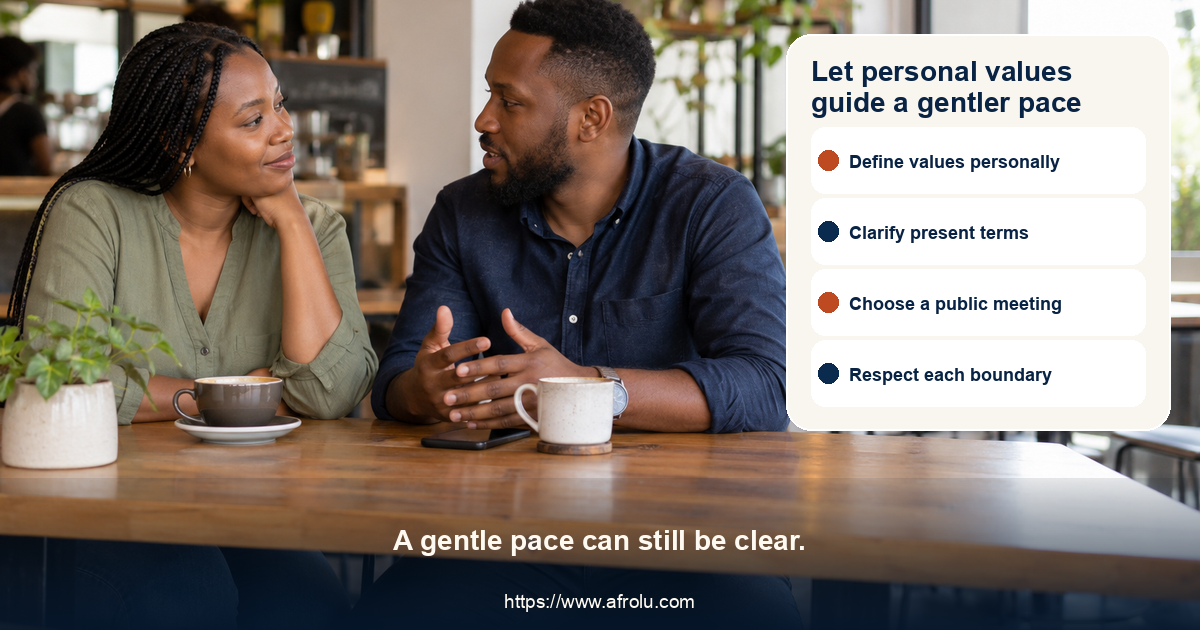
Ask what each person means while leaving room for a different answer.
Written and edited by Miriam Otieno · Senior Kenya Editor
Define faith-led through your own lived values, ask how the other adult describes theirs, and clarify what low-pressure changes in the present week. Choose a public meeting both people prefer; discuss exclusivity, privacy, and physical boundaries directly; and treat a community introduction as a separate choice. Continue, adjust, pause, or end based on mutual respect rather than spiritual pressure.
Dating basics · Faith-Led Daters
How can I date in a faith-led way in Nairobi without letting a label or another person's interpretation set my pace?
Low-pressure faith-led dating in Nairobi is an adult-chosen dating rhythm informed by each person's own spiritual or ethical values, with explicit present terms, consent, privacy, and freedom to disagree.
In Nairobi, Achieng, 33, says faith shapes her approach to honesty and care but does not want a first date to become a public commitment. Peter describes his practice differently and assumes that faith-led means a family introduction after two meetings. They talk about what each values, choose a daytime cafe rather than a community event, and agree to revisit exclusivity after getting to know one another. The useful step is their shared definition, not a label imposed from outside.
Nairobi · faith-led dating · personal values
Let belief inform the choice without taking choice away
Faith is lived differently; a low-pressure pace should make room for honest terms and respectful disagreement.
Define your own values, ask rather than assume, meet publicly, and review mutual fit.
What does faith-led mean to you?
Describe lived values instead of borrowing a category test.
What stays clear today?
Discuss intent, exclusivity, and boundaries directly.
What does the venue imply?
Choose a public first meeting both adults prefer.
Can each person disagree?
Notice whether a boundary is respected without shame.
personal values · meaning · choice
Faith-led dating begins with your meaning, not someone else's checklist
Before looking for a match, identify the parts of belief or spirituality that matter to your dating choices now. That might involve honesty, compassion, sexual boundaries, community participation, or a wish to move slowly. You do not need to disclose a private history or defend how consistently you practice in order to set those preferences.
A faith label does not tell you what someone believes about exclusivity, gender roles, physical intimacy, marriage, family involvement, or an appropriate pace. Ask the person to explain their own understanding and listen for whether it leaves space for your decisions. If a doctrine or custom is important to either adult, discuss it without presenting one person's interpretation as a universal rule.
You can be spiritually curious, observant, questioning, newly involved, privately practicing, or still deciding what fits. Those positions do not make an adult more or less sincere by default. What matters for compatibility is whether you can state what you want, hear a different answer, and choose without fear or misrepresentation.
If someone says a boundary is unfaithful, selfish, or proof that you lack commitment, slow the conversation down. Ask what they are requesting in practical terms and whether you remain free to say no. A shared value should help two adults talk honestly; it should not be used as leverage to obtain access, money, secrecy, or a rapid status decision.
pace · city logistics · expectations
Low-pressure should describe the rhythm, not hide the relationship terms
Ask what low-pressure means in a typical week: occasional daytime meetings, a slower decision about labels, room for community commitments, or a preference not to message constantly. Those choices differ from uncertainty about whether someone is dating others or expects exclusivity. Clarify the present arrangement before either person relies on an assumption.
Nairobi traffic, work hours, caregiving, study, and travel across the city can make plans difficult. Suggest a public, convenient meeting point and a time window that each person can reach independently. You need not reveal your home, worship schedule, work route, or family handover details to make the plan workable.
A low-pressure plan should not require one adult to wait indefinitely while the other avoids every conversation that could affect a choice. Agree when it might be useful to check whether the arrangement still fits, especially if contact frequency, exclusivity, or physical boundaries change. A review is not a demand for marriage or a promise that feelings will progress.
If the desired pace differs, say so plainly. One adult may want a slow path toward partnership; another may prefer casual dating or no label. Neither preference needs to be shamed, but both people need enough information to decide whether continuing is worthwhile. A respectful no can prevent months of waiting on an agreement that never existed.
belief · compatibility · privacy
Discuss faith as lived practice instead of turning a date into an examination
Try questions about ordinary choices: which values shape how you treat a partner, what role community plays in your week, or how you handle disagreement. Share your own answer at a similar level. You can keep a painful experience, family conflict, or private spiritual question to yourself until you choose to discuss it.
Do not infer practice from a name, clothing, language, family origin, neighborhood, or profile photograph. People interpret the same tradition differently, and some adults do not identify with the community others assign to them. Ask how the person describes themselves and accept a correction without turning it into an argument about authenticity.
If a religious leader, family member, or community introduction is part of someone's dating life, ask what that step means to them and whether it is wanted now. A private date does not become a public commitment because a relative was informed. You may negotiate what stays private while the adults learn whether they are compatible.
Notice whether both people can disagree without being called corrupt, unserious, or spiritually inferior. Honest difference can be compatible if each person respects the other's agency; an identical label cannot make coercion healthy. If a belief discussion repeatedly ends with one adult being ordered to comply, pause and consider whether further conversation is safe and useful.

Ask and answer from personal experience.
first meeting · transport · privacy
Choose a Nairobi meeting that is easy to reach and easy to end
Pick a generic public venue that suits both people's budget and travel time, then agree on the meeting window and how each person will arrive and leave. Avoid depending on a new date for a ride across town or sharing an exact home address. If the first plan changes, check whether the alternative still feels comfortable before accepting it.
A date at a place of worship, community gathering, or family event can carry meaning beyond the meeting itself. Do not suggest one as a neutral shortcut unless both adults understand and want that context. A simple public conversation may give each person more room to ask questions without an audience or implied endorsement.
Tell a trusted person the broad plan if that is useful to you, and decide what check-in would help without giving a date ongoing access to your location. Keep the phone charged and your fare home available. These are optional ways to preserve choices; they cannot predict another person's behavior or replace local emergency help.
You can leave after a short conversation even if the person is kind, paid for tea, or travelled a long way. A date is an invitation, not a debt. If you feel uncomfortable, move toward a staffed public area, contact someone you trust, and seek appropriate local assistance if immediate safety becomes a concern.

Choose a place both adults want and can leave independently.
consent · intimacy · values
A spiritual commitment does not replace a direct conversation about consent
Explain what you personally want regarding affection, sex, privacy, and the pace of physical closeness. Ask the other adult for their view and do not present a community rule as a substitute for their individual consent. Either person may change a boundary or decide that the difference is not workable.
If sex is part of the relationship you want, discuss safer-sex choices, testing, contraception, and relevant health questions using reliable information or a qualified clinician. If you prefer to wait or not have sex, say so directly. A person may choose to leave because of a mismatch; pressure, ridicule, and threats are not respectful ways to respond.
Faith language can be meaningful when it expresses a person's own conviction. It becomes coercive when used to claim that an adult owes touch, secrecy, obedience, money, marriage, or continued contact. You can ask what a request means and take time before answering, even if the person says that a decision is spiritually urgent.
No one should share or forward intimate images without permission. Agree whether a photo or call can be saved, and avoid sending material because a partner says it proves devotion. If someone threatens to expose private content or uses a community relationship to intimidate you, keep relevant evidence, use platform reporting where appropriate, and seek local specialist support.

Consent and privacy need direct, respectful discussion.
consistency · respect · repair
Look at how each person handles a boundary when the answer is not yes
Notice whether a person does what they said they would do, acknowledges a changed plan, and can apologize without turning the discussion back on you. A lapse does not define the whole relationship, but repeated secrecy, contempt, or double standards are relevant evidence even when the person's public language sounds caring.
Ask whether the standard is mutual. If one adult expects disclosure, modesty, sexual restraint, or schedule flexibility but exempts themselves from the same conversation, clarify the difference. A couple may freely choose different roles, but neither role should be imposed through fear, financial dependency, or spiritual threats.
Community support can matter to some adults and remain private for others. Do not pressure a partner to reveal the relationship to a family member or leader before they are ready, and do not accept isolation from every trusted person as the price of dating. Ask what privacy protects and whether a safe, bounded disclosure could be discussed later.
If the person reacts to your boundary with repeated guilt or a claim that only their interpretation counts, you can stop debating doctrine and decide what is safe for you. Seek independent support from someone who respects your agency. Local services and legal options vary; this article cannot adjudicate religious disputes or provide emergency assistance.
reflection · pace · next choice
Let a check-in create clarity without turning low pressure into indefinite waiting
Choose a moment that relates to an actual decision: after a few dates, before becoming exclusive, or when a community introduction is being considered. Ask what each person now wants, which values feel aligned, and which difference still needs discussion. You can postpone topics that do not affect the present choice.
A low-pressure connection can still have a clear boundary around messages, physical contact, money, or public disclosure. If one adult wants an answer now and the other needs time, agree whether a specific pause is useful or whether the mismatch means continuing would be unfair. Avoid an open-ended promise to revisit a concern that never gets heard.
Keep your other sources of support and ordinary routines intact while you decide. Do not borrow money, change housing, stop seeing friends, or disclose a private history to prove that dating is serious. A relationship's spiritual significance is personal; it does not make the other person the sole authority on what your values require.
At the check-in, name one of four real options: continue as agreed, adjust a specific pace or boundary, pause for a defined reason, or end. You can appreciate someone and still decide that your values or desired relationship form differ. A clear choice is kinder than using faith or patience to keep another adult waiting without consent.
Eight Nairobi dating moments about belief, pace, disclosure, boundaries, and choice
A label is treated as a doctrine
A date assumes that every faith-led adult shares the same rules about sex, family, or marriage.
Explain your own view and ask how the other adult describes theirs.Low-pressure means no questions
One person refuses to discuss exclusivity because clarity feels too serious.
Ask for the present agreement without demanding a future promise.A family introduction is expected
A match says relatives must be told after one pleasant date.
Discuss what the introduction means and whether both adults want it now.A worship setting is proposed as neutral
The date assumes both people want to meet in a religious space.
Choose a generic public venue unless both prefer the community context.A boundary is called unfaithful
A person uses spiritual language to push for intimacy or access.
State your boundary and seek support if the pressure continues.A private history is demanded
The match says you must disclose past experiences to prove sincerity.
Share only what you choose and what is relevant to a decision.Rules apply to one person only
One adult expects schedule or dress changes they do not accept for themselves.
Ask whether the expectation is mutual and freely chosen.Patience becomes indefinite waiting
A decision about intent is always deferred while one person stays invested.
Set a useful check-in or decide whether the current terms work.Fourteen signs that values-led dating preserves both adults' agency
Each adult explains what faith-led means to them without speaking for an entire community.
Personal belief, observance, doubt, and privacy are not ranked as proof of sincerity.
Low-pressure describes pace while present relationship terms remain discussable.
Exclusivity is asked about directly rather than assumed from a faith label.
Questions about values invite a personal answer rather than test doctrine.
A person can decline to disclose private history without being shamed.
A community or family introduction is discussed for its actual meaning.
First meetings use a public setting both adults genuinely choose.
Travel, cost, and return options remain manageable and independent.
Physical boundaries are expressed as personal choices and respected.
Faith language is not used to demand intimacy, money, secrecy, or obedience.
Both adults can disagree without one being declared spiritually inferior.
Values are assessed through conduct, accountability, and mutual standards.
A review can lead to continuation, adjustment, a pause, or a respectful end.
A practical map for assumptions, community, consent, and review
| Situation | What it may mean | What to do next |
|---|---|---|
| They say faith-led | The phrase may not explain their actual values or expectations. | Ask what it means in ordinary dating choices. |
| Low pressure avoids labels | One adult may need present clarity while the other wants time. | Name today's agreement and choose a review point. |
| They want a family introduction | The step may imply more than one adult expects. | Ask what it means and whether you both want it now. |
| They suggest a worship venue | The setting may not be neutral or comfortable for both. | Choose a public place both adults actively prefer. |
| They call my boundary unfaithful | Belief language may be used to pressure a personal choice. | Restate your limit and seek independent support if needed. |
| They ask about painful history | Disclosure may be expected before trust or relevance exists. | Share only what you freely choose. |
| The rules feel one-sided | A standard may be imposed rather than mutually chosen. | Ask whether the expectation applies to both adults. |
| We disagree about intimacy | The difference may matter to compatibility. | Discuss it directly without coercion or debate over worth. |
| The decision keeps moving | Low pressure may have become indefinite uncertainty. | Set a concrete check-in or decide whether to continue. |
| I want to stop | A mismatch is enough reason even without a dramatic event. | End clearly and protect private information. |
Twelve scripts for asking about personal faith and present expectations
“When you say faith-led, what values do you want to practice while dating?”
“For me, faith affects how I handle honesty and pace; I do not expect everyone to define it the same way.”
“I want to date intentionally, but I am not agreeing to exclusivity yet.”
“What does a lower-pressure week look like for you in practice?”
“I will share personal history when I choose and when it is relevant to a decision.”
“What would introducing someone to your community mean to you?”
“I would prefer a public cafe for a first date rather than meeting at a worship event.”
“That is not a boundary I want to change; please do not use faith to pressure me.”
“We may interpret this differently. Can we describe our own views without deciding who is more sincere?”
“Can we check in after a few dates about pace and exclusivity without promising an outcome?”
“I need time to think, and I will contact you if I want to continue the conversation.”
“I do not think our expectations fit, so I am ending the dates. I wish you well.”
Know the difference
Values-led pace versus spiritual language used to control
Each adult describes their own values, asks rather than assumes, agrees on present terms, and respects a boundary even when they interpret faith differently.
A match claims one doctrine is universal, grades sincerity, demands private disclosure, or uses guilt to obtain access, secrecy, obedience, or commitment.
Shared language is meaningful only when both people remain free to choose.

Notice whether beliefs expand understanding or narrow choice.
Mutual values discussion versus spiritual pressure
| Type or dimension | What it describes | Best next question |
|---|---|---|
| Faith-led | Belief or spirituality informs choices in the way that adult defines it. | Ask what values appear in daily dating decisions. |
| Low-pressure | The pace is spacious, but present expectations can still be named. | Clarify contact, exclusivity, and physical boundaries. |
| Community-led | Family or a faith community has a meaningful role for that adult. | Ask what disclosure or introduction would signify. |
| Private practice | Belief is important but not something the person wants to perform publicly. | Respect privacy and ask only what affects compatibility. |
| Questioning | An adult is still revising or exploring what they believe. | Discuss current values without requiring a final label. |
| Interfaith | Partners hold different traditions or interpretations. | Talk through actual decisions rather than stereotypes. |
| Intentional | The adults want to date thoughtfully but may not be exclusive. | Ask what is agreed now and what remains open. |
| Slow-building | Both are learning before making a later decision. | Set a useful review instead of indefinite waiting. |
| Coercive | Belief language is used to narrow another adult's choices. | Pause, protect privacy, and seek independent support. |
A simple plan you can use today
Faith is personal
A label does not establish someone's doctrine, practice, or preferred relationship structure.
Low pressure can be clear
A gentle pace does not require hiding exclusivity or other present expectations.
Questions are not examinations
Ask about lived values while allowing each adult to keep private history private.
A venue carries context
A worship or community setting should be chosen by both adults, not assumed neutral.
Consent is not a doctrine shortcut
Discuss boundaries directly and treat every person's agreement as voluntary and current.
Conduct matters over time
Look at mutual standards, repair, respect, and freedom to disagree.
Questions organised by purpose and depth
Choose a few prompts that fit the moment. This is a reference library, not a list to complete.
Meaning
Begin with lived values rather than a category test.
- What values shape your choices while dating?
- Which practices matter to you personally?
- What would you rather keep private for now?
Present terms
Make a gentle pace discussable.
- What does low pressure mean in a normal week?
- Are either of us seeing other people?
- When would a check-in be useful?
Community
Ask what an introduction signifies.
- Who is part of your support community?
- What does meeting them mean to you?
- Would both of us want that step now?
Boundaries
Keep consent and privacy specific.
- Which physical boundaries matter to me?
- What personal information stays private?
- Can we disagree without spiritual shaming?
What deserves a closer look
How do I define faith-led dating?
Start with the values and practices that affect your own choices, then explain them in ordinary terms. Ask what matters to the other adult too. A shared label can open a conversation, but it cannot tell you whether your views on privacy, intimacy, family, or pace align.
Evidence limit: No guide can speak for every faith, community, or individual.
Can low-pressure dating still be intentional?
Yes. Adults can choose a spacious schedule while being honest about whether they are dating others, what contact feels workable, and which boundaries matter now. Intentionality is not a guarantee of exclusivity or a promise of marriage.
Evidence limit: Only the adults involved can decide their arrangement.
What should I ask about belief and compatibility?
Use concrete, open questions about daily values, community involvement, conflict, and which expectations affect dating. Offer your own answer at a similar level, and let either person decline to share material that is private or not yet relevant.
Evidence limit: This guide does not provide religious rulings or counseling.
Where should we meet for a first date?
Choose a public place both adults genuinely prefer and can reach independently. A worship event, family home, or community gathering may carry additional meaning, so agree on that context rather than assuming it is neutral.
Evidence limit: Venue choice cannot guarantee safety or compatibility.
What if someone uses faith to pressure me?
State the requested action and your answer in plain words. You can pause or leave a discussion and seek perspective from an independent person who respects your agency. If threats or persistent contact affect you, use suitable local specialist support.
Evidence limit: Afrolu cannot adjudicate doctrine or provide emergency support.
How long should a low-pressure connection stay undefined?
There is no universal timeline. Choose a check-in linked to a real decision, such as exclusivity or community disclosure, and decide whether both adults want the current terms. If a useful question is repeatedly refused, consider whether waiting remains your choice.
Evidence limit: No timeline should be used to force commitment.
Shortcuts that confuse belief, pace, disclosure, and consent
Assuming a faith label explains everything
Belief and practice vary between adults and communities.
Treating low pressure as no clarity
Present terms may affect whether either person wants to continue.
Using a worship venue as a shortcut
The setting can imply community access or commitment not yet agreed.
Demanding personal testimony
A date does not earn unrestricted access to private history.
Calling coercion guidance
Spiritual language does not make pressure or threats respectful.
Waiting without a review
A slow pace can become unequal uncertainty if one adult cannot ask for clarity.
Explore faith, interfaith questions, boundaries, or a slower pace
This article is editorial, not religious counseling, legal advice, medical guidance, or emergency support. Seek qualified local help for questions that require it.
Explore the guide library
Show more related guides
Continue with Afrolu
Show more Afrolu guides
Sources used for this guide
Afrolu reviewed these health, research, safety, or public guidance resources while editing this page. They support the behaviour and safety guidance; they do not diagnose any individual described by a reader.
Questions about low-pressure faith-led dating in Nairobi
What does faith-led dating mean?
It means faith or spiritual values inform dating in the way each adult personally defines. The phrase does not identify a single doctrine, practice, or relationship structure.
Can faith-led dating be low pressure?
Yes. A slower schedule can coexist with direct conversation about present intent, exclusivity, contact, privacy, and boundaries.
Does a faith label mean we share the same values?
Not necessarily. Ask how the person describes their own beliefs and which everyday choices those beliefs affect; do not infer practice from identity or appearance.
Should we meet at a place of worship?
Only if both adults actively want that setting and understand what it may signify. A generic public venue can be a simpler first meeting.
When should family or a community be involved?
There is no universal rule. Discuss what an introduction means to each person and whether both want that step now.
Does serious faith-led dating mean exclusivity?
Not by itself. Ask whether both adults have agreed to date only each other and what that boundary means.
What if our beliefs differ?
Talk about the specific decisions where the difference matters. Compatibility depends on mutual respect and choice, not on pretending every difference is small.
What if someone says my boundary is unfaithful?
You can restate your choice and seek independent support. Belief language does not replace consent or make pressure acceptable.
Can I keep parts of my spiritual history private?
Yes. You can choose what to share and when. A new date is not entitled to a personal testimony or painful history as proof of sincerity.
How do we keep a slow pace from becoming indefinite?
Set a check-in tied to a real decision, then choose to continue, adjust, pause, or end based on what both adults want.
One thing to do now
Choose a pace that honors your values and your agency
Describe the values and pace you personally choose, then ask what the other adult means in practical terms. Be direct about present intent, exclusivity, privacy, and physical boundaries; choose a public date both people want; and observe how disagreement is handled. Continue only if the current terms fit both adults. A spiritual label never substitutes for consent or obliges a future outcome.