The Practice–Privacy–Community–Future Passport
How to Turn Shared Faith Into Clear Dating Agreements
A plain-language religious dating guide for two adults to compare daily practice, privacy, community and future plans without doctrine or pressure.
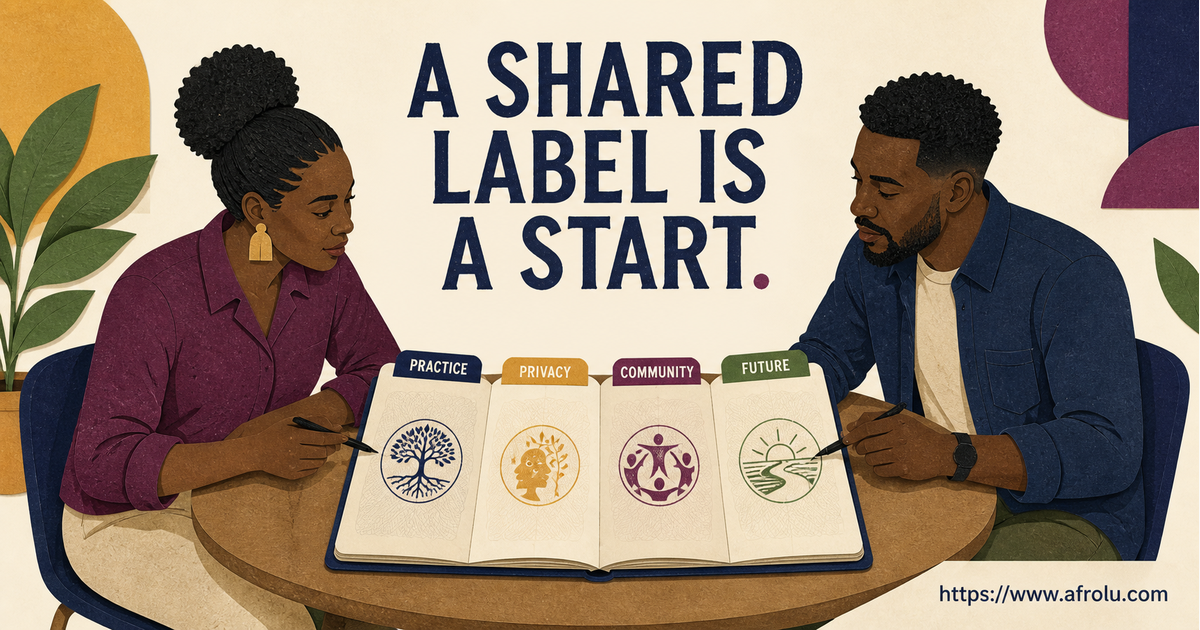
Quick answer
A shared faith label can matter, but it cannot tell you how two adults will live. Compare four things: what each person practises, what stays private, who in the community may advise, and what the pair hopes to plan for the future. Write one present choice, one limit, one open question and one review point for each part. Do not use the tool to judge faith or doctrine. Stop the normal review if belief is used to demand access, shame a no or block an exit.
Start here
A label can help you meet. Clear choices help you plan.
Many dating profiles use a faith label. The label may help two people find each other. It does not fill in the details. Two adults can share a label and still make different choices about time, food, privacy, family, money, touch, marriage or children. Those differences are not a trick. They are facts that need words.
This guide gives the pair a four-page passport. Page one is Practice: what each adult does now. Page two is Privacy: who may know what. Page three is Community: who may advise and who may not decide. Page four is Future: which hopes, needs and expert questions must be clear before a larger promise.
The passport does not say which answer is right. It does not measure faith. It does not decide a ceremony, marriage or legal case. It helps two consenting adults ask small questions in plain words. A complete page can show a good fit, a workable difference, a question that needs help or a reason to end.
Every example on this page involves adults aged 28 or older. The names and stories are fictional. No person stands for a whole religion, family, country, gender or community. The page uses Kenyan official sources for public law and privacy limits. People elsewhere should use current official help in their own country.
Simple terms
What the passport words mean
- Passport
- A four-part note page for the two adults. It is not a legal document.
- Practice
- What an adult freely does now.
- Privacy
- Who may know or share a detail.
- Community
- People who may support or advise, but do not give an adult's consent.
- Future
- Hopes and plans that may affect a home, marriage, care or children.
- Review point
- A chosen time to ask whether the plan still fits.
- Pressure
- Using love, shame, access or safety to make someone give up a choice.
- Consent
- A free yes to one exact choice. It can change to no.
The complete guide
Fill the four pages without guessing
01
Read the label carefully
Shared faith may open a door; it does not answer the household questions
A shared faith label can be meaningful. It may describe belonging, memory, language, moral imagination, community, worship or a way of making sense of life. It can also mean different things to two adults who use exactly the same word. One may practise privately while another participates publicly. One may welcome community advice while another protects the relationship from early discussion. One may expect a particular rhythm at home while another treats the label mainly as identity. None of those differences can be read reliably from a profile, name, family background, clothing or place of origin.
That is why this guide starts after the match filter has done its work. The useful question is no longer simply, ‘Do we share a faith?’ It is, ‘What does each of us freely choose to practise, keep private, share with community and plan for the future?’ The question is descriptive, not theological. It does not ask Afrolu to decide which answer is faithful, modern, traditional, serious or correct. It asks two adults to replace a guess with a present-tense answer they can understand.
Treat every answer as personal data, not evidence for a public identity file. A date does not earn access to someone’s community, family, place of worship, private history or precise routine merely because a label matches. Belief and family details can be sensitive information. Ask only what is relevant to the choice in front of you, explain why you are asking, and accept a boundary without trying to investigate around it. Curiosity stops being respectful when it becomes extraction, surveillance or a test.
The passport is therefore a conversation aid rather than a compatibility certificate. Two complete passports may reveal strong fit, a workable difference, an open question, or a respectful mismatch. They may also reveal pressure that makes ordinary negotiation unsafe. The goal is not to produce identical pages. It is to make present choices visible enough that neither adult has to rely on a stereotype, a community rumour or an implied promise.
02
Set up the conversation
Complete the passport separately before comparing it together
Use four pages: Practice, Privacy, Community and Future. Each adult writes a short present answer, one boundary, one question and one review point on every page. ‘Present’ matters because people change. ‘Boundary’ matters because shared identity does not remove consent. ‘Question’ prevents a temporary unknown from being disguised as agreement. ‘Review’ allows a genuine choice to evolve without turning every change into betrayal. The worksheet belongs to the adults using it; it is not a document for friends, relatives, leaders or social media.
Begin separately. If one person speaks first, the other may copy an answer that sounds approved. Ten private minutes can help each adult find their own words. Then compare one page at a time. Use three marks: shared, different but workable, or not solved. Do not use a match score. One need that cannot change may matter more than ten easy points. Many small differences may still be easy to plan. The adults decide what matters most.
Choose a calm, leaveable setting and a finite duration. This should not be an interrogation, a confession session or a family summit. Forty-five minutes may be enough for the first pass. Either person may decline a question, request time or end the conversation. If disclosure could create real social, housing, immigration, employment or safety consequences, plan privacy before substance. A person should not have to risk exposure in order to prove romantic seriousness.
Record the narrowest answer possible. ‘I attend twice a month’ is clearer than ‘I am devout.’ ‘I do not want our dating status discussed outside two trusted people’ is clearer than ‘keep it discreet.’ ‘I want us to consult qualified local counsel before choosing a ceremony’ is clearer than ‘we will work it out.’ Concrete language is not less spiritual. It simply keeps a relationship decision from borrowing certainty that neither adult has actually supplied.
03
Passport page one
Practice: describe the routine that actually touches shared time
Practice means actions that can affect a relationship. Examples include time for worship or thought, food, fasting, clothes, privacy, social events, giving, substances, dating pace, touch, sexual health, holidays and rest. This is not a list of what any religion requires. Say what you do now and what you hope to keep doing. Also say which choices you do not ask a partner to copy.
Separate an individual practice from a joint request. ‘I reserve this morning for worship’ describes one adult’s schedule. ‘I need a partner to join me every week’ is a relationship requirement. ‘I would like company sometimes’ is a preference. Those are three different planning facts. The passport should preserve the difference, because a date can respect a practice without adopting it, and can share an activity without surrendering the right to reconsider.
Ask how daily plans work. If fasting changes meal times, what does a date look like? If one day is protected, when are calls welcome? If dress or touch choices matter, how will each person ask for consent? If giving matters, is the money personal or part of a future budget? Small questions prevent guessing and fights about labels. They show whether two adults can make room for real routines.
Include change. A person may practise more, less or in a new way. Write what you will say if a routine starts to affect shared time, money, touch or the home. Telling a partner is not asking permission. An adult controls their own belief. A talk is still needed when a personal change affects a shared plan. Say, ‘My choice is changing. We need to look at our shared plan again.’ Do not say, ‘You promised never to change.’
Keep health and consent in their own lane. Consent means a free yes to one exact choice. Prayer, advice, fasting, vows, identity or community approval cannot create that yes. This is true for touch, sex, birth control, pregnancy, health care and private health facts. A yes can change to no. If a question needs a doctor, lawyer or faith expert, pause. A general dating worksheet cannot give a personal expert answer.
04
Passport page two
Privacy: decide who may know what, through which channel and at what time
A shared label does not make a relationship public. On the Privacy page, name who knows you are dating. Say what may be shared and what stays protected. ‘I am meeting someone’ is a general fact. A name, photo, workplace, home, family link, faith group or message screenshot can identify a person. Permission for one detail is not permission for all details. A person can also change their mind before the detail is shared.
Ask about channels. A trusted friend may receive a safety check-in without receiving intimate beliefs. A community adviser may hear a general question without learning the other person’s identity. A family member may know there is a relationship without seeing private messages. Social media, group chats, livestreams and community announcements create larger and less controllable audiences. ‘We are both religious’ is not permission to post, tag, introduce or investigate.
Protect inference as well as direct disclosure. Visiting a venue together, changing a public status, sharing a celebration photo or following a community account can reveal information neither person intended to announce. Review the likely audience before acting. If one adult needs more privacy because of work, family, housing or personal safety, do not label that boundary shame or weak commitment. Ask what safe, honest recognition is possible and whether the limitation fits both adults’ needs.
Keep the passport private. Do not photograph it or send it to a leader without permission. Do not use it as a weapon in a fight. Keep only the facts you need. If dating ends, delete or return notes about the other person. The passport should not become a lasting file about them. If you need advice, remove names when you can. Tell the other adult what kind of help you plan to seek.
Privacy is not secrecy that enables harm. A person can always seek confidential safety, medical, legal or therapeutic support. No agreement should prevent someone from documenting threats, reporting abuse or contacting emergency help. The distinction is purpose: a mutual privacy boundary protects dignity; an imposed secrecy rule isolates a person or blocks support. If a partner monitors devices, demands passwords, threatens exposure or punishes help-seeking, leave the ordinary passport review and make a safety plan.
05
Passport page three
Community: give trusted people a voice without lending them either adult's vote
Community can offer belonging, memory, practical care and wise questions. It can also create assumptions before two adults have made a relationship decision. The Community page asks who may be consulted, when an introduction would be welcome, what information may be shared and which decisions remain solely with the couple or each individual. It does not rank private dating above community life or community life above adult consent. It creates a boundary between support and control.
Use the phrase ‘voice, not vote’ carefully. It means an adviser may help an adult reflect but cannot consent to dating, intimacy, marriage or disclosure on that adult’s behalf. It does not mean every family or community concern should be dismissed. A concern about observable conduct can be useful evidence. A demand based only on status, stereotype or punishment is different. Ask, ‘What fact is this concern based on, and what choice remains mine?’
Plan introductions in stages. A first mention, a private conversation with one trusted person, a casual meeting, and a formal community introduction carry different weight. Do not let an early introduction become an announcement of engagement or a promise of marriage. State the current status in plain language. Both adults should know what the event means, who will attend, what questions may arise and how either person can leave without humiliation.
Agree on disagreement management before it is needed. If advice conflicts, will each adult hear it privately and then return to a direct conversation? Will you seek a second qualified perspective? What happens if a leader or relative contacts the other person directly? A strong boundary is, ‘Please bring concerns to me; do not recruit others to pressure my partner.’ Triangulation makes honest revision harder because every change begins to look like public defeat.
No role, title, age or community standing can replace specific consent. Spiritual language must not be used to demand passwords, money, private meetings, sex, pregnancy, marriage, isolation or continued contact. If a person says divine authority, family honour or communal shame removes your right to say no, the issue is not a small Community-page mismatch. Preserve relevant evidence where safe, contact trusted support and use local legal or emergency channels appropriate to the risk.
06
Passport page four
Future: turn hopeful words into decisions, dependencies and qualified questions
Future plans may cover commitment, living together, marriage, events, home routines, holidays, money, care, moving and children. Start by splitting a hope from a decision. ‘I hope to marry’ is a hope. ‘I need a marriage that meets these rules’ is a need. That need may call for legal or faith advice. ‘We will marry’ is not a fact until both adults freely choose it. Shared faith words must not make the status sound further ahead than it is.
Make a question map. Which choice needs legal advice? Which choice needs family or health facts? Which choice depends on money or a move? What can the pair decide now? What belongs to each adult alone? One large word, such as marriage or home, may hide many small choices. The map can also show when the pair is fighting about a possible event. They may be avoiding a current question about dating status, money or where to live.
Discuss children as a values-and-process question, not as control of a future person. Adults can explore whether they want children, what practices they imagine at home, how they would handle competing family expectations and when they would seek qualified advice. They cannot know a future child’s identity, beliefs, needs or circumstances. In Kenya, official law includes a child’s freedom of thought, conscience and religion alongside appropriate parental guidance, best interests and evolving capacities. That is a reason for care, not a ready-made answer.
Plan for change and for no. What if one adult’s practice changes? What if an event cannot meet both adults’ needs? What if a person later decides not to marry or have children? A strong plan says how the pair will talk again without pressure. The new facts may show that the match cannot work. A kind ending does not mean the talk failed. The passport works when it stops a guessed future from becoming a trap.
Do not rely on this page to determine the validity of a marriage, ceremony, divorce, custody arrangement, immigration route or religious process. The Kenya Marriage Act makes free consent important, but a general guide cannot classify a particular ceremony or advise a couple on their legal position. Take the exact question to a suitably qualified Kenyan lawyer or relevant local authority; take doctrine to a qualified adviser chosen freely by the person seeking advice.
Write the last Future entry as a current action. One option is, ‘We will list the expert questions before a ceremony promise.’ Another is, ‘We will discuss whether either of us wants children.’ A third is, ‘This need does not fit, so we are ending without asking our communities to add pressure.’ A current action is more honest than a grand promise.
07
Do not flatten the evidence
Separate a normal difference, a match that cannot work, pressure and danger
A normal difference is a choice the adults can discuss freely. A match cannot work when a key need cannot fit both adults. This does not make either person bad. Pressure means love, status, access or safety depends on giving up a choice. Danger includes threats, stalking, violence, private image abuse, money control, monitoring or a blocked exit. These facts need different actions.
Do not turn them into one score. Ten kind agreements do not cancel one threat. One schedule problem does not prove abuse. Name the act and the response to a clear limit. ‘They want a different weekly plan’ is a match fact. ‘They called me unfaithful when I kept my phone private’ is pressure. ‘They said they will expose me if I leave’ is a safety fact. Plain facts prevent both hiding danger and treating a normal difference as harm.
For a workable difference, try one small plan and review it. The pair may attend some events alone or set a private time. If the match cannot work, stop asking either person to give up a key need. End with care. If there is pressure, state a limit only when it is safe. You do not need a debate about belief to prove your right to choose. If there is danger, choose safe exit and local help before the passport.
A person never has to stay for more persuasion. Blocking or ending contact can be reasonable. A group talk may also be refused. If the pair wants shared advice, both adults must choose the adviser and speak freely. A shared meeting may be unsafe when one person uses force or control. Afrolu cannot judge one case from a web page. Use emergency or expert local help for immediate risk.
08
Read the completed pages
Choose the narrowest honest next step instead of forcing a verdict
After all four pages, check four things: clear words, shared effort, freedom and repair. Clear words are easy to plan around. Shared effort means both adults explain, listen and make room. Freedom means a no, a change or an open question does not cause punishment. Repair means a mistake can be named and fixed. These checks look at behaviour. They do not measure how true a person's faith is.
Continue when key answers are clear, differences can be discussed freely and actions match the words. Revise when a plan is too broad. Replace ‘support my faith’ with one clear action and limit. Pause when someone needs private thought, expert advice or a safety plan. Seek qualified help for law, health or questions about what a faith requires. Leave when a key need cannot fit, trust is missing or choice is not free.
Set one review point tied to evidence rather than anxiety: after three dates, before a public introduction, before travel, or before making a ceremony plan. A review date is not a deadline for commitment. It is a promise to revisit the question rather than let assumption harden. Either adult may decide sooner. If no new evidence could change the decision, say so and close the process instead of repeatedly reopening a boundary.
End by returning the passport to each writer. Do not sign it like a contract. Summarise only the current shared agreements and unresolved questions. A useful closing line is, ‘These are our choices today; each of us can raise a change, and neither of us owes agreement at the cost of freedom.’ The strongest outcome may be a relationship with clearer structure. It may also be an early, respectful no that protects two adults from a future built on imagined sameness.
Words you can change
Eight plain scripts for adult conversations
Open without testing
“Sharing a faith label matters to me, and I do not want to guess what it means for you. Could we compare the practices that actually affect dating?”
Use: Use after basic mutual interest, before treating a matching label as proof of fit.
Keep in mind: The invitation allows a no. It does not ask the other adult to prove that their faith is real.
Name a personal practice
“I reserve Friday evening for my own practice. I am telling you so we can plan time; I am not asking you to copy it.”
Use: Use when a routine affects availability but remains an individual choice.
Keep in mind: Replace the example with your actual routine; the page does not prescribe one.
Protect relationship privacy
“You may tell one trusted person that you are dating, but please do not share my name, photograph, messages or community connection yet.”
Use: Use to separate a safety check-in from identifying disclosure.
Keep in mind: Either adult may still seek confidential help or disclose what is necessary for safety.
Define community scope
“I respect that advice matters to you. I am willing to hear a question; I am not agreeing that another person can decide our status or contact me to apply pressure.”
Use: Use before an introduction or consultation whose meaning may be unclear.
Keep in mind: Do not use a joint meeting when pressure or violence makes free speech unsafe.
Route an expert question
“We do not know whether this ceremony meets our legal and personal requirements. Let us write the exact question and ask qualified sources before making a promise.”
Use: Use when hope is outrunning legal, medical or doctrinal knowledge.
Keep in mind: Choose advisers freely and distinguish their area of competence.
Respond to a change
“My practice is changing. I am not asking permission to hold a belief, but I do want to revisit the shared arrangement that this change affects.”
Use: Use when an individual choice changes time, money, intimacy or home expectations.
Keep in mind: A partner may find the new arrangement incompatible; freedom includes that decision.
Close a mismatch
“Our Future pages contain a requirement neither of us can freely change. I respect your choice and I am ending the romantic relationship rather than asking either of us to perform agreement.”
Use: Use when a key need cannot fit both adults and direct contact is safe.
Keep in mind: No continued debate, leader intervention or private meeting is owed.
Refuse spiritualized pressure
“My consent is mine. I will not share passwords, money, private images or physical access as proof of faith. Do not contact me through another channel.”
Use: Use only if stating the boundary is safe; otherwise prioritize a protected exit.
Keep in mind: Threats, monitoring or defeated exit call for safety support, not persuasion.
Your next small step
Use one page, one action and one review point
Start with one page, not all four. Each adult writes alone for ten minutes. Compare facts without scoring them. Choose one next action and one time to review it.
Pause when the question needs a lawyer, doctor, child-focused professional or freely chosen religious adviser. Leave ordinary planning when there is a threat, surveillance, money control, violence, exposure or a blocked exit.
Keep the notes private. Delete or return the other adult's sensitive details if dating ends. A clear no can be a good result because it prevents a future based on guessed agreement.
Six original visual lessons
See the passport before you use it
The first picture above introduces the guide. Each picture below explains one more decision in a clear visual step.


© Afrolu 2026 · Image rights · Rights contact
Evidence register
What the sources support—and what they cannot decide
How this page uses evidence
- Translate the shared label into choices the two adults can describe and revise.
- Separate personal practice, disclosure, community participation and future planning.
- Route doctrine and individualized law to qualified people rather than inventing an answer.
- Treat coercion, surveillance, threats and defeated exit as safety facts, not compatibility scores.
Official or primary source · checked 2026-08-25
Constitution of Kenya
Publisher: Kenya Law
Supports: The constitutional baseline for privacy and freedom of conscience, religion, thought, belief and opinion, including practice in public or private and protection against compulsion contrary to belief.
Cannot establish: Whether either adult is religiously compatible, what a faith tradition requires, or how a court would decide a particular dispute.
Official or primary source · checked 2026-08-25
Marriage Act, current consolidated version
Publisher: Kenya Law
Supports: The statutory importance of free consent and the rule that coercion or fraud defeats free consent to a marriage.
Cannot establish: Whether a proposed ceremony or marriage is valid, recognised, advisable, or compliant with the rules of any religious community.
Official or primary source · checked 2026-08-25
Data Protection Act, current consolidated version
Publisher: Kenya Law
Supports: That conscience, belief and family details fall within sensitive personal-data concepts under Kenyan law, supporting a cautious privacy boundary.
Cannot establish: A private person's compliance status, an individualized remedy, or permission to collect, publish or infer another person's beliefs.
Official or primary source · checked 2026-08-25
General Comment No. 22 on freedom of thought, conscience and religion
Publisher: United Nations Human Rights Committee
Supports: An international interpretive baseline that protects theistic, non-theistic and atheistic beliefs, the right not to profess a belief, and freedom from coercion to adopt, recant or reveal belief.
Cannot establish: Kenyan legal advice, a doctrinal ruling, compatibility between two adults, or a conclusion that a relationship must continue or end.
Official or primary source · checked 2026-08-25
Universal Declaration of Human Rights, Articles 16 and 18
Publisher: Office of the United Nations High Commissioner for Human Rights
Supports: A high-level human-rights baseline for free and full consent to marriage and freedom of thought, conscience and religion.
Cannot establish: Local marriage procedure, recognition of a ceremony, a faith rule, or individualized legal advice.
Official or primary source · checked 2026-08-25
Frequently Asked Questions
Publisher: Office of the Data Protection Commissioner Kenya
Supports: Official practical confirmation that conscience, belief and family details receive sensitive-data treatment and merit additional protection.
Cannot establish: Whether a date has committed an offence, whether a disclosure is lawful in a specific case, or which enforcement route applies.
Limits of this guide
- No survey or prevalence claim is made.
- No religion, denomination, community, gender, country or family is described as uniform.
- The page does not interpret doctrine, decide marriage validity or give individualized legal advice.
- The worksheet cannot certify compatibility, sincerity, safety or future conduct.
This is general information, not personal legal, medical, safety or faith advice.
Six common questions
Religious dating FAQ
Does sharing a faith mean we are compatible?
No. A shared label may matter, but a good match depends on choices that affect the relationship. Compare practice, privacy, community and future needs. Afrolu cannot decide what a faith requires or whether a person's faith is real.
What should we ask about religious practice while dating?
Ask only about routines relevant to shared time, money, food, privacy, touch, holidays or future planning. Distinguish a personal practice, a preference and a relationship requirement, and accept that an adult may keep some beliefs private.
Should family or faith leaders approve our relationship?
Adults may freely seek counsel and value community, but another person cannot provide either adult's consent. Agree who may advise, what may be shared and whether any introduction has a defined purpose.
How private should a faith-based relationship be?
There is no universal level. Agree separately on safety check-ins, names, photographs, messages, family details, community introductions and public posts. Privacy must not be used to isolate someone or block confidential safety support.
Can this passport tell us which ceremony or marriage is valid?
No. It can identify the exact question, but marriage law and religious processes require suitably qualified local advice. Do not make a ceremony promise from a general guide or treat romantic confidence as expertise.
What if belief is used to pressure consent or prevent a breakup?
Prayer, leaders, family honour or shared identity cannot create consent or cancel an exit. Threats, surveillance, exposure, violence or blocked contact are safety issues; use trusted, specialist, legal or emergency support appropriate to the risk.