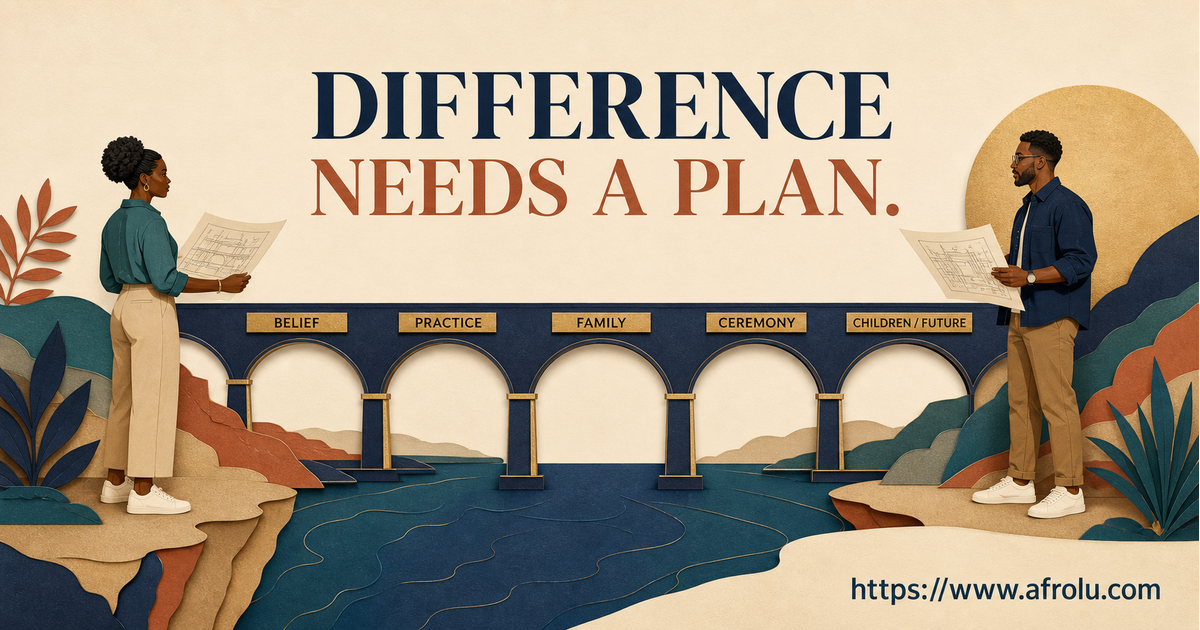
The Belief–Practice–Family–Ceremony–Children/Future Bridge
How to Plan an Interfaith Relationship Without Conversion Pressure
A plain-language interfaith dating guide for two adults to plan belief, practice, family, ceremony and future choices without conversion pressure.
- Belief
- Practice
- Family
- Ceremony
- Children / Future
WriterClarisse UwimanaDating Culture Editor
Faith and scope reviewSamira BenaliFaith and North Africa Editor
Safety reviewAdwoa BoatengDating Safety Editor
DatesPublished 2026-08-25Reviewed 2026-08-25
Treat the belief difference as five small planning questions. What does each adult believe? Which practices affect shared time? What may families know or do? Which ceremony questions need a qualified answer? What can the pair plan about children or the future without choosing another person's mind? A good plan keeps both adults free. Conversion cannot be the price of love, housing, marriage, safety or continued contact.
Start with the real difference
A plan can join two lives without erasing either person
An interfaith relationship joins two adults with different belief labels or worldviews. The difference may be religious, non-religious or hard to name. This page does not ask which view is true. It asks what the difference changes in daily life and what plan, if any, both adults can freely choose.
The planning tool is a bridge with five spans. Belief covers what each person holds and keeps private. Practice covers daily actions. Family covers information, contact and influence. Ceremony covers hopes, law and religious process. Children or Future covers the home, care and plans that cannot be settled by guessing.
Each span gets four short notes: my choice now, what I will not accept, what I still need to learn and when we will review it. The pair may build, redesign, pause, seek qualified help or stop. Staying together is not the only good result. A respectful no can protect both people.
Every story on this page is fictional and involves adults aged 28 or older. No adult stands for a religion, culture, country, family or gender. Kenyan law sources give a public baseline for consent, privacy and children. They are not personal legal advice. Readers elsewhere should check the rules and support in their own country.
Simple terms
Know the words before you build
Bridge
A five-part plan for the two adults. It is not a promise to stay.
Span
One part of the bridge plan.
Belief
A person's religious or non-religious view.
Practice
What an adult freely does now.
Family
Relatives, chosen family or trusted community people.
Ceremony
A public, legal, family or religious event; these may be different steps.
Conversion pressure
Making love, safety or access depend on a change in belief.
The full bridge
Cross one planning span at a time
Start with a clear meaning
Interfaith dating is a planning question, not a contest
Interfaith dating means two adults do not share the same belief label or worldview. One person may follow a religion and the other may follow another religion. One may be religious and the other may not be. Both may use the same broad word but understand it in different ways. This page treats that difference as a fact to plan around. It does not treat either person as a problem to fix.
Difference is not the same as danger. It is also not proof of a good match. A couple may handle a large difference with care. A couple may also find that one small future rule makes the match impossible. The point is to ask what the difference changes in daily life. Does it affect time, food, privacy, family, a ceremony, children, money, sex, health or the home? A clear answer is more useful than a debate about whose label is better.
This guide uses a bridge with five spans. The spans are Belief, Practice, Family, Ceremony and Children or Future. A span is one part of the plan. The pair checks every span on its own. They do not trade one answer for another. For example, kind family contact does not cancel pressure about conversion. A shared holiday does not answer a question about a wedding ceremony. Each choice needs its own words.
The bridge is not a promise to stay together. It can lead to a plan, a new design, a pause, expert help or an ending. All five routes can be honest. The test is simple: Can each adult speak, choose, change an answer and leave without shame, threat or punishment? If not, stop ordinary planning and think about safety.
Use one small worksheet
Write four notes for each of the five spans
Each adult writes four notes under every span. First: my choice now. Second: what I will not accept. Third: what I still need to learn. Fourth: when we will review it. Use short facts. ‘I go once a week’ is a fact. ‘I need a good partner’ is too broad. ‘I will not ask you to join’ is a clear limit. ‘We will talk again before any family visit’ is a clear review point.
Write alone first. This makes it easier to hear your own answer. Then compare the two pages. Mark an answer as shared, different but workable, or not yet solved. Do not give the match a score. A score can hide the one fact that matters most. A person may care deeply about one ceremony rule and care very little about shared meals. The couple, not Afrolu, decides how much each fact matters.
Use a safe place and a short time. Both adults should be able to leave. Either adult may skip a question. No one must tell a private story to prove love. Ask only for facts that affect the choice in front of you. A broad answer may be enough early on. More detail can come later if trust grows. Belief and family details can be sensitive. Do not record or share them without a clear reason and permission.
End each talk with one next action. It may be a small test, such as planning one holiday meal. It may be a question for a lawyer or a freely chosen religious adviser. It may be time to think alone. It may be a clear no. Do not leave the talk with a grand promise that depends on facts no one has checked.
Bridge span one
Belief: say what you hold without asking the other person to copy it
Belief means a person's view about religion, conscience, meaning or the lack of religious belief. A label may help explain it, but it never tells the full story. Ask, ‘What do you believe now, and what part of that matters for dating?’ The other adult may answer in their own words. They may also keep private ideas private. The goal is not to test knowledge or win a debate.
Separate respect from agreement. Respect means listening, using the words a person asks you to use, and not mocking or exposing them. Agreement means holding the same view. A couple may have respect without agreement. They may not be able to build a life together if a key belief difference changes a future rule. That would be a fit problem, not proof that one person is bad.
Write what will stay personal. One adult may pray alone. One may not wish to join any worship. One may enjoy learning about the other's view without adopting it. None of these choices is a hidden promise to convert. A visit, book, meal, holiday or talk cannot be used later as proof that a person agreed to change belief. Ask again for each new step.
Plan for change. Adults can change belief or choose not to name a belief. The United Nations human-rights material used for this page protects religious and non-religious belief and freedom from pressure to adopt or give up belief. That is a high-level rule, not advice about one case. In the bridge, it means the pair writes how a change will be discussed. It does not mean either person gets control over the other's mind.
Bridge span two
Practice: find the daily choices that need space, time or a shared rule
Practice means what a person does. It can include worship, reflection, food, fasting, clothing, holidays, giving, rest, substances, touch and sexual boundaries. The list is only a set of examples. It does not say what any religion demands. Ask what the person does now. Ask which parts affect dates, a home or a future budget. Do not guess from clothes, a name, a country or a family.
Make three columns: mine, yours and ours. A private prayer time can stay in ‘mine.’ A partner's non-religious weekend routine can stay in ‘yours.’ A meal at home may need an ‘ours’ plan. A choice only moves into ‘ours’ when it truly affects both people. This stops one adult from treating every personal practice as a rule for the other.
Use small trials for workable differences. The pair might choose two meal options, keep separate morning routines or attend some events alone. Set a review date. Ask whether the plan was kind, practical and free. A trial is not a trick. It should not make one person slowly give up their choice because saying no feels rude. Either person may stop the trial.
Keep consent clear. No belief or practice creates consent for touch, sex, health choices, pregnancy, money, passwords or private images. Consent must be given by the person for that exact choice. It can change. A leader, parent or partner cannot give it for them. If someone uses a practice to demand access, name the behaviour. Do not argue about the whole faith in order to defend a simple no.
Bridge span three
Family: plan contact, information and influence before an introduction
Family can mean parents, children, siblings, relatives, chosen family or community elders. Every family is different. Do not assume that one region, religion or age group handles dating in one way. Ask who matters to each adult and what role that person may have. An adult can value family advice and still make their own dating choice.
Plan levels of contact. A safety check-in is not an introduction. A name is not a photograph. A meal is not an engagement. A formal visit may carry a meaning that a casual visit does not. Write what the next contact means before it happens. Both adults should know who will be there, what may be asked and how they can leave.
Protect private data. Do not share the other person's belief, family story, past relationship, home, workplace, messages or image without permission. Do not ask relatives to search for more details. In Kenya, official data-protection sources treat belief and family details as sensitive. The safest dating rule is simple: collect less, share less, and ask before each wider disclosure.
Set a line around pressure. A relative may raise a fact about conduct. The adult can listen and decide what weight it has. A relative may not threaten, shame, expose or bargain with the partner. If family approval is a firm need for one adult, it should be said early as a relationship condition. The other person can then choose freely. It must not appear later as a trap.
Bridge span four
Ceremony: split hope, law, family meaning and religious process
Ceremony is a broad word. It may mean a wedding, a civil step, a religious rite, a family event or more than one event. These are not always the same thing. Two adults may both want marriage and still mean different legal or personal arrangements. The bridge asks them to list each part. It does not tell them which ceremony to choose.
Write four questions. What does each adult want? What does each family think the event means? Which legal questions need a qualified answer? Which religious questions need a qualified adviser chosen freely by the person asking? Do not use one adviser for every question. A faith leader is not automatically a lawyer. A lawyer does not decide doctrine. A dating guide does neither.
The Kenya Marriage Act source on this page supports one narrow point: free consent matters, and coercion or fraud defeats free consent. It does not let Afrolu rule on a ceremony. Before making promises, get current advice for the place and process you may use. If you live outside Kenya, use the law and official services in your own country.
Do not let a public event force the decision. Family travel, deposits, invitations or social posts can make it hard to say no. Keep the final choice open until both adults have the needed facts and give free consent. Money already spent does not create consent. Public hope does not create consent. A person can stop even when stopping is hard.
Bridge span five
Children and future: plan the adult process without choosing a child's mind
Start with the adult questions. Does each person want children? Are there children already in either home? What privacy do those children need? What home routines do the adults imagine? What family pressure may arise? These are different questions. Do not move a new date into a child's life just because the adults have started a future talk. Adult trust and a stable plan come first.
A couple can discuss how they may guide a future child. They can name holidays, learning, family contact and the way they will handle disagreement. They cannot know the child's future belief. They also cannot use this page to settle a real child's legal or welfare needs. In Kenya, the Children Act includes freedom of thought, conscience and religion, best interests, suitable parental guidance and a child's growing ability to decide. The exact case may need qualified help.
Use age-aware language. A very young child and a teenager do not take part in decisions in the same way. A child's voice and needs can change as the child grows. Write a process that can grow too. For example: ‘We will give age-appropriate information, avoid making the child carry our argument, and seek child-focused advice if a serious conflict appears.’ This is a planning value, not a court order.
Future also includes home, money, care, death, holidays, relocation and a possible end to the relationship. Ask which parts need shared rules. Ask which parts stay personal. Ask what happens if belief changes. A bridge with no repair plan may feel strong only while nothing changes. A real plan leaves room to review and, when needed, to end without using children or family as leverage.
Know the hard boundary
Conversion pressure is not a normal price for interfaith love
Conversion pressure means making love, safety, money, housing, marriage, family access or continued contact depend on changing belief. It can be direct: ‘Convert or I will expose you.’ It can also hide inside repeated tests, shame, threats, isolation or surprise meetings with people chosen to persuade one partner. A free question leaves room for no. Pressure tries to remove no.
Learning is not conversion. Attending one event is not conversion. Asking a question is not conversion. Changing belief by free personal choice is not the same as being pushed. The key facts are who chose the step, what was promised, whether no was safe and whether the person can change their mind. Do not infer consent from a kind gesture or from silence during a group meeting.
If pressure is mild and it is safe to speak, name one clear line: ‘I will not change belief as a condition of dating.’ Then watch the response. Respect looks like stopping, listening and repairing. More debate, ridicule, contact through other people or punishment is new evidence. You do not owe a longer defence. A person does not need to win a belief argument to keep control of their own choice.
Threats, stalking, violence, forced contact, image abuse, money control and blocked exit are safety issues. They should not go through the normal bridge review. Save evidence only when safe. Secure devices and accounts. Tell a trusted person. Use local specialist, legal or emergency support that fits the risk. Joint advice may be unsafe when one person controls the room or the result.
Finish the bridge review
Check clarity, balance, freedom and repair before choosing the next route
Clarity means you can state the plan in simple words. Balance means both adults make room, answer questions and keep limits. Freedom means either person can say no, change a choice or leave. Repair means a mistake can be named and fixed. These four checks are about behaviour. They do not rate anyone's faith, lack of faith or culture.
Choose Build when key spans have clear, free plans. Choose Redesign when the goal fits but one rule needs to change. Choose Pause when someone needs time, facts or private support. Choose Qualified Help for legal, medical, child, safety or religious questions beyond the couple's skill. Choose Stop when a key need conflicts, trust is missing or freedom is gone. Staying is not the only successful route.
Pick one review point. It could be before a family meeting, before travel, before a ceremony promise or after trying a home routine. Say what evidence you hope to learn. A review is not a deadline for love. It is a time to ask whether the plan still fits. Either adult may decide sooner. Do not keep moving the date just to avoid an honest answer.
Close by writing one sentence for each span. Keep it private. Do not sign it as a contract or send it to an audience. A simple ending is, ‘These are our choices now. Neither person must change belief to keep the relationship. We will raise changes early and we will stop if the plan no longer stays free.’ If that sentence is not true, the bridge is not ready.
Use your own voice
Eight short scripts that keep choice free
Open the bridge
“Our beliefs are different. I do not want either of us to guess. Can we name what the difference changes in daily life?”
Use: Use when both adults want to explore fit without starting a belief debate.
Limit: Either person may decline the talk or keep a private belief private.
Remove conversion pressure
“I will not ask you to convert, and I will not agree to conversion as the price of this relationship.”
Use: Use early when the meaning of interfaith dating is unclear.
Limit: A free later change in belief is a personal choice, not a debt created by dating.
Make practice concrete
“This practice changes my Saturday morning. It does not require you to join. What plan would protect both routines?”
Use: Use when a personal routine affects shared time.
Limit: Name the actual practice; do not claim it speaks for every person with that label.
Set a family boundary
“Your family may know that you are dating. Please do not share my belief, photograph or messages, and do not invite anyone to persuade me.”
Use: Use before a family disclosure or introduction.
Limit: Safety check-ins and confidential help remain available to both adults.
Split the ceremony question
“We share the hope of marriage, but we do not yet know the legal or religious answers. Let us ask the right qualified people before we promise a ceremony.”
Use: Use when one big future word hides several expert questions.
Limit: The advisers give information; the adults still choose freely.
Protect a future child from the argument
“We can plan our values and process. We cannot choose a future child's mind today or use a child to win our disagreement.”
Use: Use when the pair starts speaking as if a future child were property.
Limit: Real child matters need age-aware, child-focused and sometimes legal support.
Name a mismatch
“This future need matters to both of us, and the two answers do not fit. I am ending the relationship without asking either of us to give up belief.”
Use: Use for a clear incompatibility when direct contact is safe.
Limit: No family meeting, debate or further persuasion is owed.
End pressure
“My belief is not a condition you may bargain with. Do not contact me, expose me or send other people to change my answer.”
Use: Use only when saying it is safe; a protected exit may be better.
Limit: Threats, tracking or a blocked exit need safety help, not another bridge talk.
One safe next move
Write one span before you promise the whole bridge
Choose one span. Write four short notes alone. Compare the notes without trying to win. Name one fact, one limit and one next action.
Use qualified help for law, health, child welfare, safety or doctrine. An adviser gives information. The two adults keep their own consent and final choice.
Stop the normal bridge talk when there are threats, surprise persuasion, stalking, money control, exposure or a blocked exit. Use trusted and local specialist help that fits the risk.
Six original visual lessons
Look at the route from both shores
The first picture above introduces the guide. Each picture below explains one more part of the bridge in a clear visual step.


© Afrolu 2026 · Image rights · Rights contact
Evidence and limits
Official sources set boundaries; they do not choose the relationship
How this guide uses evidence
- Name the actual difference before trying to solve it.
- Cross belief, practice, family, ceremony and children or future as separate planning spans.
- Record each adult's present choice, unacceptable pressure, open question and review point.
- Keep conversion, doctrine, law and child-specific decisions outside the page's authority.
Constitution of Kenya
Kenya Law
SupportsThe constitutional baseline for privacy and freedom of conscience, religion, thought, belief and opinion, including practice in public or private and protection against compulsion contrary to belief.
Cannot decideWhether either adult is religiously compatible, what a faith tradition requires, or how a court would decide a particular dispute.
Marriage Act, current consolidated version
Kenya Law
SupportsThe statutory importance of free consent and the rule that coercion or fraud defeats free consent to a marriage.
Cannot decideWhether a proposed ceremony or marriage is valid, recognised, advisable, or compliant with the rules of any religious community.
Data Protection Act, current consolidated version
Kenya Law
SupportsThat conscience, belief and family details fall within sensitive personal-data concepts under Kenyan law, supporting a cautious privacy boundary.
Cannot decideA private person's compliance status, an individualized remedy, or permission to collect, publish or infer another person's beliefs.
Children Act, 2022
Kenya Law
SupportsA Kenyan statutory baseline on a child's freedom of thought, conscience and religion, appropriate parental guidance, best interests and evolving capacities.
Cannot decideA parenting order, a correct religious upbringing, a custody outcome, or a prediction of what any future child will believe.
General Comment No. 22 on freedom of thought, conscience and religion
United Nations Human Rights Committee
SupportsAn international interpretive baseline that protects theistic, non-theistic and atheistic beliefs, the right not to profess a belief, and freedom from coercion to adopt, recant or reveal belief.
Cannot decideKenyan legal advice, a doctrinal ruling, compatibility between two adults, or a conclusion that a relationship must continue or end.
Universal Declaration of Human Rights, Articles 16 and 18
Office of the United Nations High Commissioner for Human Rights
SupportsA high-level human-rights baseline for free and full consent to marriage and freedom of thought, conscience and religion.
Cannot decideLocal marriage procedure, recognition of a ceremony, a faith rule, or individualized legal advice.
Frequently Asked Questions
Office of the Data Protection Commissioner Kenya
SupportsOfficial practical confirmation that conscience, belief and family details receive sensitive-data treatment and merit additional protection.
Cannot decideWhether a date has committed an offence, whether a disclosure is lawful in a specific case, or which enforcement route applies.
Hard limits
- No religion or non-religious worldview is treated as a problem to be corrected.
- No conversion, marriage, parenting or ceremony outcome is recommended.
- No court, clergy, community or future child outcome is predicted.
- The bridge cannot prove compatibility, erase a disagreement or replace qualified support.
This is general information. It is not personal legal, medical, child, safety or faith advice.
Exactly six questions
Interfaith dating FAQ
Can an interfaith relationship work?
It can work for some adults, but the label alone cannot predict the result. Compare belief, daily practice, family, ceremony and children or future. A respectful mismatch is also a valid finding.
Do either of us need to convert?
No dating relationship creates a duty to convert. A person's freely chosen change in belief is different from making love, marriage, housing, safety or family access depend on conversion.
How do we handle different religious practices?
List which practices stay personal, which affect shared time and which need a joint rule. Try a small plan, keep consent clear and review whether both adults still have a free choice.
When should our families be involved?
There is no universal date. Before an introduction, agree who will know, what the event means, what information may be shared and whether either adult can leave without pressure.
How should an interfaith couple plan for children?
First discuss whether you want children and how you would handle learning, practice, family pressure and a child's growing voice. Do not choose a future child's beliefs as if the child were property. Real cases may need child-focused and legal advice.
What if my partner or their family pressures me to change belief?
State a clear no only if it is safe. Repeated shame, surprise persuasion, threats, exposure, monitoring or a blocked exit are not normal planning problems. Use trusted, specialist, legal or emergency support that fits the risk.

