Faith-led · clarity · weekend dating
Faith-Led Dating with Clarity About Weekends
Explore faith-led dating without assumptions: clarify personal practice, plan around weekends, discuss serious intent, and protect consent and choice.
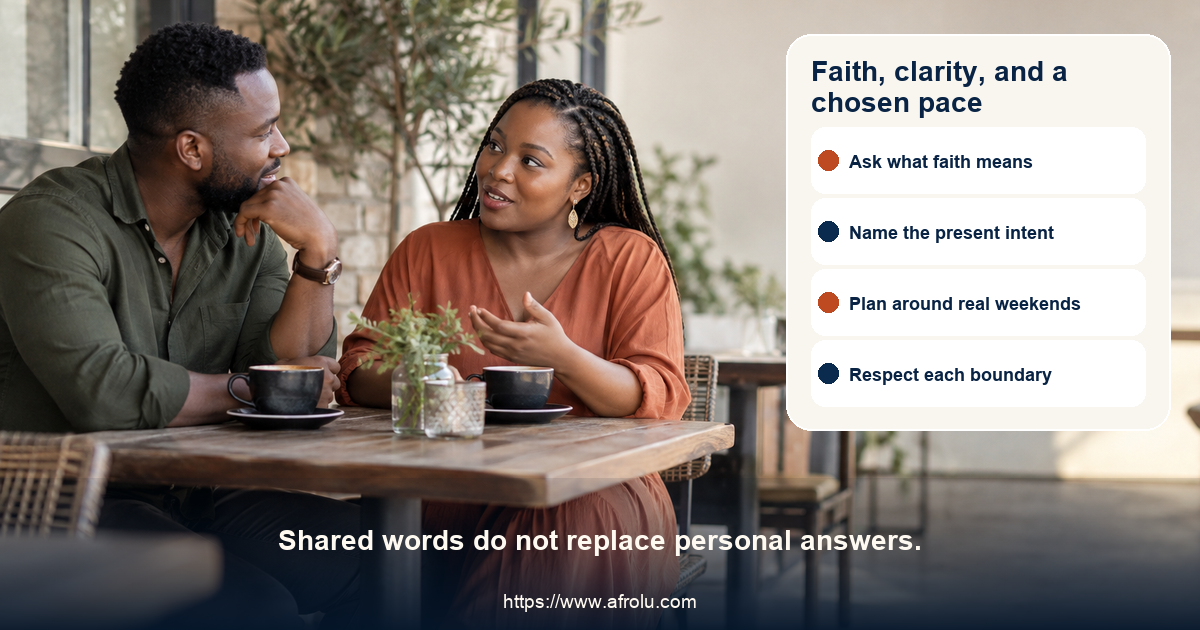
Clarify practice, intent, and weekend availability without assumptions.
Written and edited by Tariro Ncube · Diaspora Dating Editor
Describe what faith means in your own life, then ask what it means to the other adult; do not infer doctrine or a timeline from a label. Compare real weekend commitments, discuss exclusivity separately, and raise family or future questions when they affect a choice. A faith-informed boundary is still personal, and no partner, relative, or leader should use shame or authority to make a no feel unsafe.
Dating basics · Faith-Led Daters
How can adults date with faith-led intentions while clarifying practice, weekend availability, future expectations, and consent?
Faith-led dating is a personal approach in which belief or spiritual practice informs some relationship choices. Adults define what that means for them. Weekend availability, exclusivity, intimacy, family, and future hopes still need direct conversation and voluntary agreement.
After two enjoyable dates, Amara and Joel realise they both describe themselves as faith-led but have different weekend routines. Amara reserves Sunday morning for worship and family; Joel works some Saturdays and values a quiet Sunday afternoon. They compare calendars and agree on a short Saturday date twice a month. Neither has to prove devotion by missing a commitment, and both keep the future conversation open.
faith-led · personal practice and time
Let belief be part of the conversation, not a substitute for it
Separate a personal faith label from assumed doctrine, a weekend rhythm from a loyalty test, and guidance from coercion.
Describe lived practice, compare actual schedules, ask consequential questions, and preserve each adult's freedom to choose.
What does belief mean to you?
Let each adult describe it personally.
Which weekend windows work?
Respect worship, work, family, and rest.
Which values affect a next step?
Ask about intent, family, and children.
Can both adults say no freely?
A boundary should not require a spiritual defence.
faith · values · personal practice
Start with your own practice before asking whether someone is faith-led
Faith-led dating is not one universal template. For one adult it may mean prayer or worship is part of a weekly routine; for another it may mean a moral framework, community connection, or a hope for a partner who shares core beliefs. Some people are observant, questioning, private, or changing. Let each person describe what their faith means rather than asking them to prove authenticity.
Before a date, consider what you want a partner to understand: time reserved for worship, food or alcohol boundaries, sexual ethics, family involvement, children, or how you make difficult decisions. You do not have to disclose every private belief immediately. You can state the practical boundary that affects the date and decide when deeper conversations feel appropriate.
Ask the other adult the same open question and listen for how they describe choices, not just the label they use. Shared religion does not guarantee compatible expectations; different traditions do not guarantee conflict. What matters is whether both people can explain their views without ridicule, pressure, or an assumption that one person must eventually convert or conform.
Do not treat a dating article as religious authority. If a question depends on doctrine, ask a trusted leader or source within your own tradition, while remembering that the personal relationship decision remains yours. A healthy conversation can respect spiritual guidance and still leave each adult able to ask questions, set a boundary, and decide freely.
weekends · routine · shared time
A weekend-first dating rhythm should make room for practice without hiding the rest of life
Ask which parts of the weekend are usually unavailable, which events are occasional, and how much notice helps. Someone may attend a service, volunteer, host family, work a shift, or keep one day quiet. Avoid reducing an entire tradition to a presumed weekly schedule; the person can tell you what is true in their life now.
A workable plan might be a late afternoon walk, a short call after a community event, or dates on alternating weekends. The format is less important than whether both adults can participate without rushing through a commitment they value. If weekends are the only shared window, discuss whether that pace is enough for both people or whether a weekday option is realistic.
Notice whether planning effort is shared. One adult should not always travel, rearrange worship, or choose between a date and a family obligation. Sometimes a schedule will not align; that is information about compatibility, not evidence that someone cares less. Ask what flexibility exists and accept an honest no rather than bargaining against a stated practice.
Keep space for rest and friendships too. Faith practice should not be used to demand unlimited access to a partner's community, nor should a date expect someone to miss a valued event as proof of romantic interest. A schedule can be negotiated while a core boundary remains intact. If no meeting rhythm works, consider whether a different pace or relationship structure suits you.
intent · family · future
Talk about serious intent through the decisions faith may actually shape
If partnership or marriage is your aim, ask how the other adult understands a serious direction, how long they prefer to date before major decisions, and which family or community conversations matter. The answer may be clear or still developing. A concrete difference—such as whether children should be raised in a tradition—deserves attention before either person treats the relationship as settled.
Do not assume that a faith label answers questions about gender roles, finances, work, caregiving, sexuality, or household decisions. Ask what partnership looks like in practice: who makes decisions, how disagreement is handled, and what each person considers fair. Listen for respect as well as similarity. A shared vocabulary can make a mismatch less visible if nobody explains what it means.
Family or community introductions may be important, but timing and meaning vary. Ask whether an introduction is a casual meeting, a sign of serious intent, or a step someone is not ready to take. It is reasonable to want clarity about a long-term relationship; it is not reasonable to use relatives, leaders, or public pressure to force a commitment the other adult has not chosen.
The purpose is not to interrogate someone for a perfect answer. Share your own view, say which questions are non-negotiable, and acknowledge what you are still considering. If both adults can discuss a difference with curiosity, there may be room to learn. If one person mocks the other's belief or treats disagreement as disobedience, the issue is not merely theological compatibility; it is how power is used.

Discuss which values are shared, different, or not yet decided.
consent · boundaries · power
Faith can inform a boundary, but it must not be used to pressure someone past it
Talk about physical and digital boundaries in direct language. Adults may choose abstinence, different forms of intimacy, or a pace shaped by personal belief; partners can ask questions without ridiculing those choices. Consent remains specific and ongoing. A prior yes, a private conversation, or a religious commitment does not create blanket permission for a new activity.
Be alert to pressure disguised as certainty: someone says a good believer must submit, marry quickly, provide sexual access, share a device, or keep a harmful secret. A sincere disagreement about doctrine is different from using spiritual fear, public shame, money, or authority to make refusal feel unsafe. You can pause the relationship and seek advice from someone you trust outside that pressure.
Religious leaders and mentors may offer guidance, but no dating partner should use a title or community role to demand private access or silence. If a leader also controls housing, employment, education, or spiritual standing, consider a confidential second opinion. This page cannot decide a doctrine question or determine whether a particular person's conduct violates law or institutional rules.
RAINN describes consent as voluntary, specific, and ongoing, including the right to change one's mind. Its hotline serves people in the United States; readers elsewhere should use services available in their location. Whatever your tradition, a respectful partner can hear a boundary without threatening to expose you, punish you, or make your faith identity conditional on compliance.

Listen to a no without spiritual pressure or shame.
first dates · logistics · comfort
Choose a first date that fits both adults' boundaries and leaves each person free to leave
Ask what kind of setting feels comfortable: daytime coffee, a walk in a public place, a community event, or another option both people choose. Do not assume that a religious venue is automatically appropriate or that one adult wants their dating life visible to a congregation. The person should be able to explain their preference without being assigned a rule.
Be specific about food, alcohol, dress, timing, and transport if any of those affect comfort. Someone can choose not to enter a bar, share a meal, or accept a ride, and can suggest an alternative. Agree on the place and duration before leaving. Keep enough independence to change the plan if the meeting feels different in person.
A first date is not a test of how closely a person follows a tradition. Nor is it a chance to persuade them out of a boundary they have already named. If the proposed location or time does not work, ask what would. If no option feels right to one adult, postpone or decline rather than framing the refusal as a spiritual or romantic failure.
Use current local information for transport and venue logistics; an editorial guide cannot report real-time conditions or guarantee safety. If a person changes the destination without agreement, asks you to keep the meeting secret for reasons you do not understand, or makes leaving difficult, you can end the date and seek help suited to your setting.
belief · behaviour · trust
Notice how belief appears in everyday conduct, not only in polished dating language
A person may use faith language fluently and still behave inconsistently; another may be quieter about belief and live their values carefully. Avoid treating clothing, social-media posts, community roles, or a profile badge as proof of character. Learn through the way each adult handles a boundary, a disagreement, a changed plan, and another person's independent life.
Ask what happens when two values conflict. Can each adult explain why something matters, hear the other's account, and decide whether a compromise is possible? Some matters are negotiable; others are not. A thoughtful conversation can end in respectful incompatibility. It does not require one person to dilute a core conviction to preserve the appearance of harmony.
Notice whether accountability moves in both directions. Does one person apologise and change behaviour after causing harm, or use faith to excuse themselves while policing the other? Are different standards applied to each partner? A repeated double standard may be more important than a disagreement about a particular practice because it affects whether both people have equal voice.
Keep your own trusted relationships and practices. A new partner should not require you to cut off friends, abandon a community, surrender private reflection, or treat them as the only source of truth. If a connection moves very quickly from admiration to isolation or shame, talk it through with someone who can listen without controlling your choice.

Keep independent judgment and supportive relationships intact.
review · compatibility · choice
Review the weekend rhythm and the relationship direction before either becomes resentment
After several dates, ask what the current rhythm feels like: enough connection, too much pressure, or simply hard to coordinate? Check whether both adults initiate, whether important weekend commitments are respected, and whether any compromise has become one-sided. A busy month can change availability; it should not silently change the relationship agreement.
Review any serious questions that affect a next step: exclusivity, community introductions, family involvement, children, marriage, or how each person practises faith. You do not need to settle every topic at once. Pick the question that could change your decision now, hear the answer, and decide whether the remaining uncertainty is acceptable to you.
If your beliefs or feelings change, you can tell the other adult without demanding that they change too. A respectful response may include disappointment, questions, or a decision to part ways. It should not include threats, exposure, financial punishment, or spiritual coercion. If you worry that leaving or setting a boundary could create danger, consult confidential support in your area before acting.
A faith-led relationship can be meaningful without having identical practices, and a shared faith does not guarantee compatibility. What matters is whether both people can make their own choices, speak honestly about their commitments, and treat difference without contempt. You may continue, adjust the pace, or end dating. The decision belongs to the adults living it.
Eight dating moments about personal practice, weekend time, consent, and community pressure

The label is clear, the practice is not
A profile says faith-led but leaves daily expectations unspoken.
Ask what belief changes in the person's actual choices.Only one person's calendar counts
Dates repeatedly require one adult to miss a valued weekly commitment.
Compare both schedules and find a plan neither has to resent.Serious is treated as automatic
One adult believes faith-led dating means immediate exclusivity; the other does not.
Discuss exclusivity as a separate agreement.An introduction becomes a deadline
Relatives or a community event are used to force a commitment.
Ask what an introduction means and decide without public pressure.A no is called a faith failure
A partner uses spiritual language to push past a physical boundary.
Stop the interaction and seek support outside that pressure.Traditions are assumed to match
Two people use the same label but have different practices or expectations.
Ask specific questions and decide whether the differences are workable.The venue is chosen for you
A person assumes the other adult will accept a religious or private location.
Choose a setting and duration both adults freely prefer.The weekend rhythm creates resentment
One adult keeps rearranging work, worship, rest, or family every week.
Name the cost and review whether a mutual schedule exists.Fourteen signs a faith-informed dating path still leaves room for two free choices
Each adult can describe what faith-led dating means personally.
A shared label is not used as proof of shared doctrine or observance.
Weekend practices and work commitments are discussed rather than assumed.
Both people have a voice in the time, venue, and cost of a date.
Exclusivity and serious intention are discussed as separate decisions.
Questions about family, marriage, or children are raised without a forced deadline.
Either person can ask a belief question without ridicule or interrogation.
Personal spiritual or physical boundaries are accepted without shaming.
No one uses faith language to demand intimacy, money, silence, or account access.
A religious title or community role does not remove the need for independent advice.
Difference can be discussed without threats or a double standard.
Each person keeps supportive relationships outside the dating connection.
A first date has agreed logistics and a way for either adult to leave.
A review can lead to continuing, changing pace, or ending without coercion.
A decision map for practice, family, boundaries, venue, and pace
| Situation | What it may mean | What to do next |
|---|---|---|
| They say faith-led | The label may not explain daily practice or expectations. | Ask which choices faith shapes for them personally. |
| Weekends do not align | Work, worship, family, or rest may compete for the same time. | Compare actual schedules and test another rhythm. |
| They expect exclusivity | A belief or dating label may be treated as an agreement that was never made. | Discuss exclusivity directly and decide whether you consent. |
| Family wants an answer | Community pressure may be replacing a private decision. | Ask what you want before responding to relatives or leaders. |
| A boundary is challenged | Spiritual language may be used to make refusal feel shameful. | Pause; seek trusted support outside the pressure. |
| Our practices differ | A shared identity may hide a meaningful compatibility question. | Name the specific difference and what each person can accept. |
| They choose the venue | A date setting may not fit both adults' beliefs or comfort. | Offer alternatives and accept a no from either person. |
| A leader is involved | The role may carry influence beyond the relationship. | Get a confidential second opinion if you need one. |
| The pace feels rushed | A future promise may be asked for before trust and compatibility develop. | State the pace you can choose without pressure. |
| My belief changes | Your relationship or practice may need a new conversation. | Share what changed and let each adult choose their next step. |
Twelve ways to ask about faith and weekends without assuming an answer
“What does faith-led dating mean in your ordinary week, rather than only in your profile?”
“Saturday is full for me, but Sunday afternoon could work. What does your weekend usually allow?”
“I want to talk about seeing other people separately from our shared faith language.”
“I do not drink, and I would prefer a public cafe. Would that setting work for you?”
“What would meeting family mean to you, and when would it feel appropriate?”
“If we continue, how important is it to you that children share a particular practice?”
“I am not comfortable with that, and my answer is not a test of my faith or affection.”
“We seem to practise differently. Could we talk about what is non-negotiable for each of us?”
“I need advice from someone outside our relationship before deciding about this.”
“I do not want either of us to keep missing an important commitment; can we try another time?”
“Which part of our dating rhythm feels respectful, and which part needs to change?”
“I respect your beliefs, but our expectations are not compatible enough for me to continue.”
Know the difference
Faith-led clarity versus a relationship shaped by assumption or spiritual pressure
Both adults explain what belief means to them, plan around real weekend commitments, discuss future questions, and respect a boundary or different answer.
A label, leader, relative, or partner is used to dictate a timeline, require intimacy, or treat one person's practice as the only valid choice.
Faith can inform a relationship without replacing each adult's consent.

Faith may inform dating but cannot replace consent or personal agency.
Mutual faith-led clarity is different from a relationship role imposed through pressure
| Type or dimension | What it describes | Best next question |
|---|---|---|
| Faith-led | Belief informs dating choices in a way the adult should define personally. | Ask what it changes in everyday life. |
| Serious intention | A relationship direction that does not itself settle exclusivity. | Discuss what is agreed now. |
| Exclusive | A mutual decision about other partners. | Do not infer it from shared belief or regular dates. |
| Weekend-first | Meetings usually happen on days off or around weekly commitments. | Compare both people's actual calendars. |
| Slow dating | A deliberate pace for learning compatibility. | Name the questions that still need an answer. |
| Interfaith | Adults have different religious identities or practices. | Ask which differences are negotiable and which are not. |
| Private practice | A person keeps some spiritual matters outside public dating. | Respect privacy while clarifying decision-relevant terms. |
| Community-connected | Family or a faith community may be part of support and life. | Ask what introductions mean to each adult. |
| Undefined | A relationship term or future question remains unanswered. | Choose whether that uncertainty is acceptable now. |
A simple plan you can use today
Faith is personal
A label does not tell you a person's practice, doctrine, or timeline.
Weekends vary
Work, worship, family, community, and rest shape each adult's availability differently.
Shared belief is not a contract
Exclusivity and commitment still need explicit agreement.
Boundaries remain yours
No belief label, date, or relationship stage replaces ongoing consent.
Community can carry power
A leader or family member may influence choices; independent advice can help.
Difference reveals fit
Compatibility depends on how adults discuss non-negotiables, not just shared words.
Questions organised by purpose and depth
Choose a few prompts that fit the moment. This is a reference library, not a list to complete.
Personal practice
Share a lived answer rather than testing identity.
- What does faith mean in your week?
- Which boundaries matter in dating?
- What is private for now?
Weekend rhythm
Look for a workable window rather than a loyalty test.
- Which commitments are fixed?
- What time can we both protect?
- How do we handle a busy weekend?
Future questions
Raise the decisions that affect your next step.
- What does serious mean?
- How important are family introductions?
- Which views about children are non-negotiable?
Respect and power
Make room for a voluntary yes and a safe no.
- Can either of us disagree freely?
- Does someone hold authority?
- Who can offer independent guidance?
What deserves a closer look
What does faith-led dating mean?
Ask what belief changes in everyday choices, how private practice is, and which relationship decisions matter most. Give each adult room to describe a changing or questioning relationship with faith.
Evidence limit: This guide is not a religious authority and cannot interpret doctrine for a reader.
How do we plan around worship and family?
Compare actual calendars and ask what events are fixed, occasional, or flexible. Try a date window that does not require one person to miss something important repeatedly.
Evidence limit: Traditions and individual schedules vary; do not generalise from a faith label.
Which future questions need early clarity?
Discuss exclusivity, family involvement, children, marriage hopes, and partnership roles when each affects a choice you are making. Raise one concrete question at a time.
Evidence limit: Neither a shared belief nor a first date predicts compatibility.
Can faith influence an intimacy boundary?
An adult may set boundaries based on belief, comfort, health, or preference. Consent remains specific and ongoing, and pressure or shame does not turn a no into a yes.
Evidence limit: RAINN support resources are U.S.-specific; other services depend on location.
What if a partner or leader has authority?
Consider whether refusal could affect housing, work, education, community access, or personal safety. Seek a confidential perspective from someone outside the relationship if needed.
Evidence limit: Applicable institutional policies and law depend on the setting.
How can interfaith or different-practice dating work?
Adults can explore what is shared, what differs, and which questions affect a future. Compatibility is not guaranteed by similarity or ruled out by difference; mutual respect matters.
Evidence limit: No single guide can decide a couple's theology or future.
Shortcuts that confuse a label, a leader, or a family expectation with consent
Assuming a shared label means shared practice
People interpret and live faith differently.
Treating serious intent as exclusivity
A direction and a present agreement answer different questions.
Using weekends as a loyalty test
One person's worship, work, or rest should not be dismissed to prove interest.
Letting family announce a commitment
Public expectation cannot replace both adults' private choice.
Calling pressure a spiritual duty
Shame or threat does not create voluntary consent.
Treating a leader as the only adviser
A role may be influential; independent counsel can protect perspective.
Discuss serious intent, weekend availability, or a personal boundary
Afrolu is not a religious authority or emergency service. For doctrine, institutional, or safety concerns, seek a trusted source or qualified support in your location.
Explore the guide library
Show more related guides
Continue with Afrolu
Show more Afrolu guides
Sources used for this guide
Afrolu reviewed these health, research, safety, or public guidance resources while editing this page. They support the behaviour and safety guidance; they do not diagnose any individual described by a reader.
Questions about faith-led dating and weekend compatibility
What does faith-led dating mean?
There is no single definition. Ask what belief or spiritual practice changes in the person's daily choices, relationship expectations, and future hopes.
Should faith-led dating happen only on weekends?
Not necessarily. Some adults reserve weekend time for worship, family, or rest; others have different schedules. Compare actual availability rather than assuming one routine.
Does shared faith mean we are exclusive?
No. Exclusivity is a separate agreement about other partners. Discuss it directly, even when both adults share a religious identity.
How do we discuss different practices?
Describe your own non-negotiables and ask the other adult about theirs. Focus on choices that affect the relationship rather than testing who is more authentic.
When should we discuss marriage or children?
Raise the question when it affects a next decision, but do not demand an instant life plan. Share what you know, what remains open, and which differences would matter.
Can a partner use faith to pressure me?
A belief label does not make pressure or shame into consent. You can pause, seek advice from someone you trust outside the relationship, and choose a boundary.
Is a religious leader always the right person to advise us?
A trusted leader may be helpful, but you can seek a confidential second perspective, especially if that person has influence over your work, housing, education, or community standing.
How should we choose a first date?
Agree on a place, timing, cost, and transport that fit both adults' boundaries. No venue guarantees safety; use current local information and keep a way to change the plan.
Can interfaith dating be serious?
It can be, but the adults need to discuss which beliefs, practices, family expectations, and future decisions are important to each of them.
How do I know if the weekend pace fits?
Notice whether both people contribute, whether valued commitments are respected, and whether the amount of contact works without recurring resentment.
One thing to do now
Make room for faith, honest difference, and a voluntary choice
Ask what belief changes in each person's real week, compare weekend schedules, and discuss the specific relationship term that affects your next decision. State boundaries without shame, listen for equal voice, and seek independent support if faith or community authority is used to pressure a choice. Continue only at a pace both adults can freely choose.