The six-door commitment courtyard
Faith-Led Serious Dating in Nairobi Before Courtship or Engagement
A Nairobi guide to faith-led serious dating, courtship and engagement, with clear choices about exclusivity, privacy, consent, money and safety.
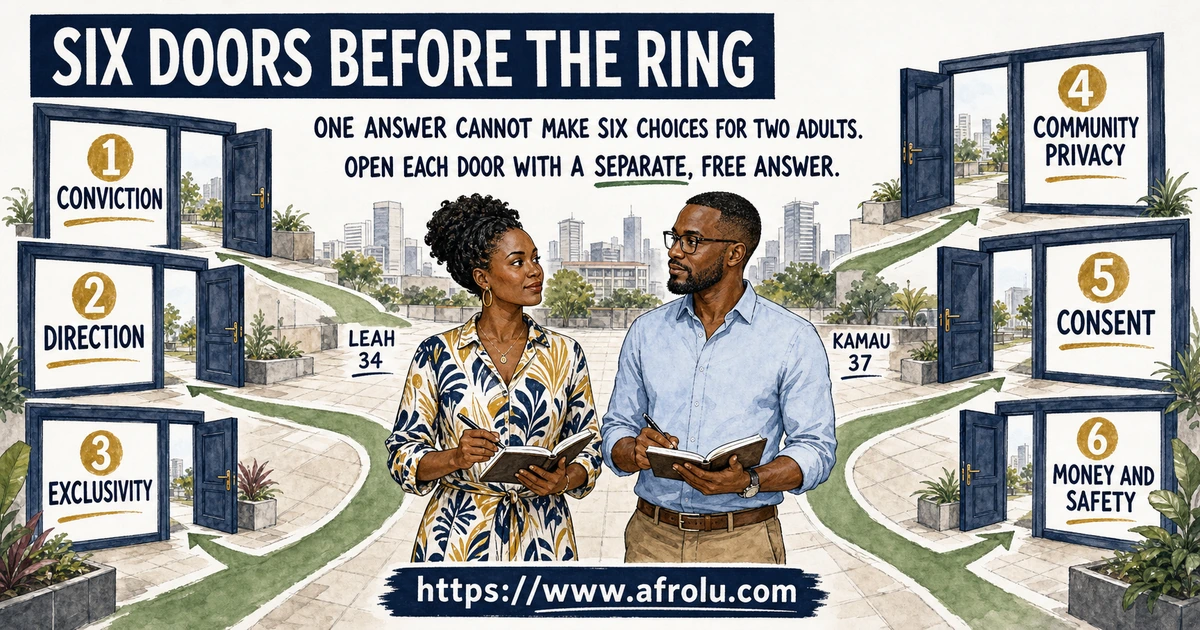
Faith-led serious dating still needs separate answers about conviction, direction, exclusivity, community privacy, consent, money, and safety.
Written and edited by Samira Benali · Faith and North Africa Editor
Give each relationship word one job. Faith-led dating describes the values and practices that guide how you date. Serious dating describes an honest direction toward a long-term partnership, not a guaranteed outcome. Courtship is a chosen time for deciding whether to marry. Its customs and community role vary, so define yours rather than assuming a shared script. Engagement begins only after both adults have privately and freely decided to marry. It is a commitment to plan a marriage. It is not consent to sex, account access, debt, living together or publicity. Other people cannot choose the wedding date. Then open six doors. They cover personal conviction, relationship direction, exclusivity and community privacy. They also cover consent for touch and private access, plus money and daily-life readiness. A Nairobi relationship may be visible to a congregation or family network very quickly, but visibility is not a decision. Keep early meetings public, transport independent, phone and mobile-wallet credentials private, and disclosures limited to what both adults approved. Move toward courtship or engagement only when ordinary conduct supports the label. Either person must still be able to ask for time, revise a boundary or say no without spiritual, social or financial pressure.
Relationship intent · Faith-Led Daters
How can two adults date toward commitment in Nairobi while keeping faith, serious intention, courtship, engagement, community involvement and consent distinct?
Faith-led serious dating is an adult relationship that may lead to a long-term partnership. Personal religious or spiritual beliefs shape how both people date. Faith-led answers, 'What values guide my choices?' Serious answers, 'What future am I honestly open to?' Neither term settles exclusivity, pace or physical boundaries. It also cannot decide community access, money, marriage timing or compatibility. Those questions require their own mutual answers. This guide uses faith broadly because Nairobi adults follow different religions and practise their faith in different ways. This guide does not tell anyone what to believe. It offers a decision map that leaves each adult free to follow their convictions, seek trusted counsel and decline an incompatible relationship. Every dating example and every pictured dating subject in this guide is an adult aged 25 or older.
Leah is 34, works in quantity surveying near Upper Hill and lives in South B. Kamau is 37, manages logistics in Industrial Area and lives in Kasarani. They are fictional composite adults, built from common decisions rather than presented as reported people. A mutual friend introduces them after a Saturday service project connected to their faith communities. Both say they are dating with marriage in mind. The sentence sounds complete, especially when their friend starts joking about a wedding, but it contains several unanswered questions. Leah means that she will not continue a connection that has no real path toward marriage. Kamau means that marriage is his preferred future if affection, family fit and practical life align. Neither has agreed to exclusivity. Their congregations know different amounts. Their views on physical affection are close but not identical. Kamau assumes courtship would begin after a family introduction; Leah thinks courtship begins only after a private conversation and a defined review period. Their fourth date is at a staffed cafe. It is convenient for neither person, but both can control their journey home. They stop asking whether they are 'equally serious.' They draw six doors on a page. Behind each door they write one present agreement, one unanswered question and one person who may know. That page prevents a warm public story from becoming a private trap. Over the next twelve weeks they see ordinary Nairobi life. A workday runs late. A cross-city plan is cancelled. They handle separate Sunday commitments, a request for mobile money and a relative's video call. They also discuss photographs and a physical boundary directly. At the review they choose exclusivity, but not courtship yet. Eight weeks later they enter a defined courtship. First they discuss money, children, work, care duties, health and housing. They also discuss faith practice and how either person could stop. Their eventual engagement is a fresh private yes before it is a ring, a family announcement or a group celebration.
The six-door commitment courtyard
Walk through six separate agreements before asking for one larger promise
Picture commitment as a Nairobi courtyard with six doors opening onto one shared space. A couple may stand together in the centre and still have different keys. Opening one door does not unlock the others. Shared worship does not create exclusivity; exclusivity does not create physical consent; courtship does not merge money; engagement does not surrender privacy.
For each door, write three lines: my current answer, our mutual agreement and the next review point. Add a fourth line where community is involved: who may know what. The method is deliberately modest. It lets a couple honour conviction without pretending that certainty exists before evidence.
What do I freely believe and practise?
Name worship, ethics, family duties, physical choices, service, food, celebrations and future hopes in first-person language. A personal conviction is not yet a rule imposed on a date.
What future are we genuinely exploring?
Serious intention means a possible long-term partnership is the purpose of dating. It does not promise that compatibility will be found or that a wedding must follow.
Are we exclusive, and what does that mean?
Say whether either adult may date, message romantically or remain physically involved with someone else. Do not infer the answer from prayer, frequency, family visibility or seriousness.
Who may see, advise or share?
Separate confidential counsel from public announcement. Agree before names, photos, health details, prior relationships, family circumstances or a new label enters a group chat.
Can consent change without punishment?
Consent applies to touch, sex, photographs, location, home access, prayer, counselling and disclosure. A free yes remains revisable; a no does not need a doctrinal defence.
Can money and practical life stay honest?
Keep rent, debt, family support, giving, transport, wedding expectations and future housing visible without merging accounts or making spending proof of love.
Start in the middle
Use the six-door map before the next relationship label
The six doors are not six levels. A couple does not have to finish one before talking about another. The map simply stops one answer from pretending to answer everything. Shared faith can open the conviction door. It cannot open exclusivity, consent or money.
Read the doors in pairs. Conviction and direction ask what each adult believes and which future the couple is exploring. Exclusivity and community privacy ask what the present relationship allows and who may know about it. Consent and money and safety protect each adult's body, private access, accounts, transport and power to leave.
Leah, 34, and Kamau, 37, each write one short answer for every door. They compare answers, circle the door that still needs a talk and choose one next action. They do not use the map to score each other. They use it to find the question hidden by the word serious.
Begin with language that cannot borrow authority
Give faith-led dating, serious dating, courtship and engagement four different jobs
Faith-led dating is the widest of the four ideas. It says that belief is not kept outside the relationship; convictions influence choices about conduct, purpose, community, service, sex, family and marriage. Two faith-led daters may still choose very different relationship structures. One may be meeting several people honestly while deciding. Another may be exclusive. A third may be in a formal courtship. The phrase is a values lens, not a complete status update.
Serious dating describes direction. The adults are not maintaining the connection only for entertainment or an undefined present. They are testing whether a long-term partnership is possible. Serious direction still includes uncertainty. It should make difficult questions more discussable, not force a result. A person may be completely sincere about wanting marriage and still discover that this particular relationship should end. That ending does not prove the intention was false.
Courtship is a chosen structure for deciding whether marriage is right. Some adults use the word for exclusive dating with family or faith-community awareness. Others reserve it for a formal plan with advisers, boundaries and a time frame. Neither definition is universal. Before using the label, say whether courtship includes exclusivity. List the decisions it will explore and the people who may advise. Mark what stays private, when the first review happens and how either adult may leave.
Engagement is narrower and larger: a mutual decision to marry. A proposal can invite that decision, but surprise, an audience, a ring or family expectation must not supply the answer. Engagement starts with a free yes between the adults. It creates work to do together about marriage, ceremony, law, home, money, health and family. It does not create blanket consent, ownership, account access, debt liability or permission to publish intimate information. If the answer changes, social embarrassment is not a reason to continue toward a marriage one adult no longer chooses.
Let ordinary city life test the beautiful sentence
Leah and Kamau replace one public story with six private answers
The introduction carries social warmth. Their mutual friend knows both adults through service and assumes that this proves the match is safe. Leah and Kamau appreciate the context but keep the first dates ordinary: staffed public places, clear end times and separate journeys home. Community familiarity provides one piece of information; it cannot reveal private behaviour, relationship history, financial stability, health, compatibility or how someone responds when disappointed.
Nairobi geography enters the relationship before romance can edit it out. A plan between Kasarani, South B, Upper Hill and Industrial Area can be affected by work, weather, traffic and transport choices. They do not turn every late arrival into a character judgment, but they do watch how changes are communicated. Kamau once cancels too late after a warehouse issue. Leah names the wasted preparation without calling him unserious. He apologises, pays only the cost they had agreed he would cover and lets her choose whether to reschedule. The repair is more useful than a dramatic promise that no plan will ever fail again.
Their first real conflict concerns a photograph. Kamau wants to send it to a family WhatsApp group after relatives ask about the woman he is seeing. Leah is comfortable with one sibling knowing but not with a photo or the word courtship. Kamau initially hears secrecy. The fourth door changes the discussion. The question is not whether Leah is proud of him. It is who may receive her image and which label is accurate. They agree on one sentence, no image and no forwarding. Community becomes support without becoming an audience that writes the next chapter.
The money test is smaller but revealing. Leah sends Kamau her part of concert tickets through mobile money. A week later he asks whether she can cover fuel for a family visit because his month is tight. She can afford it but asks what the trip means and whether she is expected to attend. He realises he has bundled three requests: money, family visibility and travel. They separate them. Leah declines the transfer and the trip, while remaining interested in the relationship. Kamau accepts the answer. A serious relationship becomes more believable because a small no can survive inside it.
At twelve weeks, they are not ready for the word courtship. They have enough evidence to choose exclusivity and another review period. That smaller decision protects the meaning of the larger one. When they later choose courtship, they write its purpose: to explore marriage compatibility across faith practice, conflict, children, money, work, home, family and health. Their advisers receive questions, not voting rights. Their private answer remains the centre of the courtyard.

A warm public story cannot answer private relationship questions. Two adults should write their own agreements before a community names the relationship.
Ask for two yeses instead of one impressive label
Serious intention and exclusivity answer different questions
Ask about intention first. Are you dating to explore a lasting partnership with each other? Then ask whether you have agreed not to pursue romantic or sexual connections with other people. A person can say yes to the first and not yet to the second. That does not automatically make them dishonest. It means the structure needs a direct conversation before either adult relies on it.
Define enough detail to prevent two private versions. Does exclusivity cover dating apps, active dates, flirtatious messaging, sexual contact, former partners and new introductions? What existing contact needs to be disclosed? What sexual-health conversation is relevant? What happens if either adult changes their mind? The aim is not surveillance. It is a usable promise whose boundary can be understood without reading a phone or asking friends to monitor behaviour.
Do not use faith practice as indirect evidence. Praying together, attending a service, sharing devotional material, meeting a leader or volunteering side by side may matter deeply. None of those actions is a substitute for the exclusivity sentence. Likewise, an exclusive agreement does not prove shared theology, emotional readiness, marriage compatibility or a fixed timeline. It is one structure, not the whole relationship.
Put a review date beside a serious agreement. Leah and Kamau choose six weeks because it includes demanding work periods and separate community commitments. Another couple may choose a different period. At review, compare kept plans, honesty, repair, boundaries, ordinary generosity, differences and the questions that remain. Do not use a deadline to coerce courtship. Its purpose is to stop silence from becoming the default agreement.

Serious intention asks about a lasting future. Exclusivity asks about other romantic or sexual connections now. Each answer needs a separate mutual yes.
Invite witness without surrendering the story
Build three circles: mine, ours and public
The personal circle contains information each adult controls. This includes health, past relationships, private messages, spiritual doubts, family conflict and income. It also includes location patterns, photographs and experiences shared in confidence. Dating does not automatically move these facts into the shared circle. Ask before recording, forwarding, adding someone to a group, sharing a testimony or turning a private struggle into a prayer request. Good intentions do not reverse an unauthorised disclosure.
The shared circle contains what the couple has mutually agreed to hold and discuss: their current label, direction, boundaries, questions and selected practical plans. Even here, access is not unlimited. One adult can tell a counsellor or trusted person enough to seek safety or support. A privacy agreement should never require secrecy about harm. The difference is between getting necessary help and publishing details to recruit pressure, curiosity or punishment.
The public circle needs the smallest accurate statement. 'We are getting to know each other seriously' may be enough. Courtship and engagement should be used only after the adults choose them. Decide whether names, photos, workplaces, home areas, family details and timing may be shared. In a close congregation or social network, a single post can travel beyond its intended audience. Permission to tell one person is not permission for that person to announce it.
Advisers need a clear, limited role. Each adult may choose a faith leader, older couple, relative, therapist or trusted friend. The couple should name the question and the information the adviser may receive. Advice can expose a blind spot; it cannot vote over consent or force two people to stay in a poor match. A wise adviser can say, 'Here is what I notice,' while leaving the adult to say, 'Here is what I choose.'
If a breakup happens, use a closure agreement. Return belongings, end shared access, settle only genuine agreed costs and choose a neutral public sentence. Do not contact the other person's leader, employer or relatives to force reconsideration. Do not share confessions, images or health details to defend your reputation. Where threats, stalking, outing or image abuse appears, move beyond etiquette and seek suitable local legal, safeguarding or support services.

Separate personal, shared, and public information. Permission to tell one trusted person is not permission to announce; safety support remains available.
Keep every yes free, specific and changeable
A faith boundary belongs beside consent, never in place of it
A person may choose a physical boundary because of faith, comfort, health, past experience or simple preference. They do not owe a persuasive explanation. A useful sentence is specific: 'I am comfortable holding hands, not kissing.' Add the plan: 'I want dates to end before we go to either home.' The other adult may agree or decide the match will not work. They may not shame, debate or repeatedly test the boundary until resistance becomes exhausting.
Consent is not a one-time moral category. It is needed for each sexual or affectionate act and can change. It also matters outside touch. Ask before entering a home, taking a photo or sharing a location. Ask before joining a private prayer, involving a counsellor, reading messages or announcing an engagement. These choices are not identical in law, but the everyday relationship principle is consistent: ask for the access you want and accept the answer.
Kenya's Sexual Offences Act defines consent for that Act as agreement by choice with freedom and capacity to make the choice. That legal text is not a complete dating manual, and this article does not interpret a particular incident. It supports one essential limit. Force, threats and intimidation do not become acceptable when people are serious, courting or engaged. A faith ceremony and other people's hopes do not change that limit. Personal legal questions need qualified help.
Faith language becomes pressure when it makes refusal costly. A person might claim that God revealed the match and call a no rebellion. They might say forgiveness requires private access or threaten exclusion from community. They might use scripture to excuse sexual, financial or emotional harm. They might demand private details as proof of honesty. The National Domestic Violence Hotline describes spiritual abuse as including beliefs used to manipulate, shame or excuse abuse. Its service context is American, but the warning is useful without diagnosing every disagreement as abuse.
Use a response test after any boundary. A respectful partner may feel disappointed and still stop, ask what plan works, or decide the mismatch is too large. A concerning response adds guilt, anger, bargaining, spiritual authority, public pressure, repeated requests or consequences. Do not keep a private meeting merely to prove that you are calm. Move toward people, transport and support you control. Immediate danger requires urgent local help, not another relationship conversation.

A changed yes is a no now. A respectful adult stops, accepts the answer, and protects the other person's independent exit without debate or spiritual pressure.
Talk about money without making it hard to leave
Discuss money in layers before wedding hope creates shared risk
Start with date-level money: venue, transport, tickets, food, cancellations and giving. Choose plans each adult can afford without sacrificing rent, food, debt obligations, medicine, family support, worship commitments or emergency savings. Fair does not always mean equal, but it must be freely discussed. The person who pays has not bought time, touch, home access, exclusivity, family approval or a favourable courtship decision.
Next discuss financial habits without demanding account control. Topics may include income stability, debt, saving, dependants, remittances, giving, business obligations, credit, insurance and attitudes to risk. Share enough facts that you can check for the decision being made. Early serious dating rarely requires statements, PINs, passwords, one-time codes or remote access. A refusal to hand over credentials is ordinary security, not evidence of a secret relationship.
Keep generosity and emergency stories separate. A date may face a real problem, but romantic urgency makes verification harder. The U.S. Federal Trade Commission warns against sending money or gifts to an online love interest not met in person. Reporting routes differ in Kenya, but the protective step is still useful. Do not send money because a new relationship makes an unverified request feel morally urgent. This includes fare, medical, investment, charity and family stories. Find any institution through your own search.
Courtship can justify deeper questions, not automatic financial merging. Ask how rent, housing location, household labour, care for relatives, children, wedding costs, customary or family expectations and faith giving might be handled. Kenyan family and marriage customs vary widely, including within the same faith, so each adult should describe their actual expectations. 'Our families will decide' is not a budget. Record estimates, decision owners and limits before any deposit or debt.
Engagement should make money facts more concrete while each adult keeps control. Agree who may book vendors, whose name is on each contract, what happens if plans change and which expenses are refundable. Do not sign a loan, guarantee a debt, transfer property or open a joint account only because ending the engagement would be embarrassing. Those choices can carry serious legal and financial effects and deserve independent qualified advice where relevant.
Use evidence to choose the next label
Stand at the centre and decide which door is actually open
Review the relationship after enough ordinary life has appeared. Include a plan that changed, a money limit, a difference in belief or practice, separate time, a community boundary and a direct consent conversation. The goal is not to create a hidden test. It is to avoid making a life decision from dates on which both adults can perform their most agreeable selves. Ordinary evidence includes repair, curiosity, responsibility, patience and the freedom to disappoint each other safely.
Use four outcomes, not a forced yes-or-no milestone. Continue as you are when direction is good and the current structure remains honest. Clarify one door when a specific answer is missing. Step back when the pace, visibility or obligation has exceeded the evidence. End when values or futures are incompatible, or when respect and safety are absent. A decision to stop is not a failed courtship; it can be the work courtship was meant to do.
Before courtship, both adults should be able to define its purpose, exclusivity, first review date, advisers, privacy limits, physical boundaries and practical questions. Before engagement, they should have explicit agreement on marriage, not merely an expectation. They should know the big open questions about faith practice, children and health. They should also discuss money, debt, work, care duties, residence, family influence, conflict and the ceremony. Every open question needs a clear way to find the answer.
Safety matters more than a beautiful proposal. A public proposal should follow a private conversation where no remains possible. A family gathering should not be used to corner an uncertain answer. A faith leader's blessing should not replace either adult's choice. A paid venue should not make cancellation unthinkable. When the relationship is safe, the ring can express a decision already made. When the decision is not free, making the moment more beautiful does not repair it.
Leah and Kamau's final page is intentionally unfinished. They can name their shared faith, serious direction, exclusive structure, community circle, physical boundaries and money rules. They can also name two open questions about residence and care for relatives. Their readiness does not come from pretending the questions vanished. It comes from knowing who owns each decision, what information is needed and how either person can speak honestly while the answer develops.

Before courtship, engagement, or shared spending, review all six doors and choose one honest action: continue, clarify, step back, or stop.
Six Nairobi moments when a label begins making decisions for the couple
A community introduction is treated as the start of courtship
Miriam, 31, introduces Joseph, 35, to friends at a faith event. The friends begin using a formal label. Miriam and Joseph have discussed serious direction but have not chosen exclusivity, advisers or a courtship structure. Correcting the story feels awkward.
Use one accurate sentence with the group, then decide privately whether courtship is the next real agreement. Awkwardness is cheaper than carrying a label neither adult chose.Daily prayer calls hide two different assumptions
Wairimu, 29, closes her dating apps because daily prayer calls with Hassan, 33, feel exclusive. Hassan continues accepting introductions because no agreement was spoken. Both believe they have acted honestly inside a serious connection.
Ask the exclusivity question directly, disclose any current dating that affects the decision and choose a structure from today. Do not rewrite the past with an unspoken rule.A prayer request reveals health information
Nduta, 30, shares Peter's private health concern with a support group. Peter, 36, did not agree to the detail or the audience. Nduta wanted help, but the caring reason does not undo the disclosure.
Ask the group not to forward the information. Admit the breach without defending the reason. Then set a clear rule for future requests and urgent support.A boundary is treated as a test of spiritual trust
Asha, 28, declines a private home visit with Bilal, 32. Bilal says that after months of prayer and serious conversation, another public meeting shows distrust and immaturity.
Keep the boundary and public plan. A partner may discuss compatibility once, but repeated spiritual arguments designed to wear down a no are a reason to step back.A wedding contribution arrives before an engagement decision
Ruth, 39, and Mark, 41, hear that relatives want to send money and discuss a venue because the relationship is serious. Accepting would create gratitude, expectation and repayment questions before Ruth and Mark have decided to marry.
Decline or hold no funds until there is a mutual engagement and written clarity about ownership, conditions and refunds. Family enthusiasm is not working capital.A breakup triggers contact through leaders and relatives
Esther, 34, clearly ends her relationship with Joel, 38. Joel keeps calling from new numbers and asks community members to deliver messages. He describes the campaign as reconciliation and prayer.
Tell other people not to carry messages. Keep useful records and tighten location and account privacy. Seek local support if contact, threats or stalking continues.Eight signs faith and commitment still leave both adults free
Each adult can describe personal conviction without claiming authority over the other's conscience.
Serious direction, exclusivity, courtship and engagement are chosen in separate conversations.
Plans survive ordinary Nairobi problems through timely updates, repair and fair rescheduling.
Community advisers receive limited questions and do not control private consent or relationship status.
A boundary about touch, home, photographs, disclosure or time can change without punishment.
Date costs and family expectations are discussable without access debt, secrecy or harmful borrowing.
Both adults retain phones, accounts, identity documents, transport decisions and trusted support.
A pause, smaller commitment or ending remains possible even after public hope or money has appeared.
Choose the response by finding the door that actually changed
| Situation | What it may mean | What to do next |
|---|---|---|
| Grace, 30, and David, 34, say they are dating for marriage but have never discussed other dates. | Long-term intention overlaps, while the present relationship structure remains unknown. | Ask for a separate exclusivity answer and define what it covers before relying on it. |
| A 52-year-old adviser recommends courtship after meeting Amara, 32, and Musa, 36, once. | The recommendation may be sincere, but an adviser has supplied a label the adults have not chosen. | Receive the advice, decide privately, and state the purpose, privacy and exit before adopting the label. |
| Faith, 28, asks to post a photograph of James, 31, because serious relationships should not be hidden. | Public visibility is being used as proof, while image consent and audience are unresolved. | Choose the public sentence and image permission separately; decline publication without defending seriousness. |
| After an affectionate evening, Kevin, 35, tells Naliaka, 33, that his physical boundary has changed. | Consent changed in the moment; it does not establish deception or a theological inconsistency. | Stop the activity, make the return plan easy and discuss future compatibility only after pressure has passed. |
| Irene, 37, asks Otieno, 40, for his mobile-wallet PIN to demonstrate financial openness. | Transparency is being confused with credential access and control. | Refuse the request, keep credentials private and discuss the specific financial fact relevant to the decision. |
| The families of Zawadi, 29, and Baraka, 33, discuss ceremony costs before the couple has agreed to marry. | Other people's plans and new money pressure are building before the engagement decision. | Pause planning and money. Ask the marriage question privately without an audience or sunk cost. |
| Atieno, 38, and Said, 42, discuss future faith practice with respect but remain far apart. | The relationship may be safe and caring while still containing a major compatibility question. | Describe the likely weekly and family consequences, seek chosen counsel if useful, then decide without moral attack. |
| After Mercy, 31, says no, John, 36, threatens her reputation, community access and private information. | The issue has moved from disagreement into pressure, threats and possible abuse. | Prioritise safety, preserve relevant evidence, restrict access and seek suitable local specialist or legal support. |
Ten sentences for belief, status, witness, body, money and closure
“My faith shapes how I date. I want to tell you the choices it creates for me, then hear yours without assuming the same label means the same practice.”
“I am exploring a lasting partnership, including marriage if we become compatible. I am not promising that outcome before we have lived the questions.”
“Serious is our direction. Have we also chosen exclusivity, and what contact with other people would fall outside that agreement?”
“If we use the word courtship, let us define its purpose and first review date. We also need rules for advisers, privacy, physical boundaries and how either of us can stop.”
“You may tell your sister that we are dating seriously. Please do not send my photo or call this courtship until we choose those things together.”
“I have changed my mind about going to a private place. I am ending the date here and taking my own transport home.”
“I can discuss the cost and what it means, but I will not share my PIN, code or account access. What exact financial question are we trying to answer?”
“I would value your leader's perspective on this question. I am not giving permission to share my history, health information or messages.”
“Before any public proposal, I need us to decide privately whether we both want to marry and which important questions remain open.”
“I am ending the relationship. Please do not contact my family, workplace or faith community to change my answer, and keep what I shared private.”
Know the difference
Four words around one possible marriage
Values guide conduct while two adults intentionally explore a long-term partnership. The outcome, exclusivity and timing remain matters for explicit agreement.
Courtship is a chosen structure for deciding whether to marry. Engagement is the later mutual decision to marry. Neither should be inferred from seriousness or community visibility.
Faith supplies a lens, seriousness supplies direction, courtship supplies a chosen structure and engagement supplies a decision.

Faith-led dating guides personal choices. Serious dating names direction. Courtship may add a formal path. Engagement is a mutual decision to marry. None replaces consent.
Six nearby ideas that should never be used as synonyms
| Type or dimension | What it describes | Best next question |
|---|---|---|
| Faith-led dating | Beliefs and values shape conduct; relationship direction may still be open or serious. | Which personal practices and limits affect an ordinary week? |
| Serious dating | The adults are testing a possible long-term partnership without guaranteeing the result. | Which evidence and major compatibility questions belong in the next review? |
| Exclusive dating | Both agree on limits concerning romantic or sexual involvement with others. | What exactly is inside the agreement, and how can it be changed? |
| Courtship | A deliberately defined period focused on discerning marriage; customs vary. | What are its purpose, time frame, advisers, privacy, boundaries and exit? |
| Engagement | Both adults have freely decided to marry and are planning toward marriage. | Which legal, financial, health, family, home and ceremony facts need action? |
| Community-approved match | Other people support the connection; that support does not establish private compatibility or consent. | Which parts belong to advice, and which decisions remain only with the adults? |
Use the six-door courtyard before the next public step
Write the four nouns
Complete one sentence each for faith-led, serious, courtship and engagement. Any sentence that uses another label as its definition needs more work.
Ask for the second yes
After agreeing on serious direction, ask separately about exclusivity. Hope, prayer and frequent contact cannot answer for either adult.
Draw three privacy circles
Place information in personal, shared and public circles. Add the name, label, photo and detail permissions that community involvement requires.
Watch the boundary response
The first no reveals more than a polished values statement. Notice whether the response preserves dignity, safety, transport and the freedom to decide later.
Build a money ladder
Move from affordable dates to financial habits, then courtship questions and only later to engagement planning. Do not jump from generosity to account access.
Choose the smallest next promise
Continue, clarify, step back or stop. Commitment becomes trustworthy when the label matches the evidence and every larger promise still has a free no.
Questions to answer alone, together, with advisers and before engagement
Choose a few prompts that fit the moment. This is a reference library, not a list to complete.
Answer alone before borrowing the community's words
Personal conviction becomes clearer when it is written before a respected voice or romantic hope supplies the expected answer.
- Which beliefs shape my dating conduct, and which choices are personal rather than universal?
- Am I open to marriage generally, and am I seriously exploring it with this person now?
- Which differences could I live with, and which would make a shared life unworkable?
- What touch, privacy, money, time and community boundaries do I choose today?
- Who can support me without taking over the decision?
Answer together before choosing exclusivity or courtship
Turn shared values into arrangements that can survive an ordinary Nairobi month.
- What future are we exploring, and what outcome have we not promised?
- Are we exclusive, what does it cover, and how would either person change the agreement?
- What would courtship add beyond the serious dating relationship we have now?
- Which faith, family, work, health, money and home questions belong in the first review?
- How will we handle a late plan, a changed boundary, a disagreement and a possible ending?
Answer before inviting advisers or family
Community is most useful when it receives a real question and a limited role.
- Who may know our current label, and what exact sentence may they use?
- May names, photographs, messages, health, family or prior-relationship details be shared?
- Which question are we asking this adviser, and whose decision remains at the end?
- How will we correct a public assumption without exposing private disagreement?
- Who will tell the community if we stop, and what neutral statement protects both adults?
Answer privately before a proposal or engagement announcement
A celebration is safer and more meaningful after the marriage decision already belongs to both adults.
- Have both of us freely decided to marry, away from an audience and financial pressure?
- Which major facts about faith, children, health, money, debt, care, work and residence are known?
- Which unknowns have a responsible plan, owner and information date?
- What engagement spending, contracts, publicity and family involvement can each adult accept?
- If the answer changes, can either person pause without threats, outing, debt leverage or pursuit?
Six shortcuts that weaken a faith-led commitment
Making shared faith a compatibility verdict
A shared identity can coexist with different practice, marriage goals, family roles, money habits, physical choices or ways of handling conflict.
Reading exclusivity from seriousness
The future direction may be mutual while the present rule about other dates remains unspoken and therefore unsafe to rely on.
Letting courtship mean whatever the community assumes
Without a stated purpose, privacy limit, review point and exit, the label can add pressure without helping the couple decide whether marriage is right.
Using disclosure as proof of honesty
Private health, history, messages, credentials and family details should be shared for a defined decision, not surrendered to pass a loyalty test.
Allowing wedding money to arrive before the marriage answer
Deposits, gifts, debt and relatives' spending can make a later no costly without making the couple more ready.
Confusing forgiveness with restored access
A person may forgive according to their beliefs and still keep distance, decline contact, end the relationship or require accountability and professional support.
Use a reviewed resource that matches the decision
This guide focuses on the relationship decision, so it does not rank dating apps. Check current prices, safety tools, and local availability before choosing a service.
Explore the guide library
Show more related guides
Continue with Afrolu
Show more Afrolu guides
Sources for commitment, consent, privacy, health, abuse and fraud
Afrolu reviewed these health, research, safety, or public guidance resources while editing this page. They support the behaviour and safety guidance; they do not diagnose any individual described by a reader.
Faith-Led Serious Dating in Nairobi: Ten Questions
Does faith-led dating mean the couple is already dating for marriage?
Not always. Faith-led describes the values guiding choices. Serious dating adds a direction toward a long-term partnership, which may include marriage. Ask both questions: How does faith shape your dating, and what future are you genuinely exploring with me?
Is serious dating the same as courtship in Nairobi?
No universal Nairobi definition applies. Serious dating means a long-term direction is being explored. Courtship is usually a more focused time for deciding whether to marry, but families and faith communities use the word differently. Define exclusivity, purpose, advisers, privacy, boundaries, review timing and exit before adopting it.
Are we exclusive once we agree that the relationship is serious?
Not unless both adults also agree to exclusivity. State whether either person may date, message romantically or have sexual contact with others, and discuss relevant sexual-health information. A direct agreement is kinder than asking either person to infer a rule.
When should family or a faith leader become involved?
When the adult seeking advice freely wants their perspective and the other person's privacy is protected. Name the question, audience and information limit. An adviser may help examine compatibility or safety; they should not replace consent, announce a label or campaign against a clear ending.
Can I keep a serious relationship private from my congregation?
Yes. Privacy is not automatically dishonesty. Choose what one trusted person may know for support and what remains between the adults. If secrecy is being demanded to hide harm, deception or a conflicting relationship, seek confidential advice; that is different from limiting public curiosity.
Does engagement change physical consent?
No. Engagement is a mutual decision to marry, not standing consent to kissing, sex, a home visit, photographs, location sharing or any other access. Consent remains specific and changeable. A partner may discuss compatibility, but they must accept a no in the moment.
How much financial information should serious partners share?
Share information in proportion to the decision. Date budgets need affordability and a fair split. Courtship may require honest discussion of income patterns, debt, dependants, giving and housing expectations. Engagement planning needs facts that both adults can check. PINs, passwords, one-time codes and remote access are not proof of honesty.
Should I contribute to wedding or family plans before engagement?
Do not let spending create the marriage decision. First agree privately that you both want to marry. Then clarify who owns each payment, any conditions, refund rules and what happens if plans change. Family and customary expectations vary, so discuss the actual steps and seek qualified advice for contracts, debt or legal effects.
What if a leader says the relationship is divinely confirmed but I am uncertain?
You may respect the leader and still decline. Ask for time away from the audience, speak with a trusted person of your choice and keep transport, money and communication under your control. A spiritual claim does not remove your responsibility or freedom to decide. Threats, shame or blocked exit are safety concerns.
When should faith-led serious dating end?
It may end when futures, practice, children, family roles, money, location or attraction are not compatible, even if both adults behaved well. End more urgently when deception, ignored consent, financial pressure, surveillance, spiritual manipulation, threats, stalking or community punishment makes the relationship unsafe. A clear no does not need a moral winner.
One thing to do now
Open the right door before reaching for the next label
Choose the smallest honest next commitment. Continue serious dating when direction is mutual but important evidence is still developing. Choose exclusivity only when both adults define what it covers. Enter courtship when both freely choose a marriage-focused structure, its time frame, community role and exit. Become engaged only after a private mutual decision to marry and enough practical information to plan responsibly. Slow down when a label is doing work that a conversation has not done. Stop or seek appropriate support when belief, reputation, money, sexual access, housing, surveillance, threats or community influence is used to remove choice.