Parents dating · serious direction · weekends
Types of Dating for Parents Planning Serious Weekend Dates
A practical guide for parents dating seriously on limited weekends: protect child privacy, test reliability, plan safer meetings and name adult expectations.
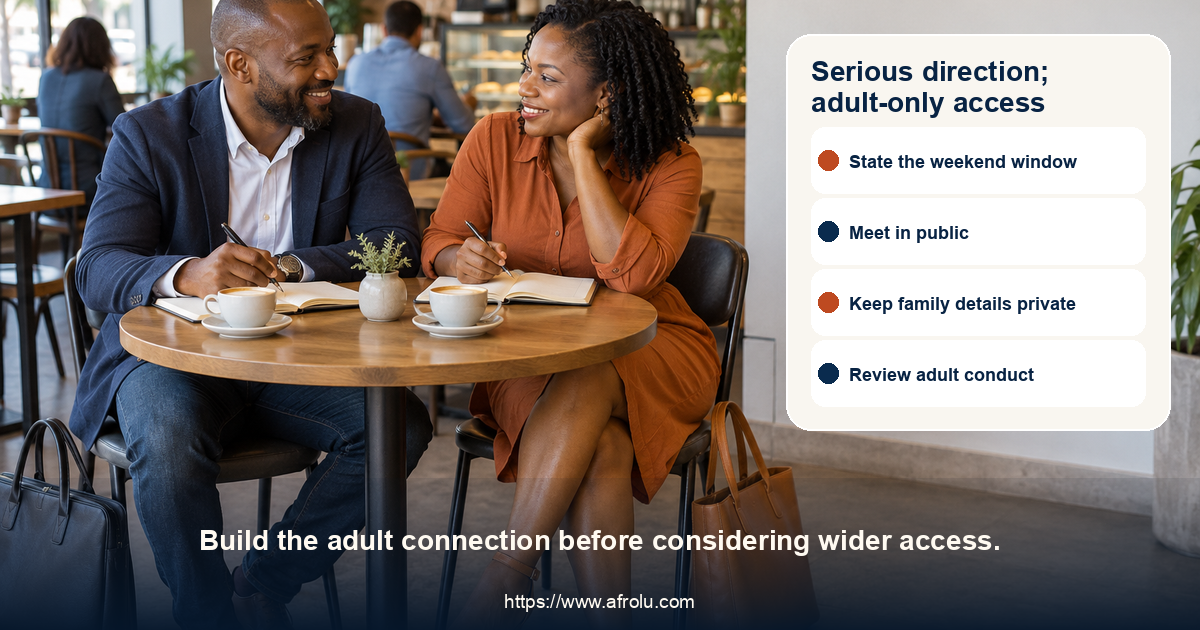
Name direction, protect family privacy, and keep the first plan reversible.
Written and edited by Jean-Claude Mukendi · Relationship Guides Editor
State the serious direction and the actual adult-only rhythm together. Plan public meetings with independent returns, keep child and household information private, and treat home visits, exclusivity, travel, and family introduction as separate decisions. Judge reliability by planning, notice, repair, and respect under change; continue, revise, or end before wider access is considered.
Dating basics · Parents Returning To Dating
How can I date toward partnership on limited weekends without turning serious intent into premature access to children, home, routines, or family information?
Serious weekend dating for parents is an adult relationship structure with long-term direction, limited planned meeting windows, protected family information, and staged decisions about commitment and access.
Amina can meet twice this month and hopes to build a partnership. Her date assumes that serious intent should include home pickups and family photographs. She offers a public Saturday plan, keeps the household private, and proposes a review after several dates. His response tests respect without involving anyone outside their adult connection.
Weekend capacity · adult relationship · family privacy
Keep serious intent inside an adult-only lane
A parent can be open about direction while keeping family people, places, and routines private.
Map the full window, meet publicly, stage access, and review reciprocity under change.
What are you building?
Name long-term hope without promising this match.
What adult time exists?
Count travel, the date, return, and recovery.
Who stays outside?
Keep child, home, school, and routine details protected.
How is change repaired?
Use notice, alternatives, and shared effort as evidence.
serious direction · weekend capacity · terms
Hold serious direction beside limited weekend capacity
A parent may want partnership and still have only two adult-only windows in a month. State both facts early and without apology. Serious dating can begin with low frequency when the other adult understands the rhythm and freely decides whether it offers enough contact for them.
Do not use family responsibility as a blanket explanation that ends every conversation. Offer the specific adult time you can control, a reasonable contact rhythm, and a review point. Keep care schedules broad. A new match does not need names, schools, addresses, health details, or another caregiver's movements.
Amina says she wants a committed relationship and can meet on alternate Saturday afternoons. She is not offering family introductions or home visits. Her date can judge the actual arrangement without being asked to prove seriousness by waiting through unexplained absences or accepting access that arrives too soon.
If the available weekends cannot support the connection both people want, the mismatch is logistical and real. Neither adult needs to minimise parenting nor pretend low-frequency dating is effortless. They can revise contact, pause, or end before goodwill becomes an open-ended obligation to stay available.
planning · privacy · independent return
Build an adult-only dating window
Count the full adult window rather than only the meal or activity. Leave enough time for each person to reach a public place and return independently. Avoid plans that require a new date to collect you from home, wait near a school, or learn a household routine simply because the free period is short.
Use a neutral meeting point and share only the information needed for that meeting. A broad statement such as “I have parenting responsibilities before noon” is enough. Do not forward care messages, calendars, photographs, or live location to prove why a weekend window begins or ends at a particular time.
Keep a backup plan that does not transfer responsibility to the date. If care arrangements change, notify the other adult and propose a new window you can actually hold. Do not ask them to supervise, transport, entertain, or meet a child as the price of keeping the original plan.
A short date can still test conversation, follow-through, respect, and comfort. Serious intent is visible in responsible planning over time, not in how quickly an adult enters a home or family setting. Let the first window remain an adult meeting with two independent ways home.
adult relationship · family privacy · stages
Use an access ladder before family integration
The first rung is an adult-only public meeting. Later rungs may include repeated reliable dates, a clear relationship conversation, and discussion with relevant caregivers or professionals when appropriate. The ladder is not a fixed timetable. It is a reminder that each access decision needs its own reasons and consent.
Do not make photographs, video calls with children nearby, school names, home addresses, or care calendars a test of honesty. A parent can be truthful while keeping those details private. A date who respects that boundary demonstrates more than someone who argues that serious interest should earn immediate family visibility.
Family introduction is not a reward for paying, waiting, exclusivity, or emotional support. It may involve the needs of people who did not choose the dating relationship. This guide cannot decide a particular introduction timeline, custody question, or safeguarding plan; use appropriate local and professional support for those decisions.
If an adult presses past one rung, return to the last safe level or stop. Repeatedly arriving near the home, requesting school details, contacting relatives, or using public posts to map routines can require stronger privacy steps. Preserve relevant evidence if safe and seek specialist help when contact becomes unwanted or threatening.

Do not let time, money, or a label unlock every step at once.
change · repair · no character test
Treat care-plan changes as logistics, not a character test
When a plan moves, look for timely notice, a proportionate explanation, and a realistic alternative. The parent can protect private family facts while acknowledging the effect on the other adult. “My care plan changed and I cannot meet” is enough; an apology and two new options make the next decision possible.
The other adult may still decide the frequency no longer suits them. Respecting parenthood does not require accepting every disruption indefinitely. They can discuss whether shorter calls, different weekends, or a pause would work. Compatibility includes whether both people can live with the real rhythm, not whether every reason is worthy.
Avoid demands for screenshots, messages from another caregiver, or live proof from a home. Those requests expose private people and do not guarantee future reliability. Judge what affects the relationship: notice, repair, repeated patterns, honesty about capacity, and whether planning effort travels in both directions.
One changed date is different from a pattern in which the parent returns only when convenient and expects instant availability. Likewise, one disappointed reaction is different from punishment or contempt. Review conduct across several ordinary moments and shared planning decisions before revising the arrangement or closing it.

Repair a changed plan without demanding family proof.
reciprocity · consistency · serious conduct
Test serious intent through reliability under change
Notice who suggests affordable venues, confirms plans, accepts a no, and follows the agreed contact rhythm. A person can speak warmly about family life while ignoring the parent's privacy boundary. Another may use simple language but consistently protect the window and share the work of planning.
Money should stay outside proof of seriousness. Neither childcare expense nor a date's contribution creates entitlement to family access, sex, home entry, or a future relationship. Plan each meeting within each adult's own means and keep essential household funds, account credentials, and emergency money independent.
Consent also remains activity-specific. Exclusivity, a weekend away, or a serious label does not settle physical choices. Ask in the moment, respond respectfully to uncertainty, and make room for either adult to stop. A parent does not owe intimacy because arranging the date required extra effort.
At a review point, ask whether the arrangement supports both adult lives without pulling a new person into caregiving or exposing private family information. Continue when conduct is reliable and mutual. Revise one term if the pattern is promising but strained. End when respect depends on ever-wider access.
conversation · privacy · ending
Use scripts that protect adult choice and family privacy
For availability: “I can meet alternate Saturday afternoons and confirm by Thursday.” For privacy: “I do not share child details or my home location with someone new.” For serious intent: “I am dating toward partnership, and introductions are a separate later decision.” Each sentence reduces room for assumptions.
If a match asks why, you can explain the principle without producing proof. Repeating the same request after a clear answer, approaching relatives, or using social media to identify a routine is not ordinary curiosity. Tighten privacy, end contact, report through the relevant service, and use current local support when needed.
An ending can be simple: the weekend structure or requested level of access does not fit, so you are closing the connection. Do not invite a debate by listing every parenting decision. If the two adults share a community, ask trusted people not to pass messages or disclose schedules after the ending.
Scripts work best before pressure. Write one line for scheduling, home privacy, photographs, money, physical consent, and ending. A prepared sentence helps a parent respond consistently and calmly even when a date is charming, disappointed, or offering to solve a logistical problem that should remain separate.

Pair the limit with the weekend plan you can offer.
two-week review · reciprocity · next rung
Review reciprocity before widening access
List the plans made, the plans kept, how changes were repaired, and whether each adult respected family privacy. Ask whether the contact rhythm supports connection between weekends. This evidence is more useful than counting how much either person spent or how often they spoke about a future family.
Continue at the same rung when more observation is needed and both adults accept that pace. Revise logistics when the relationship is mutual but a particular weekend rhythm fails. Discuss a later rung only when it serves a considered purpose and any people affected can be protected and appropriately involved.
Do not combine several changes into one milestone. Exclusivity, a home visit, meeting relatives, travel, and family introduction are different decisions. Agree to each separately. An adult who declines one may still value the relationship; an adult who accepts one has not silently accepted the rest.
Release the connection when serious language repeatedly competes with disregard for limits, or when the available structure does not meet one person's needs. A respectful ending protects adult time and family privacy. It also leaves both people free to seek arrangements that better fit their actual lives.
Eight decisions for serious weekend dating

Partnership is wanted but only two windows exist
A parent fears that naming low frequency will look unserious.
State the direction and the real weekend offer together.The easiest pickup point is the home
Convenience would disclose a private address to a new date.
Meet at a neutral public location with independent transport.A match asks to see family photos
Serious interest is presented as a reason for early child visibility.
Decline and keep the adult conversation in its own lane.A care plan shifts on Saturday morning
The date is affected, but private family details are not required.
Give notice, apologise, and offer realistic alternatives.A date offers to cover caregiving costs
Financial help is tied to keeping the plan or gaining access.
Keep essential costs independent and decline attached support.A home visit is treated as the next automatic step
Repeated dates are being converted into family access without discussion.
Review the adult relationship before considering a new rung.Extra effort is treated as physical obligation
A person says the parent owes intimacy because the weekend was difficult to arrange.
Stop the activity and restate that consent is current and voluntary.A mismatch continues through guilt
One adult needs more contact than the parent can offer.
Acknowledge the fit problem and close without blaming parenting.Fourteen signs that adult dating and family privacy coexist
Serious direction and present weekend frequency are stated separately.
Dates occur in adult-only public settings with independent returns.
Child names, images, schools, routines, and addresses remain private.
A new match is not recruited to solve caregiving logistics.
Changed plans receive notice without exposing another person's details.
Both adults contribute to arranging replacement dates.
Exclusivity is discussed instead of inferred from limited availability.
Home access and family introduction are separate later decisions.
Money does not purchase intimacy, gratitude, or family access.
Each physical choice receives current, voluntary consent.
A privacy boundary is accepted without demands for proof.
Contact between weekends is sustainable for both adults.
The next rung is considered only after reliable adult conduct.
Either person can end when the structure no longer fits.
A map for capacity, repair, and access
| Situation | What it may mean | What to do next |
|---|---|---|
| Only alternate weekends are open | The relationship may need a lower-frequency structure. | Offer the exact rhythm and ask whether it is enough. |
| They want child photographs | Curiosity is crossing a privacy boundary. | Decline without supplying substitute family details. |
| They suggest a home pickup | Convenience would widen access early. | Choose a neutral meeting point and separate transport. |
| A care plan changes | The adult date needs notice, not the private story. | Acknowledge the effect and offer real alternatives. |
| They pay a family-related cost | The offer may create pressure or dependency. | Keep essential expenses independent and clarify no access is purchased. |
| Serious is equated with introduction | Direction is being used to skip an access decision. | Review the adult relationship before any family step. |
| They contact a relative | The person is bypassing a stated boundary. | End access, preserve evidence, and seek help if needed. |
| They need weekly meetings | Their valid need may exceed the available schedule. | Explore one revision, then recognise a mismatch if it remains. |
| Physical pressure follows the date | Effort is being framed as a debt. | Stop and leave; consent is never purchased by planning. |
| The pattern is reciprocal | The present rung may support more observation. | Continue without treating time served as automatic promotion. |
Twelve scripts for adult time and family boundaries
“I am dating toward partnership, and our current arrangement is still new.”
“I can meet alternate Saturday afternoons and confirm by Thursday.”
“I do not share child details, photographs, or routines with someone new.”
“Let us meet there separately and each arrange our own return.”
“My care plan changed; I cannot meet today, and I can offer these two dates.”
“A home visit is not part of the relationship at this stage.”
“Meeting family is a later decision, not proof that we are serious.”
“I will keep household and caregiving costs separate from our dates.”
“The effort to arrange today does not change what I want physically.”
“Between dates, one planned call works better for me than daily check-ins.”
“This weekend rhythm is not enough for you; should we try one change or close?”
“Our available structures do not fit, so I am ending the dating connection.”
Know the difference
Serious intent versus family access
Adults name direction, keep plans, repair changes, and review commitment together.
A label, payment, or number of dates is used to demand home, child, school, or routine information.
Build the adult relationship first and decide each wider access step separately.

Evaluate the adult relationship without using home or child visibility as proof.
Serious adult intent versus premature family access
| Type or dimension | What it describes | Best next question |
|---|---|---|
| Serious dating | The adults explore long-term fit without promising this match will last. | Name present frequency and commitment. |
| Weekend dating | Meetings concentrate in limited adult-only windows. | Count travel and recovery as part of the window. |
| Slow dating | Observation can continue without early family integration. | Agree how connection will continue between meetings. |
| Exclusive dating | Both adults choose to stop other romantic dates. | Discuss the agreement without attaching family access. |
| Casual dating | Commitment may be lower while privacy and consent still apply. | Describe exactly what casual changes and what it does not. |
| Long-distance dating | Travel can consume rare weekend capacity. | Keep visits independent and avoid involving children in early calls. |
| Home-based dating | Private convenience increases household exposure. | Prefer adult public venues until access is considered separately. |
| Family-integrated dating | Other people's privacy and welfare enter the decision. | Use deliberate local guidance rather than a fixed online timeline. |
| Dating pause | No adult-only window may currently be sustainable. | Pause without asking a match to wait indefinitely. |
A simple plan you can use today
Direction is not frequency
Serious goals can coexist with limited weekends when terms are clear.
The whole window counts
Preparation, travel, return, and recovery use real capacity.
Adult dating has a boundary
Children and family routines stay outside the early relationship.
Repair preserves privacy
A changed plan can be acknowledged without forwarding private proof.
Money buys no rung
Payment cannot create home, family, or physical access.
Time does not unlock access
Every wider step needs a fresh reason and decision.
Questions organised by purpose and depth
Choose a few prompts that fit the moment. This is a reference library, not a list to complete.
Adult capacity
Count the whole dating window.
- Which weekends are controlled?
- How much travel fits?
- What recovery time remains?
Privacy edge
List information outside a new connection.
- Which images stay private?
- What location detail is unnecessary?
- Who should not be contacted?
Current terms
Describe the adult relationship today.
- Are we exclusive?
- What contact rhythm works?
- When will we review?
Access review
Use conduct before considering another rung.
- Were limits respected?
- How were changes repaired?
- Is planning reciprocal?
What deserves a closer look
Reduce identifying details
Images can reveal faces, names, school marks, locations, and routines, so a parent can keep family material out of early dating.
Evidence limit: No sharing choice guarantees safety, and local rules may differ.
Check the background before posting
Photographs and captions can disclose location clues or link a new relationship to people who did not choose publicity.
Evidence limit: This is general privacy guidance, not a custody ruling.
Treat family integration carefully
Research guidance on repartnering and shared parenting highlights that household change can affect a child's sense of home and stability.
Evidence limit: It does not set a universal introduction timetable.
Look for honesty, support, and space
Communication and respect can be observed in planning, repair, privacy, and the ability to accept a limit.
Evidence limit: A checklist cannot predict relationship success.
Keep every physical choice current
An adult can pause or stop regardless of the cost, planning effort, serious label, or earlier agreement.
Evidence limit: Consent law and support routes vary by country.
Respond to a repeated pattern
Tracking, monitoring, repeated messages, or appearing without invitation may require evidence preservation, blocking, reporting, and local specialist support.
Evidence limit: Definitions and services in the cited material are United States specific.
Shortcuts that pull family access forward
Hiding the actual frequency
A serious goal cannot make limited weekends disappear.
Using home pickup for convenience
It discloses household access before trust supports it.
Sending family photos as proof
It exposes people who did not choose the dating connection.
Accepting attached financial help
A payment can be turned into pressure for access or intimacy.
Treating introduction as a milestone
Elapsed time does not settle a family decision.
Demanding care-plan evidence
Screenshots and messages expose private adults and children.
Turn serious direction into a private, workable weekend plan
This guide is editorial information, not custody, safeguarding, legal, medical, or emergency advice. Use qualified local support for decisions that require it.
Explore the guide library
Show more related guides
Continue with Afrolu
Show more Afrolu guides
Sources used for this guide
Afrolu reviewed these health, research, safety, or public guidance resources while editing this page. They support the behaviour and safety guidance; they do not diagnose any individual described by a reader.
Questions about serious dating on limited weekends
Can a parent date seriously only on weekends?
Yes, if the available rhythm is stated honestly and meets both adults' needs. Serious direction does not require immediate high frequency.
When should a new date meet my children?
This guide sets no universal timetable. Build the adult relationship, protect privacy, and use appropriate local or professional guidance for your circumstances.
Should I share family photographs?
You can keep them private. Images may reveal faces, locations, school details, routines, and connections.
Is a home pickup easier?
It may be easier and still disclose a private address too early. A neutral public meeting with separate transport preserves more choice.
What if my care plan changes?
Give notice, acknowledge the effect, and offer realistic alternatives without forwarding private messages or details.
Does exclusivity mean family access?
No. Exclusivity governs other romantic connections; home visits and family introductions are separate decisions.
Can a date pay caregiving costs?
Treat essential family costs carefully and avoid any offer tied to access, intimacy, or keeping a date. Financial circumstances may need qualified advice.
How can we stay connected between weekends?
Choose a call or message rhythm both adults can sustain without monitoring, guilt, or intrusion into family time.
What if someone contacts my relatives?
Restate or end the boundary, preserve evidence if safe, restrict access, and use platform or local specialist support if contact persists.
When should we stop?
End when the available structure does not meet one person's needs or when respect repeatedly depends on family, home, money, or physical access.
One thing to do now
Review the adult relationship before widening access
Build the relationship only from adult time and information you can freely offer. Keep each access decision separate, especially family details, home, money, physical intimacy, and introductions. Continue when the pattern is reciprocal; revise logistics when both adults agree; leave when the structure or privacy boundary is repeatedly rejected.