Later entry · clarity first · casual terms
Clarity-First Casual Dating for Adults Starting Later
Starting dating later? Define casual terms, learn app privacy at your pace, plan a reversible first meeting, and keep boundaries and consent in your control.
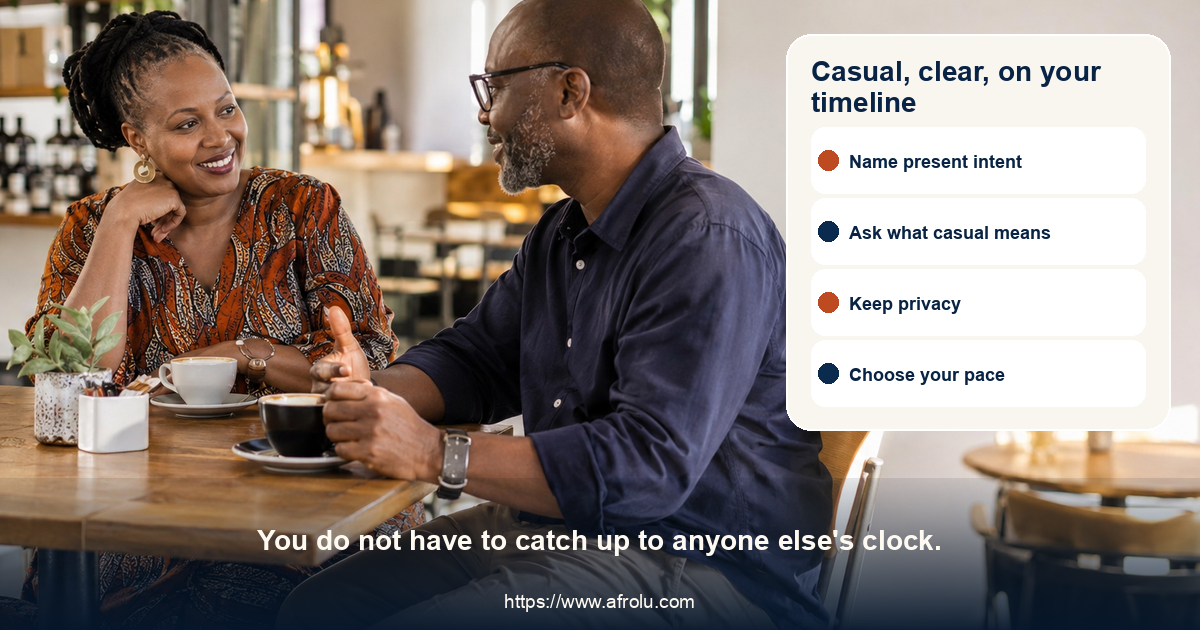
Name casual terms, ask questions, and keep your own pace.
Written and edited by Ruth Akinyi · Local Dating Editor
Treat a later start as your timeline, not a deficit. Ask what casual means today, including exclusivity, contact, intimacy, and review. Learn platform controls from official sources while keeping passwords and codes private; choose a public first date with your own return plan; and allow yourself to continue, redesign, pause, or end without promising a future upgrade.
Dating basics · Late Entrants
How can an adult starting later choose casual dating without being hurried by a more experienced match?
Clarity-first casual dating is an adult-chosen, lower-commitment arrangement in which people state current expectations about contact, other dates, intimacy, and privacy while recognizing that either person can revise or end the connection.
At 42, Selam downloads a dating app after years focused on work and family. A match says she should move to private messaging quickly because experienced daters do not wait. Selam checks the app's help page, keeps her number private, and asks what he means by casual. He wants non-exclusive dates; she is comfortable with that for now but sets a public coffee and a time limit. Her first decision is hers, not a catch-up exercise.
later entry · clarity-first casual dating
Learn the format without surrendering the decision
A later start can be curious, deliberate, and casual without being hurried or shamed.
Name present terms, learn privacy tools, plan a reversible meeting, and review the fit in your own time.
What does later mean to you?
Describe your own path rather than accepting a match's guess.
What is casual today?
Clarify contact, other dates, intimacy, and review.
Who controls your account?
Learn platform tools while keeping access private.
Can you pause or revise?
Continue, redesign, wait, or end without a deadline.
timeline · confidence · choice
Starting later does not mean you have to catch up on someone else's schedule
Later entrant is a self-description, not a diagnosis or an age bracket. Some adults are new to dating platforms; others have dated before but are re-entering after caregiving, relocation, separation, grief, illness, or a deliberate break. Do not assume inexperience, loneliness, or a wish to settle down from the phrase alone.
A useful beginning is to name what you want now, even if it is modest: conversation, occasional dates, physical intimacy with clear terms, or time to decide. Casual does not mean careless, secret, or automatically non-exclusive. Ask what the other adult means and share what you are choosing before either person builds a different story from frequency or chemistry.
There is no universal amount of dating experience required before you can make a choice. You can learn how an app works one feature at a time, ask a trusted person to look at privacy controls, and keep your own pace. A match does not earn access to your phone, accounts, past relationships, or private photographs because they have more experience.
If you feel behind, notice who benefits from that belief. A person who says you should move faster because you are lucky to be chosen is using a personal timeline to narrow your choice. Someone who is genuinely interested can explain their own preference, answer direct questions, and accept that you may need time to learn the format.
casual · clarity · non-exclusivity
Casual can be honest and considerate when its terms are spoken
People use casual to mean occasional dates, non-exclusive dating, companionship without a partnership goal, or an early stage before deciding. Ask which meaning applies here. If you are still exploring, say that; if you already know you do not want exclusivity, say that before a pattern of daily contact implies something else.
A direct conversation can stay proportionate. You might say that you are open to meeting and want to keep the arrangement non-exclusive for now, then ask whether that fits the other adult. You do not need to justify the choice with a past relationship or promise that it will later become serious. A no is useful information, not a negotiation target.
Physical intimacy requires its own discussion. Talk about what each person wants, safer-sex choices, testing where relevant, and the ability to stop or change course. A casual label does not reduce the need for consent or make a previous yes apply to another activity or date. Seek qualified health information for personal medical decisions.
Review is an option, not an automatic promotion path. If feelings or needs change, tell the other person and ask whether the arrangement still works. Either adult may continue, renegotiate, pause, or end. Honest casual dating respects both people's choice; it does not keep one person waiting for an unspoken upgrade.

Ask what the other person means by casual.
apps · privacy · digital confidence
Learn the tools gradually and keep control of your own accounts
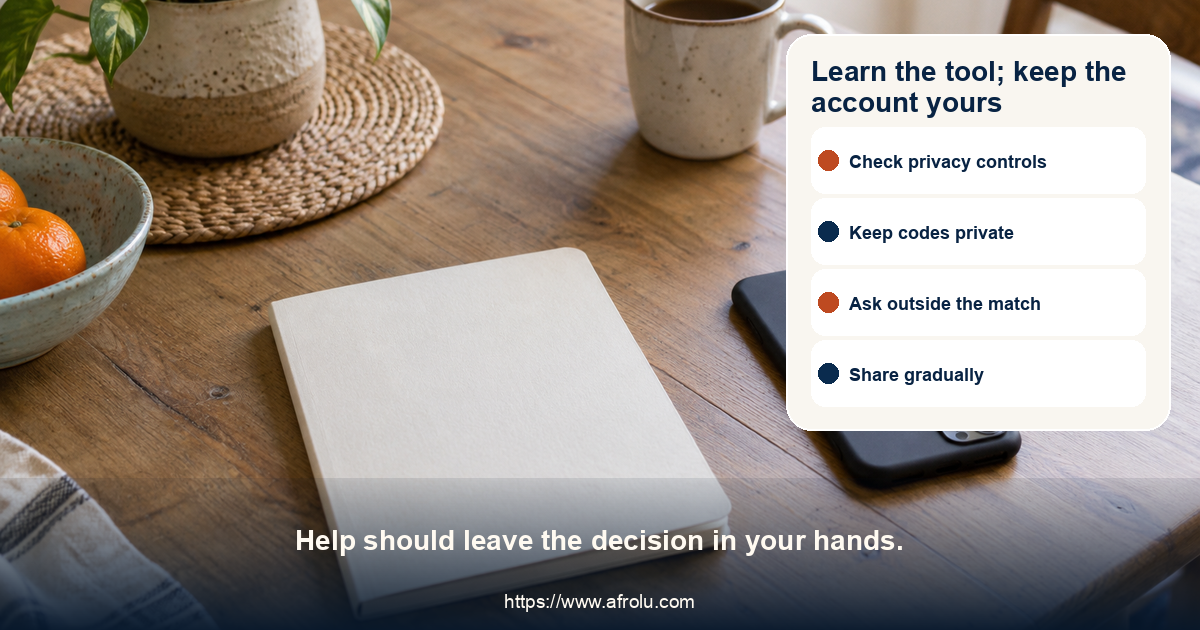
Start by checking the platform's own privacy, block, report, and location settings. You can use a profile that shares interests without listing your home, employer, daily route, or family details. If a feature is confusing, read the help page or ask someone you trust outside the match rather than letting a new date configure your account.
Keep early conversation on the service while you learn whether the person is consistent and respectful. Moving to a private messaging app can expose a phone number, profile image, contacts, or other account clues. You can decide to move later; a request to do it immediately is not an obligation or proof of trust.
Never share a one-time code, password, recovery link, banking detail, identity document, or intimate image because someone says it is necessary to verify your feelings. An app badge has limits, and a video call does not prove every biographical or financial claim. Verify consequential details independently and stop when pressure replaces ordinary conversation.
Take breaks if the volume, unfamiliar interface, or repeated requests become tiring. A pause from an app is not failure and does not mean you have lost a chance. Save only information you need, use platform tools when appropriate, and ask a trusted person for help if you are unsure about a digital request.
first dates · public plans · exit
A first date should give you information while leaving your options open
Choose a public place, a time window, and a cost that work for you. Arrange your own arrival and return, tell a trusted person the broad plan if that supports your safety, and confirm the details on the day. These are options that preserve agency, not guarantees that a venue or routine makes every date safe.
Avoid giving a new match your home address, live location, work route, or details that let them predict when you are alone. If travel is involved, keep accommodation, documents, funds, and transport under your control. Do not pay a stranger's airfare or emergency expense as a condition of meeting.
You can state a time limit in advance: a coffee before another commitment, a walk in a busy public area, or a short lunch. If the person pushes to change venues, drink more, stay later, or depend on them for transport, you can decline and leave. Consent includes the choice to change your mind after arriving.
Afterward, record your own observations rather than looking for a perfect performance. Did the person answer a reasonable question? Did you feel able to disagree? Was a no accepted without sulking or bargaining? One date does not establish safety, compatibility, or a relationship label; it simply gives you another piece of information.

Keep an independent way to arrive and leave.
experience gaps · pressure · boundaries
More dating experience does not give one adult authority over the other
Experience gaps can be harmless when someone answers questions, explains a feature, and lets you decide. They become relevant when a match uses jargon, age, popularity, or a claimed dating rule to rush exclusivity, sexual content, spending, or private contact. You are allowed to ask what a request means and take time before answering.
Watch for statements that make your inexperience a problem to solve by surrendering privacy: 'everyone shares this', 'you are too cautious', or 'let me log in for you'. Ask whether the step is optional and how to reverse it. If the answer depends on secrecy or urgency, pause and verify through an independent source.
A genuine mismatch in experience can be discussed without shame. Tell the other person what you are learning, identify which questions you need answered, and see whether the pace stays respectful. You do not have to disclose why you started later or recount a private history simply to prove that your preferences are informed.
If pressure continues, reduce access and stop the conversation. Keep relevant evidence if there is a threat or financial request, use the platform's report controls, and contact local specialist support if you feel unsafe. The right response depends on your circumstances; a dating guide cannot investigate identity or provide emergency services.

A respectful match can hear 'let me think'.
reciprocity · changing needs · review
Casual should not mean one person carries all the uncertainty
Notice who initiates, chooses the meeting place, pays, travels, and decides when contact resumes. A difference in style is not automatically a problem, but a repeated pattern where one person benefits from vagueness deserves a conversation. Ask for the small change that would make the arrangement more workable for you.
If one person wants more contact or exclusivity, the other can decline without being accused of betrayal. The adult who wants a different arrangement may then decide that continuing casually no longer fits. Neither person has to persuade the other to stay; compatibility includes whether the terms are acceptable to both.
Make an update explicit when your expectations change. Say what you want now, ask whether the other person wants it too, and allow time to answer. Do not treat a weekend trip, gift, long conversation, or intimate moment as an agreement that was never stated.
Ending can be kind and brief. You can thank someone for the time, say that you do not want more dates, and stop responding after the decision is clear. Do not publish private chats or use a match's personal details to explain your choice. If they keep contacting or tracking you, strengthen account privacy and seek appropriate local support.
reflection · learning · agency
You can continue learning without turning dating into a test you must pass
Before another date, ask what you want to learn: whether conversation flows, whether the person respects a boundary, or whether your definitions of casual match. Choose one reasonable step rather than trying to resolve an entire future in a single meeting. You can be curious and cautious at the same time.
A review point can help if contact is ongoing. Ask whether the pace, privacy, and expectations still work after several meetings or a change in circumstances. It need not be a countdown toward exclusivity. The purpose is to stop accidental assumptions from becoming an arrangement one person never chose.
Keep outside sources and trusted relationships available. Official app help can explain a feature; a health professional can answer personal sexual-health questions; a trusted friend can help you think through a request. A match should not be your only source of advice about their own urgent financial, legal, or identity claim.
Continue if the terms are clear enough and your boundaries are respected. Redesign if a specific expectation can change. Pause if you need time or want to learn more about the platform. End if the arrangement does not fit or pressure continues. None of these choices proves that starting later was a mistake.
Eight later-entry moments involving labels, apps, consent, money, and first meetings
A match calls you behind
Someone says your limited app experience means you should agree quickly before other people notice you.
Reject the deadline and make the choice on your own information.Casual has two definitions
One adult means non-exclusive dating while the other assumes a future relationship is already implied.
Ask what each person has agreed to today.They offer to log in for you
A date requests your password and phone to improve your profile settings.
Decline account access and use the platform's official help.A code is needed to prove trust
A match asks you to read out a one-time code sent to your phone.
Do not share it; secure the account and verify independently.The public plan becomes a private ride
At the venue, the person urges you to leave with them and skip your own return plan.
Keep your transport option and leave if the change is unwelcome.Past agreement is treated as ongoing consent
A prior yes is used to pressure you into a different activity or image.
Restate that consent is specific and can change at any time.A first date requires an emergency transfer
An online match says a travel problem must be solved before they can meet.
Do not send money to an online sweetheart you have not met.The terms never get revisited
Regular dates continue, but a request for clarity is repeatedly postponed.
Choose a review point and decide whether the uncertainty still suits you.Fourteen signs that learning and adult boundaries can coexist
A later start is treated as a timeline, not a personal deficiency.
The adult can ask how an app feature works without being mocked or rushed.
Casual intent is described in present terms rather than hinted at through message frequency.
Exclusivity is discussed separately from emotional closeness or regular dates.
Each person can decline a request without being told they are inexperienced or ungrateful.
The match explains platform tools without requesting passwords, codes, or device control.
Personal history is shared voluntarily and only when relevant to a choice.
First meetings are public, affordable, time-bounded, and independently reversible.
Travel, lodging, and return transport remain under each person's control.
Physical boundaries are specific and can be changed without punishment.
The adult can pause app use or dating without being told they have lost their chance.
The person avoids urgent requests for money, documents, or intimate images.
Both adults can review the casual arrangement if their needs change.
Ending a connection does not lead to threats to publish private messages or details.
A practical map for casual terms, digital confidence, and your next choice
| Situation | What it may mean | What to do next |
|---|---|---|
| I am new to apps | You may need time to learn platform controls, not a partner to take over. | Read official help and keep your login private. |
| They say casual | The label may cover different expectations. | Ask about exclusivity, contact, and intimacy directly. |
| I want time to reply | Your decision may need more information or simply a pause. | State when you want to revisit it, if at all. |
| They request a code | The request could expose account access. | Do not share it and secure your account independently. |
| The date wants to change venue | The new plan may affect your comfort or exit. | Accept only if it still works and you control your return. |
| A prior yes is repeated back | The person may be treating consent as permanent. | Clarify that each activity needs current agreement. |
| I want casual, they want serious | The present goals may not align. | Say what you want and allow either person to end it. |
| They ask for travel money | Urgency and romance may be used to prompt a transfer. | Do not send funds; verify and seek trusted advice. |
| I feel behind | Comparison may be setting a pace that is not yours. | Choose one small next step that you actually want. |
| The arrangement stays vague | One person may be comfortable with uncertainty the other did not choose. | Ask for a review or end the connection if needed. |
Twelve direct scripts for asking, pausing, and changing your answer
“I am new to this app, so I may ask how a feature works. I will decide what I use.”
“I am open to casual dates, but I do not want to imply exclusivity we have not agreed on.”
“When you say casual, do you mean non-exclusive, occasional, or something else?”
“I would like another day to think about that before I answer.”
“I keep my phone number and daily route private until I am comfortable sharing more.”
“I will not read out a login or verification code. Please do not ask me again.”
“I can meet for coffee in public from two to three and will make my own way home.”
“I agreed to that earlier activity, not this one. I am changing my answer.”
“Before we become physical, I want to discuss boundaries and safer-sex choices.”
“Could we check after a few dates whether the casual terms still work for both of us?”
“I will not send money to someone I have not met in person.”
“I do not want to continue dating. I wish you well, and I am not reopening the decision.”
Know the difference
Curious casual dating versus being hurried because you started later
The adult asks questions, chooses platform tools, names casual terms, plans a reversible meeting, and can pause or change their mind without penalty.
A match uses your timeline to hurry private contact, spending, sexual access, exclusivity, or account sharing before you understand the request.
Experience should make explanations easier, not make pressure sound normal.

Notice whether explanations increase your choices.
Learning at your pace is different from catching up on someone else's clock
| Type or dimension | What it describes | Best next question |
|---|---|---|
| New to apps | Platform skills may be new even when the adult knows what they want. | Learn settings from official help and choose features yourself. |
| Returning dater | A long pause can change preferences without erasing earlier experience. | Name what is different for you now. |
| Casual and exclusive | Casual can still include an explicit agreement about other dates. | Ask whether exclusivity is chosen or still open. |
| Casual and non-exclusive | Each adult remains free to date others under agreed terms. | Discuss safer sex and communication where relevant. |
| Low-pressure | The pace is spacious while important terms stay discussable. | State a review point rather than leaving everything implied. |
| Slow-building | The adults may be open to change but have not promised an outcome. | Describe what would make a future review useful. |
| Private dating | Personal information is shared gradually and voluntarily. | Keep account, location, and identity details under your control. |
| Undefined | A label hides a choice one adult needs to make. | Ask directly and decide whether uncertainty fits. |
| Paused | Someone chooses not to date while learning or reassessing. | Treat the pause as complete; no one owes a return date. |
A simple plan you can use today
A timeline is not a deficit
Starting or restarting later does not make an adult less able to set boundaries.
Casual still has terms
Clarify exclusivity, contact, intimacy, and safer-sex expectations when they affect a choice.
Features are optional
A match can explain an app control, but your login and device remain yours.
A first date is reversible
Choose a public plan with an independent end and return option.
Consent is current
A past yes does not settle a new activity or a later date.
A review is not a promotion
Changing casual terms requires mutual agreement; continuing, waiting, and ending are all available.
Questions organised by purpose and depth
Choose a few prompts that fit the moment. This is a reference library, not a list to complete.
Your timeline
Describe your own path without defending it.
- What am I curious about now?
- What would feel rushed?
- Which detail stays private?
Casual terms
Use words that change a present choice.
- Are we exclusive?
- What contact works?
- What should we revisit?
Digital confidence
Learn features while keeping control.
- Which setting can I check?
- What should never be shared?
- Who can advise me outside this match?
First meeting
Make a small plan that can end independently.
- Where is public and convenient?
- How will I return?
- What is my planned end time?
What deserves a closer look
What does later entry mean to you?
It might mean returning after a pause, using an app for the first time, or simply choosing to date now. Use your own description rather than accepting a match's guess about your age, confidence, or history.
Evidence limit: No single dating timeline is right for every adult.
Which terms should casual dating include?
Talk about exclusivity, contact, physical boundaries, safer sex, and whether either person wants a review. Keep the conversation focused on the choices that matter to you today.
Evidence limit: This guide cannot provide individualized medical advice.
How can I learn an app without giving up control?
Read the service's own help pages, test privacy settings, and keep passwords, codes, recovery links, and device access private. A trusted person outside the match can help you think through a confusing request.
Evidence limit: Features and policies vary by platform and can change.
What makes a first date more reversible?
Choose a public venue, a manageable time, independent transport, and a cost you can cover. Confirm the plan on the day and leave if the setting or behavior no longer works for you.
Evidence limit: No venue or checklist guarantees safety.
What if a match says I should trust them because they are experienced?
Ask what the request is for and whether it is optional. If the answer depends on secrecy, urgency, account access, or sexual pressure, pause and verify independently before deciding.
Evidence limit: Afrolu cannot verify another person's identity or motive.
Can a casual arrangement become something else?
It can change only if both adults want the new terms. State what you want, listen to the answer, and decide whether the current arrangement remains acceptable rather than treating time or intimacy as an automatic upgrade.
Evidence limit: Neither adult owes continued dating while waiting for a change.
Shortcuts that confuse experience, access, intimacy, or a label
Treating later entry as inexperience in every area
The phrase describes a timing or platform path, not someone's whole history.
Agreeing to casual without defining it
Two adults can use the same word for different relationship terms.
Handing over a device for convenience
A match does not need account control to help you learn a feature.
Treating a badge as identity proof
Verification tools have limits; consequential claims need independent checking.
Moving a first date to a private place under pressure
A new location can change cost, transport, and your ability to leave.
Continuing to avoid seeming difficult
A boundary is useful information, not a test you must pass.
Clarify casual terms, learn a platform tool, or plan one short date
Use official platform help for feature questions and qualified local health support for personal medical concerns. Afrolu cannot verify a match's identity.
Explore the guide library
Show more related guides
Continue with Afrolu
Show more Afrolu guides
Sources used for this guide
Afrolu reviewed these health, research, safety, or public guidance resources while editing this page. They support the behaviour and safety guidance; they do not diagnose any individual described by a reader.
Questions about starting dating later and choosing casual terms
What does late entrant mean in dating?
It is a self-description for an adult who is starting, returning, or trying a platform later than they expected. It does not establish age, relationship history, confidence, or what they want now.
Can I start dating later and want something casual?
Yes. State the arrangement you want today and clarify whether it is non-exclusive, occasional, or open to review. You do not need to promise a future relationship to make casual dating honest.
Does casual dating always mean non-exclusive?
No. Casual is used in different ways. Ask directly whether either person is seeing other people and what communication or intimacy expectations are in place.
How do I learn a dating app safely?
Start with the service's official privacy, blocking, reporting, and location controls. Keep your password, one-time codes, recovery links, and device access private from matches.
Should I move to private messaging right away?
You can choose when to share another contact channel. Keeping early conversation on the app may preserve its safety tools and make it easier to stop contact if you become uncomfortable.
What if the other person has more experience?
They can share information, but they do not get to set your pace or decide for you. A respectful person answers questions and accepts a pause without mocking your timeline.
How should a first date be planned?
Choose a public place, a manageable duration and cost, and independent transport. Confirm the plan on the day and keep the option to leave or change your mind.
Does a prior yes mean I have agreed again?
No. Consent is specific to the current activity and can be changed. You can stop or decline at any time, including after earlier agreement.
What if an online match asks for travel or emergency money?
Do not send money or gifts to an online sweetheart you have not met in person. Verify the claim independently and ask someone you trust before making a financial decision.
Can I stop dating if I am still learning?
Yes. You can continue, change the pace, pause app use, or end contact. Learning does not create an obligation to keep seeing someone.
One thing to do now
Let experience grow one decision at a time
Define the casual arrangement in present terms, learn digital controls without transferring account access, and choose a first meeting you can end independently. Treat experience as information, not authority. If the terms fit and boundaries are respected, continue; if a specific burden can change, redesign it; if pressure or uncertainty no longer suits you, pause or end without owing a justification.