Later start · serious weekend dating
Serious Dating Later in Life: Build a Weekend Pace That Fits
New to dating later in life? Seek a serious partnership without rushing: plan around weekends, look for mutual effort, and keep every first-date choice yours.

Separate the goal from the pace of learning.
Written and edited by Miriam Otieno · Senior Kenya Editor
State that you date with partnership in mind while letting compatibility develop at a measured pace. Offer weekend capacity you can actually keep, and look across several plans for shared initiative and honest updates. Keep first dates public, affordable, and easy to leave independently. A later start is context, not a reason to accept pressure or skip a clear agreement.
Dating basics · Late Entrants
How can I pursue serious dating later in life when weekends are my main available time, without rushing or confusing frequency with commitment?
Serious weekend dating is an adult's present intention to explore partnership while most reliable meetings occur on weekends. The schedule does not itself show commitment, effort, or compatibility; those depend on what both people agree and do over time.
At 48, Sifa is returning to dating after focusing elsewhere. She wants a committed partnership, but Saturday mornings are the only dependable window. When Joseph says he wants to move quickly, she explains that serious is her direction, not an immediate promise. They discuss a short public date and decide whether the rhythm works before planning further.
later start · serious intent and weekend capacity
Let a real schedule support a deliberate partnership search
Separate the relationship direction from the pace, a narrow weekend from low effort, and a future goal from today's agreement.
Offer a truthful window, ask one practical question, observe reciprocal follow-through, and review after evidence develops.
What am I looking for?
Serious intent can be clear before compatibility is.
Which weekends are real?
Share a rhythm you can repeat without exhaustion.
Who contributes?
Look across plans, not one message or date.
Can I change my mind?
Keep cost, transport, and duration within your control.
later start · intention
Wanting a serious relationship does not require you to hurry into one
The phrase 'late-comer' may describe someone dating for the first time as an adult, returning after years away, or simply beginning later than their friends. It does not describe a shortage of worth, maturity, or capacity. If a serious relationship is what you want, you may say so without apologising for your history or implying that the next person must fill a role immediately.
Serious dating has at least two clocks: the direction someone hopes to build toward and the pace at which two people gather evidence. The first can be clear early. The second belongs to real interactions—how each person handles plans, disappointment, a difference in values, and the answer no. Asking for a slow first month does not cancel a serious intention; it makes the route more honest.
A weekend-only schedule may intensify the urge to make every meeting count. Resist turning Saturday coffee into an audition for marriage. Decide what you want to learn on the next date: perhaps how each person spends ordinary rest time, whether conversation feels reciprocal, or how they understand commitment. One purposeful question can be more useful than demanding a complete future plan over brunch.
You are not required to imitate the dating style of younger relatives or people who have had more relationships. You may prefer one date a week, two a month, or time between meetings to reflect. State that rhythm and ask what the other adult can offer. A relationship can be serious in intention and still end because the present fit, life stage, or pace is wrong.
weekend rhythm · reciprocity
A narrow window can still reveal whether planning is mutual
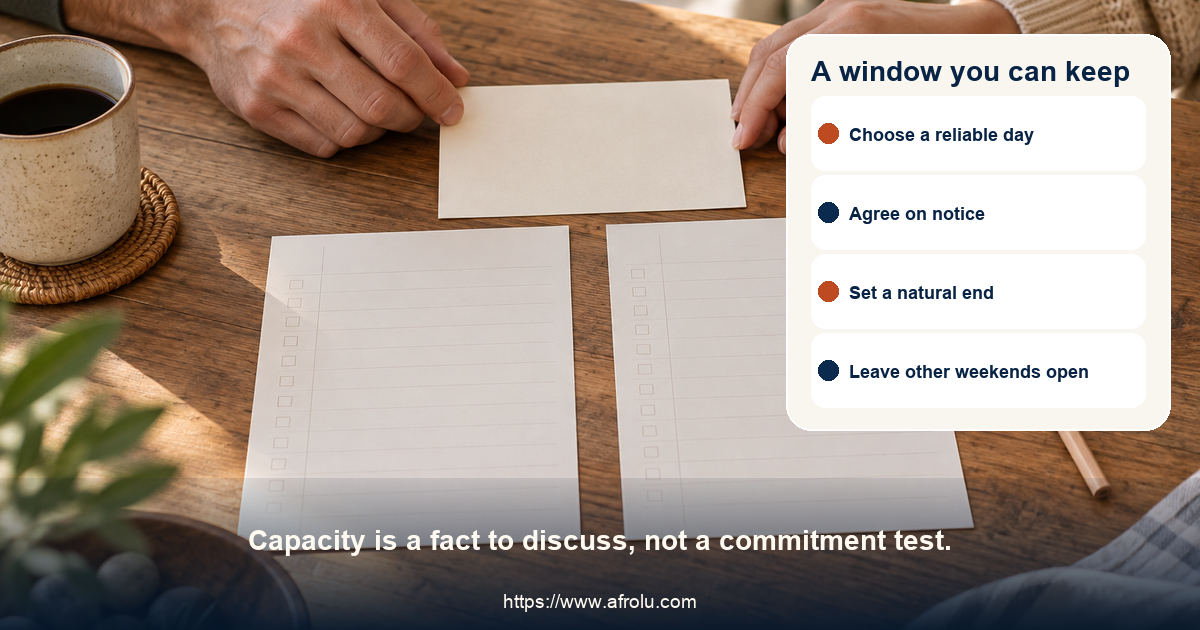
If weekends hold your free time, say what that means operationally. Perhaps you need a plan by Wednesday, prefer daytime meetings, or reserve one weekend each month for family and rest. These are usable facts. 'I am always busy' is less helpful than naming a window you can actually keep, and a match does not need your full weekly calendar to respond.
A healthy rhythm need not be perfectly equal each week. One adult may travel for work; another may have care responsibilities. Look across several attempts: does the person suggest an alternative when the proposed time fails, or does every reschedule land back on you? A different schedule can be negotiated; repeated unilateral adaptation can be a mismatch even without malice.
Avoid making a long weekend or overnight the default second step simply because distance between dates feels awkward. A short public outing can still tell you whether conversation flows and whether boundaries are accepted. Keep your own route home. If either adult wants more time, ask rather than treating a paid booking, family invitation, or ticket as permission to extend the meeting.
Build continuity between weekends in a way both adults can sustain. That may be a brief check-in, a call, or no daily messages at all. Ask what is realistic and how to update when a week goes sideways. Constant contact is not the only evidence of interest, and silence that repeatedly leaves one person guessing is not automatically excused by a full calendar.

Look for shared initiative over several plans.
commitment · evidence
Serious intention becomes useful when it turns into observable choices
Someone can sincerely want marriage someday and still not know whether they want a second date with you. Someone else may be ready to build a partnership without using marriage language early. Neither phrase settles compatibility. Ask what commitment means at the current stage: dating one person at a time, meeting family, planning ahead, or simply agreeing to communicate changes directly.
Use ordinary decisions as evidence. Does the person arrive near the agreed time or send an update? Can they hear that you prefer separate bills? Do they ask about your weekend routine rather than treat it as empty? Is there room for both adults to suggest a plan and decline one? Reliability is a pattern across small situations, not a promise made in a single moving conversation.
Do not let a serious label accelerate financial entanglement. Keep accounts, investments, housing, identity documents, and major travel independent while trust develops. A new connection asking for funds, a loan, or a rushed purchase has introduced a financial decision that deserves its own verification. Romance is not a substitute for professional financial or legal advice.
The intention conversation may reveal a good-faith difference. If one adult wants exclusivity immediately and the other needs several more meetings, neither has to be wrong. The next question is whether both can accept a pace without coercion. If not, you can leave with respect for the information learned rather than persuading the other person to adopt your timeline.

Ask what the term changes at this stage.
first meetings · consent · budget
A weekend plan should preserve your ability to change your mind
A crowded weekend calendar can make a prepaid event look efficient, but a high-cost booking may make it harder to leave when the conversation feels wrong. Start with a plan whose price you can comfortably cover, whose duration has a natural end, and whose location you can reach and exit yourself. No restaurant, event, neighborhood, or app can guarantee another person's behavior.
Tell someone you trust where you plan to be if that helps you feel prepared. Keep home, work, financial, and live-location details limited while a match is new. If an in-person plan shifts to a private destination, choose again. You are allowed to stay with the original public plan, propose another option, or end the meeting without waiting for the other adult to agree that your reason is good enough.
A date is not consent to touch, sex, or an overnight. Consent is specific and can change; RAINN describes it as an ongoing conversation rather than a single blanket yes. If intimacy becomes relevant, discuss boundaries and any sexual-health information that affects the choice. An adult can want marriage, enjoy kissing, decline sex, or change their mind; these are separate decisions.
Plan for ordinary accessibility too. Consider daylight, mobility, hearing, medication timing, energy, and whether the meeting place makes conversation comfortable. You need not disclose health information to justify a shorter plan. A serious partner should be able to discuss practical needs without treating them as a measure of desirability or commitment.

Choose the next step after the date, not under pressure.
disclosure · dignity
Dating experience is not a résumé you must defend before meeting someone
If you have not dated much, you may worry that asking basic questions will expose you. In practice, 'I prefer to be clear about plans rather than guess' is a sensible communication preference, not a confession that invites someone else to set your rules. You can also say you want a serious relationship and are learning what pace feels right for you.
Some background becomes relevant to a relationship decision: an existing commitment, a care responsibility, or a practical limit on weekend travel. Share that information directly when it affects the other adult's choice. Other details—an ex-partner's private story, a trauma history, your retirement account, your home address—do not become owed just because someone asks over dinner.
A respectful person can hear 'I would rather answer that later' without making a joke about your age or experience. If someone treats your first date as a lesson they own, or turns each question into a demonstration that you are behind, end the lesson. You can leave, block, or seek support in the channel that feels safest; no closing conversation is mandatory.
Listen for what the other adult can offer rather than treating your own vulnerability as a reason to accept less. Serious dating does not require a perfect emotional history. It does require both people to be able to speak honestly about present availability, boundaries, and expectations as those questions become relevant.
scarcity · money · self-trust
Limited dating time is not a reason to ignore an answer you already have
When the next free Saturday is weeks away, you may feel pressure to stretch a connection because arranging another meeting sounds tiring. That is a scheduling cost, not evidence that this person is a rare match. Notice how you feel after the date, what happened when you stated a small preference, and whether you want another conversation for reasons you can name.
Do not borrow, travel overnight, share a room, or accept financial help to compensate for a scarce weekend slot. A gift or booking may be generous, but it never creates an obligation to stay, touch, or continue dating. The FTC warns against sending money to online sweethearts you have not met in person; urgent travel, emergency, or investment requests need independent verification rather than a romance-based exception.
If the first meeting went well but you need time to consider, say so. If you want another date, suggest a realistic window. If you are unsure, a brief message can hold the boundary without promising another meeting. If you know the answer is no, a clear ending is kinder than maintaining contact only because the next weekend was hard to arrange.
Scarcity thinking can also make you overvalue a polished profile or a partner who appears to share your stated goal. Keep the ordinary questions alive: can both people compromise on a plan, afford it without strain, respect a limit, and tolerate a different answer? A serious future is made of repeatable daily choices; it cannot be inferred from one rare free afternoon.
review · next steps
Review the arrangement at a point that serves you, not a peer's calendar
You may decide to revisit the connection after three dates, a month, or a specific practical conversation. The point is not to count meetings as a formula. Choose an event that will provide information: a plan that both adults arrange, a discussion about exclusivity, or a weekend when one person's responsibility changes. This keeps reflection tied to evidence instead of an arbitrary age or relationship milestone.
At the review, ask whether the current arrangement still matches what you each said. Are weekends chosen together? Is a midweek check-in expected or optional? Do both people understand whether other dates are happening? Did the serious intention become mutual planning or remain a persuasive phrase? The answer can be 'continue,' 'change one term,' 'pause,' or 'end.'
If your preferred pace differs, make the mismatch explicit before one person starts acting on an assumption. A good-faith compromise should be sustainable for both; it should not mean the less powerful or more anxious adult repeatedly giving up their preferred boundary. You can respect the other person's urgency and still refuse to be rushed.
Beginning later does not reduce the seriousness of your choices. A weekend relationship can grow through dependable plans, room for individual lives, and conversation about what the future would require. If those elements are absent, a label cannot supply them. Keep the part that is yours to control: decide what you want now, observe what is offered, and make the next step at a pace that leaves you free.
Eight later-start situations where a serious goal meets real weekend capacity
A serious answer on date one
A match says they want marriage soon, and you fear that a slower pace means wasting time.
Ask what commitment means for the next few dates, not for a lifetime forecast.Only one person proposes
You have two free Saturdays but the other adult repeatedly waits for you to arrange everything.
Offer one concrete plan and notice whether they reciprocate or suggest an alternative.Monthly dates feel serious to one person
Limited weekends work for you but leave the other adult uncertain about momentum.
Discuss a between-date rhythm and whether the difference is workable.A full weekend away
A match proposes an overnight trip as the next step because both calendars are busy.
Choose a shorter public date if that is what you can freely accept.A joke about being inexperienced
Someone frames a direct question as proof that you are too old to date.
Name the disrespect, leave, or stop contact in the safest way available.The prepaid event
A costly ticket makes you reluctant to leave a date that feels uncomfortable.
Treat the sunk cost as a separate expense and choose your exit.A travel emergency
An online match requests money for a weekend flight before meeting you.
Do not transfer funds; verify and seek independent advice.The next Saturday is far away
A pleasant date has no mutually proposed next plan, and scarcity pushes you to keep guessing.
Ask once about interest and availability; use the answer rather than the calendar gap.Fourteen behaviors that make a weekend rhythm reciprocal and self-directed
You can state a serious direction without promising a result with this person.
A later start is not treated as a flaw that must be repaired quickly.
Each adult can name a weekend rhythm they can genuinely keep.
A limited calendar does not leave one person doing all the planning.
A declined weekend receives an alternative or an honest answer, not punishment.
Both people can distinguish serious intent from immediate exclusivity.
The next date has a duration and cost each person can choose comfortably.
A ticket, meal, or ride does not become pressure to stay or be intimate.
You can ask about dating experience without being patronised.
A shorter public plan is accepted as a meaningful meeting.
Weekend-only contact does not require surveillance during the week.
Money and major travel remain independent while trust develops.
A review point is used to clarify, not to force relationship progress.
Either adult can end things when the pace or life fit is wrong.
A guide to seriousness, frequency, shared planning, cost, and changing your mind
| Situation | What it may mean | What to do next |
|---|---|---|
| I want a serious relationship | Direction is clear; compatibility still needs observation. | Say both things without apologising for either. |
| They want commitment immediately | Their pace may be a preference or pressure; the response to your limit matters. | Name the next step you can freely accept. |
| We can only meet weekends | A narrow schedule may work if planning and contact are mutual. | Discuss notice, cadence, and how to keep continuity. |
| They cannot meet this weekend | One conflict says little; repeated unreturned planning says more. | Notice whether they suggest an alternative. |
| A trip is proposed | Travel increases cost, privacy, and exit complexity. | Choose a shorter public meeting until trust is better established. |
| I feel too inexperienced | A fear about history may be making your present boundary seem unreasonable. | Ask directly and keep disclosure at the level you choose. |
| I feel obliged after a ticket | A prepaid plan is a cost, not consent or commitment. | Leave if you want and handle the ticket separately. |
| A money emergency appears | An online story may not be independently verified. | Pause transfers and consult a trusted person or provider. |
| We disagree on contact | A cadence mismatch may be real even when both people are sincere. | Try a specific rhythm once, then assess whether it suits you. |
| The date was pleasant but vague | Enjoyment is not a promise of another meeting. | Ask whether they want to set a concrete next plan. |
Twelve lines for discussing weekend time without performing certainty
“I am dating with a long-term partnership in mind, but I make that decision one relationship at a time.”
“Weekends are my reliable time. I can usually plan one date every other week with notice.”
“Would you like to suggest the next plan, or should we decide together now?”
“What would serious dating change for you at this stage?”
“I do not need daily messages, but I appreciate a clear update if a plan changes.”
“I can meet for an hour on Saturday; I am not available for an overnight.”
“I would prefer a simple plan that each of us can comfortably afford.”
“I am newer to dating, so I prefer direct questions over assumptions about the rules.”
“I want to pause here; agreeing to this date does not mean I want the next step.”
“I am not ready to travel overnight together. I would like another local public date first.”
“I enjoyed meeting you. Would you like to plan another date, or are you unsure?”
“I do not feel the fit I am looking for, so I am going to leave this here.”
Know the difference
Serious direction versus accelerated commitment
The adult can describe wanting a partnership, choose a realistic weekend rhythm, and let compatibility emerge through reciprocal plans and honest discussion.
A late start, an open Saturday, or an expensive trip is treated as a reason to skip boundaries and promise a future before evidence exists.
A serious goal is compatible with a measured process.

Serious is a direction, not a stopwatch.
A purposeful serious direction is different from a deadline-driven rush
| Type or dimension | What it describes | Best next question |
|---|---|---|
| Serious intention | A direction toward partnership, not proof of compatibility. | Name the future you hope for and the present pace you need. |
| Exclusive | An agreement not to date other people, separate from a marriage promise. | Discuss it directly before changing your behavior. |
| Slow dating | A deliberate rate of decisions that may still include a clear goal. | Pick one practical question to answer on the next date. |
| Weekend-only | A schedule constraint, not a measure of emotional availability. | Agree on notice and a between-date communication rhythm. |
| Long-distance | Geography can make weekend visits costly and harder to exit. | Keep early trips independent and verify plans before spending. |
| Casual | A present offer that may not include a partnership direction. | Do not accept it hoping the other person silently means serious. |
| Exploratory | A wish to meet and learn before selecting a structure. | Say if you are dating others or undecided about exclusivity. |
| Committed partnership | A shared set of ongoing responsibilities rather than a label alone. | Discuss practical expectations after both people choose the direction. |
| Weekend relationship | A meeting pattern that may be satisfying or may leave needs unmet. | Ask whether the cadence works for each person's ordinary week. |
A simple plan you can use today
Later is not lesser
Your dating history does not set a discount on respect, consent, or compatibility.
Serious can be gradual
A clear destination preference does not require an immediate promise to one match.
Weekend time is real capacity
Offer what fits your ordinary life instead of performing limitless availability.
Plans reveal reciprocity
Notice who confirms, updates, proposes, and adapts across several weekends.
Money is not momentum
An expensive date or trip cannot make trust arrive faster.
A review is not a deadline
Use a check-in to learn, not to force the next relationship milestone.
Questions organised by purpose and depth
Choose a few prompts that fit the moment. This is a reference library, not a list to complete.
My serious direction
Describe what you want without borrowing a milestone.
- What does partnership mean to me?
- Which part can I decide today?
- What needs time and evidence?
My weekend
Protect capacity without leaving the other adult to guess.
- How often can I meet?
- How much notice helps?
- What kind of between-date contact works?
My next date
Choose one useful observation rather than a whole-life audition.
- What do I want to learn?
- What boundary matters this time?
- How will I leave independently?
My review
Check the pattern after a real interaction.
- Who shared planning?
- Could I say no freely?
- What one term needs a conversation?
What deserves a closer look
What does serious mean before exclusivity?
It can mean a long-term direction while both adults are still learning whether they want to date each other. Name the difference so a hope is not mistaken for a current promise.
Evidence limit: There is no universal sequence of relationship milestones.
Can a weekend-only relationship be serious?
Yes, if both adults want that rhythm, can plan reliably, and can talk honestly about how the arrangement meets their needs. The schedule alone cannot establish commitment.
Evidence limit: Different cadence needs may still make two people incompatible.
How do I assess effort when dates are infrequent?
Look across invitations, confirmations, reschedules, and between-date updates. A pattern of shared initiative tells more than a single free Saturday or message gap.
Evidence limit: Do not turn a hidden test into a substitute for conversation.
Why keep early travel independent?
A public meeting, separate return plan, and manageable expense let either adult change the plan without relying on a new match for transport.
Evidence limit: No setting or logistics can guarantee another person's conduct.
Should I explain that I am new to dating?
You can share that fact if it helps explain your preference for direct questions. You do not owe a complete history or permission for someone else to define your pace.
Evidence limit: Share third-party or sensitive details only when relevant and appropriate.
What if a match asks for help with a visit?
Do not send money or gifts to an online sweetheart you have not met in person. Pause, verify independently, and talk with someone you trust before any financial decision.
Evidence limit: Contact a bank or payment provider quickly if funds were already sent.
Shortcuts that mistake scarcity, payment, or a label for commitment
Treating a later start as a deadline
Pressure does not reveal which person or relationship is right for you.
Confusing serious with immediate exclusivity
Those are separate agreements with different consequences.
Making every Saturday an audition
Performance can crowd out the ordinary observations that matter.
Letting the planner do all the work
A narrow schedule still allows reciprocal proposals and updates.
Choosing an overnight to save calendar time
Travel can add cost and reduce the freedom to change your mind.
Staying because a ticket was paid
A sunk cost is not consent, commitment, or a reason to ignore discomfort.
Compare serious dating, ask a useful question, or consider a measured pace
Choose the next guide for the choice you face. Afrolu cannot verify a match's intentions, identity, or future behavior.
Explore the guide library
Show more related guides
Continue with Afrolu
Show more Afrolu guides
Sources used for this guide
Afrolu reviewed these health, research, safety, or public guidance resources while editing this page. They support the behaviour and safety guidance; they do not diagnose any individual described by a reader.
Questions about serious dating, late starts, and weekend schedules
Can I look for a serious relationship if I am new to dating?
Yes. A serious direction is a preference you can name; it does not mean you must promise a future with the first person you meet. Let compatibility develop through actual interactions.
How do I date seriously when I am only free on weekends?
State the times and notice you can reliably offer. Discuss whether the other adult wants the same cadence and how you will communicate between meetings. A weekend schedule can work when it is mutual.
Does serious dating mean being exclusive right away?
No. Serious intention and exclusivity are different terms. Ask whether either person expects to stop meeting others before you rely on that assumption.
Is a monthly date too infrequent for a serious relationship?
There is no universal frequency. The useful question is whether both people feel connected, can make reliable plans, and can discuss unmet needs without pressure.
Should I tell a date that I have little experience?
You may, if it helps explain what you want. You can also simply say that direct plans and questions work best for you; no one is owed your full history on a first date.
How can I tell if someone is serious?
A label alone cannot prove it. Notice consistency, shared planning, honesty about expectations, respect for limits, and willingness to revisit the agreement when circumstances change.
Should we take a weekend trip to see if we are compatible?
A trip can add cost and make it harder to leave. If you are uncertain, choose a shorter public meeting first and keep transport and spending independent.
What if my match wants a faster pace?
Ask what they are ready for and state what you can accept. If the difference cannot be negotiated freely, it may be incompatibility rather than a reason for one person to override their boundary.
Do I owe another date because they paid for the first?
No. A meal, ticket, ride, or gift does not buy intimacy or another meeting. Discuss splitting costs before the plan if that supports your comfort.
What should I do if an online match asks for money?
Do not send money or gifts to an online sweetheart you have not met in person. Pause, talk with a trusted person, and contact your bank or payment provider promptly if you already paid.
One thing to do now
Let the next decision fit both your intention and your life
Name partnership as your direction, state the weekend rhythm you can sustain, ask what the other adult means by serious, and watch whether planning is reciprocal over multiple interactions. Keep dates affordable and independently reachable. Do not let age, scarcity, a ticket, or one declaration overrule your ability to choose the next step.