Parents · lower-pressure pace · career capacity
Low-Pressure Dating for Parents with Career Demands
Low-pressure dating for parents with demanding careers: set a clear rhythm, protect child privacy, discuss casual intent, and plan dates around real capacity.

Agree on pace, privacy, and a time window both adults can choose.
Written and edited by Miriam Otieno · Senior Kenya Editor
Define low-pressure as a pace choice, not a vague promise. Share broad availability and update a changed week; protect a child's identity, routines, and family access; and keep first meetings public, affordable, and adult-only. Clarify casual intent, exclusivity, and intimacy where they affect consent. Review who bears the practical effort, then continue, redesign, pause, or end without treating parenting as a debt.
Dating basics · Parents Returning To Dating
How can a parent date at a gentler pace without hiding relationship terms or exposing a child's private life?
Low-pressure dating for a parent is an adult-chosen rhythm that leaves room for care, work, rest, and honest discussion of present relationship terms while keeping children and co-parents out of early proof or access negotiations.
In Nairobi, Wanjiru, a 39-year-old project coordinator and co-parent, likes Daniel's humor but cannot meet on short notice during a reporting week. He asks whether she is serious enough to introduce her daughter. Wanjiru says she is open to learning whether they fit, names the two evenings she can usually protect, and keeps family access private. Daniel accepts a Saturday lunch instead. The useful evidence is not that he met her child; it is that he can hear a boundary and plan with the adult in front of him.
parenting · low-pressure dating · work capacity
Make room for connection without making family life proof
Separate a gentle pace from vague intent, and adult scheduling from a child's private routine.
Clarify present terms, offer realistic windows, safeguard children, and review the effort together.
What does low-pressure change?
Name the frequency and expectations each adult actually wants.
What belongs to the child?
Keep identifying details and introductions parent-led.
Who absorbs the adjustments?
Compare work, care, travel, and cost without keeping score.
Does the arrangement still fit?
Continue, redesign, pause, or end without owing access.
intent · pace · choice
Lower pressure should make the agreement clearer, not harder to find
Low-pressure can describe a modest schedule, no rush to meet family, fewer messages, or a wish to get acquainted before deciding whether to build a partnership. Those are different requests. Ask which one the person means rather than assuming that a casual label settles every practical question. Your answer can be tentative without being hidden.
Parenthood does not automatically make someone ready for commitment, unavailable for intimacy, or interested only in casual dating. A person may want companionship while keeping evenings protected; another may hope for a future partnership but prefer a slow introduction. The useful information is what each adult wants now, what remains open, and which boundary cannot be traded.
A clear conversation need not become an interview about a former relationship or parenting history. Start with the decision at hand: how often to meet, whether other dates are still part of the picture, and what kind of notice works. Share only facts that materially affect the other adult's choice. Personal history and third-party details remain yours to protect.
If two people want different arrangements, neither has to be cast as careless or demanding. A parent may want no introductions for a long time; a date may not want a relationship that stays separate from family forever. Naming that difference early lets both people choose rather than hoping affection will quietly change an incompatible plan.
work · care · availability
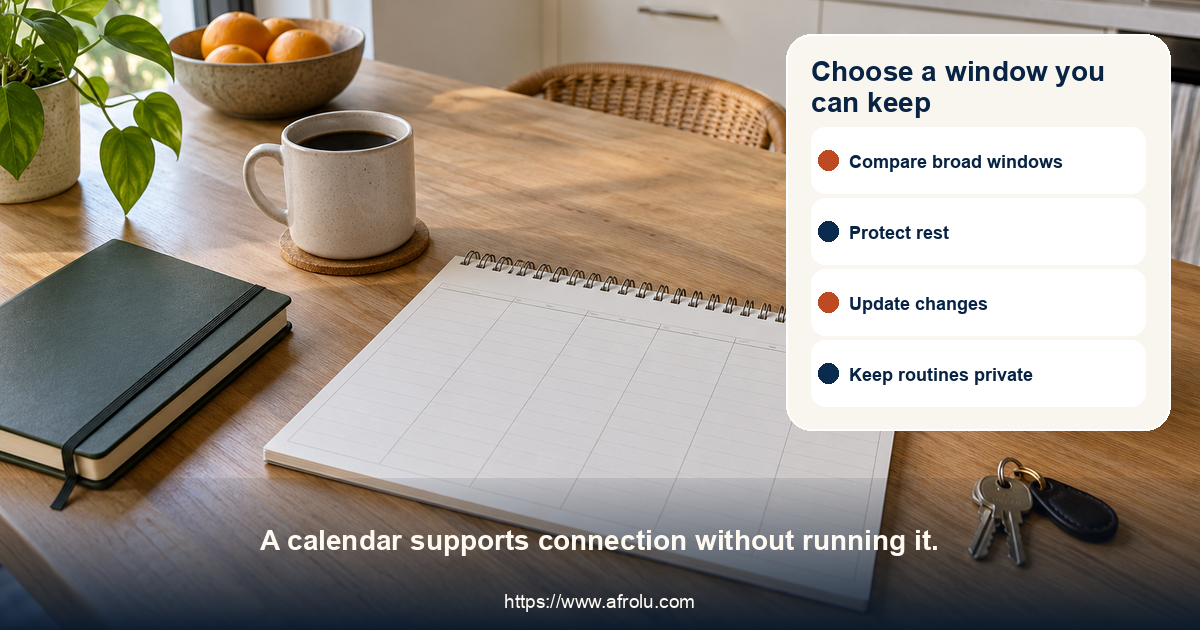
Use the week you can actually offer, including the week that changes
Describe availability in broad terms: one early evening with notice, a daytime weekend every few weeks, or a short call after a shift. You do not need to disclose a child's routine, a co-parent's schedule, a workplace calendar, or the exact place you will be. A bounded window is enough to make an invitation concrete.
Some jobs bring deadlines, on-call shifts, travel, or sudden changes. Agree what a useful update looks like when a plan must move, and whether either person can suggest another time without guilt. A late reply during a documented work stretch is different from repeatedly cancelling while demanding that the other person remain available on standby.
Look at who absorbs every adjustment. If one adult always pays for transport, changes a shift, books childcare, or loses rest, the dating rhythm can become one-sided even when the invitations sound affectionate. Compare the actual effort, including planning and cost, then test a small change such as alternating who chooses the next public venue.
Protect work boundaries on both sides. A partner should not require access to a staff calendar, a manager's contact, a live location feed, or an explanation of every gap in the day. Share enough to make a plan if you choose; keep confidential information and ordinary offline time outside the relationship's entitlement.
privacy · family · safeguarding
Children's privacy is a boundary, not a test of how serious you are
You can say that you are a parent, that some evenings are protected, or that plans need advance notice. You do not owe a new match a child's full name, school, photograph, health information, home address, or recurring handover schedule. Do not send images or screenshots that reveal another adult's or child's private details.
An introduction belongs to the parent and should be guided by the child's needs, existing agreements, and the adults responsible for care. It is not a reward for paying for a date, a shortcut to closeness, or evidence that a parent is committed. If legal or co-parenting questions affect a decision, seek qualified local advice rather than asking a dating partner to interpret them.
Keep early dates separate from childcare. Do not take a new match to a child's home, arrange a meeting while the child is present, or use a child as a reason someone must prove affection. If a person pushes for contact, pictures, or school details after a boundary is stated, pause the dating plan and consider what further privacy steps are needed.
A co-parent or other caregiver is a third party, not an information channel for a new date. Do not share their number, messages, location, or personal history to demonstrate that your account is true. Describe only the present logistics you own. This protects everyone while still allowing an adult relationship to develop on honest terms.

Keep a child's identity and routine outside adult reassurance.
first meetings · cost · exit
A good first meeting can fit between responsibilities and still feel complete
Suggest a public place and a defined window that works with your own transport and care arrangements. A coffee, lunch, or walk in a busy shared setting may be enough. Tell a trusted person the broad plan if that supports your safety, but do not share another adult's private information more widely than necessary.
Set the full cost before choosing an activity. If childcare, a long trip, or a late finish makes the invitation impractical, say so and propose a smaller alternative if you want one. Someone who responds to a limit by demanding that you prove interest, borrow money, or reveal where your child will be has supplied decision-relevant information.
Keep arrival and return options independent. Do not rely on a new match for a ride home, accommodation, an emergency transfer, or access to work contacts. Confirm the meeting time on the day and change the plan if conditions no longer suit you. Being a parent does not reduce your right to leave, decline, or revise consent.
After the meeting, ask what you learned rather than whether the date was impressive. Did conversation feel mutual? Could each adult talk about pace without ridicule? Did the person respect the time limit and avoid probing for a child's routine? One pleasant evening is an observation, not a reason to accelerate family access or commitment.

Confirm the place, cost, and return plan before meeting.
labels · intimacy · expectations
Clarity matters even when the relationship is deliberately unhurried
Ask whether casual means non-exclusive dating, occasional companionship, an open-ended connection, or simply an early stage without a promise. Ask what each person expects around communication, physical intimacy, safer sex, and future review. You can keep the conversation proportionate while still discussing the decisions that affect consent and emotional expectations.
Do not treat parenthood as a reason to accept less information. A parent may prefer a lower frequency of dates and still need an honest answer about whether the other person is seeing others. If a choice affects sexual health, travel, money, or family privacy, ask before relying on an assumption. Agreement is specific and can change.
People can revisit an arrangement without either person having done something wrong. Say when a low-pressure setup no longer works, ask whether the other adult wants to renegotiate, and allow a no. Do not make a child, a childcare cost, or past effort into a debt that requires continued intimacy or a new label.
If one person wants an ongoing casual connection and the other hopes it will become exclusive, discuss that difference before it becomes a silent contract. You may decide to continue with the present terms, set a review point, or end. Each option is more respectful than asking a partner to wait indefinitely while withholding information they need to choose.

Clarify contact, exclusivity, and what remains private.
effort · repair · difference
Assess the arrangement rather than grading someone's parenting or career
A parent may have fewer spontaneous hours than someone without care duties, and a person without children may still have demanding work or family responsibilities. Do not turn those differences into a scorecard. Instead, ask whether the plan offers enough connection to both adults and whether each person can suggest alternatives without being punished.
Repair is observable. When someone misses an agreed call, do they acknowledge the effect and propose a workable next step? When you say a detail about your child stays private, does the person accept that boundary without demanding proof? The answer matters more than a speech about being family-oriented or patient.
If a pattern is unfair, describe its effect and request one concrete adjustment. For example, alternate the trip, reduce the time commitment, or pause until the busy period has passed. A partner may not be able to meet every request; what matters is whether they engage honestly instead of using guilt, money, or access to children as leverage.
Leaving can be the right choice even when nobody can be labelled the villain. If you end the connection, communicate the decision clearly, remove shared digital access, and avoid exposing the other person's private messages or identity. If contact becomes threatening or persistent, use platform reporting and local specialist support that fits your circumstances.
reflection · next choice · agency
Review whether this pace still fits before it becomes indefinite waiting
Choose a practical review point tied to a real change: after a few meetings, after a work cycle, or before discussing an introduction. Ask what each adult now understands about the other's availability, expectations, and boundaries. The review is a conversation, not a deadline that obliges someone to become exclusive or meet a child.
Separate questions that need an answer now from questions that can wait. Present exclusivity, consent, or a material financial expectation may affect today's decision. A hypothetical future home or family plan may need more time. You can ask for clarity about the first group without demanding certainty about every later chapter.
Keep your ordinary life intact while you decide. Maintain care plans, friendships, rest, work obligations, and independent transport. A relationship that fits only when a parent repeatedly cancels other responsibilities may be asking for more than the available evidence supports. A smaller step can reveal fit without making a large sacrifice first.
When the review comes, choose among four complete options: continue the current arrangement, redesign a specific burden, wait because timing is genuinely constrained, or close the connection. Explain the choice in plain language. No adult owes a new partner a child introduction, private documents, a job change, or continued dating to make a boundary count.
Eight parent-dating moments involving work, care, privacy, money, and pace
Only late nights are offered
A match suggests calls after midnight although you start work early and have morning care duties.
Name the hours you can offer and ask whether another window works.A school name is requested
Someone says they need the child's school and photo to understand your life.
Keep identifying details private and notice whether the boundary is accepted.Meeting your child is called proof
A date frames an early family introduction as evidence that you are serious.
Separate adult intent from the child's pace and make the decision yourself.A changed shift becomes a loyalty test
A cancelled date leads to accusations that your job matters more than the relationship.
Explain the change once and see whether a workable alternative is discussed.Childcare is turned into a debt
Someone pays for a sitter and then says you owe them extra time or intimacy.
Reject the transaction and keep consent separate from the expense.Casual is left undefined
One adult assumes non-exclusivity while the other expects exclusivity from regular contact.
Ask what each person has actually agreed to before acting on it.A location feed is demanded
A new partner says they need your live location to feel comfortable about your schedule.
Offer a voluntary check-in if wanted, not continuous tracking or account access.Private details are threatened
After you decline another date, the person hints they may tell your co-parent or employer.
Save relevant evidence, limit access, report through appropriate channels, and seek local support.Fourteen signs that a gentle rhythm still leaves room for honest choice
Both adults describe what low-pressure means to them rather than treating it as a shared definition.
The parent can name broad availability without exposing a child's timetable or address.
A demanding work week can be discussed without requiring employer details or constant proof.
Plans include enough notice for care arrangements and do not assume spontaneous childcare.
A missed window leads to a practical reschedule, not guilt about being a good parent.
Casual intent, exclusivity, and physical boundaries are discussed as separate choices.
No adult makes a child introduction the price of continued dating.
Identifying child information stays out of early profiles, chats, and date logistics.
First meetings are public, affordable, time-bounded, and independently reachable.
Childcare costs are not treated as a purchase of affection or access.
Work and care adjustments can be shared or renegotiated as circumstances change.
A co-parent's contact details and private messages are not used as verification material.
A parent can pause or end dating without being accused of wasting someone's investment.
A review point makes the arrangement discussable without promising a future outcome.
A practical map for work changes, casual terms, family privacy, and next steps
| Situation | What it may mean | What to do next |
|---|---|---|
| They say keep it light | The desired pace or relationship terms may still be unclear. | Ask what low-pressure changes in meetings, messages, and expectations. |
| My work week changed | The plan may not fit the current capacity. | Offer a realistic alternative once, then observe whether the adjustment is mutual. |
| They ask for my child's school | A private detail is being requested earlier than necessary. | Keep the information private and ask why it is needed. |
| They want to meet my child | The adults may assign different meaning to an introduction. | Decide based on the child's needs and relevant existing agreements. |
| I always arrange care | The dating logistics may be costing one person more. | Discuss lower-cost, shorter, or alternating plans. |
| Casual means different things | An important agreement may have been assumed. | Clarify exclusivity, intimacy, contact, and review directly. |
| They need live location | Reassurance may be turning into monitoring. | Offer a bounded check-in only if you want one; keep location control. |
| A sitter payment is mentioned later | A voluntary cost is being converted into leverage. | Separate payment from consent and decline any owed-access claim. |
| I cannot meet this month | The delay may be genuine or an indefinite pattern. | Name your limit and choose whether a review date would help. |
| I want to stop dating them | A clear ending may be the best fit even without a dramatic event. | End plainly, protect private information, and seek help if contact persists. |
Twelve direct scripts for making capacity and boundaries discussable
“When you say low-pressure, what would feel different in an ordinary week?”
“I am open to getting to know you; I do not want to imply exclusivity we have not agreed on.”
“I can meet on one early evening with notice, but I cannot promise a call every night.”
“This work change means tonight will not fit. Would Saturday afternoon suit, or should we choose another week?”
“I can tell you I am a parent and share my availability; I keep my child's details private.”
“I decide when a family introduction is appropriate, and it will not be a test of commitment.”
“Childcare and transport add up; can we choose a shorter public plan and share the planning?”
“Are we both choosing exclusivity, or are we still dating other people? I want to be clear.”
“I do not share passwords or continuous location. I am happy to confirm a plan directly.”
“Could we check in after a few dates about whether this pace still works for each of us?”
“Paying for childcare does not change what I consent to or what I owe you.”
“I appreciate the time we spent, but I do not want to continue dating. Please respect that decision.”
Know the difference
A lower-pressure pace versus an arrangement that hides the terms
The adults define present expectations, plan around work and care, protect child privacy, share practical effort, and revisit the arrangement without demanding a family introduction.
One person stays on standby, pays every care cost, reveals family details, or accepts an undefined casual label while the other controls access and timing.
Less pressure should leave both adults with more choice, not less information.

Notice who absorbs changes, cost, and waiting.
A spacious pace is different from one adult waiting without clear terms
| Type or dimension | What it describes | Best next question |
|---|---|---|
| Casual and explicit | The adults agree on limited expectations without implying exclusivity. | State what contact and physical intimacy mean to you. |
| Low-frequency | Dates are less frequent because capacity is limited. | Choose a rhythm each person can realistically keep. |
| Slow-building | The relationship may deepen, but no outcome is promised. | Review what has changed after real shared experience. |
| Exclusive | A separate agreement limits dating other people. | Ask directly before relying on it. |
| Parenting-private | Children and care logistics remain outside early dating. | Share adult-owned facts while safeguarding third parties. |
| Career-heavy | Work reduces spontaneous time but does not decide intent. | Compare windows and alternatives, not job prestige. |
| Undefined | Important terms remain unspoken or differ between people. | Ask about the choices that affect your consent. |
| Paused | A person chooses not to date during a demanding season. | Treat a pause as a complete answer, not a promise to wait. |
| Committed partnership | Both adults choose shared responsibilities over time. | Name responsibilities instead of assuming a label supplies them. |
A simple plan you can use today
Pace is not intent
Fewer meetings can coexist with a serious direction or a casual preference; ask what is true now.
Parenting is not a dating credential
A child should never be used to prove that an adult is trustworthy or committed.
Capacity can be negotiated
Share broad windows and propose alternatives without exposing work or care details.
Casual still needs terms
Discuss exclusivity, intimacy, safer sex, and review where they affect a person's decision.
Costs are not consent
Childcare, transport, gifts, and paid meals do not purchase access or affection.
A pause is allowed
Waiting, redesigning the rhythm, and ending are complete choices without a verdict on parenthood.
Questions organised by purpose and depth
Choose a few prompts that fit the moment. This is a reference library, not a list to complete.
Intent and pace
Separate frequency from relationship terms.
- What does low-pressure mean to you?
- Are we seeing other people?
- Which choice affects us now?
Capacity
Plan for the week you actually have.
- Which windows can I usually keep?
- How should we update a change?
- Who keeps adjusting?
Family privacy
Keep the child out of adult proof.
- What can I share safely?
- Which details stay private?
- Would an introduction serve the child?
Review
Give uncertainty a chosen place in the conversation.
- What works so far?
- Which burden needs redesign?
- Do I want to continue?
What deserves a closer look
What does low-pressure mean in practice?
Compare desired frequency, response expectations, physical intimacy, and whether other dating remains open. A modest schedule is easier to choose when its meaning is spoken.
Evidence limit: A lower-pressure label does not answer every relationship question.
Which family facts belong in early dating?
Share present adult facts that materially affect a decision, such as needing notice for plans. Keep child identifiers, routines, photographs, and another caregiver's private details out of the exchange.
Evidence limit: This guide cannot interpret a custody order or local family law.
How can two adults share a demanding week?
Name broad windows, update changes, and check whether rescheduling effort is mutual. Confidential calendars and continuous availability are not requirements for honest planning.
Evidence limit: No suggested rhythm fits every occupation or care arrangement.
When should a date meet a child?
There is no universal timetable here. Consider the child's needs, the parent's judgment, existing agreements, and whether the relationship has enough stability to make an introduction useful rather than symbolic.
Evidence limit: Seek qualified local advice for legal or safeguarding questions.
Can a date's spending create an obligation?
No. A meal, sitter, transport fare, or gift does not purchase consent, continued contact, or a family introduction. If money is used as leverage, stop and reassess the arrangement.
Evidence limit: Afrolu cannot resolve a payment dispute or assess another person's intent.
How do I know whether the pace still works?
Ask what each adult can sustain, which boundary was respected, who absorbed the latest change, and whether the stated terms match behavior. Decide whether to continue, redesign, wait, or end.
Evidence limit: A review does not require either adult to promise a future outcome.
Shortcuts that confuse parenting, patience, spending, and commitment
Using a child introduction as proof
A child's access is not a reward for adult affection or a test of seriousness.
Calling every limit a lack of interest
A real capacity boundary can coexist with genuine curiosity.
Leaving casual undefined
An unstated assumption about exclusivity can affect consent and emotional expectations.
Revealing care routines too soon
A date does not need recurring locations or handoff details to plan an adult meeting.
Letting a sitter cost create debt
A voluntary expense cannot purchase time, intimacy, or family access.
Promising availability you cannot keep
A smaller reliable window is more informative than repeated cancellations.
Clarify the pace, protect family privacy, or plan a smaller date
Use qualified local advice for legal, custody, or safeguarding questions. Afrolu cannot assess another person's intentions or replace emergency support.
Explore the guide library
Show more related guides
Continue with Afrolu
Show more Afrolu guides
Sources used for this guide
Afrolu reviewed these health, research, safety, or public guidance resources while editing this page. They support the behaviour and safety guidance; they do not diagnose any individual described by a reader.
Questions about dating as a parent with work and care responsibilities
What does low-pressure dating mean for a parent?
It can mean fewer dates, more notice, slower family introductions, or no immediate commitment. Ask which choices the person means; the label should not hide exclusivity, intimacy, or communication expectations.
Can a parent date casually and still be honest?
Yes. State whether you are open to other dates, what kind of contact you want, and which boundaries matter. Casual intent does not require pretending to want a partnership or leaving the other adult to guess.
Should I introduce someone I just started dating to my child?
This guide sets no universal deadline. Keep early meetings adult-only and make any later introduction a deliberate parent decision informed by the child's needs and relevant existing agreements.
How much should I share about my child?
Share only the adult-owned information needed for a dating decision, such as broad availability. Keep names, photos, school, address, care handoffs, health details, and recurring schedules private.
How can I date when work is unpredictable?
Offer broad windows you can usually keep and explain how you will update a changed week. A smaller reliable plan is more useful than promising availability that conflicts with work or care.
Does paying for childcare mean I owe my date more time?
No. Paying a sitter, transport, or meal does not create an obligation to continue a date, share intimacy, or introduce a child. Consent and family access are not repayment.
Does a regular texting rhythm mean we are exclusive?
No. Frequent contact is not an exclusivity agreement. Ask directly what each adult has chosen before making decisions that depend on it.
What if my date asks for my child's school or live location?
You can decline. Those details are not needed for an ordinary adult date. If requests continue after a boundary, pause contact, protect account access, and consider relevant platform or local support.
How do I handle a cancelled plan?
Communicate a changed constraint and offer another time only if you want to. Notice whether both people can adapt; repeated guilt or standby demands are information about the fit.
Can I stop dating even if the other person has been patient?
Yes. Patience does not create a debt. End the connection clearly, avoid exposing private details, and seek local help if contact becomes unwanted or threatening.
One thing to do now
Let the adult connection grow without borrowing a child's privacy
Name the pace and present terms, share only adult-owned availability, and keep child access deliberate. Make early dates workable on time, cost, transport, and childcare; observe who absorbs repeated changes; then choose whether the arrangement is worth continuing. A paid sitter, consistent texting, or patient waiting never creates a duty to provide intimacy, exclusivity, or an introduction.