Two full careers, chosen time, one clear next step
Build a Serious Relationship Without Letting Dating Take Over Work
A plain guide for adults 25+ who want serious dating and a calm pace. Protect work, money, privacy, consent, plans, and rest.
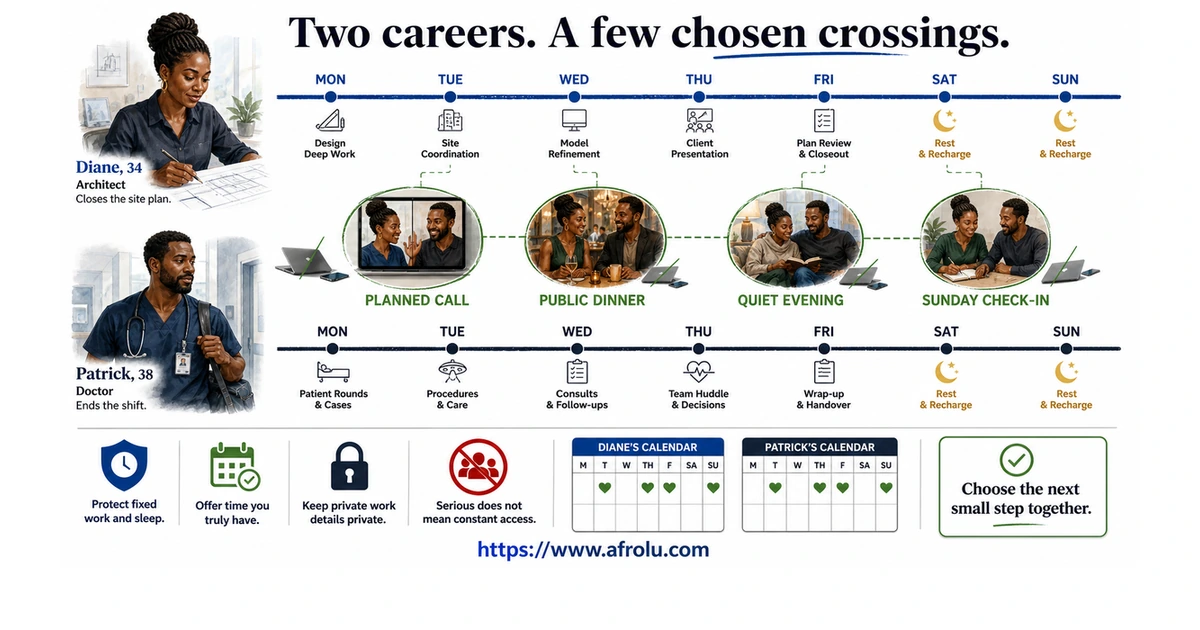
https://www.afrolu.com | Protect each work line. Choose shared time. Keep the next step clear, small, and free.
Written and edited by Clarisse Uwimana · Dating Culture Editor
Keep both careers whole and choose a few clear places where your weeks meet. First, say what serious means now. It may mean that you are exploring a long-term partnership. It does not automatically mean exclusivity, daily calls, shared money, work access, sex, or a promise to move. Next, protect fixed work, sleep, care, health, and quiet time. Offer personal time that you can truly give. Make dates with a place, start, finish, cost, and way home. When work changes a plan, give clear news and a real new offer. Keep employer accounts, client details, calendars, devices, and private meetings outside the relationship. Add public sharing, money, travel, and physical closeness only after a separate free yes. After twelve ordinary weeks, choose one small next step. Continue, change one part, deepen one agreement, or end clearly. Low pressure should remove force. It should not remove truth or effort.
Relationship intent · Professionals
How can two busy adults date toward a serious future without making speed, constant access, or career sacrifice the price of love?
Low-pressure serious dating is for adults who are open to a long-term future. They do not use speed or access as proof. Serious describes the future they want to explore. Low pressure describes how they move today. A calm pace still has clear plans, honest limits, and useful action. It is not the same as casual dating. It is also not an excuse for vague promises, missing effort, or months of waiting. Two professionals can care deeply and still keep separate work accounts, private calendars, independent money, personal friends, and the right to say no. A job title does not prove honesty. A busy week does not prove rejection. The important question is how both adults handle real time, changes, privacy, money, disappointment, consent, and choice.
Diane, age 34, and Patrick, age 38, form an adult composite story. This means their story joins common dating choices. They are not two real people. Diane plans construction projects in Kigali. Patrick helps run a hospital. They meet through friends and agree that both want a lasting partnership. The first month feels calm until work gets hard. Diane has an early site meeting and stops answering late messages. Patrick covers an evening problem and cancels a Tuesday dinner. Each starts to wonder whether the other is truly serious. Their fear pushes them toward the wrong fixes. Diane thinks about sharing her whole work calendar. Patrick thinks about promising every Sunday for the next three months. They pause. Diane shares only her personal free windows. Patrick names the Tuesday change and offers Saturday lunch at a public place. Diane is free on Saturday and accepts. They agree on two messages during busy weekdays and one planned date most weeks. Neither rule is a test. When the week changes, the adult who changes the plan must say so. They also agree that private work details, passwords, and staff names will never become proof of trust. By week twelve, they know more than they learned from their job titles or first-month hope. Both can make a plan. Both can change one without blame. Both can hear no. Their careers still belong to them. They choose to keep dating and discuss exclusivity as its own decision.
The two-career workweek weave
Let the relationship cross two full lives without swallowing either one
Many busy adults make one of two mistakes. They give dating every open hour, or they offer only leftover time. The first choice creates strain. The second makes a serious future hard to trust. A weave gives a simpler picture. Two strong lines stay visible. They meet at chosen places.
Draw each workweek first. Add sleep, care, health, friends, and quiet. The remaining space is not empty. It is personal time. Each adult decides what part to offer. A call or date becomes one crossing. A changed plan pulls at that crossing, so it needs a clear new offer. A deeper step adds a new stitch. It never rewrites the whole week without a free yes from both adults.
A relationship can know your free time without owning your job
Share the personal windows needed for a plan. Keep work accounts, client details, internal travel, devices, and private meetings private.
Put calls and dates where both adults have real space
A useful plan names the time, place, cost, and finish. It does not depend on one adult giving up sleep or waiting through an open-ended maybe.
A change needs news, a new offer, and room for no
Busy work explains some changes. It does not excuse silence or blame. The adult who changes a plan should help make the next usable plan.
Let each deeper choice keep its own yes
Exclusivity, public labels, work introductions, travel, money, touch, sex, and living together are separate choices. Serious intent decides none of them.
Use ordinary actions to choose the next step
Look at plans, changes, limits, joy, privacy, and effort. Continue, adjust one part, deepen one agreement, or end with clear words.
Start with what already has a place
Lay out two real workweeks before offering dating time
Begin with facts that cannot move easily. Add shifts, site visits, client meetings, court dates, teaching hours, travel, care duties, and sleep. Include the trip to and from work. Add time to eat and recover. Do not treat these hours as an enemy of the relationship. They are part of the adult life a partner is asking to join. A person with a full week can still date seriously. The plan simply has to fit the life that exists.
Next, mark private space. This may include exercise, worship, therapy, friends, family, health care, or a quiet evening alone. Personal space is not a weak form of commitment. It helps an adult arrive with attention instead of quiet anger. The World Health Organization lists many risks to mental health at work. They include heavy workloads, long or rigid hours, low control, and clashing work and home demands. That does not set a dating schedule. It does show why adding more pressure is not a harmless proof of love.
Now offer time. Each adult should offer from personal space they can truly give. One may offer a Tuesday call and Saturday lunch. The other may offer Thursday dinner and a short Sunday walk. Compare the offers. Do not count hours as if equal love must look identical. A hospital worker, shop owner, teacher, consultant, and shift worker may have very different weeks. Fairness means that both adults make room and both understand the cost.
Keep a personal calendar between the couple and work calendars with their owners. A partner may need to know that Wednesday is blocked. They do not need the client name, meeting link, building access, patient detail, tender deadline, or names of staff. One broad entry is unavailable until 19:00. Another is free after 18:30. Never share a work password or approve a login to prove honesty. Follow the privacy and security duties of the job.
End with a small minimum, not a perfect week. The minimum may be one date, one call, and two short messages. It may be less during travel or a hard season. Write what happens when the minimum cannot happen. Use a simple rule. Say so as soon as you can. Offer the next real window. Accept that the other adult may choose a different time. This gives the week a shape without turning the calendar into a test.
Give the two main words separate jobs
Say what serious means and what low pressure changes today
Serious answers a future question. Low pressure answers a pace question. An adult may say, 'I am dating because I hope to build a lasting partnership. I want to learn slowly enough to keep my work and health steady.' That is a clear starting point. It does not promise marriage to this person. It does not promise exclusivity unless both adults add that agreement. It does not create consent, money duties, home access, or a place in the other adult's workplace.
Ask what low pressure does not mean. It should not mean that one adult can vanish for weeks and return with a warm message. It should not mean that all planning belongs to the adult with more free time. It should not mean that a hard question is delayed forever. A calm pace still includes answers. It has plans that can be used. It leaves both adults free to ask for more, accept the current pace, or decide that the fit is wrong.
Diane and Patrick first agreed that they were serious, but each heard more. Diane thought it meant they would stop dating other people. Patrick thought it meant that they were open to exclusivity later. Neither had lied. They had asked one word to carry two answers. They fixed the gap with plain words: 'We are exploring a lasting relationship. We have not agreed to exclusivity yet. We will discuss it again after twelve weeks.'
A review date should not become a hidden deadline. It is a time to tell the truth about what has happened. Either adult may be ready for exclusivity. One may need more time. One may know that the relationship does not fit. The talk does not have to end in the same choice. Its job is to stop silent guesses from running the relationship. A no at the review is a valid adult answer.
Keep public words no larger than the private agreement. Do not call someone a partner at a work event if you have only agreed to date. Do not let friends, colleagues, or family turn a quiet relationship into an engagement story. Ask before posting a photograph or naming an employer. A serious future can stay private while two adults learn. Privacy is not secrecy when both understand it and no one is being hidden to support deception.
Make a few crossing points worth keeping
Choose contact and dates that create attention, not constant checking
A call is useful when both adults can be present. Ten rushed calls during work may create less closeness than one planned talk after dinner. Decide which messages need a quick answer. Most do not. A warm update can wait until a break. An emergency has its own route and should not depend on a new dating partner. Do not make reply speed a daily score for care.
Choose more than one kind of contact. A short message can carry a small update. A planned call can hold a real question. A date can bring shared experience. Quiet time can let each adult return to work, friends, and self. Do not use a single channel for everything. A serious disagreement deserves more than short messages sent between meetings. A simple change does not always need a long call.
Give dates a clear edge. Name the place, start, expected finish, cost range, and way home. A short weekday dinner can be serious. A long weekend is not more meaningful merely because it uses more time. Early dates should stay in public places with separate transport. Each adult keeps a working phone, money, and a way to leave. If the plan becomes private at the last minute, either adult may keep the first plan or cancel.
Make room for delight that is not a test. Cook together in a safe setting after trust has grown. Visit an exhibition. Walk in a busy park. Share a meal after a normal day. Serious dating can become too focused on checking the future. Adults also need to learn whether ordinary time feels kind, curious, and alive. Fun does not make the relationship casual. A planned talk does not make it an interview.
Notice who keeps the crossing points alive. Does each adult suggest places, confirm plans, ask questions, and make space? One person may plan more during a busy month. The pattern should still return to shared effort. Low pressure is not low effort. If every date begins with one adult asking and ends with that same adult fixing the details, name the imbalance. Ask for one clear change and watch what happens.

https://www.afrolu.com | Look for clear intent, kept plans, room for work, a calm no, private accounts, fair costs, rest, and shared effort.
A career has doors that dating does not open
Keep work channels, reputation, devices, and decisions with their owner
Use personal contact for dating. Do not begin a private relationship through a client email, staff group, company chat, or business phone when another safe channel is available. A partner should not contact a manager, assistant, customer, student, patient, or colleague to find you after a slow reply. A work trip is not automatic date access. A conference hotel is not an invitation to the room. Make a separate personal plan and accept no.
Protect devices and accounts. A dating partner does not need a work password, door code, customer list, payroll record, private calendar, or live view of a screen. They do not need a photo of a badge or confidential paper. Keep personal messages off shared work screens when possible. Use the security steps required by the employer. If private material has been exposed, contact the right work security person instead of hiding the problem.
Protect reputation without making the relationship ashamed. Adults may choose privacy because their field is public, small, bound by strict rules, or full of shared contacts. Agree on photographs, tags, event introductions, and what colleagues may know. Do not post a workplace, travel plan, name badge, or live location without a clear yes. A yes to one photograph does not cover a new caption or audience.
Keep career choices free. A partner may ask how a promotion, transfer, new business, or study plan could affect the relationship. They may not demand that the other adult quit or turn down an offer. A lower salary does not mean that career should be thrown away. A higher title does not give one adult the final vote. Discuss the effect, the options, and the date for a decision. The career choice stays with its owner.
A workplace romance needs extra care because job power can change how free a choice feels. Follow the employer's rules. Pay attention to reporting lines, hiring power, pay decisions, schedules, and access to private information. Seek qualified local or workplace advice when needed. This guide cannot decide whether a workplace relationship is allowed or fair in a specific job. Do not use a serious label to bypass those rules.
Work will change a plan sooner or later
Judge the change by the next action, not by the excuse alone
A deadline, sick colleague, delayed trip, family need, or tired body can change a date. The reason may be real and the effect may still hurt. Both facts can fit in one talk. The adult who changes the plan should say what happened in broad terms. They do not need to expose private work details. They should name what is cancelled and offer a real next option when they have one.
A useful change sounds like this: 'I cannot make Friday dinner. I have to cover a work problem until late. I can offer Sunday at 15:00 for a walk, or Tuesday after 19:00 for dinner. Either answer is okay.' The sentence gives news, choices, and room for no. It does not ask the other adult to sit ready all weekend. It also does not turn a work duty into a claim of greater importance.
The adult who receives the change can name the effect. They might say, 'I understand that work changed. I am disappointed because this is the second late cancellation. Sunday does not work for me. I can do Tuesday.' They do not have to hide hurt to look easygoing. They also do not need to punish the other adult. Low pressure makes room for honest disappointment and a free next choice.
Look at the pattern after the talk. Does the new date happen? Does the same person always cancel? Are changes shared early or only after the other adult asks? Does one job always outrank the other? Does an apology lead to a useful action? One hard month may need a smaller plan. Repeated open promises may show that the relationship does not have usable space. The answer can be a slower pace or an ending.
Safety changes the response. Repeated unwanted contact, showing up at work, secret tracking, threats, account entry, or harm to a career is not a calendar problem. Do not arrange a private meeting to solve it. Save useful records when safe. Tell a trusted person. Use platform, workplace, specialist, legal, or emergency support that fits your location and risk. A job title and a serious label do not make these actions safe.

https://www.afrolu.com | Name the limit, say what you can offer, keep private work private, and leave room for the other adult's answer.
A deeper relationship adds separate choices
Discuss money, public life, travel, and physical closeness one at a time
Money should grow slowly. Early dates can use costs that both adults can lose without harming rent, food, care, transport, debt, or savings. A fair split may be equal, based on income, or divided by item. Say the plan before spending. A high salary does not create a duty to pay. A lower salary does not create a duty to accept a private or unsafe plan. Gifts do not buy more time, touch, sex, or access.
Keep investment and rescue money outside new romance. A claim about a delayed salary, business deal, medical need, account problem, travel fee, device, or family emergency can create urgency. Do not send money, gift cards, crypto, payment codes, or account details to prove trust. The U.S. Federal Trade Commission warns that romance scammers build trust and then ask for urgent payments. Its reporting steps are for the United States. Readers elsewhere need local banking, platform, fraud, and police routes.
Public life also needs a yes. Ask before inviting a date to a work dinner, professional group, faith event, family meal, or friend trip. Explain who will be there and what label you plan to use. The invited adult may decline. They may attend without accepting a new relationship status. A public introduction does not create exclusivity, engagement, money duties, or consent.
Travel needs a plan that each adult can enter and leave. Keep tickets, identity papers, money, phone, lodging, and transport under personal control. Meet first in a staffed public place. Give a trusted person the useful plan. Check official travel and local safety information for the real date and place. A work-paid flight or hotel does not give a partner access to the traveller, room, or free time.
Physical closeness needs a free yes for the specific activity now. A nice dinner, long courtship, serious label, exclusive agreement, gift, promotion, trip, or earlier yes does not create consent. An adult may want a kiss and not want sex. They may change a plan and return home. The other adult must stop without bargaining, shame, anger, or a bill. Check the law where you are.
Use twelve ordinary weeks, not a dramatic test
Choose the next step from real actions across work and dating
Twelve weeks can include a deadline, a tired day, a good date, a changed plan, and a small disagreement. It is not a magic number. It is simply long enough to look beyond the first rush. Review what actually happened. Did both adults make plans? Did each protect the other's work and rest? Could either say no without losing warmth, contact, money, or reputation?
Read the quiet parts too. Did the relationship include ordinary joy? Could both adults talk about something other than jobs and the future? Did friends, health, and personal interests stay alive? Did each adult feel free to focus at work? A relationship can be calm because it is secure. It can also be quiet because one person has stopped asking. Use actions and honest answers to tell the difference.
Choose one of four next steps. First, keep the same plan because it works. Second, change one part, such as fewer weekday messages or a firmer date finish. Third, deepen one agreement, such as exclusivity or meeting close friends. Fourth, end the relationship with direct and kind words. Do not deepen five areas at once. A small next step is easier to understand and freely choose.
If one adult wants more time, ask what the time is for. A useful answer names something that can be learned or changed. It also gives a date to talk again. 'I need eight more weeks to see how our travel seasons fit' can be discussed. 'Let us not add pressure' without any plan may keep the other adult waiting. They are free to decline that wait.
If the answer is an ending, do not turn it into a career verdict. Two good adults can have weeks, locations, money needs, family duties, or future plans that do not fit. Say what is ending. Return belongings through a safe plan. Remove account or calendar access. Keep work contact out of the ending. A respectful ending is not a failed serious relationship. It is a clear decision made before either life becomes smaller.

https://www.afrolu.com | Review real weeks, not job titles or big claims. Choose the smallest next step that protects both adults.
Seven adult workweek moments where low pressure needs a clear action

Grace and Musa replace an instant-reply rule with two clear windows
Grace is 29 and works as a data analyst. Musa is 36 and owns a busy restaurant. Grace often puts her phone away during deep work. Musa cannot answer during the evening meal rush. Both want a lasting relationship, but each reads the other's silence as low interest. They begin sending more messages during the hours when the other adult is least able to answer. The extra contact creates pressure without adding useful time together.
They stop using reply speed as a score. Grace usually checks personal messages at lunch and after work. Musa sends a short note before service and answers fully the next morning. Urgent personal needs use family, friends, health care, or emergency services. A new dating partner is not the only emergency contact. After two weeks, both feel more connected because the expected windows are real.Lindiwe and Sipho look at what follows the second cancellation
Lindiwe is 31 and leads a design studio. Sipho is 37 and works in sales. Sipho cancels Friday dinner when a customer meeting runs late. He apologises but offers no new date. Two weeks later, travel changes another Friday. This time he asks Lindiwe to stay open all weekend. She does not question whether his work is real. She questions whether the dating plan is usable.
Lindiwe says, 'I can accept changed work. I cannot keep whole weekends open. Please offer a time you can confirm.' Sipho offers Sunday lunch and books the place. He also stops choosing Fridays during his busiest sales month. If he had answered with blame or another open promise, Lindiwe would have slowed the relationship. The useful fact is the new action, not the size of the apology.Abena keeps Kofi's conference invitation separate from relationship status
Abena is 35 and works as a lawyer. Kofi is 40 and directs a small business. After six dates, Kofi invites Abena to a company dinner. He plans to introduce her as his partner. Abena is interested in him, but they have not chosen that label. The event also includes customers and staff. A warm invitation would place their private relationship inside his work world.
Abena asks who will attend, whether photographs will be posted, and how she will be introduced. Kofi offers 'my guest' and promises to ask before any photo. Abena accepts but uses her own transport. Attending does not make them exclusive. It does not give Kofi a place at Abena's office. Each workplace introduction needs its own purpose, limits, and free answer.Farah refuses to mix a new relationship with Idris's business need
Farah is 32 and manages a pharmacy. Idris is 39 and says he imports building supplies. They have dated online and in public for three months. Idris says a payment delay may ruin a large order. He asks Farah to transfer money for two days and promises a quick return. He says serious partners solve problems together. The request joins urgency, business, money, and proof of care.
Farah sends no money, code, card, account detail, or identity paper. She does not use her workplace to check his medical or financial story. She speaks with a trusted adult and checks the profile outside their private chat. If the pressure continues, she saves useful records, reports the account, and ends contact. A serious label does not turn a new partner into a lender or investor.Chantal and Eric compare two lives before discussing a move
Chantal is 41 and leads a school. Eric is 45 and works as an engineer. Chantal is offered a larger role in another city. Eric first says that serious dating should make the choice easy. He assumes Chantal will decline because his work is less easy to move. Chantal hears that her growth has become a threat to the relationship. Neither adult has checked travel, timing, or other options.
They remove the yes-or-no demand. Chantal gathers the written offer and deadline. Eric checks his own travel and remote-work limits. They compare continued dating, more travel, a later transfer, and an ending. Chantal keeps the career decision. Eric keeps his. The relationship question is whether their chosen futures still overlap, not which adult can prove love through loss.Tolu changes the plan and Ada accepts the answer without a debate
Tolu is 30 and tests software. Ada is 35 and works as a pharmacist. They have agreed to exclusive serious dating. After a work award dinner, Tolu planned to stay at Ada's home. The event runs late and Tolu feels tired. Tolu decides to go home instead. The exclusive label, expensive dinner, earlier plan, and affection do not create consent for a private visit or physical contact.
Tolu says, 'I am going home now. I will arrange my ride.' Ada answers, 'Okay. Message me when you arrive if you want.' Ada does not ask Tolu to repay the dinner or prove commitment. The next day they can talk about the change. In the moment, Ada's job is to respect the answer. Consent belongs to the specific choice now.Njeri treats Samuel's office visit as a safety issue, not romance
Njeri is 28 and works in communications. Samuel is 34 and works in finance. Njeri ends the relationship after Samuel keeps asking for her passwords and live location. Samuel later appears at her workplace with flowers and asks reception to call her. He sends messages to a colleague when Njeri does not meet him. He calls the visit a serious gesture. Njeri has already said no to contact.
Njeri does not meet him alone to soften the ending. She tells workplace security and a trusted person. She saves useful records when safe and checks her account privacy. She uses local specialist, platform, legal, or police help as needed. Unwanted workplace visits, tracking, and repeated contact can form a stalking pattern. A gift or serious label does not make them caring.Eight signs that serious dating leaves both careers whole
Both adults can explain the long-term goal and today's agreement. They do not assume exclusivity, public labels, money duties, or consent.
Each adult offers personal time they can truly give. Work, sleep, care, friends, health, and quiet do not have to disappear.
Plans name a place, time, finish, cost, and way home. Neither adult is kept ready for an open-ended maybe.
When a plan changes, the adult who changes it gives clear news and a usable new offer. They accept that the answer may be no.
Work accounts, devices, client details, staff names, private meetings, and internal travel stay with their owner.
Both adults make effort across time. One may carry more during a hard week, but the pattern returns to shared planning.
Money, public sharing, travel, touch, sex, and deeper commitment each receive a separate free answer.
Either adult can ask for more, slow down, change a plan, or end. The answer does not bring shame, threats, tracking, workplace contact, or punishment.
Choose the next action from what happened, not from a job title
| Situation | What it may mean | What to do next |
|---|---|---|
| A normal workday passes without a reply. | The adult may be focused, in a meeting, travelling, resting, or unable to use a phone. One slow reply does not prove low interest. | Use the agreed message window. Ask about the wider pattern only when unclear or missing contact keeps repeating. |
| A date changes because work runs late. | A real work need may have changed. The dating impact still matters. The next action shows whether the adults can make a new plan. | Name what ended. Ask for or offer one real new time. Do not keep a whole evening or weekend open without a plan. |
| A partner asks to see the full work calendar. | They may want planning help or constant proof. Full access can expose private people, places, meetings, and systems. | Share personal free windows only. Refuse account, password, client, location, and private-meeting access. |
| One adult invites the other to a work event. | The invitation may be warm. It also places a private relationship near colleagues, customers, photographs, and public labels. | Ask who will attend, how you will be introduced, what may be posted, and whether you can arrive and leave on your own. |
| A business or salary problem leads to an urgent money request. | The need may be real, false, or impossible for a dating partner to check. Urgency and affection make a poor setting for a transfer. | Send nothing. Protect codes and accounts. Check outside the private chat and use local banking, platform, fraud, or police help if needed. |
| A promotion or transfer may change the relationship. | Two valued futures may be pulling apart. Income and job title are only part of the choice. | Gather real dates and terms. Compare more than one path. Keep each career choice with its owner and set a date for the relationship talk. |
| A serious or exclusive partner expects physical contact after a date. | They are treating a label, earlier plan, spending, or affection as consent. None of those things creates consent. | Ask for a free yes to the specific activity now. Stop when the answer is no or changes. Leave and seek help if pressure or force appears. |
| An ex keeps contacting work or appearing at the workplace. | Repeated unwanted contact, watching, tracking, or visits may form a stalking or harassment pattern. This is not a low-pressure dating question. | Do not meet alone. Save useful records when safe. Tell workplace support and use local specialist, legal, police, or emergency help suited to the risk. |
Ten plain lines for time, work privacy, money, consent, and the next step
“I am dating toward a lasting partnership. I still want us to learn without rushing access.”
“We both use the word serious. Have we agreed not to date other people, or is that still open?”
“I am free Tuesday after 19:00 or Saturday from 12:00 to 15:00. Which works for you?”
“I cannot keep Friday. I can offer Sunday lunch or Tuesday dinner. Either answer is okay.”
“I can share when I am free. I do not share work accounts, client details, or my private calendar.”
“I put my phone away while I work. I usually answer personal messages at lunch or after 18:30.”
“I am not ready to meet colleagues or be posted online. Let us keep our next date personal.”
“I do not lend, invest, send codes, or move money to prove a new relationship. I will not pay.”
“Our serious relationship does not decide physical contact. I will say what I want in the moment.”
“Let us review what worked, what felt hard, and one next step. Ending is also an honest answer.”
Know the difference
Low-pressure serious dating or casual dating?
Two adults are open to a lasting partnership with each other. They choose a pace that protects work, rest, privacy, and free choice. The calm pace does not remove planning. They still need direct answers about exclusivity, contact, public sharing, money, physical closeness, and the next review.
Two adults may keep the future open, limited, or less focused on long-term partnership. Casual dating can also be clear, kind, and low pressure. It may be exclusive or not. The label does not lower consent, honesty, privacy, or safety duties. Adults must define what the word means to them.
Low pressure describes the pace. Serious or casual describes the future goal. Neither label creates exclusivity, work access, payment duties, travel duties, physical access, or consent. Ask about the future and today's agreement separately.

https://www.afrolu.com | Low pressure can be serious or casual. A label never creates exclusivity, access, payment duties, or consent.
Separate future goals, pace, exclusivity, feelings, and workplace rules
| Type or dimension | What it describes | Best next question |
|---|---|---|
| Low-pressure serious dating | Explores a lasting partnership through small, clear steps. A calm pace and real effort appear together. | What long-term future are we exploring, and what is agreed today? |
| Serious dating | Names a long-term goal. It does not set speed, contact, exclusivity, money, consent, or career sacrifice. | Which action this month makes the serious goal easier to trust? |
| Slow dating | Names a careful pace for learning. The future goal may be serious, casual, or still open. | What are we learning slowly, and when will we discuss it again? |
| Exclusive dating | Names an agreement not to date other people. It does not prove long-term fit or open work, money, home, travel, or physical access. | What exactly does exclusivity cover, and how can either adult change it? |
| Casual dating | May keep the future open or limited. It can still have clear plans, honest limits, respect, and full consent. | What does casual mean here, including other partners and safer-sex choices? |
| Emotionally available dating | Describes the ability to share feelings, hear another adult, and respond with care. It does not require constant contact or instant commitment. | Can we discuss disappointment without blame, silence, or work intrusion? |
| Workplace romance | Adds employer rules, job power, reporting lines, reputation, and private data. The workplace may limit what is fair or allowed. | What rules and power differences must be checked before personal dating? |
Make a workweek weave in six useful moves
Draw the real week
Mark fixed work, travel, sleep, care, health, friends, and quiet. Each adult then offers personal time they can truly give.
Give the labels one job each
Serious names the future goal. Low pressure names the pace. Exclusivity, public sharing, money, and consent need separate answers.
Choose a few crossings
Use clear calls and dates instead of constant checking. Name the time, place, finish, cost, and way home.
Keep the work wall
Share personal free windows. Keep employer accounts, devices, clients, staff, private meetings, and internal travel outside dating.
Fix the changed plan
Give clear news, offer a real next time, and accept no. Judge the wider pattern when changes or silence keep repeating.
Choose one next stitch
After twelve weeks, continue, change one part, deepen one agreement, or end. Do not expand every kind of access at once.
Questions for the week, the changed plan, and the twelve-week choice
Choose a few prompts that fit the moment. This is a reference library, not a list to complete.
Draw the week
Use broad personal time, not private work details.
- Which work, travel, sleep, care, health, and quiet times cannot move?
- Which personal windows can each adult freely offer?
- What contact can both adults keep during a hard week?
- Which messages, if any, truly need a quick answer?
- What stays private because it belongs to work or another person?
Name today's dating agreement
Give each label one clear job.
- What long-term future are we exploring?
- Are we dating other people, or have we chosen exclusivity?
- Who may know about us or see a photograph?
- What money and work access remain personal?
- Which physical and online choices need a fresh yes?
Handle the changed plan
Look for news, a real option, and room for no.
- What exactly changed, and which plan no longer exists?
- What new time can the changing adult truly offer?
- What effect did the change have on the other adult?
- Is this one hard event or a repeated pattern?
- Would a smaller plan, slower pace, or ending be more honest?
Read twelve weeks
Choose one next step from ordinary actions.
- Did both adults make plans and protect work?
- Could both adults say no without punishment?
- Did money, privacy, public sharing, and consent stay free?
- Was there ordinary joy beside future talks?
- Should we continue, adjust one part, deepen one agreement, or end?
What six kinds of facts can show and what they cannot prove
A clear week shows available time, not love or character
A calendar can show fixed duties, free windows, and whether a planned date happened. It can reveal that one adult is making all the offers. It can also show that a particular weekday often fails. Use that information to make a better plan.
Evidence limit: A calendar cannot prove honesty, care, safety, or long-term fit. Do not demand a full work calendar, private meeting names, or live location to fill that gap.
Work explains some limits but does not excuse harm
A role may explain shifts, travel, a duty to keep work details private, fatigue, or a hard season. A person can give broad truth without exposing protected details. Look at whether they make usable plans and speak with respect when work changes.
Evidence limit: A title, salary, uniform, company, or public profile does not prove identity or kind behaviour. Work pressure does not excuse threats, tracking, account entry, or forced choices.
The next action tells more than the reason alone
A clear message, honest broad reason, specific new offer, and kept replacement date show care for the effect. A calm adult can also hear that the new offer does not work.
Evidence limit: One good change does not prove a lasting pattern. One hard cancellation does not prove rejection. Look across ordinary weeks and name repeated gaps.
A respected limit shows more than complete access
Adults can share enough to plan while keeping work and personal accounts separate. Ask before posting an image, naming an employer, sharing a location, or making a relationship public.
Evidence limit: Privacy settings and careful sharing reduce some exposure. They cannot guarantee that another person will not copy, save, forward, or misuse information.
A calm date budget can show planning, not the depth of love
A useful budget protects basic needs and a safe return. It names who pays before spending. Both adults can choose a smaller plan without shame.
Evidence limit: A high bill, gift, loan, or investment does not prove serious intent. Payment never buys time, access, touch, sex, a public label, or a future.
A free yes shows a choice for this moment and activity
Consent needs freedom and the ability to choose. A yes to a kiss is not a yes to sex. A yes before dinner can change later. A respectful adult notices and accepts the answer now.
Evidence limit: Serious dating, exclusivity, time together, a gift, travel, a work celebration, or an earlier yes never creates consent. Laws differ, so check the law where you are.
Six habits that turn low pressure into strain or confusion
Using instant replies as a care score
Reply speed often reflects access, not love. Agree on useful contact windows and look at the wider pattern of attention and action.
Calling every open promise low pressure
A calm pace still needs real dates and answers. Endless maybe language keeps one adult waiting without a choice they can use.
Sharing work access to prove trust
Passwords, private calendars, client details, and work locations expose other people and can break job duties. Share free windows instead.
Letting a work event set the relationship label
An introduction may be public before the agreement is ready. Decide the label, photographs, and audience together before the event.
Treating money as serious effort
A costly date, loan, gift, or investment can create debt and pressure. Serious effort also appears in time, truth, planning, limits, and care.
Making a promotion choose the winner
A career choice and a relationship choice affect each other but remain separate. Compare real paths instead of demanding sacrifice before facts are known.
Use a reviewed resource that matches the decision
This guide focuses on the relationship decision, so it does not rank dating apps. Check current prices, safety tools, and local availability before choosing a service.
Explore the guide library
Show more related guides
Continue with Afrolu
Show more Afrolu guides
Sources for work time, privacy, fraud, stalking, and consent
Afrolu reviewed these health, research, safety, or public guidance resources while editing this page. They support the behaviour and safety guidance; they do not diagnose any individual described by a reader.
Low-Pressure Serious Dating for Professionals: Questions
Can serious dating really be low pressure?
Yes. Serious names the long-term future that two adults want to explore. Low pressure describes how they move today. The relationship can have clear dates, honest questions, shared effort, and a time to review without using speed as proof. Low pressure does not mean low effort or endless uncertainty. Both adults should know today's agreement and be free to ask for a different pace.
How often should two busy professionals text or call?
There is no number that fits every job or couple. Start with contact both adults can keep without regular lost sleep, hidden work, or quiet anger. One couple may choose a planned call, one date, and a few short messages each week. Another may talk briefly most days. Name which messages need a quick answer. Most do not. Review the plan when work, health, care, or travel changes.
Does serious dating mean we are exclusive?
No. Serious dating usually means that adults are exploring a lasting partnership. Exclusivity is a separate agreement about dating other people. Ask directly. Include what counts as dating, how safer-sex information will be shared, and how either adult would communicate a change. Daily contact, a work event, a family introduction, prayer, a gift, or a serious label does not silently create exclusivity.
What parts of my work calendar should I share with a dating partner?
Share only the personal availability needed for a plan. You can say that you are not free until 19:00 or that travel will make Friday uncertain. Keep client names, patient details, private meetings, internal links, passwords, building access, staff schedules, and full live calendars private. Follow the rules of your job. A partner can plan with your free windows without entering work systems.
How many cancelled dates are too many?
A number alone cannot answer. Look at the reason, timing, effect, new offer, and wider pattern. One late cancellation during a real emergency may receive clear news and a kept replacement date. Repeated vague changes with no new offer make the relationship hard to use. Name the impact and ask for one clear change. You may slow down or end even when every excuse could be true.
Should I invite a serious date to a work event?
Only after a separate talk. Explain the event, people, photographs, expected label, cost, and transport. Ask what the other adult wants colleagues to know. They may decline or attend as a guest without accepting a new relationship status. Check employer rules when needed. Never use an invitation to gain a work introduction, customer contact, public claim, private room, or physical access.
What if one adult earns much more than the other?
Choose costs both adults can accept. An equal split may work. A split based on income may also work. One adult may pay for dinner while the other plans a lower-cost date. Protect rent, food, care, debt, savings, and a safe return. A higher income does not buy control or physical access. A lower income does not require debt, a private venue, or gratitude shown through touch.
Can a partner help me make a promotion or transfer decision?
A partner can listen, ask questions, and discuss how each option affects time or location. They should not demand that you accept, decline, quit your job, or move as proof of love. Gather the real terms, dates, money, travel, care, and legal facts. Compare more than one relationship path. The career choice stays with the adult whose work it is. The couple then chooses what the result means for dating.
Does an exclusive or serious relationship change sexual consent?
No. Consent must be a free choice for the specific activity now. A yes to kissing is not a yes to sex. A planned overnight stay can change. A dinner, gift, trip, job celebration, exclusive agreement, serious label, engagement, marriage, or earlier yes does not create consent. The other adult must stop when the answer is no or changes. Check local law and seek local help if pressure or force occurs.
When does career pressure become a safety problem?
Move from normal planning to safety when there are threats, secret tracking, or forced account access. Do the same for repeated unwanted contact, blackmail, sexual pressure, or harm to work. Unwanted visits or messages to colleagues also matter. Do not meet alone to calm the person. Save useful records when safe. Tell a trusted person and workplace support. Use local specialist, platform, banking, legal, police, or emergency help that fits the risk.
One thing to do now
Choose one clear crossing, not a larger claim
Choose the next step that adds truth without taking away work, rest, privacy, money, consent, or a safe exit. Continue when both adults make plans and respect limits. Slow down when warm words are clearer than the calendar. Change the plan when one job or body is carrying too much. Stop ordinary dating talks when threats, stalking, or secret tracking appear. The same applies to forced account access, money pressure, sexual pressure, or workplace contact after a clear no. Use trusted, workplace, platform, banking, specialist, legal, or emergency help that fits the risk.