Parents · casual dating and safety
Casual Dating as a Parent: Protect Family Boundaries
Explore casual dating as an adult parent: define the agreement, protect a child's privacy, plan independent dates, and make family introductions deliberately.

Keep the adult agreement separate from family access.
Written and edited by Amina Wanjiru · Senior Dating Apps Editor
Define what casual means about contact, exclusivity, intimacy, and endings. Tell a match that parenting shapes your availability, but keep a child's name, images, school, address, and routine private. Choose public adult dates and trusted childcare; decide independently whether and when an introduction serves your child. Use qualified local help for custody or safety questions.
Dating basics · Parents Returning To Dating
How can I date casually as a parent without confusing an adult arrangement with a child's access or safety?
Casual dating as a parent is a present-tense adult arrangement that may involve limited commitment without making a child part of the connection. The parent chooses what family information to share and whether an introduction is appropriate; no universal timeline replaces a child's context or a family's agreements.
After separating her adult schedule from family time, Zola meets Musa for coffee and says she is open to casual dating but does not introduce new matches to her child. He asks what casual means about exclusivity; she asks the same of him. They can decide whether those adult terms fit without making a child attend a date or keep a secret.
adult parents · privacy and casual dating
Keep romantic terms clear and family access deliberate
Separate casual intent from care roles, a date's curiosity from a child's privacy, and a future introduction from a first meeting.
Define the adult offer, share scheduling context selectively, protect the family routine, and get local advice where legal or safety terms matter.
What does casual mean?
Ask about contact, exclusivity, intimacy, and endings.
What stays family-only?
Keep identifiers, school, home, and routine private.
Who has a trusted role?
Do not make a new date an unvetted caregiver.
Whose decision is it?
The parent chooses with the child's context in view.
parenting · adult dating
Casual describes the adult connection; it does not define your family
Parents sometimes hear that casual dating must be secret, careless, or incompatible with family life. None of those conclusions follows from the word. Casual may mean no immediate commitment, fewer shared plans, or a present agreement to explore without promising a future. It does not mean that a parent must expose a child's routine, home, school, photographs, or emotions to every new match.
Before using the label, decide what you are offering the adult you meet. Are you open to occasional dates without exclusivity? Do you want a discreet connection while you learn whether conversation works? How much notice do care and work schedules require? A truthful answer lets another adult consent to the arrangement without treating your child as an obstacle or assuming that a parent is seeking a replacement caregiver.
The family boundary is a separate decision. You may keep early dates away from home and from parenting exchanges, avoid posting identifying child details, and wait to introduce a person until the relationship has enough stability to justify that decision. This is not a claim that one timeline fits every family. A child's age, history, temperament, co-parenting arrangement, and any legal order can change what is sensible.
If your own circumstances include separation, grief, conflict, or a safety concern, you do not have to turn a new date into a mediator or adviser. Give only the scheduling context that affects your agreement. For legal, custody, or family-safety questions, seek qualified support in your jurisdiction. The date's comfort with your boundaries is useful information; their approval is not permission you need to parent.
privacy · safeguarding
Treat a child's identifying details as a different category of information
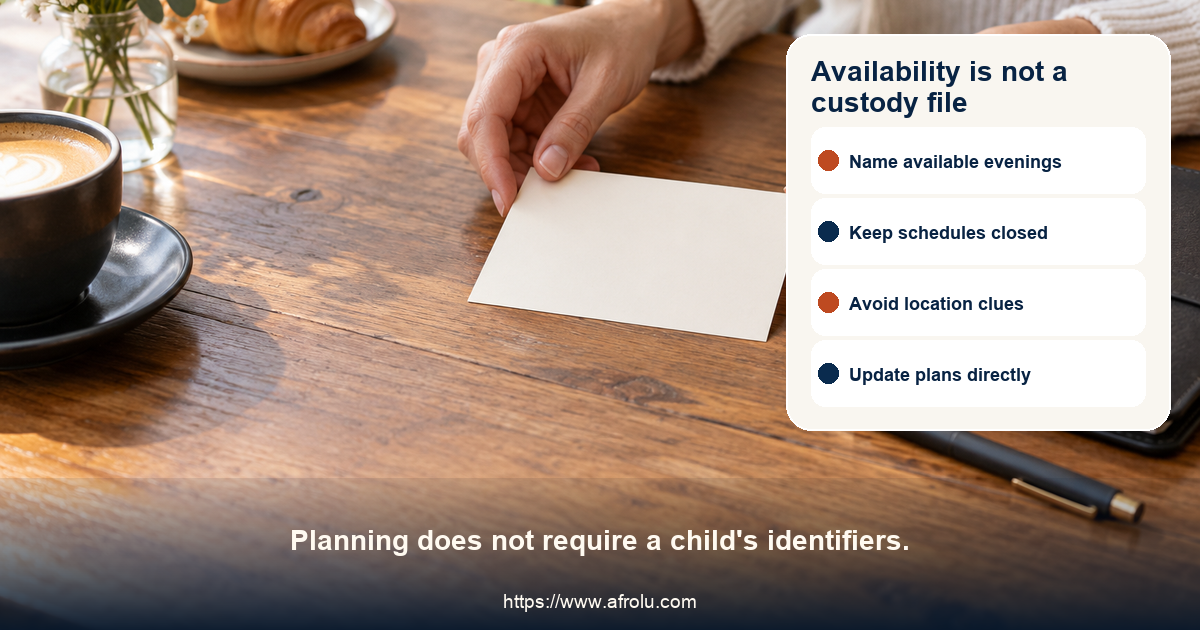
You can say, 'I have parenting responsibilities on alternate weeks, so I plan ahead,' without sending a custody calendar or a screenshot of school notices. Avoid connecting a match to public family photos, tagging locations, or describing a regular route in detail. Small fragments can combine into a location trail, especially when an online profile already includes a workplace or neighborhood.
Keep early meetings in adult settings that do not reveal where a child sleeps or studies. Do not use a child's device, account, image, or voice note to make a new date feel included. Do not ask the child to carry messages, conceal a relationship, decide whether an adult is safe, or reassure the parent about an adult's behavior. Those responsibilities belong with adults and appropriate support people.
A prospective partner can be told that a child's access is gradual and not part of a casual arrangement by default. If someone requests the child's photo, name, room, school, unsupervised time, or authority to discipline before trust and a family decision exist, slow down. A helpful person can accept a boundary without needing privileged access to prove affection.
If a former partner or another adult presents a credible safety risk, the safest digital steps may depend on the situation; changing settings or blocking can sometimes escalate abuse. Use advice from a qualified local family-violence or safety service where relevant. General online dating guidance is not a substitute for an individualized safety plan, court order, or professional assessment.

Notice whether each boundary stays in its proper place.
agreement · consent · sexual health
Casual needs a clear agreement about what each adult is and is not offering
Some adults use casual to mean non-exclusive dating; others mean an occasional sexual connection, a friendship with dates, or simply no immediate commitment. Ask instead of guessing. If you need to know whether either of you is meeting other people before sex, ask that question directly and talk about safer sex and testing in a way that fits the choices ahead.
Clarity is mutual. A parent can explain that a date cannot be moved into a home where a child lives, even if the relationship feels exciting. The other adult can say that this limit does not fit what they want. Neither response is automatically immoral; what matters is that both adults can choose without pressure, and that the child is not made responsible for soothing an adult's disappointment.
Consent is not supplied by a label, a late hour, a paid meal, an overnight invitation, or a previous yes. Each change in touch or intimacy requires a current choice. If a plan changes, ask again. If a person freezes, withdraws, or seems unable to choose freely, pause rather than using silence to move forward. A casual arrangement still requires care around the body and the consequences that affect both people.
Discuss endings as well as beginnings. You might agree that either adult can say they no longer want to meet, and that a parent's schedule may make same-day plans impossible. A clean ending does not require continuing access to the family, a dramatic explanation, or a final visit. If contact becomes unwanted or threatening, use support and reporting options suitable to your local context.

State the condition without asking a child to carry it.
family transitions · no universal clock
There is no calendar rule that can decide when a child should meet a date
The American Academy of Pediatrics' general guidance on dating after divorce suggests limiting introductions to relationships that are becoming serious and allowing a gradual first meeting; it also describes talking with children rather than keeping them as secret-keepers. That resource is a starting point, not a universal timer or a rule for every family structure. Age, culture, past experience, safety, and local legal arrangements matter.
If you choose an introduction, a short, low-pressure hello can be more appropriate than a holiday, trip, overnight, or instant blended-family activity. Tell the child in age-appropriate language what the meeting is and is not: this is someone you are getting to know; the person is not replacing a parent, and the child does not have to manufacture enthusiasm. Listen to discomfort without making the child responsible for the adult relationship.
A new partner does not automatically acquire parenting authority, access to school records, or a role in discipline. Keep ordinary care arrangements with trusted adults who already have a clear role. Avoid asking a child to keep the relationship secret from another parent. Where disclosure could create danger or conflict with a court order, get advice from an appropriate professional before acting; do not rely on a dating article to resolve custody questions.
Some adults decide not to introduce a casual date at all. That can be a coherent boundary, not a confession that the connection is shameful. Another family may decide an introduction is appropriate in a particular context. The decision should be made by the adults responsible for the child, with the child's needs in view, rather than by pressure from a new match who wants proof of seriousness.
scheduling · money · energy
A parent's calendar is real capacity, not an invitation to demand exceptions
Care plans can change at short notice, and a parent may not be able to replace a cancelled evening with a last-minute overnight. Explain the kind of notice that helps you arrange care, but do not send a child's full schedule to prove why a plan will not work. The other adult can decide whether planned dates suit them; they cannot claim access to the hours you reserve for parenting.
Budget for childcare, travel, and the date as separate choices. Do not take on debt or leave a child with an unvetted person because someone expects a spontaneous weekend. Agree on how expenses will be handled and preserve your ability to pay your own way. A costly activity is not evidence that the connection is more serious, and a lower-cost meeting is not evidence that you care less.
Notice how a person handles a necessary reschedule. They may be disappointed and still respond respectfully. Repeated guilt, retaliation, surprise visits, messages to your child, or demands that you choose between dating and caregiving are not a simple difference in texting rhythm. You are allowed to stop sharing logistical information and to end the connection if the pattern threatens privacy or autonomy.
Your energy matters as much as available hours. A parent who works, studies, or cares for others may want one date each month, a daytime meeting, or no dates in a particular season. State a rhythm you can offer without asking a date to approve your family role. If the other adult wants more, let the mismatch remain visible instead of arranging unreliable care to keep their interest.

Keep an exit plan that does not expose family routines.
online dating · identity · money
Keep digital romance and family access on separate tracks
Online conversations can feel intimate long before two people have shared ordinary offline time. Keep early communication on a platform when its safety tools are useful, review profile and location settings, and avoid sending a child's image, school name, or identifiable routine. If an adult repeatedly refuses ordinary verification while asking for travel money, account codes, or family details, pause instead of escalating disclosure to make the relationship feel real.
The FTC warns that romance scammers may build trust online and then request money for travel, emergencies, or another urgent story. Do not send money, gift cards, crypto, or account credentials to a new online sweetheart. If money has already been sent, contact the bank or payment provider quickly and use reporting channels in your country. A cross-border match is not inherently suspicious; urgency plus a transfer request deserves independent verification.
Do not introduce someone to a child to test whether their profile is genuine, to prevent them from leaving, or to create pressure to repay a travel cost. Those are separate questions. A suitable first meeting for adults should stay public and independently reachable; any later family introduction should be a separate decision made when it serves the child and fits the parent's actual circumstances.
If a person misuses a child's photo, tracks a parent's location, contacts a school, or persists after being told to stop, preserve relevant evidence where safe and seek platform, local safeguarding, or law-enforcement help appropriate to the facts. Emergency contacts and legal definitions vary by location. No single online checklist can assess the danger in a specific family situation.
review · self-respect
The right casual arrangement leaves room for both adult choice and parenting care
After several interactions, compare the words 'casual' and 'parent' with what actually happened. Did the other adult plan around the availability you gave? Did either person assume exclusivity? Could you refuse an introduction without an argument about commitment? Did you keep your child's identifying details off a new person's phone? These facts help distinguish a useful arrangement from one that quietly expands access.
A casual connection may continue for a long time, end quickly, or become something more. None of those outcomes changes the child's right to privacy or the parent's ability to decide who enters the home. If the connection changes, discuss what is different before changing the family boundary. You can also decide that casual dating is not compatible with your current care capacity and pause without treating the choice as failure.
If the child's other parent is involved, communication should follow the family's agreements and any applicable orders. A new match should not become a messenger, mediator, or witness in a co-parent conflict. If a separation includes coercive control, threats, or stalking, use a specialist support service before changing digital or contact practices. Advice written for ordinary dating cannot replace an individualized plan.
Choose relationships that can tolerate adult responsibility. A respectful date may be curious about your life and still accept that a child is not part of an early casual arrangement. You may set that condition plainly, listen to the answer, and leave if the fit is wrong. Careful parenting is not a reason to apologise for dating; dating is not a reason to relax a boundary you need to keep.
Eight adult-parent dating situations involving privacy, care, money, and family introductions
A child's face in the match chat
A new date asks for a photo of your child to prove that parenting is part of your life.
Say you do not share a child's images with new matches.The last-minute weekend
A match expects you to cancel a care plan because an open evening appeared.
Offer a realistic future window; do not destabilize care to preserve interest.One adult assumes exclusivity
Both people call the connection casual but have different assumptions about other dates.
Discuss exclusivity and safer-sex choices before relying on either assumption.An invitation after bedtime
A new person says meeting at your home is the only convenient option.
Keep early dates separate from the child's home and routines.The instant family weekend
A match asks to meet the child on a trip after only a few dates.
Make the introduction a parent-led decision, not a proof-of-seriousness test.The unsolicited babysitter
A date offers to watch the child before trust and a caregiving role exist.
Keep childcare with people who already have a clear, vetted role.A message carried by the child
Someone suggests asking the child to tell the other parent about the relationship.
Do not put the child in the middle; get local advice if disclosure is complex.A visit fee
An online match asks for travel funds before the first in-person meeting.
Do not transfer money; verify independently and contact your provider if you paid.Fourteen signs that casual dating and family safety remain distinct
A casual label is defined through present agreements, not guessed from affection.
The other adult accepts that a child's identity is not early-date content.
A parent's care window is treated as real rather than as a challenge to overcome.
No one asks to enter the family home as a condition of meeting.
Childcare stays with adults who already have a clear, trusted role.
A child is not asked to keep secrets, carry messages, or assess a new date.
The parent can decline an introduction without being accused of dishonesty.
Plans include enough notice to preserve reliable care arrangements.
A date change does not become a reason to expose school or pickup details.
Both adults can discuss exclusivity and sexual health before intimacy.
A paid activity never becomes a claim on a parent's home or child's time.
Online money requests can be paused without guilt or retaliation.
A new adult does not assume authority over discipline or family decisions.
Any safety or custody uncertainty is referred to qualified local guidance.
A parent-led map for privacy, introductions, care, online requests, and changing terms
| Situation | What it may mean | What to do next |
|---|---|---|
| I want casual dates | You may want a limited adult arrangement, not a family introduction. | Define what casual changes around contact, exclusivity, and privacy. |
| They ask about my child | Curiosity does not entitle a new match to identifying details. | Share only general context needed to understand your schedule. |
| My care plan changed | Your availability changed; your interest may or may not have. | Update the date directly and offer another window only if you want to. |
| They ask to meet the child | This is a parent-led family decision, not a relationship test. | Consider stability, the child's context, and any legal arrangement. |
| A date offers childcare | An offer does not establish a trusted caregiving role. | Keep care with people already known and authorized by you. |
| They want my address | Convenience does not require sharing a child's home location. | Meet elsewhere and keep the first plan public. |
| They request a transfer | An online story cannot verify a money emergency. | Do not send money; check with your bank or payment provider if needed. |
| The child dislikes an introduction | A reaction is information, not a demand that the child decide your dating life. | Listen, reassure, slow the change, and seek support if needed. |
| An ex may react badly | Disclosure can have a safety or legal context beyond dating etiquette. | Follow applicable agreements and consult qualified local support. |
| Casual becomes serious | Family access and expectations may need a new conversation. | Review the adult agreement before changing a child's routine. |
Twelve adult scripts for casual terms and child-centered boundaries
“I am open to casual dates. For me that means we should talk about exclusivity rather than assume it.”
“I have parenting responsibilities, but I do not share my child's identifying details with new matches.”
“I plan dates around care arrangements, so same-day invitations usually do not work for me.”
“I keep my home separate from early dating. I can meet in a public place instead.”
“I decide if and when someone meets my child; I do not use introductions to prove a relationship.”
“I already have trusted care arranged, so I will not ask a new date to babysit.”
“What does casual mean to you about frequency, other dates, and how we end things?”
“Before intimacy, I want us to discuss testing, protection, and whether either of us has other partners.”
“I do not send travel or emergency money to someone I have not met in person.”
“That new location does not work for me; I am keeping our original public plan.”
“Please do not contact my child's other parent or involve my child in our dating conversations.”
“I do not want to continue. Please do not contact my child or come to our home.”
Know the difference
Adult casual dating versus unplanned family access
Both people understand contact, exclusivity, intimacy, and endings; the parent's child and home remain outside early dates unless the parent later makes a considered choice.
A date treats a child's image, school, home, schedule, childcare, or instant introduction as proof of affection or commitment.
A casual adult connection can be honest while a child's access stays deliberate and private.

A casual label and careful parenting can coexist.
An adult dating agreement does not grant access to a child's life
| Type or dimension | What it describes | Best next question |
|---|---|---|
| Casual | An adult arrangement with terms that still need to be named. | Discuss frequency, other dates, sexual health, and endings. |
| Exclusive | A choice about other romantic or sexual partners, not a parenting title. | Agree directly before either person relies on it. |
| Serious intention | A hope for a partnership does not decide when a child meets someone. | Discuss adult expectations and family timing separately. |
| Low-pressure | Plans can be slower and still be reliable. | Agree on notice and what happens when care changes. |
| Co-parenting | A family arrangement that may have private or legal terms. | Follow applicable agreements and seek local advice when unclear. |
| Dating after separation | A family transition may affect a child's context differently. | Do not use a fixed article timeline as a substitute for judgment. |
| Private dating | Privacy can protect a child without misrepresenting the adult offer. | Tell a match you are a parent while limiting identifying information. |
| Family introduction | An introduction changes a child's social world, not just a date plan. | Decide when there is a reason beyond pressure or convenience. |
| Committed partnership | A partner may become important without automatically becoming a co-parent. | Discuss roles and boundaries before changing household routines. |
A simple plan you can use today
Parenthood is not a dating label
Say what casual means to you instead of assuming another adult will interpret it correctly.
Child privacy is its own boundary
Schedule context is different from a child's identity, school, home, or routine.
Introductions are parent-led
A date's wish to meet a child does not create a deadline or entitlement.
Care is not a romantic favor
Keep childcare with people who already have a clear, trusted role.
Family law is local
Custody, disclosure, and safety arrangements should be checked with qualified local guidance.
Casual still requires consent
Discuss intimacy, sexual health, exclusivity, and endings as adults.
Questions organised by purpose and depth
Choose a few prompts that fit the moment. This is a reference library, not a list to complete.
The adult agreement
Clarify the offer without using a child's role as shorthand.
- What does casual mean to me?
- What about exclusivity needs an explicit answer?
- What would make me end the arrangement?
Family privacy
Choose the details that stay outside new dating conversations.
- What schedule context is enough?
- Which child identifiers stay private?
- Where will I keep early meetings separate from home?
Introduction decision
Think about this child and family, not a date's deadline.
- What is the reason to introduce this person?
- What would a low-pressure hello look like?
- Which agreement or safety context matters?
Care capacity
Protect the arrangements that keep family life stable.
- How much notice can I offer?
- Who already has a trusted caregiving role?
- What changes if the plan is cancelled?
What deserves a closer look
What can a new match reasonably know?
They can know that parenting affects your calendar and whether you want casual, exclusive, or exploratory dating. A child’s name, image, school, residence, and predictable route are different information and can remain private.
Evidence limit: No online privacy setting can guarantee that shared information stays private.
What does gradual mean in practice?
A parent may choose a short, age-appropriate introduction only after deciding the adult relationship warrants it, explaining the situation plainly, and leaving room for the child to react without having to perform approval.
Evidence limit: The AAP resource is general guidance, not a universal timer or custody rule.
Does the other parent always need notice?
That depends on the family agreement, applicable orders, safety context, and local law. Do not use a new date to manage or deliver information in a contentious family system.
Evidence limit: Seek qualified local legal or family-safety guidance where the issue matters.
Does casual mean non-exclusive?
Not automatically. People use the word differently, so ask about other dates, sexual-health decisions, contact, and what either person expects if feelings change.
Evidence limit: A label is not a substitute for mutual, ongoing consent.
Should an early date happen at home?
Many parents prefer a separate public place and independent transport while a match is new. That keeps the child's home and daily pattern private and makes it easier for either adult to end a meeting.
Evidence limit: A public place does not guarantee safety or suitability.
How should a travel-money request be handled?
Pause the transfer, do not share codes or account access, and check independently. The FTC warns against sending money or gifts to online sweethearts whom you have not met in person.
Evidence limit: Use the reporting and financial-protection process available in your country.
Shortcuts that confuse romantic interest with family access
Calling family access proof of seriousness
A child should not have to validate an adult relationship.
Sending a child's picture to reassure a match
A new connection has not earned access to identifying family information.
Using a child as a messenger
Adult relationship or co-parent communication belongs with adults.
Accepting childcare as a dating favor
A romantic offer does not establish safe or agreed caregiving.
Applying one fixed introduction timer
Children and family situations differ; a calendar cannot assess individual context.
Treating casual as careless
A less committed arrangement can still need honest terms and active consent.
Clarify casual dating, set a family boundary, or review first-date safety
Choose guidance that fits the decision at hand. Afrolu cannot assess custody terms, a specific person's suitability, or a family's safety plan.
Explore the guide library
Show more related guides
Continue with Afrolu
Show more Afrolu guides
Sources used for this guide
Afrolu reviewed these health, research, safety, or public guidance resources while editing this page. They support the behaviour and safety guidance; they do not diagnose any individual described by a reader.
Questions about casual dating, child privacy, and introductions
Can a parent date casually?
Yes. Casual dating is an adult relationship choice. You can be clear about your present offer while keeping a child's identity, home, and routine separate from early dating.
Does casual dating mean I should introduce every date to my child?
No. An introduction is a family decision, not a default step or a way to prove that a connection is genuine. The American Academy of Pediatrics offers general advice about limiting introductions and proceeding gradually after divorce, but family situations differ.
How long should I wait before introducing a partner?
There is no universal timer that fits every child or family. Consider the relationship's stability, the child's needs and history, your safety context, and any co-parenting agreement or order. Get qualified local advice if a legal issue is involved.
Should I tell a date that I have a child?
You can say that parenting shapes your schedule and that you are a parent. You do not have to provide the child's name, photo, school, address, or full routine to someone you have just met.
Is it safe to share my custody calendar?
A match may need to know when you can meet, not a screenshot or identifying care schedule. Offer a time window and keep precise routines private unless a trusted, necessary reason changes that decision.
Should a new date babysit?
An early romantic connection is not automatically a trusted caregiver. Keep childcare with people you know and have deliberately chosen for that role.
What if my child dislikes the person I am dating?
Listen without asking the child to decide your adult relationship. Reassure them about their place in your life, slow any family changes, and seek qualified support if the reaction raises a safety concern.
What does casual mean about exclusivity?
It varies. Ask whether either adult is meeting other people and discuss sexual health before choices that make that information relevant. Do not infer exclusivity from affection or frequency.
Can I bring a date home after my child is asleep?
That is a family and safety decision, not a test of casualness. Many parents choose to keep early dates away from the child's home and routine. Consider privacy, the child's context, and any agreements that apply.
What should I do if an online date asks for travel money?
Do not send money or gifts to an online sweetheart you have not met in person. Pause, talk to someone you trust, and contact your financial provider promptly if you have already paid.
One thing to do now
Keep adult choice clear and family decisions deliberate
Name the adult arrangement, share only enough parenting context to plan, protect child and household identifiers, and keep care with trusted adults. Treat any introduction as a separate parent-led decision. If separation, custody, or safety obligations apply, follow the family's terms and seek qualified local guidance rather than improvising from dating advice.