Adult students · serious intent · long distance
Serious Long-Distance Dating for Adult Students
Adult students can date seriously across distance without promising constant access. Define intent, plan around term time, budget visits, and review together.

Agree on intent and capacity without promising constant access.
Written and edited by Ruth Akinyi · Local Dating Editor
Define serious intent separately from exclusivity; build a contact rhythm around ordinary academic weeks, time zones, work, and rest; and discuss travel costs without risking essentials. Keep accounts private, make first visits public and independently reversible, and state what is known about graduation or placements. Review the arrangement as circumstances change; no adult owes a move or financial sacrifice.
Dating basics · Students
How can adult students build serious long-distance dating around term-time schedules and limited travel budgets?
Serious long-distance dating for adult students is a mutually discussed intention to explore a committed connection while living apart, with explicit present agreements and a rhythm that respects study, work, budget, privacy, and independent choice.
At 24, Nia is completing a nursing placement while Eli, 26, studies in another city and works evenings. They both say they want to date seriously, but Nia does not assume that phrase means exclusivity. They agree to a Sunday call during term, talk about seeing other people, and plan a public lunch when their budgets allow. When her placement location remains uncertain, they choose a month to review instead of promising a move.
adult students · serious dating · distance
Build a deliberate connection without making study a loyalty test
Separate intention from status and plan around academic life as it actually changes.
Clarify terms, choose a sustainable rhythm, protect essentials, and review transitions together.
What does serious mean now?
Discuss direction and exclusivity separately.
What fits term time?
Plan contact for the ordinary academic week.
Can each visit work?
Protect essentials and keep costs explicit.
What remains unknown?
Set a review point for placements or graduation.
serious intent · distance · present choice
Serious intent is a direction to discuss, not a relationship status by itself
Start with the present-tense question: are you both open to building a committed relationship if the fit develops, or is one person already asking for exclusivity? Those are related but distinct decisions. Clear language lets each adult decide whether the current arrangement matches what they want, rather than inferring a promise from long calls or affectionate messages.
A serious intention can coexist with uncertainty about timing, geography, or eventual compatibility. It does not require someone to forecast marriage, change a course, move cities, or make a financial commitment before the relationship has enough evidence. You can be deliberate and still let the connection develop through ordinary choices.
If either person is dating others, discuss it before making assumptions that affect emotional or sexual-health decisions. Ask what exclusivity would mean in practice, when it would begin, and whether both adults freely want it. A label is useful only when the people involved can describe the same terms and revise them honestly.
Notice whether a future plan is mutual or being used to hurry a present sacrifice. A partner may share hopes, but one person's timeline cannot set another adult's enrollment, budget, family obligations, or location. Treat a request to change life plans as a separate consequential choice that deserves time and independent advice.

Ask what both people have chosen today.
academic calendar · time zones · capacity
Make contact plans that survive exams, placements, work, and rest
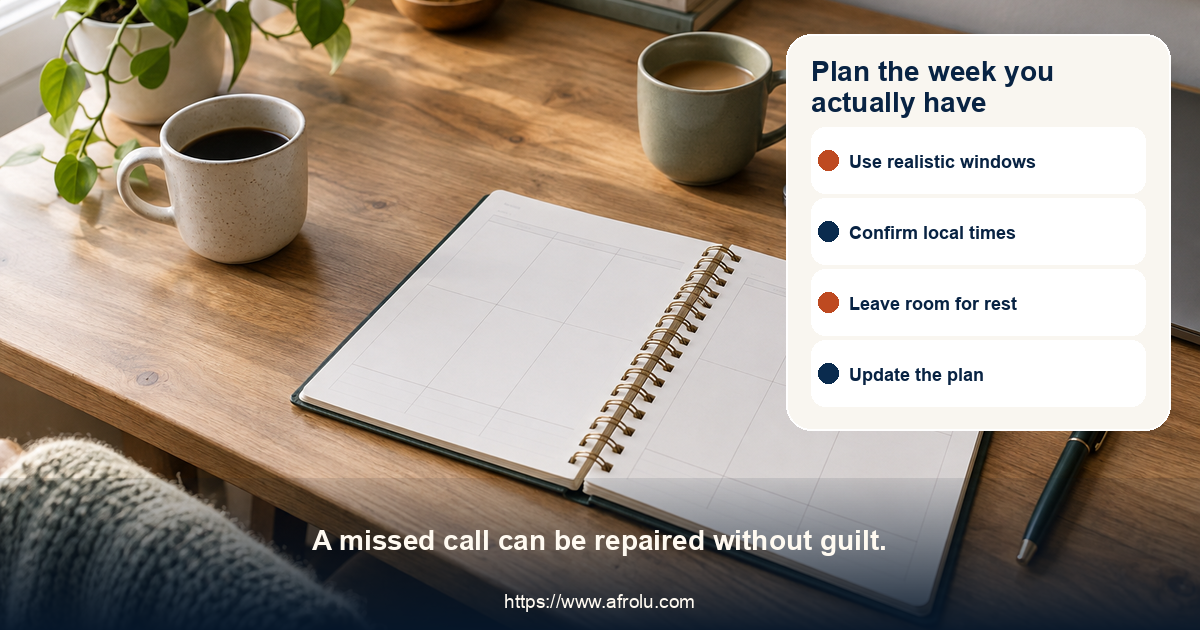
Compare broad weekly windows, time zones, class or placement blocks, paid work, caregiving, and sleep. Share what is relevant without exposing a full timetable or location. Agree how to update a plan when an exam week or shift changes, and whether a short voice note or a rescheduled call works for both adults.
Do not promise a message frequency you can only maintain by skipping study, rest, or work. If one adult likes frequent contact and the other needs longer offline periods, test a specific routine and review how it feels. The aim is dependable communication, not an attendance record used to grade the relationship.
Time zones make 'later tonight' ambiguous for everyone. Name the local time and date for each person, including which calendar day it falls on, and confirm who will initiate. Keep the convention simple and revisit it when a term schedule or daylight-saving change shifts the overlap.
When a call is missed, look at the pattern and the repair. Does the person acknowledge the change, offer a realistic alternative, and accept that you may be unavailable too? Repeated last-minute cancellations paired with demands for your instant replies may point to a mismatch that deserves discussion, not more self-blame.
budget · travel · financial independence
Plan visits around real money and preserve each person's independence
List the actual cost categories before suggesting a visit: transport, local travel, meals, time away from work, and where each person will stay. Agree what is shared and what remains individual. Do not treat tuition, rent, food, debt, or emergency savings as proof that someone is willing to build a relationship.
If one person pays more, describe whether it is a gift, a loan, or a one-time arrangement and keep the choice free of later leverage. A new partner should not request account access, passwords, financial aid credentials, or repeated emergency transfers. For a significant loan or shared financial obligation, pause and seek independent advice.
Travel need not be equally frequent to be fair; the constraints may differ. Compare total effort and who carries the cost across time. A lower-cost visit, shorter stay, or agreed pause during exams can be a sound choice. If only one adult repeatedly travels, pays, and rearranges their life, discuss whether the pattern works for both.
Keep transportation and accommodation independent enough that either person can change plans. Do not make a first visit contingent on staying in a partner's room or borrowing money from them. If funds are not available for a reversible trip, choose calls or wait until the budget changes rather than accepting dependency under pressure.

Discuss the full cost before a visit is planned.
calls · privacy · digital boundaries
Shared routines can build connection without turning availability into monitoring
Choose a small routine that fits both schedules: a weekly call, an occasional meal over video, or a short update after a demanding day. Treat it as an invitation with a way to reschedule. Each adult should be able to miss a moment without surrendering private accounts or explaining every hour away.
Do not share institutional logins, financial portal access, email recovery codes, or one-time passwords to prove trust. Keep class schedules, home addresses, and live location private unless you choose to share limited information for a specific reason. A partner can ask about your day without gaining access to the systems that run it.
Photos, intimate content, and recorded calls need their own consent and privacy discussion. Agree whether something may be saved or shared, and do not pressure the other person to provide sexual images because distance makes in-person intimacy less frequent. A past exchange is not permission to keep, forward, or use content later.
If digital access or constant check-ins become a conflict, describe the effect and propose a bounded alternative. For instance, agree on a message when a call must move, rather than continuous tracking. If a boundary is ignored or content is threatened, preserve relevant evidence, use platform reporting, and seek appropriate local support.
first meeting · travel · consent
A first visit should confirm the connection, not force a decision
Choose a public place and a duration that leaves you with your own transport and a clear end. Confirm details on the day, tell a trusted person the broad plan if useful, and keep enough money and phone access to leave independently. These steps help preserve options but do not guarantee safety.
Avoid making a first meeting dependent on a partner's accommodation, car, or account. If the person proposes a private venue or changes the plan after you arrive, reassess rather than accepting because you travelled. You can keep the original public plan, suggest another time, or end the meeting without debating the fare.
Talk before the visit about expectations for rooms, physical affection, safer sex, and whether either adult assumes exclusivity. You can agree to meet without agreeing to stay overnight, have sex, or make a status decision. Consent remains specific and changeable, including when two people have planned the weekend together.
After the visit, return to your own routines before making a large commitment. Compare what you observed with what you had discussed: Did each person keep the plan? Could you say no? Did the in-person interaction feel reciprocal? A pleasant trip is one data point, not a reason to move, borrow, or change an education plan quickly.
graduation · placement · relocation · change
Treat study and graduation as changing conditions, not hidden tests
Describe what is known and what is not. You may know that a placement starts in January but not which city you will be assigned to. Tell the other adult what could change and when you expect better information; do not invent certainty to keep the connection calm or promise a move to reassure them.
Ask what each person would be willing to consider if the distance continues: visit frequency, a defined long-distance period, or a review after a placement ends. These are options to discuss, not a contract. Either adult can conclude that the arrangement is not workable even while caring about the other person.
A transition can also change power. One person may graduate first, earn more, or control the travel calendar. Keep decisions around money, housing, work, and immigration independent of romantic pressure. For legal, financial, or educational questions, consult a qualified source rather than relying on a partner's interpretation.
Review the arrangement at a meaningful milestone instead of making vague promises to 'figure it out someday'. A check-in can cover contact, exclusivity, cost, and willingness to keep dating across distance. If the answers no longer align, choose a pause, a redesign, or an ending without recasting the original intention as a lie.

Share what is known and name a review date.
reciprocity · repair · next decision
Seriousness shows in the quality of choices, not the size of a sacrifice
Notice who initiates calls, makes plans, travels, absorbs costs, and repairs a missed commitment. A temporary imbalance during exams or illness may be understandable; a repeated pattern deserves a direct conversation. Describe the effect and ask for one realistic change instead of guessing at motives.
Check whether serious intent is being used to limit ordinary independence. A partner should not ask you to abandon friends, hide a relationship from every trusted person, share passwords, or skip study to demonstrate commitment. Discuss what reassurance would help without accepting a condition that reduces your agency.
The relationship can be meaningful and still not fit the current season. If a change could help, agree on a trial period and a review date. If the gap in budget, geography, or desired status is too large, ending may be kinder than keeping one adult in indefinite uncertainty.
Choose the next step using present evidence: continue with the current plan, redesign a specific burden, pause during a known transition, or end. Say what you have decided plainly. Neither adult owes a move, debt, exclusivity, intimate content, or continued contact as repayment for time already invested.
Eight adult-student moments involving intent, exams, time zones, budgets, and visits
The word is treated as exclusivity
One adult assumes that intentional dating means neither person may meet anyone else.
Ask what was actually agreed and discuss exclusivity separately.A busy week becomes a loyalty test
A partner says a missed call proves the student is not committed.
Share a realistic window and discuss how rescheduling should work.A vague late call keeps failing
Each person means a different local time and assumes the other is careless.
Confirm the date and local time for both adults.Travel is expected despite rent pressure
One person asks the student to borrow money to visit during term.
Protect essentials and suggest a lower-cost or later plan.A first visit depends on a partner's room
The visitor would have no independent place to stay or way to leave.
Arrange separate lodging or choose a remote date instead.A password is requested as reassurance
A match asks to access school email or a private account.
Keep credentials private and discuss a bounded check-in.A future move is promised too early
The student feels pressed to commit before placement results are known.
State what is known, what is uncertain, and when to review.Only one person travels
One adult repeatedly pays and rearranges work while the other makes no plan.
Describe the pattern and ask what mutual effort could look like.Fourteen signs that serious dating leaves both adults independent
Both adults can describe what serious intent means before choosing a status label.
Exclusivity is discussed directly rather than inferred from message frequency.
Call plans account for local times, course blocks, paid work, and sleep.
Exam or placement changes can be communicated without accusations of disloyalty.
The contact routine is realistic during ordinary weeks, not only vacation periods.
Education, work, and friendships remain part of each adult's independent life.
Neither adult needs institutional logins, passwords, or live location to feel trusted.
Travel is budgeted without threatening rent, food, tuition, or essential savings.
Each visitor can arrange lodging and transport without relying on the date.
A first visit leaves room to meet publicly and change one's mind.
Consent and intimate content are handled as specific, revisable choices.
Known transitions are discussed with honest uncertainty, not rushed promises.
Planning and repair are shared over time even when contributions differ.
Either adult can pause or end without owing a move or financial sacrifice.
A practical map for term-time plans, exclusivity, travel, and transition
| Situation | What it may mean | What to do next |
|---|---|---|
| They say serious | Intent may be clear while exclusivity is not. | Ask what each adult has agreed to today. |
| Exams are near | The current contact plan may not fit the next few weeks. | Name available windows and set a review after exams. |
| We keep missing calls | Time zones or expectations may be underspecified. | Confirm local date and time and agree how to reschedule. |
| I cannot afford a visit | The trip may compete with essential expenses. | Do not borrow under pressure; consider a smaller plan or wait. |
| They offer their room | The visitor may lack a separate exit or place to stay. | Book independent lodging or keep the meeting remote. |
| They request my login | Reassurance may be turning into account access. | Keep credentials private and suggest another check-in. |
| Placement location is unknown | A consequential detail is not available yet. | Explain the uncertainty and choose a date to revisit it. |
| I always make the trip | Costs and time may have become one-sided. | Describe the pattern and discuss a sustainable alternative. |
| I want exclusivity | A desired agreement may not be mutual yet. | Ask clearly and accept the answer before acting on it. |
| Distance no longer works | The present arrangement may not fit either adult's capacity. | Continue, redesign, pause, or end without turning it into a debt. |
Twelve scripts for discussing a serious direction across distance
“When you say serious, what would you like us to do differently now?”
“Are we agreeing to see only each other, or are we still discussing that?”
“During exams I can reliably call on Sunday afternoon, not every night.”
“Can we confirm the date and local time for each of us before the call?”
“If one of us has to cancel, let's suggest another time without treating it as rejection.”
“I cannot spend money reserved for rent on a visit. Let's plan something affordable.”
“I will arrange my own room and transport for the first visit.”
“I do not share school logins or passwords with a partner.”
“I do not know my placement city yet; I should have an answer in March.”
“I have travelled the last three times. Can we discuss another way to share the effort?”
“I want us to discuss boundaries separately from the fact that I travelled.”
“I care about this, but I need us to decide whether this distance still works for both.”
Know the difference
Intentional long distance versus commitment measured by sacrifice
Both adults state present intent, agree what exclusivity means, make a realistic contact routine, share planning effort, and review changes in study or geography.
One person must skip study, borrow money, share credentials, reply constantly, or promise a move before the facts and mutual agreement exist.
Serious intent should make honest planning easier, not make sacrifice compulsory.

Notice whether planning respects both calendars.
Intentional long distance versus commitment measured by sacrifice
| Type or dimension | What it describes | Best next question |
|---|---|---|
| Intentional dating | Both are exploring a committed direction without assuming a label. | Ask what present choices would reflect that intention. |
| Exclusive dating | Both have agreed not to date others under defined terms. | Confirm what exclusivity includes and when it begins. |
| Long-distance | Geography limits in-person contact but does not define commitment. | Plan calls, visits, cost, and independent routines. |
| Exam-period pause | One adult temporarily has less capacity during a known academic block. | Agree whether contact changes and when to check in. |
| Async connection | Adults use messages or voice notes around different schedules. | Discuss expected response windows and privacy. |
| First visit | The adults have not yet learned their in-person dynamic. | Keep the meeting public and reversible. |
| Future planning | A possible move or graduation outcome remains uncertain. | Separate what is known from what is hoped. |
| One-sided travel | One adult carries most recurring cost and time. | Review the impact and ask for a workable change. |
| Undefined serious | A meaningful label is used without a shared agreement. | Ask what each person believes has been decided. |
A simple plan you can use today
Serious is not exclusive by default
Ask for the agreement rather than inferring it from affection or time invested.
Schedules are not character tests
Compare actual capacity and the way each person repairs a missed plan.
Distance needs explicit time
Use both local times and revisit the routine when calendars change.
Essentials are not proof
Protect rent, food, tuition, debt obligations, and independent savings.
Access is not reassurance
A healthy check-in does not require passwords, institutional accounts, or tracking.
Transitions deserve uncertainty
A placement, graduation, or move can be discussed before every answer is known.
Questions organised by purpose and depth
Choose a few prompts that fit the moment. This is a reference library, not a list to complete.
Intent
Separate direction from a present agreement.
- What does serious mean to each of us?
- Are we exclusive today?
- Which decision needs a review date?
Term rhythm
Plan around the ordinary calendar.
- When are our dependable call windows?
- How will we update a missed plan?
- What changes during exams?
Visits
Keep money and exit choices visible.
- What can each adult afford without stress?
- Who books lodging and transport?
- What is our public first-meeting plan?
Transition
Be honest about geography and uncertainty.
- What do we know about placements or work?
- When will we know more?
- What options remain if the distance continues?
What deserves a closer look
What does serious dating mean before exclusivity?
It can mean approaching the connection intentionally while still learning fit. Ask whether either person is dating others, what would change under exclusivity, and whether a future review is wanted. Do not use the word alone as proof of a shared contract.
Evidence limit: Only the adults involved can define their agreement.
How can a contact plan survive exams?
Build around an ordinary week and agree how to reschedule when a deadline, placement, or shift changes. A smaller consistent call or asynchronous note may fit better than a daily schedule one person cannot keep.
Evidence limit: Course schedules and obligations vary by person and institution.
What should we include when arranging calls?
Write the date and local time for both people, confirm who initiates, and revisit the overlap when term dates or clock changes shift it. Keep the process simple enough that a missed call can be repaired.
Evidence limit: This guide does not calculate a changing time-zone offset.
How do we handle travel costs fairly?
Discuss total cost and capacity rather than assuming equal spending. Keep rent, tuition, food, and emergency savings protected; describe whether a contribution is a gift or loan; and do not accept a transfer request as proof of commitment.
Evidence limit: This is not individualized financial advice.
What makes a first visit manageable?
Use a public first meeting, independent transport, and lodging you can control. Discuss physical boundaries separately, then review the experience after returning to ordinary routines rather than deciding under travel momentum.
Evidence limit: No public venue or itinerary guarantees safety.
What if graduation could change the distance?
State the likely options and what remains unknown, then agree when to revisit the plan. Neither adult needs to promise a move, job change, or educational decision before reliable information and mutual consent exist.
Evidence limit: Seek qualified education, legal, or financial advice for individual decisions.
Shortcuts that confuse academic capacity, status, access, and commitment
Treating serious as exclusive
Intent and an agreed boundary are different decisions.
Promising daily availability
A vacation rhythm may collapse when classes and work resume.
Using replies as attendance
Response speed alone does not establish care or compatibility.
Borrowing for a proof trip
Financial risk should not be the price of being believed.
Sharing a school login
Relationship reassurance never requires access to institutional systems.
Promising a move before results
A future placement may be unknown and deserves honest uncertainty.
Clarify intent, set a term-time rhythm, or plan a manageable visit
For personal financial, education, health, or legal decisions, use qualified independent guidance. This editorial guide does not replace professional advice.
Explore the guide library
Show more related guides
Continue with Afrolu
Show more Afrolu guides
Sources used for this guide
Afrolu reviewed these health, research, safety, or public guidance resources while editing this page. They support the behaviour and safety guidance; they do not diagnose any individual described by a reader.
Questions about serious long-distance dating as an adult student
Can students have a serious long-distance relationship?
Adults can choose one, but both should discuss what serious means now, how contact fits real calendars, how costs are handled, and what each person wants about exclusivity.
Does serious dating mean we are exclusive?
Not automatically. Ask whether either adult is seeing other people and what specific boundary both want to agree to.
How often should long-distance students call?
There is no required frequency. Pick a rhythm both can keep during an ordinary term and agree how to reschedule around exams, placements, or work.
What if my partner is upset during exams?
Explain the capacity you can offer and discuss a realistic alternative. A missed call can be repaired; repeated guilt or demands for constant access deserve a boundary conversation.
Who should pay for visits?
Discuss the actual budget and constraints. Contributions need not be equal, but neither person should risk essential expenses or use money to gain control.
Should I share my student account password?
No. Keep institutional, email, and financial credentials private; a partner does not need login access to feel connected.
How do we handle different time zones?
Confirm the date and local time for each adult and establish who will initiate or reschedule.
What if I do not know where I will be placed?
Say what is known, what remains uncertain, and when you expect an update. Set a review point instead of promising a move before you have facts.
Should a first visit include an overnight stay?
That is a separate choice. Consider public meetings, independent lodging and transport, and clear boundaries before travelling.
Can we be serious if we later end things?
Yes. Intent describes the approach you chose at the time; it cannot guarantee future compatibility or oblige either adult to continue.
One thing to do now
Choose a relationship rhythm that respects both people's real lives
Define the current relationship agreement, then build a contact plan for ordinary term weeks and discuss visits within each person's real budget. Keep digital access and life decisions independent; meet publicly and review transitions honestly. Continue, redesign, pause, or end when the arrangement changes. Serious intent is meaningful, but it cannot promise compatibility or require a sacrifice that was never freely chosen.