Professionals · long-distance · safety
Safety-Aware Long-Distance Dating for Professionals
Build safer long-distance dating around work: verify claims, plan independent visits, protect money and images, and set a contact rhythm without monitoring.
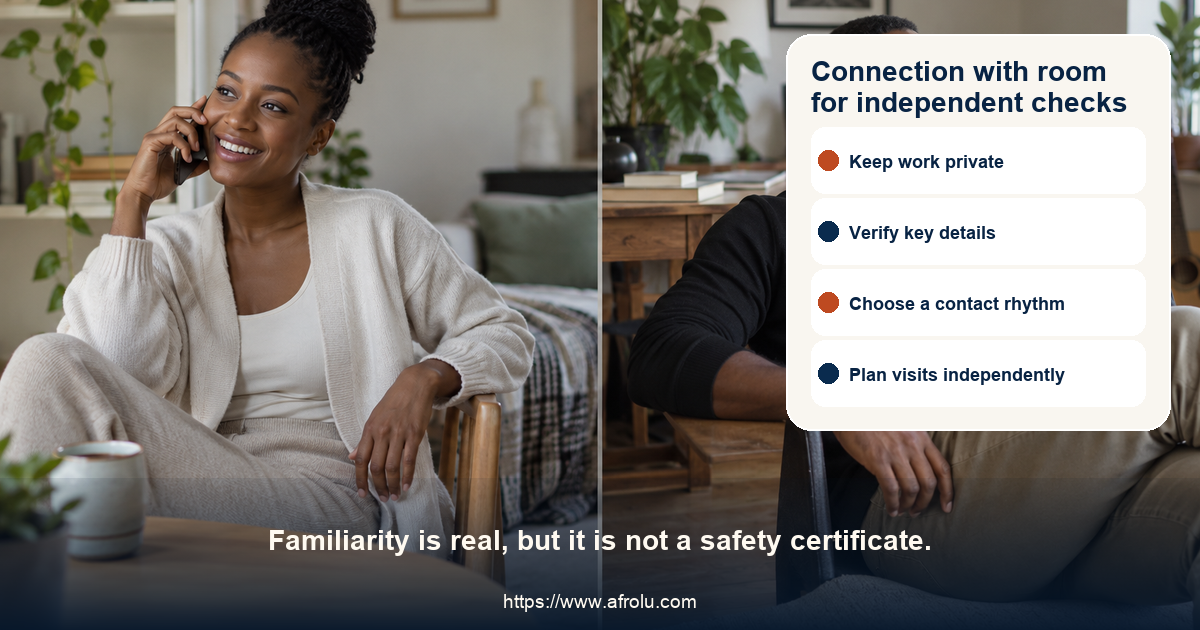
Keep trust gradual and consequential decisions verifiable.
Written and edited by Tariro Ncube · Diaspora Dating Editor
Let online trust grow gradually: a video call or profile badge cannot verify every claim. Agree on contact around real work schedules without sharing passwords or live location. Before a first visit, set a public meeting, costs, lodging, transport, and an exit option; do not send money to an online sweetheart you have not met in person. Digital images and account access remain optional, and safety steps should fit the person's circumstances and location.
Dating basics · Professionals
How can professionals date long-distance while balancing work, digital privacy, first visits, and realistic safety choices?
Safety-aware long-distance dating is a relationship approach that combines a chosen communication pace with proportionate identity checks, financial independence, digital consent, and reversible in-person plans. It reduces avoidable dependence but cannot guarantee another person's behaviour.
Leah and David work in different cities and have had several long calls. When David proposes a visit, Leah asks them to agree on dates, costs, separate lodging, and a public first meeting. They verify the practical details independently and choose a call rhythm that fits two work schedules. The plan does not declare the relationship risk-free; it lets both adults learn more while keeping their choices intact.
professionals · distance and practical safety
Make room for connection without giving up independent choices
Separate a video call from verification, contact from monitoring, and a visit from financial dependence.
Protect work data, check consequential plans independently, keep visits reversible, and review who carries the distance.
What is actually verified?
Treat calls and badges as limited information.
Can contact fit real capacity?
Set anchors, not surveillance.
Can both adults leave?
Plan costs, lodging, and return options.
What remains yours?
Images, codes, and location are separate choices.
distance · identity · evidence
A long video call can build familiarity without proving every profile claim
Long-distance dating often concentrates intimacy into messages and calls. That can make someone feel familiar before you have seen how they handle ordinary plans, disagreement, money, or a boundary. Enjoying the conversation is real; it is not the same as independently confirming a person's employment, address, finances, or identity claims.
Keep communication on the platform while you are deciding whether to continue, if that feels useful. Check privacy and blocking features before you need them. Avoid sharing your full name, home or work address, live location, account code, or a predictable routine early. A profile badge may describe one platform check; read what it actually verifies rather than assuming more.
If a profile photo or story seems inconsistent, slow down and verify through channels you find yourself. Do not use an identity document or private database as a substitute for judgment, and do not send a code to someone who claims they need it to confirm your account. A respectful adult can tolerate reasonable questions without turning them into a loyalty test.
No checklist eliminates uncertainty. The practical goal is to avoid putting money, travel, intimate images, or access to sensitive accounts at risk while you learn. Notice whether details remain consistent over time and whether the person accepts a slower pace. If your unease grows, you may stop communicating without proving a crime or winning an argument first.
work · time zones · digital boundaries
Agree on contact that survives busy workweeks without turning into surveillance
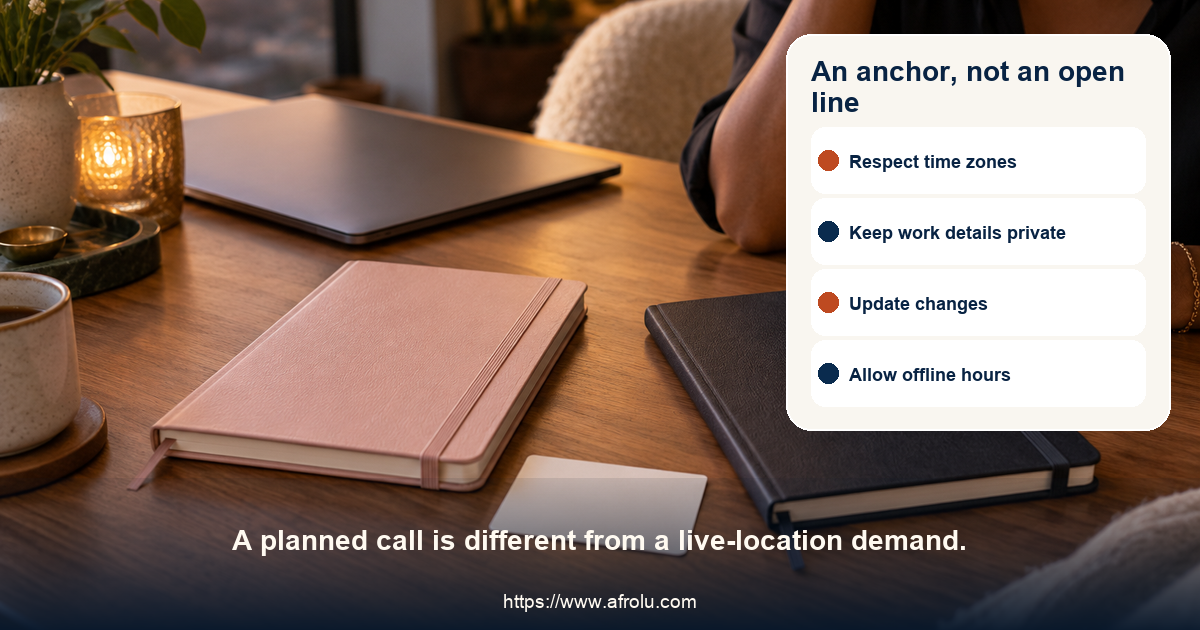
Compare working hours, on-call expectations, travel, rest, and the time difference before promising a cadence. One dependable weekly call may be more meaningful than daily check-ins that disappear during every deadline. Agree how you will say a week has changed and whether a voice note or delayed message works when calls do not.
Keep professional details proportionate. A person may say they are travelling for work without sharing client names, internal calendars, building access, or colleagues' identities. The same boundary should apply to both adults. If someone insists that a serious relationship entitles them to your email, work device, password, or location history, ask what concern they are trying to solve without surrendering control.
Notice whether a missed call is handled with curiosity and a practical adjustment, or with accusations, repeated calls, and requests for proof. One anxious moment can be discussed; a pattern of tracking, checking, or punishing ordinary offline time deserves more attention. CDC describes stalking as a pattern of repeated unwanted attention or contact in a U.S. context; local definitions and support vary.
If a partner has previously used technology to control or threaten you, changing settings or blocking can sometimes affect their behaviour. Seek safety advice suited to your situation before taking an action that could alert them. eSafety's resources offer Australia-specific support routes; people elsewhere should look for a specialist service where they live.
first meeting · travel · exit planning
Make a first in-person meeting public, independently reachable, and easy to change
Agree on a public place and a time limit that fits your comfort. Confirm the details directly on the day, choose your own route where possible, and retain enough fare, data, or another option to leave. Tell a trusted person a general plan if that is useful. Do not share a home address simply because a match says a ride would be convenient.
For a cross-border visit, discuss who pays each cost, where each adult will stay, and what happens if a flight, work shift, or health issue changes. Each traveler should check current official entry and travel information for their own passport and destination. Keep documents and return funds under your control. Separate lodging may be the most comfortable first choice.
Avoid using a ticket, expensive dinner, hotel, or employer invitation as proof that the relationship is safe. The Federal Trade Commission warns about online sweetheart stories involving emergency costs, visas, or travel and says not to send money or gifts to someone not met in person. Its complaint channels are U.S.-specific; the risk principle applies broadly, while local services differ.
If the other adult changes the venue to a private home, asks you to surrender a document, or makes leaving dependent on them, pause. You can return to the agreed plan, contact someone you trust, or end the meeting. A first date is a choice, not a commitment to stay until the other person decides the visit is over.

Agree on venue, duration, transport, and an exit before meeting.
money · scams · financial privacy
Keep romance separate from transfers, investments, and access to professional accounts
An online match may describe a delayed salary, medical emergency, customs fee, blocked bank account, work equipment, or a lucrative investment. A real professional can also face hardship, but you are not the appropriate verification channel. Do not send funds, share banking credentials, accept a deposit to forward, buy gift cards, or open an account for a person you are dating online.
Scammers may encourage a move off-platform, ask for secrecy, or build trust through repeated calls before requesting a small amount. They may also try to involve you in receiving and transferring funds. Pause when the request relies on speed or asks you to hide it from people you trust. Verify any claimed employer or institution using contact details you locate independently.
The FTC's current consumer guidance says not to send money or gifts to an online sweetheart not met in person and recommends contacting a bank or payment provider promptly if funds have been sent. Its report routes serve U.S. consumers. In another country, contact your own financial provider and the relevant official fraud-reporting service as soon as possible.
Keep professional accounts out of the relationship. Do not forward confidential documents, client information, security codes, or a work device to demonstrate trust. If an offer sounds like an investment opportunity, evaluate it through a qualified, independent source rather than the person who would benefit from your participation. Dating is not due diligence for a financial product.

Do not transfer funds or share account access with an online match.
images · consent · account safety
Digital intimacy is optional even when a long-distance connection feels serious
You can choose voice calls, video, or no intimate images at all. If you share content, decide what you are comfortable with and whether you expect it to be saved or shown to anyone. No app can guarantee that a recipient will not screenshot, record, or forward an image. Do not let fear of losing a match set the terms of your digital privacy.
Consent remains specific and ongoing online. A partner must respect a pause or a no without threatening to expose an image or contact your workplace. eSafety describes image-based abuse and sextortion; its services and laws are Australia-specific, so look up the support and reporting options where you live. Do not pay a blackmailer or send more content because of an urgent demand.
Protect accounts with unique passwords and multi-factor authentication where available. Keep one-time codes private and review which devices can access your email or messaging apps. If someone might monitor a device, consider using a safer device and contacting a specialist service before changing settings; a sudden security change can sometimes alert a controlling person.
If a private image is shared without consent, the responsibility belongs to the person who shared it. Preserve evidence only if safe, report the content to the platform, and seek local specialist support. You do not have to negotiate with a threat alone. A dating page cannot remove content or provide emergency response, but it can remind you that your boundary remains valid.

Keep codes private and choose image boundaries freely.
consistency · boundaries · judgement
Look for patterns in how someone responds to ordinary limits, not a perfect safety performance
Notice whether a person can keep a plan, explain a change, accept a slower pace, and answer a practical question without demanding a reward. A single awkward moment can be repaired. Repeated pressure to move off-platform, share a password, send money, or meet privately after you decline is a pattern worth taking seriously.
Be cautious of a story that requires secrecy from every friend, a payment before a first meeting, or a refusal to verify any detail while asking you to disclose more. Do not diagnose a stranger or conduct a risky confrontation. You can end contact, use the platform's tools, and seek a second perspective from someone who is not financially or emotionally invested in the match.
There is no need to treat all long-distance partners as suspicious. Build trust through proportionate, reciprocal steps: each adult shares what they choose, plans are independently checked, costs are discussed, and both people retain separate lives. A person who respects you can disagree about the pace and still accept that your account, money, and travel remain yours.
If you are concerned about stalking or coercive control, general online advice may not fit the risk. CDC and eSafety provide useful educational material, but their legal definitions and services are specific to their jurisdictions. Use a local specialist or emergency service when needed, and choose a plan that does not increase danger by exposing a search or report to the person monitoring you.
review · reciprocity · next choice
Review whether distance is a shared challenge or an arrangement one person is carrying alone
Choose a review point after enough experience to discuss real behaviour: after a visit, a work cycle, or a period of consistent calls. Ask whether plans become more concrete, whether both people contribute, and whether the amount of uncertainty still feels chosen. Do not use a review date to demand a guarantee; use it to decide what information you need next.
Discuss exclusivity and sexual health separately from contact frequency. If the relationship is not exclusive, both adults may need to decide what information they want to share to make their choices. If it is exclusive, agree what each person understands by that term and how to revisit it if circumstances change. Never infer these terms from a long chat history.
Look at costs in more than money: sleep, leave, privacy, emotional attention, caregiving, and professional flexibility. Contributions need not be identical, but the imbalance should be visible and accepted by both. If only one adult travels, pays, researches, or waits, ask whether a different arrangement is possible and whether the other person is willing to participate.
If a safety concern is unresolved, you do not owe another visit to gather proof. You may pause, stay online, end contact, or ask for advice before deciding. A relationship can be affectionate and still not meet your needs. Make the next choice at your own pace, with people and resources you trust outside the connection.
Eight long-distance situations involving work, money, travel, images, and privacy
The video call proves everything
A match treats one call as proof of employment, finances, and identity.
Treat it as one data point and verify consequential claims independently.A missed call triggers tracking
A busy workday leads to repeated calls and a live-location demand.
Discuss a routine without sharing continuous access.A visit depends on a transfer
A new match asks for visa or emergency money before meeting.
Do not send funds; consult a trusted person and verify independently.The venue changes after arrival
The agreed public place becomes a private address without consent.
Decline the change and use an independent way to leave.A client file is requested
A partner says sharing confidential work information would prove trust.
Keep employer, client, and account data private.A private photo becomes leverage
Someone threatens exposure after an intimate conversation.
Stop negotiating alone; preserve evidence if safe and seek local support.Every plan has an urgent exception
Travel, calls, or payments repeatedly change at the last minute.
Pause the next commitment and review the observable pattern.Only one adult carries distance
One person pays, travels, and adjusts while future plans stay vague.
Name the imbalance and decide whether a mutual plan exists.Fourteen signs the connection protects both adults' choices without promising certainty
A video call is treated as useful context, not complete identity proof.
Both adults can keep appropriate work and personal data private.
Contact expectations fit time zones and realistic work capacity.
A missed call receives an update rather than tracking or punishment.
No one requests a password, login code, client file, or banking credential.
A first meeting has an agreed place, duration, and independent exit option.
Travel costs, lodging, and cancellation choices are discussed in advance.
No money or gift is sent to an online sweetheart not met in person.
Each adult can decline intimate images or a private meeting without pressure.
Platform reporting and privacy tools are understood before they are needed.
A safety action accounts for whether a controlling person could be alerted.
Plans and personal stories remain reasonably consistent over time.
Both adults contribute to calls, visits, and future conversations.
Either person can pause or end the connection without being forced to prove danger.
A map for verification, contact, visits, financial requests, and unwanted access
| Situation | What it may mean | What to do next |
|---|---|---|
| They have a verification badge | A platform check may cover only one limited detail. | Read what the service actually verifies and keep learning over time. |
| They want to move off-app | Privacy or convenience may be the reason, but platform tools are left behind. | Choose when you are comfortable and keep personal details limited. |
| My call is missed | A work or time-zone change may have disrupted the plan. | Use an agreed update instead of demanding location proof. |
| They need a visa fee | A compelling travel story is paired with a payment request. | Do not send money to an online match you have not met in person. |
| They offer an investment | Romance may be used to create financial urgency or access. | Decline account access and seek independent financial information. |
| The venue changes | The new location is a different choice from the one you agreed to. | Decline the change and use your own transport plan. |
| They ask for an intimate image | A private request may become a pressure or exposure risk. | Choose freely; do not send images to keep a match. |
| My device may be monitored | A setting change or block might alert a controlling person. | Seek tailored safety advice before changing access if risk is present. |
| They want my work login | Professional access is being treated as reassurance. | Keep credentials and client information private. |
| Distance is one-sided | One adult may be absorbing most time, cost, or future uncertainty. | Discuss reciprocity and decide whether the arrangement remains workable. |
Twelve scripts for setting professional and long-distance boundaries
“I enjoy talking, and I will verify travel or work details independently before making a commitment.”
“I would like to keep chatting here while we get to know each other; I am not ready to share my number.”
“My week is on call. I can plan one call on Sunday and update you if the rota changes.”
“I do not share live location as proof. We can choose a check-in time that works for both of us.”
“I do not send money or gifts to an online match I have not met in person.”
“I keep work and investment decisions independent from dating, so I will not open or move money for you.”
“I agreed to meet at the public cafe. I am not changing to a private address today.”
“Before booking, can we agree on separate lodging, total costs, and a way for either of us to change plans?”
“I am not comfortable sending private images. Please do not ask again after I have said no.”
“I want to talk with someone I trust before taking the next step; I will decide after that.”
“What has distance asked from each of us, and does this effort feel mutual?”
“I am ending this connection. Do not contact me at work or through colleagues.”
Know the difference
Safety-aware long-distance dating versus urgency, access, and one-sided risk
Both adults protect work and account privacy, verify consequential plans independently, choose reversible visits, and respect a no without surveillance.
One person supplies money, credentials, travel, or intimate content while the other controls information, deadlines, or the way home.
Safety planning preserves choice; it does not promise certainty.

Safety-aware dating is reciprocal, not a demand for proof from one person.
Reciprocal planning is different from urgent dependence and one-sided risk
| Type or dimension | What it describes | Best next question |
|---|---|---|
| Long-distance | Geography adds communication, travel, and cost decisions. | Agree on contact and visits that preserve independence. |
| Serious intention | A future direction does not verify identity or define exclusivity. | Discuss the present agreement directly. |
| Exclusive | A mutual agreement about dating other people. | Do not infer it from long calls or travel plans. |
| Online-only | Most evidence comes through accounts and remote communication. | Keep personal and financial information limited. |
| Visit-based | Meetings happen periodically and need clear logistics. | Agree on costs, lodging, transport, and exit options. |
| Low-pressure | A manageable pace with room to ask for clarity. | Name the questions that affect your choices. |
| Digital intimacy | Private images or calls are separate consent decisions. | Choose boundaries before sharing content. |
| Surveillance | Access and monitoring are treated as proof of trust. | Consider whether the pattern respects each adult's privacy. |
| Undefined | An important term remains unanswered despite emotional closeness. | Ask directly and choose your own review point. |
A simple plan you can use today
A video call is one data point
Online familiarity cannot verify every claim or predict offline behaviour.
Work needs boundaries
Availability can be shared without client details, logins, or constant access.
Travel should be reversible
Agree on costs, lodging, transport, and a way to leave before booking.
Money is not a relationship test
Do not transfer funds or move money for an online match you have not met.
Digital intimacy is optional
A serious label or previous image does not create permission for a new request.
Safety is contextual
Platform tools and legal or support routes differ by location and personal circumstances.
Questions organised by purpose and depth
Choose a few prompts that fit the moment. This is a reference library, not a list to complete.
Contact and privacy
Choose continuity without surveillance.
- Which call windows work?
- What work details stay private?
- How do we update a changed week?
First visit
Keep the logistics and exit options visible.
- Who pays which costs?
- Where will each adult stay?
- How can either person leave?
Digital intimacy
Make every online choice specific and voluntary.
- What is okay to share?
- Will images be saved?
- What happens if someone changes their mind?
Review
Assess observable reciprocity after real experience.
- Who carries the distance?
- What is more certain now?
- What remains too costly?
What deserves a closer look
What can a video call verify?
It can add context about voice and appearance, but it does not prove every identity, employment, financial, or safety claim. Verify consequential details independently and avoid sharing codes.
Evidence limit: No online check guarantees identity or future behaviour.
What if an online partner needs travel funds?
The FTC warns not to send money or gifts to an online sweetheart not met in person. Pause, discuss the request with someone trusted, and contact your payment provider promptly if a transfer has already occurred.
Evidence limit: FTC reporting services apply in the United States; local routes differ.
How can busy professionals keep boundaries?
Share a realistic availability window without disclosing client names, internal calendars, work logins, or location history. Professional confidentiality is separate from a relationship's seriousness.
Evidence limit: Employment rules depend on the role and jurisdiction.
What should a first visit include?
Discuss dates, total costs, lodging, transport, independent funds, and a return plan before booking. Each person should check current entry requirements that apply to their own passport.
Evidence limit: Travel rules change; consult official government information.
What if someone threatens to share an image?
Do not send more content or pay under pressure. Preserve messages if safe, report the material to the platform, and seek local specialist help. Consider whether changing device settings could alert a controlling person.
Evidence limit: eSafety support and legal pathways are Australia-specific.
When does repeated contact deserve attention?
A pattern of unwanted calls, tracking, or attempts to reach someone after a clear no can be concerning. CDC describes stalking in U.S. public-health context; seek advice relevant to your location.
Evidence limit: Legal definitions and safety options vary by place.
Shortcuts that confuse a badge, transfer, location share, or call with safety
Treating a badge as full verification
A platform may check only one limited feature.
Sharing work access to prove trust
Professional credentials and client data carry responsibilities beyond dating.
Sending travel money under urgency
A romance story does not independently verify the expense.
Using location sharing as reassurance
Continuous access can become monitoring without resolving uncertainty.
Booking a visit without an exit plan
Travel costs and private lodging can create dependence after arrival.
Blocking without considering risk
In an abusive situation, some digital actions may alert the person monitoring you.
Plan a first visit, protect digital boundaries, or review scam pressure
Platform, reporting, and emergency services vary by country. Use current local sources; this guide cannot verify a profile or provide an emergency response.
Explore the guide library
Show more related guides
Continue with Afrolu
Show more Afrolu guides
Sources used for this guide
Afrolu reviewed these health, research, safety, or public guidance resources while editing this page. They support the behaviour and safety guidance; they do not diagnose any individual described by a reader.
Questions about long-distance dating and professional life
How do professionals date long-distance safely?
Build trust gradually, keep work and account information private, verify consequential plans independently, and make visits affordable and reversible. No checklist can guarantee another person's behaviour.
Does a video call prove someone's identity?
It adds context but cannot verify every claim or guarantee offline safety. Treat it as one piece of information and keep money, travel, and account decisions independent.
Should I send money for a partner's ticket or visa?
Do not send money or gifts to an online sweetheart you have not met in person. The FTC warns about travel and emergency stories; its reporting channels are U.S.-specific.
How often should long-distance partners talk?
There is no universal number. Choose a rhythm that fits both adults' work, time zones, care, and rest, and agree how to update a changed week.
Do I owe a partner my live location?
No. Location sharing is a separate privacy choice, not a condition of trust. You can agree on a check-in time without continuous tracking.
How should I plan a first visit?
Agree on dates, costs, lodging, transport, and a return option before booking. Check current official entry requirements and preserve independent choices.
Is a dating-app verification badge enough?
Not necessarily. Read what the platform says it checks; a badge may not verify employment, finances, or future behaviour.
What should I do about intimate-image pressure?
You can refuse. If someone threatens to share an image, do not pay or send more content under pressure; seek platform and local specialist support.
Can stalking happen in a long-distance relationship?
Repeated unwanted contact, tracking, or attempts to reach someone after a clear request to stop may be concerning. Definitions and support routes vary by country.
How do I know whether distance is one-sided?
Look at who plans calls, pays, travels, adjusts work, and keeps future questions open. Contributions can differ, but both adults should understand and accept the balance.
One thing to do now
Keep the next step connected, proportionate, and reversible
Keep work and financial access separate, verify consequential details using sources you find yourself, and arrange visits so either adult can leave. Choose a contact rhythm without surveillance and set digital boundaries before sharing private content. If a safety action could alert someone who monitors you, seek tailored support before changing settings.