Seven gates · values without access pressure
Test Early Intensity in Faith-Led Serious Nairobi Dating
A faith-aware Nairobi guide to early intensity: test seven gates, protect community and privacy, separate gifts from consent, and keep every exit open.
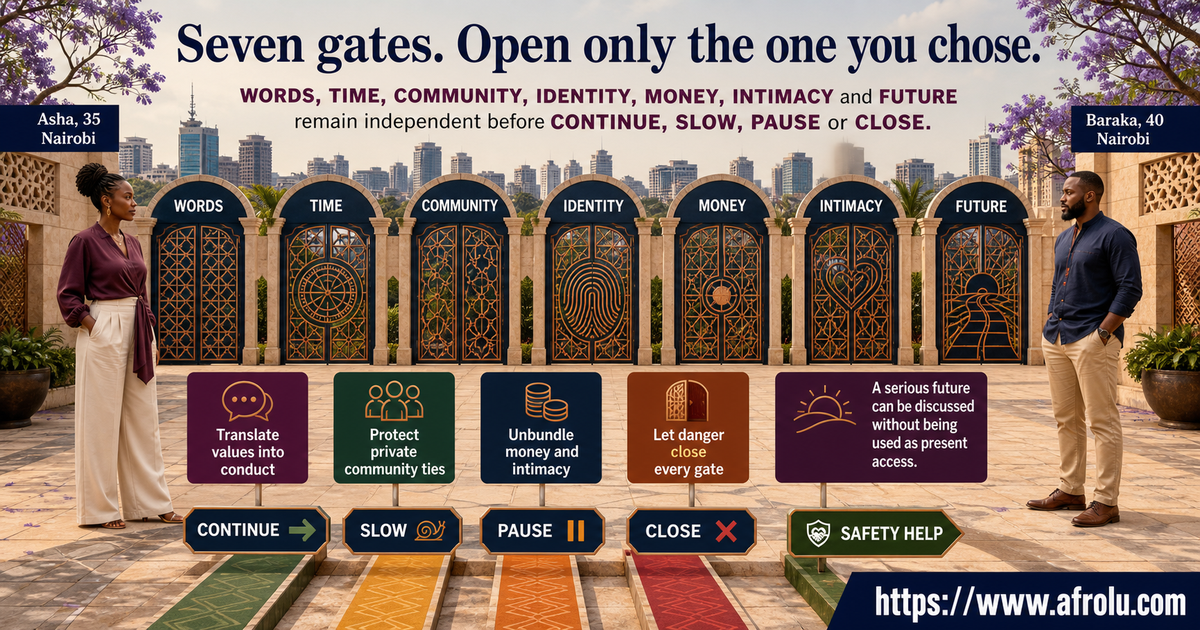
Shared faith may shape purpose; delivered respect decides whether the next gate opens.
Written and edited by Samira Benali · Faith and North Africa Editor
Move early intensity through seven independent gates: WORDS, TIME, COMMUNITY, IDENTITY, MONEY, INTIMACY and FUTURE. Translate faith-led and serious into mutual present conduct. Slow one genuinely unwanted variable and observe the response. Keep advisers permissioned, verification proportionate, finances separate and every sexual choice specific. Choose CONTINUE SMALL, SLOW, PAUSE, CLOSE, SEEK CARE or SEEK SAFETY HELP. No universal courtship pace exists. Threats, stalking, isolation, fraud, sexual coercion, image abuse, tracking or blocked movement bypass ordinary pacing.
Emotional safety · Faith-Led Daters
How can a faith-led Nairobi adult receive strong early affection and discuss serious partnership while keeping community, identity, money, intimacy, future and safety under independent control?
Love bombing is used here as a non-diagnostic description of intense affection that may help create pressure, debt, isolation or accelerated access. Enthusiasm, expressive style and shared values can be healthy when boundaries remain intact. The seven-gate courtyard compares delivered conduct after limits; it cannot read motive, judge devotion, calculate compatibility or certify safety.
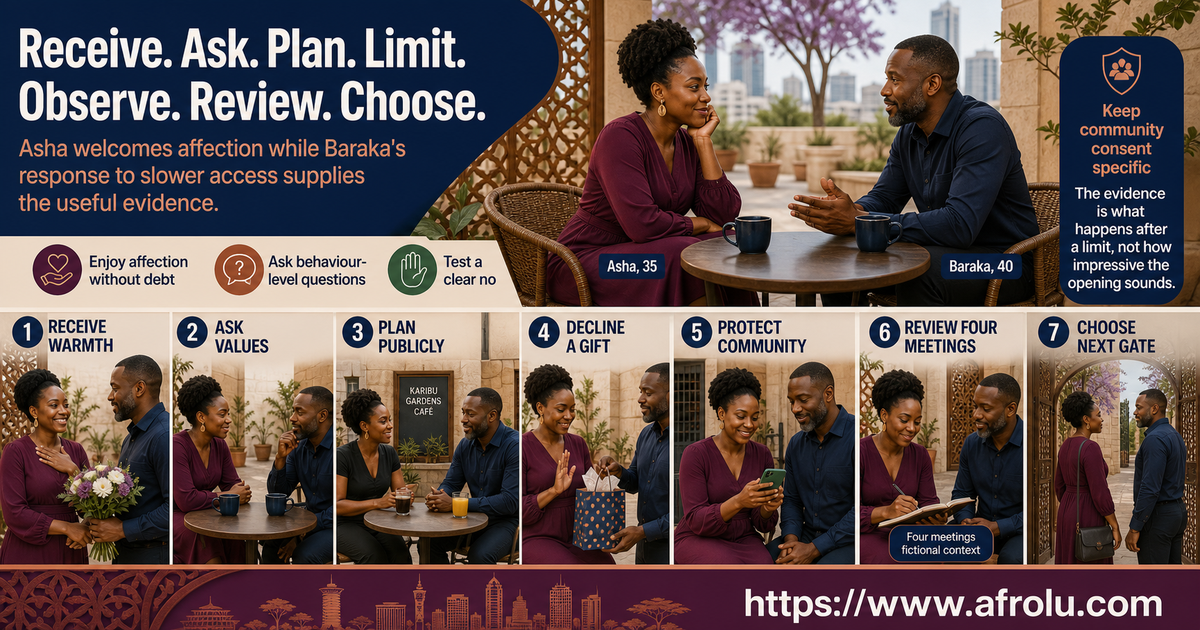
Asha, a fictional 35-year-old faith-led adult in Nairobi, enjoys Baraka's warmth across four public meetings while declining an expensive gift and early community introduction. Baraka, 40, respects both decisions, accepts a smaller call rhythm and keeps serious future talk separate from exclusivity and intimacy. She continues slowly without treating four meetings as a universal test.
The seven-gate intention courtyard
Welcome warmth, translate values and watch what happens after a limit
Samira keeps serious hope visible while making community, privacy, money, intimacy and future independently answerable.
Define two broad labels, review seven gates, slow one real variable and choose from delivered conduct.
Ground the warmth
Specific affection can coexist with delay, work, rest and private practice.
Permission every introduction
No adviser or sensitive record enters without a chosen purpose.
Keep every gift and yes clean
Generosity, images, touch and sex carry no automatic bundle.
Hope is not access
A promised destination never cancels a present boundary or danger.
Values need translation
Let faith and serious intent guide questions without transferring authority
Faith-led dating can include reflection, community wisdom, sexual boundaries, marriage intention, honesty, service or other personally chosen commitments. Because adults and communities differ, the label cannot carry the whole agreement. Asha asks what Baraka's values require from him in present conduct and what they may never require from her, leaving disagreement and closure available.
Serious dating also needs translation. It may mean dating toward partnership, prioritising compatibility questions or avoiding a casual format. It does not automatically mean exclusivity, daily access, family introductions, financial disclosure, home visits, sexual consent or a shared future. Each of those gates needs its own information, timing and freely changeable choice.
Early warmth is not wrongdoing. Long messages, compliments, gifts or future talk can feel welcome when they remain proportionate and responsive. The concern is a pattern in which affection becomes leverage for access, debt, isolation or speed. Since motive is rarely observable, the practical test is what happens after Asha asks for less, says no or keeps an area private.
Community can support reflection without becoming a pressure machine. A trusted person may help Asha notice facts if she consents and privacy is protected. Baraka should not contact leaders, relatives or friends to recruit an answer, disclose private conversations or portray hesitation as a spiritual failure. Advice remains advice; identity, money, intimacy and relationship decisions belong to the adults involved.
The seven-gate courtyard
Move early intensity through words, time, community, identity, money, intimacy and future
The WORDS gate asks whether compliments match observable knowledge. Affection that is grounded can survive questions and correction; grand certainty about destiny before ordinary evidence remains a claim. The TIME gate asks whether both adults keep sleep, work, worship, family and solitude. Frequency is not the verdict. Consent to the frequency and the response to delay matter more.
The COMMUNITY gate asks who may know what. Asha can seek counsel without giving an adviser control, and she can keep a new connection private until disclosure is wanted and safe. The IDENTITY gate uses proportionate checks while protecting documents, account codes, work systems, home location and sensitive community records. Shared contacts add context but do not certify character.
The MONEY gate keeps gifts, transport and future finances separate from affection. Declining a gift should not trigger guilt, and no online match should receive funds, tickets or credentials as proof of seriousness. The INTIMACY gate unbundles emotional disclosure, private images, touch and sex. Faith or future-marriage language cannot create present consent, and every yes remains specific and reversible.
The FUTURE gate holds hopes without pretending they are contracts. Marriage, children, location and family expectations can be discussed honestly, yet four pleasant meetings do not deliver certainty. A slower pace is not deception when it is stated. If future imagery is used to override current boundaries, close that gate and evaluate conduct rather than negotiating the promised destination.
Four meetings, seven gates
Follow warmth through a fictional Nairobi courtship without turning it into a clock
After matching, Baraka sends generous compliments and says he dates for marriage. Asha likes the clarity but answers that she wants to learn how his values appear in conflict, money and consent. He answers without claiming that shared faith proves compatibility. They choose a daytime café, arrive separately and end after the agreed hour rather than extending from momentum.
Before the second meeting, Baraka offers an expensive gift and suggests introducing Asha to a community elder. She declines both. She says gifts and community involvement will wait until the connection has more evidence. He accepts without asking why her faith is not stronger, does not contact anyone around her and proposes a simple public walk that costs neither person much.
At the third meeting they discuss serious relationship direction, family hopes and sexual boundaries. Asha welcomes the conversation but says future language does not create exclusivity or physical consent. Baraka repeats her boundary accurately and asks what contact rhythm fits. They choose two planned calls rather than continuous messages. The reduction produces calm rather than retaliation.
After a fourth meeting, Asha reviews each gate. Warmth remains, work and community life remain intact, money is separate and every no has held. She chooses to continue slowly without declaring the relationship safe or destined. If Baraka had shamed, monitored, threatened, recruited others, demanded funds or blocked an exit, the next step would have been protection rather than another pace discussion.
Read fourteen gate signals
Compare affection that respects choice with affection that presses for access
At WORDS and TIME, respect sounds curious and behaves patiently. A person can be enthusiastic, message often and speak plainly about partnership while accepting a delayed answer. Pressure appears when compliments are followed by entitlement, silence becomes punishment or ordinary unavailability is framed as rejection. Slow one variable openly and observe what is delivered next.
At COMMUNITY and IDENTITY, respect leaves each adult's network and private records under their control. Pressure may use reputation, spiritual authority, family honour or mutual contacts to obtain compliance. It may also demand documents, live location or workplace proof. Do not answer intrusive requests merely to appear transparent; proportionate checks should reduce exposure for both people.
At MONEY and INTIMACY, respect accepts a declined gift, separate payment and every physical boundary without sulking or bargaining. Pressure makes generosity transactional, links support to loyalty or treats serious intention as sexual consent. Financial exploitation, stealthing, image abuse and coercion are not courtship-speed questions. They require the safety, financial or health response that fits the facts.
At FUTURE, respect can discuss hopes and remain honest about uncertainty. Pressure declares destiny, invents obligations or uses a promised marriage to bypass the present. A broken promise may be painful without proving a calculated pattern; describe what happened precisely. When unsafe control appears, do not average it with kind moments or wait for every gate to turn red.

No affection score can cancel coercion, fraud, surveillance or a complete no.
Speak at the gate
Use values-aware scripts that leave both adults free to accept, counter or close
Faith-aware language works best when it remains behavioural. Instead of asking whether Baraka is truly serious, Asha asks what serious changes now. Instead of defending her private practice, she states the time she can offer. The sentence does not require a theological debate or a verdict on character; it creates an answerable present decision.
Community boundaries deserve their own script because disclosure can be difficult to reverse. Asha may consult one trusted person while asking them not to contact Baraka. She may also decline introductions until she chooses otherwise. If either adult needs community involvement as an early requirement, that preference can be stated and may reveal incompatibility without making either person immoral.
Money, transport and intimacy benefit from blunt clarity. A gift can be declined without replacement. Each adult can pay ordinary costs and travel independently. Emotional honesty, private images, touch and sex are separate, and a yes to one does not travel to another. Before sex, discuss partners, testing and prevention with enough time to seek relevant local care.
Closure should not become a final persuasion hearing. Asha can say that the pace or values do not fit and end contact. She need not list every gate or defend her spirituality. If Baraka responds with repeated cross-platform messages, threats, impersonation or community pressure, the task changes from courteous closure to access protection and suitable reporting or safety support.

A values conversation is useful when disagreement and a complete no remain possible.
Choose the next door
Continue small, slow, pause, close, seek care or use safety help
CONTINUE SMALL fits when warmth remains welcome, facts stay consistent and every gate can close without punishment. Define the next gate instead of declaring a global result: perhaps one meeting, one values question or one change in contact rhythm. A connection that cooperates with smallness can earn more evidence, but it never earns unconditional access.
SLOW fits when interest remains but language or plans are outrunning knowledge. PAUSE fits when the reader wants distance from the interaction without managing another experiment. CLOSE fits for mismatch, unwanted contact or pressure; no dramatic incident is required. These choices do not rank devotion, readiness or worth, and no universal number of days or meetings selects among them.
SEEK CARE belongs to persistent or severe distress that crosses contexts, not to an accusation against a date. Qualified local assessment can consider symptoms and circumstances. SEEK SAFETY HELP belongs to threats, stalking, coercion, financial exploitation, image abuse, non-consensual tracking or blocked movement and may use platform, financial, legal, health or emergency routes.
After choosing, protect the decision from being reopened by guilt. Tell only the people who need to know, review account and location exposure, and avoid announcing a safety plan to someone who may retaliate. If the issue is ordinary mismatch, a short respectful ending may be enough. Precision keeps an incompatible courtship from being labelled abuse and keeps abuse from being softened into incompatibility.

Closing after pressure is a complete result, not proof that faith or serious dating failed.
Evidence with humility
Use current guidance without turning a label into a diagnosis or prophecy
Current eSafety guidance describes love bombing as behaviour that may appear within coercive control, including excessive attention and early promises. The word may help a reader recognise a pattern, but it does not establish motive or a mental-health condition. This guide therefore pairs it with observable conduct: pressure, surveillance, isolation, debt, sexual coercion or retaliation after a boundary.
Research on online disclosure supports treating medium and content as relevant to intimacy, while its established-relationship samples cannot dictate a new match's pace. Asha can choose meaningful conversation without sending documents, intimate images or community details. A disclosure that was freely chosen once does not create a standing permission to save, share, demand or weaponise more.
Official online-dating and romance-scam guidance supports protecting personal data, using platform controls, refusing money routes and making public meeting plans. Kenya's privacy framework gives useful local context for personal information, while reporting and legal options depend on the current facts and jurisdiction. Navigate independently to any service rather than using a link supplied by a pressuring match.
Consent and sexual-health guidance supports asking before online or offline sexual activity and talking before sex about information relevant to informed choices. Shared values, exclusivity talk, gifts or a future promise never substitute for consent. If a boundary is ignored or an assault occurs, responsibility remains with the person who caused harm, and appropriate local health and safety support matters more than analysing the courtship label.
Eight faith-led Nairobi moments where a courtship gate changes
The destiny message
The adviser introduction
The expensive gift
The daily call rule
The prayer screenshot
The family future
The accepted boundary
The recruited pressure
Twelve signs across words, time, community, identity, money, intimacy and future
{'signal': 'Compliments remain specific', 'meaning': 'Warm words refer to things actually learned rather than invented certainty.', 'next_step': 'Enjoy them while comparing with later conduct.'}
{'signal': 'Delay is ordinary', 'meaning': 'Work, rest and private practice do not trigger loyalty tests.', 'next_step': 'Keep the stated rhythm and observe consistency.'}
{'signal': 'Questions go both ways', 'meaning': 'Values inquiry is mutual rather than an interrogation.', 'next_step': 'Answer only what serves a freely chosen conversation.'}
{'signal': 'Community access waits', 'meaning': 'Neither person recruits advisers or relatives without permission.', 'next_step': 'Name who may know what and when.'}
{'signal': 'Identity remains proportionate', 'meaning': 'A call and consistent context do not require documents or codes.', 'next_step': 'Use independent checks while limiting exposure.'}
{'signal': 'Gifts carry no debt', 'meaning': 'A gift can be declined and creates no intimacy or reply obligation.', 'next_step': 'Return, refuse or keep it only on freely stated terms.'}
{'signal': 'Money remains separate', 'meaning': 'No emergency, investment or travel request appears.', 'next_step': 'Keep financial systems outside the courtship.'}
{'signal': 'Touch remains specific', 'meaning': 'Each physical step receives a current, sober, unpressured yes.', 'next_step': 'Check in and accept any pause immediately.'}
{'signal': 'Future talk admits uncertainty', 'meaning': 'Marriage hopes do not pretend a commitment exists.', 'next_step': 'Ask what is agreed now and review later.'}
{'signal': 'A no does not change the climate', 'meaning': 'Warmth and respect remain after a limit.', 'next_step': 'Treat the response as evidence, never a safety guarantee.'}
{'signal': 'Pressure recruits morality', 'meaning': 'A boundary is called selfish, impure or unserious.', 'next_step': 'Stop debating worth and reduce or close access.'}
{'signal': 'Control crosses systems', 'meaning': 'Tracking, threats, impersonation or harassment expands beyond one channel.', 'next_step': 'Use appropriate safety, platform, legal or emergency support.'}
Review early intensity through ten independent gate questions
| Situation | What it may mean | What to do next |
|---|---|---|
| Do words match actual knowledge? | Fits: Affection remains specific and revisable. Needs review: Certainty outruns ordinary facts. Stop: Promises are used to demand access. | Ask one grounded question and keep the words gate separate. |
| Can time remain independent? | Fits: Delay and private practice are respected. Needs review: Constant contact is expected. Stop: Monitoring or punishment follows unavailability. | State the rhythm, reduce access or protect accounts. |
| Is community involvement consensual? | Fits: Each adult chooses advisers and disclosure. Needs review: Introductions arrive before readiness. Stop: Others are recruited to shame or pressure. | Close unauthorised access and use suitable support. |
| Is identity checking proportionate? | Fits: Context is consistent without sensitive files. Needs review: Oversharing is praised as trust. Stop: Documents, codes or live location are demanded. | Protect data and verify independently. |
| Can a gift be declined? | Fits: The no is accepted without changed warmth. Needs review: Generosity is repeatedly emphasised. Stop: The gift becomes leverage or debt. | Return or refuse it and close financial pressure. |
| Does money stay separate? | Fits: Each adult funds ordinary choices. Needs review: Future finances are discussed too specifically. Stop: Emergency, ticket or investment money is requested. | Do not transfer; use independent fraud or financial help. |
| Is intimacy still unbundled? | Fits: Disclosure, images, touch and sex have separate consent. Needs review: Serious language creates assumptions. Stop: Pressure, stealthing or image abuse appears. | Stop the branch and use suitable health or safety support. |
| Does future talk leave room for no? | Fits: Hopes remain honest about uncertainty. Needs review: Detailed plans outrun the relationship. Stop: A promised future is used to override the present. | Return to current agreements or close. |
| What happened after a slower gate? | Fits: Respect and curiosity remained. Needs review: Warmth disappeared when access shrank. Stop: Retaliation crossed people, platforms or places. | Keep the evidence; slow, close or protect access. |
| Which route has the right authority? | Fits: One ordinary decision fits the facts. Needs review: Distress may need qualified care. Stop: Danger requires immediate specialised support. | Continue, slow, pause, close, seek care or seek safety help. |
Ten values-aware lines for privacy, gifts, pace, intimacy and closure
“What does faith-led serious dating require from you in practice, and what may it never require from me?”
“I can speak on Tuesday and Saturday; private time is not a loyalty test.”
“I will choose if and when anyone in my community hears about us.”
“I can do a bounded video call, but I do not share documents, codes or work records.”
“I am declining this gift, and that decision does not need a replacement gesture.”
“We will fund our own ordinary dates and I do not send money to an online match.”
“Affection, private images, touch and sex are separate choices every time.”
“I also date toward partnership, but we have not made a commitment to each other.”
“The pace is ahead of what I know, so I am opening no new gate this week.”
“This pace or values fit is not right for me, so I am ending contact here.”
Know the difference
Early faith-led intensity and seven neighbouring relationship states
Warmth repeatedly helps obtain faster access, debt, isolation or compliance after a boundary.
Enthusiasm, expressive style, shared values, mismatch, grief, impairment or coercive control needs a more precise description.
The response to a smaller gate is often more useful than the size of the opening gesture.

Describe the observable pattern and route the response without claiming to know motive.
Separate eight nearby warmth, values, mismatch, health and control states
| Type or dimension | What it describes | Best next question |
|---|---|---|
| Warm interest | Affection is welcome, specific and compatible with delay, privacy and a complete no. | Continue one chosen gate while retaining ordinary boundaries. |
| Intense communication style | Frequent expressive contact is mutual and does not demand access or certainty. | Agree on a rhythm and review impact without diagnosing style. |
| Shared values | The adults use similar language and translate it into reciprocal present conduct. | Ask practical questions; never treat the label as verification. |
| Values mismatch | Specific expectations about commitment, community, sexuality, money or family diverge. | Name the difference and allow respectful closure. |
| City or schedule friction | Nairobi plans, work or transport make meetings difficult without relational pressure. | Build one feasible public plan or change format. |
| Ordinary grief or loneliness | Strong feeling follows loss or isolation without a pattern of controlling another adult. | Protect pace and seek ordinary or qualified support as appropriate. |
| Persistent impairment | Severe changes in functioning persist across contexts and need individual assessment. | Use qualified local care; a courtship label cannot diagnose cause. |
| Coercive control | Monitoring, isolation, threats, financial exploitation, sexual coercion or blocked exit restricts choice. | Prioritise safety and use problem-specific local support. |
Walk the seven-gate intention courtyard in six moves
Translate two labels
Define faith-led and serious through mutual present-tense behaviour.
Use seven gates
Keep words, time, community, identity, money, intimacy and future independent.
Slow one variable
State a smaller boundary and observe the delivered response.
Protect community privacy
No adviser, relative or friend receives access without consent.
Unbundle the future
Marriage talk never creates money, exclusivity or sexual permission.
Route danger directly
Coercive control does not need another courtship experiment.
Questions for words, community, intimacy and the future gate
Choose a few prompts that fit the moment. This is a reference library, not a list to complete.
Words + time
Test warmth against ordinary life.
- What do you actually know?
- Which rhythm is mutual?
- Can delay be neutral?
- What happens after no?
- Which words need grounding?
Community + identity
Keep networks and records permissioned.
- Who may know?
- Who may not contact me?
- What check is proportionate?
- Which data stays closed?
- Can uncertainty remain?
Money + intimacy
Separate generosity and every yes.
- Can a gift be declined?
- Who funds the date?
- What image is not agreed?
- What touch is wanted now?
- Which health talk comes first?
Future + route
Hold hope without obligation.
- What direction do we want?
- What exists now?
- Which gate stays closed?
- Is mismatch enough?
- Which authority fits the risk?
What current love-bombing, disclosure, privacy and consent evidence can support
eSafety explains when excessive early attention may appear within coercive control
The current official resource supports watching for big promises, rapid romance and controlling patterns rather than judging affection by size alone.
Evidence limit: The page cannot determine Baraka's motive, diagnose a person or establish how every faith community should court.
eSafety guidance describes technology-facilitated patterns that restrict another person's autonomy
The resource supports treating monitoring, isolation, threats and repeated boundary violations as safety-relevant conduct.
Evidence limit: Australian definitions and services do not replace the law or specialist resources available in Kenya.
Research across five studies examined online disclosure, intimacy and relationship satisfaction
The work supports treating medium, content and relationship context as relevant to disclosure decisions.
Evidence limit: Established-relationship findings cannot set a disclosure schedule or certify intimacy for new Nairobi matches.
Current official guidance covers privacy, platform controls, suspicious behaviour and meeting plans
The resource supports limiting personal information, recording useful details and keeping early meetings public and leaveable.
Evidence limit: Its Australian reporting pathways must be translated to the reader's current jurisdiction and circumstances.
ODPC examples frame identity, contact, location and online identifiers as personal data
The local context supports asking why community, workplace or location information is needed before sharing it.
Evidence limit: General privacy information is not individual legal advice or proof that another dater is safe.
FTC guidance describes fake profiles and money requests within online romance
The resource supports refusing transfers, tickets and investments and contacting reporting or financial services independently.
Evidence limit: It is U.S. consumer guidance; Kenyan readers should use current local and platform channels.
eSafety and CDC guidance support checking consent and talking before sex
The resources support separating online sexual activity, images, touch, testing, partners and prevention into explicit conversations.
Evidence limit: They provide general guidance rather than personal clinical, legal or faith instruction.
Six ways shared values can become unwanted access
Treating shared faith as verification
A familiar label substitutes for identity and conduct. Repair: verify proportionately and keep data private.
Calling frequency devotion
Continuous access becomes a sincerity test. Repair: state mutually workable windows.
Outsourcing consent to advisers
Community approval replaces the adults' choices. Repair: keep advice non-coercive and permissioned.
Letting gifts purchase speed
Generosity creates debt. Repair: make decline, return and no replacement valid.
Bundling marriage and intimacy
Future intention is treated as present consent. Repair: ask separately at every gate.
Using the label as a diagnosis
One intense opening becomes a verdict on motive. Repair: describe conduct and response precisely.
Use a reviewed resource that matches the decision
This guide focuses on the relationship decision, so it does not rank dating apps. Check current prices, safety tools, and local availability before choosing a service.
Explore the guide library
Show more related guides
Continue with Afrolu
Show more Afrolu guides
Current official safety guidance and bounded relationship research
Afrolu reviewed these health, research, safety, or public guidance resources while editing this page. They support the behaviour and safety guidance; they do not diagnose any individual described by a reader.
Faith-led serious Nairobi courtship questions
Is every intense faith-led courtship love bombing?
No. Intensity can reflect enthusiasm, communication style or a mutually wanted fast rhythm. Love bombing is not used here as a diagnosis or mind-reading tool. Look at observable conduct: does affection remain kind when time, community, identity, money, intimacy or future access stays closed? Pressure, retaliation, surveillance, debt or isolation matters more than the number of compliments.
How quickly should faith-led serious dating move in Nairobi?
There is no universal timeline. Adults, values, communities, work and logistics differ. Build one chosen gate at a time and keep meetings public and leaveable. Asha's four meetings are fictional narrative context, not a benchmark. A slower choice is honest when stated, and a faster mutual choice still requires privacy, consent, money and safety boundaries.
Does dating for marriage justify discussing the future early?
It can justify direct questions about direction, family, location or values, but answers remain information rather than contracts. Future talk does not create exclusivity, community disclosure, financial access, home access, intimate images, touch or sex. Ask what is agreed now, what remains undecided and what either adult may change without being accused of betrayal.
Should a faith leader or trusted elder be involved?
Only with each adult's consent and a clear privacy boundary. A trusted adviser may help someone reflect but should not contact the match, demand a relationship outcome, disclose private information or use spiritual authority to override a no. Clinical, legal, financial and urgent safety concerns also require the appropriately qualified or authorised route rather than pastoral advice alone.
Can I decline a gift without insulting someone?
Yes. State the decision directly and do not offer access as compensation. A respectful giver can accept a no, arrange a return or let the matter end. If refusal triggers guilt, threats or demands, treat that response as evidence. Avoid sharing a home or workplace address for delivery, and never accept a financial arrangement you do not freely want.
What if a match says privacy means I am hiding something?
Privacy and deception are not the same. Offer proportionate context such as consistent conversation or a bounded video call while protecting identity documents, codes, exact work systems, home details and live location. Shared faith or mutual contacts cannot certify safety. A person may decide the available verification is insufficient, but they may not compel sensitive disclosure.
Does a serious relationship goal imply sexual exclusivity?
No. Exclusivity is a separate current agreement. Discuss whether either adult is dating or having sex with others, what information affects choices, and when the agreement changes. Before sex, talk about partners, testing and prevention relevant to the encounter. Relationship labels, gifts and future-marriage discussion do not replace consent or a qualified health conversation.
How do I test the pace without manipulating the other person?
State the real boundary rather than creating a secret test. You might reduce contact, decline a gift or delay an introduction because that is genuinely what you want. Explain only what is safe and necessary, then observe the response. Do not manufacture jealousy, disappear to provoke pursuit or score the person. The boundary is valid even if no experiment follows.
When is a values mismatch enough reason to leave?
Whenever the connection no longer fits. Differences about community involvement, sexual boundaries, family, money, gender roles, communication or commitment may be decisive without anyone being abusive. Name the mismatch once if useful and close respectfully. Precision matters: do not label incompatibility coercion, and do not minimise threats or control as a mere values difference.
When should I treat the pattern as a safety issue?
When there are threats, stalking, isolation, impersonation, financial exploitation, sexual coercion, image abuse, non-consensual tracking, recruited harassment or blocked movement, stop waiting for a complete label. Protect accounts and location, preserve relevant evidence where safe and use appropriate platform, financial, legal, health or emergency support for your location. Immediate danger overrides courtship etiquette.
One thing to do now
Let hope enter slowly enough for every no to remain complete
Continue only while affection remains compatible with independent time, permissioned community involvement, limited identity data, separate money, specific consent and honest uncertainty about the future. Slow, pause or close whenever the route is unwanted. Use qualified care for severe persistent distress and appropriate platform, financial, legal, health, community or emergency support for unsafe conduct.