Three promises · two-cycle review
Read Breadcrumbing Without Turning Faith into Hidden Status
A faith-respecting guide to breadcrumbing, serious intention, honest casual scope, practical plans, community privacy, safety and clean closure.

A valued future becomes usable only through an agreement that exists today.
Written and edited by Adwoa Boateng · Dating Safety Editor
Keep PERSONAL VALUES, PRESENT SCOPE and FUTURE HOPE separate. Track three promises: SCOPE records what the adults agree now; NEXT PLAN names one bounded action; FOLLOW-THROUGH records action or direct repair. Shared faith language does not create courtship, and honest casual dating is not automatically deceptive. Offer one practical bridge and a reader-owned confirmation point. If warm contact repeatedly replaces answers or movement, close from fit without a moral verdict. Protect community privacy, money, identity, sexual consent, public meetings and transport; unsafe conduct bypasses the ordinary review.
Mixed signals · Faith-Led Daters
How can a faith-led adult respect personal conviction, ask what casual contact actually means and decide from observable scope and follow-through without moralising or diagnosing motive?
Breadcrumbing is a popular, non-clinical description for intermittent romantic attention that keeps possibility alive without enough clarity or progression for the recipient. It describes an observable pattern; it cannot diagnose attachment, prove manipulation, rank faith or make every low-frequency or casual arrangement harmful.
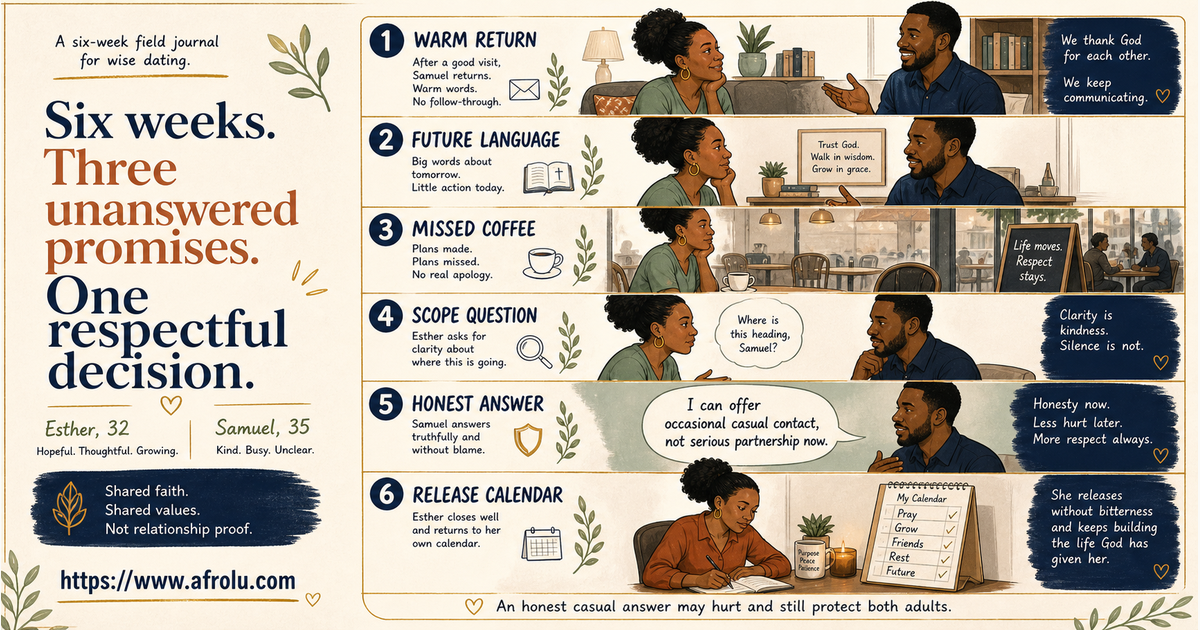
Esther, a fictional 32-year-old faith-led adult, receives Samuel's warm weekend reflections and distant partnership language across six weeks while a second date remains unconfirmed. One direct scope question reveals that Samuel wants occasional casual contact only. Esther accepts the honest answer and closes because it does not fit her serious direction.
The three-promise faith ledger
Let values guide the choice while evidence defines the contact
Adwoa separates personal faith, present scope and future hope so familiar language cannot become hidden status.
Record the scope answer, one next plan and follow-through across two relevant cycles, then choose without moral ranking or motive diagnosis.
Scope
Name casual, serious, friendship, exclusivity and other dating in present tense.
Next plan
Offer one public bounded action with a reader-owned confirmation point.
Follow-through
Count completed action or direct repair rather than unrelated warmth.
Personal values
Let conviction shape your yes or no without controlling another adult.
Track three promises separately
Scope, next plan and follow-through turn warm meaning into usable evidence
SCOPE asks what the adults are doing now: occasional messages, casual dates, friendship, an exclusive courtship or something still undecided. Esther records Samuel's actual answer instead of translating shared beliefs into implied commitment. If he says he can offer casual contact only, that answer remains valid even when it does not fit her direction.
NEXT PLAN asks for the nearest action that would matter: a public coffee, a scheduled call or a scope conversation. Distant language about marriage, family or destiny cannot reserve Esther's calendar. One bounded invitation lets Samuel say yes, no or offer an alternative, and lets Esther stop carrying every possible interpretation.
FOLLOW-THROUGH records whether the step occurred and how a change was handled. One cancellation may be ordinary when notice, accountability and a realistic alternative appear. An unrelated prayer message, compliment or future hint is not repair for a missed plan because it does not address the action that changed.
IMPACT sits beside the ledger rather than becoming a fourth promise. Esther notes whether waiting crowds worship, work, sleep, friends, money or peace of mind. Strong emotion does not make her foolish, and a difficult impact does not prove Samuel intended harm. It shows what the available pattern costs and informs her boundary.
Follow six weeks without inventing motive
Esther lets one direct answer replace a hopeful private storyline
Esther, 32, meets Samuel, 35, through friends connected to a community event. They enjoy one public coffee and discuss the importance of faith and family. Samuel later sends thoughtful weekend messages and says he hopes to build something meaningful someday. Esther likes him, but neither adult names exclusivity, courtship or even a second date.
During week three Samuel suggests a Saturday walk, then does not confirm. On Sunday he sends a warm reflection about patience without mentioning the plan. Esther replies kindly and asks whether he wants occasional casual contact or dates moving toward serious partnership. He praises her values but says work is busy and avoids choosing either description.
Esther offers one public coffee during the following week and says she will release the slot by Thursday. Thursday passes. Samuel returns after the weekend with affectionate language about a shared future. Esther records the contact, the missing scope answer, the absent plan and the lack of repair rather than treating renewed warmth as movement.
When asked once more, Samuel says he enjoys occasional contact and is not seeking a serious relationship now. Esther thanks him for answering and closes because that scope does not fit her. She does not call him immoral, ask mutual friends to intervene or wait for his values to change. An honest mismatch ends the breadcrumbing loop.
Read four domains across three states
Values, scope, plans and safety cannot be averaged into a holiness score
VALUES continue when each adult speaks from personal conviction and allows disagreement. Review repeated use of spiritual language where practical questions stay unanswered. Stop spiritual threats, public shaming, claims of divine entitlement, coercive sexual pressure or demands that Esther ignore her conscience and support network.
SCOPE continues when casual, serious, exclusive, friendship and other dating are answerable topics. Review uncertainty that is plainly admitted for a bounded period. Stop repeated evasion paired with possessiveness, assumed exclusivity, sexual-health secrecy or punishment when Esther acts according to the casual scope actually offered.
PLAN + REPAIR continues when one workable action is confirmed and changes receive notice, accountability and an alternative. Review a genuine busy season with a named endpoint. Stop indefinitely reserved time, repeated missed plans covered by affection or future talk that becomes more vivid whenever Esther withdraws attention.
SAFETY continues when money, identity, devices, venues, transport and community privacy remain independent. Review an unusual request through an official channel found separately. Stop payment pressure, impersonation, tracking, threats, image abuse, repeated accounts or community-based harassment. Immediate danger never waits for another contact cycle anywhere.

Chemistry and shared belief cannot average away a money request or ignored no.
Use complete questions and complete endings
Ten lines protect conscience while making casual or serious scope answerable
For VALUES: 'My faith informs how I date; I will describe my choices without deciding yours.' 'Shared beliefs do not create a relationship agreement.' These lines keep Esther's conviction intact while refusing spiritual ownership. Samuel can disagree, and neither adult has to defend their worth to end an incompatible route.
For SCOPE: 'Are we choosing occasional casual dates, or exploring serious partnership?' 'Are we dating other people?' 'What does casual include and exclude for you?' The answers should cover contact, exclusivity, affection, sexual health, privacy and endings rather than relying on one emotionally rich label.
For PLAN: 'I can meet in public Saturday at two.' 'If Thursday passes without confirmation, I will release the time.' 'If a plan changes, please address that plan directly.' These statements protect the speaker's calendar and let follow-through become evidence without imposing a universal message frequency.
For DECISION: 'Casual contact does not fit my serious direction, so I am closing.' 'Please do not involve our community or contact another account.' Closure does not require Samuel to accept Esther's interpretation. If access pressure appears, she can stop explaining and move to suitable safety support.

A boundary can be faithful, kind and complete without becoming a debate.
Review after two relevant cycles
A reader-owned interval can reveal repetition without becoming a patience contest
Review SCOPE first. Did Samuel answer whether the contact is casual, serious, friendship or undecided? Was other dating openly discussable? An answer that disappoints Esther can still be useful and respectful. Repeatedly replacing the question with praise, scripture or distant possibility leaves present agreement unavailable.
Review PLAN + FOLLOW-THROUGH. Did a specific invitation receive yes, no or an alternative? If a plan changed, was the missed step named and repaired? Esther releases unconfirmed time at her stated point. Holding the calendar longer would not create evidence, demonstrate patience or strengthen her values.
Review IMPACT + SAFETY. Did ordinary community life, work, sleep, friends, money and independent judgment remain intact? Any threat, tracking, payment request, impersonation or repeated unwanted access ends the ordinary review. Esther uses relevant platform, financial, community, legal or emergency help rather than arranging a private confrontation.
Choose continue, redesign the casual agreement, clarify once, close or seek support. None of these routes declares which adult has better faith. Esther can want serious partnership and decline Samuel's honest casual capacity. Samuel can decline progression without being persuaded through community pressure or moral argument.

The interval observes a real pattern; it is not a spiritual test or universal waiting rule.
Compare nearby routes without moral ranking
Low-frequency contact needs context, agreement, action and repair before a label
BREADCRUMBING describes intermittent romantic signals that repeatedly preserve possibility without adequate clarity or movement for the recipient today. HONEST CASUAL DATING explicitly names limited scope, other dating, health boundaries and endings openly. Both may contain warm messages; their actual agreements and follow-through create different choices.
SLOW COURTSHIP has a shared serious direction but advances through small mutual steps. FRIENDSHIP may include warmth, shared faith and regular community contact without romantic trajectory. Esther does not need to downgrade either route; she needs to stop treating one arrangement as a promise of another.
VALUES MISMATCH exists when adults want different sexual, family, community or commitment practices and accept each other's no. Disappointment is not proof of deception. A mismatch becomes pressuring when one person uses shame, authority, isolation or repeated access to override the other's freely stated boundary.
UNSAFE CONDUCT includes threats, stalking, fraud, image abuse, coercion or community harassment and requires access-focused action rather than another scope conversation. Choose from the strongest available evidence: continue a fitting agreement, clarify one ambiguity, close an incompatible route or seek appropriate safety and health support.
Eight faith-led moments where shared meaning and agreement diverge
A familiar faith expression feels intimate
Common language can signal affinity while leaving dating scope completely undecided.
Enjoy the resonance and ask separately what the contact means now.A warm message follows six quiet days
The contact renews hope but does not answer the pending plan or scope question.
Record it as contact and return once to the unanswered item.Samuel names occasional dates only
Honest limited scope may conflict with Esther's direction without making either adult wrong.
Accept the answer and choose whether it genuinely fits.Friends assume the pair are courting
Outside enthusiasm cannot create consent or announce a relationship for them.
Correct the assumption briefly and keep the adult conversation private.A work issue disrupts one meeting
One change can be ordinary when notice, ownership and a realistic alternative appear.
Judge the repair and later conduct rather than the single disruption.Marriage is discussed without a second date
A valued future becomes emotional atmosphere while the nearest action stays empty.
Ask for one bounded next step before reserving more time.A romantic contact sends a payment link
Shared faith and charitable language do not verify a recipient, emergency or transaction.
Send nothing and check any organisation through an official route found independently.A no is followed by community messages
Recruiting others turns disagreement into unwanted access and can increase risk.
Preserve useful evidence, close channels and seek appropriate support.Ten signs across values, scope, plans, community and safety
Shared faith language is treated as affinity rather than an automatic agreement
Casual, serious, exclusive and friendship routes can be named without shame
A direct scope question receives a present-tense answer
A proposed plan has a time, place and confirmation point
One cancellation receives notice accountability and a workable alternative
Warm reappearances repeatedly avoid the same pending question
Future partnership language grows while the nearest step remains unavailable
Community members are asked to persuade monitor or gather private information
Money identity sexual-health and transport safeguards remain independent
Threats tracking fraud or repeated accounts move the issue beyond ordinary ambiguity
Review the connection through ten answerable questions
| Situation | What it may mean | What to do next |
|---|---|---|
| Are values and status separate? | Fits: Shared beliefs are discussed without assumed commitment. Needs review: One implication needs correction. Stop: Faith language is used to claim relationship rights. | Name the present agreement independently of shared vocabulary. |
| Can casual scope be named? | Fits: Both adults can define and freely choose it. Needs review: One boundary remains unclear. Stop: Casual access is demanded while questions are punished. | Ask what contact, other dating, health and endings include. |
| Is serious direction mutual now? | Fits: Both adults explicitly choose exploration toward partnership. Needs review: One adult needs a bounded decision point. Stop: Only distant hints carry the serious meaning. | Do not promote hope into agreement without an answer. |
| Does one practical plan exist? | Fits: A time, place and confirmation are usable. Needs review: One detail needs completion. Stop: Only someday or destiny language appears. | Offer one public bounded option and release it on time. |
| Was a changed plan repaired? | Fits: Notice ownership and an alternative appear. Needs review: The proposed repair needs confirmation. Stop: Affection replaces any mention of the missed step. | Count repair only when it addresses the actual plan. |
| Can the community stay outside pressure? | Fits: Privacy and support choices are respected. Needs review: A mistaken assumption needs correction. Stop: Others are recruited to shame persuade or monitor. | Close information channels and use suitable support. |
| Can Esther say no safely? | Fits: Disappointment does not reduce respect or access control. Needs review: One defensive response is repaired. Stop: A no triggers threats exposure or repeated accounts. | Stop debating and prioritise access and safety. |
| Are money and identity separate? | Fits: No payment or document proves affection. Needs review: An unusual claim is checked independently. Stop: Urgent transfers links or credentials are requested. | Send nothing, secure accounts and report appropriately. |
| What does the pattern cost? | Fits: Faith life work sleep and friends remain available. Needs review: Waiting needs a calendar boundary. Stop: Persistent distress or impairment is growing. | Close the loop and seek qualified care when needed. |
| Would another cycle add evidence? | Fits: A real plan or named constraint is approaching. Needs review: One final bounded answer is pending. Stop: The same unanswered sequence is repeating. | Choose from the evidence already available. |
Ten lines for values, casual scope, plans and closure
“My faith guides my choices; it does not decide yours.”
“Shared beliefs do not mean we agreed to courtship.”
“Are we choosing casual dates or exploring serious partnership?”
“Are we both free to date other people?”
“What does casual include and exclude for you?”
“I can meet in public Saturday at two.”
“Without Thursday confirmation, I will release the time.”
“Please address the missed plan before changing subjects.”
“Casual contact does not fit my serious direction.”
“I am ending contact; do not involve our community.”
Know the difference
Faith language can accompany six very different contact patterns
Casual dating, friendship or slow courtship is named, freely chosen and reflected in plans and repair.
Warm or spiritual language repeatedly renews hope while present agreement and practical movement stay unavailable.
A serious future deserves explicit agreement; an honest casual present deserves an honest choice.

Different arrangements can be ethical when their scope is explicit and freely chosen.
Separate six nearby faith-and-contact patterns
| Type or dimension | What it describes | Best next question |
|---|---|---|
| Breadcrumbing | Intermittent romantic meaning renews possibility while scope and movement remain inadequate for the recipient. | Ask once, review a relevant cycle and close repetition. |
| Honest casual dating | Limited contact, other dating, health boundaries and endings are explicitly discussable. | Choose it only when the actual arrangement fits. |
| Slow courtship | Both adults share serious direction while advancing through small observable steps. | Keep agreement, pace and repair mutual. |
| Friendship | Warmth and shared faith exist without an agreed romantic trajectory. | Stop assigning romantic duties to friendly contact. |
| Values mismatch | Adults want different practices and still accept each other's complete no. | Close respectfully without moral persuasion. |
| One changed plan | A disruption is named, owned and repaired rather than repeated as a system. | Observe the alternative and later follow-through. |
| Ghosting | Contact stops rather than intermittently returning to renew romantic possibility. | Use one proportionate check, then stop chasing silence. |
| Unsafe conduct | Threats fraud coercion or repeated access creates a separate safety issue. | Protect access and use appropriate official support. |
Use the three-promise evidence ledger in six moves
Honour faith without inference
Let values guide your decision while requiring explicit consent for relationship status.
Name casual without shame
Limited dating can be ethical when scope, health, other dating and endings are honest.
Track three promises
Keep scope, the next plan and follow-through in separate evidence columns.
Use one real bridge
Offer a bounded public date or call instead of carrying indefinite possibility.
Protect community privacy
Seek support without turning friends or leaders into pressure messengers.
Close without diagnosing
A repeated mismatch can be enough even when motive and attachment remain unknown.
Questions for values, scope, evidence and decision
Choose a few prompts that fit the moment. This is a reference library, not a list to complete.
Values
Separate conviction from control.
- What choice belongs to me?
- What has been mutually agreed?
- Where can we differ?
- What stays private?
- Who supports without pressure?
Scope
Make the present answerable.
- Casual or serious?
- Are others being dated?
- What does affection mean?
- What health boundary applies?
- How would we end?
Evidence
Track three promises.
- What scope was stated?
- What plan exists?
- When is confirmation?
- What followed through?
- Was repair direct?
Decision
Choose without moral ranking.
- Does this route fit?
- Would one answer help?
- What time gets released?
- Which access closes?
- What support is appropriate?
What current breadcrumbing research and safety guidance can support
Cleveland Clinic describes intermittent attention and missing plans
The psychologist-reviewed overview discusses sporadic communication, vague future talk and weak follow-through, and suggests direct communication, boundaries and leaving a harmful cycle when appropriate.
Evidence limit: It is not a diagnostic instrument and cannot determine attachment, faith or intent.
A 2020 study reports psychological associations
A cross-sectional survey of 626 adults examined ghosting or breadcrumbing experiences alongside life satisfaction, loneliness and helplessness, supporting attention to emotional impact.
Evidence limit: Associations cannot establish causation or predict one person's outcome.
A 2023 study examines attachment associations across two countries
An online India-Spain sample found group-level associations between attachment insecurity dimensions and self-reported breadcrumbing engagement among adults aged 18 to 40.
Evidence limit: The design cannot diagnose attachment, explain motive or represent every faith community.
A young-adult study explores prevalence and online dating behaviour
University of Malaga research contributes to an emerging evidence base on breadcrumbing and ghosting rather than fixing one universal threshold or culturally complete definition.
Evidence limit: A sample estimate is not local prevalence and should not label an individual.
WHO guidance distinguishes coping tools from qualified care
WHO public guidance explains that stress may affect mind and body and advises seeking health care when symptoms make daily functioning or coping difficult.
Evidence limit: General stress information cannot prescribe a relationship, spiritual or recovery timeline.
FTC guidance keeps money outside romantic trust
FTC consumer guidance describes trust-building romance scams and advises against sending money, gift cards, wire transfers or cryptocurrency to an online love interest.
Evidence limit: The U.S. source cannot verify a match and should be paired with relevant local channels.
Six ways shared faith language can obscure present scope
Promoting affinity into commitment
Shared language becomes hidden status. Repair: ask what is mutually agreed now.
Condemning casual scope
An honest answer is treated as moral failure. Repair: decide fit without shaming.
Calling every delay breadcrumbing
Context and repair disappear. Repair: observe the relevant next cycle.
Using community as leverage
Privacy becomes public pressure. Repair: keep support confidential and adult-led.
Treating future talk as a plan
Emotion reserves time without action. Repair: request one bounded next step.
Waiting for motive certainty
Closure depends on confession. Repair: decide from pattern, impact and fit.
Use a reviewed resource that matches the decision
This guide focuses on the relationship decision, so it does not rank dating apps. Check current prices, safety tools, and local availability before choosing a service.
Explore the guide library
Show more related guides
Continue with Afrolu
Show more Afrolu guides
Clinical overview, research, stress and fraud guidance
Afrolu reviewed these health, research, safety, or public guidance resources while editing this page. They support the behaviour and safety guidance; they do not diagnose any individual described by a reader.
Faith-led breadcrumbing and honest casual-scope questions
What does breadcrumbing mean in a faith-led dating context?
It remains a popular, non-diagnostic term for intermittent romantic attention that renews possibility without enough clarity or movement for the recipient. Faith language may make a message feel especially meaningful, but it does not prove intent or create courtship. Track present scope, one next plan, follow-through and impact before choosing what fits.
Does shared faith mean we are dating seriously?
No. Shared belief can matter deeply and still be only one compatibility factor. Serious direction, exclusivity, family involvement, sexual boundaries and community disclosure each require explicit adult agreement. Ask what the connection is now. A warm but vague answer should not be promoted into status because the vocabulary feels familiar.
Is casual dating incompatible with serious faith values?
That is a personal theological and ethical decision, not a universal conclusion this guide can make. Adults may define casual dating as honest limited contact with clear sexual-health, privacy, other-dating and ending boundaries. You may decide it does not fit your convictions while respecting another adult's different, freely chosen scope.
How long should I wait for a clear answer?
There is no universal or spiritually preferred duration. Use a relevant cycle tied to an actual plan, work constraint or stated review point. Offer one bounded option and say when you will release it. If the same warm-but-unanswered sequence repeats, more waiting may add no evidence. Immediate safety concerns bypass any interval.
Should I ask a faith leader to speak to the person?
Confidential counsel for your own reflection may help, but recruiting a leader or community member to pressure, investigate or announce a relationship can violate privacy and consent. Ask the adult directly when safe. If harassment or coercion is present, use appropriate safeguarding and professional channels rather than informal mediation that increases access.
What if the person honestly wants casual contact only?
Believe the present answer and decide whether the delivered arrangement fits. An honest casual answer can be disappointing without being breadcrumbing or moral failure. Do not remain while privately expecting conversion to serious partnership. Close respectfully if serious direction is essential to you, and let both adults choose without persuasion.
Can someone be busy and still communicate respectfully?
Yes. Real work, care, health and community duties can reduce availability. Respectful limited capacity usually includes concrete context, a realistic next point, accountable repair and freedom for the other adult to decline. Indefinite busyness that appears whenever scope or a plan is requested supplies less usable evidence, regardless of motive.
What if a ministry or charity payment request appears?
Do not send money through a match-supplied link or treat shared faith as verification. Find the organisation's official contact independently, check the claim and protect accounts and identity. Romance scams can use urgent, charitable or spiritual stories. Use relevant platform, financial and local reporting routes if fraud is suspected.
How do I close without insulting the person's faith?
Speak about the arrangement and your decision: 'Casual contact does not fit my serious direction, so I am closing.' You do not need a verdict about sincerity, attachment or belief. Ask that community privacy be respected. If a clear ending produces repeated accounts, threats or public pressure, stop explaining and seek suitable support.
When should I seek additional support?
Use trusted confidential support when ambiguity crowds judgment. Seek qualified health care when distress is persistent, overwhelming or interfering with ordinary functioning. Threats, stalking, coercion, image abuse, fraud or blocked exit require appropriate platform, financial, legal, safeguarding or emergency help. Those issues do not need another breadcrumbing review cycle.
One thing to do now
Let an answerable present carry the meaning of a valued future
Continue when present scope is explicit, freely chosen and supported by plans, follow-through and accepted boundaries. Clarify one genuine ambiguity through a bounded question. Close an incompatible or repeating pattern without diagnosing faith or motive. Use qualified health support for persistent impairment and appropriate safety channels for threats, fraud, coercion or repeated unwanted access.