Five seats · a complete weekend exit
Make a Faith-Led Weekend Talking Stage Clear and Leaveable
A safety-first faith-led talking-stage guide: verify proportionately, translate values, plan a public weekend date, keep consent specific and leave freely.

Shared values can guide questions but cannot verify identity, consent, logistics or safety.
Written and edited by Adwoa Boateng · Dating Safety Editor
Set five independent places: IDENTITY, VALUES, WEEKEND, CONSENT and EXIT. Use a bounded call and consistent context without sharing documents, codes, home or workplace details. Translate faith-led and serious into reciprocal behaviour. Complete the weekend plan with public place, duration, separate payment and independent transport. Ask separately for messages, images, affection, touch and sex, and discuss partners, testing and prevention before sex. Choose CONTINUE SMALL, MAKE A PLAN, PAUSE, CLOSE, SEEK CARE or SEEK SAFETY HELP. No universal talking-stage length exists.
Early relationship discovery · Faith-Led Daters
How can faith-led adults turn weekend talking-stage attention into a proportionate identity check, mutual values discussion, public plan, specific consent and free exit?
A talking stage is a temporary low-agreement discovery period. Faith and weekend availability can shape its questions, but they do not verify identity, create exclusivity or establish consent. The five-seat table makes current information and exits answerable; it cannot calculate trust, predict harm, rank devotion or guarantee that a public meeting is safe.
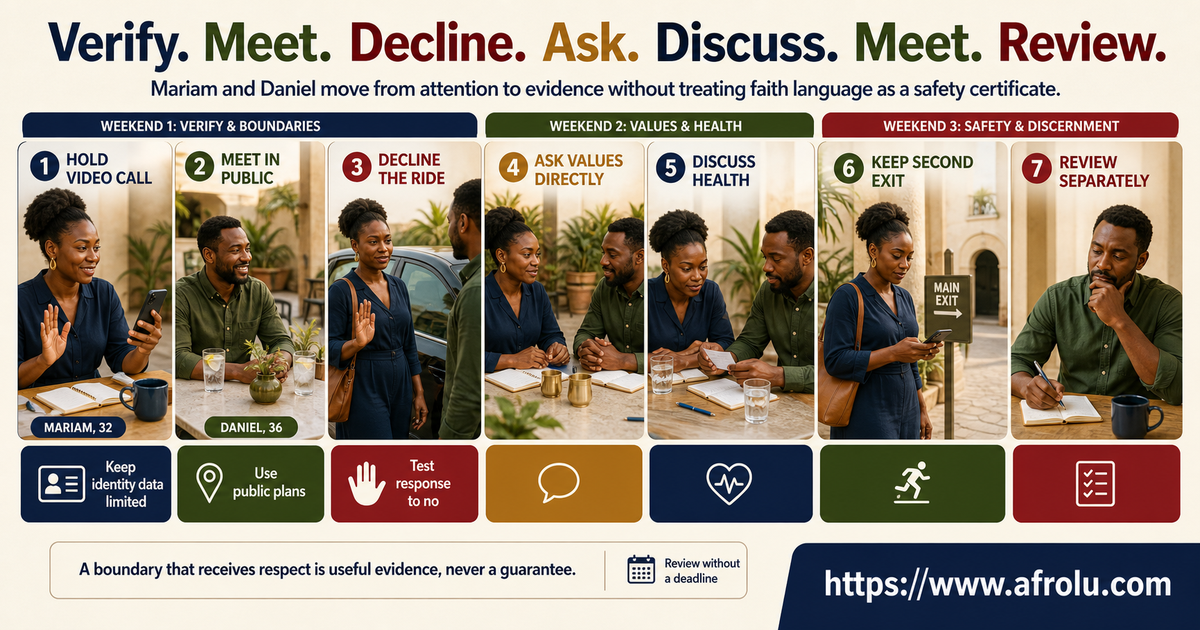
Mariam, a fictional 32-year-old faith-led adult, uses a bounded video call and two public meetings across three weekends with Daniel, 36. She declines his ride, keeps community disclosure private and separates affection from going home together. He accepts each boundary. They plan one more date without treating three weekends as a universal trust schedule.
The five-seat weekend discernment table
Translate values, finish the public plan and keep the safety aisle open
Adwoa turns a weekend talking stage into five answerable place settings instead of one vague trust feeling.
Verify for the next step, ask values through conduct, complete Saturday, unbundle consent and pre-plan exit.
Verify with limits
A bounded call can add context while documents, codes and home stay closed.
Ask behaviourally
Shared faith supports questions but never grades consent or safety.
Invite every branch
A public date includes only the time, place and affection freely chosen.
Keep the aisle clear
Independent transport, closure and urgent support remain available.
Set five places
Make identity, values, the weekend, consent and exit independently answerable
IDENTITY uses proportionate checks. A bounded video call, consistent details and public context may reduce uncertainty while documents, one-time codes, home location and sensitive community or work records stay closed. Verification adds context but does not prove character, relationship status or safety, and either adult may decline further contact.
VALUES asks behaviour-level questions. What does honesty require about other partners? How does community involvement remain consensual? Which sexual or relationship boundaries matter now? A person can discover compatibility or mismatch without submitting to a faith test. No leader, relative or mutual contact should be recruited to pressure an answer or expose private information.
WEEKEND completes logistics: day, time, public place, duration, ordinary payment, independent arrival and departure. A proposed ride or second venue is a new invitation. CONSENT separates messages, emotional disclosure, images, affection, touch and sex. Alcohol or another impairment can affect capacity; no label or earlier yes carries the decision forward.
EXIT is planned before chemistry. Each adult can end the date, talking stage or app contact without a moral hearing. Mariam knows her route home and Daniel does not control it. If a person ignores a no, follows, threatens, tracks or blocks movement, the issue leaves the ordinary table and uses appropriate safety or emergency support.
Three fictional weekends
Follow attention into a bounded call, two public meetings and a freely chosen review
Before the first weekend they hold a short video call through a chosen channel. Mariam shares no identity document, home location or community directory. Daniel accepts the limit. They plan a Saturday afternoon meeting in public, each tells a trusted person their own plan and each keeps control of payment and return transport.
The first meeting ends at the agreed time. Daniel offers a ride; Mariam declines and uses her planned route. He does not argue that shared values make him trustworthy. During the following week, they discuss what faith-led and serious mean to each of them, discovering some overlap and some questions without inviting advisers to decide.
Before the second meeting, Mariam asks about relationship format, other partners and sexual-health conversations. Neither treats an answer as a test result. At the meeting, affection is welcome but going home together is not. Daniel accepts the boundary, and both leave independently rather than using the empty evening to create another assumed plan.
On the third weekend they review separately. Identity context is consistent, values questions remain open, both public plans delivered and every no held. They choose one next date without exclusivity or constant messaging. The outcome is not proof of safety. If pressure, fraud, image abuse or tracking had appeared, protection would replace another weekend experiment.
Read ten place-setting signals
Distinguish answerable discovery, unresolved questions and unsafe conduct
IDENTITY becomes more answerable when context is consistent and a reasonable check is available without sensitive data. It needs a stop when stories repeatedly change, a camera never works or documents, codes and money are requested. Do not compensate for uncertainty by sharing more. Reduce the route or close it.
VALUES becomes answerable when both adults can explain practice, disagreement and limits without policing one another. It needs review when broad labels substitute for discussion. It becomes unsafe when morality, community shame or threats are used to obtain contact, disclosure or intimacy. Shared belief never grants another person disciplinary authority.
WEEKEND becomes answerable when the public plan, cost, duration and exits are clear. It needs review when the event expands through assumptions. CONSENT becomes answerable through specific, sober, ongoing choices. Gifts, food, transport, affection or serious talk cannot purchase a yes; a declined branch must remain closed without punishment.
EXIT becomes answerable when either person can leave, unmatch or end contact. Repeated cross-platform messages, cyberstalking, impersonation, threats, image abuse or blocked movement are safety-relevant. Preserve useful evidence where safe, protect accounts and use the platform, financial, legal, health or emergency route suited to the harm and location.

No trust score can average away a false identity, coercion, financial request or blocked exit.
Speak before the plan expands
Use ten lines for identity, values, logistics, money, consent, health and closure
Identity language should offer a proportionate option without bargaining over protected data. Mariam can agree to a video call while declining documents or codes. Daniel may decide that the available context is insufficient and leave. Neither person's uncertainty creates a right to inspect the other's accounts, workplace, home or community network.
Values language asks how a principle appears in conduct and what disagreement permits. A relationship goal can be named without pretending exclusivity exists. Community consultation can happen privately, but a new match should not contact an adviser or family member without permission. The purpose is mutual information, not certification by reputation.
Weekend language makes the plan finite. State time, public place, duration, payment and transport. Decline an extension without supplying a better reason. Before sex, discuss partners, testing and prevention relevant to the adults with time for informed choices and qualified local guidance. A faith label does not answer health questions.
Closure language is short because the talking stage has few agreements. Mariam can say the format does not fit and end contact. If Daniel continues across channels or threatens exposure, debate no longer serves the boundary. Account protection, evidence preservation and appropriate reporting or safety support can make the exit operational.

A boundary does not accuse the other adult; it defines the access currently available.
Clear the table
Continue small, make a plan, pause, close, seek care or use safety help
CONTINUE SMALL fits when contact is wanted, identity context is sufficient for the next step and values talk remains mutual. Define the next question or meeting rather than issuing a global trust verdict. MAKE A PLAN fits when interest exists but logistics are vague. Complete one public, funded, leaveable proposal.
PAUSE fits uncertainty, capacity limits or simple preference and needs no spiritual justification. CLOSE fits mismatch, unwanted ambiguity or any connection the adult no longer chooses. A respectful ending can acknowledge the exchange without reserving future access. Neither adult must prove that the talking stage lasted the correct amount of time.
SEEK CARE belongs to persistent or severe effects across ordinary functioning or to personal health questions that require qualified assessment. SEEK SAFETY HELP belongs to coercion, fraud, stalking, image abuse, threats or blocked movement. Platform tools, financial providers, health services, legal resources and emergency services hold different authority.
After choosing, adjust only the access that choice requires. Keep one contact, confirm one meeting, mute, unmatch, block or ask for help as appropriate. Avoid posting accusations or involving community members as a pressure tactic. Precision protects privacy and keeps ordinary mismatch distinct from conduct that needs formal intervention.

A weekend can end with no second plan and still be a complete, respectful outcome.
Use evidence with the right scope
Connect disclosure research and current privacy, consent, fraud and safety guidance carefully
Research on online disclosure and relationship intimacy supports treating the communication medium and the content shared as relevant. Its established-relationship samples cannot prescribe disclosure for a new talking stage. Mariam may have meaningful conversations while retaining identity documents, intimate images and community details until a specific disclosure is freely wanted.
Current eSafety online-dating guidance supports reviewing platform privacy tools, limiting personal information, recording useful profile details and keeping first meetings public. Its consent material reinforces checking before online sexual activity, images, touch or sex. These are risk-reduction practices, not a guarantee that a person or date is safe.
Official romance-scam guidance supports refusing money, ticket, investment and emergency requests from an online love interest. Kenya's data-protection context helps readers recognise contact, identity, location and online identifiers as personal data. Navigate independently to a platform, financial institution or reporting service rather than using a link supplied by a match.
Current sexual-health guidance supports talking with partners before sex about testing, partners and prevention. It is general information rather than individual clinical advice. Shared faith, a talking-stage label or one test date does not establish status. When violence, coercion or immediate danger appears, local health and emergency support takes precedence over completing an editorial checklist.
Eight faith-led weekend moments where a place setting changes
The shared-contact shortcut
The whole-weekend invitation
The ride insistence
The adviser request
The test screenshot
The private photo escalation
The clean Saturday end
The cross-platform return
Twelve signals across identity, values, weekend planning, consent and exit
{'signal': 'Identity context is consistent', 'meaning': 'Ordinary details align without a demand for protected records.', 'next_step': 'Use only the check needed for the next step.'}
{'signal': 'The camera works once', 'meaning': 'A bounded call is available and no performance is demanded.', 'next_step': 'Treat it as context, never a character certificate.'}
{'signal': 'Values can be disagreed with', 'meaning': 'Both adults answer practical questions without moral punishment.', 'next_step': 'Continue discovery or allow mismatch.'}
{'signal': 'Community stays permissioned', 'meaning': 'No adviser, relative or acquaintance is contacted without consent.', 'next_step': 'Name disclosure boundaries early.'}
{'signal': 'The weekend plan is finite', 'meaning': 'Time, place, cost, duration and exit are answerable.', 'next_step': 'Accept, counter or decline the complete event.'}
{'signal': 'Money stays ordinary', 'meaning': 'Each adult funds their own meeting and no proof payment appears.', 'next_step': 'Keep transfers and credentials closed.'}
{'signal': 'A ride remains optional', 'meaning': 'Transport does not purchase time, location or intimacy.', 'next_step': 'Retain an independent route home.'}
{'signal': 'Consent is specific', 'meaning': 'Messages, images, affection, touch and sex receive separate choices.', 'next_step': 'Check before every new branch.'}
{'signal': 'A no ends the branch', 'meaning': 'The other adult accepts a limit without spiritual judgement.', 'next_step': 'Record respect without assuming future safety.'}
{'signal': 'Health questions stay open', 'meaning': 'Testing, partners and prevention can be discussed without shame.', 'next_step': 'Use qualified guidance for personal decisions.'}
{'signal': 'Exit remains practical', 'meaning': 'Either adult can leave the date or contact without bargaining.', 'next_step': 'Keep device, transport and trusted-contact plans available.'}
{'signal': 'Contact bypasses closure', 'meaning': 'Harassment, tracking or threats cross channels or places.', 'next_step': 'Protect access and use appropriate safety authority.'}
Review the talking stage through ten independent safety questions
| Situation | What it may mean | What to do next |
|---|---|---|
| Is identity sufficient for the next step? | Fits: Context is consistent and the check is proportionate. Needs review: Important details remain vague. Stop: Documents, codes or money are requested. | Limit data, verify independently or close. |
| Can values be explained behaviourally? | Fits: Both adults name mutual expectations. Needs review: Shared labels replace questions. Stop: Faith is used to demand compliance. | Return to conduct and end spiritual pressure. |
| Is community involvement permissioned? | Fits: Each chooses advisers and disclosure. Needs review: Introductions arrive early. Stop: Others are recruited to shame or pursue. | Protect information and use suitable support. |
| Is the weekend plan complete? | Fits: Time, public place, duration, cost and exit are clear. Needs review: The event is open-ended. Stop: Only isolated or controlled settings are offered. | Build a leaveable plan or do not meet. |
| Does money stay separate? | Fits: Each funds ordinary costs. Needs review: Gifts create expectations. Stop: Transfers, tickets or credentials are requested. | Decline financial access and verify concerns independently. |
| Is transport independent? | Fits: Both can arrive and leave freely. Needs review: A ride is repeatedly encouraged. Stop: Movement, keys or destination is controlled. | Keep your exit and seek urgent help when needed. |
| Is consent current and granular? | Fits: Every branch has a free yes or no. Needs review: A label or earlier affection creates assumptions. Stop: Pressure, stealthing or image abuse appears. | Stop the branch and use health or safety support. |
| Can health be discussed without proof theatre? | Fits: Partners, testing and prevention are answerable. Needs review: A screenshot substitutes for conversation. Stop: Health information is hidden or weaponised. | Pause intimacy and use qualified local guidance. |
| Does closure remain operational? | Fits: A no, ending or unmatch is accepted. Needs review: The stage repeatedly reopens. Stop: Contact crosses channels after a no. | Close access, preserve evidence and report as appropriate. |
| Which table card fits now? | Fits: Continue small or make one plan. Needs review: Pause or close protects choice. Stop: Danger bypasses ordinary review. | Use the smallest complete route and correct authority. |
Ten lines for identity, values, privacy, logistics, consent and closure
“I can do a short video call, but I do not share documents, codes or home details.”
“What does faith-led dating change in your conduct, and what may it never demand from me?”
“I am available Saturday afternoon; the rest of the weekend is not implied.”
“I meet first in public and choose the end time before we arrive.”
“I will decide if and when anyone in my community hears about this connection.”
“We will pay our ordinary costs separately, and I do not send funds to a new match.”
“I have my own route home, so please do not arrange a ride for me.”
“A warm date does not pre-authorise images, touch, sex or another venue.”
“Before sex, I want an unhurried conversation about partners, testing and prevention.”
“This talking stage does not fit me, so I am ending contact here.”
Know the difference
Faith-led talking stages and seven neighbouring weekend states
Temporary uncertainty remains answerable, mutual and compatible with privacy, consent and exit.
Shared values, logistics, mismatch, nerves, persistent impairment or unsafe control needs a different route.
Ambiguity can be temporary, but safety and consent must be current.

Name what remains undecided, what is mismatched and what needs an immediate safety route.
Separate eight nearby ambiguity, values, logistics, health and control states
| Type or dimension | What it describes | Best next question |
|---|---|---|
| Healthy talking stage | The adults are learning with limited agreements and no silent claim on access. | Keep questions and each next plan explicit. |
| Shared values | Similar language is translated into reciprocal conduct while uncertainty remains. | Ask practical questions and retain independent verification. |
| Weekend friction | Work, travel, worship, family or rest makes one meeting format difficult. | Build another feasible plan without moralising availability. |
| Casual-format mismatch | One adult wants low commitment while the other does not. | Clarify format and allow a respectful ending. |
| Serious-intent mismatch | The adults want different relationship directions despite warm contact. | Name the difference rather than extending ambiguity. |
| Ordinary nerves | A new public meeting feels uncertain while functioning and choice remain intact. | Use a smaller plan and ordinary preparation. |
| Persistent impairment | Severe distress affects sleep, focus, appetite, enjoyment or basic tasks across contexts. | Seek qualified local assessment; a stage label cannot diagnose cause. |
| Unsafe control | Threats, tracking, coercion, fraud, image abuse or blocked exit restricts choice. | Protect access and use appropriate platform, legal, health or emergency support. |
Use the five-seat weekend discernment table in six moves
Set five places
Keep identity, values, weekend, consent and exit independently answerable.
Verify proportionately
Use enough context for the next step without sharing protected records.
Translate faith
Ask what values change in conduct and what they cannot demand.
Complete Saturday
Name public place, duration, payment, transport and ending.
Unbundle every yes
Messages, images, affection, touch and sex remain separate.
Route danger directly
Unsafe control is not another ambiguity to discuss next weekend.
Questions for identity, values, the weekend, consent and exit
Choose a few prompts that fit the moment. This is a reference library, not a list to complete.
Identity + privacy
Gather enough context without surrendering records.
- Which check fits?
- Which data stays closed?
- What detail is consistent?
- Which platform control helps?
- Can I decline?
Values
Translate belief into mutual conduct.
- What does honesty mean now?
- Who may advise?
- What remains private?
- How is disagreement handled?
- What can faith never demand?
Weekend
Build one finite public plan.
- Which time?
- Which public place?
- Who pays what?
- How does each arrive?
- How does each leave?
Consent + exit
Keep every branch reversible.
- What is welcome?
- What is not agreed?
- Which health talk comes first?
- Can the date end now?
- Which support fits danger?
What disclosure research and current privacy, consent and safety guidance can support
Five studies examined online disclosure, intimacy and relationship satisfaction
The findings support treating medium, content and context as relevant when adults decide what to share.
Evidence limit: Established-relationship samples cannot set a disclosure schedule or verify a new talking-stage partner.
Current eSafety guidance covers platform privacy, suspicious profiles and first meetings
The resource supports limiting personal data, keeping meetings public and retaining evidence when abuse occurs.
Evidence limit: Australian services do not replace local law, platform tools or emergency routes for the reader.
eSafety guidance explains checking consent for online and offline sexual activity
The resource supports asking before sexual messages, images, video, touch and sex.
Evidence limit: General guidance is not personal legal or clinical advice and cannot make a pressured choice valid.
eSafety guidance describes technology-facilitated patterns that restrict autonomy
The resource supports recognising monitoring, isolation, threats and repeated boundary violations as safety-relevant.
Evidence limit: It cannot predict who will cause harm or replace Kenyan and other local specialist support.
FTC guidance describes fake profiles and requests for money within online romance
The resource supports refusing transfers, tickets and investments and using independently found reporting routes.
Evidence limit: It is U.S. consumer guidance; readers need current local financial and law-enforcement channels.
ODPC examples identify contact, identity, location and online identifiers as personal data
The context supports asking why information is needed before sharing it with a new match.
Evidence limit: General regulatory material is not individual legal advice or a dating verification method.
CDC conversation guidance recommends talking with partners before sex
The resource supports discussing partners, testing and prevention early enough for informed choices.
Evidence limit: It is general U.S. guidance, not personal care or proof of anyone's current status.
Six ways an early weekend plan can silently expand access
Using faith as identity proof
Shared language replaces verification. Repair: keep checks proportionate and data limited.
Turning Saturday into a bundle
One meeting silently includes a ride, second venue or Sunday. Repair: invite each branch separately.
Letting advisers become referees
Community authority pressures an outcome. Repair: keep consultation private and consensual.
Paying for trust
Money, gifts or transport buys implied access. Repair: fund ordinary choices independently.
Treating a label as consent
Serious or faith-led implies images, touch or sex. Repair: ask at each new branch.
Sending one more safety explanation
Harassment receives further access. Repair: protect accounts and use suitable support.
Use a reviewed resource that matches the decision
This guide focuses on the relationship decision, so it does not rank dating apps. Check current prices, safety tools, and local availability before choosing a service.
Explore the guide library
Show more related guides
Continue with Afrolu
Show more Afrolu guides
Current online dating, privacy, consent, fraud and sexual-health guidance
Afrolu reviewed these health, research, safety, or public guidance resources while editing this page. They support the behaviour and safety guidance; they do not diagnose any individual described by a reader.
Faith-led weekend talking-stage safety questions
How long should a faith-led talking stage last?
There is no universal length. A talking stage is a temporary low-agreement period, and temporary can mean different things in different lives. Review whether identity, values, plans, consent and exit are becoming more answerable. Mariam's three weekends are fictional context, not a deadline. Either adult may continue, define the relationship, pause or close.
Does shared faith make someone safer to meet?
No label or community connection certifies identity, character or safety. Shared values can improve the questions, but use proportionate verification, limit personal data, choose a public meeting, tell a trusted person enough for the plan, control payment and transport, and retain a free exit. Risk-reduction steps do not guarantee safety.
Should I ask a faith leader to verify a match?
A trusted adviser may help you reflect if you consent and privacy is protected, but they should not certify character, contact the match or pressure an outcome. Shared community ties can add context while remaining incomplete. Identity documents, codes, workplace records and home details should stay protected unless a legitimate later purpose exists.
Can one weekend include more than one date activity?
Yes, only when each branch is separately proposed and wanted. Coffee does not silently include dinner, transport, a private venue, overnight time or Sunday. Keep an agreed end and independent travel even if another invitation may follow. Either person may decline an extension without explaining why or proving a safety concern.
What should a first public meeting plan include?
Name the day, time, public venue type, expected duration, ordinary payment, independent arrival and return. Each adult can share the plan with a trusted person and keep a charged phone. Do not publish or over-share live location. The best plan depends on current local conditions and the adults; Afrolu does not certify a specific venue.
Does serious intent imply exclusivity during the talking stage?
No. Relationship direction and current exclusivity are different agreements. Ask whether either adult is dating or having sex with others, what information affects consent and health decisions, and when exclusivity would begin. A faith-led or serious label does not create partner disclosure, sexual consent or a duty to delete an app.
How do we discuss sexual health without turning it into a test?
Ask before sex, with time for informed choices, about partners, testing and prevention relevant to the adults. A screenshot, appearance or verbal assurance is context, not a guarantee. Use qualified local care for personal testing and prevention advice. Keep health information private and do not shame someone for asking or declining intimacy.
What if I decline a ride and the person keeps insisting?
Repeat the no only if useful, keep your independent route and avoid entering a vehicle from pressure. Persistence is evidence about respect for exit. If you feel followed, threatened or blocked, move toward appropriate help and use local emergency support. You do not owe gratitude or another venue because a ride was offered.
Can I close the talking stage without defining what we were?
Yes. A low-agreement period does not require a long relationship post-mortem. Say the stage does not fit and end contact if a message is wanted and safe. You need not win agreement with the label. If contact continues across channels after a no, protect accounts, preserve evidence and use suitable reporting or safety support.
When should ambiguity be treated as unsafe control?
Ambiguity becomes a safety issue through conduct such as threats, tracking, isolation, financial exploitation, sexual coercion, image abuse, impersonation, repeated unwanted contact or blocked movement. Do not wait for a relationship definition. Protect information and devices, preserve relevant evidence where safe and use appropriate platform, legal, health or emergency help for your location.
One thing to do now
Leave the table with more evidence and every exit still yours
Continue only while identity context is sufficient for the next step, values remain mutual, weekend logistics are public and leaveable, and every consent choice stays current. Pause or close whenever the route is unwanted. Use qualified local care for personal health or persistent impairment and appropriate platform, financial, legal, health or emergency support for unsafe conduct.