Six folders · dual-intent re-entry brief
Professionals: Brief Serious Hope and Casual Dating
A clear heartbreak re-entry guide for professionals: separate serious hopes from a casual present, protect work and consent, assess fit, and exit safely.
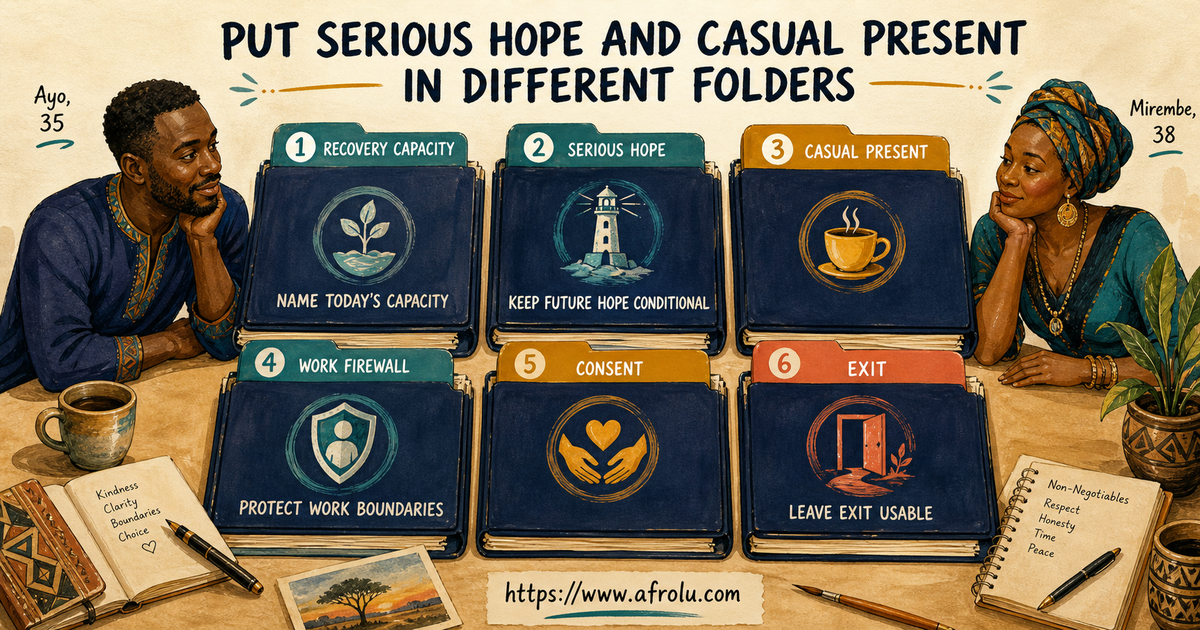
Brief the present honestly; a future hope is not a current promise.
Written and edited by Jean-Claude Mukendi · Relationship Guides Editor
Use six separate folders: RECOVERY CAPACITY, SERIOUS HOPE, CASUAL PRESENT, WORK FIREWALL, CONSENT and EXIT. State what is available now before describing a possible future. Let the other adult accept, clarify, slow, redesign, pause or close freely. Career status is not readiness evidence, and there is no universal recovery date. Seek qualified care for severe or persistent daily-life impairment and direct local help for fraud, threats, stalking or access through work and home.
Starting over · Professionals
How can a professional separate serious future hope from a casual present without creating a promise, a workplace risk or an unchosen waiting room?
Dating after heartbreak is a voluntary return to romantic contact after a painful ending, with no universal recovery sequence or deadline. Serious hope can describe a future preference while casual present describes today's lighter offer. Neither proves readiness, deception or superiority. Serious now, cautious re-entry, ordinary uncertainty, mismatch, friendship, closure, distress and danger require different evidence and responses.
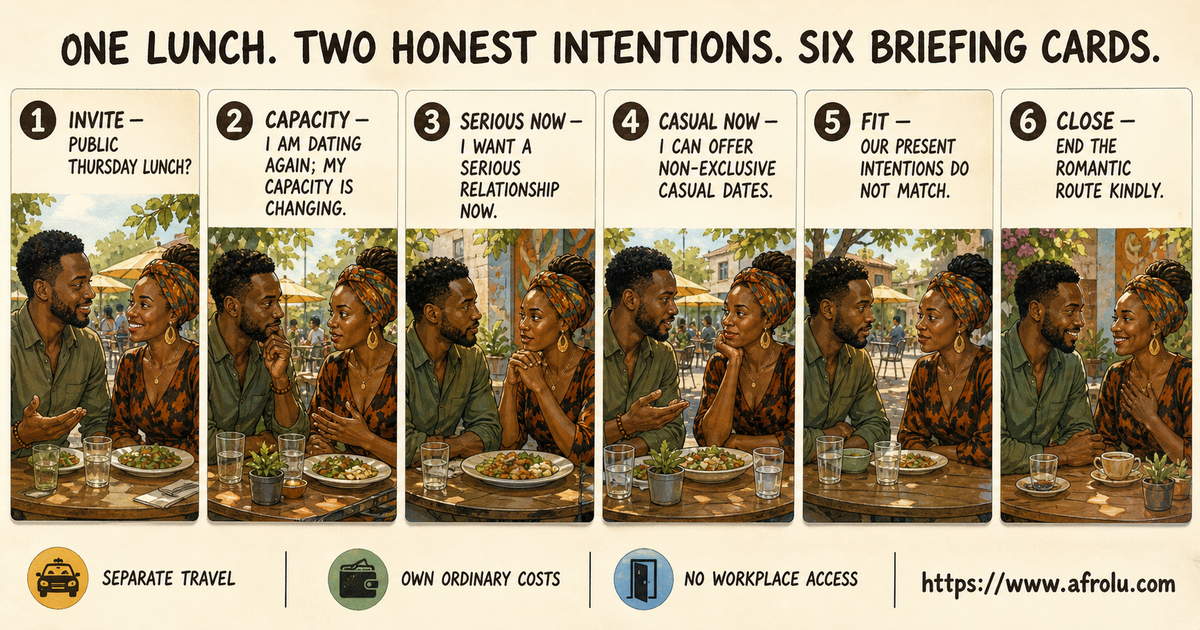
Ayo, 35, invites Mirembe, 38, to public lunch. Both fictional Black African professionals travel separately and protect employer, money, health, consent and exit. Mirembe wants serious dating now; Ayo hopes for partnership later but can offer only non-exclusive casual company now. They name the mismatch and close the romantic route kindly, without a recovery deadline or workplace contact.
The dual-intent re-entry briefing room
Separate a serious future hope from the casual present on offer
Ayo and Mirembe use six independent folders so attraction never turns possibility into a promise.
Name present capacity, protect work, keep every consent separate and choose from current evidence rather than status.
Brief today
Describe what attention and time genuinely exist now.
Keep two folders
Future seriousness and present casual scope need separate answers.
Protect the role
Colleagues, systems and confidential detail stay outside romance.
Close without appraisal
A mismatch can end kindly without ranking either adult.
Heartbreak re-entry needs two honest headings
Write the future hope and today's offer on separate pages
After heartbreak, someone may hope for a serious partnership later while having room only for casual dating now. Those statements can coexist when each is plain. Trouble begins when future hope is used as proof that a current bond is already growing. It also begins when casual scope hides limits that affect another adult.
Career skill does not settle romantic readiness. Someone can lead complex work and still feel unsure, tired or tender. Another person can have uneven work and be clear. Titles, income, travel and output do not measure recovery. Use current words and actions. Check sleep, attention, limits and fit without calling ordinary pain a work flaw or diagnosis.
Serious hope means a bond someone may want later. CASUAL PRESENT means the scope they can offer today, perhaps non-exclusive company with no pledge. Neither lane is morally higher. Both adults must know which offer is current and what contact fits. They must also say whether sex, exclusivity or future plans were discussed.
Open one briefing question at a time: capacity, present intent, work privacy, consent or exit. Ask directly. Accept a different answer and judge follow-through. Lasting distress that disrupts ordinary life may fit qualified care. Fraud, threats, stalking, coercive control or access through work and home skip normal fit review. They call for fitting local protection.
The six-folder dual-intent briefing room
Keep recovery capacity, relationship hope and present scope independent
RECOVERY CAPACITY records what attention, time and emotional range are genuinely available now. It can expand, shrink or stay uncertain without a deadline. SERIOUS HOPE records a future preference, not a forecast. Someone may value partnership and still decline a serious relationship today. Another person may need present commitment and leave rather than wait for capacity to change.
CASUAL PRESENT names the actual offer: perhaps public dates, limited messaging and no exclusivity unless discussed. It should not smuggle in partner-level care, constant availability or a later promotion. Casual dating still needs honesty, consent, sexual-health conversations and an exit. A serious-seeking adult may decline the offer without calling it deceptive when its limits were clear.
WORK FIREWALL keeps employer, clients, calendars, devices, colleagues and professional reputation outside romantic proof. Share the availability needed for a date, not confidential material or live workplace access. Busy periods may alter capacity, but a career does not excuse pressure or indefinite ambiguity. A realistic counteroffer provides more information than a job title or elaborate explanation.
CONSENT separates disclosure, images, touch, sex, exclusivity and every later meeting. EXIT lets either adult pause or close without a work review. A lunch, gift, referral, introduction or shared hurt buys no access. If no is bypassed through colleagues, another account, work, home or threats, end the intent talk. Protect access instead.
Ayo and Mirembe name the mismatch at lunch
A fictional six-card story closes kindly before hope becomes a promise
Ayo is 35 and recently ended an important relationship. Mirembe is 38 and has also known heartbreak. Both are fictional Black African professionals, but no title, employer or income supports the story. Each controls work information, money, transport, sexual-health choices, physical affection and exit. Neither person's history gives the other authority over a recovery timetable.
Ayo invites Mirembe to a public weekday lunch away from both workplaces. They travel separately and handle ordinary personal costs. Before treating warmth as momentum, Mirembe says she is dating for a serious relationship now. Ayo says serious partnership remains a future hope, but only non-exclusive casual company is genuinely available in the present.
They test fit rather than debating whose intention is more mature. Mirembe does not want to build attachment inside an offer that may never change. Ayo cannot promise a review date or use the possibility of later seriousness to keep her waiting. Both accept that clear interest can coexist with an incompatible relationship lane.
They close the romantic route after lunch and do not route contact through work. The ending proves nothing about either adult's future, status or healing. It demonstrates six completed moves: invitation, capacity, serious-now intention, casual-now intention, fit check and closure. A different pair might continue casually, but only if that present offer genuinely fits both.
Fourteen signals in the re-entry brief
Compare what is offered now with the future meaning attached to it
The fourteen signals form seven pairs. They cover recovery capacity, serious hope, casual present, time, work privacy, consent and exit. Each pair contrasts a BRIEFED NOW act with a BORROWED FUTURE belief. They do not score readiness. Mixed evidence is normal. One calm talk cannot prove future fit, sexual health or safety.
Briefed capacity names the contact available today; borrowed capacity asks another adult to wait without a present agreement. Briefed serious hope remains conditional; borrowed hope is repeated like a promise. Briefed casual scope states exclusivity and contact limits. Borrowed casual scope takes partner-level access while insisting that no expectations can be voiced.
Briefed time uses a realistic invitation, counteroffer and confirmation point. Borrowed time repeatedly turns work pressure into indefinite holding. Briefed work privacy protects both adults' roles, colleagues and information. Borrowed work access seeks calendars, internal messages, introductions or surprise visits as proof of interest. Professional visibility should never become a route around consent.
Briefed consent asks separately about information, images, touch, sex and later contact. Briefed exit accepts pause or closure across every channel. Their borrowed forms turn hurt, spending, a good date or future hope into entitlement. Money tricks, threats, stalking, image abuse and work or home bypass are safety facts. They outweigh a polished story.

Read the agreement delivered today, not the prestige of a career or the romance of a future plan.
Twelve lines that keep the brief human
Say enough to guide the next choice without conducting an interview
Professionals can hide uncertainty inside polished language. Plain sentences work better. State the present fact, name one limit and leave room for yes, a counteroffer or no. Do not ask for a recovery forecast or offer a probationary relationship. Nobody owes a full heartbreak history, therapeutic disclosure or work biography to make a current dating choice.
For recovery capacity, try: ‘I am dating again, and my capacity is still changing.’ For serious hope: ‘I may want a serious relationship later, but I am not offering one now.’ For casual present: ‘I can offer non-exclusive casual dates if that fits you.’ These lines separate aspiration, availability and the other adult's right to decline.
For pace, say: ‘I can meet twice this month and will not promise more yet.’ For an invitation: ‘Would a public lunch on Thursday work?’ For confirmation: ‘Let us confirm by Wednesday evening or release it.’ For work: ‘My workplace and colleagues stay outside dating.’ Short language protects calendars without using career pressure as automatic justification.
For privacy, money and sexual health, name only the decisions needed now. Consent remains separate for disclosure, touch, sex and every later plan. Pause can be: ‘I need dating out of my week for now.’ Closure can be: ‘Our present intentions do not fit, so I am ending the romantic route.’ An ending needs no performance score.

Clarity can be concise without sounding like a performance review.
Protect work, sexual health and online access separately
A polished profile does not verify identity, intent or safety
CDC workplace material calls job stress a harmful response. It can arise when job demands do not match a worker's skills, means or needs. The page stresses changes at work, not only personal coping. It cannot assess one dater or excuse conduct. If strain cuts free time, name the smaller offer. The other adult may still leave.
WHO guidance lists common stress effects and simple self-care. It also advises expert help when coping is hard or signs persist. The page sets no heartbreak clock. Severe or growing harm to sleep, focus, appetite, work or daily tasks may fit local care. Do not assume dating caused it or ask a partner to treat it.
CDC sexual-health guidance says STI test needs can depend on age, sexual history and other facts. It advises a talk with a health provider. A test is health data, not proof of loyalty, consent or future safety. Partners can discuss barriers, tests and exclusivity. No one must share more than an informed choice needs.
The eSafety Commissioner and FTC advise care with personal data. They also support checks on identity claims and refusal of money requests. Their services reflect Australian and U.S. settings, so local routes differ. Use public first meetings, separate travel and official contacts found on your own. Fraud, threats, stalking or work access need direct protection.
Eight equal doors out of the briefing room
Choose the next step from current evidence, capacity and safety
CONTINUE fits when the present casual offer is genuinely wanted by both adults. CLARIFY fits one answerable ambiguity about intent, exclusivity or contact. SLOW fits a connection both want at a smaller pace. REDESIGN fits when another structure, perhaps friendship or serious dating now, can be proposed honestly without using future hope as leverage.
PAUSE fits when dating takes attention needed for rest, work or ordinary life. CLOSE fits an intent mismatch, even when attraction and respect remain. Neither option requires evidence that another adult is bad or unrecovered. A person may stop using apps, choose another dating lane or leave romance entirely without failing a professional or emotional milestone.
SEEK CARE fits severe, worsening or persistent distress affecting sleep, focus, appetite, work or daily tasks. A dating label cannot identify cause or diagnosis. Qualified local support may help someone assess stress, grief or health in context. Care can accompany any relationship decision and should not be presented as a route back to dating by a deadline.
SEEK SAFETY HELP fits fraud, threats, stalking, coercive control, image abuse or access through work and home. Do not average danger against credentials, gifts or vulnerable disclosures. Secure devices, accounts, money, transport and location information as the facts require. Local definitions and services differ; use relevant platform, workplace, legal, health or emergency channels.

Choose from today's evidence; no door sets a universal recovery date.
Eight professional re-entry moments where future hope and present scope diverge
A serious hope is repeated during a casual present
The hope may be sincere, but it does not create a current commitment or a date when the offer will change.
Name what is available now.One adult wants serious dating in the present
The other can offer only non-exclusive casual company, and neither needs to argue that one lane is superior.
Close or redesign without waiting.A demanding period removes the proposed evening
The constraint becomes useful only when the adult offers a realistic alternative or releases the plan.
Use the counteroffer, not the title.Warm contact resumes after another unfinished plan
Professional fluency restores hope while the same invitation, confirmation or repair remains incomplete.
Ask once and read the action.A match asks for a full heartbreak account
The disclosure is not required to decide the current scope, pace, consent or public date.
Share only what supports the choice.Contact moves through colleagues after a pause
Workplace visibility is being used to bypass a closed personal channel rather than clarify intent.
Protect access and document safely.Two adults discuss testing before sex
They treat testing, barriers, consent and exclusivity as separate choices without using results as proof of character.
Choose fitting care and agreements.A successful-looking match requests a transfer
Credentials, urgency and affection do not independently verify identity, need or repayment.
Send nothing and check independently.Fourteen signals across recovery capacity, intent, work privacy, consent and exit
Current emotional and practical capacity is named without a recovery deadline.
A serious future hope is not presented as a promise to this person.
Casual present scope states contact, exclusivity and planning limits plainly.
Either adult can decline casual scope without being called impatient or unhealed.
Invitations use real activities, places, windows and confirmation points.
Work pressure carries a realistic counteroffer or a clean release.
Titles, income, travel and productivity are not treated as readiness evidence.
Employer, colleagues, calendars, devices and confidential work stay private.
Heartbreak history is shared by choice rather than demanded as proof.
Money, referrals, gifts and professional help purchase no romantic access.
Sexual-health discussion does not substitute for consent or exclusivity agreements.
Disclosure, images, touch, sex and each later meeting keep separate answers.
Pause and closure are respected across personal and workplace channels.
Persistent impairment, fraud and danger are routed to the fitting kind of help.
Review the dual-intent brief through ten independent questions
| Situation | What it may mean | What to do next |
|---|---|---|
| What capacity exists today? | Fits: A realistic offer is named. Needs review: One limit needs wording. Stop: Future hope hides present absence. | Write today's offer first. |
| Is serious hope conditional? | Fits: It remains a preference, not a promise. Needs review: One assumption needs correction. Stop: Later is sold as guaranteed. | Separate hope from commitment. |
| Is casual present mutual? | Fits: Both adults freely want the lane. Needs review: Exclusivity or contact is unclear. Stop: One waits for promotion. | Define or close the mismatch. |
| Can the plan be answered? | Fits: Place, time and confirmation are usable. Needs review: One detail remains open. Stop: Busy language reserves indefinite time. | Ask once or release it. |
| Does work stay firewalled? | Fits: Only needed availability is shared. Needs review: One channel needs protecting. Stop: Colleagues or systems become access. | Return contact to personal space. |
| Is personal history voluntary? | Fits: Disclosure supports current choice. Needs review: Curiosity is becoming pressure. Stop: Pain is demanded as proof. | Share less and restate scope. |
| Are money and favours separate? | Fits: Each adult controls costs and assets. Needs review: A gift assumption needs correction. Stop: Funds or access are requested. | Stop transfers and verify independently. |
| Are sexual-health choices specific? | Fits: Testing, barriers, consent and exclusivity differ. Needs review: One talk is incomplete. Stop: A result is treated as entitlement. | Use informed, separate agreements. |
| Does exit work everywhere? | Fits: Pause and closure are respected. Needs review: One account needs securing. Stop: Work or home bypasses no. | Protect access proportionately. |
| What is the strongest current fact? | Fits: An ordinary intent choice remains. Needs review: Lasting impairment may need care. Stop: Fraud or danger needs protection. | Lead with that fact. |
Twelve lines for capacity, intent, work, sexual health, pause and closure
“I am dating again, and my capacity is still changing.”
“I may want a serious relationship later, but I am not offering one now.”
“I can offer non-exclusive casual dates if that genuinely fits you.”
“I can meet twice this month and will not promise more yet.”
“Would a public lunch on Thursday work for you?”
“Let us confirm by Wednesday evening or release the plan.”
“My workplace, colleagues and internal calendar stay outside dating.”
“I will share only the history needed for this choice.”
“We handle our own costs; I send no funds, codes or investments.”
“Before sex, I want a specific talk about testing, barriers and exclusivity.”
“I need dating out of my week for now, so I am pausing contact.”
“Our present intentions do not fit, so I am ending the romantic route.”
Know the difference
A serious future hope is not the same as serious dating now
Partnership is a possible future preference, but no current commitment or change date is offered.
Both adults presently choose a relationship-building lane and name its agreements together.
Future hope may be sincere; only the current offer can be accepted.

Use the narrowest route supported by current words and actions.
Separate nine re-entry routes without ranking careers, intent or recovery
| Type or dimension | What it describes | Best next question |
|---|---|---|
| Serious now | Both adults presently choose relationship-building agreements. | Define pace, exclusivity and next steps. |
| Casual now | Both adults choose a lighter present scope without a serious promise. | Keep consent and logistics explicit. |
| Serious later hope | Partnership is wanted in principle but not offered now. | Accept only if the present fits. |
| Cautious re-entry | Interest exists within deliberately limited capacity after hurt. | Name the smaller rhythm and review freely. |
| Ordinary uncertainty | An adult does not yet know which present lane fits. | Ask one narrow question or pause. |
| Intent mismatch | Two honest present goals do not align. | Redesign or close without ranking. |
| Friendship | Warm contact continues without an agreed romantic route. | Name and respect the non-romantic scope. |
| Daily-life distress | Sleep, focus, appetite, work or routine stays badly affected. | Seek qualified local care when fitting. |
| Fraud or danger | Money deception, threats, stalking or access bypass appears. | Protect access and use relevant help. |
Use six folders to keep a future hope from becoming a present promise
Brief the present
Describe what can be offered now before discussing a possible future destination.
Unlink worth from work
Do not treat title, income or productivity as evidence of romantic readiness.
Keep two intent files
Let serious hope and casual present stay truthful without merging them.
Firewall professional life
Protect colleagues, employers, calendars, devices and confidential material.
Separate each consent
Testing, barriers, exclusivity, touch and later contact each need agreement.
Route the strongest fact
Use ordinary choice, qualified care or safety help according to present evidence.
Questions for present capacity, dual intent, work privacy and safe exit
Choose a few prompts that fit the moment. This is a reference library, not a list to complete.
Brief the present
Describe capacity before discussing a future destination.
- What can I offer now?
- What remains uncertain?
- What am I not promising?
- Can the other adult decline freely?
Separate two intents
Keep serious hope and casual present independently answerable.
- Is seriousness wanted now or later?
- Is casual scope genuinely mutual?
- Was exclusivity discussed?
- What change is merely imagined?
Protect work and health
Use only the information needed for consent and fit.
- Which channel stays personal?
- What work detail stays private?
- Which health talk is needed?
- Does every yes stay separate?
Choose the right door
Route ordinary fit, care and danger differently.
- Continue or clarify?
- Slow or redesign?
- Pause or close?
- Does care or safety help fit?
What current stress, workplace, online-safety, health and fraud guidance supports
WHO guidance supports practical stress care without a heartbreak clock
The official Q&A describes common stress signs, self-care steps and seeking professional help when coping is difficult or symptoms persist.
Evidence limit: It does not assess one reader, diagnose heartbreak or state when anyone must date again.
CDC and NIOSH frame job stress as an organisational concern
The official resource defines job stress and emphasises prevention through working conditions rather than relying only on individual coping.
Evidence limit: It does not excuse dating conduct or measure a professional's romantic availability.
eSafety separates profile polish from identity verification
The official guidance supports limiting personal details, checking claims, meeting publicly and using platform controls.
Evidence limit: Australian services and legal context require local adaptation and cannot certify a match.
CDC recommends testing decisions that fit individual factors
The official resource supports discussing suitable STI testing with a healthcare provider and identifies factors that can affect recommendations.
Evidence limit: Testing guidance does not replace consent, exclusivity talks, barriers or personalised care.
FTC guidance treats money requests as a separate risk lane
The official consumer resource supports refusing transfers, gift cards, cryptocurrency and investment requests and checking claims independently.
Evidence limit: U.S. reporting routes differ elsewhere and the page cannot verify a specific person's identity.
UK statutory guidance includes post-separation and access tactics
The official framework supports treating threats, monitoring and repeated access as safety facts rather than intent confusion.
Evidence limit: Its legal definitions apply to England and Wales; readers need jurisdiction-specific advice.
Six ways a polished re-entry brief can hide an unchosen waiting room
Selling serious later as serious now
Hope becomes a promise. Repair: state the present lane first.
Treating casual as a waiting room
One adult absorbs an unchosen audition. Repair: accept or decline today's offer.
Using work pressure as a blank cheque
Busy language reserves time indefinitely. Repair: counter or release.
Requesting the full heartbreak file
Vulnerability becomes proof. Repair: ask only what supports consent.
Using tests as trust certificates
Health data becomes entitlement. Repair: separate testing, barriers and consent.
Closing through professional channels
A mismatch becomes workplace access. Repair: use and respect the safest personal route.
Choose one resource for recovery, seriousness or casual scope
A professional can want a committed future while choosing a limited present arrangement, or want neither. Name today's capacity and agreement before letting polished plans or career status carry the decision.
Explore the guide library
Show more related guides
Continue with Afrolu
Show more Afrolu guides
Reviewed official stress, work, online-safety, sexual-health, fraud and coercion guidance
Afrolu reviewed these health, research, safety, or public guidance resources while editing this page. They support the behaviour and safety guidance; they do not diagnose any individual described by a reader.
Professional questions about heartbreak, serious hope and casual dating
Can I want a serious relationship later and date casually now?
Yes, if the serious future is described as a preference rather than a promise and the casual present is genuinely acceptable to both adults. Name contact, exclusivity, sexual-health and exit agreements. The other person may decline because they want serious dating now, and that ordinary mismatch needs no judgement about your recovery.
How long should a professional wait after heartbreak before dating?
There is no universal timetable. Look at current capacity, motivation, daily functioning, consent and the effect on ordinary life rather than a calendar rule. Start, slow, pause or stop freely. Severe, worsening or persistent disruption may fit qualified local care, but care should not be framed as a deadline for returning to romance.
Does being busy justify keeping a date open?
No. Work pressure can be real, yet the other adult still needs a usable choice. Offer a realistic activity, window and confirmation point, make a counteroffer or release the plan. You can protect confidential work details. A title or demanding schedule does not require someone else to keep indefinite time available.
Is casual dating unfair to someone who wants commitment?
It is unfair when limits are hidden, future seriousness is implied as guaranteed or one adult is pressured to wait. A clear casual offer is not inherently unfair. The serious-seeking person can decline without ranking either lane. Attraction does not require accepting a structure that conflicts with a current relationship goal.
Do I owe a new date the full story of my heartbreak?
No. Share information needed for present consent and fit, such as capacity, boundaries or a relevant health choice. You control private history, therapeutic details, former-partner information and workplace context. A match may decide the limited disclosure does not fit, but should not demand pain as proof that you are honest or ready.
Should colleagues know I am dating someone?
That is a personal and workplace-context choice, not a requirement for romantic legitimacy. Early dating can remain outside employer systems, client spaces, internal calendars and colleague mediation. Follow applicable workplace policies. If someone bypasses a pause or ending through work, treat access and safety as the issue rather than continuing an intent debate.
Does an STI test mean sex is safe or expected?
No. CDC guidance says suitable testing can depend on individual factors and may require discussion with a healthcare provider. Results do not replace barriers, contraception where relevant, exclusivity agreements or current consent. No test purchases sex, and every adult may change their answer before or during physical contact.
What if a successful-looking match asks for an emergency transfer?
Do not send money, codes, gift cards, cryptocurrency, fees or investments. Career claims, profile polish and urgency do not verify identity or need. Check any institution through an official contact you find independently, secure affected accounts and use relevant platform, bank and local reporting channels. Do not let professional familiarity lower the verification bar.
Can I close a connection even if nobody behaved badly?
Yes. A present-intent mismatch, unwanted pace or lack of capacity is enough. Use a short ending when safe, then respect access on both sides. You do not need to assess another adult's healing, offer a performance review or remain casual while waiting for their future hope to become serious.
When might qualified care or urgent help fit?
Qualified local care may fit when distress is severe, worsening or persistently affects sleep, concentration, appetite, work or ordinary tasks. Immediate danger, self-harm risk, fraud, threats, stalking, coercive control or workplace or home access may need relevant emergency, health, legal, platform, financial or organisational support. Dating labels cannot diagnose or protect by themselves.
One thing to do now
Offer today's honest lane—or release the route without ranking it
Continue only when the present lane, pace, work boundary, sexual-health discussion, consent and exit fit both adults. Clarify one real ambiguity, slow or redesign a mutually wanted connection, and pause or close an ordinary mismatch without ranking intent. Use qualified local care for severe or persistent impairment and direct platform, workplace, financial, legal, health or emergency help for fraud or danger.