Five zones · no perfect-readiness test
Return to Nairobi Dating With One Low-Pressure, Honest Step
A low-pressure Nairobi guide for professionals after heartbreak: assess motive, work capacity, public plans, consent, after-effects and support.
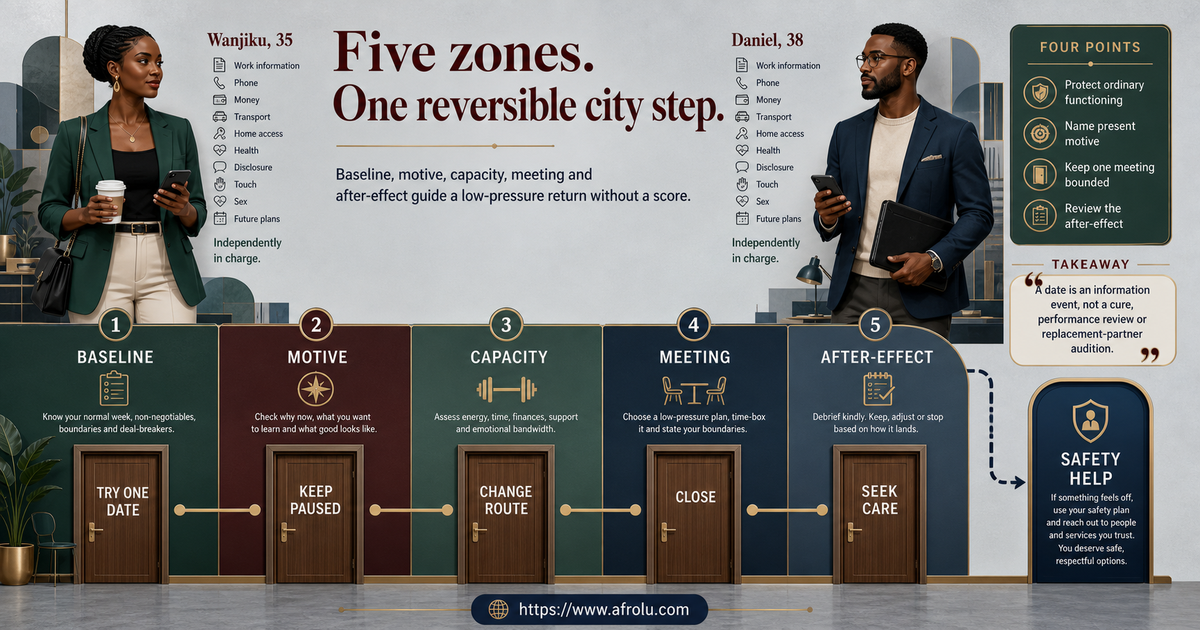
Readiness is not a feeling that must become perfect; it is enough capacity to make one honest, reversible choice.
Written and edited by Tariro Ncube · Diaspora Dating Editor
Use five independent zones: BASELINE, MOTIVE, CAPACITY, MEETING and AFTER-EFFECT. Readiness is not perfect calm; it is enough agency to choose one honest, reversible step and accept any outcome. Keep the former relationship, clients, workplace systems, money, transport and care private. Make one public plan with a time limit, separate payment and specific consent, then review tomorrow's capacity before adding another. No universal readiness feeling or timeline exists. Severe persistent impairment needs qualified local assessment; threats, stalking, fraud, coercion, image abuse or workplace intrusion use suitable safety help.
Starting over · Professionals
How can a professional try one low-pressure Nairobi date after heartbreak without treating a new person as therapy, proof of recovery or a replacement partner?
Dating after heartbreak is a present-tense choice, not proof that grief has ended. Workable re-entry can include memories, caution and one bounded meeting while ordinary function and consent remain available. Rebound escape, work overload, ex-partner entanglement, persistent impairment, mismatch and unsafe conduct are different states requiring different responses.
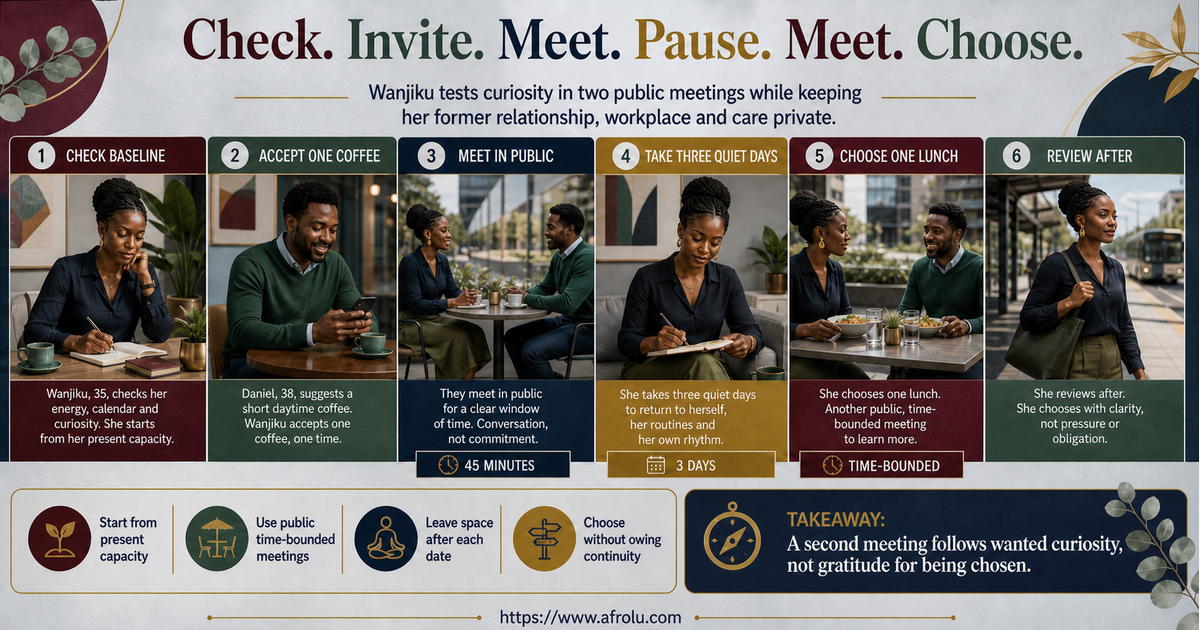
Wanjiku, a fictional 35-year-old Nairobi professional, protects a deadline, accepts one forty-five-minute public coffee with Daniel, 38, and limits breakup and work disclosure. After three quiet days she chooses one lunch, then reviews her next workday before continuing small. The two meetings illustrate reversibility, not a healing formula.
The five-zone Nairobi professional re-entry studio
Protect the workday, give the date a fair-sized job and review tomorrow
Tariro treats re-entry as a reversible adult decision rather than a recovery test, performance review or race to replace an ex.
Observe baseline and motive, state capacity, bound one public meeting and review its after-effect.
Start with ordinary function
Notice sleep, work, food, attention and existing support.
Give the date one job
Let curiosity be enough and offer only what fits now.
Keep the city step reversible
Use public time, separate payment, transport and consent.
Protect tomorrow
Review workday capacity before expanding the route.
Reject the perfect-readiness myth
Dating after heartbreak can begin with mixed feelings and honest limits
Heartbreak has no universal expiry date and readiness has no required feeling. Wanjiku may miss her former partner, feel cautious and still want one coffee. Another professional may feel calm and want no dating. Neither state is morally ahead. The practical question is whether a new adult can receive honest, present attention without becoming a cure, comparison or proof of success.
Low-pressure dating reduces the number of promises attached to one event. A public coffee is not an agreement to disclose the breakup, enter a relationship, provide emotional care, visit a home or accept touch. It can end with interest, neutrality, discomfort or a kind no. Reversibility helps Wanjiku observe impact without staging a performance of being healed.
Professional identity can hide strain. Meeting deadlines or leading a team does not prove emotional capacity, while taking a quieter week does not make someone unfit for responsibility. Wanjiku protects confidential work, colleagues and office systems from dating. She also avoids treating Daniel's job title, polished communication or network as evidence that intimacy is safe.
Severe or distressing symptoms that persist or impair sleep, concentration, appetite, enjoyment or ordinary functioning deserve qualified local assessment. Immediate danger or self-harm risk needs urgent support. Threats, stalking, coercion, fraud, image abuse or workplace intrusion are safety problems, not signs that Wanjiku needs a better dating mindset.
Use five re-entry zones
Baseline, motive, capacity, meeting and after-effect create a reversible route
BASELINE records ordinary function before a date: sleep, work, food, concentration, friendships, movement and private recovery. It does not require perfect scores. Wanjiku asks what is already difficult and what support exists, so the date is not blamed for every feeling or expected to repair a wider pattern.
MOTIVE asks what she wants from this meeting: curiosity, companionship, practice talking to someone new, sexual exploration, serious potential or simply a change of scene. Multiple motives can coexist. The warning is not pleasure or distraction itself; it is assigning Daniel responsibility for proving worth, erasing an ex or regulating distress he has not agreed to manage.
CAPACITY names time, disclosure and communication she can honestly offer around Nairobi work and travel. MEETING keeps venue, duration, payment, alcohol, transport, touch and departure separately chosen. A daytime public plan may reduce pressure, but no format guarantees safety. Each adult keeps phone, funds and return control.
AFTER-EFFECT reviews the next day rather than judging chemistry at the table. Did Wanjiku's workday remain possible? Did curiosity grow, stay neutral or disappear? Did she compare Daniel with her ex, and can that observation exist without self-condemnation? The review supports one next action, not a verdict about permanent recovery.
Follow two bounded city meetings
Wanjiku tests curiosity without assigning Daniel the job of healing her
Wanjiku has been single for several months after a long relationship ended. She works reliably but notices that late-night app browsing worsens the following morning. Before accepting Daniel's invitation, she protects one work deadline, tells a friend the public venue and chooses a forty-five-minute Saturday coffee with independent transport.
She tells Daniel, 'I am dating slowly after a significant breakup, and I do not want to process the whole story on a first meeting.' He accepts the limit and does not ask for her ex's name, workplace, photographs or blame. They speak about current interests and leave separately when the agreed window ends.
Wanjiku takes three quiet days before deciding. She notices comparison thoughts but also genuine curiosity. She chooses one weekday lunch in a location that does not expose her office. They each pay, discuss contact preferences and agree that the lunch creates no automatic weekend plan, sexual access or relationship label.
The next morning Wanjiku can concentrate and wants another conversation, but she keeps the pace small. If she had felt depleted or uninterested, pausing would have completed the experiment. Two meetings and three quiet days belong only to this story; they are not a readiness formula or treatment schedule.
Read fifteen independent signals
Five zones distinguish workable curiosity, redesign needs and another support route
BASELINE fits when ordinary function is stable enough for the chosen event. Redesign dating that repeatedly removes sleep or work capacity. Seek care when severe or distressing symptoms persist across settings. A difficult morning after one emotional conversation may be ordinary; duration, scope and impairment matter more than a trendy label.
MOTIVE fits when Wanjiku can name what she wants and Daniel remains a separate person. Redesign dates used mainly to monitor an ex, provoke jealousy or obtain reassurance. Stop contact with a former partner when legal or safety boundaries require it. A mixed motive can be observed without turning it into a moral failure.
CAPACITY fits when reply, disclosure and meeting frequency are honest. Redesign professional over-functioning that promises more than Wanjiku can deliver. MEETING fits when venue, time, payment, alcohol, consent and transport stay independent. Stop anyone who seeks confidential work, money, controlled movement or sexual access through pressure.
AFTER-EFFECT fits when the date leaves enough capacity for ordinary life and future choice. Redesign comparison spirals or contact that creates repeated depletion. Seek support when distress becomes severe, persistent or unsafe. A pleasant after-effect is evidence about one meeting, not proof of complete recovery or permanent compatibility.

No total can declare a person healed or ready; the strongest current fact chooses the next step.
Use ten low-pressure lines
Honest limits protect work, breakup privacy, money, consent and a kind ending
For pace Wanjiku can say, 'I am open to one meeting and will decide afterward.' For availability, 'I can do Saturday coffee for forty-five minutes.' These statements create a real offer without promising future consistency. Daniel can accept, counter or decline; none of those responses determines her readiness.
For the breakup, 'A significant relationship ended, and I am not discussing the full story today' is truthful. For work, she does not disclose clients, confidential systems, exact office routine or colleague information. Professional polish should not force either adult into an interview, and a date should not become informal therapy.
For money and alcohol, each adult controls spending, drink choices, food and transport. For consent, coffee, a second date, touch, sex and home access remain separate decisions. Sexual-health conversations about partners, testing and prevention happen before sex with enough time for informed, sober and unpressured choices.
For pause, 'I enjoyed meeting, and I need more space before deciding' is complete. For closure, 'I do not want another date, and I wish you well' does not require a heartbreak explanation. Persistent unwanted contact, threats or workplace pursuit changes the task from kindness to access protection.

Truthful dating requires present limits, not a complete account of the former relationship.
Review tomorrow's capacity
Try one date, stay paused, change route, close or seek suitable support
TRY ONE DATE means one public, bounded event with honest limits and no bundled future. KEEP PAUSED protects recovery, work or simple preference without a promised return. CHANGE ROUTE might mean friend introductions, daytime activities, a different service, sexual health care before dating or a smaller contact rhythm.
CLOSE applies when Daniel is not a fit, dating is unwanted or the process creates more cost than curiosity. Wanjiku does not need to prove that heartbreak caused the decision. She can like him and still decline. A second date, sex or relationship is never owed because he behaved well during the first meeting.
SEEK CARE applies to severe or persistent impairment, not to every sad memory or comparison. Qualified local professionals can assess causes, options and workplace needs. Existing care remains separate from dating; Daniel is not asked to monitor symptoms, manage treatment or replace trusted personal support.
SEEK SAFETY HELP applies to threats, stalking, fraud, coercion, image abuse, workplace intrusion or blocked exit. Depending on the conduct, relevant routes may include platform, employer security, financial, legal, health or emergency support. A final closure message is unnecessary when contact itself could increase danger.

The useful outcome may be curiosity, a continued pause, a kind no or professional support.
Compare eight nearby states
Curiosity, grief, escape, work strain, ex contact, impairment, mismatch and danger differ
WORKABLE CURIOSITY means Wanjiku can choose a bounded meeting, see Daniel as a separate person and accept any outcome. ORDINARY GRIEF may include memories, sadness or mixed feelings while ordinary life remains available. The two can coexist in the same week; dating does not require emotional amnesia.
REBOUND ESCAPE uses new attention mainly to avoid feeling, monitor worth, provoke an ex or create instant replacement. It is a question about function, not a shame label. WORK OVERLOAD can make all optional contact heavy regardless of heartbreak. Adjusting workload, rest or dating capacity may be more relevant than interpreting chemistry.
EX-PARTNER ENTANGLEMENT includes unresolved agreements, unwanted contact, shared property, legal matters or safety boundaries. It may require practical or professional support before a new date receives more access. PERSISTENT IMPAIRMENT affects sleep, concentration, appetite, enjoyment or ordinary tasks and deserves qualified assessment when severe or enduring.
MISMATCH means Wanjiku and Daniel want different pace, disclosure, sex or relationship outcomes without coercion. UNSAFE CONDUCT includes threats, stalking, fraud, sexual pressure, image abuse or workplace intrusion. A kind close fits ordinary mismatch; access-focused action and suitable authorities fit danger without requiring another private discussion.
Eight professional moments where heartbreak needs a smaller present-tense choice
A first date falls beside a major deadline
Wanjiku is curious but knows a late evening will reduce next-day concentration.
Choose a short daytime meeting after the deadline or remain paused.The date asks for the full breakup story
Daniel frames detailed disclosure as proof that she is emotionally available.
Give only present decision-relevant context and keep the former relationship private.One comparison thought appears
A song or comment reminds Wanjiku of her ex during an otherwise respectful coffee.
Notice the thought without treating it as proof that dating must stop or continue.A polished professional asks for work access
Networking language becomes a request for clients, confidential information or office entry.
Keep workplace systems and dating entirely separate.A good date creates pressure for the weekend
Daniel asks for more time before Wanjiku has reviewed the impact.
State that one meeting is complete and decide later without apology.The next workday remains steady
Sleep, attention and ordinary routines are intact, and curiosity about Daniel remains.
Choose one equally bounded meeting if genuinely wanted.Distress persists across every context
Concentration, sleep and enjoyment remain seriously affected whether or not Wanjiku dates.
Seek qualified local assessment rather than asking a new connection to regulate it.A no reaches the workplace
Unwanted messages arrive through professional channels after Wanjiku closes dating contact.
Preserve relevant records and use workplace, platform or local safety routes as appropriate.Fifteen signals across baseline, motive, capacity, meeting and after-effect
{'name': 'Stable enough baseline', 'detail': 'The chosen meeting fits current sleep, work, food, concentration and ordinary support.'}
{'name': 'Named present motive', 'detail': 'Wanjiku can describe curiosity without assigning Daniel the job of recovery.'}
{'name': 'Separate identity', 'detail': 'The new person is not treated as an ex comparison, replacement or proof of worth.'}
{'name': 'Honest capacity', 'detail': 'Available contact and disclosure are stated without professional over-promising.'}
{'name': 'Bounded public meeting', 'detail': 'Time, venue, payment, transport and departure remain independently controlled.'}
{'name': 'Protected workplace', 'detail': 'Clients, systems, colleagues, exact routines and office access stay private.'}
{'name': 'Limited breakup disclosure', 'detail': 'Wanjiku chooses what to share and is not cross-examined about the former partner.'}
{'name': 'Specific consent', 'detail': 'Conversation, another date, touch, sex and home access each retain a separate answer.'}
{'name': 'Alcohol-independent choice', 'detail': 'Drinking is optional and never used to obtain disclosure, consent or transport control.'}
{'name': 'Three quiet days are optional', 'detail': 'Space after a date can support reflection without becoming a universal rule.'}
{'name': 'Workable after-effect', 'detail': 'The next day still contains enough attention for ordinary responsibilities and choice.'}
{'name': 'Complete no', 'detail': 'Either adult can decline another meeting without requiring a recovery diagnosis.'}
{'name': 'Care remains qualified', 'detail': 'Severe persistent impairment is not assigned to a date, friend or internet checklist.'}
{'name': 'Independent money', 'detail': 'Meals, fares, gifts, investments and emergencies never purchase emotional or physical access.'}
{'name': 'Safe exit', 'detail': 'Closure does not trigger threats, surveillance, workplace pursuit or image abuse.'}
Review a low-pressure return through ten independent questions
| Situation | What it may mean | What to do next |
|---|---|---|
| What is my baseline today? | Fits: The meeting fits ordinary function. Needs review: Sleep or work capacity is thin. Stop: Severe impairment or danger is present. | Choose a smaller event, pause or use qualified support. |
| What job am I giving this date? | Fits: Curiosity and companionship are enough. Needs review: I want proof that I am desirable or recovered. Stop: The date is expected to manage crisis or retaliation against an ex. | Reduce the task and keep care or safety separate. |
| Can I see Daniel as a separate person? | Fits: Differences can be observed without ranking. Needs review: Every detail becomes an ex comparison. Stop: Private ex information is shared or weaponised. | Slow disclosure and protect all third-party privacy. |
| Is my capacity honestly stated? | Fits: One real window and limit are clear. Needs review: Professional competence masks depletion. Stop: Work access is demanded as proof. | Name the smaller offer and close workplace routes. |
| Is the city meeting leaveable? | Fits: Public venue, time, payment and return are separate. Needs review: The date expands beyond agreement. Stop: Transport, phone or exit is controlled. | Keep logistics independent and use safety help for blocked exit. |
| Does consent remain specific? | Fits: Each next step receives a fresh choice. Needs review: Kindness is treated as implied access. Stop: Sexual pressure or image abuse appears. | Unbundle every decision and use suitable support for abuse. |
| What does the next day show? | Fits: Curiosity and ordinary capacity coexist. Needs review: The date creates repeated depletion. Stop: Distress becomes severe or persistent. | Continue small, pause or seek qualified assessment. |
| Can another date be freely declined? | Fits: A no remains complete and kind. Needs review: Good behaviour creates a sense of debt. Stop: Closure triggers threats or workplace pursuit. | Decline without explanation or protect access as needed. |
| Is the issue dating or work overload? | Fits: The selected event fits both. Needs review: All optional activity feels heavy. Stop: Workplace conditions or health need formal support. | Match the response to dating, workload or qualified care. |
| Which door protects present agency? | Fits: One reversible next step is wanted. Needs review: More pause would clarify capacity. Stop: Immediate danger bypasses the board. | Try, pause, change route, close or seek appropriate help. |
Ten lines for pace, breakup privacy, work, money, consent and closure
“I am open to one meeting and will decide afterward whether I want another.”
“I can do Saturday coffee for forty-five minutes and will leave by three.”
“A significant relationship ended, and I am not discussing the full story today.”
“I keep clients, colleagues, office systems and my exact routine outside dating.”
“Let us meet in a staffed public venue and travel home separately.”
“I will cover my own meal and transport; I do not mix dating with loans or investments.”
“I am not drinking tonight, and that is not open to persuasion.”
“Coffee does not agree to touch, sex, home access or another date.”
“I enjoyed meeting, and I need more space before I make another plan.”
“I do not want another date, and I wish you well.”
Know the difference
Dating after heartbreak can involve curiosity, grief, escape, overload or danger
One reversible meeting fits ordinary function, honest capacity, specific consent and the possibility of a complete no.
Grief, escape, work overload, ex entanglement, persistent impairment, mismatch or unsafe conduct needs another route.
A date is information, not treatment or proof of recovery.

Describe the present function of dating, then choose the authority that matches the issue.
Separate eight nearby curiosity, grief, escape, overload, mismatch and safety states
| Type or dimension | What it describes | Best next question |
|---|---|---|
| Workable curiosity | Wanjiku can choose one meeting, see Daniel separately and accept any outcome. | Try one bounded date and review the after-effect. |
| Ordinary grief | Memories and sadness coexist with sleep, work, connection and freely chosen activity. | Allow mixed feelings without requiring a dating decision. |
| Rebound escape | New attention is used mainly to erase pain, prove worth, monitor an ex or force replacement. | Pause and return the recovery job to appropriate personal or professional support. |
| Work overload | Deadlines, long hours or low control make every optional plan feel costly. | Adjust dating scope and use relevant workplace resources or boundaries. |
| Ex-partner entanglement | Shared assets, unwanted contact, legal matters or safety boundaries remain active. | Resolve practical routes with suitable advice before expanding new access. |
| Persistent impairment | Severe distress affects sleep, concentration, appetite, enjoyment or ordinary tasks over time. | Seek qualified local assessment; an editorial cannot diagnose or prescribe care. |
| Ordinary mismatch | Pace, disclosure, sexual or relationship goals differ without coercion. | Name the incompatibility and close kindly. |
| Unsafe conduct | Threats, stalking, fraud, sexual pressure, image abuse or workplace intrusion changes the task. | Protect access and use suitable platform, employer, financial, legal, health or emergency help. |
Use the five-zone professional re-entry in six moves
Reject perfect readiness
Enough agency for one honest choice matters more than emotional certainty.
Use five zones
Baseline, motive, capacity, meeting and after-effect remain independent.
Bound one city event
Use public time, separate payment, transport and a planned ending.
Protect professional privacy
No clients, colleagues, systems or exact work routine become dating material.
Review tomorrow
Notice capacity and curiosity after the event instead of grading chemistry during it.
Match support to the issue
Dating, work, clinical care and urgent safety have different authorities.
Questions for baseline, motive, meeting and after-effect
Choose a few prompts that fit the moment. This is a reference library, not a list to complete.
Baseline
Observe ordinary life before dating.
- How did I sleep?
- What work needs protection?
- Which support already exists?
- What feels severely impaired?
- Is one meeting optional?
Motive
Give the date a fair-sized job.
- What do I want today?
- Am I proving worth?
- Am I monitoring an ex?
- Can curiosity be enough?
- Can a no be complete?
Meeting
Keep the city plan reversible.
- Which public venue?
- How long?
- Who pays?
- What alcohol choice?
- How does each person leave?
After-effect
Review without grading recovery.
- Can I work tomorrow?
- Did curiosity grow?
- What comparison appeared?
- Do I want space?
- Which door fits now?
What breakup, self-concept and workplace evidence can support
A longitudinal study examines attachment, coping strategies and breakup distress
The research supports recognising that coping patterns and distress can change over time rather than assuming one universal recovery route.
Evidence limit: The sample and constructs cannot diagnose Wanjiku, prescribe a dating timeline or determine whether a new relationship is advisable.
An eight-week study examines self-concept recovery following romantic separation
The work supports asking how identity, routines and self-understanding reorganise after a breakup, beyond simply counting elapsed time.
Evidence limit: A small young U.S. student sample cannot be generalised to Nairobi professionals or used as a readiness test.
Two studies examine distress, rumination, personal growth and tendency to rebound
The evidence shows that growth, distress and rebound tendencies may have complex relationships rather than one linear healing story.
Evidence limit: Cross-sectional paths do not prove causal mechanisms or make a new partner responsible for growth.
WHO guidance identifies work conditions, mental health and support responsibilities
The current fact sheet supports separating workplace risk and accommodations from private dating performance.
Evidence limit: Global workplace guidance is not personal clinical, employment or legal advice for one Kenyan professional.
eSafety guidance covers privacy, money, coercion and safer first meetings
The official resource supports public plans, limited personal information, independent checks and attention to controlling behaviour.
Evidence limit: Australian services and statistics may not apply in Nairobi; use relevant local authorities.
CDC guidance supports partner conversations before sex
The current resource supports discussing partners, testing and prevention while each adult still has time to choose.
Evidence limit: It is U.S.-based general guidance and does not replace relevant local clinical care.
Six ways re-entry can become performance, treatment or debt
Waiting to feel perfectly healed
An impossible standard replaces present capacity. Repair: assess one reversible choice.
Using a date as recovery treatment
A new adult receives an unchosen clinical job. Repair: keep care with qualified support.
Over-disclosing to prove honesty
The ex, workplace and self lose privacy. Repair: share current decision-relevant context.
Performing professional competence
Polish hides thin capacity. Repair: state the smaller offer without shame.
Owing a second date for kindness
Respect becomes debt. Repair: let good conduct remain good without purchasing continuity.
Treating two meetings as a formula
A fictional sequence becomes a timetable. Repair: review individual impact and choice.
Use a reviewed resource that matches the decision
This guide focuses on the relationship decision, so it does not rank dating apps. Check current prices, safety tools, and local availability before choosing a service.
Explore the guide library
Show more related guides
Continue with Afrolu
Show more Afrolu guides
Breakup research, workplace context and current dating-safety guidance
Afrolu reviewed these health, research, safety, or public guidance resources while editing this page. They support the behaviour and safety guidance; they do not diagnose any individual described by a reader.
Nairobi professional dating-after-heartbreak questions
How do I know I am ready to date after heartbreak?
There is no universal feeling or timeline. Look for enough present capacity to choose one bounded event, communicate limits, see the new person separately and accept any outcome. Mixed feelings or memories do not automatically disqualify you. Severe persistent impairment, active danger or an unwanted process points to another route.
How long should a professional wait after a breakup?
Elapsed time alone cannot determine readiness. Consider ordinary functioning, motive, available time, unresolved practical matters, consent and the likely impact of one event. Waiting may be right; one low-pressure date may also be right. Research cited here does not provide a Nairobi-specific countdown or a clinical assessment.
Do I need to tell a first date everything about my ex?
No. Share the present context needed for informed dating, such as moving slowly or not seeking commitment now. You can keep names, workplaces, health details, conflict and private history closed. Honest boundaries do not require turning a new person into an investigator, counsellor or judge of the former relationship.
Is comparing a new date with an ex a sign I should stop?
Not necessarily. Comparison thoughts can occur without deciding the route. Notice their frequency, impact and whether you can still see the new person accurately. If every interaction becomes ex monitoring, replacement or severe distress, pause and use appropriate support. One thought is not a diagnosis or verdict.
How can I keep Nairobi work and dating separate?
Avoid sharing confidential clients, systems, colleague details, access cards, exact routines or using a workplace as an early meeting point. Choose a public venue away from sensitive operations, keep devices and accounts secure, and use professional channels only for work. Workplace pursuit after closure may require employer security or other support.
Is a daytime coffee safer than an evening date?
It may feel more bounded and support public logistics, but no time or venue guarantees safety. Keep identity checks proportionate, tell a trusted person where feasible, control payment, phone and transport, limit alcohol as you choose and retain a clear exit. Decline or leave whenever the plan no longer fits.
Should I wait before deciding on a second date?
You may decide immediately or take space. Wanjiku's three quiet days are fictional, not a rule. The purpose is to notice after-effects when social pressure is lower. A good first date does not create debt, and a pause does not imply low interest. Choose the cadence that preserves honest agency.
Can casual sex be part of dating after heartbreak?
Yes, if it is genuinely wanted and informed rather than assumed to prove recovery. State relationship expectations, keep consent specific and discuss partners, testing and prevention before sex. Alcohol, gifts, a second date or vulnerability do not create consent. You may change your mind at any point.
When should heartbreak distress receive professional care?
Consider qualified local assessment when symptoms are severe, persistent or interfere with sleep, concentration, appetite, enjoyment, work or ordinary tasks. A dating guide cannot determine cause or treatment. Immediate self-harm risk or danger needs urgent local support; a new date should not be assigned crisis management.
When does a dating problem become a safety problem?
Threats, stalking, fraud, sexual coercion, image abuse, workplace intrusion, controlled transport or blocked exit require access-focused action. Stop explaining when engagement may increase risk. Preserve relevant records where safe and use appropriate platform, employer, financial, legal, health or emergency support for your location.
One thing to do now
Choose one honest city step without asking it to heal everything
Continue only while a small route fits ordinary function, present motive, honest capacity, work privacy, leaveable city logistics and specific consent. Pause or close without proving heartbreak caused the choice. Use qualified local care for severe persistent impairment and problem-specific platform, employer, financial, legal, health or emergency support for unsafe conduct.