Five desks · serious intent without calendar debt
Reset Serious Online Dating Around a Full Nairobi Workweek
A Nairobi professional's serious-dating reset: audit app work, protect rest and privacy, plan one leaveable date, and choose return, pause or exit.
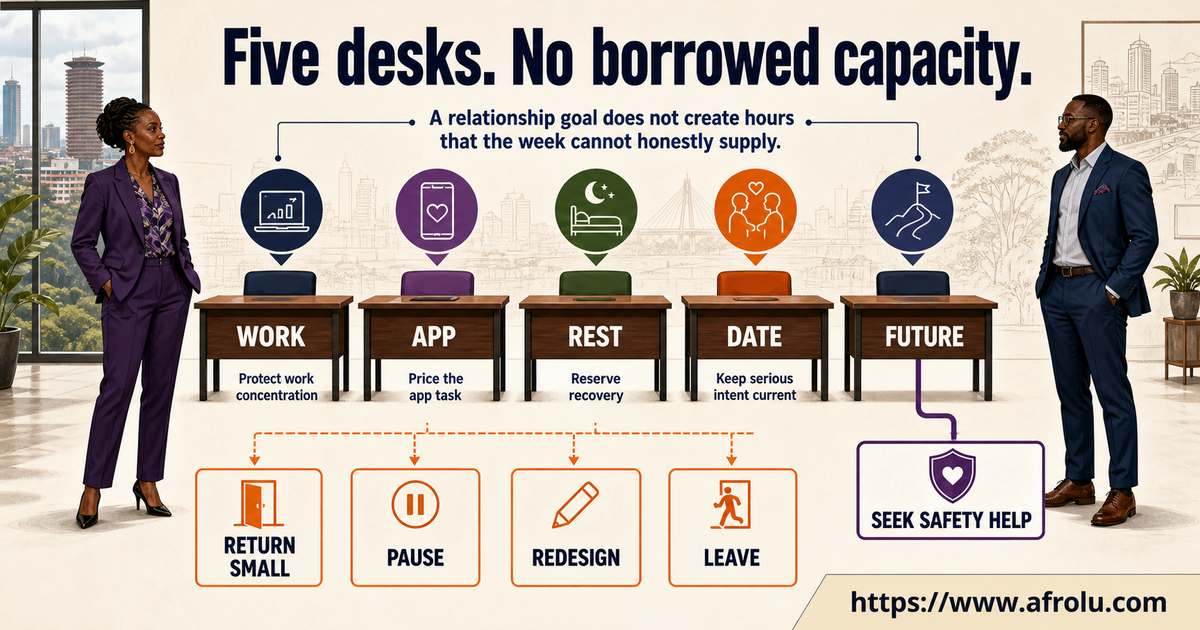
Serious intention can be clear while access stays proportionate to present capacity.
Written and edited by Miriam Otieno · Senior Kenya Editor
Open five separate desks: WORK, APP, REST, DATE and FUTURE. Remove optional notifications and unsuitable threads before measuring the load. Protect employer, client, salary, location and account details. Convert serious intent into one complete public plan rather than constant access: time, place, duration, separate payment and independent exit. Then choose RETURN SMALL, PAUSE, REDESIGN, LEAVE, SEEK CARE or SEEK SAFETY HELP. No universal reset length exists. Persistent impairment needs qualified assessment; threats, tracking, coercion, fraud, image abuse or blocked movement bypass the capacity review.
Dating wellbeing · Professionals
How can a Nairobi professional keep serious relationship intent while reducing online-dating administration, protecting work and building only the plans the current week can support?
Online-dating burnout is used here as a non-diagnostic description of unwanted work from profiles, messages, uncertainty, verification and planning. For professionals, that load may overlap with workplace conditions, Nairobi logistics, ordinary fatigue, serious-intent mismatch or wider distress. The five-desk exchange changes optional tasks to observe impact; it cannot diagnose a condition, rate an employer or certify a match.
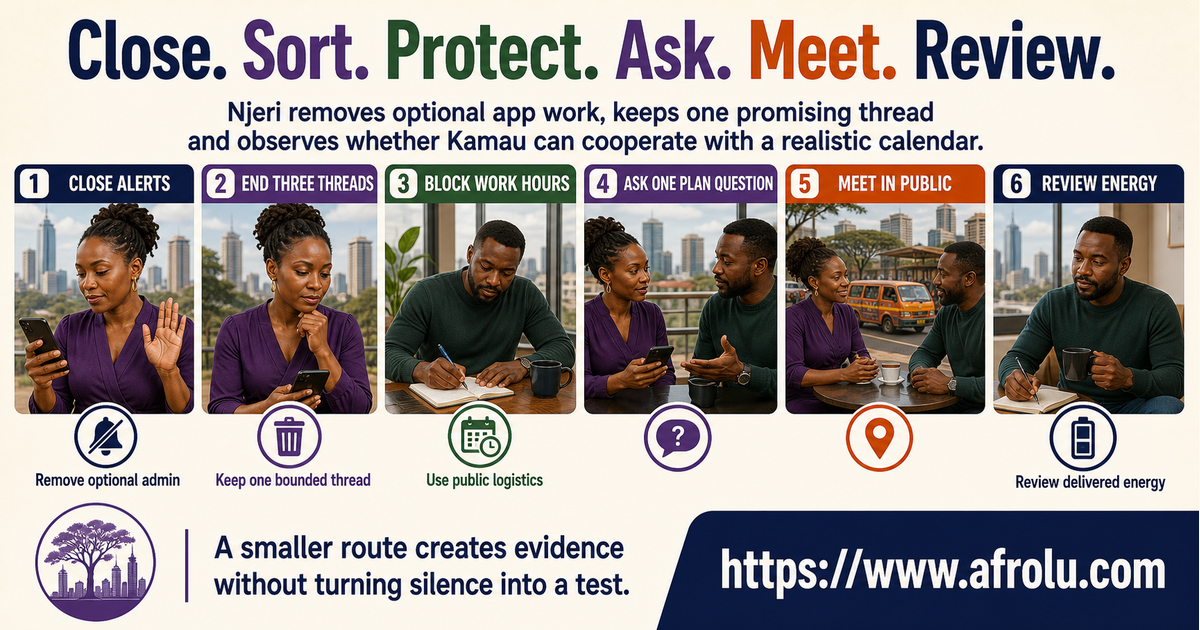
Njeri, a fictional 38-year-old Nairobi professional, removes optional alerts for two workdays, ends three unsuitable threads and accepts one bounded Saturday coffee with Kamau, 41. He respects her work privacy, public venue, separate payment and planned ending. She keeps one scheduled exchange while pausing new matches, without treating the experiment as a cure or commitment.
The Nairobi five-desk capacity exchange
Price app work, protect professional privacy and complete one real plan
Miriam treats the week as an exchange floor where work, app tasks, rest, dates and future talk cannot spend one another's budgets.
Close optional work, allocate five desks, test one complete public plan and choose the smallest supported door.
State the boundary
Share availability without exposing employer, clients, salary or live location.
Delete the optional jobs
Close stale threads before building another management system.
Finish one sentence
Name time, public place, duration, payment and independent exit.
Keep intent current
A serious goal never averages away privacy, consent or danger.
Intent is a direction, not a debt
Keep a serious relationship goal without promising instant availability
Professionals often arrive at online dating with a clear wish for a committed relationship and a week already divided among paid work, commuting, household tasks, family, friendship, movement and sleep. The honest starting question is not whether the goal matters enough. It is which dating activities can fit without silently taking time from obligations or recovery that also matter.
Serious intent describes a preferred relationship direction. It does not create a right to immediate replies, multiple weekly meetings, workplace access, salary information, home details or future promises. Njeri can say she wants partnership while offering one app window and one possible public meeting. Kamau can decide whether that small present rhythm fits him without accusing her of wasting time.
A crowded calendar can produce two opposite errors. One is continuing every thread because stopping feels like abandoning the goal. The other is treating every low-energy moment as proof that online dating is harmful. A capacity exchange avoids both verdicts: identify the exact tasks, remove optional ones and observe what changes across ordinary work and non-work contexts.
Nairobi adds real planning variables without dictating one lifestyle. Travel time, weather, transport options, venue access, cost and late-evening safety can all affect a date. They belong in a specific plan rather than a stereotype about the city. A workable connection helps both adults make leaveable arrangements; it does not demand that enthusiasm absorb every logistical uncertainty.
The capacity exchange
Give work, the app, rest, an actual date and future talk their own desks
At the WORK desk, list what cannot move: focused periods, deadlines, travel, care duties and recovery after demanding days. Do not give a match internal calendars, client details, office access or credentials to prove that work is real. The useful disclosure is the boundary—such as unavailable until Thursday—not the sensitive evidence behind it.
At the APP desk, count activities rather than minutes alone. Profile browsing, sorting, replying, verifying, moving conversations, arranging meetings and processing rejection use different kinds of attention. Close stale or unsuitable threads before adding new rules. A subscription, match or message never creates an obligation to continue, and deleting an account can remain separate from ending an individual connection.
At the REST and DATE desks, protect unstructured recovery as well as planned meetings. A free hour is not automatically date capacity. When a meeting is wanted, complete the practical sentence: day, time, public place, expected duration, separate payment, independent transport and a straightforward ending. A shorter complete plan usually reveals more than another week of vague availability talk.
At the FUTURE desk, distinguish a present preference from a shared commitment. Questions about marriage, location, family and finances can be appropriate in serious dating, yet early answers remain information rather than contracts. Expand access only after current actions become dependable. If future language keeps outrunning identity, logistics, consent or ordinary reciprocity, reduce the route instead of debating the dream harder.
A two-workday field note
Watch one Nairobi connection become smaller and more answerable
On Monday morning Njeri notices that she has opened the app between nearly every work task. She turns off optional alerts, ends three threads that already lack fit and writes down one purpose for returning: answer Kamau's practical question after work. She does not announce a silence test, invite reassurance or ask him to monitor her boundary.
Kamau receives her message on Tuesday evening: she is interested in serious dating but cannot sustain continuous contact. He replies with two possible coffee windows, says either can be declined and does not ask where she works. Njeri chooses a Saturday daytime meeting near a transport route she knows. Each plans independent arrival, payment and departure, and neither treats the plan as exclusivity.
At the café they discuss present availability, relationship direction and the difference between a demanding week and a chronically incompatible rhythm. Njeri leaves at the agreed time for another commitment. Kamau does not bargain for a second venue or appear offended. The ordinary ending becomes useful evidence because it shows how he responds when a date is finite.
On Sunday Njeri reviews energy rather than romance alone. The smaller app route reduced interruption, the date itself felt steady and the travel cost was acceptable. She keeps one scheduled exchange and pauses new matching for a week. That choice is not a cure or promise. If sleep, concentration or mood remained seriously affected across settings, she would seek qualified assessment beyond an app experiment.
Read the exchange tape
Separate workable effort, borrowed capacity and conduct that changes the problem
Workable app use has edges. The adult can say when they check, which conversations deserve attention and when a thread has ended. Borrowed capacity feels different: notifications fracture focused work, replies continue from exhaustion and every unmatched profile becomes another task. The repair is not greater discipline for its own sake; it is fewer optional jobs and a deliberate review.
Workable serious dating converts intention into modest present plans. Borrowed capacity converts intention into urgency: immediate exclusivity, repeated future forecasting or suspicion when the calendar stays full. Ask whether the connection can complete one ordinary date before it administers a hypothetical life. A person who wants commitment can still respect evidence, timing and the other adult's independent obligations.
Privacy is a separate signal lane. A professional may reasonably protect employer details, client information, travel patterns, salary, home address and professional networks. Proportionate identity checks can occur without exposing those assets. Requests for passwords, one-time codes, identity documents, private work records or money do not become safer because the speaker describes the relationship as serious.
Safety evidence overrides capacity arithmetic. Threats, stalking, impersonation, financial exploitation, image abuse, coercion, non-consensual tracking or blocked movement require a problem-specific response. More rest will not make dangerous conduct negotiable. Where safe, preserve relevant evidence and use appropriate platform, financial, legal, health, workplace-security or emergency support for the reader's location.

The strongest concrete fact chooses the response; no total can average away danger.
Calendar language that still sounds human
Replace apologies and availability theatre with ten complete sentences
Professionals sometimes over-explain a simple boundary because they expect their workload to be put on trial. A cleaner sentence gives only the decision-relevant information: when you are available, what you are proposing and what is not available. It avoids a résumé of suffering, a screenshot of the calendar or an implied promise to compensate later.
The strongest planning line is complete enough to accept or decline. Instead of saying that Nairobi is busy, offer one public time and place with an end. Instead of saying you are serious, state what serious means now: honest questions, a steady but limited rhythm and no hidden parallel agreement. Specificity reduces administration for both people, even when it reveals a mismatch.
Money and status deserve direct language. Each adult can pay their own ordinary costs, decline gifts and keep work credentials private. No one needs to demonstrate seriousness through M-Pesa transfers, ticket purchases, investment opportunities or access to professional networks. If a money request appears, independently verify the issue and use suitable fraud or financial channels rather than negotiating through affection.
Closure is also a capacity tool. A respectful ending can be one sentence and need not preserve future access. If contact is merely unsuitable, close clearly and disengage. If there is harassment or danger, skip the polished explanation when needed, protect accounts and use appropriate support. The goal is not to earn agreement with the boundary; it is to make the boundary operational.

A capacity boundary describes available access; it does not audition someone for commitment.
Settle the week's account
Choose return, pause, redesign, leave, care or safety help without ranking them
RETURN SMALL fits when the app burden changed after optional work was removed and one or two contacts still support clear, reciprocal planning. Define the size before reopening: selected days, a match limit, one planning task or no new profiles. A small return is not probation for another person and should not require them to perform under secret observation.
PAUSE fits when capacity remains unclear or the app is unwanted for now. REDESIGN fits when the goal remains but the meeting method, frequency, geography or date format does not. LEAVE fits whenever the platform or connection no longer serves the adult. None of these doors needs a universal duration, and none proves that the person has failed at serious dating.
SEEK CARE belongs to persistent or severe effects across ordinary functioning, not to an editorial score. A qualified local professional can assess symptoms, context and appropriate support. SEEK SAFETY HELP belongs to harmful conduct and may involve a platform, financial provider, health service, legal resource, workplace-security contact or emergency service, depending on the facts and jurisdiction.
Record one review sentence after the choice: what changed, what did not and which boundary now applies. Avoid a daily self-surveillance project that recreates the administrative burden. A clear next review can be tied to a real event—after a demanding project, after a chosen pause or after one meeting—while remaining changeable if the route becomes unwanted or unsafe sooner.

A complete pause or exit is a valid serious-dating decision, not a failure of ambition.
Use the authority that fits
Keep workplace strain, app design, health care and urgent safety in separate lanes
A cross-sectional adult study found associations between swipe-based dating use and some mental-health outcomes, but its design cannot prove that app use caused an individual's experience. That limitation matters. A two-day change in notifications can reveal whether app tasks are removable; it cannot diagnose depression, anxiety, occupational burnout or any other condition.
WHO guidance treats mental health at work partly through organisational conditions and accommodations, which guards against blaming an individual for every overloaded week. If the central problem is workload, harassment, insecure work or inadequate resources, a dating schedule alone cannot repair it. Depending on the situation, workplace policies, management, representation, occupational health or qualified care may have relevant roles.
Current online-dating guidance supports limiting personal information, checking platform controls, keeping early meetings public and telling a trusted person about plans. Kenya's data-protection context also helps readers recognise names, identity numbers, contact details, location and online identifiers as personal data. Share only what serves the current interaction and never surrender codes or documents to validate affection.
Sexual-health and consent conversations should occur before a pressured moment. Relationship intention, a successful date or an offered ride does not create consent. Discuss partners, testing and prevention relevant to the encounter, and use qualified local care for personal recommendations. If someone restricts exit, ignores a no or retaliates against a boundary, prioritise safety over completing the date or the explanation.
Eight Nairobi professional moments where the capacity budget changes
The Monday inbox
The serious-label sprint
The office-location request
The late ride extension
The empty Sunday
The future-budget talk
The pause protest
The low energy that stays
Twelve signals across work, app load, rest, dates, privacy and safety
{'signal': 'The app has named hours', 'meaning': 'Checking is an elective task rather than a background demand.', 'next_step': 'Keep the working boundary and review after a real event.'}
{'signal': 'Threads can end cleanly', 'meaning': 'A mismatch does not become an administrative archive.', 'next_step': 'Close decisively and avoid courtesy loops.'}
{'signal': 'Work remains private', 'meaning': 'Interest does not require employer, client or access details.', 'next_step': 'Use proportionate identity checks outside protected systems.'}
{'signal': 'Rest remains unclaimed', 'meaning': 'A free period can stay empty without romantic penalty.', 'next_step': 'Reserve recovery before adding a meeting.'}
{'signal': 'Plans are complete', 'meaning': 'One proposal contains time, public place, duration and exit.', 'next_step': 'Accept, counter or decline the whole plan.'}
{'signal': 'Serious talk stays current', 'meaning': "Future goals do not silently upgrade today's agreement.", 'next_step': 'Ask what the label changes now and what remains undecided.'}
{'signal': 'Money remains separate', 'meaning': 'Neither adult finances proof, travel or emergencies for a new contact.', 'next_step': 'Decline transfers and verify concerns independently.'}
{'signal': 'A no ends the branch', 'meaning': 'The other person does not reopen a declined topic through guilt.', 'next_step': 'Treat respectful acceptance as evidence, not a guarantee.'}
{'signal': 'App reduction changes load', 'meaning': 'Interruptions or dread fall when optional tasks disappear.', 'next_step': 'Return small, pause longer or redesign deliberately.'}
{'signal': 'Nothing changes outside the app', 'meaning': 'Work strain or wider distress may be the larger issue.', 'next_step': 'Use the work, care or support route suited to the scope.'}
{'signal': 'Contact crosses channels', 'meaning': 'A boundary is being bypassed rather than misunderstood.', 'next_step': 'Protect access and use platform or safety tools as appropriate.'}
{'signal': 'Movement becomes controlled', 'meaning': 'A date, ride or venue no longer offers a free exit.', 'next_step': 'Prioritise immediate safety and seek relevant local help.'}
Settle the five desks through ten independent questions
| Situation | What it may mean | What to do next |
|---|---|---|
| Can work proceed without app interruption? | Fits: Chosen app windows protect concentration. Needs review: Replies leak into focused periods. Stop: A contact monitors availability or workplace presence. | Reduce alerts and protect accounts, workplace and location. |
| Is the app task still wanted? | Fits: Browsing or replying serves a named purpose. Needs review: Checking continues from habit or fear. Stop: Harassment makes opening the app unsafe. | Return small, pause, leave or use reporting support. |
| Does rest remain a real option? | Fits: Unscheduled time can stay unscheduled. Needs review: Every opening becomes a date slot. Stop: Sleep is repeatedly disrupted by demanded contact. | Reserve recovery and close coercive access. |
| Can one date be fully planned? | Fits: Time, place, cost and exit are answerable. Needs review: Warmth repeats while logistics stay vague. Stop: Only isolated or controlled arrangements are allowed. | Require a public leaveable plan or do not meet. |
| Is serious intent mutual and present-tense? | Fits: Both name a direction without rushing access. Needs review: Future talk outruns current evidence. Stop: Commitment language is used to cancel a boundary. | Separate the goal from today's choices and end pressure. |
| Does money stay independent? | Fits: Each funds ordinary costs and transport. Needs review: Status display or expensive gifts become expected. Stop: Funds, codes or financial credentials are requested. | Do not transfer; use relevant fraud or financial channels. |
| Is identity checking proportionate? | Fits: Context and a bounded call are consistent. Needs review: Oversharing is mistaken for proof. Stop: Documents or private work records are demanded. | Keep sensitive data closed and verify independently. |
| What happens at the planned ending? | Fits: Both leave without bargaining or punishment. Needs review: The ending is repeatedly stretched. Stop: Transport, keys or movement are controlled. | Keep independent exit and seek safety help when needed. |
| Is impairment app-specific? | Fits: Removing app tasks improves the week. Needs review: Work or wider strain remains unclear. Stop: Severe effects persist across ordinary functioning. | Match app redesign, workplace action or qualified care to scope. |
| Which door is smallest and honest? | Fits: A bounded return or redesign fits evidence. Needs review: A complete pause would create space. Stop: Danger bypasses ordinary review. | Choose return, pause, redesign, leave, care or safety help. |
Ten lines for work boundaries, public plans, money, health and closure
“I check the app on Wednesday and Sunday evenings, not during the workday.”
“I can say when I am unavailable, but I do not share my office, clients or internal calendar.”
“A slower reply from me is capacity, not a hidden relationship test.”
“I can meet Saturday at 2 p.m. in this public place for about an hour.”
“I will arrive and leave independently, so please do not arrange transport for me.”
“I pay my ordinary dating costs and do not send money or credentials to a new match.”
“I want a committed relationship, but we have not made a commitment to each other.”
“Before sex, I want time to discuss partners, testing and prevention relevant to us.”
“Online dating is not fitting this work season, so I am pausing without a return promise.”
“This rhythm does not fit me, so I am ending our contact here.”
Know the difference
Nairobi professional app load and seven neighbouring capacity states
Profiles, threads, verification and plans create removable work that exceeds the adult's chosen budget.
Work design, city logistics, mismatch, ordinary fatigue, persistent impairment or unsafe conduct follows another route.
Remove the smallest supported load before drawing a conclusion about the whole life.

Name the smallest supported problem before borrowing a solution from another domain.
Separate eight nearby app, career, logistics, health and safety states
| Type or dimension | What it describes | Best next question |
|---|---|---|
| Dating-app overload | Checking, sorting, replying, verifying and planning are the removable burden. | Reduce or leave those tasks and observe the rest of the week. |
| Work strain | Demands, control, support or workplace conditions create load beyond dating periods. | Use organisational, occupational or qualified support appropriate to the facts. |
| Nairobi logistics | Travel time, venue access, cost or timing makes a particular meeting impractical. | Build one realistic public plan or change the location and format. |
| Date-specific mismatch | One person's desired frequency or format does not fit the other's available rhythm. | Name the mismatch and allow a respectful no. |
| Serious-intent mismatch | The adults want different relationship directions despite workable calendars. | Clarify once, then close rather than administer a conversion project. |
| Ordinary fatigue | A demanding period improves with sleep, food, movement, leisure or completed obligations. | Protect recovery without assigning a diagnosis or romantic cause. |
| Persistent impairment | Sleep, concentration, appetite, enjoyment or basic tasks remain seriously affected across contexts. | Seek qualified local assessment; an app audit cannot determine cause. |
| Unsafe control | Threats, tracking, coercion, fraud, image abuse or blocked exit changes the problem. | Protect access and use appropriate platform, legal, financial, health or emergency support. |
Use the Nairobi capacity exchange in six deliberate moves
Price five desks
Give work, app tasks, rest, dates and future talk separate capacity budgets.
Shrink optional work
Close stale threads before inventing a complicated self-management system.
Complete one plan
Use time, public place, duration, payment and exit as practical evidence.
Protect professional data
Share availability without exposing an employer, clients, salary or credentials.
Keep intent present
A serious goal never silently creates exclusivity, intimacy or future access.
Route problems precisely
App load, work strain, care needs and danger require different authority.
Questions for the work, app, date and future desks
Choose a few prompts that fit the moment. This is a reference library, not a list to complete.
Work desk
Protect obligations and private data.
- Which hours cannot move?
- What information stays private?
- What interruption can be removed?
- Who needs no explanation?
- What workplace route fits?
App desk
Name the optional jobs.
- Why open now?
- Which threads can close?
- What verification is proportionate?
- How many plans can fit?
- When does the app close?
Date desk
Complete one leaveable plan.
- Which public place?
- What duration?
- Who pays what?
- How does each arrive?
- How does each leave?
Future desk
Keep aspiration in its lane.
- What do we each want?
- What is agreed now?
- What remains undecided?
- Which access is not implied?
- What could close the route?
What adult app research and current official guidance can support
Swipe-based dating use was examined alongside mental-health outcomes in an adult cross-sectional sample
The study supports asking about use frequency, distress and context while retaining uncertainty about direction and cause.
Evidence limit: Its Australian convenience sample and cross-sectional design cannot diagnose a Nairobi professional or prove that an app caused burnout.
Research on predictors of problematic Tinder use examines motives and patterns
The work supports separating enhancement, coping and social motives rather than assigning one reason to every repeated check.
Evidence limit: A platform-specific predictor model does not establish a personal threshold, treatment or healthy schedule.
WHO guidance emphasises psychosocial risks, organisational action and support at work
The guidance supports examining workload and working conditions instead of locating every difficulty inside the individual.
Evidence limit: It is broad public-health guidance, not an assessment of Njeri's employer, health or legal entitlements.
Current eSafety guidance covers privacy controls, suspicious behaviour, meeting plans and abuse
The resource supports limiting personal information, checking platform tools, preserving useful evidence and keeping first meetings public and leaveable.
Evidence limit: Australian reporting routes do not replace Kenyan law, local emergency services or platform processes available to the reader.
ODPC material identifies names, identity details, contact data, location and online identifiers as personal data
The official context supports treating workplace and location details as information that deserves a clear purpose before disclosure.
Evidence limit: An FAQ for data-protection compliance is not personalised legal advice or a dating verification protocol.
FTC guidance describes common romance-scam money requests and independently accessed reporting
The resource supports refusing transfers, tickets and investments for an online love interest and contacting financial or reporting services directly.
Evidence limit: It is U.S. consumer guidance; Kenyan readers should use current local institutions and remedies relevant to them.
CDC conversation guidance recommends discussing sexual health with partners before sex
The resource supports unhurried questions about partners, testing and prevention before decisions become immediate.
Evidence limit: It is general U.S. guidance, not a guarantee of status or personal clinical advice for a Kenyan reader.
Six ways a serious goal can borrow capacity without permission
Turning free time into owed time
An open hour is treated as dating capacity. Repair: allocate rest before offering access.
Using serious as a speed setting
A relationship goal rushes exclusivity or disclosure. Repair: price each present step separately.
Proving work with private data
Calendar, employer or client details are overshared. Repair: state the boundary, not the evidence file.
Building a perfect checking system
Self-management becomes more app work. Repair: delete optional tasks and keep one simple window.
Letting chemistry write logistics
A good conversation produces an incomplete meeting. Repair: require public, funded, leaveable plans.
Calling persistent impairment a dating problem
A broad health concern is reduced to app fatigue. Repair: seek qualified assessment when scope persists.
Use a reviewed resource that matches the decision
This guide focuses on the relationship decision, so it does not rank dating apps. Check current prices, safety tools, and local availability before choosing a service.
Explore the guide library
Show more related guides
Continue with Afrolu
Show more Afrolu guides
Adult app research, workplace context and current privacy and safety guidance
Afrolu reviewed these health, research, safety, or public guidance resources while editing this page. They support the behaviour and safety guidance; they do not diagnose any individual described by a reader.
Nairobi professional online-dating capacity questions
Can I want a serious relationship and still check dating apps only twice a week?
Yes. Serious describes the relationship direction you prefer, not continuous availability. State your actual rhythm early enough for the other adult to decide whether it fits. A small schedule should still contain honest questions and complete plans. If someone treats limited access as proof that you are unserious, that response is information about fit and conduct rather than a reason to surrender work or rest.
How long should a professional take a dating-app break?
There is no universal reset length. Njeri's two-workday interval is fictional story context, not a prescription. Choose a pause that can answer a limited question, such as whether optional notifications are disrupting concentration. A pause may continue without a return date. If serious symptoms persist across settings, qualified assessment is more appropriate than repeatedly extending an app experiment.
Is online dating burnout a medical diagnosis?
No. This guide uses the phrase as a non-diagnostic description of unwanted profile, message, verification and planning work. App use has been associated with some mental-health outcomes in research, but cross-sectional findings cannot establish individual cause. Persistent changes in sleep, concentration, appetite, enjoyment or ordinary functioning deserve qualified local assessment rather than an editorial label.
What should I disclose about a demanding job?
Disclose the boundary and any decision-relevant availability, not private evidence. You might say that weekdays are unavailable or that travel changes your schedule. You do not owe an employer name, internal calendar, client details, salary, badge, workplace entrance or live location. Proportionate identity checking should protect sensitive professional and personal data for both adults.
What is a realistic Nairobi first-date plan for a busy week?
A realistic plan is specific and leaveable: agreed daytime or early-evening time, public place, expected duration, separate payment, independent transport and a clear ending. The best location depends on the adults, current conditions and their routes; this guide does not recommend a venue. Each person may cancel or leave, and an offered ride never creates a duty to continue elsewhere.
Should I pause every other match when one person says they want marriage?
Not automatically. A statement of intent is information, not an exclusivity agreement. Ask what each adult wants now, what dating others means, and when a future review would be useful. If you both choose exclusivity, name partners, sexual-health implications and app visibility explicitly. Do not let aspirational language silently change a current agreement.
How do I know whether work or the app is causing the load?
Run a narrow comparison rather than drawing a total verdict. Remove optional app tasks while keeping ordinary work and recovery stable enough to observe. If interruption falls only during app periods, redesign may help. If strain remains across work, sleep and non-dating life, examine the broader context and use workplace or qualified care routes suited to the actual problem.
What if a match asks for money because a date or trip is urgent?
Do not send money, purchase tickets through their link or share financial credentials. Use independently found contact details for your financial provider or relevant reporting service if needed. A serious goal, professional title, emergency story or affectionate message does not verify a request. Preserve useful records where safe and end contact if the route is unwanted or suspicious.
Can I end a promising connection simply because the administration is too much?
Yes. You may close a connection or leave a platform without proving misconduct. A mismatch in frequency, geography or planning load is enough. If you want, offer one smaller route before ending, but do not make the other adult pass a hidden test. Closure can protect capacity and leave room for another meeting method later; it is not a verdict on anyone's worth.
When should I skip another boundary message and seek safety help?
When there are threats, stalking, coercion, impersonation, financial exploitation, image abuse, persistent cross-platform contact, non-consensual tracking or blocked movement, another explanation may increase exposure. Protect devices and accounts, preserve relevant evidence where safe and use appropriate platform, workplace-security, financial, legal, health or emergency support for your location. Immediate danger takes priority over finishing a conversation.
One thing to do now
Make room for a real connection without lending the app your whole week
Continue only while app tasks fit an intentionally small budget, work and rest remain intact, serious intent stays present-tense, and dates are public, funded and leaveable. Pause, redesign or leave whenever the route is unwanted. Use qualified local care for severe or persistent impairment and the appropriate platform, workplace, financial, legal, health or emergency authority for unsafe conduct.