Four windows for a clear Nairobi workweek
Date Slowly in Nairobi Without Leaving Anyone Guessing
A four-window slow-dating guide for Nairobi professionals, covering clear offers, work privacy, cancellations, reciprocal effort, boundaries and review.

Offer a complete window, not unlimited access.
Written and edited by Miriam Otieno · Senior Kenya Editor
Define slow dating as a shared rhythm, not a personality trait. Use four windows: protect work, sleep and independent life; offer one complete date; give notice and practical repair when plans change; and review whether effort remains mutual. Share availability, not a live calendar. Keep client information, employer channels, devices, referrals and workplace access separate. Do not diagnose care from reply speed or use Nairobi traffic as a permanent excuse. A busy period can be real when it has context, a smaller offer and an edge. If no sustainable plan appears, the fit may be wrong; if monitoring, coercion or workplace intrusion appears, protect access and use appropriate support.
Intentional dating · Professionals
Is this slower pace a clear mutual agreement with real offers and repair, or is ‘busy’ keeping one adult indefinitely available?
Clear slow dating for Nairobi professionals is a mutually chosen pace with protected obligations, recurring complete offers, early notice, practical repair and scheduled review. The four-window calendar distinguishes a slower relationship from temporary overload, chronic vagueness and current incompatibility without requiring calendar surveillance or workplace access.
Wanjiku and Brian are fictional Nairobi professionals, 33 and 36. When Brian's Friday deadline expands, he cancels before Wanjiku travels, acknowledges the cost and offers a complete Saturday museum-café date. He follows through. Later Wanjiku requests a ten-day reduction during her own work peak, and Brian accepts it. Their monthly review keeps the rhythm mutual rather than ranking whose career matters.
The Nairobi four-window calendar
Make a slower rhythm visible without putting either adult under surveillance
Miriam treats professional time as a finite human resource, not a status symbol or excuse for indefinite ambiguity.
The calendar protects obligations, records complete offers, repairs changes and reviews reciprocity at the end of a real week.
Protected time
Work, rest, care and independent life remain unavailable without needing proof.
Offered time
Interest becomes a complete date that another adult can accept or decline.
Notice and repair
Changes arrive before avoidable cost and include a realistic alternative.
Friday review
Offer, effort, repair and privacy determine whether to keep, resize or close.
Start with the offer
Slow dating is a mutually chosen pace, not indefinite access to a busy person
Slow dating can suit professionals who want enough space to notice character without folding a new match into every workday. The pace may mean one planned date a week, fewer messages during concentrated work or gradual introductions to friends. Slow does not mean keeping another adult on standby. It becomes a relationship method only when both people know the rhythm, can propose changes and remain free to decide whether the offer is enough.
Professional is an audience description, not proof of maturity or emotional availability. A lawyer, nurse, founder, teacher, shift worker or informal business owner may communicate beautifully or poorly. Nairobi traffic, deadlines and family duties can affect capacity, but they cannot answer whether someone intends casual, serious, exclusive or exploratory dating. Name the relationship and the current pace in ordinary words rather than using ‘busy’ as a complete explanation.
Clarity is not total disclosure. A date needs the available window, not a live employer calendar, office location trail, client list or continuous reply feed. Share only enough context to plan and understand a meaningful constraint. Work devices and channels remain for their intended purpose. Privacy allows each adult to keep obligations and third-party information intact while still making a sincere personal offer.
The central test is reciprocity across several plans. Does each person initiate sometimes, offer complete alternatives and repair the inconvenience they create? Can one say a proposed rhythm is insufficient without being mocked as needy? A mismatch in available time can end a connection without proving anyone unsafe. Repeated last-minute summons, monitoring, workplace intrusion, financial pressure or punishment for a no changes the category and may require stronger boundaries or support.
The four-window clarity calendar
Protect work, offer real time, give notice and review the rhythm
The protected window holds obligations and recovery that are not available for dating. It may include a shift, commute, confidential meeting, worship, parenting, exercise, sleep or simply time alone. The adult naming it does not owe a screenshot or a courtroom defence. A relationship that requires proof of every unavailable hour has moved from planning toward monitoring.
The offered window is complete. ‘Saturday at two, for coffee at the museum café, until four’ can be accepted, changed or declined. ‘We should meet sometime’ transfers the work to the other person. Slow dating remains visible when actual offers recur at the agreed rhythm. A brief date is not low effort if it is thoughtfully chosen and completed; an elaborate idea is not effort if it never becomes a plan.
The notice window governs change. Work and city movement are unpredictable, so a rigid rule cannot fit every event. Give notice as soon as reasonably possible, especially before the other adult begins travel or pays a cost. Name what changed at an appropriate depth, acknowledge the effect and offer a realistic alternative if you still want the date. Emergencies may prevent perfect notice; repeated avoidable disruption still deserves review.
The review window asks whether the pace is mutual and sufficient. A two-week or monthly check can be simple: Is the current rhythm alive enough? Is one person carrying most planning? Do we want the same direction? Does protected time remain respected? Slow dating should allow adjustment. If every review is postponed because clarity might change the relationship, vagueness—not pace—is driving the arrangement.
Wanjiku and Brian repair one change
The quality of a rain check appears in timing, ownership and follow-through
Wanjiku and Brian are fictional Nairobi professionals, 33 and 36. They agree to explore a serious direction slowly: one planned weekend date, one midweek call when possible and no assumption of exclusivity yet. Both keep personal messaging separate from work systems. Their first two dates happen as agreed. Neither tries to measure interest by how quickly the other replies during the day.
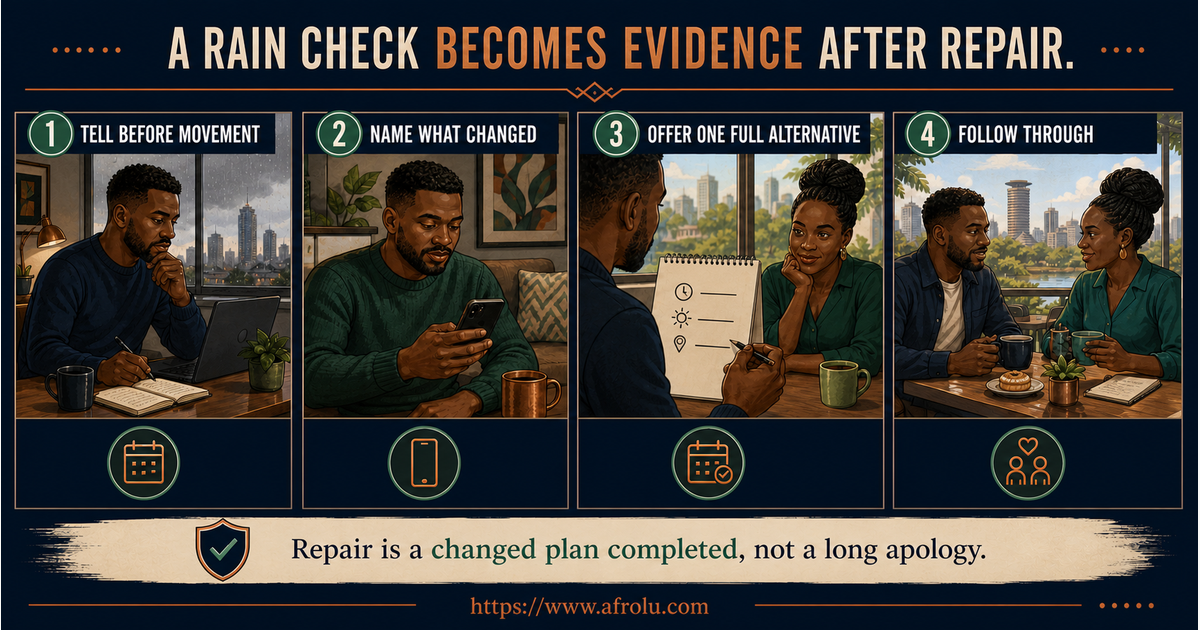
On Thursday morning, Brian learns that an essential Friday task will run late. Their dinner is Friday evening. He messages before Wanjiku begins her commute: ‘I cannot complete our plan responsibly tomorrow. I am sorry for the disruption. I can offer Saturday at two at the museum café, or we can choose next weekend.’ He does not send confidential details or ask her to hold every remaining hour.
Wanjiku is disappointed. She says Saturday works but asks for earlier notice whenever possible because crossing the city costs time. Brian acknowledges that impact. They meet Saturday, and he arrives when agreed. Repair is not the replacement date alone; it is early communication, a real alternative, recognition of the other adult's cost and changed conduct afterward.
Two weeks later, Wanjiku enters her own intense work period and asks to reduce calls for ten days. Brian accepts the boundary and chooses a Sunday date from her complete offers. At their monthly review they keep the slow rhythm. If only Brian's work had counted, or if every cancellation had become Wanjiku's planning problem, the same number of dates would describe a very different relationship.
Sort the pattern by conduct
Separate deliberate slowness, temporary overload, repeated vagueness and incompatibility
Slow and clear has a named rhythm. Plans may be modest, but each adult knows how the next one is made. Communication gaps fit the agreement, and either person can ask for review. The relationship has enough evidence to evaluate without consuming every free hour. It protects concentration and rest while still asking both adults to move toward each other.
Temporary overload has context and an edge. Someone may say an audit, exam, family duty or shift cycle lasts until a particular date, reduce the offer and return to the subject afterward. The detail need not be intimate or professionally sensitive. What matters is that ‘temporary’ does not renew forever without discussion and that the less-busy adult is not expected to remain permanently available.
Repeated vagueness contains affection but no usable offer. Messages arrive when convenient, plans appear late, clarity conversations dissolve into charm and every cancellation promises ‘soon.’ Do not solve it by tracking online status or demanding calendar proof. State the minimum relationship you can participate in. If no complete offer appears, believe the capacity shown and choose accordingly.
Unavailability can be honest. A person may like you and still be unable or unwilling to sustain the pace or direction you need. Ending for compatibility is not punishment. Safety concerns belong to observable behaviour such as coercion, monitoring, workplace contact after a no, impersonation, threats, financial grooming or retaliation. Keep disappointment and danger in different columns so each receives the right response.

Read the pattern across several plans, not one crowded day.
Window-sized language
Use complete offers instead of vague warmth or calendar surveillance
To offer time, say: ‘I can meet Saturday at two at the museum café for ninety minutes.’ This makes interest actionable without implying access to the whole weekend. If the other adult cannot accept, they can propose a complete alternative. Two incompatible windows are a planning problem; months without any window is relationship information.
To protect work, say: ‘I cannot message reliably during client hours. Use my personal number, and I will reply after seven when I can.’ Do not promise a response you cannot give. A date does not need work email, internal chat, client information or live-location access. If a personal phone carries work resources, keep passcodes and managed content private and follow the responsible organisation's security rules.
To repair a cancellation, say: ‘I need to cancel before you travel. I know this changes your evening. I can offer Sunday at three, or next Saturday morning.’ Avoid an elaborate excuse that exposes colleagues or asks the other person to comfort you. Then complete the alternative. The apology is useful only when it reduces repeated cost.
To review, say: ‘I like you, and one last-minute meeting every few weeks is not enough for me. Can we make a steadier plan, or is that outside your capacity?’ This does not demand a busier relationship. It makes fit answerable. Accept a no, including a gentle one. Clarity can preserve the connection, resize it or bring it to a respectful close.

Name the available choice and the protected time together.
Keep the office outside the courtship
Professional boundaries protect colleagues, clients and each dater's freedom
Meeting through work requires a power check before pace. Does either adult control hiring, evaluation, pay, assignments, contracts, training or access? Could informal influence affect the other person's livelihood? Check current organisational rules and use an appropriate independent route. A private statement that both people consent may not resolve a conflict or protect the person with less power.
Keep personal interest off employer directories, devices and accounts. Do not use a staff list to find a private number, place a date invitation in a client thread or arrive at an office after personal contact is declined. Kenya's Employment Act addresses sexual harassment in employment, including unwelcome conduct and employment-related promises or threats. A specific incident needs current legal and organisational guidance, not a dating-page label.
Money and status also stay separate. Choose date costs both can discuss without shame. Do not trade introductions, referrals, procurement access or investment opportunities for attention. A polished profession cannot prove honesty, and a less prestigious role cannot prove risk. Verify consequential claims independently and keep romance out of rushed transfers or secret opportunities.
If workplace contact continues after a clear no, preserve relevant messages, dates and witness information. Tell an appropriate manager, human-resources contact, security team, professional body, legal adviser, platform or emergency service according to the conduct and local options. Do not arrange a private meeting merely to protect professional reputation. Safety and employment rights can require support outside the relationship.
The Friday capacity receipt
Read four lines, then keep pace, resize or close
The offer line asks whether at least one usable next step existed. A completed call or short date can count if it fits the agreed rhythm. Do not inflate quantity into quality. The point is whether affection becomes a choice both adults can actually enter, not whether a professional maximises every spare minute.
The effort line checks direction and balance. Who initiated, crossed the city, adjusted cost or remembered the review? Equality is not identical tasks every week. It is the sense that both adults are carrying the relationship in ways their current capacity permits and that one person's work is not treated as permanently more important.
The repair and privacy lines ask what happened after friction. Did notice arrive before avoidable cost? Did an alternative become real? Did a no stop the request? Did work channels, calendars, clients, location and devices remain appropriately closed? A single mistake followed by repair differs from repeated intrusion followed by polished apology.
Keep the pace when the relationship remains visible, reciprocal and calm enough for both. Resize when a temporary capacity change needs a smaller offer or when access has expanded too quickly. Close when no sustainable offer exists or when monitoring, coercion, financial pressure, workplace intrusion, threats or retaliation appears. Slow dating is not a waiting room; it is an active agreement that either adult may leave.

Continue, resize or close from the week's pattern.
Eight Nairobi workweek moments where pace needs a clear answer
A short complete offer can still be sincere
Amina has one free Sunday hour and worries that the plan looks insufficiently romantic.
Offer the exact hour and place, then let the other adult accept, counter or decline without overpromising.Communicate before the cost grows
A cross-city delay will change arrival time after both adults have left.
Share the useful update, agree whether the plan still works and avoid turning location sharing into a standing requirement.Planning becomes monitoring
A match says screenshots are the only way to prove that work is genuinely busy.
Decline calendar access, offer one complete window and treat repeated demands as a boundary pattern.A plus-one request affects professional context
After three dates, someone expects entry to a private client reception.
Keep the event closed unless a legitimate, policy-compatible purpose and invitation exist independently of romantic proof.An apology needs an alternative
A deadline cancels dinner and the person sends a long explanation but no new plan.
Ask once whether a complete alternative exists; if none appears, update your view of current capacity.Informal influence still matters
Two people work in connected organisations and one can affect the other's contract opportunities.
Pause, name the power and seek current policy or qualified advice independently.Spontaneity becomes one-sided access
Calls arrive only after late meetings and require the other adult to drop their evening.
Set a notice boundary and participate only in plans that respect both calendars.Kind people can have incompatible capacity
Both adults communicate well, but one needs weekly time and the other can offer monthly dates only.
Name the mismatch and resize or close without manufacturing fault.Evidence that professional slow dating remains mutual and visible
Both adults can state the present relationship direction and pace without relying on a professional label.
A date offer includes a real time, place, duration and cost expectation.
Protected work, rest and personal time is accepted without demands for proof or surveillance.
Personal conversation stays off employer systems unless a legitimate work purpose exists.
Changes are communicated as soon as reasonably possible and before avoidable travel or expense.
A cancellation includes acknowledgment of impact and a realistic alternative when interest remains.
Planning and travel burdens move in both directions across several dates.
Busy periods have enough context and an end point to distinguish them from permanent vagueness.
Either adult can say the pace is insufficient without being shamed or diagnosed.
Status, income and professional polish are not treated as character or safety proof.
Workplace power and conflicts are named early enough for independent review.
A boundary produces changed conduct rather than access bargaining, monitoring or retaliation.
Sort the capacity before interpreting the delay
| Situation | What it may mean | What to do next |
|---|---|---|
| A date offers one short weekend window | Limited but usable capacity | Judge whether it fits the agreed rhythm, not whether it looks grand. |
| Replies pause during a workday | Protected concentration rather than rejection | Use the agreed contact rhythm; do not infer from online status. |
| A deadline has a known end | Temporary overload | Resize briefly and review when the stated period ends. |
| Every plan remains ‘soon’ | Affection without a usable offer | State your minimum and stop carrying the scheduling alone. |
| A live calendar is requested | Planning is crossing toward monitoring | Share the available window only and keep calendar access closed. |
| A cancellation arrives before travel | A constraint handled with some care | Look for acknowledgment, a complete alternative and follow-through. |
| A date wants a client invitation | Romance is seeking professional access | Keep the event and third-party trust separate. |
| One role affects the other's work | A material power or conflict issue | Pause and check policy and independent guidance. |
| Both initiate in different ways | Reciprocal effort within different capacities | Assess the pattern rather than demanding identical tasks. |
| The pace feels too small | A compatibility need, not proof of neediness | Ask for a specific change and accept the answer. |
| A work channel is used after a no | A channel boundary was ignored | Preserve the record, restrict access and use appropriate workplace support. |
| A review keeps being postponed | Vagueness is protecting the arrangement | Choose from the current offer rather than the promised future. |
Scripts for offers, calendars, cancellations, pace and workplace boundaries
“I can meet Saturday at two at the museum café for ninety minutes.”
“I cannot message during client hours; use my personal number and I will reply after seven.”
“I will share the time I can offer, not my live work calendar or location.”
“I need to cancel before you travel. I know this changes your evening.”
“I can offer Sunday at three or next Saturday morning; do either work for you?”
“I want to date slowly with one planned weekend date and a review each month.”
“I like you, and last-minute contact alone is not enough for me. What can you actually offer?”
“That gathering is for work and is not part of our dating plan.”
“Your role may affect my work, so I need independent guidance before this goes further.”
“For the next ten days I can offer one Sunday call; let us review after that.”
“I respect your capacity, but this pace does not fit the relationship I want.”
“I asked you not to use my workplace contact. I am ending personal contact and protecting that channel.”
Know the difference
Slow dating, temporary busyness and repeated vagueness have different evidence
A deliberate, mutual rhythm with complete offers, protected time, early notice, repair and a review point.
Warm contact without a sustainable offer, with planning transferred to one person and clarity repeatedly postponed.
Do not diagnose from response time; decide from the recurring offer and how boundaries are handled.

Name the pattern from conduct, not from a flattering label.
Compare slow, busy, vague and unavailable patterns
| Type or dimension | What it describes | Best next question |
|---|---|---|
| Slow dating | A mutually chosen deliberate pace | What rhythm and review point did we agree? |
| Busy period | A temporary capacity constraint | What smaller offer exists and when does it change? |
| Vague dating | Contact without a complete recurring offer | Can either person name the next usable step? |
| Unavailable | Current capacity cannot sustain the desired relationship | Can we accept the mismatch without blame? |
| Casual dating | A lighter relationship scope | What is available and are we exclusive? |
| Serious dating | A direction toward lasting partnership | How does the direction appear in current effort? |
| Exclusive dating | A present mutual structure | What changed by explicit agreement? |
| Work friendship | A professional or collegial relationship | Has mutual personal interest been freely expressed? |
| Calendar access | A separate privacy permission | Is anything beyond an offered window necessary? |
| Workplace power | Influence over livelihood or opportunity | Which policy and independent support apply? |
Build the four-window clarity calendar in six moves
Name the rhythm
Write a realistic frequency for dates and calls plus the next review point.
Offer one complete window
Give time, place, duration and cost context instead of exposing the whole calendar.
Protect work channels
Keep employer systems, client information and managed device access outside dating.
Repair before cost grows
Communicate change early, acknowledge impact and offer a realistic alternative.
Read several plans
Distinguish one difficult week from a recurring pattern of vagueness or one-sided effort.
Use Friday's receipt
Check offer, effort, repair and privacy, then keep pace, resize or close.
Questions organised by pace, offer, repair and review
Choose a few prompts that fit the moment. This is a reference library, not a list to complete.
Pace window
Define a rhythm that exists outside wishful thinking.
- How often can we really meet?
- What contact rhythm suits work and rest?
- What direction are we exploring?
- Are we exclusive?
- When will we review?
Offer window
Make interest usable without opening the whole calendar.
- Which complete time can I offer?
- Where will we meet?
- How long is the plan?
- What cost is expected?
- How will each person return?
Repair window
Reduce the impact of an unavoidable change.
- When can I give notice?
- What effect should I acknowledge?
- Which alternative is real?
- Did I follow through?
- Is the pattern repeating?
Friday receipt
Choose from the week's observable pattern.
- Was there a complete offer?
- Did effort move both ways?
- Did repair change conduct?
- Did work remain private?
- Do we keep pace, resize or close?
What workplace, relationship and public guidance can support
Long hours are a health issue, not a romantic virtue
WHO and ILO research links very long working hours with serious health burden. Afrolu uses that context to reject glorifying exhaustion and to protect rest in a dating plan.
Evidence limit: Population-level occupational evidence cannot assess an individual's hours, health or relationship capacity; use qualified care for personal concerns.
Feeling understood is different from receiving instant replies
Relationship research describes perceived responsiveness through feeling understood, valued and cared for. Afrolu translates that into attention to the quality of responses and repair rather than a universal messaging frequency.
Evidence limit: The studies do not prescribe a reply deadline or prove that one communication pattern will suit every couple or culture.
Workplace sexual harassment can involve employment promises or threats
Kenya's Employment Act addresses unwelcome sexual conduct and employment-related promises or threats, and requires covered employers to maintain policy. Workplace power should not be treated as an ordinary private dating detail.
Evidence limit: The statute and workplace procedures require case-specific interpretation; obtain current qualified advice for an actual situation.
Personal devices carrying work access create privacy risks
NIST's BYOD guidance describes security and privacy challenges when personal devices access organisational resources. Keep passcodes and managed work data private and follow the responsible organisation's rules.
Evidence limit: NIST provides U.S. organisational technical guidance, not a personal legal rule or endorsement of one device configuration.
A polished professional profile does not replace an independent meeting plan
Police Scotland advises online daters to protect personal information and take care with public in-person meetings. Use public plans and independent transport while evaluating conduct.
Evidence limit: This is UK police guidance, not a safety guarantee or a substitute for local support and current conditions.
Status, payment and past closeness do not create present consent
NHS guidance explains active and withdrawable consent. Work hierarchy, an expensive plan, exclusivity or a previous yes cannot answer a current intimate choice.
Evidence limit: The source describes UK public-health and legal context; laws and support routes vary by place and circumstance.
Six shortcuts that turn slow dating into waiting
Calling every delay slow dating
A deliberate pace still needs recurring complete offers and review.
Demanding calendar proof
Planning requires an available window, not surveillance of work and movement.
Overexplaining a cancellation
Confidential detail and a long apology do not replace a usable alternative.
Ranking whose career matters
Different roles and incomes do not make one adult's time permanently disposable.
Using work access as intimacy
Events, clients, devices and referrals affect third parties and stay separately permissioned.
Waiting without a review point
An undefined future can keep one person available to an arrangement that never changes.
Use a reviewed resource that matches the decision
This guide focuses on the relationship decision, so it does not rank dating apps. Check current prices, safety tools, and local availability before choosing a service.
Explore the guide library
Show more related guides
Continue with Afrolu
Show more Afrolu guides
Primary, research and public guidance reviewed for this workweek calendar
Afrolu reviewed these health, research, safety, or public guidance resources while editing this page. They support the behaviour and safety guidance; they do not diagnose any individual described by a reader.
Nairobi professional slow-dating and clarity questions
What does slow dating mean for busy professionals?
It means a deliberate pace that both adults can name and choose. Define a realistic rhythm for dates and communication, make complete offers and set a review point. Slow does not mean indefinite waiting, last-minute access or avoiding relationship questions. A smaller recurring plan can be sincere when effort and repair move both ways.
How often should Nairobi professionals date?
There is no universal number. Account for work, commute, rest, care duties, cost and the relationship direction. Choose the smallest rhythm that still lets both adults gather real evidence and feel included. If one person needs weekly time and the other can offer monthly dates only, that may be incompatibility rather than failure.
Does taking hours to reply mean someone is not interested?
Not by itself. Work, sleep and private life can delay messages. Use the contact rhythm you discussed and judge the pattern of complete offers, attention, notice and follow-through. Online status and response speed cannot diagnose interest or emotional availability. Ask directly when the answer changes a decision.
Should I share my work calendar to prove I am busy?
No. A date needs the available window, not a live map of work, movement or third-party obligations. Offer specific times and keep employer systems, client information and managed device access private. Repeated demands for calendar proof move planning toward monitoring.
What makes a cancellation respectful?
Communicate as soon as reasonably possible, ideally before the other adult travels or pays a cost. Name the change at an appropriate depth, acknowledge the effect and offer a complete realistic alternative if interest remains. Emergencies may prevent perfect notice, so judge the broader pattern and later repair.
How can I tell slow dating from breadcrumbing?
Slow dating has a mutually understood rhythm, recurring complete plans and a review point. Breadcrumbing or chronic vagueness may offer warm contact without a usable relationship. State what you need, ask whether a concrete next step exists and choose from the current offer rather than the flattering future.
Is meeting through work safe?
The route alone cannot answer. Identify reporting lines, informal influence, conflicts, organisational rules and each person's freedom to decline. Move personal interest off work systems where appropriate. If one role affects hiring, evaluation, assignments, contracts or income, pause and obtain independent guidance.
Can slow dating still be serious?
Yes. Serious is a direction toward lasting partnership; slow is the pace used to explore it. State the serious direction and current structure separately. A gradual pace can support careful observation, but it does not automatically create exclusivity or excuse indefinite uncertainty.
What if the other person says my pace is too slow?
Treat that as compatibility information, not an accusation. Ask what specific rhythm they need and decide whether you can freely offer it. Neither adult must abandon work, rest or independent life to preserve the match. A respectful close can be more honest than promising capacity that does not exist.
What if a former date contacts my workplace?
If contact continues after a clear no, save relevant messages and dates, restrict exposed channels and tell appropriate workplace management, human resources or security. Use platform, legal, advocacy or emergency support according to the conduct and local risk. You do not owe a private meeting to stop workplace intrusion.
One thing to do now
Make a smaller promise and complete it well
Name the relationship direction and a realistic pace. Protect unavailable time, make each offer complete and repair changes before avoidable cost grows. On Friday, check offer, effort, repair and privacy across the week's pattern; keep pace, resize or close without demanding calendar proof or turning work access into affection.