Close work, meet the person, decide at home
Move From a Workday to a Clear First Date
A first-date plan for busy professionals: ease ordinary nerves, protect work privacy, notice career fit, keep consent clear, and leave freely.
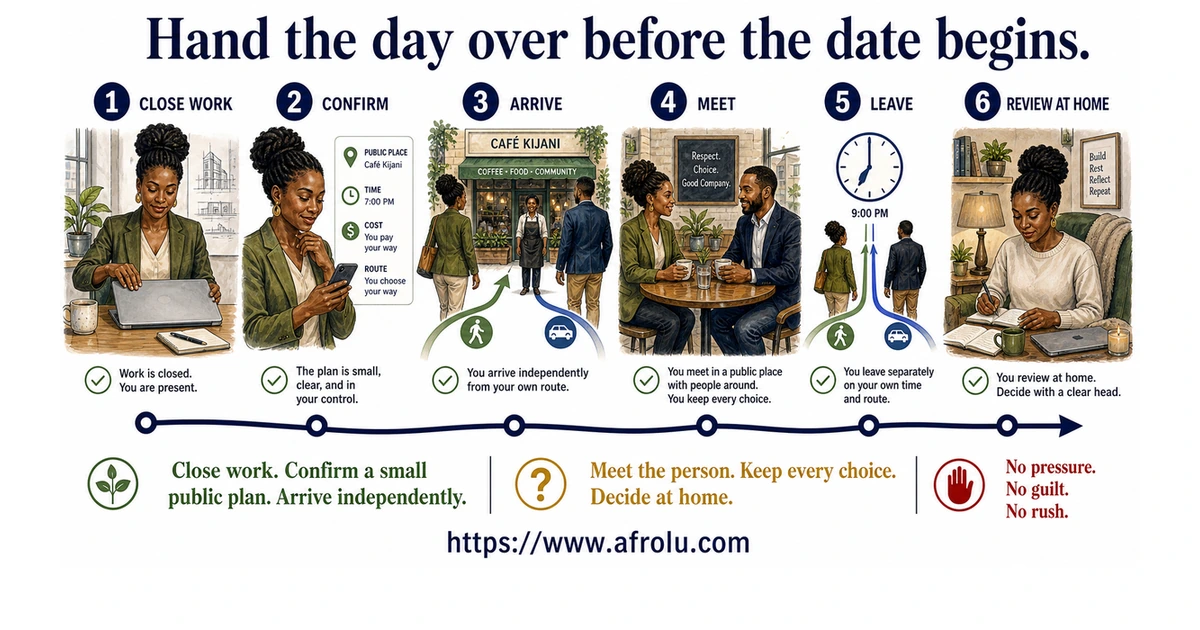
https://www.afrolu.com | Close work, confirm a small public plan, arrive independently, stay curious, protect every choice, and decide only after getting home.
Written and edited by Adwoa Boateng · Dating Safety Editor
Make the date smaller than the story in your head. Before leaving work, close private files, move the plan to a personal device, and tell the other adult only what they need to meet you. Confirm a staffed public place, a short time window, an affordable plan, and a route home you control. At the table, share your broad field and the life you want outside work. Do not use salary, employer access, client details, status, or polished performance as proof of trust or fit. Ordinary nerves may settle after arrival. A career mismatch can be discussed or accepted. Repeated pressure after a clear limit is different. Blocked movement, threats, tracking, money demands, or ignored consent are reasons to leave or seek suitable help. Keep the planned ending even after a warm meeting. Decide about another date after you are home, rested, and able to separate facts from adrenaline.
First dates · Professionals
How can a busy professional calm the pressure around a first date without ignoring a real mismatch, a privacy problem, or unsafe behaviour?
First-date anxiety is the everyday worry, tension, fear of being judged, or body reaction that can appear before meeting a new person. This guide does not diagnose an anxiety disorder. A career mismatch is an honest difference about working hours, ambition, relocation, or money. It can also concern public life, care duties, or how much life is built around work. Pressure is behaviour that keeps pushing after a limit, tries to make an adult prove private claims, or turns time and money into a debt. Danger includes threats, blocked movement, stalking, violence, or someone entering an account without permission. It also includes sexual activity without free consent. These experiences can occur together, but they are not the same. A nervous person may still notice a real red flag. Two calm people may still want lives that do not fit.
Zuri and Tunde are made-up adults used to show common first-date choices. They are not real people. Zuri is 34 and works as an architect. On the afternoon of her first date with Tunde, 37, a logistics manager, a client presentation runs twenty minutes late. Her first impulse is to send a screenshot of the project channel so Tunde will know she is not careless. She stops. The screenshot contains names and a private site detail. From her personal phone she sends a simpler message. She can reach the museum cafe at 6:20 rather than 6:00. She also says she understands if that no longer works. Tunde accepts the change. Zuri closes the work laptop, leaves it in her locked bag, buys her own ride, and tells a trusted friend the revised finish time. At the cafe, her hands still feel unsteady. She says she is glad to be there and may take a minute to arrive after a full workday. Tunde does not tease her or ask her to relax. He asks what she likes about designing spaces. When he asks which client caused the delay, Zuri says she cannot share client details but can explain the kind of problem. He accepts that answer. Later they discuss the lives they hope work will support. Tunde wants to move between countries for major projects over the next five years. Zuri wants to stay near an ageing parent and build a local practice. The difference matters, but neither person is wrong. At the planned end, Tunde suggests one more drink. Zuri says no and keeps her ride. He accepts that too. At home, she writes four facts. The time change was handled fairly. Her privacy answer was respected. The conversation felt mutual. Their location plans may not fit. Her nerves did not predict disaster, and the warm parts did not erase the mismatch. She chooses one more short date with a clear question about location before deciding.
The workday-to-date handoff
Change roles in six stations instead of carrying the office to the table
A professional first date often begins before the two adults meet. It begins when work is closed, private information is put away, and a small personal plan takes over. Think of the evening as six stations. Each station answers one question and leaves the next choice open.
The handoff is not a test to pass or a promise of safety. It is a way to lower avoidable pressure and make behaviour easier to notice. If a station changes, pause and make a fresh choice. A private venue, new cost, public introduction, physical step, or later ending should not happen only because the moment is moving fast.
What belongs to work stays at work
Finish or park the task, close files, silence work channels where possible, and move the date plan to a personal device. Share your free window, not the private records behind it.
The plan fits real time and money
Confirm the staffed public place, start, likely finish, full personal cost, and route home. Release an unconfirmed plan instead of letting it own the whole evening.
The body may need time to catch up
A fast heartbeat or awkward first minute can be ordinary. Name that you need a moment, order something simple, and notice whether the other adult lets you arrive without ridicule.
Curiosity replaces career performance
Talk about the life work supports, not only titles and achievements. Keep client, staff, security, salary, account, and device details outside the date unless a later choice truly needs them.
The original ending remains available
A warm hour does not cancel the finish, transport plan, or any boundary. End clearly, move to the route you control, and complete any chosen check-in without negotiating another step.
Facts settle before the next invitation
At home, record what happened, whether freedom stayed intact, and which fit question remains. Choose another date, one question, a pause, or an ending without grading either adult.
Station one · Before leaving work
Close the work role without showing private proof to your date
The final part of a workday can leave the mind moving at office speed. A deadline, difficult call, commute, uniform, public role, or responsibility for other people may still feel present after the screen closes. Do not demand an instant emotional transformation from yourself. Build a short bridge. Finish one necessary action, write the next work task where it belongs, close the file, take water, and allow a few quiet minutes before travelling. The goal is not perfect calm. It is enough separation to notice the date rather than replay the day.
Move personal planning away from employer systems. Keep a first date off a shared work calendar. Do not send the venue from a company account or invite a new person into an internal messaging space. A work phone may contain email previews, contact names, client records, location information, or a way into work systems. Keep it under your control and follow current workplace policy. If a personal device is available, use that for the date and the return journey.
Share the smallest fact that solves the planning problem. You may say that a meeting ran late and offer a new arrival time. You do not need to send a calendar screenshot, staff rota, patient name, client message, or site photograph. Do not send a legal document, boarding detail, or internal chat to prove the delay. These records may belong partly to other people. A respectful date can decide whether the new time works without inspecting protected information.
Set a personal stop for unfinished work. Sometimes the responsible choice is to cancel because a real duty cannot be left. Send clear notice as early as you can, own the effect, and offer a specific new plan only when you can keep it. Do not invent an emergency to avoid embarrassment. One change does not show poor character. A repeated pattern of late cancellations with no fair new plan may show that the available schedule cannot support dating now.
Protect appearance from becoming another project. Choose clothing that fits the venue, movement, weather, and your own comfort. A professional wardrobe is fine, but it does not need to signal income, rank, or success. Eat if you need to eat. Carry medicine or accessibility items you normally use. Charge the phone and keep return money separate. These ordinary steps support presence better than trying to look completely untroubled.
If the same pre-date worry repeatedly disrupts work, sleep, travel, relationships, or ordinary daily life, consider speaking with a qualified health professional. The National Institute of Mental Health distinguishes occasional anxiety from anxiety disorders that persist and interfere with life. A dating article cannot diagnose the cause or choose treatment. Support can exist alongside dating or a pause from it.
Station two · Confirm the personal plan
Choose a first meeting that remains workable after an imperfect day
Use a staffed public setting where conversation is possible and movement remains ordinary. A cafe, museum cafe, daytime food hall, or another suitable public venue may work. Check opening time, access, noise, lighting, likely crowd, transport, and whether either adult has accessibility needs. Public does not mean risk-free. It gives more options and makes a change easier than a first meeting in a home, hotel room, isolated area, or workplace after hours.
Give the date a beginning and a likely end. Sixty to ninety minutes may be enough for many first meetings. The exact duration matters less than having a shared expectation. A time box reduces the fear that one awkward minute must be repaired across an entire evening. It also protects sleep, care, medication, transport, and the next workday. Either adult may still leave earlier.
Count the full cost before agreeing. Include fare, fuel, parking, food, tickets, care, data, and the route home. Choose a plan either person can decline without debt or shame. A high income does not make unnecessary expense harmless, and a modest date is not evidence of weak interest. Never place rent, food, medicine, debt payments, or safe return money at risk to create an impressive first impression.
Control your own arrival and return where reasonably possible. This can mean public transport with a known last service, a ride booked through your account, personal transport, or a trusted pickup. If you freely accept a lift, ask what address or routine it reveals and whether another option remains. Paying for a meal or ride does not give either adult a right to more time or another venue. It also creates no right to private space, touch, sex, or a second date.
Tell a trusted person enough to support the plan if that suits your circumstances. The useful information may be the name used, public venue, likely finish, and expected check-in. Choose what to share rather than turning support into surveillance. A live location belongs with a trusted support person only when you want that; it does not belong automatically with the date.
Confirm the plan on the day using a personal channel. If the place, time, price, or transport changes, treat that as new information. You may accept, suggest another public option, or leave the original plan. A last-minute move to a private venue is not a small planning change. It changes the safety and consent setting and requires a fresh choice.
Station three · The first ten minutes
Arrive as a person, not as a polished career summary
The first few minutes contain many small demands. You must recognise the person, read the room, choose a seat, and order. You also hear a new voice and decide how close to stand. A racing heart, dry mouth, shaky hands, fast speech, blank thought, or urge to leave may be an ordinary body response. It can also be a response to something happening around you. Pause long enough to identify facts. Is the person matching the agreed identity? Is the venue still public? Can you reach the exit? Has any clear limit already been challenged?
Use one simple arrival sentence if it helps: you are glad to meet and may need a minute to settle after work. That is information, not an apology or request for the other adult to fix your body. Notice the response. A kind person may give space, ask an ordinary question, or continue without making the nervousness a spectacle. Mockery, diagnosis, demands for disclosure, forced touch, or pressure to drink are not calming skills.
Verify the ordinary match between the person and the agreed plan. A profile photograph or platform badge can add some information but cannot prove every identity, work, relationship-status, money, or safety claim. If the person looks substantially different or key details have changed, you may ask a direct question or leave. Do not hand over an identity document or ask to inspect protected workplace records as the price of continuing.
A first date is not a job interview. In an interview, one organisation reviews skills and work history for a role. On a date, two adults explore personal fit and either may decline. A networking meeting builds professional connection; romance is not assumed. These settings can share manners and questions, but their purposes differ. Do not measure romantic potential through a resume, employer rank, title, salary, speaking polish, or access to influential people.
Titles can distort attention. A respected profession may create trust that actions have not earned. A less prestigious title may hide strengths that matter deeply in a relationship. Ask how the person treats people, makes room for rest, handles disagreement, plans money, supports care, and behaves when no is the answer. Those questions reveal adult life more directly than a list of achievements.
Keep the opening light without making it empty. Comment on the shared setting, ask what gave the week meaning outside work, or discuss an interest already mentioned. You do not need instant chemistry. You need enough calm and mutual space to see whether conversation can become more real. Silence, an imperfect joke, or one missed question does not decide the future.
Station four · The middle of the date
Talk about the life around work without opening the workplace
A broad description is enough at first. An adult can name a field, general role, normal work pattern, and what they enjoy or find difficult. They do not need to name an employer, office entrance, client, patient, staff member, confidential project, security routine, exact income, internal trip, or work contact. If a public role makes identity easy to find, discuss what should stay off photographs and social posts.
Ask how work fits life instead of asking work to stand in for life. Ask what a satisfying ordinary week looks like. Ask how the person protects rest and what duties matter outside employment. Also ask whether future plans depend on relocation. These questions can reveal compatibility without turning the table into a selection panel.
Talk about ambition in concrete, non-ranking terms. One adult may seek promotion, business growth, geographic mobility, or a demanding creative project. Another may protect stable hours, family proximity, health, community, or time outside work. Neither pattern is automatically more mature. The fit question is whether the desired lives can respect both adults' important duties and hopes.
Money can be discussed without asking for proof. Early questions may cover general attitudes toward spending, saving, debt, generosity, and date cost. Exact salaries, bank screens, mobile-wallet access, property papers, investment accounts, and one-time security codes do not belong in a first-date trust test. Do not send, receive, route, invest, guarantee, or unlock money for a new connection.
Be careful with familiar professional stories. Romance scams may use believable claims about travel, overseas work, equipment, contracts, medical emergencies, fees, visas, or investments before asking for money. A real job can also involve travel and difficulty. One fact does not prove fraud. The safe response is to keep money and accounts separate, verify important claims through sources you control, and stop when urgent payment pressure appears.
Let personal questions grow in layers. A first date may include the kind of relationship each adult wants, broad family importance, and faith or values. It may also include preferred pace and the kind of future each adult imagines. It does not require a complete account of trauma, health, former partners, family conflict, home address, or sexual history. Share only what the choice in front of you needs. A respectful date does not treat hesitation as evidence of dishonesty.
Use the response to a difference as evidence. Zuri and Tunde's location plans did not match neatly. They did not need to decide the entire future at the table. They needed to name the difference and decide whether one more conversation could clarify it. A person who can hear an inconvenient answer without selling, punishing, or dismissing it is showing something useful about conflict.

https://www.afrolu.com | Name what is happening, state the limit or question, and leave the other adult free to answer honestly.
Station four · Read behaviour beside the feeling
Separate ordinary nerves, honest mismatch, pressure, and danger
Ordinary nerves often change as the situation becomes familiar. Breathing may slow after ordering, conversation may become easier, or the body may remain activated while the other adult behaves respectfully. You can lower the task: take a pause, drink water, move to a quieter public seat, or return to one simple question. You may also end at the original time. The aim is not to force yourself through distress. It is to avoid treating a body response alone as proof of danger or perfect chemistry.
A mismatch is information about fit. Different views on relocation, working hours, public visibility, religion, children, money, relationship direction, or care duties may make a partnership impractical. A mismatch can hurt while remaining respectful. Both adults can explain their positions, ask questions, and decline the relationship without insulting the other's life.
Pressure appears when a limit becomes an argument to win. A person may keep asking for a work calendar after a no. They may demand a private venue because the public plan feels formal, or treat payment as a debt. Pressure also includes asking for live location, insisting on alcohol, pushing for touch, or trying to extend the date after a clear finish. Stop the requested step. Restate the limit once if useful. Leave when discussion keeps reducing your choice.
Danger may include blocked movement, threats, following, violence, or forced sexual contact. It can also include attempts to seize a device, enter an account, track a location, or appear at a workplace after contact has ended. Move toward people, staff, transport, or another available source of help. Contact suitable local emergency or specialist support when needed. The right action depends on the setting and risk; this guide cannot provide an emergency plan for every place.
Observe what happens after a small no. A person may feel disappointed and still accept the answer. That preserves choice. Sulking, ridicule, career insults, repeated bargaining, threats to expose information, public embarrassment, or surprise workplace contact are not ordinary signs of romantic interest. The boundary response often teaches more than the original request.
Do not make anxiety responsible for another person's actions. A person with a history of anxiety can still be deceived, pressured, or harmed. A confident professional can also miss warning signs. Consider your feelings and the actions you can see. Ask a trusted person to help review facts when confusion remains, but keep the final relationship decision with the adult involved.

https://www.afrolu.com | Settle ordinary nerves, discuss a mismatch, stop at pressure, and leave or seek help when freedom or immediate safety is threatened.
Station five · Before any larger step
Keep photographs, transport, touch, sex, and the second venue separate
Consent is specific to the choice being made. Agreeing to meet is not agreement to drink alcohol, enter a vehicle, move to a home, pose for a photograph, or be tagged online. It is also not agreement to touch, kiss, have sexual contact, stay overnight, or meet again. A previous yes can change. A career title, serious intention, meal, gift, ride, ticket, or rare free evening does not supply consent for another act.
Sexual consent must be freely given for the choice happening now. Alcohol, drugs, fear, sleep, illness, pressure, and other conditions may limit a person's ability to choose. If a willing answer is uncertain, stop. Stop sexual activity when willingness is absent, unclear, or withdrawn. Laws differ by location, and a qualified local source is needed for advice about a specific incident.
Discuss sexual health before sexual contact. Depending on the adults and the choice, this may include current partners or agreements, barrier use, testing, vaccination, contraception, and other prevention needs. No profession, income, appearance, education, serious intention, or exclusive claim can reveal STI status. A healthcare professional can answer personal testing, prevention, vaccination, or treatment questions.
Photographs need a separate conversation, especially when work is public or easy to identify. Ask before taking, sharing, tagging, or sending an image. A casual photograph can reveal the venue, time, colleagues, conference badge, vehicle, building, home area, or relationship status. Declining a photograph is not proof of secrecy or bad intent.
Keep the return route available after a warm date. You may accept an extension or lift freely, but excitement should not make the original exit disappear. Check transport, phone charge, money, address exposure, and whether leaving remains easy. If the other adult resists your route or follows after a clear goodbye, move toward support rather than continuing a relationship discussion.
End in plain words. Thank the person if that is genuine, state that you are leaving, stand, collect your things, and use the route you chose. You do not need to decide about date two at the door. If you know the match is wrong and it is safe to say so, be clear. If direct explanation feels unsafe, prioritise distance and support. Being polite never requires you to keep giving someone access.
Station six · After the route home
Review facts, freedom, fit, and only then the next step
Complete any check-in you chose, settle immediate needs, and give the body time to move out of travel and social effort. You do not need to send a relationship verdict on the way home. A short message confirming arrival may be enough. If a serious concern needs action, contact the appropriate support rather than waiting for the debrief.
Write facts before interpretations. Did the person match the expected identity? Was the plan confirmed? Did the place, cost, finish, and transport remain usable? Were changes communicated? Did conversation have room for both adults? Were private details and every no respected? A factual record is more useful than a single score such as good, bad, successful, or embarrassing.
Review freedom. Could each adult ask, differ, pause, decline, and leave? Did generosity stay a gift rather than become a debt? Did the other adult accept a broad work answer, a photograph limit, the original end, or a physical boundary? Freedom does not require identical preferences. It means that differences can exist without pressure or force.
Review fit. Ask whether the important life patterns can work together. These include relationship direction, location, work rhythm, care, and public visibility. They also include money, faith or values, children where relevant, rest, communication, and pace. One difference may need a question rather than an ending. A central difference may be enough to end even after a kind date.
Choose another small date when the actions were respectful and important fit remains possible. Choose one clarifying question when a specific answer would change the decision. Pause when the next step requires more money, privacy, travel, public attention, or energy than current trust supports. End when the available relationship does not fit or when continued contact would reduce freedom.
Do not turn the date into a performance review of the other adult or yourself. A pause in conversation, ordinary nervousness, modest venue, imperfect clothing, or lack of instant spark does not make someone fail. Equally, charm, status, expensive spending, constant eye contact, or a perfect story does not make someone trustworthy. Read the whole interaction.
Zuri's useful conclusion was not that the date was a success. It was narrower: Tunde handled a change and two limits well, conversation felt mutual, and the location question remained important. One more short date could answer that question without promising a relationship. That is enough work for one evening. The handoff ends where it began: with one clear job for each step. Work stays protected. The public plan makes room for a real person. The route home keeps choice open. The home review asks only what this meeting showed. A useful first date does not decide a whole future. It makes the next honest decision possible.

https://www.afrolu.com | Write what happened, what remained free, what did not fit, and the smallest honest next step.
Ten first-date moments where nerves, work, fit, and safety need different answers
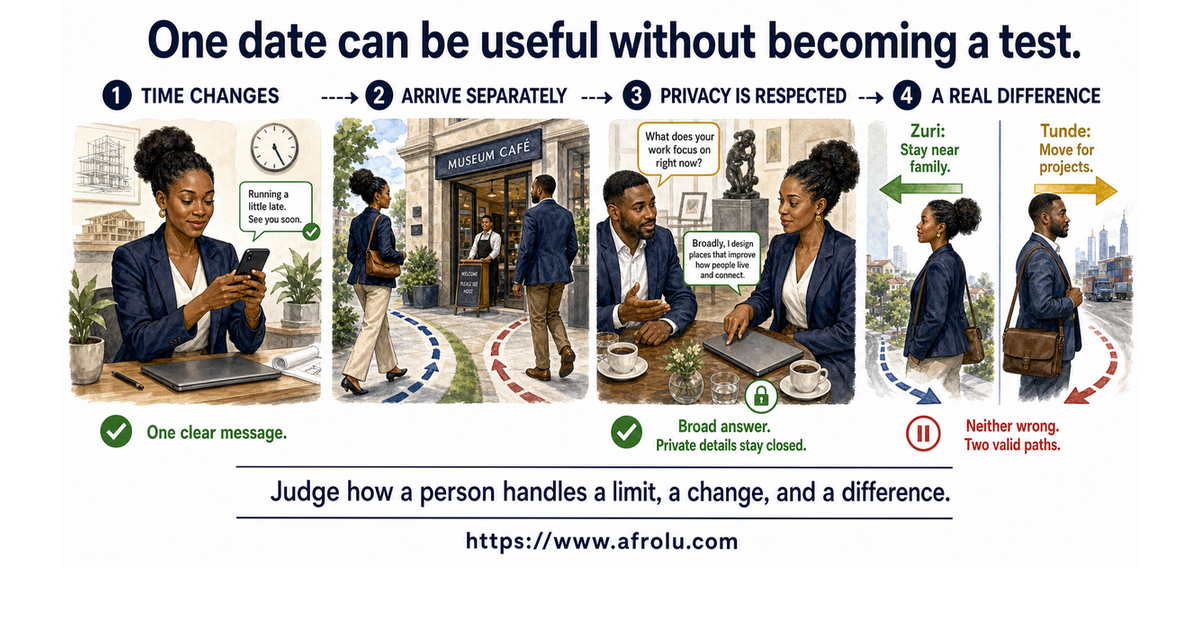
A time change does not require a private screenshot
Zuri, 34, finishes a client presentation late. Tunde, 37, needs to know whether the date still works, but he does not need the client name, project channel, or staff messages.
Send the revised arrival time from a personal device. Let the other adult accept, suggest a new day, or decline.Professional status arrives before earned trust
Maya, 31, feels she should ignore her discomfort because her date, Kofi, 43, is a respected executive. He keeps asking to see her confidential research after she says it cannot be shared.
Read the repeated privacy pressure, not the title. Stop the request, keep the files closed, and leave if the limit is not accepted.Nerves make conversation slow without making the date unsafe
Samuel, 29, loses his train of thought after meeting Lindiwe, 32. She gives him a moment and asks about a book he mentioned. The agreed public plan and boundaries remain unchanged.
Lower the task, continue only if you want to, and review the whole meeting rather than grading the awkward start.A warm conversation reveals a real career-location mismatch
Asha, 38, is building a practice near family. Daniel, 41, expects to move internationally every eighteen months. Both plans are real and important.
Ask whether either life has genuine flexibility. End kindly if the available futures do not fit; do not treat mismatch as failed chemistry.A date asks for a banking screen to confirm success
Nneka, 36, says she works in consulting. Joel, 39, asks to see her salary deposit because he does not want to date someone dishonest about status.
Decline the proof request. Discuss general financial values if useful, but keep banking, passwords, codes, and account screens private.A first date becomes visible at work without agreement
After dinner, Ada, 33, discovers that Mensah, 35, posted their photograph and tagged the venue beside her conference badge. They never discussed publicity.
Ask for removal or correction where possible. Agree on photographs, tags, names, and professional visibility before another public image.Generosity is turned into a claim on more time
Fatou, 45, keeps the planned ninety-minute finish. Peter, 47, says the expensive meal means she should join him at a private bar.
The payment creates no debt. Keep the ending and independent route. Seek staff or other support if pressure gets in the way of leaving.An impressive career story turns into an urgent payment
Before meeting, Idris, 40, tells Priya, 37, that a work permit problem has frozen his account. He asks her to pay a fee so their date can happen.
Do not send or route money. Stop, verify outside the conversation using sources you control, and use suitable platform or fraud-reporting channels.A public plan becomes a private apartment after arrival
Lebo, 30, reaches the agreed cafe. Nana, 34, says it is too noisy and orders a ride to his apartment without asking whether she agrees.
Decline the private move, keep the public setting or leave. A venue change requires a fresh choice and the booked ride creates no obligation.A clear ending is followed by unwanted workplace contact
Amara, 42, ends a first date and later asks Kato, 44, not to contact her. On Monday he appears at reception and demands a better explanation.
Treat the visit as a workplace safety issue, not a second relationship discussion. Keep useful records and seek support suited to the risk.Ten signs the date is leaving room for two adult lives
The plan names a public place, usable time window, likely finish, full cost, and route each adult controls.
A work delay is handled with timely notice and a practical option, not demands for confidential proof.
Both adults can share broad work information while client, staff, account, security, and device details stay private.
Conversation makes room for ordinary life, care, rest, values, and future direction instead of ranking titles and salaries.
A nervous pause receives patience rather than ridicule, diagnosis, forced touch, alcohol pressure, or an order to relax.
A career or location difference can be discussed without selling, shaming, or promising that one adult will change.
Photographs, online posts, colleague introductions, home access, transport, touch, and sex each receive a separate answer.
Payment remains generosity or an agreed split; it never becomes a claim on time, access, affection, or another venue.
The planned ending remains available after chemistry, and either adult can leave without a loyalty test.
A clear no leads to acceptance or an honest fit decision, not repeated contact, tracking, threats, or workplace intrusion.
Match the fact to the response before building a story around it
| Situation | What it may mean | What to do next |
|---|---|---|
| Your heart is racing, but the person matches the plan and accepts every limit. | This may be an ordinary first-date body response. The feeling is real, but the available behaviour is respectful. | Lower the task, take a moment, keep the date short, and leave whenever you want. Review after getting home. |
| Work makes you twenty minutes late and the date asks for a private calendar screenshot. | The changed time is a planning issue. The screenshot request crosses into information the plan does not need. | Offer the new time without private evidence. The other adult may accept, reschedule, or decline. |
| You want to stay near family; the other adult expects frequent international moves. | This is a possible career and location mismatch, even when the conversation feels warm. | Ask what is fixed and flexible. Choose one more conversation or end honestly; do not promise a move to preserve chemistry. |
| A prominent title makes you feel you should accept intrusive questions. | Status may be distorting trust. The questions still need a reason, and a boundary still counts. | Answer only what the choice needs. Judge how the person responds when private work or personal details stay closed. |
| The date wants an exact salary, bank screen, password, or one-time security code. | This is not a necessary first-date compatibility check and may create fraud, control, or privacy risk. | Do not share it. Keep accounts and money separate. End contact when pressure or deception continues. |
| The agreed public venue changes to a home or hotel after you arrive. | The safety and consent setting has changed. Your earlier yes did not cover the new place. | Choose another public venue or use your route home. A booking, fare, or disappointment creates no obligation. |
| A date posts your photograph beside work information without asking. | A private meeting has been linked to a professional identity or relationship story without agreement. | Ask for removal or correction where possible. Review account visibility and agree on future images before taking them. |
| After paying, the other adult keeps bargaining when you decline another venue or physical step. | Payment is being used as pressure. Consent and time remain separate from the bill. | Stop the step and leave. Move toward staff or support if the person interferes with your exit. |
| The date was respectful, but you cannot tell whether career priorities fit. | The first meeting showed respectful actions while leaving one compatibility question open. | Ask one focused question or choose one more small date. Do not enlarge the plan before the answer is clearer. |
| A former date contacts colleagues or appears at work after a clear stop. | This is repeated unwanted contact and workplace intrusion, not ordinary uncertainty about a second date. | Protect accounts and work, keep useful records when safe, and seek workplace, platform, specialist, legal, or emergency help suited to the risk. |
Ten plain sentences for arrival, work privacy, fit, money, boundaries, and ending
“I am glad to be here. I have come straight from a full day, so I may need a minute to settle.”
“I can reach at 6:20 rather than 6:00. Does that still work, or should we choose another day?”
“I can explain the kind of work I do, but I do not share client, staff, calendar, or account details.”
“What do you hope your work makes possible in the rest of your life?”
“Do you expect to stay here, move for work, or keep that open over the next few years?”
“This plan fits my budget, including my way home. I am not increasing it tonight.”
“I am not sharing first-date photographs or work-linked tags. Please keep the camera away.”
“I agreed to the cafe. I am not moving to a private place, so I will stay here or head home.”
“I enjoyed meeting you, and I am keeping the finish we planned. I will decide about another date later.”
“Our location plans do not fit the life I am building, so I am not continuing romantically.”
Know the difference
A first date and a job interview ask different questions
Two adults explore mutual personal fit. Either may decline. Broad work context may help, but salary proof, client access, polished performance, and professional rank do not decide the match.
An organisation evaluates evidence for a defined role under employment rules. Skills, experience, and approved work information may be relevant. Romantic or sexual access is not part of the exchange.
Networking is different again: it builds professional connection without assuming romance. On a date, ask whether ordinary lives and choices fit, not whether one adult can impress the other.

https://www.afrolu.com | Leave achievements at the edge of the table and ask whether ordinary life, values, pace, and respect feel workable for both adults.
Eight nearby experiences that should not be collapsed into first-date anxiety
| Type or dimension | What it describes | Best next question |
|---|---|---|
| Ordinary first-date nerves | Short-term worry or body reactions before a new meeting. They may settle, remain manageable, or lead an adult to end the date. | What facts are present, and would a smaller plan or short pause help me choose? |
| Anxiety needing professional support | Persistent or intense anxiety may interfere with work, sleep, relationships, travel, or daily life. This page cannot diagnose it. | Would a qualified health professional help me understand the pattern and available support? |
| Career incompatibility | An honest mismatch involving time, ambition, location, income expectations, public life, care, or the place of work in adult life. | Which part is fixed, which is flexible, and would either future still respect both adults? |
| Professional privacy boundary | A limit that protects employer systems, clients, staff, security, devices, public reputation, or other people's data. | What is the smallest personal fact that solves this dating decision? |
| Boundary pressure | Repeated bargaining, ridicule, debt claims, or proof demands after an adult has limited or declined a choice. | Can I stop this step and leave with my privacy, money, transport, and choice intact? |
| Danger | Danger includes threats, blocked movement, violence, tracking, account intrusion, stalking, or sexual activity without free consent. | What immediate public, trusted, specialist, local, or emergency support fits this risk? |
| Job interview | A formal way to evaluate role fit. Approved evidence about work may be relevant, but the meeting is not romantic. | Am I accidentally judging or performing for a role instead of learning about mutual personal fit? |
| Professional networking | A meeting to exchange professional context or build a work connection. Romantic intent should not be assumed from attention or access. | Has romantic interest been freely and clearly expressed outside any professional power or obligation? |
Use the six-station handoff from work close to home review
Close one work loop
Write the next work action, close private files, silence work channels where possible, and move the date plan to a personal device. Do not carry evidence from work to prove why the day was difficult.
Confirm the small plan
Check the staffed public place, arrival, likely finish, full personal cost, and route home. Treat a venue or price change as new information rather than an instruction.
Name the first minute
If useful, say that you are glad to meet and need a moment to settle. Keep attention on the response and the agreed setting rather than trying to hide every physical sign of nervousness.
Ask about the life around work
Choose one question about ordinary time, care, location, ambition, rest, or future direction. Leave titles, salary proof, confidential details, and access requests outside the conversation.
Keep the original exit
End at the agreed time unless you freely choose otherwise. Keep transport, phone, money, and the ability to decline a second venue or physical step under your control.
Review four questions at home
Record what happened, whether freedom stayed intact, and what did or did not fit. Then choose the smallest supported next move: another date, one question, a pause, or an ending.
Questions for the work handoff, the public plan, the table, and the home debrief
Choose a few prompts that fit the moment. This is a reference library, not a list to complete.
Before closing the workday
Use these to separate the job from the personal plan without abandoning a real duty.
- What work action must be finished, and what can be parked until the next work period?
- Which date details belong on my personal device rather than an employer system?
- What broad explanation can I give without exposing clients, staff, files, or internal travel?
- If I am delayed, what revised time and honest alternative can I offer?
- What food, water, medicine, clothing, or quiet transition does my body need?
- Does the full plan leave enough energy and sleep for the rest of my adult life?
Before travelling to the date
Confirm the practical facts once; do not rehearse the whole relationship.
- Is the venue staffed, public, open, accessible, and suitable for a short conversation?
- What are the start, likely finish, and confirm-by time?
- What is my full cost, including the route home?
- Which arrival and departure can I control if the plan changes?
- What does a trusted support person need to know, if anything?
- Which new venue, transport, photograph, touch, or later ending would require a fresh answer?
At the table
Choose only a few questions that fit the conversation; this is not an interview list.
- What part of your work feels meaningful, and what part do you prefer to leave at work?
- What does a satisfying ordinary week look like outside employment?
- Which responsibilities or relationships shape where and how you live?
- What future location feels likely, and what might change it?
- What are you honestly hoping dating could become now?
- How do you prefer to handle a plan when work or care changes it?
At home after the date
Write short factual answers before sending a second invitation or final decision.
- What happened with the place, time, cost, conversation, and route home?
- Could both adults ask, differ, decline, and leave?
- Which limit was tested, and how did the other adult respond?
- Which career, location, money, values, or relationship question still matters?
- Would another small date answer it without enlarging risk or commitment?
- Is the honest next step another date, one question, a pause, support, or an ending?
What seven official sources support, and what each source cannot decide
Occasional anxiety is common; worry that keeps disrupting life needs different care
The U.S. National Institute of Mental Health explains that feeling anxious can be a normal part of life. It explains that anxiety disorders can last, worsen, and disrupt daily activities, work, school, or relationships. This guide uses first-date anxiety to describe ordinary worry before a date. When distress is intense, persistent, or repeatedly disrupts daily life, a qualified health professional can help assess it.
Evidence limit: NIMH provides general U.S. health information. A webpage, a date, or another adult cannot diagnose an anxiety disorder or select treatment.
Convenience does not remove security and privacy duties
The U.S. National Institute of Standards and Technology describes security and privacy risks when personal phones are used for work. The dating lesson is narrow. Keep early personal plans outside employer systems where possible. Follow current workplace policy, and do not give a date access to a work device, work calendar, internal message, or a way into work systems. A boundary can protect employers, colleagues, clients, patients, and the worker at the same time.
Evidence limit: NIST does not define dating behaviour or promise that one device setup is secure for every job. Use qualified workplace or security help for a real incident.
Ask why a detail is needed and share only what solves the present choice
Kenya's Office of the Data Protection Commissioner says people have a right to be informed about how their personal data is used. It also describes clear purposes and collecting only the data that is needed. This suggests a careful early-dating habit. A general meeting area may be enough without a home address. A free window may be enough without a calendar screenshot. Do not pass another adult's photograph or work detail to colleagues or an online audience without a reason and agreement.
Evidence limit: Legal duties depend on who handles data, the location, and the purpose. This is a narrow reading of general rights, not full Kenyan legal guidance for a personal complaint.
Privacy controls, platform tools, and a public plan add options without guaranteeing safety
Australia's eSafety Commissioner advises online daters to limit personal information and review privacy settings. It says that moving off a dating service may remove some platform protections. It also advises planning in-person meetings with trusted support and a busy public place. For professionals, work location and public role may deserve extra care. Keep identity checks, phone control, transport, and a clear way to stop contact in view.
Evidence limit: eSafety is an Australian authority. Platforms, laws, and support differ by place, and no checklist can guarantee that a meeting is safe.
A believable work problem is not a reason to move money
The U.S. Federal Trade Commission warns that romance scammers may build trust and claim that work or distance prevents a meeting. They may later request money for travel, medical needs, fees, or investments. Keep a first connection away from payments, gifts, account access, guarantees, and money-routing requests. Check important claims through contacts or sources you find yourself, and contact the payment provider quickly after suspected fraud.
Evidence limit: A travel job, delayed meeting, or financial problem does not by itself prove fraud. The official guidance supports caution about a pattern, not a finding about one person.
Choice belongs to the specific activity and remains changeable
The cited Crown Prosecution Service page covers rape law in England and Wales. It describes sexual consent as agreement by choice, with freedom and the ability to choose. Its guidance also explains that consent can be specific. For dating, a yes to dinner is not a yes to another venue or sexual activity. A prior yes cannot replace a current free choice. Payment, status, travel, exclusivity, or serious intent does not create consent.
Evidence limit: The cited legal explanation applies to England and Wales. Laws and ways to obtain help differ elsewhere; use current local help for a specific incident.
No profession, appearance, or relationship claim can show STI status
The U.S. Centers for Disease Control and Prevention provides general information about STI transmission, testing, vaccination, barriers, partners, and prevention. It notes that many STIs may have no symptoms and that testing is important. Before sexual contact, adults can discuss the information and prevention choices they need. A healthcare professional can provide personal testing, vaccination, prevention, diagnosis, or treatment guidance.
Evidence limit: CDC material is general U.S. public-health information. It cannot diagnose an individual or choose a personal healthcare plan.
Six mistakes that turn first-date pressure into avoidable risk
Sending confidential proof of a work delay
A private calendar, rota, message, or file may expose other people and workplace systems. Give the new arrival time and a real option instead.
Treating the date like a career audition
Titles and achievements may fill the hour while hiding the ordinary life, values, care, pace, and conflict skills that romantic fit needs.
Calling every uncomfortable feeling anxiety
A real mismatch, repeated pressure, or danger may appear beside nervousness. Read the setting and behaviour as well as the body.
Using status as identity or character proof
A profession, uniform, badge, office image, or polished story may be accurate, incomplete, or false. Trust grows through facts you can check and actions over time.
Letting payment rewrite the agreement
A meal, ticket, or ride does not purchase time, a private venue, publicity, physical access, sex, or another date.
Deciding the entire future before getting home
Adrenaline, relief, embarrassment, chemistry, and fatigue can dominate the doorway. Keep the ending, then review facts, freedom, and fit.
Use a reviewed resource that matches the decision
This guide focuses on the relationship decision, so it does not rank dating apps. Check current prices, safety tools, and local availability before choosing a service.
Explore the guide library
Show more related guides
Continue with Afrolu
Show more Afrolu guides
Seven official sources behind the health, privacy, safety, money, consent, and sexual-health guidance
Afrolu reviewed these health, research, safety, or public guidance resources while editing this page. They support the behaviour and safety guidance; they do not diagnose any individual described by a reader.
Professional First-Date Anxiety: Clear Answers
Is it normal to feel anxious before a first date after work?
Occasional worry, tension, self-consciousness, or body reactions can be a normal response to a new meeting and a full workday. Make the plan small and allow a short break between work and the date. Judge the setting and the other person's actions as well as the feeling. If anxiety is intense, persistent, or repeatedly interferes with work, sleep, relationships, travel, or daily life, consider qualified health support. This guide cannot diagnose it.
Should I tell a first date my exact employer and job title?
Not unless you freely decide the detail is useful and appropriate. A broad field, general role, and real availability may be enough. Public roles can be easy to identify, so consider what an employer name reveals about location, routines, colleagues, or clients. Keep passwords, calendars, staff details, confidential work, security information, and account access private.
How do I prove that work made me late without looking dishonest?
You do not need to expose private evidence. Give notice as early as you can, state the revised arrival, own the effect, and offer a real option to reschedule. The other adult may accept or decline. Do not send screenshots containing client, patient, staff, project, travel, or internal-calendar details. Repeated changes may mean the current schedule cannot support dating, but one change can be handled plainly.
What should professionals talk about on a first date?
Discuss enough work context to understand the adult life around it, then widen the conversation. Ask about ordinary weeks, interests, rest, care, friendships, values, relationship direction, location, and what work is meant to support. Avoid turning the hour into a resume review, salary audit, client discussion, or test of professional connections. Choose a few questions and let the conversation move naturally.
Is a different career ambition a reason to stop dating?
It can be when the resulting lives do not fit. The important issue is not who is more ambitious. Ask what each plan means for time, location, care, money, public life, rest, and shared responsibilities. Learn what is fixed and flexible. One more conversation may clarify the difference, or either adult may end kindly when the available futures are incompatible.
Should I share my salary or bank balance on a first date?
No salary or bank proof is required to earn basic respect. Adults may discuss general financial values and what date cost feels comfortable. Keep bank screens, mobile-wallet access, passwords, identity documents, one-time security codes, investments, and employer payment systems private. Do not send, route, borrow, invest, or guarantee money for a new connection.
What if my date wants to move from a public place to a home?
That is a new choice, not a small extension of the original plan. You may decline, suggest another public place, or use your route home. A booked ride, paid bill, rare free evening, or disappointed reaction creates no obligation. If the person interferes with your movement or keeps pressuring, move toward staff, other people, transport, or suitable support.
Do I need to decide about a second date before leaving?
No. Keep the planned ending and decide after you are home. Review facts, whether both adults remained free to choose, and the important fit questions. You can choose another small date, ask one focused question, pause, or end. A warm goodbye does not promise another meeting, and an awkward first minute does not require rejection.
How can I tell anxiety from a red flag on a first date?
You may not be able to separate them instantly, and you may leave while unsure. Look at both your body's alarm response and the other person's actions. A respectful person accepts limits, the public plan, and the ending even if you remain nervous. Repeated proof demands, privacy intrusion, payment pressure, ignored consent, blocked movement, threats, tracking, or workplace contact after a stop are behaviour concerns, not simply anxiety.
How should I respond if a date appears at work after I said stop?
One mistaken contact differs from repeated unwanted contact, threats, following, or an office appearance after a clear stop. You do not need to reopen the romantic discussion. Give a manager, reception, or security only the facts needed to help. Keep useful records when safe, and review accounts and location settings. Seek platform, specialist, legal, local, or emergency support that fits the risk. Do not ask colleagues to carry messages or settle the relationship.
One thing to do now
Keep the career protected and let the person be known in smaller steps
Reduce ordinary performance pressure with a small plan, then judge actions rather than polish. Ask one direct question when important fit is unclear. Protect work systems, personal data, essential money, transport, health, and consent at every stage. Pause a larger step when trust or information is too small for it. End the date or seek support when a person keeps reducing your ability to choose, leave, keep privacy, or say no.