Eight-point recovery compass · adult students 25+
Use a Recovery Compass for Clear Adult-Student Dating in Nairobi
Nairobi clarity guide for adult students 25+ dating after heartbreak: protect study time and privacy, plan safely, keep consent specific and pause freely.
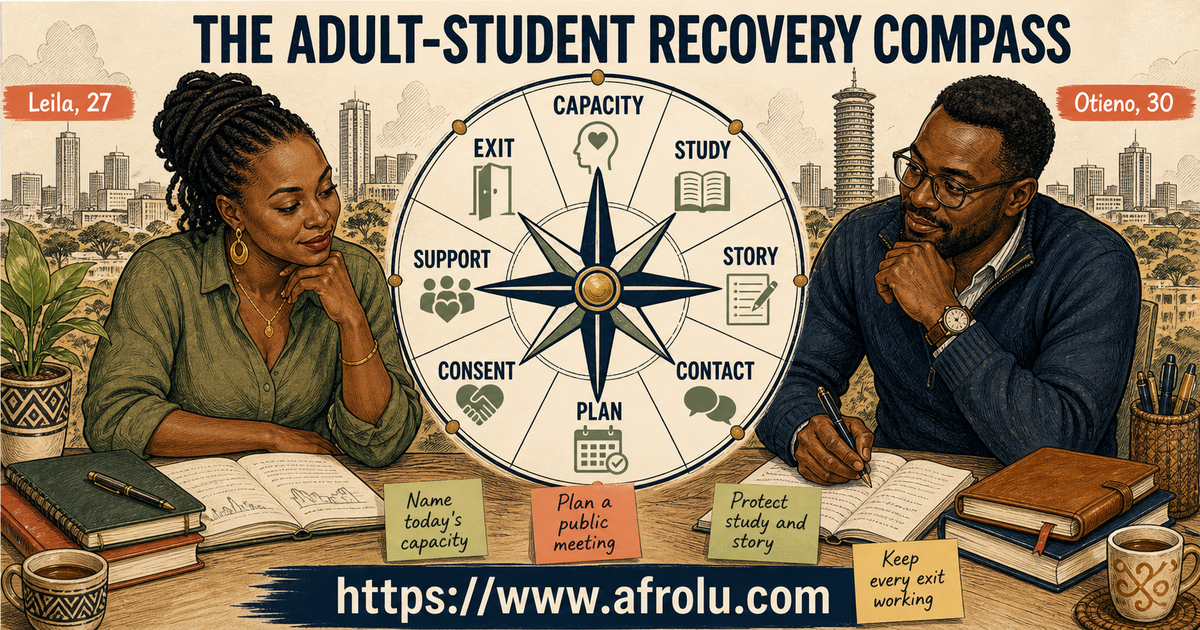
Readiness is a direction you can choose today, not a certificate that heartbreak has ended.
Written and edited by Adwoa Boateng · Dating Safety Editor
Check eight compass points: CAPACITY, STUDY, STORY, CONTACT, PLAN, CONSENT, SUPPORT and EXIT. Offer only the contact you want now. Guard quiet study time and private history. Meet in a public place, arrange your own travel and keep each physical step open to a fresh yes or no. You may DATE LIGHTLY, ASK, REDUCE, PAUSE, CLOSE, SEEK CARE or SEEK SAFETY HELP. There is no set healing date. Lasting distress may need trained care. Scams, threats, tracking or blocked movement need direct safety help.
Starting over · Students
How can an adult student aged 25+ in Nairobi date after heartbreak without turning recovery into an exam, academic pressure into romantic evidence or a new connection into an obligation?
Clear dating after heartbreak is a choice that both adults want now and may change. It is not a healing stage, school goal or duty to share the past. Slow dating, study stress, pulling away, rebound pressure, a poor fit, a kind close, daily distress, fraud and unsafe control each call for a different next step.
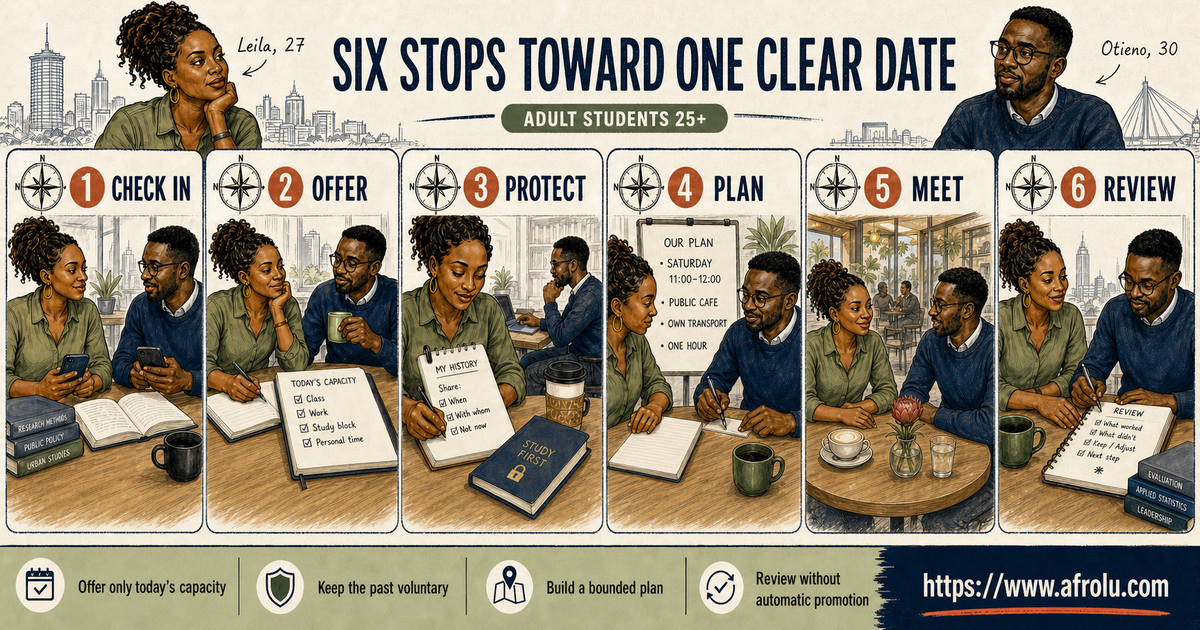
Across six fictional Nairobi stops, Leila, 27, offers two planned calls and keeps her last relationship private. Otieno, 30, accepts that limit. They plan one public daytime date from Saturday 11:00 to 12:00. Each handles travel and normal costs. They discuss intent and consent, and one good date creates no automatic next step.
The adult-student Nairobi recovery compass
Choose a present direction without grading heartbreak
Adwoa separates capacity, study, story, contact, plan, consent, support and exit for adults aged 25 and older.
Name today's offer, protect the life already in progress and plan one meeting you can leave. Then choose the right response for mismatch, care, fraud or danger.
Check capacity
Offer only the attention genuinely available today.
Protect study
Learning, work and rest keep clear boundaries.
Keep story private
Past pain remains voluntary, never proof.
Choose an exit
Reduce, pause and close remain complete choices.
Heartbreak does not set an academic deadline
Build clarity around the adult life you have today
There is no fixed date for dating again after heartbreak. There is no test to pass. This guide is for Nairobi students who are adults aged 25 or older. That includes people in postgraduate study, people who returned to learning, and people who study while they work. Dating is never a required part of healing.
Classes, research, work, travel, family care and rest can fill a week. A quiet spell may mean an exam is near. It does not prove fear or lack of interest. Ask a simpler question: what kind of contact feels welcome now? A clear answer can be a call, one coffee, a slower pace or no dating this month.
You can offer one planned call this week or a daytime coffee after class. You can also pause during exams. You do not owe a new date the full story of your last relationship. Your grades, money, care history and support circle are private too. Share only what you freely want to share.
Set limits before stress builds. Name your quiet study hours, contact pace, public meeting plan and way home. Keep money and touch as separate choices. The other adult can agree, suggest another plan or say no. If dating harms daily life, local care may help. Threats, scams, tracking or blocked movement need direct safety help.
The eight-point adult-student recovery compass
Keep capacity, study, story, contact, plan, consent, support and exit separate
The compass is a way to sort your thoughts. It is not a medical test or a score. Its eight points stop one good feeling from deciding everything. You may want a chat but not a trip. You may welcome one date but not private questions, a label or touch. Each answer can stand on its own.
CAPACITY means the time and energy you have today. STUDY protects class, work and rest from endless messages or surprise visits. STORY keeps painful history in your hands. You choose what to share and when. These points do not measure love. They make your current offer easier for another adult to understand and respect.
CONTACT sets the pace, channel and quiet hours. PLAN covers a public place, start time, length and way home. Nairobi traffic or rain may change a plan, so a clear update matters. Each adult should still choose their own transport. A useful plan lets both people agree, suggest a change or decline without guilt.
CONSENT covers each story, image, touch and sexual step. SUPPORT can come from trusted friends, family, peers or trained local help. They can care without voting on the relationship. EXIT keeps profiles, chats, money, study places and physical access easy to close. Use the compass when facts change, not as a daily healing exam.
Six Nairobi stops toward one clear date
See two adult students protect study, private history and choice
Leila is a fictional Black Kenyan postgraduate student aged 27. She also works part-time. Otieno is a fictional Black Kenyan master's student aged 30. Both are clearly adults over 25. Their course, messages, cafe and outcome are made up for this guide. A degree or an open heart does not prove identity, safety or fit.
Leila joins a dating platform months after a hard breakup. Soon, long evening chats begin to cut into sleep and research. She tells Otieno that she likes talking with him. She can offer two planned calls each week. She does not promise more contact after exams, and she keeps the breakup story private for now.
Otieno accepts that pace and asks about a daytime coffee. Leila offers Saturday from 11:00 to 12:00 at a staffed public cafe near a travel path she knows. It is one hour. Each checks the place on their own and arranges their own travel. They keep home details, study accounts and school records private.
At the cafe, they talk about what serious dating could mean. Leila is open to seeing whether they fit, but she is not agreeing to be exclusive. They discuss sexual health and consent in plain terms. Afterward, there is no set second date. One clear meeting can stay one meeting until both adults choose what comes next.
Fourteen signals that clarity is present today
Read paired evidence without grading heartbreak
The fourteen signals come in seven pairs. They cover capacity, study, story, contact, plan, consent and exit. Each pair shows a clear choice beside a limit that needs words. The pairs do not predict love or success. A hard day does not erase your choices. A lovely date does not prove that every next step is right.
Clear CAPACITY says what you can offer now. Pressure asks you to promise when you will be fully healed. Clear STUDY respects quiet hours for class, work and sleep. Pressure brings guilt, constant messages or surprise visits. Low free time can be real. It does not by itself prove that someone fears closeness.
Clear STORY leaves the past with the person who lived it. Pressure turns painful details into a trust test. Clear CONTACT has a pace and channel that suit both adults. Pressure uses silence to test care or keeps reaching out after a close. Warm interest can still sit beside limited contact during a busy term.
A clear PLAN is public, short and easy to leave. Pressure uses price, travel, home or study access as leverage. Clear CONSENT stays tied to each choice. A tender story or kind act is not permission. Clear EXIT works across profiles, chats and study places. Read the pair nearest your next choice and act on that fact.

Signals guide an adult choice; they do not diagnose grief or certify readiness.
Twelve lines for a life that includes more than dating
Say what fits without presenting heartbreak as a defence
A script is only a starting point. Use words that sound like you. Keep each line about one choice in the present. A good line does not force a private story, ask for endless patience or promise safety. An honest yes, a useful change, a kind no and a clear close are all full adult answers.
For time, try: ‘I enjoy talking, and I have room for two planned calls this week.’ For study, say: ‘I am offline while I work from seven to ten.’ These lines do not blame heartbreak or promise more later. They show what is real now and let the other adult decide if it fits.
For your past, say: ‘I will share more about my last relationship if and when I choose.’ For intent: ‘I am open to seeing if we fit, but I am not assuming we are exclusive.’ For a date: ‘I can meet Saturday at eleven in a staffed public cafe for one hour.’ Clear details make choice easier.
For travel and money, say: ‘I will arrange my own trip and normal costs.’ For consent: ‘This chat and date do not decide any physical step.’ You may pause with no return date or end contact. If a clear limit brings threats, tracking, new accounts or visits to class, stop debating and seek current safety help.

A clear sentence protects both connection and the life already being rebuilt.
Choose a reversible direction
Date lightly, ask, reduce, pause, close, seek care or seek protection
DATE LIGHTLY fits when you truly want the current pace and small plan. ASK fits when one detail is missing. REDUCE fits when you still feel interest but contact is taking time from study, work or rest. These choices are equal. They are not steps that must lead to more time, closeness or commitment.
PAUSE can have an end date or no end date. It does not reserve the other person. CLOSE fits a mismatch, lost interest or a pace you do not want. You do not need a verdict on your healing. When it is safe, one clear message is enough. No final private meeting or full breakup story is owed.
SEEK CARE fits when distress keeps harming sleep, food, focus, joy or daily tasks. Trained local help can support the adult who feels it. It cannot diagnose a match from texts. SEEK SAFETY HELP fits scams, threats, tracking, image abuse, hacked accounts or blocked movement. Care and safety help can both be right.
Check the compass again when your study load, time, contact or plans truly change. Do not retake the test after every lonely hour or new message. Dating is optional. Protecting a degree, job, friendship, sleep or private story is not failed healing. The best choice is one you can state, choose freely and leave safely.

No choice sits higher simply because it looks more romantic.
Nine nearby paths after heartbreak
Separate clear re-entry from slow dating, study stress, avoidance, pressure, mismatch, care, fraud and control
These nine paths can overlap. They are not grades or stages of healing. Plain names help us avoid two mistakes. We should not turn a busy study week into a flaw in someone's character. We should not use heartbreak to excuse a broken limit. Start with what happened, what both adults agreed, and what changed.
CLEAR RE-ENTRY is a current offer that both adults want and can change. MUTUAL SLOW DATING is a lower pace chosen by both people. ORDINARY STUDY STRESS has a clear cause and a useful new plan. None of these paths needs endless messages, a full breakup story or proof that all sad feelings have gone.
An AVOIDANT PATTERN means agreed closeness keeps moving away with no new plan. It is a description, not a diagnosis. REBOUND PRESSURE makes a new date prove healing or replace an ex. PLAN MISMATCH means two adults want a different pace, amount of sharing or future. Either person may close with respect.
DAILY-LIFE DISTRESS belongs with trained care for the adult who feels it. FRAUD OR UNSAFE CONTROL includes money tricks, threats, tracking, image abuse or a blocked exit. It needs direct protection. More than one path may be present. Lead with the strongest safety fact, then return to the dating question if it is still useful.
Eight adult-student moments where recovery pressure meets present clarity
Leila wants no dates for two weeks
A study boundary can be complete without a promise of greater availability later.
State the quiet period plainly.Otieno asks why the last relationship ended
Respectful curiosity does not create access to an ex or painful details.
Accept a short boundary.Conversation displaces sleep and research
Interest can remain while the channel or rhythm no longer fits adult capacity.
Move to planned contact.They choose one hour near a familiar travel path
A small plan protects time, cost, transport, consent and a separate exit.
Check the venue through your own source.A new match asks for money before a date
Heartbreak and student status do not make financial urgency safer.
Stop exposure and check through official sources.Warmth creates pressure to prove recovery
One enjoyable meeting does not require exclusivity, disclosure or faster intimacy.
Review the existing agreement.Leila chooses not to date
A pause needs no restart date and does not reserve either adult.
State it once when safe.A closed contact appears near class
Bypassing a clear exit changes the issue from mismatch to unwanted access.
Protect location and seek fitting help.Fourteen signals across capacity, study, story, contact, plans, consent and exit
Current dating capacity is stated without a forecast for complete recovery.
Study, work, rest and caregiving windows are respected without guilt.
A quiet exam period receives a realistic contact agreement or respectful no.
Past relationship details remain voluntary and controlled by the adult concerned.
Former partners, classmates and counsellors are not recruited as trust proof.
Contact frequency and channel are mutual, specific and revisable.
Public meeting proposals name place, time, duration, cost and exit.
Each adult controls transport, ordinary costs, devices and the way home.
Fees, emergencies, investments and account access remain outside new affection.
One good meeting does not automatically create exclusivity or greater access.
Consent stays specific to each disclosure, image, touch and later plan.
Pause and closure are accepted across profiles, channels and study spaces.
Lasting distress that harms daily life belongs with trained local care.
Fraud, threats, tracking or blocked movement bypass readiness review.
Read the adult-student recovery compass through ten independent questions
| Situation | What it may mean | What to do next |
|---|---|---|
| Is capacity present-tense? | Fits: A specific offer exists today. Needs review: One limit needs wording. Stop: A recovery forecast is demanded. | Name today's bandwidth only. |
| Is study time protected? | Fits: Quiet windows are respected. Needs review: A rhythm needs adjustment. Stop: Messages or visits defeat focus. | Set channel and time boundaries. |
| Is the past voluntary? | Fits: History remains controlled. Needs review: Curiosity needs a limit. Stop: Disclosure becomes proof of trust. | Protect the private story. |
| Is contact mutual? | Fits: Frequency fits both adults. Needs review: A counterproposal is possible. Stop: Silence tests or guilt replace agreement. | Agree, reduce or close. |
| Is the meeting bounded? | Fits: Place, time, duration and exit are clear. Needs review: One detail is missing. Stop: Home or study access is assumed. | Complete or decline the plan. |
| Are money and transport independent? | Fits: Each adult controls both. Needs review: One dependency can be repaired. Stop: Fees or movement become leverage. | Stop exposure and restore control. |
| Is consent specific? | Fits: Every step remains reversible. Needs review: One assumption needs correction. Stop: Vulnerability or effort becomes access. | Separate warmth from permission. |
| Does support stay supportive? | Fits: Chosen people aid the adult concerned. Needs review: One role needs clarification. Stop: Peers become relationship referees. | Keep support and proof separate. |
| Does exit work? | Fits: Pause and close are respected. Needs review: One channel needs securing. Stop: Accounts or study spaces bypass no. | Protect access directly. |
| Which kind of help fits? | Fits: An ordinary adult choice remains. Needs review: Daily-life distress may need care. Stop: Fraud or danger needs protection. | Start with the strongest fact. |
Twelve lines for capacity, study, private history, meetings, consent and closure
“I enjoy talking, and I have room for two planned calls this week.”
“I am not available for an all-evening message thread.”
“I am offline while I work from seven to ten.”
“I will share more about my previous relationship if and when I choose.”
“I am open to learning whether we fit; I am not assuming exclusivity.”
“I can meet Saturday at eleven in a staffed public cafe for one hour.”
“I will arrange my own journey and way home.”
“I do not fund fees, tickets, emergencies or investments for a new contact.”
“This conversation and date do not decide any physical step.”
“My friends and counsellor support me; they are not relationship referees.”
“I am pausing dating and will not set a restart date.”
“This pace does not fit me, so I am ending contact.”
Know the difference
Clear re-entry and rebound pressure ask different things of an adult student
A present, mutual and reversible offer protects study, private history, consent and exit.
Dating is used to prove healing, replace an ex or rush status beyond current choice.
Judge the agreement and present impact, not the time since the breakup or academic milestone.

Use the narrowest supported description and let safety facts lead.
Separate clear re-entry, slow dating, study stress, avoidance, rebound pressure, care, fraud and control
| Type or dimension | What it describes | Best next question |
|---|---|---|
| Clear re-entry | A present offer is mutual, bounded and reversible. | Continue while it fits. |
| Mutual slow dating | Both adults explicitly choose lower intensity. | Review when needs change. |
| Ordinary study stress | A named constraint receives a workable revision. | Use or decline the counterproposal. |
| Avoidant pattern | Agreed closeness repeatedly moves without completion. | Describe behaviour and ask once. |
| Rebound pressure | Dating becomes proof of healing or replacement. | Reduce pressure and name the present. |
| Plan mismatch | Adults want different rhythms, disclosure or futures. | Counter, reduce or close. |
| Respectful closure | One adult ends the connection without punishment. | Accept and close access. |
| Daily-life distress | Sleep, focus or other daily tasks stay badly affected. | Seek trained local care. |
| Fraud or unsafe control | Money, threats, tracking or defeated exit appear. | Protect access and report appropriately. |
Use the eight-point recovery compass in deliberate moves
Check today's capacity
Offer only the contact and meeting scope genuinely available.
Protect the study day
Give coursework, work and rest clear communication boundaries.
Keep the story voluntary
Past pain and former-partner details are not trust proof.
Plan one bounded date
Use a public place, defined duration and independent exit.
Separate support from approval
Chosen people can help without deciding the relationship.
Choose the right next step
Tell apart mismatch, daily distress, fraud and unsafe control.
Questions for capacity, study, story, Nairobi plans, support and exit
Choose a few prompts that fit the moment. This is a reference library, not a list to complete.
Capacity and study
Define an honest pace around today's adult responsibilities.
- What energy is present?
- Which quiet windows matter?
- What channel fits?
- What would crowd the week?
Story and contact
Keep private history voluntary and rhythm mutual.
- What can be shared?
- What stays private?
- Which frequency works?
- What counterproposal counts?
Plan and consent
Make one Nairobi meeting bounded and reversible.
- Which public place?
- How long?
- Who controls transport?
- What remains unagreed?
Support and exit
Choose the fitting next step when facts change.
- Date or reduce?
- Pause or close?
- Does care fit?
- Does danger bypass review?
What current safety, fraud, privacy, consent and wellbeing guidance supports
eSafety covers online-dating privacy and meetings
The guidance supports platform controls, public plans and contact you can leave.
Evidence limit: Australian steps do not replace Kenyan help.
FTC guidance describes money requests
The material supports stopping fee, emergency and investment transfers.
Evidence limit: U.S. reporting steps may differ locally.
Kenya ODPC explains personal data
The official context supports protecting identity, study, location and contact information.
Evidence limit: It is not personalised legal advice.
eSafety explains voluntary consent
The guidance supports specific, informed and reversible choices at every step.
Evidence limit: It does not replace local law or care.
eSafety describes technology-facilitated control
The material supports taking tracking, threats and channel bypass seriously.
Evidence limit: Australian services may differ locally.
WHO describes wellbeing and daily functioning
The context supports qualified care when distress persistently affects adult life.
Evidence limit: A fact sheet cannot diagnose an individual.
Six ways re-entry after heartbreak can acquire hidden pressure
Setting a healing deadline
Recovery becomes an exam. Repair: name today's capacity.
Using study silence as a test
Absence provokes pursuit. Repair: agree the rhythm.
Demanding the breakup story
Disclosure becomes proof. Repair: keep history voluntary.
Meeting inside a study space
Convenience becomes access. Repair: use a neutral venue.
Funding a student emergency
Empathy becomes exposure. Repair: keep money separate.
Promoting one good date
Warmth becomes status. Repair: review the existing agreement.
Choose a discovery resource only if it fits today's capacity
There is no need to download an app to prove recovery. If meeting people now feels welcome, compare adult-student options, shape a privacy-aware profile and read one full review before spending study time or essential money.
Explore the guide library
Show more related guides
Continue with Afrolu
Show more Afrolu guides
Current safety, fraud, privacy, consent, control and wellbeing guidance
Afrolu reviewed these health, research, safety, or public guidance resources while editing this page. They support the behaviour and safety guidance; they do not diagnose any individual described by a reader.
Adult-student questions about dating after heartbreak in Nairobi
How do I know whether I am ready to date after heartbreak as an adult student?
There is no universal test. Ask what contact, disclosure, meeting and future scope you genuinely want now while protecting study, work and rest. You may date lightly, reduce, pause or close without proving that recovery is complete.
Is this guide for university teenagers?
No. It is explicitly for adult students aged 25 and older, including postgraduate, returning and working students. Every dating scenario involves independent adults. Younger readers should use age-appropriate support and safety resources rather than these adult relationship scenarios.
Do I need to tell a new date how my relationship ended?
No. Share only what you freely choose. A new contact is not owed painful detail, facts about a former partner, care history or proof that you learned the right lesson. State your limit and the amount of contact you want now.
Can I protect study time without looking uninterested?
Yes. Offer a specific rhythm, such as two planned calls or no messages during a work block, and allow a counterproposal. Interest is not measured by constant availability. Respectful mismatch is possible when rhythms differ.
Should I date during exams to prove I have moved on?
No. Dating is optional and should not become evidence of healing. A pause can protect attention and does not reserve another person. Choose based on current capacity rather than friends, an ex, loneliness or an academic calendar.
What is a clear first date in Nairobi?
Use a staffed public place, a clear start and rough length, details checked through your own source, separate normal costs and travel, and a clear way home. One meeting never creates an exclusive bond, home access or consent to another step.
Should I help a student match with fees or an emergency?
New affection does not make fee, ticket, medical, emergency or investment requests safe. Do not share logins or codes. Stop money risk and check claims through official sources you found yourself before you decide whether a report is needed.
Can I pause without promising when I will return?
Yes. An indefinite pause is complete and does not reserve either adult. When safe, say you are pausing and will not set a restart date. You need not prove that heartbreak, study or any other reason is sufficient.
When does heartbreak belong with professional care?
Persistent changes in sleep, appetite, concentration, enjoyment or daily functioning deserve qualified local assessment. Care supports the affected adult without assigning a remote diagnosis to a dating contact or imposing a timetable for returning to relationships.
What should bypass a clarity conversation?
Threats, tracking, fake identity, money abuse, image abuse, hacked accounts, repeated contact, visits to study spaces or blocked movement need direct protection. Use the right platform, school, bank, legal, health or emergency help for the facts you face.
One thing to do now
Choose today's honest direction and protect the life already in progress
Continue while both adults want the pace. Study limits and private history should be respected. Meet in public, keep money separate, ask for consent at each step and keep exit open. You may reduce, pause or close without proving you are healed. Use trained care for lasting daily distress and direct help for fraud or danger.