Five gates for a deliberate pace and an independent way home
Date Slowly and Safely as an Adult Student in Nairobi
A Nairobi adult-student slow dating guide to study time, campus privacy, public meetings, transport, essential money, consent, scripts and review points.
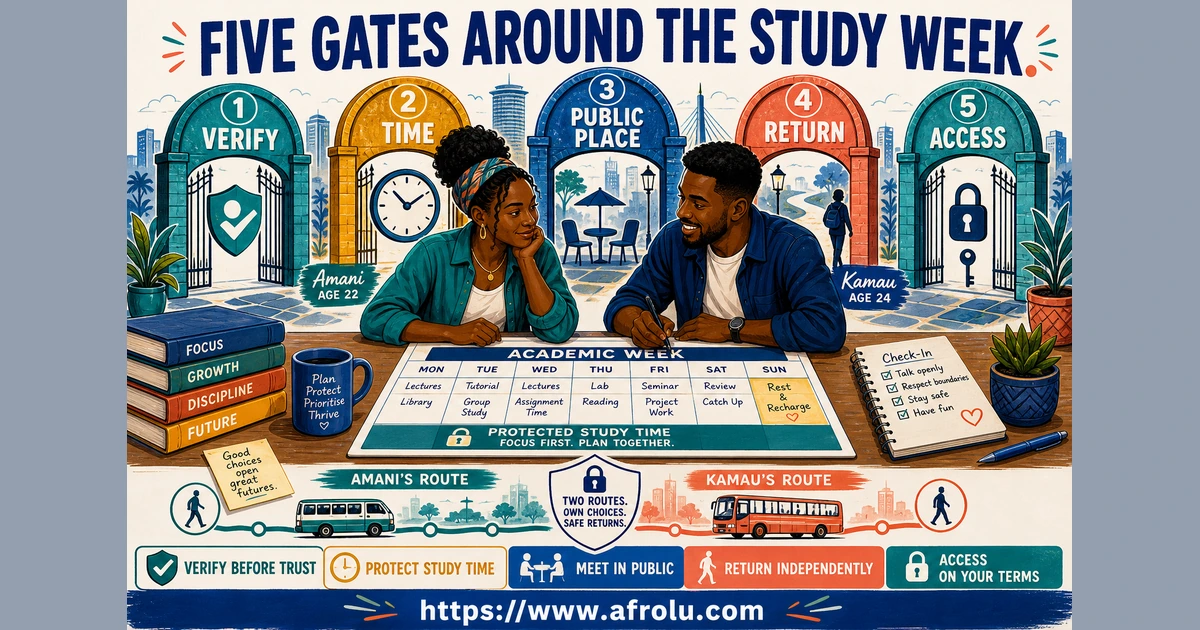
Move one gate at a time and keep the next gate closed until both adults have enough evidence.
Written and edited by Grace Mutiso · Kenya Guides Editor
Use five gates. Verify proportionately before one modest step; share a general meeting window rather than a full timetable; choose and independently check a staffed public place; retain phone, payment, transport and a trusted check-in; and keep residence, class routes, accounts, essential money and physical access separate. Slow dating should still produce confirmed plans, reciprocal effort, repair and a review point. One study delay may be ordinary. Repeated vagueness, location pursuit, private venue pressure, money requests or punishment after no requires a different response.
Intentional dating · Students
How can an adult student date slowly in Nairobi while still making visible progress and protecting timetable, campus privacy, public meetings, transport, money and consent?
Safe slow dating for an adult student is a deliberate, observable progression whose timing and practical load fit study life while verification, necessary disclosure, public meetings, independent return, financial boundaries and current consent preserve choice.
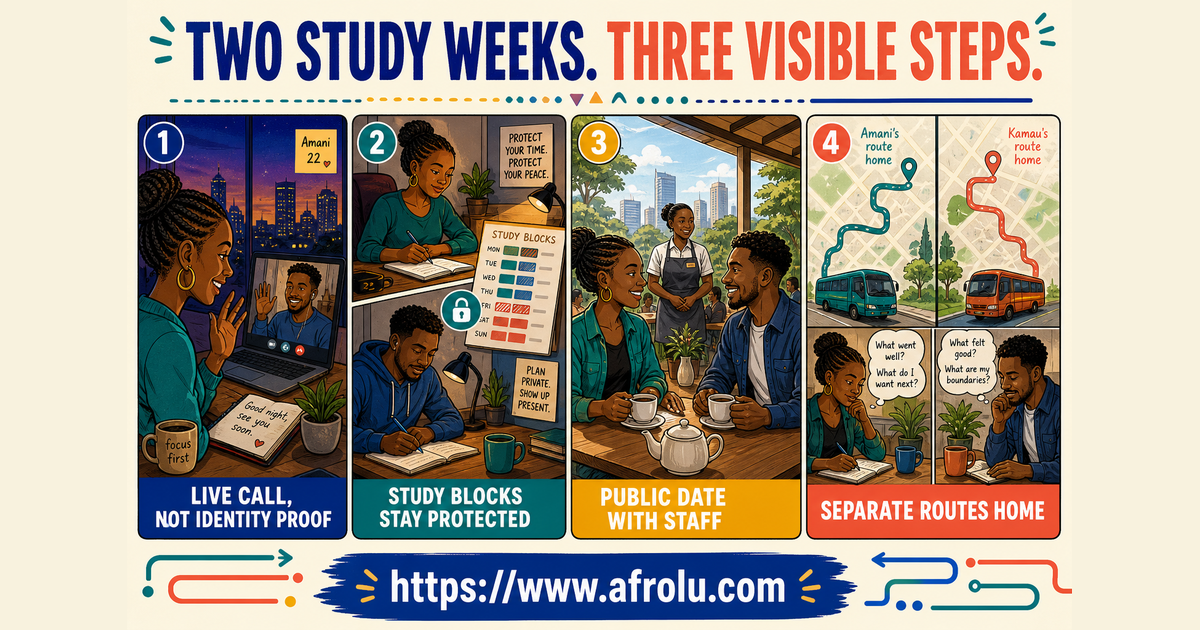
Amani and Kamau are fictional Nairobi university students, 22 and 24. Across two study weeks they use a live call, broad availability and one confirmed public tea meeting. Amani keeps residence, timetable and money private, travels independently and states a physical boundary. They review the pace and choose one more public date after exams without assuming exclusivity.
The five-gate study timetable
Make progress small enough for the semester and complete enough to evaluate
Grace separates a deliberate pace from ordinary study delay, low effort and safety pressure in a Nairobi adult-student context.
The timetable passes five gates, follows a two-week fictional story and ends with a six-stop independent return route.
Verify and schedule
Check proportionately and share only one broad adult window.
Meet publicly
Confirm staff, duration, cost and an acceptable venue boundary.
Return independently
Keep phone, fare, payment, route and check-in under your control.
Review the pattern
Separate slow progress, study repair, low effort and pressure.
Define a safe adult-student pace
Slow dating should protect the study week while producing visible progress
For this guide, students are consenting adults aged eighteen or older. Adult student life in Nairobi may combine lectures, practical placements, jobs, family duties, commuting, shared housing and limited money. Slow dating can protect those realities by reducing frequency and choosing modest plans. It should not require either adult to publish a class timetable, residence, live location or financial situation. A broad availability window is enough for a new person to plan one date.
Slow refers to the pace at which information, meetings, intimacy and private access expand. It does not decide relationship intention. An adult student may move slowly while seeking a serious partnership, a casual connection or honest exploration. Structure also remains separate: regular study-break dates do not create exclusivity. State whether either person is dating others and discuss relevant sexual-health choices before activity rather than inferring an agreement from attention or campus proximity.
Safe slow dating is observable. A match verifies enough to support the next step, proposes a complete public plan, accepts academic constraints, shares effort and responds to a no without bargaining. Progress can be small: a live call, one confirmed tea meeting or a conversation about intention. A slower pace becomes low effort when only one adult initiates, every plan stays vague or study is invoked after the other person has already carried the cost.
Safety is not a promise that nothing harmful can happen. It is a set of choices that preserve options: independent verification, necessary disclosure only, staffed public meetings, a trusted check-in, a charged phone, protected transport money and an exit that does not depend on the match. When deception, coercion, threats, stalking or theft appears, the priority shifts from relationship clarity to reducing access and using support appropriate to the situation.
Walk the five-gate timetable
Each gate asks for only the information needed by the next plan
The verification gate asks whether the person and basic story are plausible enough for the next modest step. Use platform signals, a live video call and independent public information where appropriate. A video call reduces some uncertainty but does not prove every claim. Do not exchange identity documents, student records, one-time codes or banking information as romantic proof. Contradictions deserve a pause and an independent check, not a larger disclosure from you.
The time gate converts a crowded week into one usable window. Share ‘Saturday afternoon’ or ‘Tuesday after six,’ not lecture rooms, residence patterns or a live route. Agree when the plan must be confirmed. If the deadline passes, release the time and continue with study or rest. A respectful adult may be disappointed and propose another complete option. Repeated last-minute access makes the slower pace expensive for only one person.
The public-place and return gates should be completed before leaving. Confirm a venue with staff, a realistic duration and an independent route there and back. Check current transport information yourself. Keep a charged phone, payment option and essential fare. Tell a trusted person the broad plan and arrange a check-in that does not expose more personal data than needed. If the venue changes toward private space, decline or leave without negotiating away the original condition.
The access gate stays granular. A public meeting does not grant a residence address. A second date does not grant class schedules, student portals, devices, intimate images, money or physical contact. Consent is specific and current. Ask before posting or introducing the person to campus networks. Review after several interactions: is trust growing from consistent conduct, or is the connection merely accumulating access while clarity and reciprocity remain unchanged?
Amani and Kamau use two study weeks
A small complete sequence reveals pace, repair and respect
Amani, 22, and Kamau, 24, matched during a demanding study period. Both were adult university students, but their timetables and travel needs differed. They began with messages inside the platform and scheduled a short live call. Amani saw that Kamau broadly matched his profile and conversation history, while remembering that a call could not verify every identity or intention claim. She shared only a general weekend window rather than her residence or lecture schedule.
Kamau proposed tea at a generic staffed venue accessible from both routes and confirmed before the deadline they had set. Amani retained her own fare, charged phone and return plan, and a trusted friend knew the broad meeting details. They arrived separately and kept the date to seventy-five minutes because both had coursework. The time box made the meeting easier to complete; it did not make their interest casual or unserious.
During the date, Kamau asked whether he could walk Amani to her residence. She said no and named a public stopping point instead. He accepted without requesting the address or framing protection as distrust. Later, Amani declined an intimate-image request that arose in conversation. Kamau apologised and did not repeat it. Those responses became more useful evidence than message speed because they showed whether her choice remained usable after he wanted something else.
They reviewed after another study week. Both wanted to continue slowly and were still dating non-exclusively. They planned one public lunch after exams, kept communication within mutually workable windows and left residence, student accounts and money outside the connection. If Kamau had pressed the location, demanded fees or retaliated after no, the appropriate next step would have been reduced access and support—not another date to be polite.
Sort the pattern before naming it
Slow progress, study delay, low effort and safety pressure need different responses
Slow progress has visible movement at a mutually chosen pace. Plans may be less frequent, yet dates are confirmed, questions receive honest answers and the next step is understood. Study delay is a practical disruption: an exam, placement or family duty changes availability. The useful evidence is repair. Does the adult communicate before the other person carries unnecessary cost and offer a realistic alternative, or simply return when they want access again?
Low effort is a repeated distribution problem. One student proposes every date, waits through every vague answer, pays every cost or adjusts every deadline while the other adult describes the imbalance as taking things slowly. A single direct request can test whether fit is possible: ask for the other person to propose and confirm the next plan. If nothing changes, the pattern is information. More patience will not create reciprocity by itself.
Safety pressure reduces choice. It includes demands for residence or class locations, uninvited appearances, device or account access, intimate images, urgent money, private venue switches, monitoring and punishment after no. Severity matters; you do not need to repeat a boundary after threats, stalking or coercion to prove a pattern. Preserve relevant evidence, alert affected campus or platform systems and seek local legal, advocacy or emergency support where appropriate.
Ordinary mismatch belongs outside the danger category. Two respectful adults may need different contact frequency, date budgets, religious boundaries or relationship directions. Naming incompatibility clearly protects both people from unnecessary moral judgement. Continue when conduct and fit support another small step. Revise a format when safety remains intact. Close when needs conflict or when the relationship repeatedly costs study, privacy, money or freedom that the connection cannot responsibly carry.

Read the next observable action and the response to a boundary, not message speed alone.
Use sentences that reveal less and decide more
A concise boundary keeps the timetable private and the plan testable
For availability, say: ‘I can meet Saturday between two and four; I do not share my full timetable.’ This gives enough information to create a plan without revealing recurring movement. Add a confirmation boundary: ‘If we have not confirmed the venue by Friday evening, I will treat the date as off.’ The boundary is complete because the consequence is under your control. It does not require the other person to agree before you protect the time.
For place and return, use: ‘I meet in staffed public places at first and arrange my own way home.’ If the plan changes, repeat the decision once: ‘The private venue does not work for me, so I am leaving.’ Do not let fear of seeming difficult move you away from the setting you checked. A legitimate last-minute closure may require a different public venue or cancellation; it does not require accepting an address supplied under pressure.
For money and accounts, be direct: ‘My fees, fare, devices and accounts stay separate from dating.’ A genuine hardship story can still be unverified or unsuitable for a new relationship to solve. Do not share student portal credentials, one-time codes, banking screens or identity documents. If a suspicious transfer occurs, contact the payment provider quickly and preserve records. Romantic warmth does not improve the accuracy of financial claims.
For consent and review, say: ‘I am not choosing that, and my answer does not need to match an earlier conversation.’ Then ask: ‘After the next public date, can we review pace and intention?’ The response supplies evidence. Curiosity, respectful disappointment or a different relationship need may remain discussable. Bargaining, ridicule, threats or repeated requests after a clear no make the next task protection, not better wording.

A usable boundary names the plan and what happens if the condition is not met.
Make the date survivable as an ordinary plan
Independent logistics protect the student and the semester
First, verify the venue through a source independent of the match and choose a meeting window that does not require rushing across an unfamiliar area after dark. Consider accessibility, staffing and a realistic end. Nairobi travel conditions change, so check current information close to departure. Share the broad plan with a trusted person while avoiding public posts that reveal a live location or predictable weekly movement.
Second, protect the return. Carry a charged phone, backup contact information, a working payment method and enough transport money that is not part of fees, rent, food or another essential need. Do not let the date hold your device, identification or fare for safekeeping. If you choose to share transport, keep an independent alternative and avoid disclosing the exact residence entrance before trust justifies it.
Third, define the check-in. Agree with a trusted person what time you will contact them and what they should do if the check-in is missed. A code phrase may help when you cannot speak freely. The trusted person needs enough information to act, not your entire romantic history. If risk escalates, use venue staff, platform tools, campus security, police or local support suitable to the circumstances. Immediate danger requires emergency help, not an editorial checklist.
Finally, review the impact on study and money. Was the date proportionate to the information gained? Did the person respect the end time and return plan? Did any request expose residence, accounts or essential funds? Continue with another small public step when the pattern fits. Resize when logistics were the problem. Close when safety, academic capacity or relationship direction conflicts, without treating sunk planning as a reason to stay.

If the romantic plan changes, the safe-return system should still work.
Compare date formats by load
The best format answers the next question without consuming the whole week
A short live video call has minimal travel and can test conversational ease, but it does not prove every identity claim. A public coffee or tea meeting creates a clear end and moderate conversation. A public walk can reduce interview pressure, while weather, accessibility, staffing and route choice need checking. A study-break meeting may fit capacity but can expose campus routines if the location is too close to lectures or residence. Choose a neutral edge rather than publishing a regular path.
Lunch gives more conversation within a daytime window. An activity shows cooperation and shared attention but may cost more or limit deeper discussion. A group-social plan can reduce one-to-one intensity yet creates privacy questions about introductions and photos. Dinner requires greater time, money and return planning. None of these formats decides whether the connection is serious, casual or exclusive; relationship meaning needs its own conversation.
Private-room and residence dates carry the highest early location and exit exposure. Convenience is not a reason to bypass a boundary. If cost is the concern, choose a lower-cost public option rather than transferring the risk into private space. Decide payment before ordering when uncertainty would create pressure. A person who pays for a meal, activity or transport receives no physical or digital access in return.
After the date, compare what the format revealed with what it cost. If conversation was easy but the venue was noisy, revise the setting. If travel consumed the study day, shorten the route. If the person ignored the end time, pushed for private access or made essential-money requests, treat the conduct rather than the venue as the problem. Slow dating works when each small format supplies enough evidence for one proportionate next choice.
Eight Nairobi student moments where slower pace needs a clear safety choice
A match asks for the full weekly timetable
Only one broad meeting window is necessary for the date.
Share availability without rooms, routes or residence patterns.The profile broadly matches on a live call
The call reduces uncertainty but cannot prove every claim.
Use it to plan one public step, not to release sensitive data.A date must move because of study
The adult communicates early and offers a complete alternative.
Treat the repair as ordinary evidence, not a moral failure.A public tea plan becomes a residence visit
The new setting removes the checked venue and independent exit.
Decline the switch or cancel.A new match needs urgent transport money
Affection is used to turn an unverified need into a student obligation.
Send nothing and protect essential funds.Slow dating is used to request intimate images
A relationship pace or label cannot supply consent.
Refuse, preserve evidence if needed and reduce access.A message sits unanswered during coursework
One delay contains no deception, threat or broken plan.
Judge the broader pattern and agreed communication rhythm.The date was public, respectful and complete
Both adults want more evidence while study capacity remains limited.
Plan one modest public date after exams.Signs of slow progress, ordinary delay, low effort and pressure
{'label': 'Progress', 'title': 'The next small step is visible', 'detail': 'Slow dating produces plans and learning rather than endless messaging.', 'reading': 'Deliberate'}
{'label': 'Study', 'title': 'Academic windows are respected', 'detail': 'The person accepts broad availability without demanding the timetable.', 'reading': 'Capacity-aware'}
{'label': 'Privacy', 'title': 'Only necessary location data is requested', 'detail': 'Residence, class routes and live movement remain protected.', 'reading': 'Bounded'}
{'label': 'Place', 'title': 'Public plans remain public', 'detail': 'A venue change never becomes pressure for private access.', 'reading': 'Consistent'}
{'label': 'Return', 'title': 'Independent transport is supported', 'detail': 'The date does not need to control fare, phone or route.', 'reading': 'Leaveable'}
{'label': 'Money', 'title': 'Essential funds stay untouched', 'detail': 'Fees, food, rent and fare are not romantic resources.', 'reading': 'Independent'}
{'label': 'Repair', 'title': 'A study disruption gets a concrete alternative', 'detail': 'The next plan changes rather than the apology repeating.', 'reading': 'Observable'}
{'label': 'Consent', 'title': 'A no ends the request', 'detail': 'Affection, gifts and labels create no obligation.', 'reading': 'Voluntary'}
{'label': 'Network', 'title': 'Campus introductions require permission', 'detail': 'Photos, groups and acquaintances are not used for surveillance.', 'reading': 'Privacy-aware'}
{'label': 'Review', 'title': 'Pace is revisited after evidence', 'detail': 'Either adult may continue, resize or close.', 'reading': 'Mutual'}
Choose the next step from the five-gate timetable
| Situation | What it may mean | What to do next |
|---|---|---|
| Is the next step observable? | Fits: A modest plan is proposed and completed. Needs review: Study delay has a concrete repair. Stop: Slow means permanent messaging without accountability. | Ask for one complete next step. |
| Is identity checked proportionately? | Fits: Independent signals support a public meeting. Needs review: One inconsistency needs checking. Stop: Documents or codes are demanded as proof. | Verify outside romance and share less. |
| Is study time protected? | Fits: The rhythm fits both timetables. Needs review: One window needs resizing. Stop: Attention is demanded during study or rest. | State the available window and release the rest. |
| Is location disclosure necessary? | Fits: Only the public venue and broad plan are shared. Needs review: One precise question needs a boundary. Stop: Residence, class routes or live movement are pursued. | Restrict data and change affected routines if needed. |
| Does the venue preserve exit? | Fits: Staff, duration and return are clear. Needs review: A public alternative is needed. Stop: The plan is switched to private space under pressure. | Keep it public or cancel. |
| Can the student return independently? | Fits: Phone, fare and route stand alone. Needs review: One backup needs completion. Stop: The match controls transport or device access. | Restore the return system before meeting. |
| Are essential funds protected? | Fits: Dating costs stay within discretionary money. Needs review: The format is too expensive. Stop: Fees, rent, fare or credentials are requested. | Choose a lower-cost plan and transfer nothing. |
| How does no function? | Fits: The request stops without punishment. Needs review: One misunderstanding is repaired. Stop: Pressure, threats or repeated contact follows. | Reduce access and use appropriate support. |
| Is effort reciprocal? | Fits: Planning and repair move both ways. Needs review: One adult needs to propose the next date. Stop: Only one student carries the relationship load. | Stop rescuing and observe. |
| What does the pattern support? | Fits: One more public step fits. Needs review: Resize time, format or contact. Stop: Privacy, study or agency repeatedly shrinks. | Continue, revise or close. |
Scripts for study time, campus privacy, meetings, money and consent
“I can meet Saturday afternoon; I do not share my complete timetable.”
“If the venue is not confirmed by Friday evening, I will treat the date as off.”
“I keep my residence, lecture rooms and regular routes private while dating is new.”
“I am meeting at the checked public place or cancelling; I am not moving to a room.”
“I arrange my own route home and will leave at the agreed time.”
“I do not lend fees, fare or emergency money through a new connection.”
“My student portal, banking details and verification codes are private.”
“I am not choosing that, and I need the request to stop.”
“Slow works for me when we still make and keep one clear plan.”
“After the next date, let us compare intention, pace and study capacity.”
Know the difference
The Nairobi adult-student date-format load map
A deliberate slow rhythm protects study time and personal capacity while still including plans, repair and a date to review progress.
Video, coffee, a walk and a meal carry different time, travel, privacy and exit loads. The format does not decide how serious the connection is.
Choose the smallest safe format that answers the next question without borrowing from study time, essential money or the journey home.

Pick the smallest format that answers the next question without borrowing from academic capacity.
Compare eight student date formats by practical load
| Type or dimension | What it describes | Best next question |
|---|---|---|
| Short live video | ||
| Campus-edge coffee | ||
| Public daytime walk | ||
| Timed lunch | ||
| Neutral study-break meet | ||
| Structured activity | ||
| Permission-based group social | ||
| Dinner |
Build a study-compatible slow dating plan in six moves
Verify proportionately
Protect the week
Choose public space
Build the return
Limit access
Review progress
Questions for the week, verification, meeting and review
Choose a few prompts that fit the moment. This is a reference library, not a list to complete.
Study-week questions
Protect capacity before choosing the date.
- Which window is truly free?
- What stays off the timetable?
- When must we confirm?
- What study block is protected?
- Can I rest afterward?
Verification questions
Use proportionate checks for one modest next step.
- Does the profile stay consistent?
- Can we speak live?
- What can I verify independently?
- Which documents stay private?
- Is one public meeting enough next?
Meeting questions
Build public space, return and support together.
- Is the venue staffed?
- How long is the date?
- What is my independent route?
- Who knows the broad plan?
- Can I cancel a venue switch?
Review questions
Separate progress, delay, low effort and pressure.
- Was the next step visible?
- Did repair change conduct?
- Was effort reciprocal?
- Did my no remain usable?
- What should stay closed?
What Kenyan and international official guidance can support
Kenyan law provides a framework for personal-data processing
Kenya's Data Protection Act sets principles and rights around personal data. For dating, the practical editorial lesson is narrower: minimise unnecessary disclosure of residence, recurring movement, images, identifiers and account information.
Evidence limit: This page is not legal advice and does not determine whether a particular act is lawful.
Data subjects have rights over personal information
Kenya's Office of the Data Protection Commissioner summarises rights including being informed, accessing data and objecting in specified circumstances. Dating-platform controls and legal remedies depend on facts, but a student can still begin with necessary disclosure only.
Evidence limit: Platform settings do not replace legal advice, evidence preservation or official reporting where needed.
Serious crime concerns need official local channels
Kenya's Directorate of Criminal Investigations publishes routes for reporting crime. Threats, stalking, coercion or theft should not be reframed as a relationship-communication exercise when official, campus or emergency support is needed.
Evidence limit: Use the current local emergency and reporting route appropriate to the urgency and location.
Remote affection can precede urgent money requests
The U.S. Federal Trade Commission describes romance-scam patterns involving trust, excuses for not meeting and later travel, medical or investment requests. Adult students should keep fees, food, fare and credentials outside unverified connections.
Evidence limit: FTC services are U.S.-specific; payment recovery and reporting options vary by country and provider.
Consent stays freely chosen and can change
Healthdirect explains that consent involves knowingly and freely agreeing and can be withdrawn. A date format, gift, ride, relationship label or earlier yes cannot decide a later physical or digital act.
Evidence limit: Healthdirect support and legal context are Australia-specific; use suitable local health, legal or emergency resources.
Grounding tools may help with ordinary study-and-date stress
WHO's Doing What Matters in Times of Stress presents practical skills such as grounding and making room for difficult feelings. A student may use a brief skill while still checking the facts and plan rather than treating discomfort as proof of safety or danger.
Evidence limit: A self-help guide is not diagnosis, therapy or crisis care; seek qualified help when distress is persistent, severe or unsafe.
Six ways a slow student connection can transfer risk
Use a reviewed resource that matches the decision
This guide focuses on the relationship decision, so it does not rank dating apps. Check current prices, safety tools, and local availability before choosing a service.
Explore the guide library
Show more related guides
Continue with Afrolu
Show more Afrolu guides
Kenyan privacy and reporting sources plus official scam, consent and stress guidance
Afrolu reviewed these health, research, safety, or public guidance resources while editing this page. They support the behaviour and safety guidance; they do not diagnose any individual described by a reader.
Slow dating safety questions for adult students in Nairobi
What does slow dating mean for an adult student in Nairobi?
It means a deliberate pace for contact, meetings, intimacy and access that fits study and travel capacity while still producing visible progress. A useful slow plan has a reason, reciprocal effort, one next step and a review point. It does not require sharing a full timetable, residence or live location.
How much of my class schedule should I share with a match?
Share only the general availability needed for one plan, such as Saturday afternoon. Keep lecture rooms, residence, recurring routes and live movement private while the connection is new. A respectful adult can make a date from a window; repeated pressure for precise details is information about access.
Is a video call enough to verify an online match?
No. A live call can reduce some uncertainty and test conversational consistency, but it cannot prove every identity, employment, relationship or financial claim. Combine proportionate platform signals and independent checks, then keep the first in-person step public and logistically independent.
What is a safe low-cost first date in Nairobi?
No venue guarantees safety. Choose a current staffed public option that both adults can reach and leave independently, with a clear duration and cost. A short tea, coffee or public daytime meeting may reduce load. Verify opening and travel details yourself because conditions can change.
Does replying slowly mean someone is not interested?
Not by itself. Adult students may have lectures, placements, work or family duties. Compare the delay with the agreed rhythm, whether plans are kept and whether disruptions receive concrete repair. Repeated vagueness that leaves one person carrying every plan is different from one explained study delay.
Should I send fare or fee money to a student match?
Do not use essential funds or transfers as proof of care in a new or unverified connection. Choose a date each adult can fund independently or postpone it. Urgent travel, medical, fee or investment requests deserve independent verification and may be a reason to stop contact and protect accounts.
Can a match walk me back to my residence?
Only if you freely choose and the level of location disclosure fits established trust. Early on, use a public stopping point and retain your own route. No adult is entitled to the residence address because a date went well, they paid or they want to prove protection.
How do I distinguish slow dating from low effort?
Slow progress still contains confirmed plans, honest answers, reciprocal initiation, repair and a review point. Low effort repeatedly transfers the work and consequences to one adult. Ask the other person to propose and confirm one complete plan. If the pattern stays unchanged, treat that evidence seriously.
What if a public venue changes at the last minute?
Verify a suitable public alternative independently or cancel. You do not have to accept a room, residence, vehicle or isolated place because the original venue closed. Keep your phone, payment and return plan, tell your trusted contact about any legitimate change and leave if pressured.
When should student slow dating become exclusive?
There is no universal timetable. Discuss exclusivity when assumptions affect feelings, dating choices or sexual health. Define what it means, what it does not grant and whether the pace still fits study. Both adults must choose it; frequent campus contact or a successful date cannot create the agreement silently.
One thing to do now
Let each small step fit the week and preserve the way home
Pass five gates in order: proportionate verification, protected study time, a checked public venue, independent return and limited access. Continue when the next step is visible, effort is reciprocal and no remains usable. Revise one practical load when fit is possible. Close and seek suitable support when deception, coercion, threats, stalking, account pressure or financial urgency reduces safety or agency.