Four anchors · one weekend
Plan One Safer Adult-Student Weekend Date After Heartbreak
A postgraduate adult guide to dating after heartbreak, study continuity, readiness, public meetings, consent, sexual health and a safe exit.
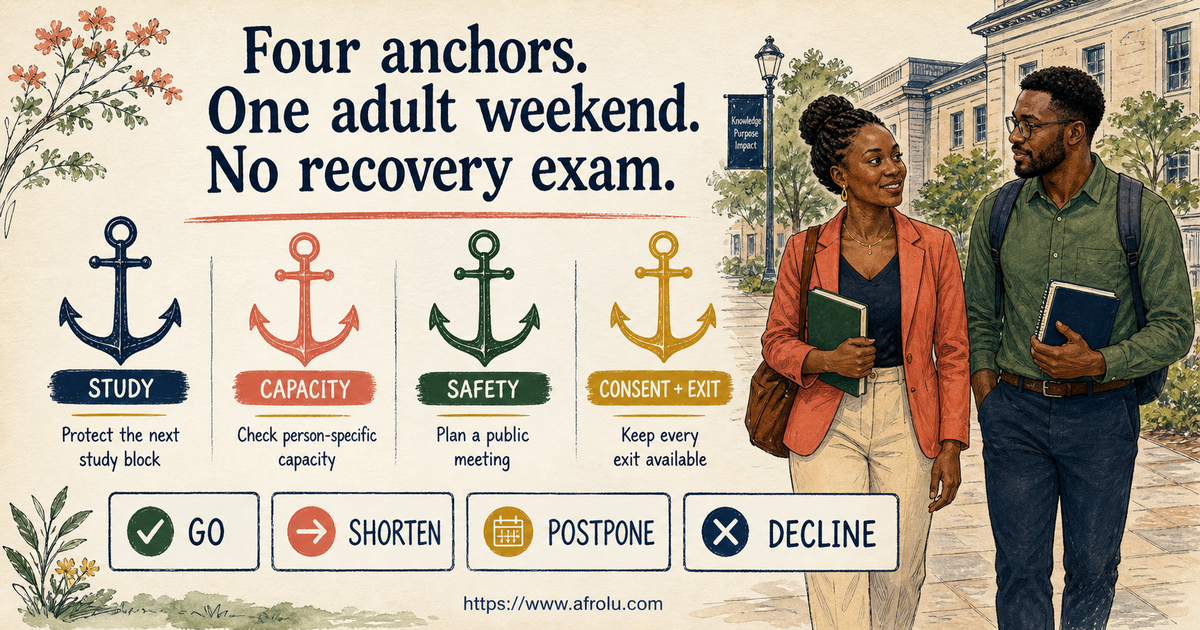
A new date may accompany recovery; it is never responsible for completing it.
Written and edited by Adwoa Boateng · Dating Safety Editor
You do not need to feel nothing or pass a recovery test. Set four independent anchors: STUDY protects the next essential block and sleep; CAPACITY asks whether curiosity is about this person rather than jealousy, numbness or the ex; SAFETY secures a public venue, trusted plan share, money, phone and independent transport; CONSENT + EXIT gives every next step a fresh yes. Keep the date short, the ex outside it and substances under your control. Review after rest if useful. One more date, a shorter date, friends-only contact, pause, decline or qualified support are equal choices. Danger bypasses review.
Starting over · Students
How can an adult student try one weekend date after heartbreak without turning the new person into treatment, losing essential study time or relaxing safety and consent boundaries?
Dating after heartbreak means choosing new romantic contact while recovery from a prior ending may still be underway. There is no universal recovery schedule. A careful reentry date is person-specific, bounded and honest; it does not appoint the new adult to erase grief, provoke an ex or certify readiness.
Njeri, a fictional 27-year-old postgraduate adult, archives an ex's Friday message, completes study, then meets 29-year-old Malik for a public ninety-minute Saturday coffee. He accepts her limit and separate return. After sleep and Sunday study, she chooses one more date without calling the weekend a cure.
The four-anchor adult-student weekend map
Keep study, capacity, safety and consent steady around one small date
Adwoa writes explicitly for adults aged 25-plus and keeps the new person outside the prior relationship's recovery job.
Protect Friday study, bound Saturday logistics, require a fresh yes at every step and assign meaning only after rest if that helps.
Study
Keep the next essential task, deadline and sleep visible.
Capacity
Choose from person-specific curiosity rather than an ex-directed purpose.
Safety
Use a public venue, trusted plan share, money, phone and own return.
Consent + exit
Let coffee, touch, sex, another venue and leaving stay separate.
Separate student life from a recovery exam
A postgraduate adult can date with grief present without proving complete healing
Njeri is 27, completing postgraduate study and making adult dating decisions. Student describes her current work and schedule, not childhood. She may grieve a prior relationship, study successfully and feel curious about Malik at the same time. Mixed feelings do not automatically mean she is unready or using someone.
There is no universal recovery schedule after heartbreak. Research often describes average associations or trajectories in particular samples, not a clock that can certify an individual. Njeri does not need to wait until every memory is neutral. She needs enough capacity to be honest, consent freely, protect ordinary functioning and keep the new adult separate from unfinished negotiations with her ex.
Dating after heartbreak becomes less usable when a new person is assigned to create jealousy, stop all grief, provide constant reassurance or decide whether the breakup was a mistake. Malik deserves to meet Njeri as himself. Njeri deserves to choose him from present curiosity rather than from an urgent need to change what her ex feels.
One low-key weekend coffee can remain small. It need not become sex, a party, a sleepover, exclusivity or a relationship announcement. Njeri can shorten, postpone or decline at any point. Readiness for one public ninety-minute plan is not a promise about Sunday, the semester or the eventual shape of recovery.
Set four anchors before accepting
Study, capacity, meeting safety and consent or exit should hold independently
STUDY asks what must remain intact: Friday's reading block, Monday's lab, sleep and essential work. Njeri does not need perfect concentration after heartbreak, but she notices whether planning the date displaces deadlines or becomes a way to avoid them. She completes Friday study before deciding whether Saturday still feels welcome.
CAPACITY asks why this person and why this date. Curiosity about Malik, willingness to hear his story and ability to accept no support a small yes. An urge to message her ex through the date, compare every trait or make the weekend erase pain supports postponing. Neither answer establishes a diagnosis or moral failure.
SAFETY covers identity, public venue, charged phone, trusted-plan share, money, substances and independent transport. A staffed café in daylight can reduce several practical risks without guaranteeing safety. Njeri buys her own drink, keeps it with her, controls what she consumes and arranges her own return rather than depending on Malik.
CONSENT + EXIT stays active throughout. Agreeing to coffee does not imply alcohol, another venue, physical affection, sex or an overnight stay. Sexual-health conversations happen before sex, not after assumptions. Njeri can change her mind without proving heartbreak, and Malik's no is equally complete. Pressure, threats or blocked exit bypass the ordinary weekend review.
Follow one weekend without making chemistry the result
Njeri protects Friday study, meets Malik briefly and reviews only after rest
On Friday afternoon, Njeri's ex sends a familiar message asking whether they can talk. She feels the old pull and briefly considers mentioning Saturday's date. Instead, she archives the thread, tells a trusted friend she is not answering tonight and completes the study block she had planned. Malik remains outside the ex conversation.
Njeri confirms a Saturday coffee from two until three-thirty at a public staffed venue. She shares the plan with a friend, charges her phone, brings enough money and arranges her own return. She tells Malik she wants one short date and will not move elsewhere afterwards. He says the limit works for him.
During coffee, Njeri notices sadness when Malik asks about favourite music because it recalls her ex. She says she is recently single and wants to keep the date light, without sharing private details as a price of honesty. Malik changes the subject. When he offers another venue, she declines; he accepts and they leave separately.
Njeri waits until Sunday afternoon to decide what the date meant. She slept, finished a reading task and still feels curious about Malik. She chooses one more public date after an upcoming deadline. The Saturday did not cure heartbreak or prove readiness. It showed that one small plan could coexist with study, honesty, consent and a safe return.
Read four anchors across three states
Ready enough, postpone and stop are separate responses rather than one score
STUDY is ready enough when essential work, sleep and deadlines remain available. Postpone when date planning repeatedly replaces required tasks or the next morning cannot be protected. Seek qualified help when distress persistently impairs functioning rather than treating academic productivity as the only measure of wellbeing.
CAPACITY is ready enough when curiosity is person-specific and Njeri can hear a no. Postpone when the date is mainly for jealousy, numbness, comparison or proving worth. Ordinary sadness can remain present. Stop contact with an ex or new date when coercion, threats or repeated unwanted access appears.
SAFETY is ready enough when identity checks are proportionate, the venue is public, funds and phone are available and transport is independent. Postpone when a practical detail cannot be secured. Stop money requests, private controlled venues, match-supplied verification, image pressure or demands for exact residence and timetable data.
CONSENT + EXIT is ready enough when each next step receives a fresh yes and either adult can leave. Postpone sexual activity when health, protection, partners, substances or capacity cannot be discussed. Stop any ignored no, intoxication-based pressure, blocked transport, stalking or threat. Those issues need suitable support, not another date-readiness conversation.

No chemistry, deadline or social pressure can average away an ignored no.
Use adult scripts for a bounded weekend
Ten lines protect study, purpose, venue, consent, health and a complete exit
For CAPACITY: 'I am recently single and want one light date.' 'I am curious about you, not looking for someone to fix the breakup.' These lines offer relevant honesty without turning Malik into counsellor, witness or messenger. Njeri can keep the prior relationship's private details private.
For STUDY + TIME: 'I can meet Saturday from two until three-thirty.' 'I have a deadline next week, so I am not adding another venue.' The date receives a clear beginning and end. Malik can prefer more time and decline; he does not need Njeri's timetable, residence or academic account access.
For SAFETY: 'I meet publicly and arrange my own return.' 'I do not send money, documents or private images.' 'I am keeping my drink with me and choosing what I consume.' These are adult autonomy statements, not accusations. They remain in force whether Malik seems familiar, kind or connected to campus.
For CONSENT + DECISION: 'Coffee does not include sex or an overnight stay.' 'If sex becomes relevant later, we will discuss consent, partners, testing and protection first.' 'I am not ready for another date, so I am closing.' Each line makes the next choice answerable and leaves no required debate.

A weekend invitation can be kind, brief and fully leaveable.
Wait for sleep before assigning meaning
A Sunday review measures cost, choice and safety rather than romantic success
Review STUDY and BODY + MOOD. Did Njeri sleep, eat, move, complete essential work and regain ordinary attention? Feeling sad after a date does not automatically make the date harmful. Persistent, overwhelming or impairing symptoms deserve qualified support rather than repeated dating experiments designed to force a different feeling.
Review DATE EXPERIENCE. Was Njeri interested in Malik as a person? Could she be present without narrating the ex all afternoon? Did Malik accept the ninety-minute limit and another-venue no? A kind date can still receive no second date. A difficult moment can still sit inside an overall respectful experience.
Review SAFETY. Did money, drink choice, phone, identity, venue, transport, sexual consent and exit stay independent? Any ignored no, tampering concern, threat or blocked exit needs suitable safety or emergency support. It should not be balanced against chemistry, an apology or the reader's wish not to overreact.
Choose one more date, a shorter date, a pause, friends-only contact, decline or seek support. Njeri chooses one more date after her deadline. Another reader might pause. None is a recovery grade. The correct size is the smallest honest choice that leaves study, health, consent and ordinary life available.

Review what the weekend cost and protected, not whether it produced a relationship.
Compare nearby experiences without moral ranking
Careful reentry, rebound pressure and unsafe conduct need different next moves
CAREFUL REENTRY means one person-specific date fits current capacity while the new adult remains separate from the prior relationship. REBOUND PRESSURE is not a moral identity; it describes urgency to use a new connection for jealousy, avoidance, reassurance or immediate replacement. The useful question is what the date is being asked to do.
SOCIAL OUTING offers company without a romantic progression decision. FRIENDS-ONLY contact can be explicit when both adults genuinely agree. EX-CONTACT LOOP appears when the new date becomes content for the ex, a reason to reopen messages or a route back into an on-off sexual or emotional pattern. Njeri can pause without condemning herself.
ORDINARY GRIEF includes memories, tears, anger or longing that may rise and fall. These experiences do not alone diagnose illness or prove that dating must stop. Qualified care becomes important when distress is persistent, overwhelming, risky or interfering with functioning. A new date cannot be appointed as treatment.
UNSAFE CONDUCT includes coercion, drink tampering, stalking, fraud, image abuse, threats or blocked exit and requires access-focused support. Continue a bounded date, shorten it, choose friendship, pause or close from purpose and impact. Safety facts never wait for a perfect recovery label or another Sunday reflection.
Eight adult-student moments where heartbreak and weekend choice diverge
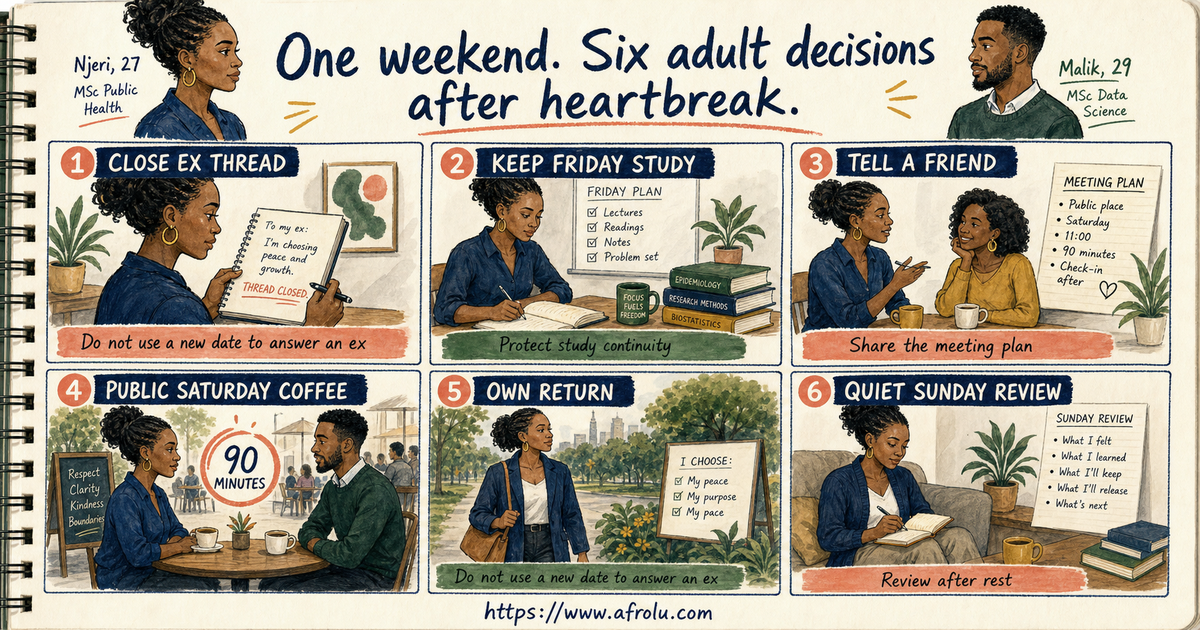
Friday ex message
Unfinished reading
Ninety-minute coffee
Music memory
Second-venue offer
Alcohol expectation
Sunday curiosity
Residence request
Ten signs across study, capacity, safety and consent
Using a new date to create a reaction from an ex
Letting date planning repeatedly replace essential study or sleep
Comparing every detail of the new adult with the prior partner
Feeling unable to hear a no without reopening the ex relationship
Sharing a timetable, residence or academic access too early
Depending on the date for money, transport or a controlled return
Using alcohol or drugs to override hesitation or sadness
Skipping sexual-health and consent conversations because the date is casual
An ignored no, image pressure, threat or blocked exit appearing
Persistent distress or impairment that needs qualified support
Review one weekend through ten independent questions
| Situation | What it may mean | What to do next |
|---|---|---|
| Can essential study remain intact? | Fits: The date fits around protected work and sleep. Needs review: One task needs deliberate rescheduling. Stop: Dating repeatedly replaces required functioning. | Postpone and restore the next essential block. |
| Is curiosity person-specific? | Fits: Njeri wants to know Malik as himself. Needs review: Comparison with the ex is noticeable. Stop: The date exists mainly to provoke or replace the ex. | Pause and separate the two relationships. |
| Can the ex stay outside the date? | Fits: No message or evidence is sent back. Needs review: One trigger needs support. Stop: The new date is used inside an on-off loop. | Close the ex thread and reconsider the weekend independently. |
| Is the plan small and public? | Fits: Time, venue and return are clear. Needs review: One logistical detail needs confirming. Stop: A private or hidden venue is required. | Redesign publicly or decline. |
| Are money and identity protected? | Fits: Each adult controls funds and personal data. Needs review: An intrusive request is refused. Stop: Payments, documents or accounts are pressed. | End access and use appropriate official help. |
| Does substance choice remain free? | Fits: Njeri chooses what to consume and keeps control. Needs review: A suggestion is declined once. Stop: Intoxication is encouraged to lower a boundary. | Leave and seek help if safety is uncertain. |
| Can each next step receive a fresh yes? | Fits: Coffee, touch, sex and another venue stay separate. Needs review: One assumption needs correction. Stop: A no is ignored or exit is blocked. | Prioritise immediate safety and appropriate support. |
| Can sexual health be discussed before sex? | Fits: Partners, testing and protection are answerable. Needs review: The conversation needs more time. Stop: Pressure or secrecy replaces informed choice. | Do not proceed and reassess the contact. |
| Does Sunday preserve choice? | Fits: One more date feels optional. Needs review: More rest would help. Stop: Another date is imagined as the only relief from distress. | Pause and use suitable support. |
| Can decline remain complete? | Fits: Malik accepts the answer. Needs review: One logistical message remains. Stop: Repeated accounts, threats or campus pursuit appears. | Use access controls and appropriate campus or local channels. |
Ten lines for an adult postgraduate date after heartbreak
“I am recently single and want one light date.”
“I am curious about you, not looking for someone to fix the breakup.”
“I can meet Saturday from two until three-thirty.”
“I meet publicly and arrange my own return.”
“I do not share my timetable, residence or academic access.”
“I choose what I consume and I am not drinking to lower a boundary.”
“Coffee does not include another venue, sex or an overnight stay.”
“Before sex, we will discuss consent, partners, testing and protection.”
“I need more time, so I am postponing rather than guessing.”
“I am not ready for another date, so I am closing.”
Know the difference
Careful heartbreak reentry, rebound pressure and ordinary grief need different weekend choices
The new adult is encountered as themselves while study, grief, consent, safety and exit remain independent.
Jealousy, avoidance, social company, ex contact, ordinary grief or unsafe conduct changes what should happen next.
Dating is one available choice after heartbreak, never proof of recovery or worth.

Dating after heartbreak is a choice, not a recovery milestone.
Separate eight nearby post-breakup experiences
| Type or dimension | What it describes | Best next question |
|---|---|---|
| Careful reentry | One person-specific date fits present capacity without carrying the prior relationship. | Keep the plan bounded and reassess after rest. |
| Rebound pressure | A new connection is urgently asked to create jealousy, numb grief or replace identity. | Pause and widen support without applying a moral label. |
| Social outing | Company is the goal without a romantic progression decision. | Name the non-romantic scope honestly. |
| Friends-only contact | Both adults explicitly choose connection without romantic trajectory. | Keep the agreement mutual rather than strategic waiting. |
| Ex-contact loop | The new date becomes evidence, a messenger or a route back into on-off contact. | Separate the relationships and protect access. |
| Ordinary grief | Memories and sadness rise without establishing illness or dating failure. | Use ordinary support and seek care when functioning is persistently affected. |
| One difficult date | A respectful outing feels emotionally hard without creating a repeated pattern. | Rest, decline or try a smaller plan according to fit. |
| Unsafe conduct | Coercion, tampering, stalking, fraud, image abuse or blocked exit creates danger. | Prioritise access, evidence and appropriate official help. |
Use the four-anchor weekend map in six practical moves
Keep adults explicit
Student context never turns a 27-year-old reader into a child or campus stereotype.
Use four anchors
Study, capacity, safety and consent or exit each need to hold.
Separate the ex
A new date does not become proof, messenger or treatment for the breakup.
Choose one bounded plan
A public ninety-minute coffee can be the whole decision.
Review after rest
Sunday evidence matters more than a chemistry rush or fear reaction.
Escalate precisely
Qualified care addresses impairment; safety channels address dangerous conduct.
Questions for study, capacity, safety and consent
Choose a few prompts that fit the moment. This is a reference library, not a list to complete.
Study
Protect the adult student's working life.
- What task is essential?
- What sleep is needed?
- Can the date stay bounded?
- What deadline follows?
- Would postponing protect choice?
Capacity
Keep the new adult separate from the ex.
- Why this person?
- Why this weekend?
- Can I hear no?
- Am I seeking jealousy?
- What grief can remain?
Safety
Make the plan independently leaveable.
- Is the venue public?
- Who knows the plan?
- Is the phone charged?
- Is money available?
- Who controls the return?
Consent
Require a fresh choice at every step.
- What does coffee include?
- What substance choice is free?
- What health talk is needed?
- Can either adult stop?
- Which conduct ends access?
What breakup research and current health guidance can support
A longitudinal study examines attachment, coping and breakup distress
The Canadian emerging-adult study follows coping and symptoms after breakups and supports attention to varied strategies and functioning.
Evidence limit: Its mostly student sample and group associations cannot set Njeri's readiness date.
A daily-diary study examines relationship dissolution and university life
The research considers affect, university activities and alcohol use around long-distance relationship status and dissolution.
Evidence limit: The sample does not prove what one weekend or one new date will cause.
A longitudinal study tracks distress and life satisfaction after unmarried breakups
The study reports average within-person changes after relationship dissolution while showing that experiences differ by context.
Evidence limit: Average changes cannot diagnose a reader or create a universal recovery schedule.
WHO explains stress effects and support thresholds
Official guidance covers mind-body effects, ordinary coping and seeking health care when functioning or coping becomes difficult.
Evidence limit: It is not a relationship prescription or campus safety plan.
CDC recommends partner conversations before sex
Current official guidance supports discussing partners, STI testing and informed choices before sexual activity.
Evidence limit: U.S. public-health guidance should be adapted with relevant local clinical advice.
FTC guidance keeps money outside online romantic trust
Official consumer guidance describes trust-building before money requests and recommends refusing funds or investment access.
Evidence limit: The U.S. source cannot verify a match or replace local reporting channels.
Six ways one weekend becomes a recovery exam
Waiting to feel nothing
Readiness becomes emotional perfection. Repair: assess one bounded choice today.
Using the date as ex evidence
A new adult enters the old relationship. Repair: keep the connections separate.
Treating students as teenagers
Adult agency disappears. Repair: write and plan for 25-plus adults.
Letting chemistry extend the plan
A safe boundary becomes optional. Repair: require a fresh yes for every step.
Using substances to prove readiness
Capacity is intentionally reduced. Repair: choose consumption independently.
Grading the weekend
A second date becomes a pass mark. Repair: keep pause and decline equally complete.
Use a reviewed resource that matches the decision
This guide focuses on the relationship decision, so it does not rank dating apps. Check current prices, safety tools, and local availability before choosing a service.
Explore the guide library
Show more related guides
Continue with Afrolu
Show more Afrolu guides
Breakup studies, stress guidance, sexual health and fraud safety
Afrolu reviewed these health, research, safety, or public guidance resources while editing this page. They support the behaviour and safety guidance; they do not diagnose any individual described by a reader.
Adult-student heartbreak and weekend-safety questions
Can an adult student date before feeling fully over an ex?
Yes. There is no universal recovery schedule or requirement to feel nothing. Ask whether one person-specific bounded date fits current capacity, whether essential study and sleep remain available, and whether the new adult stays separate from unfinished ex contact. Mixed feelings are information, not an automatic diagnosis or failure.
How old are the students in this guide?
They are fictional postgraduate adults: Njeri is 27 and Malik is 29. Every dating and image scenario is explicitly adult. Student status describes their study context and schedule; it does not reduce consent, privacy, financial autonomy or the right to set and change every boundary.
Is dating quickly after a breakup always a rebound?
No. Rebound is an imprecise popular label, not a moral or clinical verdict. Focus on purpose and effect. A person-specific date that leaves study, ordinary life and choice intact differs from urgently using someone for jealousy, numbness, reassurance or immediate replacement. Either route can be paused without shame.
How should I protect study time before a weekend date?
Name the essential Friday and Monday tasks, sleep needs and the date's firm start and end. Complete or deliberately reschedule work before confirming. If planning repeatedly replaces required functioning, postpone. Academic output is not the only wellbeing measure, and persistent impairment deserves qualified support.
What is a safer first weekend plan?
Choose a staffed public venue, a clear duration, enough money, a charged phone, a suitable trusted plan share and independent transport. Keep residence, timetable and academic access private. These steps reduce practical risk but cannot guarantee safety. Leave whenever consent, comfort or exit changes.
Should I drink to relax after heartbreak?
No substance is required for a date or proof of readiness. Choose what you consume, keep control of your drink and do not use alcohol or drugs to push through hesitation or lower a boundary. A person who pressures intoxication or ignores reduced capacity creates a safety concern, not romantic support.
How much should I tell a new date about the breakup?
Share only present-relevant context, such as being recently single and wanting a light pace. You do not owe private history, screenshots, sexual details or a full explanation to be honest. Malik can ask whether the available scope fits without becoming counsellor, judge or messenger to the ex.
What sexual-health conversation is needed?
Before sex, discuss consent, current partners, STI testing, protection and any information needed for an informed choice. Coffee, physical affection, sex and an overnight stay are separate decisions. Consent can change at any point, and substance-impaired or pressured agreement is not a substitute for a freely chosen yes.
When should I decide about a second date?
There is no required wait. Njeri chooses Sunday after sleep because it helps her distinguish chemistry from overall cost. Review study, body and mood, person-specific curiosity, boundary response and safety. One more date, a shorter plan, friends-only contact, pause or decline are all complete adult choices.
When should I seek additional support?
Seek qualified health care when distress is persistent, overwhelming, risky or interfering with daily functioning. Coercion, drink tampering, stalking, fraud, image abuse, threats or blocked exit require appropriate campus, platform, financial, legal or emergency help. Those concerns bypass an ordinary Sunday reflection.
One thing to do now
Choose one honest adult step without grading your recovery
Continue when one person-specific bounded date preserves study, honest capacity, informed consent, public safety and exit. Shorten, postpone or decline when the date is carrying the ex, avoiding essential functioning or exceeding capacity. Seek qualified care for persistent impairment and appropriate safety or emergency support for coercion, tampering, stalking, fraud, threats, image abuse or blocked exit.