The four-zone safety map
Keep a Nairobi Student Relationship Safe Across Distance
A Nairobi safety plan for adult students dating across distance: study rhythm, identity checks, fare requests, public visits, consent and exits.
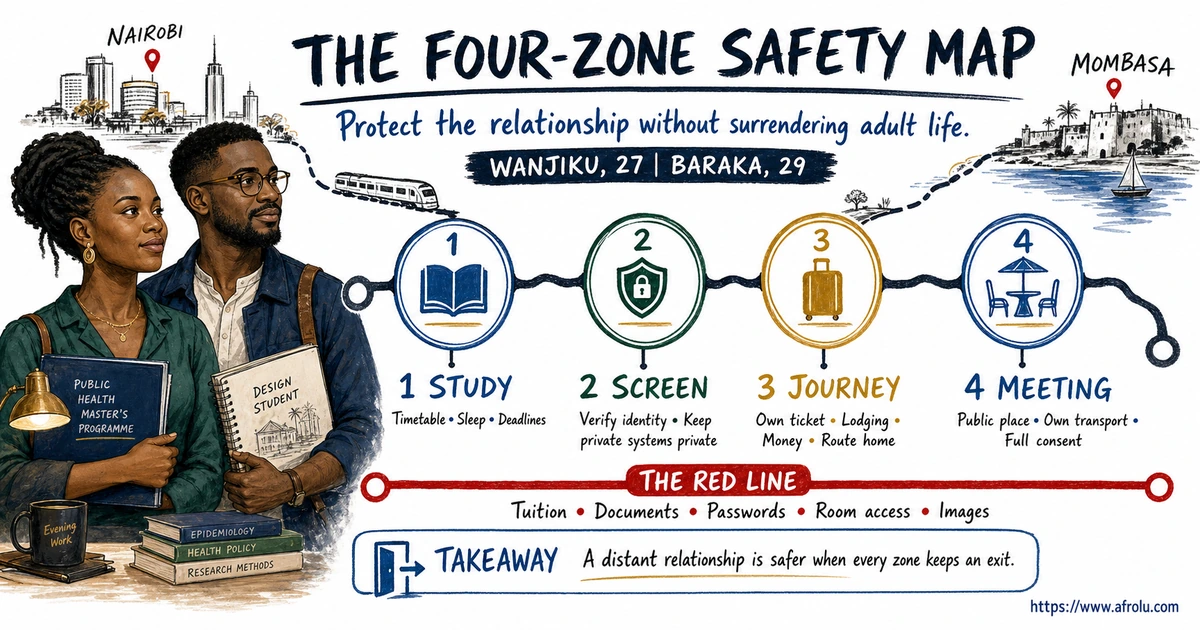
Protect study, screen, journey and meeting zones separately. A distant relationship is safer when every zone keeps an exit.
Written and edited by Thabo Mokoena · Dating Trends Editor
Protect four zones instead of trying to solve the whole relationship with more messages. In the study zone, put both calendars beside the contact plan and agree what changes during exams, placements, shifts, illness, or poor connectivity. In the screen zone, build identity evidence through consistent details and ordinary live contact while keeping passwords, student portals, room access, live location, documents, and intimate images private. In the journey zone, each adult controls their ticket, lodging, device, medication, money, and return route. Do not send fare, device, tuition, visa, emergency, or investment money because a romantic story feels urgent; pause and verify through a channel you found independently. In the meeting zone, start in a staffed public place, use independent transport, share a limited check-in with someone trusted, and keep an end time that either adult may shorten. Travel expense creates no right to a residence room, sex, more time, account access, or exclusivity. After the visit, wait until both adults are safely home, then compare what happened with the agreement. Long-distance dating can be healthy, but distance itself proves neither love nor danger. The useful evidence is truthful planning, accepted limits, mutual effort, safe repair, and a path that leaves both adult lives intact.
Distance and diaspora · Students
How can a Nairobi student let a distant relationship grow without giving away study time, tuition, private information, travel control, or consent?
Long-distance dating means two adults have limited routine in-person access because they live far enough apart that meeting requires planning. It describes geography, not commitment. Student describes a real schedule and money context, not reduced adult agency. Nairobi describes the home base for this guide, with traffic, varied transport, housing rules, coursework, work, and city costs affecting the plan. Exclusivity, seriousness, contact frequency, financial help, digital access, physical consent, and a future city remain separate agreements.
Wanjiku is 27 and completing a public-health master's programme in Nairobi while working two evening shifts each week. Baraka is 29 and studying design in Mombasa. They met during an online professional seminar and have talked for nine weeks. Their calls are warm, but the plan strains during Wanjiku's assessment month. Baraka first hears shorter calls as fading interest; Wanjiku hears late-night spontaneity as one more demand on sleep. They place both timetables on one page and choose a lighter exam rhythm. Before Baraka's first Nairobi visit, they confirm identity details again, choose a staffed daytime meeting place, and keep lodging and travel separate. A message from a new number then asks Wanjiku to send urgent fare because Baraka's phone is said to be damaged. She sends nothing and checks through their usual video channel. Baraka is fine; the new number is not his. The visit continues using the original plan. They meet publicly, keep a stated end time, and separate after lunch before choosing a second daytime walk. Their strongest evidence is not the number of messages or the distance travelled. It is that a study limit, a money pause, a public plan, and a change of pace could all be accepted without punishment.
The four protected zones
Keep study, screen, journey, and meeting decisions separate
A long-distance connection can make every problem feel like a test of love. The map turns one emotional question into four practical areas that can be reviewed calmly.
Draw four zones on one page. Write what each adult controls, what evidence exists, what remains private, and what would cause a pause. A problem in one zone does not need to unlock access in another.
Can the relationship fit two real timetables?
Protect lectures, research, paid work, placements, sleep, worship, care, and exam periods before choosing a sustainable contact rhythm.
Can identity grow without digital access?
Use consistent details and ordinary live contact. Keep portals, passwords, documents, room codes, location, devices, and intimate images under personal control.
Can both adults travel and return independently?
Confirm the person, city, date, public first plan, lodging, budget, check-in, and return route before either adult books.
Can the first visit preserve a complete no?
Start publicly, keep independent transport, and remember that fare, gifts, food, or distance travelled never purchase access or consent.
Protect the study zone
Build contact around the timetable, not through it
Mark immovable commitments first: classes, labs, library blocks, deadlines, placements, paid work, care duties, faith practice, sleep, and safe travel home. The time left is the honest relationship budget. A free hour is not automatically available; it may be needed for food, exercise, friends, or recovery.
Choose a minimum rhythm for demanding weeks and a wider rhythm for lighter ones. Wanjiku and Baraka use one planned video call, two short voice notes, and a message when a plan changes during assessment month. The agreement protects connection without turning delayed replies into a loyalty test.
When a timetable changes, name what moved and offer the next workable point. A calm reschedule is useful relationship evidence. Staying online while exhausted, missing a deadline, or sharing a live calendar password to prove availability is not.

Study and safety can stand together when agreements are named, exam changes are repaired, identity is consistent, private systems stay private, travel is complete and every no is accepted.
Protect the screen zone
Verify the person without handing over a private life
Look for stable names, stories, voice, appearance, broad location, study or work context, and ordinary contact over time. A live video call adds information but cannot prove every relationship, financial, travel, health, or identity claim. Use independent public sources only when a claim genuinely needs checking.
Do not send a student card, national document, passport page, bank screen, class roster, residence address, room code, live route, password, one-time code, or intimate image to prove trust. If a platform account or number changes, verify through a previously trusted channel before replying, paying, or sharing new information.
Healthy privacy is not deception. Each adult may keep private systems private while answering reasonable relationship questions directly. Surveillance is not a substitute for trust, and constant location access does not make a distant relationship safe.

A clear line protects the next choice. State the exam rhythm, verify account changes, keep travel independent, protect the residence and hold the end time.
Protect the journey and meeting zones
Plan the first Nairobi visit through six checkpoints
Checkpoint one is identity; two is a complete date and city; three is a staffed public first venue; four is independent lodging; five is transport and a safe return; six is a limited check-in with someone trusted. Confirm all six before either adult leaves.
Plan for Nairobi reality without making one adult dependent on the other. Traffic, rain, a delayed bus, train, flight, or ride can change timing. Each adult should have a charged device, essential medication, enough unshared money, and an alternative that does not require access to a residence room or another person's account.
Start with a short public meeting and preserve the end time. A second plan can be chosen after both adults have had room to think. The traveller is not owed a longer date, a home stay, sex, or immediate commitment because the journey required money and effort.

The safe visit begins before anyone leaves. Complete six checkpoints and verify a changed account through the usual channel before money or information moves.
Keep three safety lines bright
Fare, intimate images, and physical consent are separate decisions
Treat urgent fare, device, tuition, hospital, visa, family, investment, or account requests as claims to verify, not relationship exams. Do not transfer from tuition, rent, food, transport, or borrowed money. A genuine problem can still be handled without requiring a new romantic partner to become the emergency fund.
Digital consent is specific and reversible. No adult owes a private image. Do not pressure, forward, save beyond an agreement, threaten, or use an image as identity proof. If image pressure or threats occur, preserve useful evidence, restrict access, use platform tools, and seek appropriate local support.
Physical consent is also specific and can change at any moment. A serious label, exclusive agreement, expensive trip, gift, lodging cost, meal, or earlier yes does not create a later yes. Keep sexual-health conversations and qualified care relevant to the activity, not the label.
Finish after both are home
Use a 48-hour return review before the next booking
First confirm that both adults are safely home and practical items are closed. Do not demand an immediate relationship verdict from a bus, train, airport, or exhausted arrival. Choose a review point within 48 hours when both can think and speak privately.
Review four facts: Did the timetable and end time hold? Did identity and plans remain consistent? Were money, privacy, residence, transport, images, and physical boundaries respected? Could a delay, difference, or no be repaired without guilt or punishment? Then name one next step only.
The next step may be another public date, a slower contact rhythm, clarification of exclusivity, a pause while facts are checked, or a clear ending. A safe review does not reward travel by automatically increasing access. It lets evidence, not distance travelled, decide.

Get home, close practical items and rest. Then review time, truth, safety and repair before choosing one next step. Distance travelled does not decide access.
Four moments when distance pressure crosses a protected zone
A late call collides with tomorrow's presentation
Wanjiku wants connection but needs sleep and a final study block. Baraka feels the sudden change and asks whether interest has faded.
Use the exam rhythm: name the deadline, shorten tonight's contact, and confirm the next call.An urgent fare request arrives from an unfamiliar account
The message uses Baraka's name and visit details, but asks Wanjiku to transfer immediately before a supposed transport deadline.
Send nothing. Verify through the usual channel and check the booking independently.Saving lodging money would remove Wanjiku's private space
A room stay looks cheaper, but housing rules, privacy, sleep, and a safe exit have not been agreed.
Keep lodging independent and make the first meeting public, even if the visit becomes shorter.The first date is warm, but one adult wants to end on time
Baraka suggests extending the day; Wanjiku still wants the planned break and return check-in.
Keep the end time without apology. Choose a later second plan only after both have space.Six signs the relationship can hold study and safety together
Both adults can state the relationship direction and whether either may date other people.
Contact changes for exams, work, sleep, illness, and connectivity without punishment.
Identity details remain consistent across ordinary contact and reasonable independent checks.
Tuition, rent, food, transport, accounts, documents, and devices stay under personal control.
A first visit has a public venue, separate lodging, independent transport, and a return plan.
A no about time, money, images, location, a room, touch, sex, or commitment is accepted fully.
Choose the response that protects the affected zone
| Situation | What it may mean | What to do next |
|---|---|---|
| A planned call overlaps an assessment or placement change. | Two real calendars need repair; the change alone does not prove rejection. | State the constraint, offer the next workable point, and watch whether the update is accepted. |
| A new number or account asks for urgent fare or device money. | The request may be mistaken, compromised, manipulated, or genuine; urgency does not verify it. | Send nothing, use the established channel, and verify any booking or institution independently. |
| A live video call has happened, but identity details keep changing. | One useful check cannot resolve recurring contradictions. | Pause travel and access until the mismatch has a credible, checkable explanation. |
| The visitor expects a residence room because separate lodging costs more. | Financial convenience is being placed above housing rules, privacy, and a reversible first meeting. | Keep the address private, retain separate lodging, or postpone the visit. |
| An intimate image is requested as proof of trust or exclusivity. | Digital access is being confused with relationship evidence. | Decline. Restrict access and seek support if pressure, sharing, or threats follow. |
| The first public visit ends on time and both adults check in safely. | The plan protected warmth and independent choice at the same time. | Review within 48 hours and choose one evidence-sized next step. |
Five lines for exams, identity changes, travel, residence, and time
“My assessment week starts Monday. I can call Wednesday at 8 p.m. and send one update if that changes.”
“I will not pay or share information through a new number until we verify it on our usual channel.”
“We will each control our ticket, lodging, money, documents, device, and return route.”
“My residence and room are private. We can meet at the confirmed public place.”
“I am leaving at the time we agreed. We can discuss another date after we are both home.”
Know the difference
Long-distance dating or an online-only talking stage?
Two adults have a mutual dating agreement despite limited in-person access. Identity evidence, contact, boundaries, visits, and the direction of the relationship can be discussed.
Two adults are communicating and exploring interest online, but may not yet have a dating, exclusivity, visit, or future agreement. It can be valid when named honestly.
Screens do not decide the type. The present mutual agreement does.

Long-distance dating and an online-only talking stage can both be honest. Screens do not decide the type; the present mutual agreement does.
Six nearby connection types that can all happen through a screen
| Type or dimension | What it describes | Best next question |
|---|---|---|
| Long-distance dating | A dating connection with geographically limited routine access. | What are our present agreement, rhythm, visit safeguards, and review point? |
| Online-only talking stage | Remote communication while mutual dating status or direction may still be open. | Are we talking, dating, exclusive, or deciding? |
| Serious long-distance relationship | The adults name a committed direction while practical compatibility still develops. | What current evidence supports the serious direction? |
| Exclusive long-distance dating | Both agree not to date others; it does not automatically settle relocation or commitment. | What does exclusivity cover online and during visits? |
| Commuter relationship | Partners maintain separate weekday homes and reunite on a chosen or necessary rhythm. | Is the two-home pattern temporary, chosen, and workable? |
| Romance manipulation | Affection or a future story is used to obtain money, access, secrecy, documents, or control. | Stop transfers and access; preserve evidence and seek appropriate support. |
Draw the four-zone map before the first Nairobi visit
Map the four zones
Write study, screen, journey, and meeting decisions separately so pressure in one area cannot unlock another.
Use a minimum exam rhythm
Choose contact that survives an ordinary demanding week without using grades, sleep, or instant replies as proof of love.
Verify changes through an old channel
A new number, account, fare request, or identity detail earns a pause before money or information moves.
Keep the first visit reversible
Each adult controls lodging, transport, documents, device, money, physical consent, and a complete route home.
Review after safe return
Compare behaviour with the agreement within 48 hours, then choose one next step rather than rewarding travel with access.
Questions for the timetable, screen, journey, and return
Choose a few prompts that fit the moment. This is a reference library, not a list to complete.
Map the study and screen zones
Answer these before travel planning begins.
- Which hours belong to class, work, sleep, worship, care, friends, and recovery?
- What minimum contact can both adults sustain during a demanding week?
- Which identity details are consistent, and which important fact still needs checking?
- Which accounts, documents, images, locations, and systems remain private?
Map the journey and meeting zones
Complete these before either person books.
- Who controls each ticket, lodging choice, payment, document, and return route?
- Where is the staffed public first meeting, and when does it end?
- Who receives the limited arrival and departure check-in?
- What happens if transport, identity, health, weather, or consent changes?
Run the 48-hour return review
Compare evidence after both adults are safely home.
- Did the study rhythm, end time, money limit, and independent return hold?
- Did identity, plans, and ordinary behaviour remain consistent?
- Could either adult say no or change a plan without punishment?
- Is the next step another visit, a slower rhythm, clarification, a pause, or a clear stop?
Four shortcuts that make distance more expensive
Using constant contact as identity proof
Frequent messages can still coexist with changing details, private-system requests, or an account that has been compromised.
Taking fare from essential student money
A visit that consumes tuition, rent, food, study tools, or safe return money is not an affordable plan.
Making the residence room the safety backup
Housing rules, privacy, rest, and a reversible first meeting need protection even when independent lodging costs more.
Increasing access automatically after travel
A long journey does not earn passwords, images, sex, more time, exclusivity, or immediate commitment.
Use a reviewed resource that matches the decision
This guide focuses on the relationship decision, so it does not rank dating apps. Check current prices, safety tools, and local availability before choosing a service.
Explore the guide library
Show more related guides
Continue with Afrolu
Show more Afrolu guides
Sources behind the distance, digital, scam, and health notes
Afrolu reviewed these health, research, safety, or public guidance resources while editing this page. They support the behaviour and safety guidance; they do not diagnose any individual described by a reader.
Nairobi Student Long-Distance Dating: Questions
Can long-distance dating work while studying in Nairobi?
It can when contact fits both adult timetables, money remains affordable, identity and plans are checked, visits preserve independent exits, and the relationship has a mutual present agreement. Distance alone cannot promise an outcome.
How often should adult students in a long-distance relationship call?
There is no universal quota. Choose a minimum rhythm for demanding weeks and agree how exams, placements, shifts, illness, travel, sleep, and poor connectivity change it.
Should I send M-PESA fare for a first visit?
Do not use tuition, rent, food, borrowed money, or safe return funds. A safer first plan lets each adult control and afford their own travel; urgent payment claims should be paused and verified independently.
Is one video call enough to verify a distant partner?
No. It adds evidence but cannot prove every identity, relationship-status, financial, travel, study, work, or safety claim. Look for consistent ordinary details and verify important changes through trusted channels.
Should a distant date stay in my student residence?
Not because it is cheaper or expected. Protect housing rules, your address, sleep, privacy, and a safe exit. Separate lodging and a public first meeting may be the better plan at any stage.
Does daily contact mean we are exclusive?
No. Contact frequency and exclusivity are different. Both adults need to agree when exclusivity begins and what it covers online, during visits, and with other partners.
What if a new number asks for urgent help using my partner's name?
Do not pay or share information. Contact your partner through the established channel and verify any booking, institution, or provider through contact details you found independently.
Should I share an intimate image to prove trust?
No adult owes an intimate image. Digital consent is specific and reversible, and identity should not be tested through private content. Seek appropriate support if pressure, threats, or non-consensual sharing occurs.
When should we discuss living in the same city?
Discuss the broad direction early enough to reveal a major mismatch, then research graduation, work, registration, housing, family, cost, and personal preference before either adult promises to move.
When should I cancel a planned visit?
Cancel or pause when identity contradictions, private-venue pressure, missing lodging or return details, money requests, document demands, stalking, threats, image pressure, or ignored consent removes safe choice.
One thing to do now
Keep every zone clear enough to choose the next step
Proceed one zone at a time when identity details remain consistent, limits are accepted, costs are affordable, and each adult controls their own exit. Slow down when a timetable, relationship label, fare, lodging plan, or identity detail is unclear. Cancel or step away when urgency, secrecy, threats, surveillance, document requests, money pressure, image pressure, or ignored consent reduces safe choice.