Quiet-hours discernment · faith and career
Protect Faith, Career and Clarity From Dating-App Burnout
A practical faith-aware guide to dating-app burnout that protects prayer, career focus, rest and privacy while building one clear, leaveable dating next step.
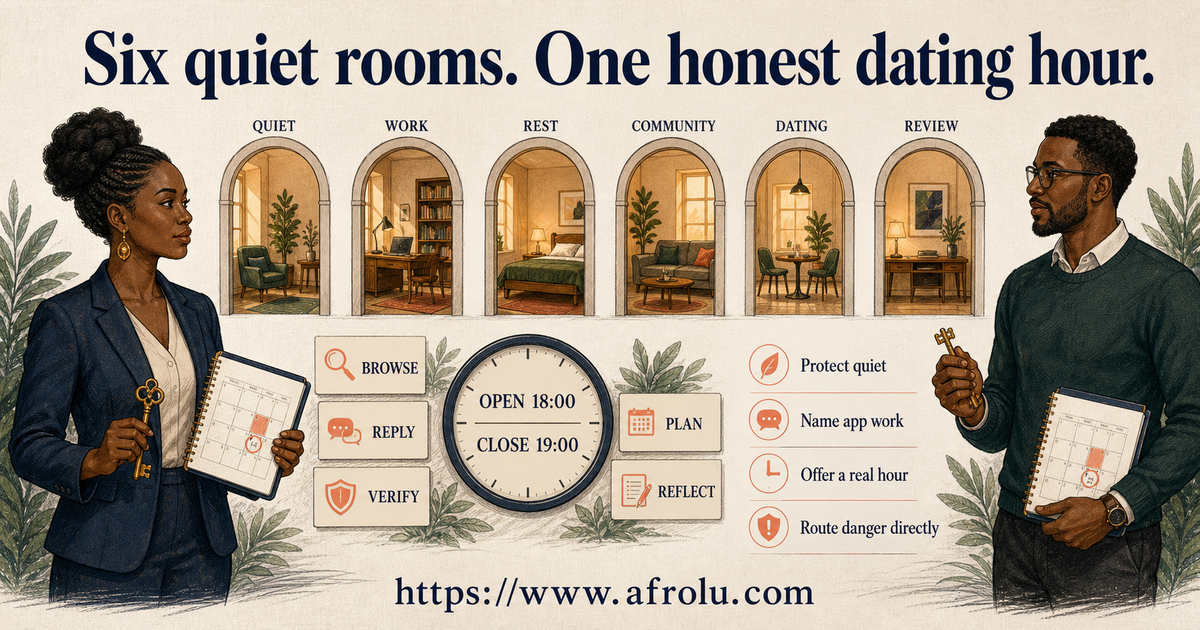
Clarity begins when a dating task receives one honest hour instead of borrowing every quiet moment.
Written and edited by Samira Benali · Faith and North Africa Editor
Open six separate rooms: QUIET, WORK, REST, COMMUNITY, DATING and REVIEW. Give dating one real clock. Separate browse, reply, verify, plan and reflect. Share broad availability, not private practice or work files. Keep one wanted thread and one leaveable public plan. Then CONTINUE ONE, SLOW, PAUSE APPS, CHANGE FORMAT, CLOSE or SEEK HELP. Persistent impairment belongs with qualified care; fraud, threats, tracking and force go directly to protection.
Dating wellbeing · Faith-Led Daters
How can a faith-led working adult reduce dating-app load while keeping belief private, career systems protected and one next dating step clear?
Here, dating-app burnout is non-diagnostic shorthand for unwanted browsing, replying, checking and planning work. It is not WHO's occupational burn-out category, a faith verdict or a medical conclusion. Career strain, spiritual discernment, low interest, mismatch, persistent impairment, romance fraud and unsafe control need different routes.
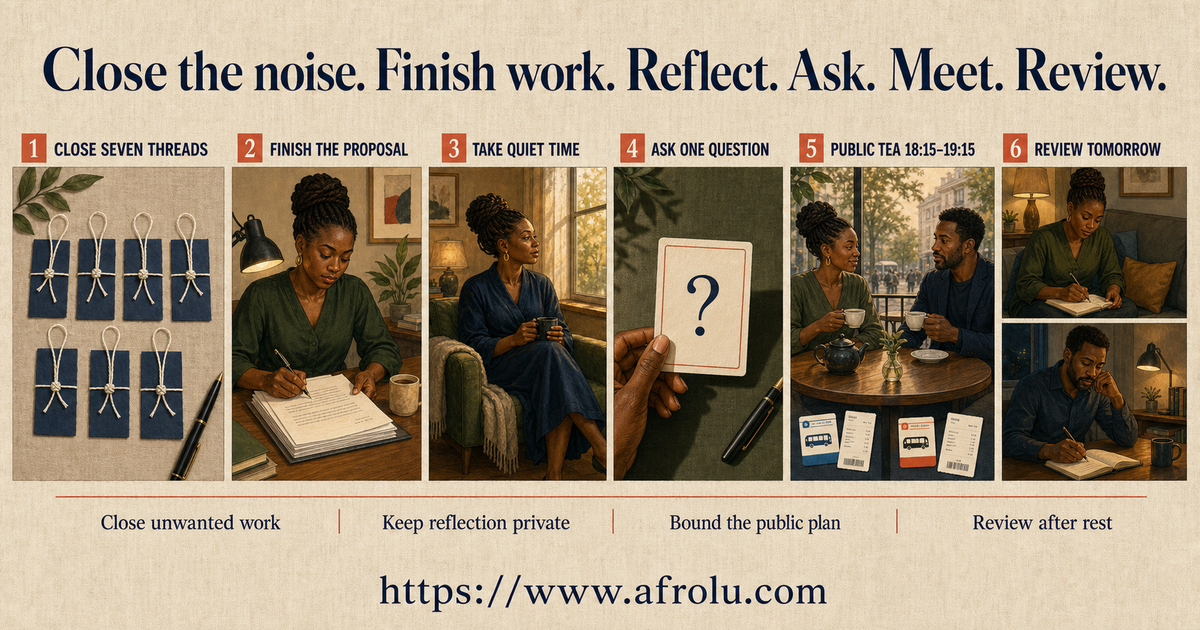
Salma, 35, closes seven unwanted threads, completes a work proposal and takes private quiet time before offering Elias, 39, one public tea from 18:15 to 19:15. They travel and pay separately. She later keeps one Sunday call, while every person, job, belief and event remains fictional.
The faith-and-career quiet-hours discernment room
Give belief, work, rest and dating separate doors
Samira treats faith as freely chosen context, not a score, promise or reason to override ordinary adult boundaries.
Name the task, protect the room it borrows from, offer one real dating hour and follow the highest-risk fact first.
Protect quiet
Reflection can remain private and unproved.
Protect work
Focus, files and networks stay outside a new match.
Offer one hour
Availability gains a beginning and an ending.
Choose freely
Continue, slow, pause, change, close or seek help.
The notification is not a calling
Name the app work that is borrowing from faith, career and rest
A faith-led adult may want to answer kindly, avoid careless endings and make room for reflection. A career may also demand focus, travel or recovery after a difficult day. When every notification feels like a moral duty, dating work can spread into both spaces. That spread is a capacity problem, not evidence of weak values.
Write the task before judging the feeling: browse, reply, verify, plan, meet or reflect. Note what it interrupted and whether you still chose it. A delayed reply may come from work strain, low interest, a pace mismatch or ordinary fatigue. The narrowest description gives you a smaller, fairer next move.
Faith-aware clarity is not vague access. It is a real offer that respects belief without recruiting belief as pressure. You may want shared values and still keep prayer, advisers, community and private doubts outside a new match. The other adult may need a different rhythm. That is a compatibility question, not a spiritual failure.
Try one small change for a real week. Close one app function, protect one work block or answer only inside the hours you named. Then notice what changed without forcing a lesson. If interest returns, you have capacity evidence. If relief comes from closing completely, that answer can be equally honest and faithful.
Open the quiet-hours room
Give six parts of life a door before dating receives one clock
At the dating clock, separate BROWSE, REPLY, VERIFY, PLAN and REFLECT. Browsing creates no duty to reply. A reply creates no meeting. A live check grants no work files, home address or account code. Shared faith creates no claim over money, touch, community introductions, private practice or another date.
Set opening hours you can really keep. Salma chooses Wednesday and Sunday evenings, then closes the app. She does not publish her job schedule or private reflection routine. Elias can accept the rhythm, suggest another one or leave. Clear hours prevent courtesy from becoming an all-day promise that neither adult freely made.
Review after the room is quiet. Ask whether one change restored focus, rest or voluntary interest. If the strain remains across settings, do not force the app to explain it. If money requests, threats, tracking or defeated closure appear, skip the ordinary review. Protect accounts, movement and contact with help suited to the location.
Trusted people may support the review, but they do not own the room. Choose someone who can hear a boundary without turning it into gossip, doctrine or a command. Share only the facts needed for help. An adviser can offer perspective; the adult still decides whether to continue, slow, pause, close or seek specialist support.
Salma closes seven open loops
A fictional after-work tea shows what one honest hour can and cannot prove
On Tuesday, Salma sees seven app conversations she no longer wants. She closes them without offering a spiritual explanation. One thread with Elias remains because his questions are answerable and his plans are specific. She finishes a proposal, takes private quiet time and asks whether he wants one public tea after work.
They choose 18:15 to 19:15 in a generic public place. Each controls transport and ordinary costs. Neither shares a workplace, home, live route, banking detail or private community contact. Tea agrees only to tea. A thoughtful conversation cannot verify future conduct, and a shared value cannot grant another kind of access.
The next day, Salma reviews after sleep rather than inside the chat. She enjoyed the hour and Elias respected its ending, so she offers one Sunday call. The story would remain complete if she paused or closed. The useful outcome is a free next decision with career focus and private faith intact, not continuation itself.
Elias is not a prize for Salma managing her week, and he does not earn access by accepting one boundary. He remains free to want more contact or to leave. One respectful hour is only one piece of evidence. Each later request for time, community, money, touch or future still needs its own voluntary answer.
Read fifteen lamps without making a score
Observe capacity, intent, reciprocity, career impact and safety after one limit
Capacity is workable when quiet and rest survive, app hours close and replies remain chosen. Intent is clearer when serious hope, casual structure or uncertainty can be named without a moral speech. A person may share your values and still want a different pace. Honest mismatch is safer than agreement performed to keep approval.
Reciprocity is visible when questions, plans and changed times travel both ways. Career boundaries hold when work files, employer details, schedules and professional contacts remain optional. A match can be disappointed. The key fact is whether the limit changes the request, or whether praise, guilt and spiritual language keep reopening the same access.
Safety is not the last point on a pleasant scorecard. Requests for money, passwords or sensitive documents need direct protection. Threats, stalking, forced contact or new channels after closure change the question. Preserve useful evidence where safe, secure devices and funds, and use suitable platform, financial, legal, health, safety or emergency support.
Keep notes about your own experience, not a secret case file on another adult. Write the stated limit, what followed and how your week changed. Avoid surveillance, loyalty tests and endless screenshots of harmless ambiguity. A short record can clarify repeated pressure, while direct danger already justifies action without waiting for more lamps to appear.

No kind message or shared value cancels money pressure, tracking, threats or defeated closure.
Use words that leave both adults free
Twelve scripts keep faith, work, money, meetings and closure separately answerable
For intent, say: 'I want faith-aware dating with clear, mutual plans.' For time: 'I check this app on Wednesday and Sunday evenings.' For quiet: 'My reflection time is private and does not need proof.' These lines welcome shared values while refusing the idea that constant contact measures seriousness or care.
For career privacy: 'I am offline during focus blocks and will offer another time.' Add: 'I can do one live call; I do not share work files or codes.' For money: 'I do not send fares, fees, gifts or account access.' A sincere match can answer the boundary without receiving sensitive proof.
For the date: 'I can meet in public from 18:15 to 19:15.' Add separate transport and specific consent. To pause: 'I am pausing the app without promising a return date.' To finish: 'I am ending romantic contact and closing this channel.' Closure does not need a faith verdict, diagnosis or career excuse.
A script is an offer, not a spell. The other adult can understand it and still want something different. You do not need to repeat the same sentence until they agree. One fair counteroffer may deserve an answer; repeated pressure is new evidence. When words increase risk, stop explaining and protect access instead.

A calm limit leaves both adults free to accept, counter or close.
Choose one door, not a life sentence
Continue, slow, pause, change format, close or seek the right help
PAUSE APPS when you want quiet with no promised return date. CHANGE FORMAT when a public introduction, scheduled call or offline community route better fits. CLOSE when interest, pace or values do not fit. You do not need proof of burnout. A respectful ending can be complete even when neither adult behaved badly.
SEEK HELP has two routes. Qualified care fits severe or persistent changes in sleep, focus, appetite, enjoyment or daily functioning. Safety help fits fraud, threats, tracking, force, image abuse or blocked exit. Choose the platform, bank, legal, health, safety or emergency service that matches the location and present risk.
Turn the choice into one act: close seven chats, set two app windows, propose one public hour, remove a profile, book care or secure an account. Review a safe action later if useful. It does not have to predict marriage, career direction or whether faith will lead you back to online dating.
Do not rank the doors by romance value. Continuing can be healthy, and closing can be healthy. Care is not failure, while safety help is not an overreaction to direct danger. The board works only when every route remains available. Choose the door that present facts support, not the one that looks most hopeful.

A pause can protect what matters without becoming a promise to return.
Leave the room with your life still whole
Keep belief, work, community and rest larger than one app or one match
Career ambition can also become a convenient excuse for unclear dating. If you want one connection, say what time you can offer. If you want none, close honestly. Boundaries protect focus, but strategic silence leaves another adult guessing. Clarity is the bridge between privacy and consideration, not a demand for round-the-clock access.
A commercial dating guide can help only after the problem is named. Compare privacy controls, reporting, cost and cancellation using current terms. No verification badge, faith filter or premium tier guarantees conduct. A useful next tool should support your chosen route; it should not promise that another app will repair an overloaded week.
The quiet-hours room ends where ordinary life resumes. Keep worship or reflection freely chosen, work files private, rest unearned, money closed and meetings leaveable. Let shared values appear through repeated conduct rather than a performance. Dating can receive one honest hour and still remain meaningful, serious and open to a future neither adult owes.
If you return to an app, return with a job for it. You may want introductions, one serious conversation or a public meeting plan. Compare tools only after naming that purpose and the controls you need. Cancel what no longer serves it. A platform is a doorway, not a measure of readiness, worth or divine timing.
Eight faith-and-career moments where dating capacity becomes visible
The late-night courtesy loop
A match sends kind messages after every long workday. Kindness does not create an all-night duty.
Offer two reply windows and close notifications outside them.The compatibility shortcut
One belief in common is treated as proof of full compatibility. A value is one fact, not an access key.
Enjoy the overlap and keep money, time and future separate.The adviser request
A new match asks to speak with a trusted faith adviser immediately. Third-party access needs its own purpose and consent.
Keep community contact private until you freely choose it.The deadline week
A work proposal leaves no room for app planning. Capacity can close without becoming rejection of love.
Pause the app without promising a return date.The public tea
Both adults want one clear after-work meeting. A bounded plan produces useful, leaveable evidence.
Choose 18:15 to 19:15 with separate return.The gift for prayer
A costly gift is framed as support for a personal practice. Generosity cannot purchase gratitude or access.
Decline and keep money and devotion unrelated.The career introduction
A match offers a professional contact before trust exists. Career leverage can create pressure and exposure.
Decline and keep work networks outside dating.The repeated new number
Contact resumes elsewhere after a clear romantic ending. Defeated closure is no longer an ordinary pace issue.
Protect access and use suitable reporting or local help.Fifteen lamps for capacity, intent, reciprocity, career impact and safety
Hours have edges — the app opens and closes at chosen times; keep the window that fits.
Quiet remains private — reflection needs no proof or supervision; share only what you want.
Rest survives — sleep is not traded for courtesy replies; close notifications when the hour ends.
Intent has plain words — hopes are named without moral pressure; ask what today's structure means.
Values stay specific — one shared belief creates no automatic future; discuss the next real choice.
Mismatch stays honest — different paces can be named without shame; counter once or close.
Questions travel both ways — curiosity and disclosure remain mutual; notice delivered balance.
Plans are shared — both adults help create the public meeting; keep time and return clear.
Repair changes conduct — a declined request stops instead of changing wording; judge the next behaviour.
Focus blocks survive — work can be private and uninterrupted; offer broad availability only.
Networks remain separate — employers and professional contacts are optional; decline career access early.
No performance debt appears — success, gifts or advice buy no romantic duty; keep gratitude separate from consent.
Daily life stays impaired — sleep, focus or enjoyment remain badly changed across settings; seek qualified local care.
Money or records are pressed — affection carries fees, codes or work files; protect accounts and send nothing.
Exit is defeated — threats, tracking or new channels bypass closure; use direct safety help.
Choose one quiet-room door through ten answerable questions
| Situation | What it may mean | What to do next |
|---|---|---|
| Does dating have an opening and ending? | Fits: The chosen hour closes cleanly. Needs review: One task needs shrinking. Stop: Every quiet moment feels owed. | Set or close the app window. |
| Is faith freely chosen? | Fits: Belief can be private or shared. Needs review: Meaning needs a question. Stop: Faith is used to demand access. | Keep practice and consent separate. |
| Is current intent plain? | Fits: Both can name today's hope. Needs review: One term needs defining. Stop: Labels replace an actual plan. | Ask for one answerable next step. |
| Do questions and plans travel both ways? | Fits: Effort is mutual. Needs review: Delivery is still brief. Stop: One adult carries every exchange. | Reduce effort and watch delivery. |
| Does repair change conduct? | Fits: A declined request stops. Needs review: One fair counteroffer appears. Stop: Pressure returns as praise or guilt. | Slow or close based on conduct. |
| Can work stay private? | Fits: Focus and files remain protected. Needs review: One detail needs a limit. Stop: Career access is treated as proof. | Close the professional door. |
| Is the meeting leaveable? | Fits: Public time and separate return are clear. Needs review: One detail is missing. Stop: Movement depends on the match. | Do not meet until exits work. |
| Can money stay closed? | Fits: Ordinary costs remain separate. Needs review: A gift needs discussion. Stop: Fees, fares or accounts are requested. | Send nothing and verify independently. |
| Is daily functioning still badly changed? | Fits: A smaller load restores room. Needs review: Impact needs more observation. Stop: Impairment persists across settings. | Use qualified local care. |
| Which fact carries the highest risk? | Fits: Mismatch remains a free choice. Needs review: Care may fit persistent strain. Stop: Fraud, threats, tracking or force appears. | Handle danger before romance. |
Twelve lines for faith, app hours, work, money, meetings and closure
“I want faith-aware dating with clear, mutual plans.”
“I check this app on Wednesday and Sunday evenings.”
“My reflection time is private and does not need proof.”
“I am offline during focus blocks and will offer another time.”
“I choose if and when a trusted person joins the conversation.”
“I can do one live call; I do not share work files or codes.”
“I can meet in public from 18:15 to 19:15.”
“I will arrive and leave with my own plan.”
“I do not send fares, fees, gifts or account access.”
“Shared values do not replace a clear yes for each step.”
“I am pausing the app without promising a return date.”
“I am ending romantic contact and closing this channel.”
Know the difference
Dating-app overload needs a narrower explanation than weak faith or poor discipline
Browsing, replying, checking and planning keep borrowing from time the adult did not choose to offer.
A small, clear dating offer leaves private practice, career, money, consent and exit independently controlled.
Career strain, spiritual discernment, low interest, mismatch, persistent impairment, fraud and unsafe control need different routes.

Name the narrowest supported problem before deciding what to reduce, discuss or protect.
Separate app load, career strain, discernment, mismatch, care, fraud and control
| Type or dimension | What it describes | Best next question |
|---|---|---|
| App load | Unwanted dating tasks spread across the week. | Shrink or close specific tasks. |
| Career load | Work strain remains after the app closes. | Address work and dating separately. |
| Spiritual discernment | Private reflection helps the adult choose without proving a result. | Keep it voluntary and unscored. |
| Low interest | Replies feel heavy while wider life stays steady. | Close kindly without diagnosing. |
| Pace mismatch | Two adults want different contact or planning rhythms. | Counter once or close. |
| Persistent impairment | Daily functioning remains seriously affected across settings. | Seek qualified local care. |
| Romance fraud | Affection carries money, account or fabricated opportunity requests. | Stop payment and use fitting reports. |
| Unsafe control | Threats, tracking, force or blocked exit changes the problem. | Protect access and use current local help. |
Use the six-room quiet-hours method without grading faith or productivity
Give quiet a door
Private reflection can exist without becoming proof for a match.
Give work an edge
Broad availability is enough; schedules and files remain private.
Name one dating task
Browse, reply, verify, plan, meet and reflect are separate choices.
Watch what follows no
Delivered repair tells you more than a polished apology.
Keep money outside values
Shared belief cannot verify a fare, fee, gift or opportunity.
Choose one door
Continue, slow, pause, change format, close or seek fitting help.
Questions for quiet, career, one dating hour and the next door
Choose a few prompts that fit the moment. This is a reference library, not a list to complete.
Quiet
Protect private practice.
- What stays private?
- What is freely shared?
- Is faith being used as leverage?
- Can no remain safe?
Career
Keep work systems closed.
- Which focus block matters?
- What broad time can I offer?
- Which files stay private?
- Is a contact creating debt?
Dating hour
Name one task and ending.
- Browse or reply?
- What check fits?
- Is there a public plan?
- When does it close?
Door
Choose by present evidence.
- Continue or slow?
- Pause or change format?
- Close?
- Does care or safety help fit?
What current official work, safety, fraud, data and control guidance supports
WHO limits burn-out to an occupational phenomenon
The distinction supports using dating-app burnout only as non-diagnostic shorthand for unwanted tasks.
Evidence limit: The page cannot diagnose work burnout or any health condition.
WHO addresses psychosocial risks and support at work
The guidance supports protecting work conditions rather than asking dating discipline to solve career strain.
Evidence limit: Global workplace guidance cannot assess an individual employer or reader.
eSafety explains privacy, boundaries, breaks and safer meetings
The official advice supports smaller profiles, platform controls, public plans and the right to stop contact.
Evidence limit: Australian services and law do not replace help where the reader lives.
FTC guidance describes affection followed by urgent money requests
The resource supports sending no fare, fee, gift or investment money and checking claims independently.
Evidence limit: U.S. reporting routes may not recover funds or replace local reporting.
Kenya ODPC explains personal data and data-subject rights
The Kenyan context supports limiting work details, contact information, images, codes and live location.
Evidence limit: General guidance is not a background check or personal legal advice.
CPS guidance describes repeated control over time, work and money
The official prosecution context supports taking monitoring, isolation, economic abuse and defeated closure seriously.
Evidence limit: English and Welsh legal tests do not decide conduct in another country.
Six ways faith-aware capacity can become pressure, exposure or another score
Turning courtesy into duty
Every kind message receives an immediate reply. Set honest opening hours instead.
Using faith as proof
Shared values open private practice or future access. Ask about one specific choice instead.
Publishing the workday
A match receives schedules, files or live location. Share broad availability only.
Running a secret delay test
Silence is staged to measure pursuit. State the pace you actually want.
Scoring all signals
Pleasant facts are added against one dangerous fact. Act on the highest-risk conduct.
Promising a return
A pause becomes another deadline and source of guilt. Pause without forecasting.
Choose one resource after faith, work and app time are separate
A pause can be the faithful and practical decision. First name the work, rest, community and private reflection that the app may not enter; then choose one resource for the single question that remains.
Explore the guide library
Show more related guides
Continue with Afrolu
Show more Afrolu guides
Current official burn-out, work-health, online-safety, fraud, data and control sources
Afrolu reviewed these health, research, safety, or public guidance resources while editing this page. They support the behaviour and safety guidance; they do not diagnose any individual described by a reader.
Faith-led career questions about dating-app load, clarity and safety
Is dating-app burnout a medical diagnosis?
No. This page uses the phrase for unwanted browsing, replying, checking and planning work. WHO's formal burn-out description is occupational, so it should not be stretched into a dating diagnosis. Persistent or severe changes in daily functioning deserve qualified local care.
Can faith-led dating still use apps?
Yes. Faith-aware dating can happen online when each adult chooses the tool and keeps belief, time, privacy, money and consent separate. An app filter or shared label does not verify conduct. Compare current privacy, reporting, cost and cancellation features before choosing a service.
Does a slow reply disrespect shared values?
Not by itself. Work, rest, low interest or a different contact rhythm may explain it. State when you reply and ask what the other adult needs. They may accept, counter or leave. Shared values do not create constant availability or a right to private schedules.
Should I share my prayer or reflection routine?
Only if you freely want to. Broad availability is enough for planning. A new match does not need your private routine, adviser, community contact or location. Faith practice can remain personal while you discuss values in plain language and watch ordinary conduct over time.
How do I protect my career while dating?
Keep focus blocks, employer, clients, files, professional contacts and live travel private. Offer broad dating windows and one public plan. Decline introductions or opportunities that create debt. A match can learn about your ambitions without entering the systems that support your livelihood.
Is one public after-work date too formal?
No. A clear place, start, end, ordinary cost and separate return can make a small plan easier to evaluate. Formal or casual is less important than consent and exit. Tea agrees only to tea, and either adult can leave or decline another date.
What if a match uses faith to push commitment?
Return to the specific request. You may share a belief and still decline a label, meeting, gift, touch, family introduction or future plan. Repeated guilt or spiritual threats are information. You need not debate doctrine before slowing, closing or protecting access.
Should I send fare, a fee or a supportive gift?
No new romantic connection needs your money, account access or codes. Affection and shared values cannot verify an emergency or opportunity. Find public contact details independently. If money moved, contact the provider promptly and use reporting routes suited to your location.
When should I seek health support?
Use qualified local care when distress is severe, lasts or disrupts sleep, focus, appetite, enjoyment or ordinary tasks across settings. Closing an app may remove one load but cannot identify every cause. Urgent health or safety concerns need urgent local help.
What should bypass the quiet-hours review?
Act directly on fraud, threats, tracking, forced contact, image abuse, stolen accounts, blocked movement or new channels after closure. Preserve useful evidence where safe, secure devices and funds, and use fitting platform, bank, legal, health, safety or emergency services.
One thing to do now
Leave the dating room with faith, work, rest and choice intact
Continue only while the chosen window closes, faith remains voluntary, present intent is plain, effort travels both ways, work systems stay private, money stays closed and every exit works. Slow, pause, change format or close without proving burnout. Use qualified care for persistent impairment and direct help for danger.