Two careers, four horizons, no forced sacrifice
Build a Faith-Led Long-Distance Relationship Without Losing Either Career
A four-horizon guide for adults 25+ planning time zones, work, visits, faith, money, privacy, and a possible move.
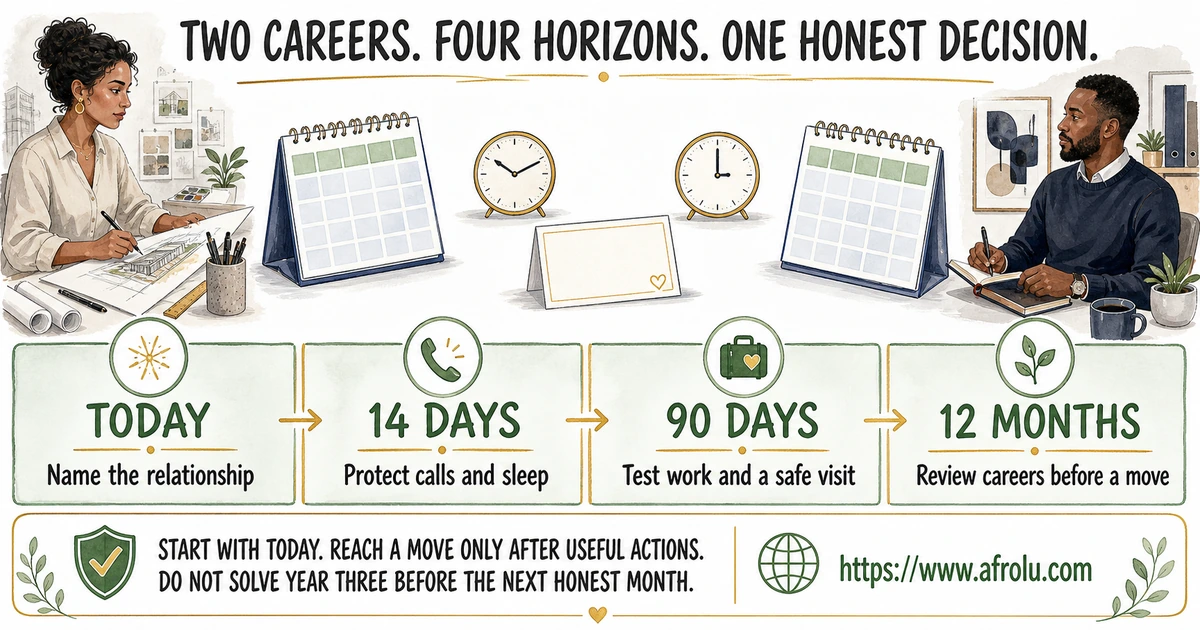
A serious future becomes believable through small plans that protect both adults' work, faith, money, consent, privacy, and freedom to leave.
Written and edited by Samira Benali · Faith and North Africa Editor
Use four horizons. A horizon is simply a point in time. First, write what is true today. Are you serious, exclusive, and private, or have you agreed to something else? Next, plan fourteen days around both local times, work, worship, care, and sleep. Then use ninety days to see how you handle calls, changed plans, money limits, and one safe visit. Only after that should you look at the next year and a possible move. At every step, each person keeps control of work choices, documents, money, private details, and consent. Faith can guide how you act. Prayer and trusted advice can help you think. They cannot make either person commit, pay, travel, touch, have sex, marry, or move. A strong relationship lets both adults tell the truth, keep a full life, meet safely, and change a plan without fear.
Distance and diaspora · Faith-Led Daters
How can two faith-led adults build a serious future across distance without asking one person to lose sleep, work, money, privacy, or choice?
Faith-led serious long-distance dating is a relationship between adults who live far enough apart that time together needs planning. They are open about wanting a future together. They also want faith or spiritual values to guide how they treat each other. Each part means something different. Long-distance describes place. Serious describes the hope for the future. Faith-led describes the values used today. These labels do not make a couple exclusive or engaged. They do not join bank accounts, open work accounts, require travel, or create consent. Two adults can share a belief and still disagree about work, worship, family, sex, children, money, or where to live. What matters is whether both people understand today's agreement and can live it across two real calendars.
Consider Mariam, age 34, and Daniel, age 37. Mariam is an architect in Casablanca. Daniel manages hospital services in London. They met through a work group for adults, later discovered a shared faith practice, and have dated across distance for seven months. They speak seriously about a future, but each has begun to use the future as an answer to a present problem. When Daniel's work schedule changes, he promises a long holiday later. When Mariam's project reaches a hard week, she says a future move will make all the strain worth it. Neither promise tells them when to call on Tuesday. It does not say who can travel in the next ninety days or how either career would survive a move. They open a shared page, but they keep their private work calendars separate. Each writes fixed work, worship, care, and sleep first. They choose two live calls in fourteen days, one voice-note day, and a rule for moving a call. They price a visit without booking it. They also agree that no one will announce the relationship without two clear yeses. The board gives them a calm next step they can keep.
The four-horizon career-distance board
Make the near decision before the far promise
A big promise about the future can feel stronger than ten small actions. Busy work can also make a couple wait for a quiet month that never comes. The board puts each choice in its own time box. A hard Tuesday can stay a Tuesday problem instead of becoming a fight about marriage or moving.
Begin with today. Move to the next time box only when the nearer one has a clear answer. Ask three questions. What did each adult freely agree to? What can each adult truly do? What still belongs to one person alone? A no, a changed plan, or a work limit is useful truth. It is not a failure of faith.
Name the present relationship
Say whether you are exploring, exclusive, seriously committed, or using a courtship path. Then define the word. Shared prayer, daily contact, a community introduction, or future talk does not answer for you.
Protect two ordinary weeks
Write both local times, fixed work, worship, care, meals, and sleep. Choose a small call plan and a kind way to move a call. Do not make one adult's midnight the normal price of closeness.
Test the plan in real life
Include a busy work period, a disagreement, a money limit, and a safe visit if both adults want and can afford one. Notice whether both people help with the plan and make a clear new offer when it changes.
Discuss reducing distance without forcing a move
Compare places, careers, legal ways to move, costs, faith community, care duties, and a safe way back. A move is one option. It is not automatic proof that the relationship is serious.
Horizon 1: today
Write today's agreement before opening both calendars
Start with four short answers. What kind of future are you exploring? Are either of you dating other people? What physical and digital boundaries apply now? Who may know about the relationship? Use words about today. For example: 'We are seriously dating and exclusive. We are not engaged. We are learning whether our lives fit.' That sentence is more useful than 'We know where this is going' because it says what each adult may rely on today.
Do not ask one word to answer four questions. 'Faith-led' does not tell you whether you are exclusive. 'Serious' does not tell you whether a community adviser may see private messages. 'Long-distance' does not tell you who pays for travel. 'Career-focused' does not mean a person is allowed to vanish without an explanation or a new plan. When meanings differ, write both answers. You can only work through a difference you can see.
Today's agreement can change, but the change needs a talk. If one adult no longer wants exclusivity, they should say so before dating someone else. A new physical boundary applies only after a free yes in that moment. Either adult may also ask for more privacy from the community. Clear dating is not a locked contract. It gives both adults the truth they need to choose.
Horizon 2: the next fourteen days
Build a fair call window from two local times and two workdays
Time zones are not a one-time fact. Local clock rules can change, and some places change clocks during the year. Check the actual local time for both places when you make or move a plan. Write the date, each local time, and expected length. For example: 'Tuesday, 20:00 for me and 19:00 for you. We will talk for forty minutes.' This is clearer than 'our usual evening call.' A calendar entry can update; memory and habit often do not.
Now mark what cannot move: shifts, client meetings, worship, caregiving, sleep, travel to work, meals, and time to rest. The open hours are the time you truly have for the relationship. Choose fewer good windows if daily calls would harm one adult's sleep or work. Text and voice notes can carry small updates without demanding a live answer. A message sent now does not need a reply now.
Mariam, age 34, first offered late calls because her mornings were busy. Daniel, age 37, accepted even when the calls followed long hospital days. They changed the rule. Each adult had to offer from healthy hours, not from guilt. Their two-week board held two live calls, one voice-note day, and several quiet nights. When Daniel's schedule changed, he wrote one line: 'I cannot make Wednesday. I can offer Thursday at 19:30 my time for thirty minutes. Does that protect your evening?' His clear new offer showed more care than staying awake and becoming angry later.

A caring call plan protects sleep and work on both sides and includes a simple way to move the call when real life changes.
Horizon 3: ninety days of real life
Include deadlines, changed plans, and ordinary joy
A ninety-day board is long enough to show more than the easiest week and short enough to discuss without making a forever promise. Put known busy periods on it first. These may include a work deadline, exam, harvest, conference, religious season, family duty, or work trip. A busy week is not a test of love. Decide what small amount of contact still feels kind.
Add one relationship action at a time. It might be a longer talk about values, a safe first visit, or a new talk about exclusivity. It could also be a calm look at where each career could grow. Write who will act and by when. Fair effort does not mean doing the same job or spending the same sum. It means both adults understand and freely accept the plan.
At the end of ninety days, look at what happened instead of counting messages. Did both adults protect important work? Did each make plans and fix changes? Could either person say no to a call, expense, image, visit, prayer practice, or community introduction? Did warmth exist beside ordinary responsibility? A hard season can still show a good match when truth and care are present. An easy season can hide problems when every hard question is delayed.

Look for plans made by both adults, calm new plans after changes, separate travel money, respectful faith choices, and care for both careers.
The visit belongs inside Horizon 3
Plan a visit that either adult can enter, change, and leave safely
A visit is a meeting, not a reward for months of calls. Check identity in more than one normal way before travel. Use official sources for entry rules, local laws, health needs, transport, and emergency contacts. Keep original travel papers with their owner. A partner may know the basic meeting plan. They do not need passwords, one-time codes, bank access, or a passport.
For an early visit, meet first in a busy public place with staff. Each adult should have their own transport and a place to stay that they can leave. A trusted person can keep the travel plan and check-in times. Each traveller also needs a working phone, local emergency numbers, and enough money to change the plan or return. If cost makes these basics impossible, the answer is to wait, save, shorten the visit, or meet in another way.
Travel does not create physical consent. A ticket, hotel, gift, prayer, serious label, or promise of marriage creates no debt. Neither person owes touch, sex, a private room, or more time. Consent must be a free choice for the specific act and can change at any point. An adult who hears no should stop without bargaining, anger, spiritual shame, or a bill for the trip.
Write five lines for the visit. Name who books travel and where each person sleeps. Add when you meet, who checks in, and how each person can leave. Add one line for what the visit does not decide. It does not decide engagement, a move, sex, shared accounts, or a public announcement. Talk about those choices later, when both adults are home and free to think.
Faith and community have a defined place
Invite support without giving another person the relationship controls
Faith can help two adults speak about meaning, honesty, service, sex, marriage, family, forgiveness, and responsibility. Begin with personal language: 'My practice is...' and 'My boundary is...' One adult should not have to defend an entire faith. They also do not have to prove that a personal limit is the only faithful answer. Shared identity can open a useful conversation. It does not remove the need to ask how each person lives.
Community support works best with a clear purpose. Before involving a leader, elder, relative, or friend, agree on the question. You might ask for help comparing two places. You may ask how to handle family worry about different beliefs. You may ask how to find a welcoming community after a move. Also agree on what stays private. An adviser does not need intimate messages, health details, work records, income papers, or a partner's private history. Share a private detail only when its owner freely agrees and the question truly needs it.
Naomi, age 29, and Elias, age 33, both wanted advice from an older couple in their faith community. Naomi wanted to ask about keeping two careers during marriage. Elias expected the advisers to tell them which city to choose. They narrowed the meeting to one question: 'What costs did you miss when you moved?' They kept salary figures and private physical boundaries outside the meeting. Afterwards, Naomi and Elias made their own decision. Advice widened their view without becoming an order.
Take spiritual pressure seriously. The National Domestic Violence Hotline warns about mocking belief, blocking worship, using belief to shame or control, and using sacred teaching to excuse abuse. A leader or partner cannot declare that faith requires money, secrecy, sex, marriage, forgiveness without change, or staying in danger. If support feels controlling, speak to a trusted person outside that pressure. Make a private safety plan that fits the danger you face.

Ask for advice on a clear question, keep private details private, and remember that each adult still makes every relationship decision.
Five lines stay personal at every horizon
Keep work, documents, money, privacy, and consent under personal control
Work freedom means each adult controls job choices and private work accounts. A partner may discuss career hopes. They should not demand company email, client names, private calendars, passwords, badge access, or secret help with a contract. Do not use a work trip as surprise romantic access. A conference in the same city still needs a separate dating invitation, a personal place to stay, and a free yes.
Document freedom means passports, visas, identity papers, tickets, booking codes, and legal records stay with their owner. Share only what an official travel or legal task truly needs. Use the official service. A romantic partner is not an embassy, bank, employer, or immigration adviser. If a future move may cross a border, check the rules with the government office or a qualified adviser. Do not rely on a partner's promise.
Money freedom means each adult can protect rent, food, care, debt payments, savings, and a return journey. Decide visit costs before booking. One plan may split costs equally. Another may use income or give each adult different costs. Put the amount and refund risk in plain words. Do not send money to an online love interest for an urgent fare, visa fee, medical crisis, investment, device, gift card, or account problem. Urgency and affection do not prove that the story is true.
Privacy freedom means a partner receives information in steps. Work location, home address, daily route, family contacts, and worship routine can reveal a lot. Live location and intimate images can also create risk when shared too early. Ask before posting a photograph, tagging a workplace, adding someone to a community group, or telling relatives. Online sharing also needs a yes. An old yes does not cover a new image or a new group of viewers.
Consent freedom covers calls, prayer together, advice, visits, touch, sex, contraception, photographs, public labels, and staying in the relationship. Each yes is for one choice at one time. Either adult can pause a call, leave a venue, return to separate lodging, refuse an image, or end the relationship. A calm response protects dignity. Anger, threats, tracking, repeated pressure, or punishment after no makes this a safety problem.
Horizon 4: the next twelve months
Compare real career seasons before choosing a city or country
The twelve-month review is not a countdown to a move. It is a way to see whether distance can be reduced without making one adult disappear. Place both work paths on one page. Add fixed contracts, chances for promotion, licences, training, business duties, retirement rules, care duties, and periods when leave is hard. Mark facts as facts and hopes as hopes. 'I have a written offer' is different from 'My manager may allow remote work.'
Then compare locations instead of assuming the higher earner's city wins. For each place, ask whether both adults can work legally and find suitable jobs. Ask whether they can get health care, practise faith freely, build community, and meet family or care duties. Add housing, transport, travel home, taxes, insurance, and a personal emergency fund. Do not use exact cost figures until they have been checked for the date and location.
Do not decide from job titles alone. A job that looks easy to move may need a local licence, local contacts, or permission to work. A business tied to one city may still run during a short stay with trusted help. Write down what each adult knows and what each adult still needs to check. Keep personal money while you test an idea. Wait for real work facts before making a lasting choice.
End the review with three possible paths, not one romantic answer. The first keeps both homes and makes visits work better. The second tests a short stay or job change with clear limits. The third prepares a lasting move after legal, work, money, community, and safety questions are answered. Either adult may also decide that no path protects both lives well enough. An honest ending can respect faith and love more than a move built on fear.
The relocation gate comes last
Open five separate locks before either adult moves
Lock one is mutual desire. Ask whether each adult wants the move when no leader, family member, employer, visa clock, pregnancy plan, or breakup threat is speaking for them. A reluctant yes is not made free by prayer, a public announcement, or money already spent. Both adults need time to ask questions and the freedom to say not now.
Lock two is a checked legal way to move. Check current immigration, work, tax, licence, and health rules with government offices or qualified advisers. Tell the truth on every form. Do not enter a marriage, job, investment, or paper deal that either adult does not understand. A partner may not hide the steps, control every paper, or ban private advice. That is not a safe plan.
Lock three asks whether each career can continue. The moving adult needs a real plan for work, training, job rules, language needs, care work, or a chosen break. The staying adult needs a plan for what will change at home. Do not call unpaid dependence temporary unless there is a date, budget, and review. Do not treat one career as a hobby because it earns less today.
Lock four is independent money and privacy. Each adult should understand housing, shared bills, debt, insurance, emergency costs, and what happens if the relationship ends. The moving adult keeps access to personal money, a working phone, identity documents, trusted contacts, and private advice. A shared account may be useful later, but it should not be the only way to eat, travel, or leave.
Lock five is a trial and a way home. When legal and possible, a short stay can show commuting, worship, loneliness, home duties, a job search, and conflict that holidays hide. Agree on the review date and the conditions for ending the trial. Keep a way home. This does not show weak commitment. It keeps the choice free.

A move should expand a shared life without removing one adult's work, documents, money, community, consent, or safe way home.
Six adult career-and-distance moments where the board earns its place
Achieng and Idris stop using delay as a test of care
Achieng is 31 and leads buying work in Nairobi. Idris is 35 and works in civil engineering in Dakar. A project handover makes Achieng miss two calls. Idris first writes that a serious partner would make time. Achieng explains that she can offer a short Sunday call or a longer call after the handover. The useful fact is not that two calls were missed. It is whether they can make a new plan without shame, sleep loss, or a demand to see her whole work calendar.
They choose Sunday for twenty minutes and book a longer call for the next week. Idris apologises for turning a hard week into a loyalty test. Achieng shares the busy period, not private job details. After ninety days, they ask whether both adults have become better at making a clear new offer.Hawa keeps a conference visit separate from romantic access
Hawa is 27 and works in marine logistics in Mombasa. Yusuf is 30 and works in Doha. Yusuf's conference brings him near Hawa for three days. He suggests that his employer-paid hotel solves their visit costs and asks her to stay there. Hawa wants to meet, but a work booking does not give Yusuf the right to set her lodging, transport, hours, or physical boundaries. The conference also cannot receive private details about their relationship.
Hawa proposes a public dinner after the conference programme. She uses her own transport and returns home. Yusuf keeps work and dating expenses separate. If he argues that the free room means she owes more time or touch, Hawa cancels. A useful visit keeps the work trip separate from Hawa's personal choice.Naomi and Elias correct a public label before it grows
Naomi is 29 and works in public health in Johannesburg. Elias is 33 and runs a training company in Kigali. After a warm visit, a community friend calls Naomi Elias's future wife in a group message. Elias enjoys the support and stays quiet. Naomi feels that a private serious relationship has been turned into a public engagement story. Shared faith does not make the label accurate, and silence may allow family pressure to grow.
They reply together: 'We are seriously dating and learning whether our lives fit. We are not engaged. Please ask before sharing our relationship.' Elias also speaks privately with the friend who posted it. Naomi watches whether he protects the correction when she is not present. Community warmth becomes helpful again when it follows the adults' real agreement.Leila refuses an urgent fare request without debating faith
Leila is 36 and checks that financial rules are followed in Rabat. Adam is 39 and works in Toronto. They have spoken for four months but have not met. Adam says a bank issue has blocked his ticket. He asks Leila to send money quickly so that a faith-community event can be their first visit. He says trust should come before questions. The story joins distance, urgency, money, and moral pressure. Those features require a stop, not more romantic proof.
Leila sends no money, gift card, account detail, identity document, or code. She checks the profile and story outside their private chat. She speaks with a trusted person. If she finds lies or more pressure, she keeps useful records and reports the account. She blocks contact. She alerts her bank if she shared any financial information.Sofia and Kwame compare three paths instead of choosing a loser
Sofia is 38 and leads a design team in Tunis. Kwame is 41 and owns a small business in Accra. Both careers matter. Sofia earns more now, while Kwame's business depends more on location. Their families assume the higher earner's city should win. Their faith adviser suggests sacrifice but does not know the work or legal details. A quick winner would turn one person's career into the hidden cost of the relationship.
They compare continued distance with better visits, a legal trial stay, and a later permanent move. For each path they list work, money, community, care, and ways home. They invite advice only after agreeing on the question. The answer may still be difficult, but neither adult has to pretend that love makes a career easy to replace.Rehema changes the evening plan and Micah accepts the new answer
Rehema is 32 and works in education technology in Nairobi. Micah is 36 and works in Lusaka. On their second visit, Rehema had planned to spend the evening at Micah's apartment after dinner. During the date she feels tired and wants to return to her hotel. The booked ticket, shared faith, serious label, earlier plan, and previous affection do not remove her right to change the evening.
Rehema says, 'I am going back to my hotel now. I will message when I arrive.' Micah answers, 'Okay. Do you want me to call a car, or do you prefer to arrange your own?' He does not ask her to prove love or repay his visit spending. The next day they can discuss how the evening felt. In the moment, the clear task is to respect her choice now.Eight signs the plan can survive ordinary work and distance
Both adults can state the present relationship in matching words, including future goal, exclusivity, physical boundaries, and who may know.
Call windows come from two healthy schedules. One adult's late night, workday, or worship time is not treated as the normal relationship cost.
A moved call or visit gets a clear new offer and a calm talk rather than silence, blame, spiritual shame, or demands for proof.
Each adult protects job duties and private work accounts. They still share enough free time to make plans they can keep.
Visit details come from official sources and checks outside the private chat. Each adult controls documents, money, a safe place to stay, transport, and a way home.
Faith and community support are invited for a clear purpose. Advice can be declined, private information stays private, and no adviser decides consent.
Money questions are slow and written down. Neither adult sends urgent rescue money, hides debt, controls the other's account, or makes spending proof of care.
Talk about a move includes at least two places and both careers. It also covers legal steps, care duties, community, personal money, a trial, and a way home.
Match each moment to the horizon that can answer it
| Situation | What it may mean | What to do next |
|---|---|---|
| One adult can no longer make the usual call because work changed. | A work schedule, deadline, travel day, or need for rest may have changed. One moved call does not show weak faith or weak love. Repeated silence without a new plan shows that the contact plan is not dependable. | Name the limit, offer one or two real alternatives, and update both local times. Look at the wider pattern only if new plans keep failing. |
| A community member starts using an engagement or marriage label. | The person may be hopeful, may use a local custom, or may be adding pressure. The public label is still inaccurate unless both dating adults chose it. | Correct the label together, ask before future sharing, and notice whether each partner protects the correction in their own community. |
| A work trip places one partner in the other's city. | The trip creates an opportunity, not romantic access. Employer travel, a paid hotel, or free hours do not decide lodging, touch, sex, or time together. | Make a separate personal invitation and public plan. Keep work information, expenses, accommodation, transport, and consent under the right owners. |
| An urgent fare, visa, medical, device, or investment request appears. | Romance scammers often use distance and urgent stories. A loving tone, faith claim, job title, video call, or future plan does not prove the request is real. | Send nothing. Check independently, speak with someone trusted, protect accounts, and report or block when deception or pressure is present. |
| One city seems better because one adult earns more there. | Income is one fact. Each career's future, legal work, care, community, health, personal safety, and the cost of dependence may change the answer. | Compare at least two locations and three paths: improve distance, test a change, or prepare a move. Mark every hope that still needs proof. |
| A partner asks for passwords, live location, or a full work calendar. | The request may be presented as trust or planning, but it removes privacy and can become monitoring. Dependable plans do not require constant access. | Share only the free time needed for the plan. Refuse access to private accounts. Treat repeated pressure, secret tracking, or threats as a safety concern. |
| A leader says forgiveness requires the relationship to continue. | Advice has crossed into control. Forgiveness, if meaningful to an adult, does not require restored access, silence about harm, or staying in danger. | Seek support outside the pressure, protect private contact and documents, and make a safety plan suited to any threats, stalking, or control. |
| After a visit, both adults still want a future but no fair move exists. | Love and daily life can point in different ways. A no to moving now may be about timing. It may also show a lasting difference or an honest limit. | Choose a date to talk again, a long-distance plan both can keep, or a respectful ending. Do not keep one adult waiting for a move that nobody is preparing. |
Ten plain scripts for clocks, careers, faith, visits, and a move
“I am dating toward a long-term partnership. Are we exclusive now, and what does serious mean in our ordinary week?”
“Let us write both local times and choose two call windows that protect work, worship, and sleep for both of us.”
“I cannot make Wednesday. I can offer Friday at 19:00 my time for thirty minutes. Does that work in your local time?”
“I can share my free windows, but I do not share client details, company accounts, passwords, or my full work calendar.”
“I will arrange my own documents, lodging, transport, and return. Let us meet first in a staffed public place.”
“Please do not share my photo or call us engaged. We will agree together on what the community may know.”
“I am open to advice on this one question. The final choice and our private details stay with us.”
“I do not send urgent fare, visa, medical, device, or investment money to an online partner. I will not make this payment.”
“The trip and our serious relationship do not decide physical contact. I will say what I want in the moment, and I may change my answer.”
“Before either of us moves, let us compare both careers, legal steps, money, community, a trial plan, and a safe way home.”
Know the difference
Serious long-distance dating or long-distance courtship?
This usually means two adults live apart and are dating with a long-term goal. They may be exclusive or not, may involve community or not, and may not yet have a marriage plan. Serious names the future goal. Long-distance names the places. The adults still need clear answers about pace, visits, faith practice, consent, money, and a move.
Some adults and faith groups use courtship for a more formal path toward marriage, often with planned family or community involvement. Others use the word differently. Courtship does not guarantee compatibility or safety, and it does not give relatives or leaders control of private details, money, consent, or an ending.
Each adult can finish two sentences: 'This label means we have agreed to...' and 'This label does not yet mean...' Compare the answers. If they do not match, keep talking before a public introduction, visit, payment, engagement, or move.

Neither label creates consent. Neither one decides exclusivity, physical boundaries, money duties, a wedding date, or who should move.
Tell place, future goals, faith, today's agreement, and a move apart
| Type or dimension | What it describes | Best next question |
|---|---|---|
| Long-distance dating | Describes a relationship in which regular in-person time needs travel or special planning. It does not state intention or exclusivity. | What are we building, and when will we next meet safely? |
| Serious dating | Describes a long-term goal. It does not promise marriage, set a deadline, or decide who will move. | Which actions today show that goal without forcing the ending? |
| Faith-led dating | Describes how belief or spiritual values guide daily choices. It does not give one universal rule for pace, touch, family, work, or money. | Which personal practices and boundaries affect our next decision? |
| Exclusive dating | Describes a mutual agreement about not dating other people. It does not prove career fit, safe actions, or readiness for a move. | What exactly is exclusive, and how will either adult communicate change? |
| Courtship | May describe a formal marriage-directed path with family or community involvement. Meanings vary, so the word cannot replace a present agreement. | What role, if any, do marriage intent and invited advisers have today? |
| Online-only connection | Describes contact between adults who have not safely checked how they get along in person. Strong feelings can be real while daily life is still unknown. | What identity and safety checks are needed before a visit we can afford? |
| Relocating partnership | Describes a later stage in which adults are checking or making a real move. It adds legal, career, housing, money, community, and exit questions. | Do all five move locks have checked answers that both adults freely chose? |
Build your own four-horizon board in six moves
Write today's four answers
Each adult writes the future goal, exclusivity, physical and online boundaries, and who may know. Compare the words. Do not hide a difference under a warmer label. Ask what each person can rely on now and what remains open.
Build one fourteen-day clock
Mark both local times and duties that cannot move. Choose how often to talk live. Add an option such as voice notes and a clear line for changed plans. Check actual local times again when clocks or travel change.
Choose one ninety-day test
Try something the relationship has not yet faced. It may be a busy work season, a money limit, a disagreement, a values talk, or a safe visit. Write what you hope to learn. Do not turn the task into a loyalty test.
Close all five freedom lines
Check work accounts, documents, money, privacy, and consent. Each one remains under personal control. Fix weak limits before adding travel, public public sharing, shared spending, account access, or plans to live together.
Compare three twelve-month paths
Write a path that improves distance, a path that tests a temporary change, and a path that prepares a permanent move. Include both careers, legal ways to move, money, care, faith community, and a way to stop or return.
Choose the next honest decision
The next answer may be a call window, visit, boundary, career fact, trial plan, move, or ending. Choose the smallest decision that adds truth and protects both adults. Large promises do not fill gaps in the plan.
Questions for today, fourteen days, ninety days, and twelve months
Choose a few prompts that fit the moment. This is a reference library, not a list to complete.
Today: name what exists
Keep each answer in the present tense.
- What long-term future is each adult freely exploring?
- Are we exclusive, and what exactly does that agreement cover?
- Which physical and digital boundaries apply now?
- Who may know, see a photograph, or use a relationship label?
- What would either adult need to say if the agreement changes?
Fourteen days: protect the ordinary week
Build contact from time and energy you truly have, not guilt.
- What are the actual local times for the windows we are considering?
- Which work, worship, care, meal, and sleep times cannot move?
- How much live contact would feel warm and easy to keep for each adult?
- Which updates can travel by text or voice note without an instant reply?
- What exact line will we use when a planned call must move?
Ninety days: test what screens have not proved
Choose one useful task and one review date.
- Which busy work period should the plan survive?
- What disagreement or disappointment still needs a calm talk and a new plan?
- Can a visit happen with independent money, lodging, transport, and return?
- Which community question, if any, needs invited outside advice?
- What would support another ninety days, a slower pace, or an ending?
Twelve months: compare paths before a move
Mark every fact, hope, owner, and missing answer.
- What happens to each career in each possible location?
- Which legal work or right-to-live-there facts have been checked?
- How will each adult keep personal money, documents, contacts, and choice?
- Could a legal trial stay show ordinary life before a permanent move?
- What would make staying apart, moving, or ending the honest answer?
What each part can show and what it cannot decide
Local time is a planning fact, not a measure of love
Time-zone data changes when governments change local clock rules. Calendar and device updates help, but adults should still confirm both local times for important calls and travel. A late reply can come from sleep, work, worship, care, poor connection, or ordinary life. Look at what happens next and at the wider pattern. One delay does not define a person's character.
Evidence limit: Clock information explains timing only. It cannot prove honesty, a good match, interest, safety, or a duty to stay available.
A job title says less than a protected ordinary week
A fine job title, salary claim, uniform, conference, or work profile may sound reliable. None proves identity or kind actions in a relationship. Look at small choices. Does the adult do their work and tell the truth about free time? Do they avoid asking for company access and make a new plan after a change? Careers matter here because they shape time and location, not because status earns trust.
Evidence limit: This guide does not check any employer, income, qualification, contract, or right to work. Check important facts outside the private chat.
A visit adds information but does not settle the future
In-person time can show how adults handle delay, public behaviour, tiredness, food, faith practice, boundaries, spending, and changed plans. A holiday may still hide commuting, a job search, housework, loneliness, and normal stress. Keep the visit's purpose small. Meet safely, notice daily actions, and talk after both adults return to their own support and routines.
Evidence limit: One good or difficult visit cannot predict a whole marriage or move. Use it as one part of what you know beside the longer pattern.
Shared belief can support values without proving safe actions
Shared prayer, worship, language, or community may create real meaning. Safety still appears in actions. Look for respect for no, room for questions, freedom to practise, honest money, protected privacy, and responsibility after harm. Spiritual abuse can occur when belief is used to shame, control, block practice, or excuse abuse. A faith label never makes control acceptable. It never creates consent.
Evidence limit: Faith traditions and personal practice vary. This guide does not decide doctrine or rank one belief, boundary, or relationship label above another.
More access is not the same as more trust
A full calendar, live location, password, home camera, private image, or work login can make distance feel smaller. It can also create a way to watch or harm someone. Trust can grow through limited, accurate sharing and respected boundaries. Use account privacy controls, keep work and dating accounts separate, and ask before sharing another adult's image or relationship status.
Evidence limit: Privacy settings reduce some exposure but cannot guarantee that a recipient will not save, copy, forward, or misuse information. Share with that limit in mind.
A budget can show care; an urgent transfer cannot prove love
A useful visit budget shows fares, lodging, transport, food, fees, refund rules, and personal money for returning home. Make it before there is pressure. Keep money for basic needs safe. Fraud guidance warns about distant love interests who build trust and then request travel, medical, visa, or other urgent money. Do not send money to solve a romantic story that you have not checked.
Evidence limit: Prices, payment protections, travel rules, and recovery options change. Check current terms with the responsible provider and contact a bank quickly after fraud.
A yes belongs to one moment and one choice
Consent needs freedom and the ability to choose. A yes to one activity is not a yes to another. A person can take back a yes. Distance does not save up consent through months of calls. Travel spending does not buy it. Faith, exclusivity, courtship, engagement, and marriage do not let one person choose for the other. A respectful partner notices the current answer and stops when the answer is no.
Evidence limit: The cited legal guide covers England and Wales. Local laws differ. Always seek a free yes for the exact activity now, and check the law where you are.
A move needs five real keys and a route back
The five keys answer different risks. They include a free choice and a legal way to move. They also cover both careers, personal money, privacy, and a trial or way home. No single key opens the whole gate. Written offers, official rules, realistic budgets, and lived trials are stronger than hopes. The adult who moves should not become cut off from work, money, documents, faith, friends, or help in order to prove commitment.
Evidence limit: Laws and rules about moving, tax, licences, housing, health, and work must be checked for the actual people, date, and place. Use official or qualified sources.
Six shortcuts that make a serious future less believable
Solving every hard week with relocation talk
A future move cannot fix tonight's missed call or next month's work conflict. It can also make one adult wait on a promise that has no legal, career, or money plan.
Calling constant access a sign of trust
Passwords, live location, full calendars, and instant replies can become monitoring. Useful sharing has a clear purpose, limited information, and a free yes.
Letting community hope create a private contract
A public introduction or marriage-minded comment can create pressure before two adults agree. Correct the label and decide together what may be shared.
Using sacrifice as the only sign of faith
Lost sleep, debt, unsafe travel, surrendered documents, unwanted sex, and a ruined career do not prove belief or love. A healthy plan protects free choice and both lives.
Booking the visit before agreeing on its job
A costly booking can make adults force meaning onto the meeting. Define safety, budget, boundaries, and what the visit does not decide before spending.
Treating a higher salary as the relocation answer
Income matters, but so do legal work, care, health, community, safety, career loss, and dependence. Compare full lives in more than one location.
Use a reviewed resource that matches the decision
This guide focuses on the relationship decision, so it does not rank dating apps. Check current prices, safety tools, and local availability before choosing a service.
Explore the guide library
Show more related guides
Continue with Afrolu
Show more Afrolu guides
Sources for time, travel, privacy, fraud, spiritual abuse, and consent
Afrolu reviewed these health, research, safety, or public guidance resources while editing this page. They support the behaviour and safety guidance; they do not diagnose any individual described by a reader.
Faith-Led Long-Distance Dating Across Two Careers: Questions
How often should two adults with busy jobs talk across distance?
There is no one number for every couple. Start with the fewest calls that give both adults enough warmth and truth without harming work, worship, care, or sleep. For one couple that may be two planned calls plus voice notes in fourteen days. For another it may be short daily contact and one longer weekend call. Write both local times. Include a way to move a call and a date to talk about the plan again. The better question is whether both adults help make a plan they can keep and change.
Does praying together every day mean we are exclusive or in courtship?
No. Shared prayer can be meaningful, but it does not set the dating agreement. Ask directly whether either adult may date other people and which label each person uses now. If one person says serious dating and the other says courtship, ask what each word changes in daily life. Include who may know, physical boundaries, and how either adult would communicate a change. A faith practice supports the relationship only when it remains freely chosen.
What should we put on a shared calendar, and what should stay private?
Share the windows and limits needed for personal plans: free evenings, known busy periods, travel days that affect contact, worship, care, and agreed calls. Keep client names, private meetings, company links, passwords, personal health details, and a full minute-by-minute work calendar outside the relationship. A useful entry says when a person is unavailable, not every reason and location. Each adult keeps control of their own calendar account and can change sharing.
Who should pay when one career earns much more than the other?
There is no single fair split. Equal amounts may be unfair when incomes and basic costs differ. A split based on income may work. One adult may pay a fare while the other pays local transport and plans. Discuss the full cost, refund risk, personal money for returning home, and what each adult can freely afford. Protect rent, food, care, debt, and savings. Do not borrow under pressure or send urgent money to an online partner whose story has not been checked outside the private chat.
Can a faith leader or family member decide whether we should marry or move?
They may share helpful views when both adults freely invite them. Give the adviser one clear question and decide what stays private. The final choice belongs to the adults whose lives, work, money, bodies, and legal rights are involved. A leader cannot create consent, approve access to documents, require payment, force public disclosure, or order an adult to stay in danger. Seek support outside the pressure if belief or community standing is used to shame or control.
When is it safe to make the first international visit?
Visit only when both adults freely want it. The plan must work without secrecy or rescue money. Check identity in more than one normal way outside the private chat. Confirm current official entry rules, local laws, health needs, lodging, transport, and emergency contacts. Keep personal documents, phone, money, and return travel under the traveller's control. Meet first in a staffed public place and give a trusted person the itinerary and check-in plan. Wait if safe independence is not affordable.
Does paying for a visit create a duty to stay together or be physically intimate?
No. A fare, room, meal, gift, long journey, serious label, engagement, prayer, or past consent does not buy consent now. Each adult chooses each activity and may change the answer. A person may leave a date, return to separate lodging, or end the relationship. The adult who spent money may feel disappointed. They may not use the cost to bargain, threaten, shame, block travel, or demand touch or sex. Plan costs that both adults can accept even if the relationship changes.
How do we know whether a plan to move is real enough to trust?
Look for five separate keys. Both adults freely want the plan. The legal way to move has been checked. Both careers have a plan that can work. Money, documents, privacy, and trusted contacts remain available. A trial or safe exit has been discussed. Mark written facts separately from hopes. A possible remote job, expected visa, future business manager, or family offer is not final until checked. Compare at least two locations and include the valid option of staying apart longer.
What if our careers are both good but no location is fair to both of us?
Do not choose a loser simply to make the relationship look serious. Compare three paths: make the long-distance plan better, test a legal short change, and prepare a later permanent move. Give each path a review date and a limit. If none protects work, money, care, community, health, safety, and free choice well enough, say so. The answer may be 'not now.' It may also be a respectful ending. Love can be real while two life paths do not fit.
Which behaviours mean we should stop planning and focus on safety?
Stop the ordinary planning when there are threats, stalking, secret tracking, or blocked movement. Also stop for document control, forced debt, account access, sexual pressure, blackmail, repeated unwanted contact, or belief used to excuse abuse. Do not travel to fix these patterns. Use a safer device if needed. Keep useful records when safe, tell a trusted person, and protect money and accounts. Contact local specialist, platform, legal, banking, work-security, or emergency help suited to the risk.
One thing to do now
Choose the next honest horizon, not the biggest promise
Choose the smallest next step that shows you something useful and protects both careers. Continue when the plan works for both people, costs no more than they can afford, and stays safe. Slow down when talk about a future move replaces a real visit plan. Stop when faith, reputation, money, documents, work access, tracking, threats, or shame take away free choice. The honest answer may be another ninety days, a slower pace, a different place to live, or an ending. A serious choice does not have to be a large choice.