Seven-panel clarity control room · parents across distance
Date After Heartbreak Across Distance Without Opening Family Access
A parent clarity guide to long-distance dating after heartbreak: name adult scope, protect child data, plan independent visits, and keep every exit open.
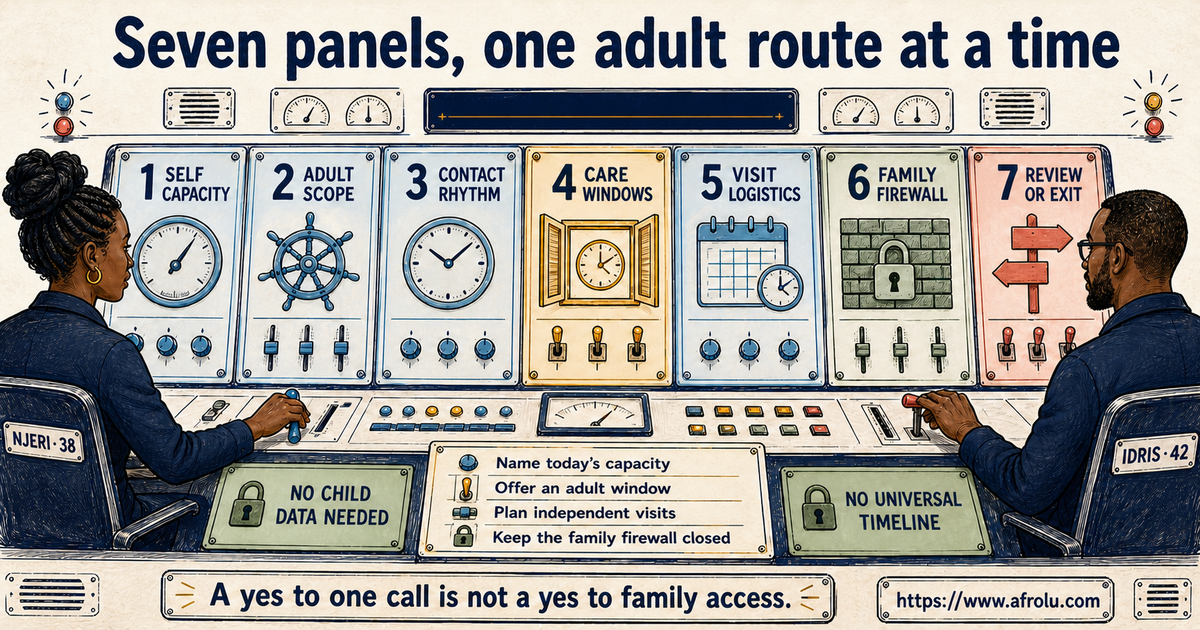
Clarity opens one adult channel; it does not open the family system.
Written and edited by Clarisse Uwimana · Dating Culture Editor
Use seven independent panels: SELF CAPACITY, ADULT SCOPE, CONTACT RHYTHM, CARE WINDOWS, VISIT LOGISTICS, FAMILY FIREWALL and REVIEW OR EXIT. Offer only the adult step you want now, state care availability without child data, use both clocks and plan any visit with separate money, accommodation, transport and return. Continue, redesign, wait or close without a recovery verdict. Child-data requests and unsafe conduct bypass ordinary review.
Starting over · Parents Returning To Dating
How can a parent explore one long-distance adult connection after heartbreak without using elapsed time as a readiness test or turning children, care schedules and family access into proof of seriousness?
No calendar turns heartbreak into a completed stage; re-entering dating depends on the particular choice available now. Parent-safe long-distance clarity means naming the adult offer and logistics while children, co-parents, care records, home and future family roles retain separate control. A call or visit never certifies readiness, identity, safety, exclusivity, relocation or child introduction.
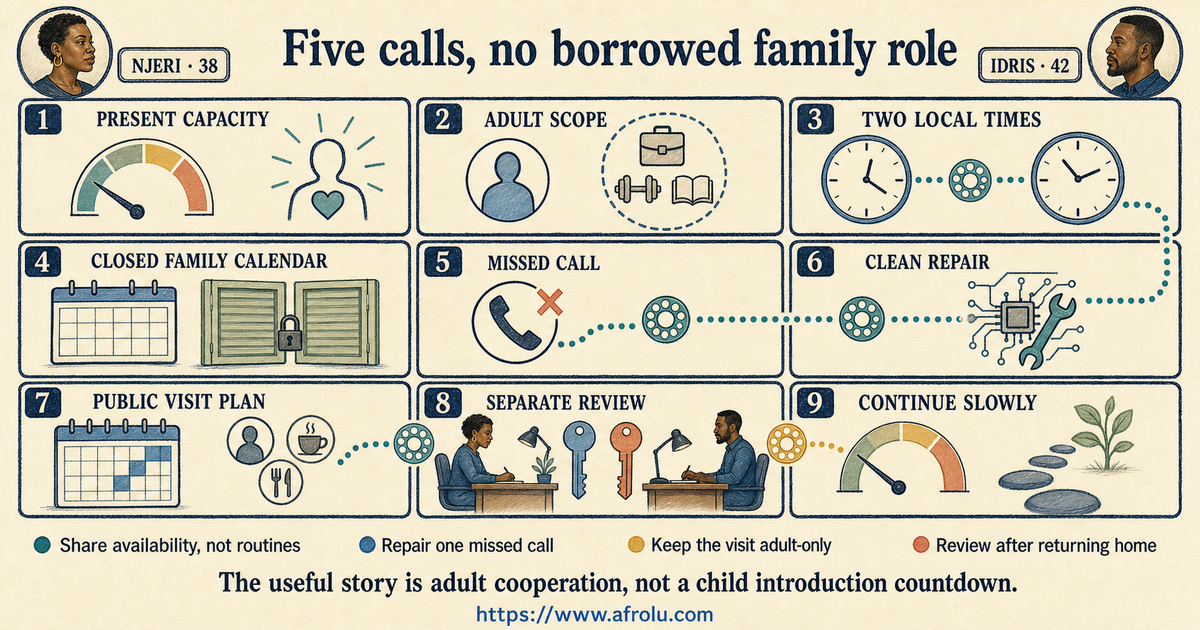
Njeri, 38, and Idris, 42, are fictional Black African parents in different countries. Across five adult-only calls, Njeri shares capacity rather than family evidence, Idris repairs a missed call without requesting child details and they design an independently funded public visit with separate accommodation. They continue slowly after separate reflection, with no home or child access promised.
Clarisse's adult-only seven-panel clarity control room
Let one distant connection become clear without routing it through a child
This route treats heartbreak as changing experience, parenting as protected context and long distance as a practical adult agreement problem.
Size the adult offer, abstract care time, use both clocks, keep visits independent and review after ordinary life returns.
Size the adult offer
Choose one call or meeting without producing a healing verdict.
Abstract care time
Share availability without a child, school or former-partner file.
Keep visits independent
Separate lawful travel, lodging, money, transport and return.
Hold the family firewall
No adult milestone automatically grants child or home access.
Begin smaller than the family story
Let a parent want connection without making a new adult prove recovery or join the household
A parent returning after heartbreak may feel that even a call contains a future family decision. It does not have to. Njeri can choose one adult conversation because she is curious about Idris, not because she has completed grief or decided that another household should form. The first task is to keep the size of the choice honest.
Heartbreak can include sadness, relief, anger, uncertainty or a mixture that changes by day. None supplies a universal dating clock. Research on breakup distress describes group averages and variation; it cannot certify an individual parent's readiness. The practical question is narrower: can this specific adult interaction remain voluntary, bounded and compatible with current functioning and care responsibilities?
Clarity does not require complete disclosure. A parent may say that a previous relationship ended, that the pace needs to be slow and that family information stays private. Idris can decide whether the current offer fits without receiving allegations, intimate history, legal records or messages from the former partner. Purpose, not emotional pressure, should govern what is shared.
Distance can help keep early contact adult-only, but it can also magnify imagination and planning labour. A voice call is not a family audition, and a visit is not a promise to relocate or introduce children. The connection should earn only the access explicitly chosen for the next adult step, while care routines, family locations and home remain behind a separate firewall.
Use the adult-only control room
Keep capacity, scope, rhythm, care windows, visits, family privacy and exit independently answerable
SELF CAPACITY asks what Njeri can offer today: perhaps one call, slow dating and no promise of exclusivity. ADULT SCOPE asks whether the contact is friendship, exploratory romance, casual dating, serious-intention dating or undecided. The words matter only when both adults understand their present consequences and remain free to counter or decline.
CONTACT RHYTHM uses both local times and realistic channels. CARE WINDOWS state availability without exposing a child's name, school, health information, routine, location or custody arrangement. Njeri can say that Tuesday and Thursday are unavailable and that changes need notice. Idris needs the adult window, not the evidence that created it.
VISIT LOGISTICS cover lawful travel, affordable cost, independent accommodation, public plans, transport and return. FAMILY FIREWALL keeps children, co-parents, relatives, homes and family devices outside the early connection. A completed visit grants no introduction, address, overnight access or relationship role. Every possible expansion remains a new and separate adult decision.
REVIEW OR EXIT asks what happens after the call or visit, when both adults have returned to ordinary life. Continue, redesign, wait or close without treating family access as progress. Persistent distress affecting daily functioning may need qualified care. Child-data requests, money pressure, threats, tracking, coercion, image abuse or defeated closure require direct protective action instead of another panel review.
Five calls with the family channel muted
See adult clarity grow through scheduling, repair and a public visit plan without a child introduction
On their first call, Njeri says that she is dating after a painful ending and can offer slow exploratory romance. She does not describe her child, former partner or household. Idris says he is also a parent and is willing to keep every early interaction adult-only. They choose one weekly call rather than promising constant availability.
Their third call passes because Njeri's care availability changes. She says only that the window is gone and offers two alternatives. Idris accepts one without requesting a school calendar, co-parent explanation or live-location proof. He later keeps the replacement time. Repair is visible in the changed action, although one respectful response cannot certify all future conduct.
After five calls, Idris proposes a short visit in Njeri's city. They independently check lawful travel, fund their own arrangements and choose separate accommodation and a staffed public meeting. Njeri shares no home address and makes no child introduction. The plan has a beginning, ending and separate return; either adult can cancel without becoming responsible for the other's essential costs.
They review only after Idris returns home. Both want to continue slowly, but neither promises relocation, exclusivity or family involvement. Another pair could discover a mismatch and close. If Idris had requested child photographs, money, secret access or contact through the former partner, Njeri would protect the family channel rather than scheduling a sixth call for clarity.
Read fourteen switches without scoring a parent
Distinguish workable adult evidence, a route needing redesign and facts that bypass dating review
CAPACITY is workable when curiosity is specific to this person and the step can remain modest. It needs another route when the match must prove that Njeri is lovable, recovered or ready to form a household. SCOPE is workable when the present adult offer is named; it needs redesign when one person silently treats exploratory contact as exclusivity or family progression.
RHYTHM is workable when both clocks, quiet periods and notice expectations fit. CARE WINDOWS are workable when availability is clear without a family dossier. Repeated demands for reasons, screenshots, routines or confirmation from a former partner do not increase clarity. They create unnecessary access to people and information outside the relationship.
VISITS are workable when each adult can lawfully plan, pay, stay, meet and return independently. The FAMILY FIREWALL works when no one asks a child to appear on a call, supply trust, carry a message or become the imagined reward for commitment. A parent may discuss parenting as part of identity without supplying identifying details or an introduction path.
REVIEW OR EXIT works when either adult may continue, wait, close or seek support without punishment. Persistent impairment belongs with qualified care, not a dating score. Child-data extraction, fraud, threats, tracking, coercion, image abuse, retaliation through family networks or blocked movement bypass every positive switch and use current local protection.

Read each panel alone; no good call can cancel a family privacy breach.
Protect the closed family channel
Plan digital contact and an adult visit without exposing children, home, money or return travel
Child privacy includes names, images, voices, schools, activities, health details, care providers, routines, location, home features and documents. Official Australian eSafety guidance explains how photos and videos can reveal identifying details and metadata. Its jurisdiction and services differ elsewhere, but the basic editorial limit is simple: a new date does not need child data to verify adult availability.
Keep early calls on chosen channels and avoid accidental family exposure in backgrounds, shared devices or notifications. A live call can reduce one uncertainty but cannot certify identity, relationship status or future behaviour. Use proportional independent checks for consequential claims. Do not ask children, co-parents or relatives to investigate, endorse or secretly observe a match.
For a visit, use a public adult-only plan, independent accommodation, separate transport and controlled return money. Check lawful requirements through relevant authorities. Do not send fares, emergency funds, visa fees, gift cards, cryptocurrency, investments, identity copies or verification codes. Contact financial providers promptly through independently found details if money moved.
Consent remains specific and reversible. Calls, disclosure, a paid meal or travel do not decide images, home access, touch, sex, sexual-health choices, exclusivity, relocation or another visit. If someone pressures for child access, defeats a no, tracks devices, threatens, impersonates or abuses images, preserve useful evidence where safe and use suitable platform, financial, legal, safeguarding, health or emergency help.
Give the adult answer and close the family file
Use direct wording for capacity, scope, clocks, care windows, visits, money, consent and closure
For heartbreak and capacity, say: I am dating slowly after an ending and can offer one adult call this week. That sentence supplies relevant context without assigning Idris the work of healing or judging Njeri. For scope, add: I am exploring romance, not promising exclusivity, relocation or family involvement. Idris remains free to need a different offer.
For scheduling, use both clocks and abstract the care reason: I can call from 19:00 to 19:45 my time; my other family windows stay private. If a plan changes, one line is enough: I cannot make tonight and can offer Saturday morning. A respectful counteroffer tests coordination without exposing a child or former partner.
For travel and home, say: We will each check and fund our own journey, accommodation and return; my home is not part of this visit. For privacy and money: I do not share child details, family documents, fares, fees, codes or accounts. For consent: A visit would not decide images, touch, sex, exclusivity or the next trip.
Repair names action rather than character: The call passed without notice; another plan needs a time you can carry. Closure can be final: This long-distance connection no longer fits me, so I am ending romantic contact. When closure is bypassed through new accounts, children, relatives, a co-parent or work, stop perfecting the sentence and protect access.

Share the open adult window, not the family machinery behind it.
Return every switch to its owner
Choose one honest adult next channel without making family access the reward
CONTINUE SLOWLY fits a modest connection with enough capacity, explicit scope, workable rhythm and a closed family firewall. SET ONE CALL fits curiosity that needs one answerable coordination step. PLAN ONE ADULT VISIT fits a sufficiently established connection only when lawful travel, cost, accommodation, public meetings and return are independently manageable.
REDESIGN fits an ordinary mismatch in call frequency, pace or visit timing that both adults freely want to negotiate. WAIT fits a complete present choice with no reserved return date or emotional queue. CLOSE fits a mismatch, depleted capacity or simply a connection no longer wanted. None of these routes proves that heartbreak won or that parenting prevented love.
SEEK CARE fits severe or persistent distress or impairment that needs qualified attention; a new date should not be used as treatment. SEEK PROTECTION fits child-data requests, financial deception, threats, tracking, coercion, image abuse or contact that defeats closure. Care and protection may coexist, but they are not interchangeable and should match the relevant location.
Njeri can enjoy Idris, protect her family, feel an old memory and still make a clear present choice. The adult-only lesson is deliberately limited: reveal only what serves the next interaction, make distance practical, keep money and return controlled, review after ordinary life resumes and never ask a child to verify, carry or reward the relationship.

A smaller adult step is complete; family access is never the prize.
Eight moments when adult clarity and family access take different routes
A parent wants to explain the whole breakup
The new adult needs only the context that shapes today's offer, not allegations, legal files or intimate history.
Name pace and scope; keep the evidence file elsewhere.A call slot disappears unexpectedly
Availability changed, but child identity, routine and former-partner detail are not needed to make a counteroffer.
Offer another adult window or release the call.A video call may reveal a family location
Visual convenience can expose names, images, uniforms, addresses, schedules or shared-device notifications.
Choose a neutral adult setting and protect the frame.A match asks to say hello to the child
Warmth does not create a role, and an early call does not need a child participant to feel genuine.
Keep the connection adult-only without promising a later date.One adult proposes staying in the family home
Saving money would collapse accommodation, address, child privacy and exit into one decision.
Use separate independently controlled lodging or postpone.A missed call receives notice and a kept replacement
The adult protects privacy, acknowledges the effect and carries one alternative without demanding more access.
Credit one repair and review the wider pattern separately.A possible meeting depends on your money
Long-distance affection is tied to a fare, visa fee, emergency, code or financial channel you cannot independently verify.
Send nothing and use verified provider or reporting help.Contact reaches a child, co-parent or relative after closure
The issue is no longer ordinary dating ambiguity because the adult ending is being defeated through family access.
Secure channels and seek location-appropriate protection.Fourteen signals across capacity, scope, rhythm, care, visits, privacy and exit
Curiosity is about this adult rather than proof that heartbreak is over.
Sadness or a memory can be noticed without making the new match responsible for it.
Present scope names romance, exclusivity and pace without promising family progression.
Either adult may decline the offered scope without diagnosing the parent.
Calls use both local times, a chosen channel and an approximate ending.
Quiet periods and changed plans do not demand surveillance or family evidence.
Care availability is stated as an adult window without child identifiers or routines.
Children and former partners are not asked to verify, mediate or endorse the match.
Visit plans keep lawful checks, costs, lodging, transport and return independent.
A completed visit grants no home, child, image, sexual or future-trip access.
Child names, images, schools, health details, schedules and locations remain private.
Shared devices, call backgrounds and metadata do not expose the family by accident.
Review, wait and closure are accepted as complete adult choices.
Privacy breach, fraud, threats, tracking, coercion and defeated exit move directly to protection.
Ten control-room questions without a parent-readiness score
| Situation | What it may mean | What to do next |
|---|---|---|
| Is today's capacity specific? | Fits: One modest adult step is genuinely wanted. Needs review: Capacity changes by task. Stop: The match must prove recovery or worth. | Reduce the step to what is honestly available. |
| Is adult scope clear? | Fits: Romance, pace and exclusivity are named. Needs review: One consequence needs words. Stop: Family progression is silently assumed. | Describe the present offer only. |
| Does the rhythm fit? | Fits: Both clocks and quiet periods work. Needs review: One channel needs redesign. Stop: Availability is demanded or monitored. | Set one sustainable contact window. |
| Are care windows abstracted? | Fits: Adult availability is enough. Needs review: One detail should be reduced. Stop: Child or co-parent evidence is requested. | Share the window, not the family file. |
| Is a visit independently leaveable? | Fits: Travel, lodging, transport and return are controlled. Needs review: One logistics gap remains. Stop: Home or financial dependence removes exit. | Separate the logistics or postpone. |
| Is the family firewall closed? | Fits: No child role or data is expected. Needs review: A device or background needs protection. Stop: A child is contacted, shown or used as proof. | Close access and respond to the breach. |
| Does repair protect privacy? | Fits: A miss is acknowledged and replaced simply. Needs review: An apology lacks a counteroffer. Stop: Repair demands family disclosure or leverage. | Require changed adult action only. |
| Are money and documents controlled? | Fits: Each adult funds and checks essentials. Needs review: One cost needs clarification. Stop: Fares, fees, codes or records are requested. | Refuse and verify independently. |
| Can review produce no? | Fits: Continue, wait and close are equal. Needs review: One expectation needs release. Stop: A child introduction is treated as progress owed. | Return every future gate to its owner. |
| What is the strongest present fact? | Fits: An ordinary adult fit decision remains. Needs review: Persistent impairment may need care. Stop: Privacy breach or danger needs protection. | Use the route matched to that fact. |
Twelve adult lines for heartbreak, two clocks, care windows, travel and closure
“A relationship ended painfully; I will share only what shapes our present choices.”
“I can offer one adult call this week and will decide later about another.”
“I am exploring romance slowly, without promising exclusivity, relocation or family involvement.”
“I can call from 19:00 to 19:45 my time; please confirm your local time.”
“That family window is unavailable; I can offer Saturday morning instead.”
“My child's name, images, school, routine, location and records stay private.”
“A visit would be adult-only, public and independently planned by each of us.”
“My home is not part of this visit, and we will use separate accommodation and transport.”
“I do not send dating contacts fares, fees, codes, documents or investments.”
“A call or visit does not decide images, touch, sex, exclusivity or another trip.”
“The call passed without notice; a new plan needs one time you can carry.”
“This long-distance connection no longer fits me, so I am ending romantic contact.”
Know the difference
Parental caution is not the same as being unavailable for every adult step
Capacity is action-specific, scope and rhythm are named, visits remain independent and the family firewall stays closed.
Calls, travel or affection are treated as entitlement to child details, home, endorsement, a role or a promised future.
Judge the adult offer and response to limits; never use a child introduction as the readiness score.

Heartbreak, caution and distance may coexist; none automatically means unready.
Workable adult re-entry, family access pressure and seven nearby states
| Type or dimension | What it describes | Best next question |
|---|---|---|
| Ordinary heartbreak | Sadness, relief or anger appears without automatically defeating present choice or daily functioning. | Choose a smaller step, wait or decline freely. |
| Memory trigger | A place, phrase or call evokes the former relationship for a time. | Name it privately and decide whether any action is needed. |
| Parental caution | Family information, time and home expand slowly because access has consequences. | Respect the boundary without demanding proof. |
| Workable adult distance | Scope, rhythm, care windows and independent visits fit while children remain outside the route. | Continue with an agreed review point. |
| Scope mismatch | One adult wants exploratory contact while the other expects exclusivity, relocation or family progression. | Redesign once or close without blame. |
| Persistent impairment | Distress continues to disrupt sleep, focus, appetite, care or ordinary tasks severely. | Seek qualified local assessment rather than dating as treatment. |
| Child privacy breach | Names, images, routines, locations, devices or family networks are obtained or used without permission. | Secure the data and use suitable safeguarding or legal help. |
| Romance fraud | Affection or a visit becomes a route to fares, fees, documents, codes, gifts or investment money. | Send nothing and contact verified providers or reporting services. |
| Unsafe control | Threats, tracking, coercion, image abuse, family retaliation or blocked exit changes the problem. | Prioritise current local protection and emergency help. |
Use seven independent panels before opening another adult channel
Keep the choice adult-sized
A call can be complete without proving recovery or planning a household.
Use seven separate panels
Capacity, scope, rhythm, care, visits, family privacy and exit answer different questions.
Abstract care time
Offer an adult window without exposing a child's identity, routine or former-partner records.
Make distance practical
Use both clocks and keep travel, lodging, transport and return independently controlled.
Hold the family firewall
No adult milestone automatically grants child, home or family-device access.
Match the response
Ordinary mismatch, care needs, privacy breach, fraud and danger require different routes.
Questions for the adult offer, care windows, a visit and the final review
Choose a few prompts that fit the moment. This is a reference library, not a list to complete.
Adult offer
Keep the first choice smaller than the family story.
- What can I offer now?
- What is our scope?
- What is not promised?
- Can either adult decline freely?
Time + care
Make one call clear without exposing a routine.
- What are both local times?
- Which adult window is open?
- What notice is needed?
- Which family facts stay closed?
Visit + firewall
Plan the meeting and family boundary separately.
- What is lawful?
- Who pays and stays where?
- How does each return?
- What child and home access is unavailable?
Review + response
Match the next route to the strongest fact.
- Continue or redesign?
- Wait or close?
- Does distress need care?
- Does conduct need protection?
What breakup, parent-dating and distance research can actually support
A U.S. longitudinal study tracks well-being before and after unmarried breakups
The study supports acknowledging average increases in distress and declines in life satisfaction while retaining substantial individual variation.
Evidence limit: Its 1,295 U.S. English-speaking unmarried adults were ages 18–35 and in different-sex relationships at recruitment; it cannot set a parent's recovery or dating timeline.
A U.S. longitudinal study examines mothers' post-divorce dating transitions
The analysis found little direct effect of dating transitions on child adjustment and inconsistent moderation involving mother-child rapport, supporting caution about simple claims.
Evidence limit: The 316 participants were recently divorcing U.S. mothers of elementary-aged children; results cannot represent fathers, all families, countries, long-distance dating or any individual child.
A one-week U.S. diary study examines disclosure and intimacy across media
The findings support looking at communication process and adaptation instead of assuming that geographic separation determines intimacy.
Evidence limit: The 63 heterosexual couples were young and mostly students at one northeastern U.S. university; most distance was school-related and no parent-specific timetable follows.
eSafety explains how child information, images and metadata can expose identity and routines
The official page supports limiting names, schools, locations, schedules and photo metadata and involving children appropriately in sharing decisions.
Evidence limit: Australian law and reporting services differ elsewhere; the page is not a custody, safeguarding or personalised legal assessment.
eSafety covers data minimisation, verification limits, meeting plans and abuse response
The official guidance supports limiting profile data, understanding verification limits, keeping screenshots or evidence where useful, telling a trusted person the meeting plan, and using blocking and reporting tools.
Evidence limit: Australian statistics and powers do not transfer automatically, and no platform feature can certify identity, future conduct or family safety.
FTC guidance separates long-distance affection from money requests
The U.S. resource describes requests for tickets, visas, emergencies, gift cards, cryptocurrency and investments and recommends prompt provider contact after payment.
Evidence limit: It cannot verify a particular match, guarantee recovery or replace current financial, police and legal routes in another country.
Six ways an adult route can expose a family system too early
Using a new match as a recovery test
Another adult must prove the parent is ready. Repair: choose one action by present capacity.
Explaining availability with child data
A private routine becomes scheduling evidence. Repair: offer only the adult window.
Turning video calls into family calls
A child becomes proof of trust or seriousness. Repair: keep the channel adult-only.
Saving costs with home access
Travel convenience collapses address, lodging and exit. Repair: plan independently.
Counting calls toward introduction
A number becomes a family-safety certificate. Repair: treat every future gate separately.
Debating a privacy breach as caution
Direct access harm is averaged against good dates. Repair: protect the family channel immediately.
Choose the smallest adult step while the family firewall stays closed
Use the resource matched to capacity, the parent boundary, or independent distance logistics; none sets a recovery or child-introduction deadline.
Explore the guide library
Show more related guides
Continue with Afrolu
Show more Afrolu guides
Three bounded primary studies and three current official safety resources
Afrolu reviewed these health, research, safety, or public guidance resources while editing this page. They support the behaviour and safety guidance; they do not diagnose any individual described by a reader.
Parent clarity questions for long-distance dating after heartbreak
How long should a parent wait to date after heartbreak?
There is no universal timetable. Ask whether one specific adult step is wanted, manageable and freely leaveable now. Research describes group patterns, not an individual readiness date. A parent may feel sadness and choose coffee, feel calm and decline dating, or seek qualified care when distress severely disrupts ordinary functioning.
Must I explain my breakup to a long-distance match?
No complete account is owed. Share only what shapes the current offer, such as moving slowly or not offering exclusivity. Keep allegations, intimate details, legal documents and former-partner messages private unless a clear purpose and qualified advice justify disclosure. The other adult can accept or decline the available scope.
What can I say about my parenting schedule?
State adult availability and notice requirements: for example, Tuesday is unavailable and Saturday morning is possible. A date does not need child names, schools, activities, health information, care providers, custody records, former-partner messages or live routines to accept, counter or decline a call. Use qualified local advice for legal questions.
Should my child appear on a video call?
An early adult connection does not need a child participant, witness or verifier. Protect call backgrounds, shared devices, notifications, names, voices, locations and routines. A future introduction, if ever considered, is a separate family decision with no universal date count. This guide cannot provide a personalised safeguarding or custody assessment.
Does long distance make dating safer for a parent?
Distance may reduce immediate physical access, but digital contact can expose identity, family data, devices, images, money and location. A video call or verified profile cannot certify every claim or future conduct. Use proportional independent checks, control what appears on screen and preserve blocking, reporting and local support routes.
When is an adult visit clear enough to plan?
Both adults should be able to check lawful requirements, afford their own essential costs, use independent accommodation and transport, choose public meetings and retain return options. A visit is not a child introduction, home invitation, sexual agreement, exclusivity promise or relocation plan. Either adult may cancel without losing essential safety.
Can a match stay in my home to reduce costs?
You may decide differently later, but separate accommodation protects a family address, child privacy and independent exit during early contact. If the visit is unaffordable without home access or one adult funding the other, postpone or decline. Convenience does not require a parent to merge lodging, family space and relationship assessment.
What if my former partner or relatives want details?
Keep the new adult relationship and co-parenting communication purpose-limited. Do not recruit relatives or former partners to investigate, persuade or monitor. Share only what is necessary for your responsibilities and local legal arrangements. Unexpected contact through family networks after a boundary is an access issue that may need qualified local support.
What if a match says privacy means I am not healed?
A boundary does not require their psychological approval. Restate the adult offer or close. They may respectfully decide the available pace does not fit, but pressure for child details, home access, money or surveillance is different conduct. Protect data and use suitable support if no is bypassed or retaliation begins.
When should I seek care or direct safety help?
Seek qualified care when distress is severe, persistent or disrupts sleep, focus, appetite, care or ordinary tasks; do not use a new relationship as treatment. Use direct protection for child-data breaches, fraud, threats, tracking, coercion, image abuse, family-network retaliation or blocked exit through current local platform, financial, legal, safeguarding, health or emergency routes.
One thing to do now
Choose the adult next step and leave the family channel with its owners
Continue only while one adult step fits present capacity, scope and rhythm are explicit, care windows stay abstract, visits remain lawful and independently leaveable, the family firewall stays closed, consent remains unbundled and review can produce no. Wait or close without diagnosing recovery. Use qualified care for persistent impairment and current local protection for child-data breaches, fraud, threats, tracking, coercion, image abuse or defeated exit.